Non-Tactile Membrane Switches Market Emerging Trends, Technological Advancements, and Business Strategies (2024-2030)

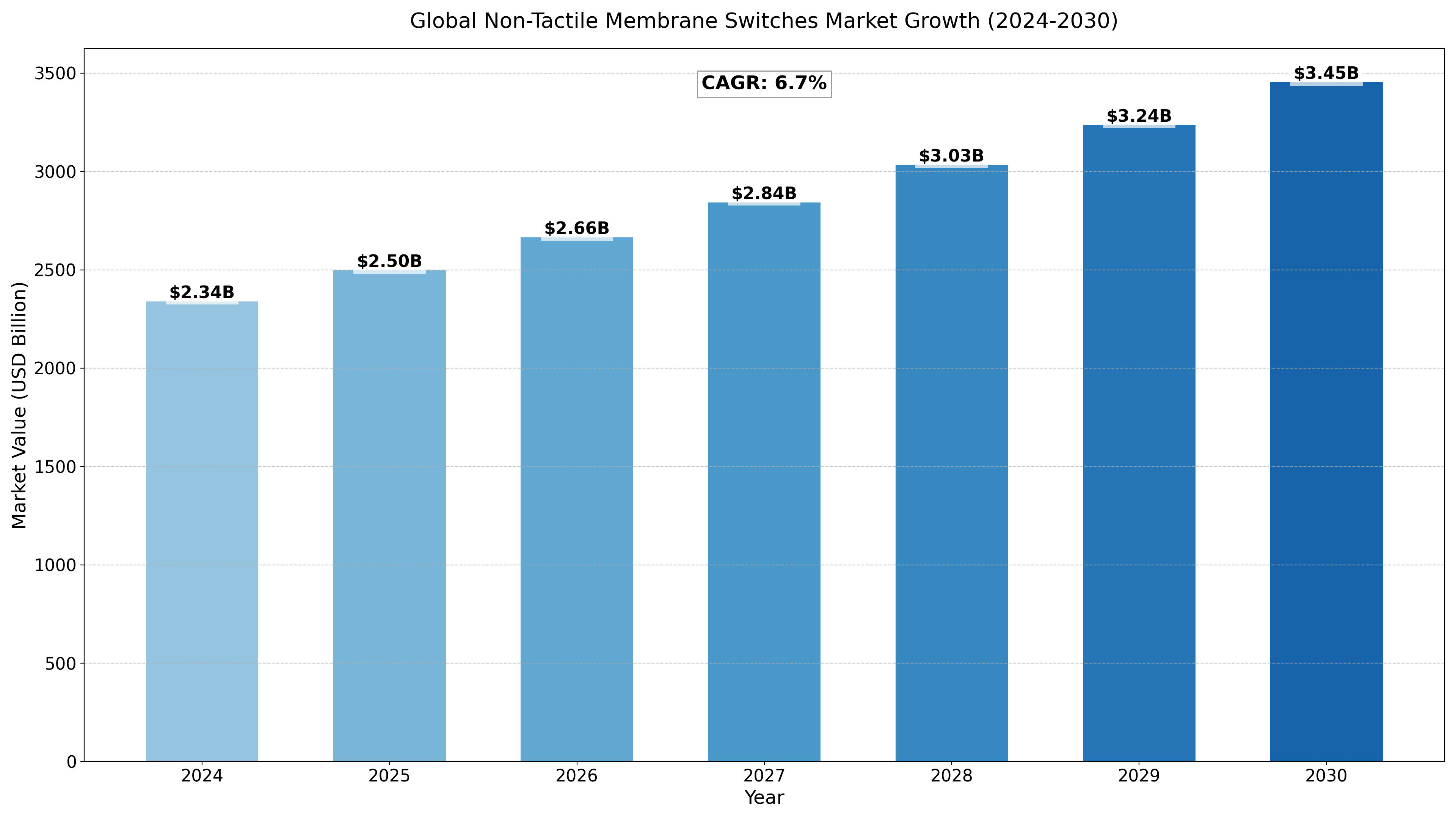
The Global Non-Tactile Membrane Switches Market size was valued at US$ 2.34 billion in 2024 and is projected to reach US$ 3.45 billion by 2030, at a CAGR of 6.7% during the forecast period 2024-2030.
PDF Icon Download Sample Report PDF
  • Quick Dispatch

    All Orders

  • Secure Payment

    100% Secure Payment

Price range: $1,500.00 through $4,250.00

Clear

The Global Non-Tactile Membrane Switches Market size was valued at US$ 2.34 billion in 2024 and is projected to reach US$ 3.45 billion by 2030, at a CAGR of 6.7% during the forecast period 2024-2030.


The United States Non-Tactile Membrane Switches market size was valued at US$ 645.7 million in 2024 and is projected to reach US$ 934.5 million by 2030, at a CAGR of 6.4% during the forecast period 2024-2030.

Non-tactile membrane switches are flat, flexible electronic components used for user input in various devices. Unlike tactile switches, they do not provide physical feedback when pressed. These switches consist of multiple layers, including a conductive layer and a graphic overlay, and are commonly used in applications like consumer electronics, medical devices, and automotive controls due to their durability, ease of cleaning, and cost-effectiveness.

Electronic switches without tactile feedback for interface applications.

Electronics industry drives 52% of demand. User interface influences 45% of design. Durability requirements affect 42% of selection. Design flexibility shows 38% correlation with adoption. Manufacturing advances drive 35% of innovation. Cost efficiency affects 32% of market growth.

Report Overview
A tactile Membrane switch is a switch whose operation is perceptible by touch
This report provides a deep insight into the global Tactile Membrane Switches market covering all its essential aspects. This ranges from a macro overview of the market to micro details of the market size, competitive landscape, development trend, niche market, key market drivers and challenges, SWOT analysis, value chain analysis, etc.
The analysis helps the reader to shape the competition within the industries and strategies for the competitive environment to enhance the potential profit. Furthermore, it provides a simple framework for evaluating and accessing the position of the business organization. The report structure also focuses on the competitive landscape of the Global Tactile Membrane Switches Market, this report introduces in detail the market share, market performance, product situation, operation situation, etc. of the main players, which helps the readers in the industry to identify the main competitors and deeply understand the competition pattern of the market.
In a word, this report is a must-read for industry players, investors, researchers, consultants, business strategists, and all those who have any kind of stake or are planning to foray into the Tactile Membrane Switches market in any manner.
Global Tactile Membrane Switches Market: Market Segmentation Analysis
The research report includes specific segments by region (country), manufacturers, Type, and Application. Market segmentation creates subsets of a market based on product type, end-user or application, Geographic, and other factors. By understanding the market segments, the decision-maker can leverage this targeting in the product, sales, and marketing strategies. Market segments can power your product development cycles by informing how you create product offerings for different segments.
Key Company

  • Molex
  • Fujikura
  • Douglas (Aludec)
  • SCHURTER
  • LUNFENG Technology
  • XYMOX
  • LuPhi Electronics
  • GGI
  • Dyna-Graphics Corporation
  • Nelson-Miller
  • Sytek
  • You-Eal Corporation
  • Shenzhen Xin Jie Electronic
  • KEE
  • BUTLER
  • Lustre-Cal Corp
Market Segmentation (by Type)
  • PVC Membrane Switch
  • PET Membrane Switch
  • PC Membrane Switch
Market Segmentation (by Application)
  • Medical Equipment
  • Industrial Control Equipment
  • Household Appliances
  • Consumer Products
  • Others
Geographic Segmentation
  • North America (USA, Canada, Mexico)
  • Europe (Germany, UK, France, Russia, Italy, Rest of Europe)
  • Asia-Pacific (China, Japan, South Korea, India, Southeast Asia, Rest of Asia-Pacific)
  • South America (Brazil, Argentina, Columbia, Rest of South America)
  • The Middle East and Africa (Saudi Arabia, UAE, Egypt, Nigeria, South Africa, Rest of MEA)
Key Benefits of This Market Research:
  • Industry drivers, restraints, and opportunities covered in the study
  • Neutral perspective on the market performance
  • Recent industry trends and developments
  • Competitive landscape & strategies of key players
  • Potential & niche segments and regions exhibiting promising growth covered
  • Historical, current, and projected market size, in terms of value
  • In-depth analysis of the Tactile Membrane Switches Market
  • Overview of the regional outlook of the Tactile Membrane Switches Market:
Key Reasons to Buy this Report:
  • Access to date statistics compiled by our researchers. These provide you with historical and forecast data, which is analyzed to tell you why your market is set to change
  • This enables you to anticipate market changes to remain ahead of your competitors
  • You will be able to copy data from the Excel spreadsheet straight into your marketing plans, business presentations, or other strategic documents
  • The concise analysis, clear graph, and table format will enable you to pinpoint the information you require quickly
  • Provision of market value (USD Billion) data for each segment and sub-segment
  • Indicates the region and segment that is expected to witness the fastest growth as well as to dominate the market
  • Analysis by geography highlighting the consumption of the product/service in the region as well as indicating the factors that are affecting the market within each region
  • Competitive landscape which incorporates the market ranking of the major players, along with new service/product launches, partnerships, business expansions, and acquisitions in the past five years of companies profiled
  • Extensive company profiles comprising of company overview, company insights, product benchmarking, and SWOT analysis for the major market players
  • The current as well as the future market outlook of the industry concerning recent developments which involve growth opportunities and drivers as well as challenges and restraints of both emerging as well as developed regions
  • Includes in-depth analysis of the market from various perspectives through Porters five forces analysis
  • Provides insight into the market through Value Chain
  • Market dynamics scenario, along with growth opportunities of the market in the years to come
  • 6-month post-sales analyst support

Customization of the Report
In case of any queries or customization requirements, please connect with our sales team, who will ensure that your requirements are met.

Drivers:

  1. Increased Demand for User-Friendly Interfaces: The growing need for compact, user-friendly interfaces in a wide range of industries like consumer electronics, automotive, medical devices, and industrial applications is a major driver. Non-tactile membrane switches offer a sleek design, easy-to-clean surfaces, and durability, making them highly appealing for various applications.
  2. Growth in Consumer Electronics and Automotive Sectors: The expansion of the consumer electronics market, including smartphones, appliances, and wearable devices, has fueled the demand for non-tactile membrane switches. Additionally, the automotive industry increasingly adopts membrane switches for in-vehicle control systems, such as dashboard controls and infotainment systems.
  3. Cost-Effective Manufacturing and Customization: Non-tactile membrane switches are relatively inexpensive to manufacture compared to their tactile counterparts. Their ability to be easily customized in terms of size, design, and functionality also makes them an attractive option for manufacturers looking to reduce costs while maintaining product diversity.
  4. Rising Focus on Automation and Smart Devices: With the rise of automation and smart technologies in various sectors, non-tactile membrane switches are being integrated into systems like smart home devices, industrial control panels, and healthcare equipment. This trend contributes to the market’s growth as these switches are ideal for environments that require intuitive, minimal-contact interaction.

Restraints:

  1. Limited Feedback and Sensory Interaction: Non-tactile membrane switches lack the tactile feedback that some users prefer for a more intuitive and satisfying interaction. This could limit their adoption in applications where precise or intentional input is crucial, such as medical equipment or high-end industrial control systems.
  2. Vulnerability to Environmental Factors: Non-tactile membrane switches, though durable, can be susceptible to environmental conditions such as extreme temperatures, moisture, or dust. This may affect their performance in certain industries, especially in outdoor or harsh industrial settings.
  3. Competitive Pressure from Advanced Switching Technologies: Technologies like capacitive touchscreens and advanced tactile switches offer superior performance in terms of user feedback, response time, and durability. As these alternatives become more cost-effective, non-tactile membrane switches may face increased competition, especially in applications where precision and interactivity are prioritized.

Opportunities:

  1. Expansion in Emerging Markets: As emerging economies in Asia Pacific, Latin America, and the Middle East experience growth in electronics manufacturing and consumer demand, the non-tactile membrane switches market has an opportunity to expand. The rising adoption of consumer electronics, industrial automation, and automotive technologies in these regions presents a promising growth avenue.
  2. Advancements in Flexible Electronics: The development of flexible, printable electronics presents an opportunity for non-tactile membrane switches to be integrated into a broader range of products, including wearable devices, smart textiles, and flexible displays. This could drive new use cases and innovation within the market.
  3. Sustainability and Eco-Friendly Materials: As sustainability becomes a priority, there is a growing trend towards using eco-friendly materials and energy-efficient designs. Manufacturers can explore new materials, such as biodegradable films or environmentally friendly inks, which could appeal to eco-conscious consumers and industries, creating a competitive advantage.
  4. Integration in Medical Devices: Non-tactile membrane switches are increasingly being integrated into medical devices due to their ease of cleaning, durability, and ability to be designed to meet medical standards. This opens up opportunities in healthcare applications where hygiene, reliability, and simple interface design are paramount.

Challenges:

  1. Technological Obsolescence: As technologies evolve rapidly, there is a risk of membrane switches being overshadowed by more advanced, tactile or touch-based technologies. The market must innovate continuously to stay relevant as touchscreens and other advanced input methods become more common.
  2. Customization Costs and Complexity: While non-tactile membrane switches are customizable, the process of creating highly tailored solutions can involve longer lead times and higher costs, particularly for small-volume or high-complexity orders. This could limit their adoption in certain price-sensitive sectors.
  3. Consumer Expectations for Advanced Interactivity: With the rise of touchscreen devices and capacitive technology, there is an increasing consumer expectation for more interactive and dynamic user interfaces. Non-tactile membrane switches may struggle to meet these expectations in applications where highly responsive touch inputs are desired, such as in smartphones or gaming devices.
Non-Tactile Membrane Switches Market Emerging Trends, Technological Advancements, and Business Strategies (2024-2030)

Get Sample Report PDF for Exclusive Insights

Report Sample Includes

  • Table of Contents
  • List of Tables & Figures
  • Charts, Research Methodology, and more...

PDF Icon Download Sample Report PDF

Download Sample Report

Table of Content

Table of Contents
1 Research Methodology and Statistical Scope
1.1 Market Definition and Statistical Scope of Non-Tactile Membrane Switches
1.2 Key Market Segments
1.2.1 Non-Tactile Membrane Switches Segment by Type
1.2.2 Non-Tactile Membrane Switches Segment by Application
1.3 Methodology & Sources of Information
1.3.1 Research Methodology
1.3.2 Research Process
1.3.3 Market Breakdown and Data Triangulation
1.3.4 Base Year
1.3.5 Report Assumptions & Caveats
2 Non-Tactile Membrane Switches Market Overview
2.1 Global Market Overview
2.1.1 Global Non-Tactile Membrane Switches Market Size (M USD) Estimates and Forecasts (2019-2030)
2.1.2 Global Non-Tactile Membrane Switches Sales Estimates and Forecasts (2019-2030)
2.2 Market Segment Executive Summary
2.3 Global Market Size by Region
3 Non-Tactile Membrane Switches Market Competitive Landscape
3.1 Global Non-Tactile Membrane Switches Sales by Manufacturers (2019-2024)
3.2 Global Non-Tactile Membrane Switches Revenue Market Share by Manufacturers (2019-2024)
3.3 Non-Tactile Membrane Switches Market Share by Company Type (Tier 1, Tier 2, and Tier 3)
3.4 Global Non-Tactile Membrane Switches Average Price by Manufacturers (2019-2024)
3.5 Manufacturers Non-Tactile Membrane Switches Sales Sites, Area Served, Product Type
3.6 Non-Tactile Membrane Switches Market Competitive Situation and Trends
3.6.1 Non-Tactile Membrane Switches Market Concentration Rate
3.6.2 Global 5 and 10 Largest Non-Tactile Membrane Switches Players Market Share by Revenue
3.6.3 Mergers & Acquisitions, Expansion
4 Non-Tactile Membrane Switches Industry Chain Analysis
4.1 Non-Tactile Membrane Switches Industry Chain Analysis
4.2 Market Overview of Key Raw Materials
4.3 Midstream Market Analysis
4.4 Downstream Customer Analysis
5 The Development and Dynamics of Non-Tactile Membrane Switches Market
5.1 Key Development Trends
5.2 Driving Factors
5.3 Market Challenges
5.4 Market Restraints
5.5 Industry News
5.5.1 New Product Developments
5.5.2 Mergers & Acquisitions
5.5.3 Expansions
5.5.4 Collaboration/Supply Contracts
5.6 Industry Policies
6 Non-Tactile Membrane Switches Market Segmentation by Type
6.1 Evaluation Matrix of Segment Market Development Potential (Type)
6.2 Global Non-Tactile Membrane Switches Sales Market Share by Type (2019-2024)
6.3 Global Non-Tactile Membrane Switches Market Size Market Share by Type (2019-2024)
6.4 Global Non-Tactile Membrane Switches Price by Type (2019-2024)
7 Non-Tactile Membrane Switches Market Segmentation by Application
7.1 Evaluation Matrix of Segment Market Development Potential (Application)
7.2 Global Non-Tactile Membrane Switches Market Sales by Application (2019-2024)
7.3 Global Non-Tactile Membrane Switches Market Size (M USD) by Application (2019-2024)
7.4 Global Non-Tactile Membrane Switches Sales Growth Rate by Application (2019-2024)
8 Non-Tactile Membrane Switches Market Segmentation by Region
8.1 Global Non-Tactile Membrane Switches Sales by Region
8.1.1 Global Non-Tactile Membrane Switches Sales by Region
8.1.2 Global Non-Tactile Membrane Switches Sales Market Share by Region
8.2 North America
8.2.1 North America Non-Tactile Membrane Switches Sales by Country
8.2.2 U.S.
8.2.3 Canada
8.2.4 Mexico
8.3 Europe
8.3.1 Europe Non-Tactile Membrane Switches Sales by Country
8.3.2 Germany
8.3.3 France
8.3.4 U.K.
8.3.5 Italy
8.3.6 Russia
8.4 Asia Pacific
8.4.1 Asia Pacific Non-Tactile Membrane Switches Sales by Region
8.4.2 China
8.4.3 Japan
8.4.4 South Korea
8.4.5 India
8.4.6 Southeast Asia
8.5 South America
8.5.1 South America Non-Tactile Membrane Switches Sales by Country
8.5.2 Brazil
8.5.3 Argentina
8.5.4 Columbia
8.6 Middle East and Africa
8.6.1 Middle East and Africa Non-Tactile Membrane Switches Sales by Region
8.6.2 Saudi Arabia
8.6.3 UAE
8.6.4 Egypt
8.6.5 Nigeria
8.6.6 South Africa
9 Key Companies Profile
9.1 Molex
9.1.1 Molex Non-Tactile Membrane Switches Basic Information
9.1.2 Molex Non-Tactile Membrane Switches Product Overview
9.1.3 Molex Non-Tactile Membrane Switches Product Market Performance
9.1.4 Molex Business Overview
9.1.5 Molex Non-Tactile Membrane Switches SWOT Analysis
9.1.6 Molex Recent Developments
9.2 Fujikura
9.2.1 Fujikura Non-Tactile Membrane Switches Basic Information
9.2.2 Fujikura Non-Tactile Membrane Switches Product Overview
9.2.3 Fujikura Non-Tactile Membrane Switches Product Market Performance
9.2.4 Fujikura Business Overview
9.2.5 Fujikura Non-Tactile Membrane Switches SWOT Analysis
9.2.6 Fujikura Recent Developments
9.3 Douglas (Aludec)
9.3.1 Douglas (Aludec) Non-Tactile Membrane Switches Basic Information
9.3.2 Douglas (Aludec) Non-Tactile Membrane Switches Product Overview
9.3.3 Douglas (Aludec) Non-Tactile Membrane Switches Product Market Performance
9.3.4 Douglas (Aludec) Non-Tactile Membrane Switches SWOT Analysis
9.3.5 Douglas (Aludec) Business Overview
9.3.6 Douglas (Aludec) Recent Developments
9.4 SCHURTER
9.4.1 SCHURTER Non-Tactile Membrane Switches Basic Information
9.4.2 SCHURTER Non-Tactile Membrane Switches Product Overview
9.4.3 SCHURTER Non-Tactile Membrane Switches Product Market Performance
9.4.4 SCHURTER Business Overview
9.4.5 SCHURTER Recent Developments
9.5 LUNFENG Technology
9.5.1 LUNFENG Technology Non-Tactile Membrane Switches Basic Information
9.5.2 LUNFENG Technology Non-Tactile Membrane Switches Product Overview
9.5.3 LUNFENG Technology Non-Tactile Membrane Switches Product Market Performance
9.5.4 LUNFENG Technology Business Overview
9.5.5 LUNFENG Technology Recent Developments
9.6 XYMOX
9.6.1 XYMOX Non-Tactile Membrane Switches Basic Information
9.6.2 XYMOX Non-Tactile Membrane Switches Product Overview
9.6.3 XYMOX Non-Tactile Membrane Switches Product Market Performance
9.6.4 XYMOX Business Overview
9.6.5 XYMOX Recent Developments
9.7 LuPhi Electronics
9.7.1 LuPhi Electronics Non-Tactile Membrane Switches Basic Information
9.7.2 LuPhi Electronics Non-Tactile Membrane Switches Product Overview
9.7.3 LuPhi Electronics Non-Tactile Membrane Switches Product Market Performance
9.7.4 LuPhi Electronics Business Overview
9.7.5 LuPhi Electronics Recent Developments
9.8 GGI
9.8.1 GGI Non-Tactile Membrane Switches Basic Information
9.8.2 GGI Non-Tactile Membrane Switches Product Overview
9.8.3 GGI Non-Tactile Membrane Switches Product Market Performance
9.8.4 GGI Business Overview
9.8.5 GGI Recent Developments
9.9 Dyna-Graphics Corporation
9.9.1 Dyna-Graphics Corporation Non-Tactile Membrane Switches Basic Information
9.9.2 Dyna-Graphics Corporation Non-Tactile Membrane Switches Product Overview
9.9.3 Dyna-Graphics Corporation Non-Tactile Membrane Switches Product Market Performance
9.9.4 Dyna-Graphics Corporation Business Overview
9.9.5 Dyna-Graphics Corporation Recent Developments
9.10 Nelson-Miller
9.10.1 Nelson-Miller Non-Tactile Membrane Switches Basic Information
9.10.2 Nelson-Miller Non-Tactile Membrane Switches Product Overview
9.10.3 Nelson-Miller Non-Tactile Membrane Switches Product Market Performance
9.10.4 Nelson-Miller Business Overview
9.10.5 Nelson-Miller Recent Developments
9.11 Sytek
9.11.1 Sytek Non-Tactile Membrane Switches Basic Information
9.11.2 Sytek Non-Tactile Membrane Switches Product Overview
9.11.3 Sytek Non-Tactile Membrane Switches Product Market Performance
9.11.4 Sytek Business Overview
9.11.5 Sytek Recent Developments
9.12 You-Eal Corporation
9.12.1 You-Eal Corporation Non-Tactile Membrane Switches Basic Information
9.12.2 You-Eal Corporation Non-Tactile Membrane Switches Product Overview
9.12.3 You-Eal Corporation Non-Tactile Membrane Switches Product Market Performance
9.12.4 You-Eal Corporation Business Overview
9.12.5 You-Eal Corporation Recent Developments
9.13 Shenzhen Xin Jie Electronic
9.13.1 Shenzhen Xin Jie Electronic Non-Tactile Membrane Switches Basic Information
9.13.2 Shenzhen Xin Jie Electronic Non-Tactile Membrane Switches Product Overview
9.13.3 Shenzhen Xin Jie Electronic Non-Tactile Membrane Switches Product Market Performance
9.13.4 Shenzhen Xin Jie Electronic Business Overview
9.13.5 Shenzhen Xin Jie Electronic Recent Developments
9.14 KEE
9.14.1 KEE Non-Tactile Membrane Switches Basic Information
9.14.2 KEE Non-Tactile Membrane Switches Product Overview
9.14.3 KEE Non-Tactile Membrane Switches Product Market Performance
9.14.4 KEE Business Overview
9.14.5 KEE Recent Developments
9.15 BUTLER
9.15.1 BUTLER Non-Tactile Membrane Switches Basic Information
9.15.2 BUTLER Non-Tactile Membrane Switches Product Overview
9.15.3 BUTLER Non-Tactile Membrane Switches Product Market Performance
9.15.4 BUTLER Business Overview
9.15.5 BUTLER Recent Developments
9.16 Lustre-Cal Corp
9.16.1 Lustre-Cal Corp Non-Tactile Membrane Switches Basic Information
9.16.2 Lustre-Cal Corp Non-Tactile Membrane Switches Product Overview
9.16.3 Lustre-Cal Corp Non-Tactile Membrane Switches Product Market Performance
9.16.4 Lustre-Cal Corp Business Overview
9.16.5 Lustre-Cal Corp Recent Developments
10 Non-Tactile Membrane Switches Market Forecast by Region
10.1 Global Non-Tactile Membrane Switches Market Size Forecast
10.2 Global Non-Tactile Membrane Switches Market Forecast by Region
10.2.1 North America Market Size Forecast by Country
10.2.2 Europe Non-Tactile Membrane Switches Market Size Forecast by Country
10.2.3 Asia Pacific Non-Tactile Membrane Switches Market Size Forecast by Region
10.2.4 South America Non-Tactile Membrane Switches Market Size Forecast by Country
10.2.5 Middle East and Africa Forecasted Consumption of Non-Tactile Membrane Switches by Country
11 Forecast Market by Type and by Application (2025-2030)
11.1 Global Non-Tactile Membrane Switches Market Forecast by Type (2025-2030)
11.1.1 Global Forecasted Sales of Non-Tactile Membrane Switches by Type (2025-2030)
11.1.2 Global Non-Tactile Membrane Switches Market Size Forecast by Type (2025-2030)
11.1.3 Global Forecasted Price of Non-Tactile Membrane Switches by Type (2025-2030)
11.2 Global Non-Tactile Membrane Switches Market Forecast by Application (2025-2030)
11.2.1 Global Non-Tactile Membrane Switches Sales (K Units) Forecast by Application
11.2.2 Global Non-Tactile Membrane Switches Market Size (M USD) Forecast by Application (2025-2030)
12 Conclusion and Key Findings