Non-Laser Light Sources for Semiconductor Market, Trends, Business Strategies 2025-2032

Non-Laser Light Sources for Semiconductor Market was valued at 176 million in 2024 and is projected to reach US$ 327 million by 2032, at a CAGR of 9.5% during the forecast period

PDF Icon Download Sample Report PDF
  • Quick Dispatch

    All Orders

  • Secure Payment

    100% Secure Payment

Price range: $1,500.00 through $4,250.00

Clear

MARKET INSIGHTS

The global Non-Laser Light Sources for Semiconductor Market was valued at 176 million in 2024 and is projected to reach US$ 327 million by 2032, at a CAGR of 9.5% during the forecast period.

Non-laser light sources are critical components in semiconductor manufacturing processes, providing precise and uniform illumination for applications such as photolithography, inspection, metrology, and annealing. These light sources, which include LED, halogen lamps, mercury lamps, and xenon lamps, are preferred in applications where laser-based systems are either unnecessary or impractical due to cost or technical constraints.

Market growth is primarily driven by increasing demand for advanced semiconductor devices, rising investments in wafer fabrication facilities, and the expansion of the electronics industry. The LED light source segment is expected to grow significantly due to its energy efficiency and longer lifespan compared to traditional lamps. Furthermore, key players like USHIO, Signify NV, and Hamamatsu Photonics are continuously innovating to enhance light source performance, which is expected to further propel market expansion.
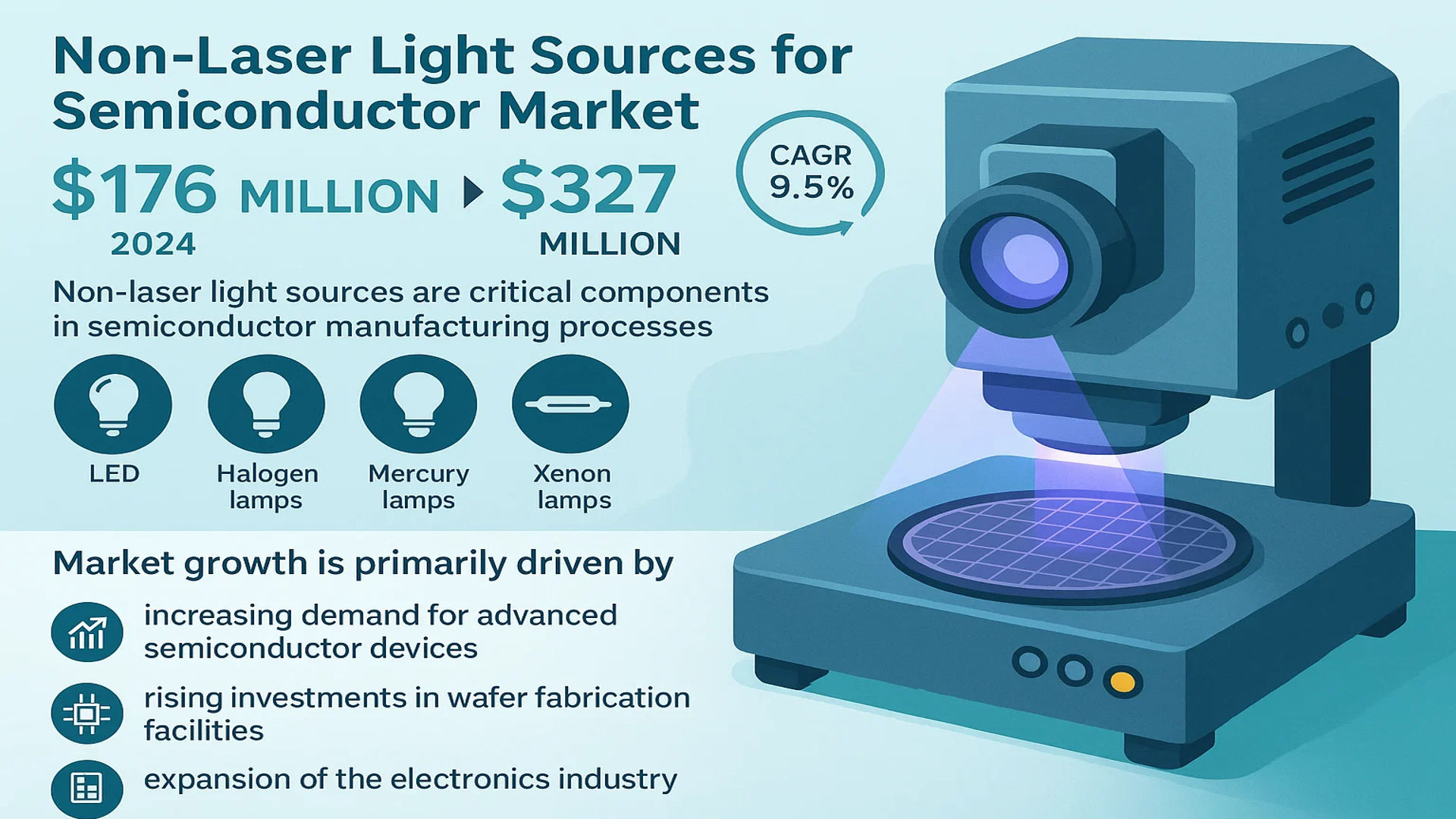
Non-Laser Light Sources for Semiconductor Market

MARKET DYNAMICS

MARKET DRIVERS

Advancements in Semiconductor Manufacturing Processes Fuel Demand for Non-Laser Light Sources

The semiconductor industry is experiencing unprecedented growth with wafer production volumes projected to exceed 15 million units annually by 2026. This expansion directly increases the demand for reliable non-laser light sources in critical processes like photolithography and inspection. Traditional halogen and mercury lamp technologies have evolved significantly, offering improved spectral stability and longer operational lifetimes exceeding 4,000 hours in most industrial applications. The ability to provide uniform illumination across large semiconductor wafers makes these non-coherent light sources indispensable for high-precision manufacturing operations. Additionally, recent breakthroughs in LED technology have enabled some systems to achieve optical power densities comparable to traditional lamps while reducing energy consumption by approximately 40%.

Growing Adoption of Advanced Packaging Technologies Drives Market Expansion

Advanced packaging techniques such as 3D IC stacking and fan-out wafer-level packaging are becoming increasingly prevalent, with the market for these technologies expected to grow at a compound annual growth rate of over 14% through 2030. These packaging methods require precise alignment and inspection processes that extensively utilize non-laser illumination systems. Xenon-based light sources have demonstrated particular effectiveness in these applications due to their broad spectral output and high intensity. Furthermore, the transition to smaller node sizes below 7nm has created new demands for inspection systems capable of detecting nanometer-scale defects, where controlled illumination becomes critical. Market leaders have responded by developing specialized light source configurations with tunable wavelengths to address these emerging requirements.

Cost-Effectiveness of Non-Laser Systems Compared to Laser Alternatives Supports Market Penetration

While laser-based systems offer superior coherence, non-laser light sources provide significant economic advantages with acquisition costs typically 25-35% lower than comparable laser solutions. This cost differential becomes particularly important for high-volume manufacturing where systems are deployed in parallel. Moreover, the total cost of ownership is further reduced through simpler maintenance requirements and the ability to replace individual components rather than entire systems. In inspection applications, modern LED-based systems have achieved detection capabilities approaching those of lasers for many defect types, making them increasingly attractive for quality control operations. The ability to precisely control illumination angles and intensities in these systems has closed much of the performance gap while maintaining economic benefits.

MARKET RESTRAINTS

Limitations in Precision Compared to Laser Systems Constrains Critical Applications

Despite significant advancements, non-laser light sources still face fundamental limitations in applications requiring extremely high spatial coherence. In photolithography processes for nodes below 5nm, the lack of perfect collimation in conventional illumination systems can create challenges in pattern fidelity. This has led some manufacturers to continue preferring laser-based systems for these cutting-edge applications, particularly in EUV lithography implementations. Additionally, thermal management remains a challenge for high-intensity operations, where lamp degradation can affect spectral output stability. While advanced cooling systems have mitigated these issues substantially, they still require careful monitoring and maintenance to ensure consistent performance over extended operational periods.

Regulatory Pressure on Mercury-Based Systems Impacts Market Segments

Environmental regulations affecting mercury-containing light sources have created uncertainty in this segment of the market. Some regions have implemented strict controls on mercury content in industrial equipment, prompting manufacturers to accelerate development of alternative technologies. While LED alternatives continue to improve, certain specialized applications still rely on the unique spectral characteristics of mercury vapor lamps. The transition has been challenging for inspection systems that depend on precise wavelength emissions at 365nm, 405nm, and 436nm spectral lines. Compliance costs associated with these regulatory changes have added approximately 12-16% to the development budgets of affected products, creating short-term pressures on profitability.

Other Restraints

Supply Chain Disruptions
The semiconductor equipment sector has experienced significant supply chain challenges affecting critical components for light source manufacturing. Lead times for certain optical elements and power supplies have extended to 12-16 weeks in some cases, creating bottlenecks in system production. These disruptions have been particularly acute for xenon lamp components where specialized materials are required.

Technology Transition Periods
The shift from traditional lamps to solid-state alternatives requires substantial retooling and retraining investments. Many fabrication facilities operate on tight schedules that make equipment transitions challenging, slowing adoption of next-generation systems despite their long-term benefits.

MARKET OPPORTUNITIES

Emerging Applications in Heterogeneous Integration Create New Growth Avenues

The rapid development of heterogeneous integration technologies presents significant opportunities for non-laser light source providers. As semiconductor manufacturers increasingly combine different chip technologies into single packages, the need for specialized inspection and alignment systems grows accordingly. This trend is particularly evident in the development of chiplets, where precise optical alignment becomes critical. Market leaders are investing in customized illumination solutions that can address the unique requirements of these multi-die systems. Recent product launches have demonstrated the ability to provide tailored spectral outputs optimized for distinguishing different materials and structures in complex 3D assemblies.

Expansion of Compound Semiconductor Manufacturing Opens New Markets

The growing adoption of compound semiconductors for power electronics and RF applications is creating demand for specialized process equipment, including inspection and metrology systems. Gallium nitride and silicon carbide wafer processing present unique challenges that conventional silicon-focused systems are not always optimized to address. This has spurred development of new illumination configurations specifically designed for these materials, with several major equipment providers introducing products targeting this niche. The compound semiconductor market is projected to maintain double-digit growth rates through the decade, providing a sustained expansion opportunity for specialized light source technologies.

Integration of AI-Based Inspection Creates Demand for Advanced Illumination Controls

The implementation of machine learning algorithms in semiconductor inspection systems is driving requirements for more sophisticated illumination capabilities. AI-enhanced systems benefit from multi-angle and multi-spectral imaging that requires precise light source control. This has led to development of smart illumination systems with programmable intensity profiles and spectral tuning capabilities. The ability to dynamically adjust illumination parameters based on defect detection patterns allows for more efficient inspection processes, reducing false positives and improving throughput. Equipment manufacturers are increasingly viewing illumination as an active component of the inspection system rather than just a passive light source.

MARKET CHALLENGES

Intense Competition from Laser-Based Solutions in Precision Applications

Non-laser light sources face persistent competition from advanced laser systems in applications requiring the highest levels of precision. While significant progress has been made in improving the performance characteristics of conventional illumination, laser systems maintain advantages in certain critical parameters. The spot size and coherence length of laser illumination remain superior for applications like mask alignment and certain metrology tasks. Laser manufacturers continue to drive down costs through technological improvements, narrowing the price differential that has traditionally favored non-laser solutions. This competitive pressure requires continuous innovation from non-laser system providers to maintain their value proposition.

Other Challenges

Thermal Management Limitations
High-power illumination systems generate significant thermal loads that can affect performance stability. Managing these thermal effects becomes increasingly challenging as intensity requirements grow for advanced inspection applications. While modern cooling systems have improved significantly, they add complexity and cost to overall system designs.

Spectral Stability Over Operational Lifetime
Maintaining consistent spectral output throughout a light source’s operational life remains a technical challenge, particularly for traditional lamp technologies. The gradual degradation of lamp electrodes and phosphors can lead to subtle shifts in spectral characteristics that may impact measurement consistency. Advanced monitoring and compensation systems have been developed but represent an added cost burden.

NON-LASER LIGHT SOURCES FOR SEMICONDUCTOR MARKET TRENDS

Rise of Advanced Manufacturing Processes Driving Market Expansion

The global non-laser light sources market for semiconductors has witnessed significant growth due to the increasing demand for precise and uniform illumination in semiconductor manufacturing. With photolithography, inspection, and annealing applications requiring high-performance lighting solutions, technologies such as LED, halogen lamps, mercury lamps, and xenon lamps have become critical. The market was valued at $176 million in 2024 and is projected to expand at a CAGR of 9.5%, reaching $327 million by 2032. The growing adoption of LED light sources is particularly notable due to their energy efficiency, longer lifespan, and precise spectral control. Additionally, the U.S. continues to lead in market share, while China is emerging as a key growth region, driven by semiconductor infrastructure investments.

Other Trends

Shift Towards Hybrid Light Source Solutions

Manufacturers are increasingly integrating hybrid light source systems to enhance flexibility and performance in semiconductor fabrication. Combining LED and xenon lamps, for example, provides both energy efficiency and high-intensity illumination required for advanced lithography processes. The segment for LED light sources alone is expected to grow substantially, supported by continuous technological advancements that improve brightness, spectral range, and longevity. Furthermore, decreasing production costs of LEDs have made them more accessible for large-scale semiconductor manufacturing facilities.

Increasing Demand for Semiconductor Inspection and Metrology

The semiconductor industry’s emphasis on yield optimization and defect detection has heightened the need for non-laser light sources in inspection and metrology applications. High-resolution imaging systems rely heavily on precisely calibrated lighting to detect nanometer-scale defects. Companies such as Hamamatsu Photonics and Excelitas Technologies are developing advanced illumination systems optimized for automated optical inspection (AOI) equipment. Additionally, innovations in ultraviolet (UV) and deep-ultraviolet (DUV) light sources are enabling better defect detection in next-generation semiconductor nodes, supporting the market’s growth trajectory.

COMPETITIVE LANDSCAPE

Key Industry Players

Innovation and Strategic Partnerships Drive Market Competition

The global non-laser light sources for semiconductor market is characterized by a competitive yet fragmented landscape, with established players and emerging innovators vying for market share. USHIO Inc. leads the industry due to its comprehensive portfolio of high-performance LED and xenon lamp solutions, which are widely adopted in photolithography and inspection applications. The company’s strong foothold in Asia and North America has positioned it as a key market influencer.

Closely following USHIO, ams OSRAM and Hamamatsu Photonics have carved out significant market shares. These companies are known for their precision light sources used in semiconductor manufacturing, leveraging advanced R&D capabilities to maintain technological leadership. Hamamatsu, in particular, has gained traction with its mercury lamp solutions, which remain critical for legacy semiconductor processes.

Another notable player, Excelitas Technologies, differentiates itself with customized lighting solutions tailored for semiconductor annealing and etching applications. The company’s focus on energy-efficient LED technology aligns with the industry’s shift toward sustainable manufacturing practices.

Meanwhile, Signify NV (formerly Philips Lighting) has been expanding its footprint through strategic acquisitions and collaborations, particularly in the inspection and measurement segment. Their emphasis on smart lighting solutions for semiconductor fabrication plants has resonated with manufacturers seeking to optimize operational efficiency.

List of Key Non-Laser Light Source Companies Profiled

Segment Analysis:

By Type

LED Light Source Segment Leads Due to Energy Efficiency and Long Lifespan

The market is segmented based on type into:

  • LED Light Source
    • Subtypes: UV LED, Visible LED, and others
  • Halogen Lamp
  • Mercury Lamp
    • Subtypes: High-pressure, Low-pressure, and others
  • Xenon Lamp
  • Others

By Application

Inspection and Measurement Segment Dominates Due to Rising Semiconductor Quality Standards

The market is segmented based on application into:

  • Inspection and measurement
  • Photolithography
  • Annealing
  • Marking and Etching
  • Others

Regional Analysis: Non-Laser Light Sources for Semiconductor Market

Asia-Pacific
Asia-Pacific dominates the global non-laser light sources market for semiconductors, with China, Japan, and South Korea leading in production and consumption. The region accounts for over 45% of global semiconductor manufacturing, creating substantial demand for LED, halogen, and xenon lamp technologies. China’s aggressive semiconductor self-sufficiency push, including the US$ 150 billion Made in China 2025 initiative, has accelerated adoption across photolithography and inspection applications. However, Japan remains the technology leader, with companies like Hamamatsu Photonics and USHIO driving innovations in mercury lamp alternatives. While cost-effective LED solutions gain traction, mercury lamps still dominate critical processes due to their wavelength precision.

North America
The North American market prioritizes high-performance non-laser solutions for advanced packaging and 3D NAND applications, with the U.S. accounting for approximately 28% of global R&D investment in semiconductor light technologies. Regulatory pressures are phasing out mercury lamps, creating opportunities for Excelitas Technologies’ UV LED systems in inspection equipment. The CHIPS and Science Act’s US$ 52 billion funding is spurring domestic semiconductor production, indirectly boosting demand for localized light source suppliers. Thermal annealing applications increasingly use customized xenon lamp systems from firms like Heraeus, particularly for AI and HPC chip manufacturing.

Europe
Europe maintains a niche position in specialty light sources, with ams OSRAM and Signify NV leading in deep UV LED development for semiconductor metrology. Strict RoHS and REACH regulations have accelerated the transition from mercury to LED-based systems, particularly in Germany’s automotive semiconductor sector. However, the market growth is restrained by limited local semiconductor fabrication capacity, with most demand coming from equipment manufacturers supplying Asian foundries. Collaborative projects like the EU Chips Act aim to rebuild local production capabilities, which could revive demand for advanced non-laser illumination systems in photolithography by 2030.

South America
South America represents an emerging market, primarily serving back-end semiconductor processes with imported light source systems. Brazil shows growing demand for LED-based inspection tools in its consumer electronics assembly sector, though economic instability limits capital investment. Argentina’s nascent semiconductor packaging industry utilizes refurbished halogen lamp systems for cost-sensitive applications. The lack of local manufacturers creates opportunities for Asian suppliers, but adoption of advanced technologies remains 5-7 years behind leading markets due to infrastructure limitations.

Middle East & Africa
This region focuses on downstream semiconductor applications, with Israel and UAE importing specialized xenon lamp systems for military and aerospace component manufacturing. Saudi Arabia’s US$ 100 billion investment in NEOM’s technology hub may create future demand for wafer inspection equipment. However, the absence of local semiconductor fabrication results in minimal direct consumption, with most light source applications confined to university research labs and electronics repair facilities using basic halogen systems. Partnerships with Chinese suppliers are gradually introducing LED alternatives for industrial marking applications.

Report Scope

This market research report provides a comprehensive analysis of the Global Non-Laser Light Sources for Semiconductor Market, covering the forecast period 2024–2032. It offers detailed insights into market dynamics, technological advancements, competitive landscape, and key trends shaping the industry.

Key focus areas of the report include:

  • Market Size & Forecast: Historical data and future projections for revenue, unit shipments, and market value across major regions and segments. The market was valued at USD 176 million in 2024 and is projected to reach USD 327 million by 2032, growing at a CAGR of 9.5%.
  • Segmentation Analysis: Detailed breakdown by product type (LED Light Source, Halogen Lamp, Mercury Lamp, Xenon Lamp) and application (Inspection and Measurement, Photolithography, Annealing, Marking and Etching, Others) to identify high-growth segments.
  • Regional Outlook: Insights into market performance across North America, Europe, Asia-Pacific, Latin America, and the Middle East & Africa. The U.S. and China are key markets with significant growth potential.
  • Competitive Landscape: Profiles of leading market participants including USHIO, Signify NV, ams OSRAM, Excelitas Technologies, and Hamamatsu Photonics, covering their product portfolios, R&D investments, and strategic initiatives.
  • Technology Trends & Innovation: Assessment of emerging light source technologies, integration with semiconductor manufacturing processes, and evolving industry standards.
  • Market Drivers & Restraints: Evaluation of factors driving market growth (semiconductor industry expansion, advanced packaging demand) along with challenges (high equipment costs, regulatory constraints).
  • Stakeholder Analysis: Strategic insights for semiconductor manufacturers, equipment suppliers, and investors regarding market opportunities and competitive positioning.

The report employs rigorous primary and secondary research methodologies, including interviews with industry experts and analysis of verified market data, to ensure accuracy and reliability.

FREQUENTLY ASKED QUESTIONS:

What is the current market size of Global Non-Laser Light Sources for Semiconductor Market?

-> Non-Laser Light Sources for Semiconductor Market was valued at 176 million in 2024 and is projected to reach US$ 327 million by 2032, at a CAGR of 9.5% during the forecast period.

Which key companies operate in this market?

-> Key players include USHIO, Signify NV, ams OSRAM, Excelitas Technologies, Hamamatsu Photonics, and Nikon, among others.

What are the key growth drivers?

-> Growth is driven by increasing semiconductor production, demand for advanced packaging, and the expansion of IoT and AI applications requiring precise light-based processes.

Which region dominates the market?

-> Asia-Pacific leads the market due to semiconductor manufacturing concentration, while North America shows strong growth in R&D applications.

What are the emerging trends?

-> Emerging trends include high-efficiency LED adoption, miniaturization of light sources, and integration with smart manufacturing systems.

Non-Laser Light Sources for Semiconductor Market, Trends, Business Strategies 2025-2032

Get Sample Report PDF for Exclusive Insights

Report Sample Includes

  • Table of Contents
  • List of Tables & Figures
  • Charts, Research Methodology, and more...

PDF Icon Download Sample Report PDF

Download Sample Report

Table of Content

1 Introduction to Research & Analysis Reports
1.1 Non-Laser Light Sources for Semiconductor Market Definition
1.2 Market Segments
1.2.1 Segment by Type
1.2.2 Segment by Application
1.3 Global Non-Laser Light Sources for Semiconductor Market Overview
1.4 Features & Benefits of This Report
1.5 Methodology & Sources of Information
1.5.1 Research Methodology
1.5.2 Research Process
1.5.3 Base Year
1.5.4 Report Assumptions & Caveats
2 Global Non-Laser Light Sources for Semiconductor Overall Market Size
2.1 Global Non-Laser Light Sources for Semiconductor Market Size: 2024 VS 2032
2.2 Global Non-Laser Light Sources for Semiconductor Market Size, Prospects & Forecasts: 2020-2032
2.3 Global Non-Laser Light Sources for Semiconductor Sales: 2020-2032
3 Company Landscape
3.1 Top Non-Laser Light Sources for Semiconductor Players in Global Market
3.2 Top Global Non-Laser Light Sources for Semiconductor Companies Ranked by Revenue
3.3 Global Non-Laser Light Sources for Semiconductor Revenue by Companies
3.4 Global Non-Laser Light Sources for Semiconductor Sales by Companies
3.5 Global Non-Laser Light Sources for Semiconductor Price by Manufacturer (2020-2025)
3.6 Top 3 and Top 5 Non-Laser Light Sources for Semiconductor Companies in Global Market, by Revenue in 2024
3.7 Global Manufacturers Non-Laser Light Sources for Semiconductor Product Type
3.8 Tier 1, Tier 2, and Tier 3 Non-Laser Light Sources for Semiconductor Players in Global Market
3.8.1 List of Global Tier 1 Non-Laser Light Sources for Semiconductor Companies
3.8.2 List of Global Tier 2 and Tier 3 Non-Laser Light Sources for Semiconductor Companies
4 Sights by Product
4.1 Overview
4.1.1 Segment by Type – Global Non-Laser Light Sources for Semiconductor Market Size Markets, 2024 & 2032
4.1.2 LED Light Source
4.1.3 Halogen Lamp
4.1.4 Mercury Lamp
4.1.5 Xenon Lamp
4.2 Segment by Type – Global Non-Laser Light Sources for Semiconductor Revenue & Forecasts
4.2.1 Segment by Type – Global Non-Laser Light Sources for Semiconductor Revenue, 2020-2025
4.2.2 Segment by Type – Global Non-Laser Light Sources for Semiconductor Revenue, 2026-2032
4.2.3 Segment by Type – Global Non-Laser Light Sources for Semiconductor Revenue Market Share, 2020-2032
4.3 Segment by Type – Global Non-Laser Light Sources for Semiconductor Sales & Forecasts
4.3.1 Segment by Type – Global Non-Laser Light Sources for Semiconductor Sales, 2020-2025
4.3.2 Segment by Type – Global Non-Laser Light Sources for Semiconductor Sales, 2026-2032
4.3.3 Segment by Type – Global Non-Laser Light Sources for Semiconductor Sales Market Share, 2020-2032
4.4 Segment by Type – Global Non-Laser Light Sources for Semiconductor Price (Manufacturers Selling Prices), 2020-2032
5 Sights by Application
5.1 Overview
5.1.1 Segment by Application – Global Non-Laser Light Sources for Semiconductor Market Size, 2024 & 2032
5.1.2 Inspection and measurement
5.1.3 Photolithography
5.1.4 Annealing
5.1.5 Marking and Etching
5.1.6 Others
5.2 Segment by Application – Global Non-Laser Light Sources for Semiconductor Revenue & Forecasts
5.2.1 Segment by Application – Global Non-Laser Light Sources for Semiconductor Revenue, 2020-2025
5.2.2 Segment by Application – Global Non-Laser Light Sources for Semiconductor Revenue, 2026-2032
5.2.3 Segment by Application – Global Non-Laser Light Sources for Semiconductor Revenue Market Share, 2020-2032
5.3 Segment by Application – Global Non-Laser Light Sources for Semiconductor Sales & Forecasts
5.3.1 Segment by Application – Global Non-Laser Light Sources for Semiconductor Sales, 2020-2025
5.3.2 Segment by Application – Global Non-Laser Light Sources for Semiconductor Sales, 2026-2032
5.3.3 Segment by Application – Global Non-Laser Light Sources for Semiconductor Sales Market Share, 2020-2032
5.4 Segment by Application – Global Non-Laser Light Sources for Semiconductor Price (Manufacturers Selling Prices), 2020-2032
6 Sights by Region
6.1 By Region – Global Non-Laser Light Sources for Semiconductor Market Size, 2024 & 2032
6.2 By Region – Global Non-Laser Light Sources for Semiconductor Revenue & Forecasts
6.2.1 By Region – Global Non-Laser Light Sources for Semiconductor Revenue, 2020-2025
6.2.2 By Region – Global Non-Laser Light Sources for Semiconductor Revenue, 2026-2032
6.2.3 By Region – Global Non-Laser Light Sources for Semiconductor Revenue Market Share, 2020-2032
6.3 By Region – Global Non-Laser Light Sources for Semiconductor Sales & Forecasts
6.3.1 By Region – Global Non-Laser Light Sources for Semiconductor Sales, 2020-2025
6.3.2 By Region – Global Non-Laser Light Sources for Semiconductor Sales, 2026-2032
6.3.3 By Region – Global Non-Laser Light Sources for Semiconductor Sales Market Share, 2020-2032
6.4 North America
6.4.1 By Country – North America Non-Laser Light Sources for Semiconductor Revenue, 2020-2032
6.4.2 By Country – North America Non-Laser Light Sources for Semiconductor Sales, 2020-2032
6.4.3 United States Non-Laser Light Sources for Semiconductor Market Size, 2020-2032
6.4.4 Canada Non-Laser Light Sources for Semiconductor Market Size, 2020-2032
6.4.5 Mexico Non-Laser Light Sources for Semiconductor Market Size, 2020-2032
6.5 Europe
6.5.1 By Country – Europe Non-Laser Light Sources for Semiconductor Revenue, 2020-2032
6.5.2 By Country – Europe Non-Laser Light Sources for Semiconductor Sales, 2020-2032
6.5.3 Germany Non-Laser Light Sources for Semiconductor Market Size, 2020-2032
6.5.4 France Non-Laser Light Sources for Semiconductor Market Size, 2020-2032
6.5.5 U.K. Non-Laser Light Sources for Semiconductor Market Size, 2020-2032
6.5.6 Italy Non-Laser Light Sources for Semiconductor Market Size, 2020-2032
6.5.7 Russia Non-Laser Light Sources for Semiconductor Market Size, 2020-2032
6.5.8 Nordic Countries Non-Laser Light Sources for Semiconductor Market Size, 2020-2032
6.5.9 Benelux Non-Laser Light Sources for Semiconductor Market Size, 2020-2032
6.6 Asia
6.6.1 By Region – Asia Non-Laser Light Sources for Semiconductor Revenue, 2020-2032
6.6.2 By Region – Asia Non-Laser Light Sources for Semiconductor Sales, 2020-2032
6.6.3 China Non-Laser Light Sources for Semiconductor Market Size, 2020-2032
6.6.4 Japan Non-Laser Light Sources for Semiconductor Market Size, 2020-2032
6.6.5 South Korea Non-Laser Light Sources for Semiconductor Market Size, 2020-2032
6.6.6 Southeast Asia Non-Laser Light Sources for Semiconductor Market Size, 2020-2032
6.6.7 India Non-Laser Light Sources for Semiconductor Market Size, 2020-2032
6.7 South America
6.7.1 By Country – South America Non-Laser Light Sources for Semiconductor Revenue, 2020-2032
6.7.2 By Country – South America Non-Laser Light Sources for Semiconductor Sales, 2020-2032
6.7.3 Brazil Non-Laser Light Sources for Semiconductor Market Size, 2020-2032
6.7.4 Argentina Non-Laser Light Sources for Semiconductor Market Size, 2020-2032
6.8 Middle East & Africa
6.8.1 By Country – Middle East & Africa Non-Laser Light Sources for Semiconductor Revenue, 2020-2032
6.8.2 By Country – Middle East & Africa Non-Laser Light Sources for Semiconductor Sales, 2020-2032
6.8.3 Turkey Non-Laser Light Sources for Semiconductor Market Size, 2020-2032
6.8.4 Israel Non-Laser Light Sources for Semiconductor Market Size, 2020-2032
6.8.5 Saudi Arabia Non-Laser Light Sources for Semiconductor Market Size, 2020-2032
6.8.6 UAE Non-Laser Light Sources for Semiconductor Market Size, 2020-2032
7 Manufacturers & Brands Profiles
7.1 USHIO
7.1.1 USHIO Company Summary
7.1.2 USHIO Business Overview
7.1.3 USHIO Non-Laser Light Sources for Semiconductor Major Product Offerings
7.1.4 USHIO Non-Laser Light Sources for Semiconductor Sales and Revenue in Global (2020-2025)
7.1.5 USHIO Key News & Latest Developments
7.2 Signify NV
7.2.1 Signify NV Company Summary
7.2.2 Signify NV Business Overview
7.2.3 Signify NV Non-Laser Light Sources for Semiconductor Major Product Offerings
7.2.4 Signify NV Non-Laser Light Sources for Semiconductor Sales and Revenue in Global (2020-2025)
7.2.5 Signify NV Key News & Latest Developments
7.3 ams OSRAM
7.3.1 ams OSRAM Company Summary
7.3.2 ams OSRAM Business Overview
7.3.3 ams OSRAM Non-Laser Light Sources for Semiconductor Major Product Offerings
7.3.4 ams OSRAM Non-Laser Light Sources for Semiconductor Sales and Revenue in Global (2020-2025)
7.3.5 ams OSRAM Key News & Latest Developments
7.4 Excelitas Technologies
7.4.1 Excelitas Technologies Company Summary
7.4.2 Excelitas Technologies Business Overview
7.4.3 Excelitas Technologies Non-Laser Light Sources for Semiconductor Major Product Offerings
7.4.4 Excelitas Technologies Non-Laser Light Sources for Semiconductor Sales and Revenue in Global (2020-2025)
7.4.5 Excelitas Technologies Key News & Latest Developments
7.5 ARC
7.5.1 ARC Company Summary
7.5.2 ARC Business Overview
7.5.3 ARC Non-Laser Light Sources for Semiconductor Major Product Offerings
7.5.4 ARC Non-Laser Light Sources for Semiconductor Sales and Revenue in Global (2020-2025)
7.5.5 ARC Key News & Latest Developments
7.6 Heraeus
7.6.1 Heraeus Company Summary
7.6.2 Heraeus Business Overview
7.6.3 Heraeus Non-Laser Light Sources for Semiconductor Major Product Offerings
7.6.4 Heraeus Non-Laser Light Sources for Semiconductor Sales and Revenue in Global (2020-2025)
7.6.5 Heraeus Key News & Latest Developments
7.7 Hamamatsu Photonics
7.7.1 Hamamatsu Photonics Company Summary
7.7.2 Hamamatsu Photonics Business Overview
7.7.3 Hamamatsu Photonics Non-Laser Light Sources for Semiconductor Major Product Offerings
7.7.4 Hamamatsu Photonics Non-Laser Light Sources for Semiconductor Sales and Revenue in Global (2020-2025)
7.7.5 Hamamatsu Photonics Key News & Latest Developments
7.8 Nikon
7.8.1 Nikon Company Summary
7.8.2 Nikon Business Overview
7.8.3 Nikon Non-Laser Light Sources for Semiconductor Major Product Offerings
7.8.4 Nikon Non-Laser Light Sources for Semiconductor Sales and Revenue in Global (2020-2025)
7.8.5 Nikon Key News & Latest Developments
7.9 YUMEX
7.9.1 YUMEX Company Summary
7.9.2 YUMEX Business Overview
7.9.3 YUMEX Non-Laser Light Sources for Semiconductor Major Product Offerings
7.9.4 YUMEX Non-Laser Light Sources for Semiconductor Sales and Revenue in Global (2020-2025)
7.9.5 YUMEX Key News & Latest Developments
7.10 OPT Machine Vision Tech
7.10.1 OPT Machine Vision Tech Company Summary
7.10.2 OPT Machine Vision Tech Business Overview
7.10.3 OPT Machine Vision Tech Non-Laser Light Sources for Semiconductor Major Product Offerings
7.10.4 OPT Machine Vision Tech Non-Laser Light Sources for Semiconductor Sales and Revenue in Global (2020-2025)
7.10.5 OPT Machine Vision Tech Key News & Latest Developments
7.11 Changzhou Yuyu Electro-optical Device
7.11.1 Changzhou Yuyu Electro-optical Device Company Summary
7.11.2 Changzhou Yuyu Electro-optical Device Business Overview
7.11.3 Changzhou Yuyu Electro-optical Device Non-Laser Light Sources for Semiconductor Major Product Offerings
7.11.4 Changzhou Yuyu Electro-optical Device Non-Laser Light Sources for Semiconductor Sales and Revenue in Global (2020-2025)
7.11.5 Changzhou Yuyu Electro-optical Device Key News & Latest Developments
8 Global Non-Laser Light Sources for Semiconductor Production Capacity, Analysis
8.1 Global Non-Laser Light Sources for Semiconductor Production Capacity, 2020-2032
8.2 Non-Laser Light Sources for Semiconductor Production Capacity of Key Manufacturers in Global Market
8.3 Global Non-Laser Light Sources for Semiconductor Production by Region
9 Key Market Trends, Opportunity, Drivers and Restraints
9.1 Market Opportunities & Trends
9.2 Market Drivers
9.3 Market Restraints
10 Non-Laser Light Sources for Semiconductor Supply Chain Analysis
10.1 Non-Laser Light Sources for Semiconductor Industry Value Chain
10.2 Non-Laser Light Sources for Semiconductor Upstream Market
10.3 Non-Laser Light Sources for Semiconductor Downstream and Clients
10.4 Marketing Channels Analysis
10.4.1 Marketing Channels
10.4.2 Non-Laser Light Sources for Semiconductor Distributors and Sales Agents in Global
11 Conclusion
12 Appendix
12.1 Note
12.2 Examples of Clients
12.3 DisclaimerList of Tables
Table 1. Key Players of Non-Laser Light Sources for Semiconductor in Global Market
Table 2. Top Non-Laser Light Sources for Semiconductor Players in Global Market, Ranking by Revenue (2024)
Table 3. Global Non-Laser Light Sources for Semiconductor Revenue by Companies, (US$, Mn), 2020-2025
Table 4. Global Non-Laser Light Sources for Semiconductor Revenue Share by Companies, 2020-2025
Table 5. Global Non-Laser Light Sources for Semiconductor Sales by Companies, (K Units), 2020-2025
Table 6. Global Non-Laser Light Sources for Semiconductor Sales Share by Companies, 2020-2025
Table 7. Key Manufacturers Non-Laser Light Sources for Semiconductor Price (2020-2025) & (US$/Unit)
Table 8. Global Manufacturers Non-Laser Light Sources for Semiconductor Product Type
Table 9. List of Global Tier 1 Non-Laser Light Sources for Semiconductor Companies, Revenue (US$, Mn) in 2024 and Market Share
Table 10. List of Global Tier 2 and Tier 3 Non-Laser Light Sources for Semiconductor Companies, Revenue (US$, Mn) in 2024 and Market Share
Table 11. Segment by Type – Global Non-Laser Light Sources for Semiconductor Revenue, (US$, Mn), 2024 & 2032
Table 12. Segment by Type – Global Non-Laser Light Sources for Semiconductor Revenue (US$, Mn), 2020-2025
Table 13. Segment by Type – Global Non-Laser Light Sources for Semiconductor Revenue (US$, Mn), 2026-2032
Table 14. Segment by Type – Global Non-Laser Light Sources for Semiconductor Sales (K Units), 2020-2025
Table 15. Segment by Type – Global Non-Laser Light Sources for Semiconductor Sales (K Units), 2026-2032
Table 16. Segment by Application – Global Non-Laser Light Sources for Semiconductor Revenue, (US$, Mn), 2024 & 2032
Table 17. Segment by Application – Global Non-Laser Light Sources for Semiconductor Revenue, (US$, Mn), 2020-2025
Table 18. Segment by Application – Global Non-Laser Light Sources for Semiconductor Revenue, (US$, Mn), 2026-2032
Table 19. Segment by Application – Global Non-Laser Light Sources for Semiconductor Sales, (K Units), 2020-2025
Table 20. Segment by Application – Global Non-Laser Light Sources for Semiconductor Sales, (K Units), 2026-2032
Table 21. By Region – Global Non-Laser Light Sources for Semiconductor Revenue, (US$, Mn), 2025-2032
Table 22. By Region – Global Non-Laser Light Sources for Semiconductor Revenue, (US$, Mn), 2020-2025
Table 23. By Region – Global Non-Laser Light Sources for Semiconductor Revenue, (US$, Mn), 2026-2032
Table 24. By Region – Global Non-Laser Light Sources for Semiconductor Sales, (K Units), 2020-2025
Table 25. By Region – Global Non-Laser Light Sources for Semiconductor Sales, (K Units), 2026-2032
Table 26. By Country – North America Non-Laser Light Sources for Semiconductor Revenue, (US$, Mn), 2020-2025
Table 27. By Country – North America Non-Laser Light Sources for Semiconductor Revenue, (US$, Mn), 2026-2032
Table 28. By Country – North America Non-Laser Light Sources for Semiconductor Sales, (K Units), 2020-2025
Table 29. By Country – North America Non-Laser Light Sources for Semiconductor Sales, (K Units), 2026-2032
Table 30. By Country – Europe Non-Laser Light Sources for Semiconductor Revenue, (US$, Mn), 2020-2025
Table 31. By Country – Europe Non-Laser Light Sources for Semiconductor Revenue, (US$, Mn), 2026-2032
Table 32. By Country – Europe Non-Laser Light Sources for Semiconductor Sales, (K Units), 2020-2025
Table 33. By Country – Europe Non-Laser Light Sources for Semiconductor Sales, (K Units), 2026-2032
Table 34. By Region – Asia Non-Laser Light Sources for Semiconductor Revenue, (US$, Mn), 2020-2025
Table 35. By Region – Asia Non-Laser Light Sources for Semiconductor Revenue, (US$, Mn), 2026-2032
Table 36. By Region – Asia Non-Laser Light Sources for Semiconductor Sales, (K Units), 2020-2025
Table 37. By Region – Asia Non-Laser Light Sources for Semiconductor Sales, (K Units), 2026-2032
Table 38. By Country – South America Non-Laser Light Sources for Semiconductor Revenue, (US$, Mn), 2020-2025
Table 39. By Country – South America Non-Laser Light Sources for Semiconductor Revenue, (US$, Mn), 2026-2032
Table 40. By Country – South America Non-Laser Light Sources for Semiconductor Sales, (K Units), 2020-2025
Table 41. By Country – South America Non-Laser Light Sources for Semiconductor Sales, (K Units), 2026-2032
Table 42. By Country – Middle East & Africa Non-Laser Light Sources for Semiconductor Revenue, (US$, Mn), 2020-2025
Table 43. By Country – Middle East & Africa Non-Laser Light Sources for Semiconductor Revenue, (US$, Mn), 2026-2032
Table 44. By Country – Middle East & Africa Non-Laser Light Sources for Semiconductor Sales, (K Units), 2020-2025
Table 45. By Country – Middle East & Africa Non-Laser Light Sources for Semiconductor Sales, (K Units), 2026-2032
Table 46. USHIO Company Summary
Table 47. USHIO Non-Laser Light Sources for Semiconductor Product Offerings
Table 48. USHIO Non-Laser Light Sources for Semiconductor Sales (K Units), Revenue (US$, Mn) and Average Price (US$/Unit) & (2020-2025)
Table 49. USHIO Key News & Latest Developments
Table 50. Signify NV Company Summary
Table 51. Signify NV Non-Laser Light Sources for Semiconductor Product Offerings
Table 52. Signify NV Non-Laser Light Sources for Semiconductor Sales (K Units), Revenue (US$, Mn) and Average Price (US$/Unit) & (2020-2025)
Table 53. Signify NV Key News & Latest Developments
Table 54. ams OSRAM Company Summary
Table 55. ams OSRAM Non-Laser Light Sources for Semiconductor Product Offerings
Table 56. ams OSRAM Non-Laser Light Sources for Semiconductor Sales (K Units), Revenue (US$, Mn) and Average Price (US$/Unit) & (2020-2025)
Table 57. ams OSRAM Key News & Latest Developments
Table 58. Excelitas Technologies Company Summary
Table 59. Excelitas Technologies Non-Laser Light Sources for Semiconductor Product Offerings
Table 60. Excelitas Technologies Non-Laser Light Sources for Semiconductor Sales (K Units), Revenue (US$, Mn) and Average Price (US$/Unit) & (2020-2025)
Table 61. Excelitas Technologies Key News & Latest Developments
Table 62. ARC Company Summary
Table 63. ARC Non-Laser Light Sources for Semiconductor Product Offerings
Table 64. ARC Non-Laser Light Sources for Semiconductor Sales (K Units), Revenue (US$, Mn) and Average Price (US$/Unit) & (2020-2025)
Table 65. ARC Key News & Latest Developments
Table 66. Heraeus Company Summary
Table 67. Heraeus Non-Laser Light Sources for Semiconductor Product Offerings
Table 68. Heraeus Non-Laser Light Sources for Semiconductor Sales (K Units), Revenue (US$, Mn) and Average Price (US$/Unit) & (2020-2025)
Table 69. Heraeus Key News & Latest Developments
Table 70. Hamamatsu Photonics Company Summary
Table 71. Hamamatsu Photonics Non-Laser Light Sources for Semiconductor Product Offerings
Table 72. Hamamatsu Photonics Non-Laser Light Sources for Semiconductor Sales (K Units), Revenue (US$, Mn) and Average Price (US$/Unit) & (2020-2025)
Table 73. Hamamatsu Photonics Key News & Latest Developments
Table 74. Nikon Company Summary
Table 75. Nikon Non-Laser Light Sources for Semiconductor Product Offerings
Table 76. Nikon Non-Laser Light Sources for Semiconductor Sales (K Units), Revenue (US$, Mn) and Average Price (US$/Unit) & (2020-2025)
Table 77. Nikon Key News & Latest Developments
Table 78. YUMEX Company Summary
Table 79. YUMEX Non-Laser Light Sources for Semiconductor Product Offerings
Table 80. YUMEX Non-Laser Light Sources for Semiconductor Sales (K Units), Revenue (US$, Mn) and Average Price (US$/Unit) & (2020-2025)
Table 81. YUMEX Key News & Latest Developments
Table 82. OPT Machine Vision Tech Company Summary
Table 83. OPT Machine Vision Tech Non-Laser Light Sources for Semiconductor Product Offerings
Table 84. OPT Machine Vision Tech Non-Laser Light Sources for Semiconductor Sales (K Units), Revenue (US$, Mn) and Average Price (US$/Unit) & (2020-2025)
Table 85. OPT Machine Vision Tech Key News & Latest Developments
Table 86. Changzhou Yuyu Electro-optical Device Company Summary
Table 87. Changzhou Yuyu Electro-optical Device Non-Laser Light Sources for Semiconductor Product Offerings
Table 88. Changzhou Yuyu Electro-optical Device Non-Laser Light Sources for Semiconductor Sales (K Units), Revenue (US$, Mn) and Average Price (US$/Unit) & (2020-2025)
Table 89. Changzhou Yuyu Electro-optical Device Key News & Latest Developments
Table 90. Non-Laser Light Sources for Semiconductor Capacity of Key Manufacturers in Global Market, 2023-2025 (K Units)
Table 91. Global Non-Laser Light Sources for Semiconductor Capacity Market Share of Key Manufacturers, 2023-2025
Table 92. Global Non-Laser Light Sources for Semiconductor Production by Region, 2020-2025 (K Units)
Table 93. Global Non-Laser Light Sources for Semiconductor Production by Region, 2026-2032 (K Units)
Table 94. Non-Laser Light Sources for Semiconductor Market Opportunities & Trends in Global Market
Table 95. Non-Laser Light Sources for Semiconductor Market Drivers in Global Market
Table 96. Non-Laser Light Sources for Semiconductor Market Restraints in Global Market
Table 97. Non-Laser Light Sources for Semiconductor Raw Materials
Table 98. Non-Laser Light Sources for Semiconductor Raw Materials Suppliers in Global Market
Table 99. Typical Non-Laser Light Sources for Semiconductor Downstream
Table 100. Non-Laser Light Sources for Semiconductor Downstream Clients in Global Market
Table 101. Non-Laser Light Sources for Semiconductor Distributors and Sales Agents in Global Market

List of Figures
Figure 1. Non-Laser Light Sources for Semiconductor Product Picture
Figure 2. Non-Laser Light Sources for Semiconductor Segment by Type in 2024
Figure 3. Non-Laser Light Sources for Semiconductor Segment by Application in 2024
Figure 4. Global Non-Laser Light Sources for Semiconductor Market Overview: 2024
Figure 5. Key Caveats
Figure 6. Global Non-Laser Light Sources for Semiconductor Market Size: 2024 VS 2032 (US$, Mn)
Figure 7. Global Non-Laser Light Sources for Semiconductor Revenue: 2020-2032 (US$, Mn)
Figure 8. Non-Laser Light Sources for Semiconductor Sales in Global Market: 2020-2032 (K Units)
Figure 9. The Top 3 and 5 Players Market Share by Non-Laser Light Sources for Semiconductor Revenue in 2024
Figure 10. Segment by Type – Global Non-Laser Light Sources for Semiconductor Revenue, (US$, Mn), 2024 & 2032
Figure 11. Segment by Type – Global Non-Laser Light Sources for Semiconductor Revenue Market Share, 2020-2032
Figure 12. Segment by Type – Global Non-Laser Light Sources for Semiconductor Sales Market Share, 2020-2032
Figure 13. Segment by Type – Global Non-Laser Light Sources for Semiconductor Price (US$/Unit), 2020-2032
Figure 14. Segment by Application – Global Non-Laser Light Sources for Semiconductor Revenue, (US$, Mn), 2024 & 2032
Figure 15. Segment by Application – Global Non-Laser Light Sources for Semiconductor Revenue Market Share, 2020-2032
Figure 16. Segment by Application – Global Non-Laser Light Sources for Semiconductor Sales Market Share, 2020-2032
Figure 17. Segment by Application -Global Non-Laser Light Sources for Semiconductor Price (US$/Unit), 2020-2032
Figure 18. By Region – Global Non-Laser Light Sources for Semiconductor Revenue, (US$, Mn), 2025 & 2032
Figure 19. By Region – Global Non-Laser Light Sources for Semiconductor Revenue Market Share, 2020 VS 2024 VS 2032
Figure 20. By Region – Global Non-Laser Light Sources for Semiconductor Revenue Market Share, 2020-2032
Figure 21. By Region – Global Non-Laser Light Sources for Semiconductor Sales Market Share, 2020-2032
Figure 22. By Country – North America Non-Laser Light Sources for Semiconductor Revenue Market Share, 2020-2032
Figure 23. By Country – North America Non-Laser Light Sources for Semiconductor Sales Market Share, 2020-2032
Figure 24. United States Non-Laser Light Sources for Semiconductor Revenue, (US$, Mn), 2020-2032
Figure 25. Canada Non-Laser Light Sources for Semiconductor Revenue, (US$, Mn), 2020-2032
Figure 26. Mexico Non-Laser Light Sources for Semiconductor Revenue, (US$, Mn), 2020-2032
Figure 27. By Country – Europe Non-Laser Light Sources for Semiconductor Revenue Market Share, 2020-2032
Figure 28. By Country – Europe Non-Laser Light Sources for Semiconductor Sales Market Share, 2020-2032
Figure 29. Germany Non-Laser Light Sources for Semiconductor Revenue, (US$, Mn), 2020-2032
Figure 30. France Non-Laser Light Sources for Semiconductor Revenue, (US$, Mn), 2020-2032
Figure 31. U.K. Non-Laser Light Sources for Semiconductor Revenue, (US$, Mn), 2020-2032
Figure 32. Italy Non-Laser Light Sources for Semiconductor Revenue, (US$, Mn), 2020-2032
Figure 33. Russia Non-Laser Light Sources for Semiconductor Revenue, (US$, Mn), 2020-2032
Figure 34. Nordic Countries Non-Laser Light Sources for Semiconductor Revenue, (US$, Mn), 2020-2032
Figure 35. Benelux Non-Laser Light Sources for Semiconductor Revenue, (US$, Mn), 2020-2032
Figure 36. By Region – Asia Non-Laser Light Sources for Semiconductor Revenue Market Share, 2020-2032
Figure 37. By Region – Asia Non-Laser Light Sources for Semiconductor Sales Market Share, 2020-2032
Figure 38. China Non-Laser Light Sources for Semiconductor Revenue, (US$, Mn), 2020-2032
Figure 39. Japan Non-Laser Light Sources for Semiconductor Revenue, (US$, Mn), 2020-2032
Figure 40. South Korea Non-Laser Light Sources for Semiconductor Revenue, (US$, Mn), 2020-2032
Figure 41. Southeast Asia Non-Laser Light Sources for Semiconductor Revenue, (US$, Mn), 2020-2032
Figure 42. India Non-Laser Light Sources for Semiconductor Revenue, (US$, Mn), 2020-2032
Figure 43. By Country – South America Non-Laser Light Sources for Semiconductor Revenue Market Share, 2020-2032
Figure 44. By Country – South America Non-Laser Light Sources for Semiconductor Sales, Market Share, 2020-2032
Figure 45. Brazil Non-Laser Light Sources for Semiconductor Revenue, (US$, Mn), 2020-2032
Figure 46. Argentina Non-Laser Light Sources for Semiconductor Revenue, (US$, Mn), 2020-2032
Figure 47. By Country – Middle East & Africa Non-Laser Light Sources for Semiconductor Revenue, Market Share, 2020-2032
Figure 48. By Country – Middle East & Africa Non-Laser Light Sources for Semiconductor Sales, Market Share, 2020-2032
Figure 49. Turkey Non-Laser Light Sources for Semiconductor Revenue, (US$, Mn), 2020-2032
Figure 50. Israel Non-Laser Light Sources for Semiconductor Revenue, (US$, Mn), 2020-2032
Figure 51. Saudi Arabia Non-Laser Light Sources for Semiconductor Revenue, (US$, Mn), 2020-2032
Figure 52. UAE Non-Laser Light Sources for Semiconductor Revenue, (US$, Mn), 2020-2032
Figure 53. Global Non-Laser Light Sources for Semiconductor Production Capacity (K Units), 2020-2032
Figure 54. The Percentage of Production Non-Laser Light Sources for Semiconductor by Region, 2024 VS 2032
Figure 55. Non-Laser Light Sources for Semiconductor Industry Value Chain
Figure 56. Marketing Channels


