
MARKET INSIGHTS
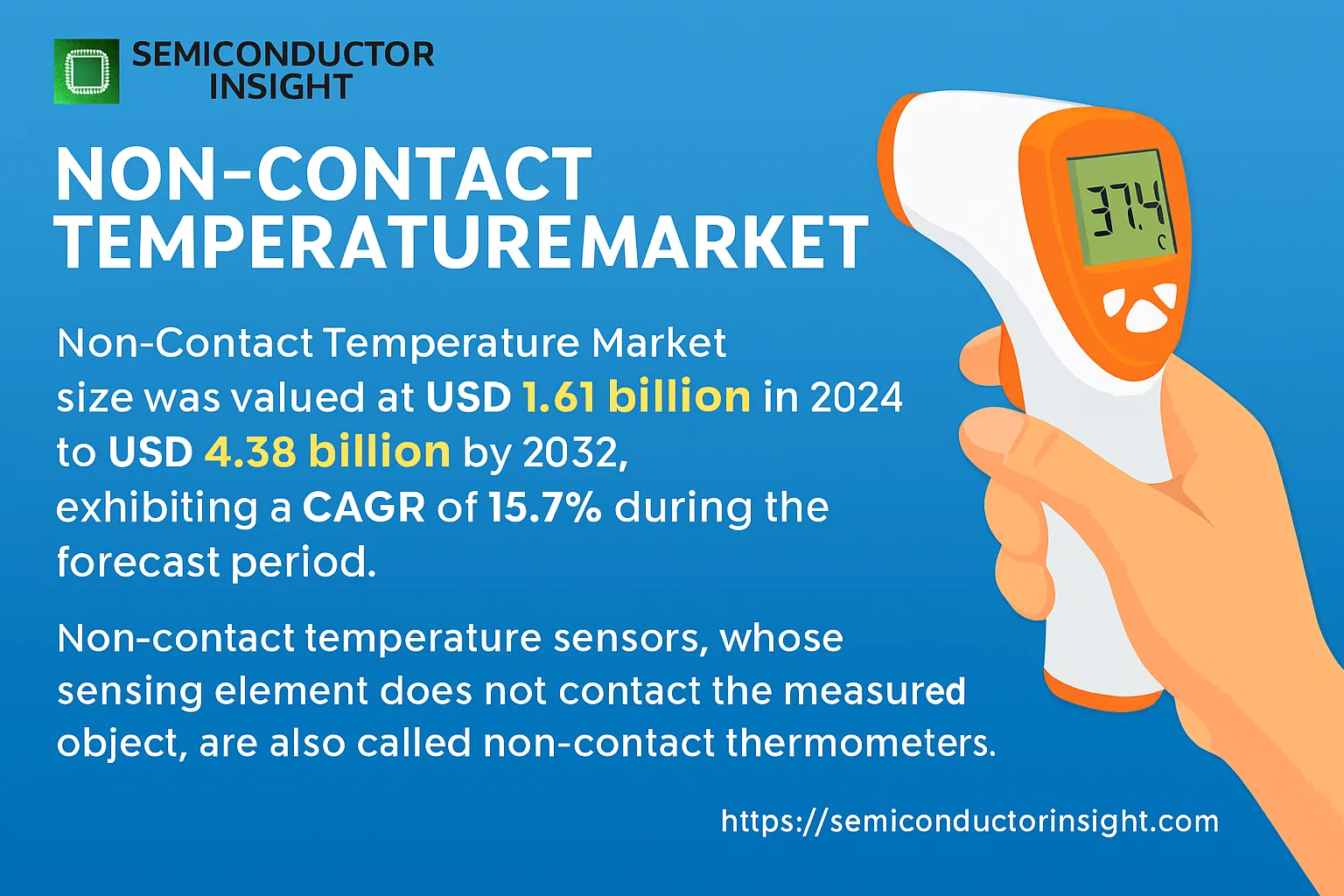
Global Non-Contact Temperature Market size was valued at USD 1.61 billion in 2024 to USD 4.38 billion by 2032, exhibiting a CAGR of 15.7% during the forecast period.
Non-contact temperature sensors, whose sensing element does not contact the measured object, are also called non-contact thermometers. These devices measure temperature by intercepting infrared energy emitted by objects and detecting its intensity, enabling measurement of moving objects, small components, or rapidly changing temperatures without physical contact.
The market is experiencing significant growth due to several factors, including increased demand for industrial automation, enhanced safety protocols across sectors, and growing adoption in healthcare applications. Additionally, technological advancements in infrared sensing and thermal imaging capabilities are contributing to market expansion. Key players are developing innovative solutions with improved accuracy and connectivity features. For instance, FLIR Systems (now Teledyne FLIR) has introduced advanced thermal cameras with AI integration for predictive maintenance applications. FLUKE Corporation continues to expand its portfolio with high-precision infrared thermometers for industrial use cases. FLUKE, OMRON Corporation, and KEYENCE Corporation represent some of the prominent players operating in this market with diverse product offerings.
MARKET DRIVERS
Heightened Demand for Infection Control in Healthcare
Global emphasis on infection prevention and control, significantly accelerated by the COVID-19 pandemic, remains a primary driver. Non-contact infrared thermometers and thermal imaging systems have become essential tools for mass fever screening in hospitals, airports, and public venues. This demand extends beyond pandemic response to routine healthcare protocols, driving sustained market growth. The technology’s ability to provide quick, hygienic temperature readings with minimal operator training is a key advantage.
Industrial Automation and Predictive Maintenance
Industrial sectors increasingly rely on non-contact temperature sensors for condition monitoring and predictive maintenance. These sensors are critical for detecting overheating in electrical systems, motors, and manufacturing equipment, preventing costly downtime and enhancing worker safety. The push towards Industry 4.0 and smart factories, which integrate IoT for real-time data analytics, fuels the adoption of these sophisticated monitoring solutions.
➤ Technological advancements in sensor accuracy and affordability are making high-performance infrared thermography accessible to a broader range of industries and applications.
Furthermore, integration with the Internet of Things (IoT) is a significant driver. Smart non-contact sensors can now transmit data wirelessly to centralized monitoring systems, enabling predictive analytics and remote management. This capability is crucial for applications in smart buildings for HVAC efficiency and in logistics for monitoring temperature-sensitive goods.
MARKET CHALLENGES
Accuracy and Environmental Sensitivity
A persistent challenge for non-contact temperature measurement is ensuring accuracy, which can be affected by environmental factors such as ambient temperature, humidity, dust, and the emissivity of the target surface. For medical-grade devices, strict regulatory standards require high precision, which can be difficult to maintain consistently across diverse real-world conditions without proper calibration and operator knowledge.
Other Challenges
Price Sensitivity in Consumer Markets
While industrial and high-end medical systems command higher prices, the consumer market for basic infrared thermometers is highly price-sensitive. Intense competition, particularly from manufacturers in Asia, puts pressure on profit margins and can lead to a proliferation of lower-quality products that may not meet performance standards.
Regulatory Hurdles
Medical device regulations, such as those from the FDA and CE marking, pose significant barriers to entry. The process of obtaining certifications is time-consuming and expensive, which can slow down the time-to-market for new products and innovations, particularly for smaller companies.
MARKET RESTRAINTS
Limitations in Medical Diagnostics
Non-contact thermometers measure surface temperature, which is an indirect indicator of core body temperature. This inherent limitation means they are often considered less accurate than contact methods like oral or rectal thermometers for definitive medical diagnosis. This perception can restrain their adoption in critical clinical settings where precise core temperature measurement is required, limiting their use to initial screening purposes.
Market Saturation in Post-Pandemic Era
The surge in demand during the pandemic led to massive production and stockpiling of non-contact thermometers. As the acute phase of the pandemic subsides, the market is experiencing a correction. Demand from the consumer and some public sectors has softened, leading to an oversupply and increased price competition, which acts as a restraint on market value growth.
MARKET OPPORTUNITIES
Expansion into New Industrial and Automotive Sectors
There is significant growth potential in emerging industrial applications. The automotive industry, for instance, is adopting thermal imaging for advanced driver-assistance systems (ADAS) for night vision and pedestrian detection. Similarly, the energy sector uses thermal monitoring for solar panels and wind turbines to optimize performance and prevent failures, representing a substantial new market avenue.
Advancements in AI and Multispectral Imaging
The integration of Artificial Intelligence (AI) and machine learning with thermal cameras creates opportunities for automated analysis and anomaly detection. This is particularly valuable in security surveillance, firefighting, and industrial quality control. Furthermore, the development of multispectral imaging systems, which combine infrared with other wavelengths, can provide more comprehensive data for complex diagnostics and research applications.
Growth in Smart Home and Building Automation
The smart home market presents a growing opportunity for non-contact temperature sensors. These devices can be integrated into smart thermostats and environmental control systems to monitor room occupancy and adjust heating or cooling dynamically, improving energy efficiency. This trend is expanding into larger commercial building automation systems, driving demand for reliable, non-intrusive sensors.
Non-Contact Temperature Market Trends
Robust Market Expansion Fueled by Industrial Automation
Global Non-Contact Temperature Market is experiencing significant growth, with a valuation of USD 1614 million in 2024 projected to surge to USD 4376 million by 2032, representing a compound annual growth rate (CAGR) of 15.7%. This strong expansion is primarily driven by the escalating demand for industrial automation and the critical need for precise temperature monitoring in manufacturing processes. Non-contact temperature sensors, which operate by intercepting infrared energy emitted by an object without physical contact, are indispensable for measuring the temperature of moving or rapidly changing objects, as well as for creating temperature distribution maps. Their ability to provide accurate readings in challenging environments makes them a cornerstone of modern industrial operations.
Other Trends
Dominance of Infrared Sensor Technology
Within the technology segments, infrared temperature sensors hold the largest market share due to their versatility, reliability, and broad applicability across various industries. The market is segmented by type into infrared and fiber optic sensors, with infrared technology being the dominant force. These sensors are crucial in applications ranging from electronic component manufacturing to metallurgy, where precise thermal management is essential for product quality and operational safety. The continuous advancements in infrared sensing technology, including improved accuracy and lower costs, are further propelling their adoption.
Regional Market Leadership and Applications
Europe currently leads the global market, accounting for approximately 43% of the total share, followed by North America with 29%. This regional dominance is attributed to the strong presence of advanced manufacturing sectors and stringent regulatory standards requiring precise temperature control. The applications for non-contact temperature sensors are diverse, spanning the electronic industry, metallurgy, petrochemical, general industry (including pharmacy and automobile), and transportation sectors. Each of these segments relies on the non-invasive nature of these sensors to ensure process efficiency and safety.
Consolidated Competitive Landscape with Strategic Focus
The competitive landscape is characterized by the presence of key players such as FLUKE, OMRON, and IFM Electronic, with the top three companies collectively occupying about 36% of the market share. Other significant participants include Micro-Epsilon, OMEGA, and Keyence. These companies are actively engaged in strategies including new product development, technological enhancements, and mergers and acquisitions to strengthen their market positions. The industry’s focus remains on developing sensors that offer higher precision, faster response times, and enhanced connectivity for integration into Industry 4.0 and smart factory environments, addressing the evolving needs of a digitally transforming industrial landscape.
COMPETITIVE LANDSCAPE
Key Industry Players
A dynamic market led by established industrial instrumentation giants and specialized sensor manufacturers
Global Non-Contact Temperature Market is moderately concentrated, with the top three players accounting for approximately 36% of the market share. The competitive environment is characterized by the dominance of large, diversified industrial technology companies that leverage their extensive sales networks and broad product portfolios. A key leader in this space is FLUKE, renowned for its high-precision test and measurement tools, which commands a significant portion of the market. Close competitors include OMRON and IFM Electronic, which offer comprehensive automation solutions integrating non-contact temperature sensors. This market structure is driven by the need for reliable, accurate, and robust sensing solutions across critical industries such as electronics, metallurgy, and petrochemicals, where product performance and brand reputation are paramount.
Beyond the market leaders, numerous other players compete effectively by focusing on specific technologies or niche applications. Companies like Micro-Epsilon and LumaSense are recognized for their high-performance infrared and fiber optic sensors catering to demanding industrial and scientific applications. Specialists such as Keyence and OPTEX Group provide advanced sensor solutions with integrated control and measurement functions. The market also includes strong regional players and suppliers like Turck, Banner, and Melexis, which serve various segments from general industry to automotive. This diverse ecosystem ensures a wide range of product options, from cost-effective standard sensors to highly specialized custom solutions, fostering continuous innovation and competition.
List of Key Non-Contact Temperature Companies Profiled
- FLUKE
- Accurate Sensors
- OMRON
- IFM Electronic
- Turck
- Micro-Epsilon
- OMEGA
- LumaSense
- Calex Electronics
- Melexis
- Keyence
- OPTEX Group
- Pasco
- Process-Sensors
- Proxitron
Segment Analysis:
| Segment Category | Sub-Segments | Key Insights |
| By Type |
|
Infrared Temperature Sensors represent the leading product category, driven by their superior ability to measure the temperature of moving objects, small targets, and surfaces experiencing rapid temperature fluctuations. The technology’s versatility across numerous industrial applications, coupled with its established presence and relatively lower cost compared to more specialized alternatives, ensures its dominant market position. This segment is further bolstered by ongoing innovations that enhance accuracy and integrate advanced features like thermal imaging. |
| By Application |
|
General Industry, encompassing sectors such as pharmaceuticals and automotive manufacturing, is the leading application segment. The demand here is fueled by stringent process control requirements, the need for quality assurance, and the critical nature of temperature monitoring in production lines and research environments. Non-contact sensors are indispensable for ensuring product integrity, optimizing energy consumption, and enhancing workplace safety by allowing temperature measurement in hazardous or hard-to-reach areas without interrupting the process flow. |
| By End User |
|
Manufacturing & Industrial Plants are the dominant end-user group for non-contact temperature sensors. This leadership is attributable to the extensive adoption of automated process control systems and predictive maintenance protocols across global industries. These users rely on non-contact sensors for continuous, real-time monitoring of equipment health, energy management, and ensuring the quality of manufactured goods. The drive toward Industry 4.0 and smart factories further cements this segment’s prominence, integrating sensor data into broader industrial IoT platforms for operational intelligence. |
| By Technology |
|
Single-Wavelength Infrared technology is the leading segment due to its widespread applicability, cost-effectiveness, and operational simplicity. It is well-suited for the vast majority of industrial temperature measurement tasks involving solids and liquids. The technology’s maturity means it is supported by a robust ecosystem of manufacturers and is relatively easy to integrate and maintain. While more advanced technologies offer benefits in specific challenging conditions, the general-purpose nature and reliability of single-wavelength solutions make them the foundational technology for the market. |
| By Product Form Factor |
|
Fixed Mount Sensors lead the form factor segment, as they are essential for integration into automated industrial systems for continuous process monitoring and control. Their ability to provide real-time, unattended temperature data is critical for applications ranging from production line quality checks to equipment condition monitoring. The growing automation across industries drives the demand for these permanently installed solutions. While handheld devices are vital for spot-checking and maintenance, and thermal cameras for diagnostic imaging, it is the fixed sensor that forms the backbone of industrial temperature measurement infrastructure. |
Regional Analysis: Non-Contact Temperature Market
Asia-Pacific’s dominance is rooted in its massive electronics manufacturing capabilities. The region produces a significant portion of the world’s infrared sensors and microbolometers, which are critical components for non-contact thermometers. This integrated supply chain allows for cost-effective production and rapid innovation, enabling local companies to cater to both domestic and international demand with competitive pricing and advanced features, solidifying its leadership position.
Proactive government policies have been a major catalyst. In response to health crises, many Asia-Pacific governments implemented widespread screening protocols using non-contact thermometers in public spaces, schools, and airports. This created sustained demand and normalized the technology’s use. Ongoing public health investments and the integration of thermal screening into national safety standards ensure a steady market for both high-volume and high-accuracy devices.
Beyond healthcare, the market is driven by rapid industrial automation. Factories across the region are increasingly adopting non-contact temperature sensors for predictive maintenance on machinery, process control in manufacturing, and monitoring electrical systems. This industrial application represents a large and growing segment, as companies seek to improve operational efficiency, enhance safety, and reduce downtime through continuous thermal monitoring.
The region’s strong consumer electronics sector is a key growth area. Non-contact temperature sensors are being integrated into smartphones, smart home devices, and wearable technology. This trend is fueled by tech-savvy consumers and leading device manufacturers who are constantly adding new features. The demand for personal health monitoring and smart appliances with ambient temperature control contributes significantly to the diverse and expanding market landscape.
North America
The North American Non-Contact Temperature Market is characterized by high technological sophistication and stringent regulatory standards, particularly in the United States and Canada. The region has a strong demand for high-accuracy, medical-grade devices driven by a advanced healthcare infrastructure and rigorous FDA approvals. The market is also significantly influenced by industrial safety regulations from bodies like OSHA, which mandate temperature monitoring in hazardous environments. Furthermore, the integration of thermal imaging with AI and IoT platforms for building automation, security systems, and firefighting applications is a major trend. High consumer awareness and spending power also drive the adoption of personal and consumer-grade non-contact thermometers.
Europe
Europe represents a mature and well-regulated market for non-contact temperature devices, with growth propelled by the region’s emphasis on industrial safety, energy efficiency, and advanced healthcare systems. The presence of strict EU-wide regulations, such as the Medical Device Regulation (MDR), ensures high product quality and safety, fostering trust and demand. Key applications include industrial process monitoring in automotive and manufacturing sectors, building automation for energy management, and public health screening in transportation hubs. Research and development activities, particularly in Western European nations like Germany and the UK, focus on enhancing accuracy and integrating thermal sensing with other technologies for smart city applications.
South America
The South American market for non-contact temperature solutions is developing, with growth primarily concentrated in countries like Brazil and Argentina. The market dynamics are heavily influenced by public health needs, spurred by experiences with infectious diseases, leading to increased adoption in hospitals, airports, and large public venues. Industrial applications are also growing, particularly in the mining, oil and gas sectors, where safety monitoring is critical. However, market expansion can be challenged by economic volatility and lower healthcare spending compared to other regions, leading to a greater focus on cost-effective solutions and gradual technological adoption.
Middle East & Africa
The Middle East & Africa region shows a diverse and emerging market landscape. In the Middle East, particularly in Gulf Cooperation Council (GCC) countries, high investments in infrastructure, smart city projects, and healthcare modernization drive demand for advanced thermal imaging systems for security, building management, and medical use. In Africa, the market is more nascent, with growth driven by basic public health initiatives and industrial applications in sectors like mining. The region faces challenges related to economic disparities and infrastructure gaps, but presents long-term growth potential as technology becomes more accessible and awareness increases.
Report Scope
This market research report provides a comprehensive analysis of the Non-Contact Temperature Market , covering the forecast period 2025–2032. It offers detailed insights into market dynamics, technological advancements, competitive landscape, and key trends shaping the industry.
Key focus areas of the report include:
- Market Overview: The report begins with an overview outlining its current market scenario, key growth indicators, and industry transformation drivers. It discusses macroeconomic factors, demand–supply balance, regulatory landscape, and the strategic role of semiconductors in powering advancements across industries such as automotive, telecommunications, consumer electronics, and industrial automation.
- Market Size & Forecast: Historical data and future projections for revenue, unit shipments, and market value across major regions and segments.
- Segmentation Analysis: Detailed breakdown by product type, technology, application, and end-user industry to identify high-growth segments and investment opportunities.
- Regional Insights: Insights into market performance across North America, Europe, Asia-Pacific, Latin America, and the Middle East & Africa, including country-level analysis where relevant.
- Competitive Landscape: Profiles of leading market participants, including their product offerings, R&D focus, manufacturing capacity, pricing strategies, and recent developments such as mergers, acquisitions, and partnerships.
- Technology Trends & Innovation: Assessment of emerging technologies, integration of AI/IoT, semiconductor design trends, fabrication techniques, and evolving industry standards.
- Market Drivers & Restraints: Evaluation of factors driving market growth along with challenges, supply chain constraints, regulatory issues, and market-entry barriers.
- Stakeholder Insights: Insights for component suppliers, OEMs, system integrators, investors, and policymakers regarding the evolving ecosystem and strategic opportunities.
Primary and secondary research methods are employed, including interviews with industry experts, data from verified sources, and real-time market intelligence to ensure the accuracy and reliability of the insights presented.
FREQUENTLY ASKED QUESTIONS:
What is the current market size of Non-Contact Temperature Market?
-> Global Non-Contact Temperature Market size was valued at USD 1.61 billion in 2024 to USD 4.38 billion by 2032, exhibiting a CAGR of 15.7% during the forecast period.
Which key companies operate in Non-Contact Temperature Market?
-> Key players include FLUKE, Accurate Sensors, OMRON, IFM Electronic, Turck, Micro-Epsilon, OMEGA, LumaSense, Calex Electronics, Melexis, Keyence, OPTEX Group, Pasco, Process-Sensors, Proxitron, Banner, HTM, Eluox Automation, Bodach, and FSG Sensing, among others. The top 3 companies occupied about 36% market share.
What are the key applications of Non-Contact Temperature sensors?
-> These sensors are used to measure the temperature of moving objects, small objects, or objects whose temperature changes rapidly, and for measurement of temperature distribution. Key applications include the Electronic Industry, Metallurgy Field, Petrochemical, General Industry (Pharmacy, Automobile), and Transportation.
Which region dominates the market?
-> Europe is the largest Non-Contact Temperature Market with about 43% market share. North America is the follower, accounting for about 29% market share.
What are the different types of Non-Contact Temperature sensors?
-> The market is segmented primarily by type into Infrared Temperature Sensors and Fiber Optic Temperature Sensors.

Get Sample Report PDF for Exclusive Insights
Report Sample Includes
- Table of Contents
- List of Tables & Figures
- Charts, Research Methodology, and more...
 Download Sample Report PDF


