MARKET INSIGHTS
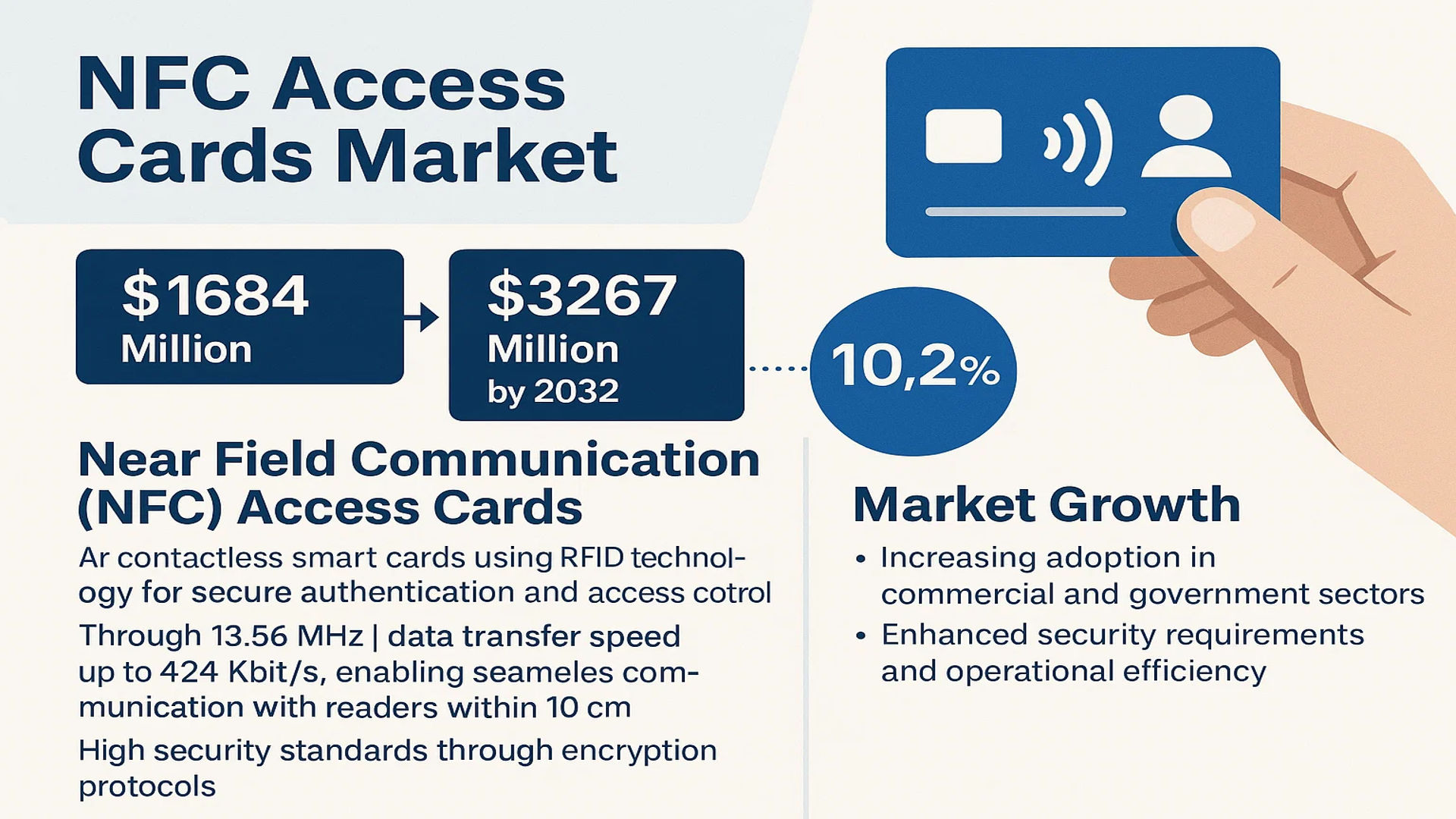
The global NFC Access Cards Market was valued at 1684 million in 2024 and is projected to reach US$ 3267 million by 2032, at a CAGR of 10.2% during the forecast period.
Near Field Communication (NFC) Access Cards are contactless smart cards that utilize radio frequency identification (RFID) technology for secure authentication and access control. These cards operate at 13.56 MHz frequency with data transfer speeds up to 424 Kbit/s, enabling seamless communication with readers within a 10 cm range. The technology allows integration with mobile devices, eliminating the need for physical cards while maintaining high security standards through encryption protocols.
Market growth is driven by increasing adoption in commercial and government sectors due to enhanced security requirements and operational efficiency. The shift towards mobile-based access solutions and integration with IoT platforms is creating new opportunities. However, interoperability challenges between different NFC standards remain a concern. Key players like HID Global, ASSA Abloy, and Gemalto are investing in advanced encryption technologies to address security vulnerabilities while expanding their product portfolios.
MARKET DYNAMICS
MARKET DRIVERS
Increasing Adoption of Contactless Security Solutions to Drive NFC Access Card Demand
The global shift toward contactless technologies continues to accelerate NFC access card adoption across commercial and government sectors. Organizations are rapidly replacing traditional magnetic stripe and proximity cards with NFC-enabled solutions, driven by their enhanced security features and ability to integrate with mobile devices. NFC technology’s inherent encryption capabilities and dynamic authentication make it significantly more secure than legacy systems, reducing vulnerabilities to cloning and unauthorized access. The technology’s 13.56 MHz operating frequency and 424 Kbps data transfer rate enable quick, reliable authentication while maintaining robust security standards. This growing preference for sophisticated access control infrastructure continues pushing annual NFC card shipments upward.
Smart Building Investments Fuel Market Expansion
Commercial real estate’s transition toward intelligent building management systems represents a major growth catalyst for NFC access solutions. Modern office complexes increasingly deploy NFC as the backbone for integrated workplace ecosystems, combining physical access control with visitor management, parking systems, and cashless payments. The technology’s ability to serve as both identifier and data carrier makes it indispensable for comprehensive building automation. Recent strategic partnerships between access control providers and building management software developers have further enhanced NFC’s value proposition, creating seamless user experiences across diverse facility systems.
Municipal governments also contribute to market growth through smart city initiatives that standardize NFC technology for public building access. Several national ID programs now incorporate NFC functionality, signaling sustained institutional demand.
➤ The integration of biometric authentication with NFC card systems has emerged as a key differentiator, with fingerprint-enabled smart cards gaining traction in high-security environments.
Furthermore, the technology’s compatibility with existing RFID infrastructure allows organizations to implement NFC solutions without complete system overhauls, significantly lowering adoption barriers.
MARKET RESTRAINTS
Competition from Mobile Credential Solutions Challenges Card-Based NFC Growth
While NFC access cards maintain market dominance, the proliferation of smartphone-based mobile credentials presents a growing competitive challenge. Many organizations now prefer deploying virtual credentials directly to employee devices through mobile access control platforms, eliminating physical card costs and logistics. This shift particularly impacts sectors with younger, tech-savvy workforces that expect mobile-first solutions. Though NFC card shipments continue growing annually, their growth trajectory faces pressure as mobile credential adoption accelerates in commercial and residential segments.
MARKET CHALLENGES
Standardization and Interoperability Issues Create Implementation Complexities
The lack of universal standards for NFC access control systems creates significant deployment challenges across multinational organizations. Varied frequency allocations, data formatting requirements, and encryption protocols between regions often necessitate customized card configurations. This fragmentation increases solution costs and complicates large-scale rollouts. Some manufacturers attempt to address this through multi-frequency card designs, but these premium products typically carry 15-20% price premiums over standard offerings, limiting their widespread adoption.
Other Challenges
Security Vulnerabilities
Recent demonstrations of NFC relay attacks have highlighted potential security gaps that could undermine confidence in the technology. Though such exploits require specialized equipment and proximity, they demonstrate the ongoing arms race between security technologies and potential attackers.
Supply Chain Constraints
The global semiconductor shortage continues impacting NFC chip availability, particularly for secure element modules required for high-assurance applications. These supply chain issues have extended lead times for some card products by 20-30 weeks in recent years.
MARKET OPPORTUNITIES
Convergence with IoT Ecosystems Presents New Growth Frontiers
The expanding Internet of Things landscape offers substantial growth potential for NFC access solutions as organizations seek unified credentialing across physical and digital environments. NFC’s ability to bridge offline and online authentication makes it particularly valuable for hybrid workplace models where employees access both physical facilities and cloud resources. Recent technological advancements now enable NFC cards to interact with IoT sensors and smart devices, creating opportunities for innovative use cases beyond traditional access control.
Healthcare represents a particularly promising vertical, where NFC-enabled staff badges increasingly integrate with medical equipment access, prescription tracking, and patient record systems. Similar convergence opportunities are emerging in industrial settings, where NFC cards authenticate both facility entry and equipment operation privileges.
NFC ACCESS CARDS MARKET TRENDS
Integration with Smartphone Technology to Drive Market Growth
The rapid adoption of smartphone-based NFC solutions is transforming the access control landscape, eliminating the need for physical cards by enabling virtual credentials on mobile devices. This trend is gaining traction as businesses increasingly prefer digital identity solutions for their flexibility, cost-efficiency, and enhanced security. Smartphone-based access systems reduce physical card issuance costs by up to 30%, making them attractive for enterprises managing large workforces. The convenience of tapping a phone instead of carrying separate access cards has accelerated adoption in corporate and residential sectors, particularly in regions with high mobile penetration rates exceeding 85%.
Other Trends
Cloud-Based Access Control Systems
Cloud-based NFC access solutions are reshaping security infrastructure by enabling remote management of permissions and real-time monitoring. These systems have seen 22% year-over-year growth as organizations transition from traditional card management to scalable cloud platforms. Integration with IoT devices and AI-powered analytics allows for predictive security measures, detecting anomalies in access patterns. This evolution supports hybrid work environments where access rights require frequent updates across multiple locations.
Enhanced Security Features Combat Sophisticated Threats
Modern NFC cards now incorporate biometric authentication and dynamic encryption to counter skimming and cloning risks. The latest generation features cryptographic chips that refresh security keys with each transaction, making intercepted data useless for replication. Financial and government institutions are driving demand for these advanced solutions, with the high-security segment projected to grow at a CAGR of 12.3% through 2030. Manufacturers are responding with dual-frequency cards that combine 13.56MHz NFC with 125kHz RFID to maintain legacy system compatibility while upgrading security protocols.
COMPETITIVE LANDSCAPE
Key Industry Players
Leading Providers Focus on Innovation and Strategic Partnerships to Gain Market Share
The global NFC access cards market features a dynamic competitive environment with established security technology providers competing alongside specialized access control manufacturers. The market is semi-consolidated, with the top five players accounting for approximately 38% market share in 2024, while numerous regional and niche players cater to specific applications.
HID Global, a subsidiary of ASSA Abloy, dominates the sector with its comprehensive portfolio of NFC-enabled smart cards and readers. Their market leadership stems from innovative offerings like the Seos credential technology and strong partnerships with building management system providers. Meanwhile, Identiv has been gaining traction through its focus on secure identity solutions for government and enterprise applications, reporting 12% revenue growth in its physical security segment last fiscal year.
European players like Gemalto (now part of Thales Group) and Giesecke & Devrient maintain strong positions in government and banking applications, leveraging their expertise in secure credentialing. Their technological edge in encryption and authentication protocols gives them an advantage in high-security environments.
The competitive intensity is increasing as traditional access control companies like Honeywell and dormakaba Group expand their NFC offerings through both organic R&D and strategic acquisitions. Recent developments include the integration of mobile credentials with existing access control ecosystems, creating more value for end-users transitioning from physical cards.
Emerging players are focusing on niche segments like hotel key cards and residential access, with companies such as Southco and Kona I offering specialized solutions. These players compete through customization options and rapid deployment capabilities, challenging established providers in specific verticals.
List of Key NFC Access Card Companies Profiled
- HID Global (U.S.)
- Identiv (U.S.)
- Gemalto (Netherlands)
- Honeywell International Inc. (U.S.)
- ASSA Abloy (Sweden)
- ADT Security Systems (U.S.)
- dormakaba Group (Switzerland)
- Giesecke & Devrient (Germany)
- Oberthur Technologies (France)
- Morpho (Safran) (France)
- VALID (Brazil)
- Gallagher Security (New Zealand)
- Southco (U.S.)
- Suprema (South Korea)
- Allegion (Ireland)
Segment Analysis:
By Type
Smart Cards Segment Dominates Due to Enhanced Security and Data Storage Capabilities
The market is segmented based on type into:
- Proximity Cards
- Smart Cards
- Others
By Application
Office Building Segment Leads Owing to Rising Demand for Secure Access Control Solutions
The market is segmented based on application into:
- Hotel Building
- Office Building
- Government Building
- Others
By Technology
Contactless NFC Technology Segment Grows Rapidly for Seamless User Experience
The market is segmented based on technology into:
- Contactless NFC
- Hybrid (NFC + RFID)
- Embedded NFC
By End User
Corporate Sector Accounts for Largest Share Due to Increased Security Needs
The market is segmented based on end user into:
- Corporate Sector
- Healthcare
- Education
- Government
- Others
Regional Analysis: NFC Access Cards Market
Asia-Pacific
The Asia-Pacific region dominates the NFC Access Cards market, accounting for over 35% of global revenue in 2024, driven by China, Japan, and India’s rapid digital transformation. China leads with extensive adoption in government and corporate sectors, supported by national smart city initiatives that mandate secure access systems. Japan’s mature market focuses on high-security applications, while India shows explosive growth due to rising commercial real estate development and smartphone penetration. The region benefits from strong local manufacturers like Hengbao and Watchdata Technologies, which offer cost-competitive solutions tailored to local infrastructure requirements.
North America
North America holds the second-largest market share, valued at USD 527 million in 2024, with the U.S. contributing over 80% of regional demand. Strict corporate security protocols and widespread NFC smartphone compatibility drive adoption. Key players like HID Global and Allegion provide advanced solutions for Fortune 500 companies and federal agencies. The Infrastructure Investment and Jobs Act allocates funds for modernizing government facilities, indirectly boosting demand for secure access systems. However, growing smartphone-as-a-key solutions pose competition to traditional card-based systems in this tech-savvy market.
Europe
Europe’s market grows steadily at 8.7% CAGR, propelled by GDPR-compliant security requirements and smart building initiatives. Germany and the U.K. lead in adoption, with ASSA Abloy and Gemalto supplying advanced cards featuring encrypted data protocols. The region shows increasing preference for dual-interface cards combining traditional RFID with NFC functionality. EU directives on workplace security and the phasing out of magnetic stripe cards create sustained demand, though high penetration of mobile access solutions in Nordic countries temper growth prospects for standalone card systems.
Middle East & Africa
This emerging market benefits from smart city projects in UAE and Saudi Arabia, where NFC cards integrate with national ID systems. The region shows 12% annual growth, highest globally, though from a smaller base. Luxury hospitality sectors in Dubai and Doha drive premium card solutions, while infrastructure limitations in African nations restrict widespread adoption. Government initiatives like Saudi Vision 2030 prioritize digital security investments, creating opportunities for vendors offering Sharia-compliant access solutions with biometric integration.
South America
Market growth remains modest at 6.5% CAGR, constrained by economic volatility but supported by Brazil’s financial sector modernization. Corporate offices in São Paulo and Rio de Janeiro adopt NFC cards for access control, while Argentinian banks implement them for secure transactions. The region faces challenges from counterfeit card proliferation, driving demand for advanced authentication features. Local players like VALID compete with multinationals by offering cost-effective solutions adapted to regional infrastructure constraints.
Report Scope
This market research report provides a comprehensive analysis of the Global NFC Access Cards Market, covering the forecast period 2024–2032. It offers detailed insights into market dynamics, technological advancements, competitive landscape, and key trends shaping the industry.
Key focus areas of the report include:
- Market Size & Forecast: Historical data and future projections for revenue, unit shipments, and market value across major regions and segments. The market was valued at USD 1,684 million in 2024 and is projected to reach USD 3,267 million by 2032 at a CAGR of 10.2%.
- Segmentation Analysis: Detailed breakdown by product type (Proximity Cards, Smart Cards, Others), application (Hotel Building, Office Building, Government Building, Others), and end-user industries to identify high-growth segments.
- Regional Outlook: Insights into market performance across North America, Europe, Asia-Pacific, Latin America, and Middle East & Africa, with country-level analysis of key markets including US, China, Germany, Japan, and others.
- Competitive Landscape: Profiles of 20+ leading market participants including HID Global, Identiv, Gemalto, Honeywell, ASSA Abloy, covering their product portfolios, market shares, and strategic developments.
- Technology Trends & Innovation: Assessment of NFC technology evolution, integration with mobile access control systems, and emerging applications in smart buildings and security systems.
- Market Drivers & Restraints: Evaluation of factors such as increasing security concerns, adoption of smart building technologies, and challenges related to standardization and interoperability.
- Stakeholder Analysis: Strategic insights for card manufacturers, system integrators, security solution providers, and investors regarding market opportunities and competitive positioning.
The research methodology combines primary interviews with industry experts and analysis of verified market data from authoritative sources to ensure accuracy and reliability.
FREQUENTLY ASKED QUESTIONS:
What is the current market size of Global NFC Access Cards Market?
-> NFC Access Cards Market was valued at 1684 million in 2024 and is projected to reach US$ 3267 million by 2032, at a CAGR of 10.2% during the forecast period.
Which key companies operate in Global NFC Access Cards Market?
-> Key players include HID Global, Identiv, Gemalto, Honeywell, ASSA Abloy, ADT Security Systems, dormakaba Group, Giesecke & Devrient, among others.
What are the key growth drivers?
-> Key growth drivers include rising security concerns, adoption of smart building technologies, and increasing demand for contactless access solutions.
Which region dominates the market?
-> North America currently leads in market share, while Asia-Pacific is expected to witness the fastest growth during the forecast period.
What are the emerging trends?
-> Emerging trends include integration with mobile access systems, multi-technology cards, and advanced encryption technologies for enhanced security.

Get Sample Report PDF for Exclusive Insights
Report Sample Includes
- Table of Contents
- List of Tables & Figures
- Charts, Research Methodology, and more...
 Download Sample Report PDF