MARKET INSIGHTS
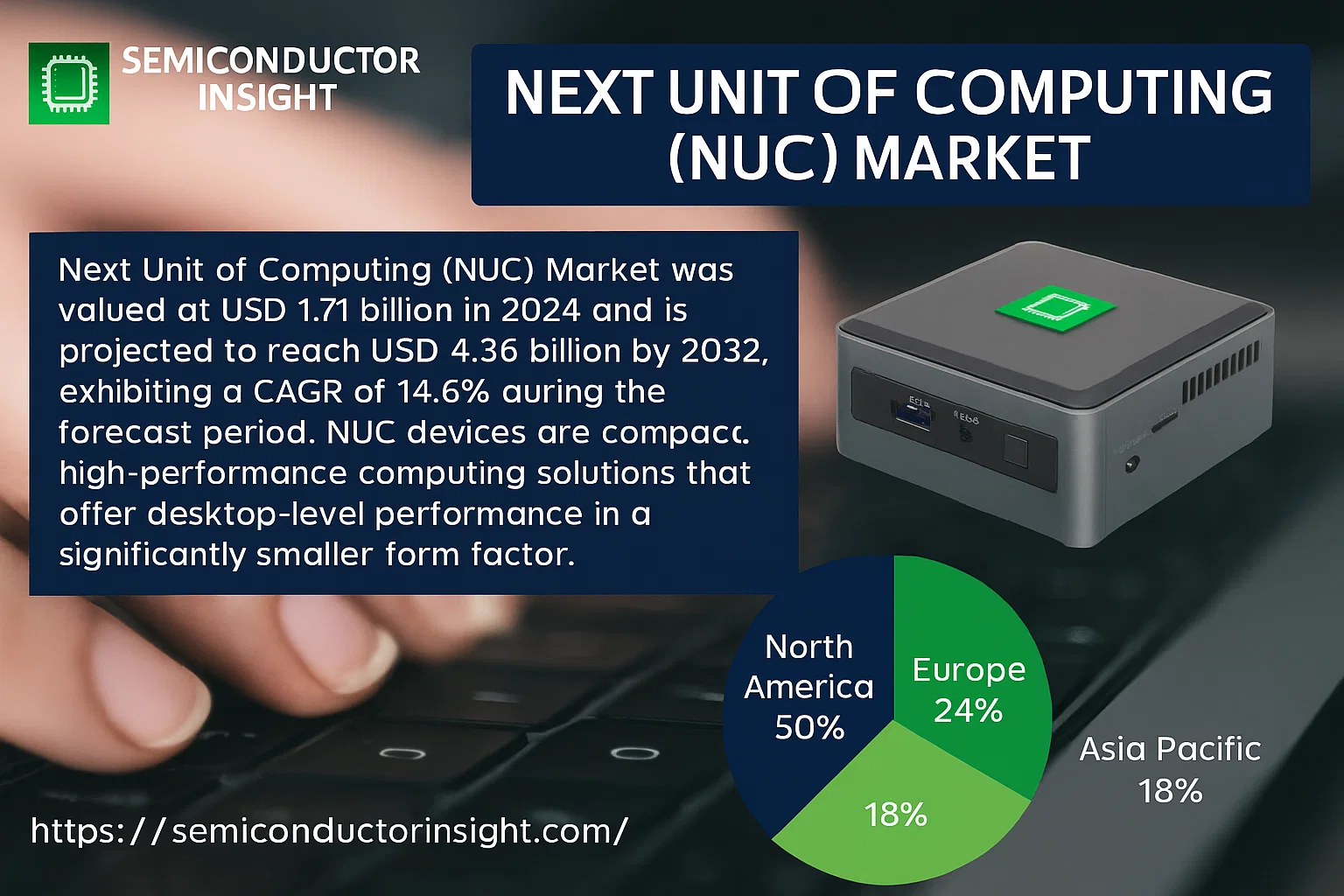
Global Next Unit of Computing (NUC) Market was valued at USD 1.71 billion in 2024 and is projected to reach USD 4.36 billion by 2032, exhibiting a CAGR of 14.6% during the forecast period. NUC devices are compact, high-performance computing solutions that offer desktop-level performance in a significantly smaller form factor.
North America dominated the market with a 50% revenue share in 2024, followed by Europe at 24% and Asia Pacific at 18%. This distribution reflects higher technology adoption rates and greater enterprise investment in compact computing solutions across these regions.
The market’s rapid growth is driven by increasing demand for compact computing solutions across commercial, gaming, and mainstream consumer segments. The rise of remote work and digitalization has accelerated adoption of space-efficient computing solutions. Additionally, ongoing advancements in processor technology, particularly from Intel, enable these small form factor devices to deliver performance comparable to traditional desktops.
Intel Corporation leads the market with over 78% revenue share among key players. Their NUC product lines set industry standards for performance and form factor optimization. Other major players include Apple, Lenovo, Dell, HP, ASUS, GIGABYTE, Acer, and several specialized manufacturers, each contributing to market growth through continuous innovation and competitive pricing.
Market growth faces potential challenges from the increasing popularity of mobile computing and cloud-based solutions. However, the persistent need for localized, high-performance computing in professional environments continues to drive demand. The market is expected to maintain strong growth through 2032, supported by ongoing technological advancements and expanding application scenarios.
MARKET DRIVERS
Shift Towards Small Form Factor (SFF) Computing
The global trend towards space-efficient and minimalist computing solutions is a primary driver for the NUC market. Businesses and consumers are increasingly seeking powerful computing in compact footprints to save physical space, reduce energy consumption, and enable flexible deployments in environments like digital signage, kiosks, and modern offices.
Rising Demand for Energy-Efficient and Cost-Effective Solutions
NUCs consume significantly less power than traditional desktop towers, leading to lower operational costs. This is particularly attractive for enterprises deploying devices at scale and for environmentally conscious consumers, driving adoption in sectors like education and corporate IT.
➤ The proliferation of remote and hybrid work models has accelerated the need for compact, portable, yet powerful desktop solutions that support productivity from any location.
Advancements in processor technology from Intel and AMD have enabled NUCs to deliver performance comparable to larger desktops, making them viable for a wider range of applications, including light content creation and entry-level gaming.
MARKET CHALLENGES
Limited Upgradeability and Customization
A significant challenge for the NUC market is the inherent limitation on hardware upgrades. Unlike traditional PCs, most NUCs have soldered components, restricting users from easily upgrading RAM or storage after purchase, which can be a barrier for power users.
Other Challenges
Thermal Management Constraints
The compact design of NUCs presents challenges in heat dissipation, which can lead to thermal throttling under sustained heavy workloads, potentially impacting performance and long-term reliability.
Competition from Alternative Form Factors
NUCs face strong competition from other compact solutions like mini PCs from competitors and the growing capabilities of high-end laptops, which offer similar performance in a portable form factor with an integrated display and battery.
MARKET RESTRAINTS
Higher Initial Cost per Performance Unit
On a performance-per-dollar basis, NUCs can be more expensive than building a similarly specced traditional desktop computer. This price premium can restrain adoption among budget-conscious consumers and small businesses.
Dependence on a Limited Number of Suppliers
The market is heavily influenced by Intel’s roadmap and product strategy, as they pioneered the NUC form factor. This concentration can lead to supply chain vulnerabilities and less competitive pricing compared to the broader PC market.
MARKET OPPORTUNITIES
Expansion in Edge Computing and IoT Deployments
The compact size, low power draw, and sufficient processing power of NUCs make them ideal for edge computing applications. There is significant growth potential in deploying NUCs for data processing in smart factories, retail analytics, and telecommunications networks.
Growing Niche in Home Entertainment and Gaming
NUCs are increasingly positioned as compact home theater PCs (HTPCs) and capable gaming machines with dedicated graphics options. This opens a substantial opportunity in the consumer electronics market for users seeking a sleek, living-room-friendly computer.
Adoption in Specific Vertical Markets
Vertical markets such as healthcare for patient monitoring systems, education for computer labs, and finance for thin client deployments present targeted growth avenues where the benefits of small size and centralized management are highly valued.
Next Unit of Computing (NUC) Market Trends
Surging Global Market Growth Fueled by Compact Computing Demand
The global Next Unit of Computing (NUC) market is experiencing robust expansion, with its valuation projected to rise from 1714 million USD in 2024 to 4359 million USD by 2032, representing a compound annual growth rate (CAGR) of 14.6%. This impressive growth trajectory is primarily driven by the increasing demand for small-footprint computers that deliver the performance of traditional desktops. The core appeal of NUCs, as devices with a volume under 5 liters, lies in their ability to provide powerful computing in an extremely compact form factor, making them ideal for space-constrained environments.
Other Trends
Dominance of Barebone Hosts and Key Applications
The market is segmented into Barebone Hosts and Full Hosts, with specific trends emerging in each category and their applications. Commercial use represents a dominant application segment, as businesses adopt NUCs for digital signage, office workstations, and kiosks due to their space efficiency and manageability. Gaming use is another significant growth area, with manufacturers developing NUCs equipped with dedicated graphics to cater to enthusiasts seeking a small form-factor gaming PC. Mainstream consumer use for home media centers and general computing continues to contribute to market volume.
Regional Market Concentration and Competitive Landscape
Geographically, the market is concentrated, with North America accounting for approximately 50% of the global market share. Europe and the Asia-Pacific region follow, holding shares of about 24% and 18%, respectively. The competitive landscape is characterized by a high level of market consolidation. Intel, the originator of the NUC concept, holds a commanding position with over 78% market share. Other key players include Apple, Lenovo, Dell, HP, ASUS, GIGABYTE, Acer, Maxtang, and Asrock. The competitive dynamics involve continuous innovation in performance, connectivity, and thermal management to maintain market position.
COMPETITIVE LANDSCAPE
Key Industry Players
A Market Shaped by a Dominant Pioneer and a Diverse Ecosystem of Challengers
The global Next Unit of Computing (NUC) market is characterized by a concentrated competitive environment, with Intel Corporation holding a commanding position. As the originator of the NUC concept, Intel has established substantial brand recognition and technological leadership, controlling over 78% of the global market share in 2024. This dominance is built on a robust product portfolio spanning from entry-level barebone kits to high-performance models, catering to commercial, gaming, and mainstream applications. The market structure is heavily influenced by Intel’s product roadmaps, component supply, and strategic direction, making it the primary force shaping the competitive dynamics.
Beyond the market leader, a dynamic ecosystem of prominent technology companies competes for the remaining share. These players leverage their expertise in PC manufacturing and component supply to offer compelling alternatives. Major PC OEMs like Apple, with its Mac mini, and Lenovo, with its ThinkCentre and IdeaCentre mini PCs, represent significant challengers by integrating NUCs into their broader computing solutions. Other key competitors include Dell (Wyse, OptiPlex Micro), HP (Elite, Pro Mini), ASUS (PN series), and GIGABYTE (BRIX series), which focus on specific niches such as enterprise digital signage, kiosks, and compact gaming systems. Additionally, specialists like Acer, Maxtang, and ASRock offer targeted solutions, further diversifying the competitive landscape and providing options for various price points and performance requirements.
List of Key Next Unit of Computing (NUC) Companies Profiled
- Intel Corporation
- Apple Inc.
- Lenovo Group Limited
- Dell Technologies Inc.
- HP Inc.
- ASUSTeK Computer Inc.
- GIGABYTE Technology Co., Ltd.
- Acer Inc.
- Maxtang Technology Limited
- ASRock Inc.
- Zotac Technology Limited
- MSI (Micro-Star International)
- Simply NUC, Inc.
Segment Analysis:
| Segment Category | Sub-Segments | Key Insights |
| By Type |
|
Barebone Host represents a significant portion of the market, favored by tech-savvy users and businesses seeking customization and cost-effectiveness. The appeal lies in the flexibility to select specific components like memory and storage, allowing for tailored performance and potential future upgrades, which provides a strategic advantage for specialized commercial deployments and enthusiast builds. |
| By Application |
|
Commercial Use is the dominant application segment, driven by the critical need for space-saving, energy-efficient computing solutions in modern office environments, digital signage, and point-of-sale systems. The compact form factor of NUCs enables businesses to create clean, uncluttered workspaces while maintaining robust performance for everyday tasks, which is a key driver for adoption across various industries. |
| By End User |
|
Large Enterprises lead this segment as they are the primary adopters of NUCs for standardized, scalable IT deployments in corporate settings. The ability to deploy numerous compact, reliable units for tasks ranging from virtual desktop infrastructure to dedicated application servers makes NUCs an attractive solution for managing large-scale IT infrastructure with reduced physical footprint and power consumption. |
| By Processing Power |
|
Mid-Range / Core i3/i5 Series is the leading segment due to its optimal balance between performance, energy efficiency, and cost, making it the preferred choice for the majority of commercial and mainstream applications. This processing tier delivers sufficient power for multitasking, business software, and media consumption without the premium cost associated with the highest-end models, thus achieving widespread appeal. |
| By Sales Channel |
|
Online Retailers represent a crucial and growing channel, providing easy access and a wide selection for both individual consumers and business purchasers. The convenience of comparing specifications, reading reviews, and having units delivered directly facilitates informed purchasing decisions and supports the market’s expansion, especially among SMEs and tech enthusiasts who value the extensive product information available online. |
Regional Analysis: Next Unit of Computing (NUC) Market
North America
Corporate North America is a primary driver, utilizing NUCs to create minimalist, flexible workspaces and reduce the real estate footprint of on-premise IT infrastructure. Their deployment in virtual desktop infrastructure (VDI) setups is particularly significant, offering a streamlined alternative to traditional desktop towers and contributing heavily to market volume.
Federal, state, and local governments, along with major educational institutions, prefer NUCs for their security features, low power consumption, and ease of centralized management in labs and administrative offices. Standardization on these devices for specific use cases provides a consistent and reliable computing environment across large organizations.
The retail and hospitality sectors extensively use NUCs as the brains behind digital signage networks and interactive kiosks. Their small size allows for discreet mounting, while their reliability and performance are well-suited for running media-rich content and applications 24/7, a key growth segment.
A vibrant community of technology enthusiasts and home users embraces NUCs for home theater PCs (HTPCs), compact gaming setups, and powerful home labs. This segment values the blend of performance, upgradability, and minimalist design, often driving demand for higher-end NUC models.
Europe
Europe represents a strong and steadily growing market for NUCs, characterized by a high focus on energy efficiency and space optimization, particularly in dense urban centers. Businesses across the region are increasingly adopting NUCs to support hybrid work models and modernize office spaces. The European market is also driven by stringent environmental regulations and corporate sustainability goals, where the low power consumption of NUCs is a significant advantage. There is notable uptake in the industrial sector for embedded applications and in the digital signage market across retail and public transport systems. While adoption is slightly more fragmented than in North America due to varying economic conditions, Western European nations, especially Germany, the UK, and France, are key contributors to the regional demand.
Asia-Pacific
The Asia-Pacific region is the fastest-growing market for NUCs, fueled by rapid digital transformation, expanding IT infrastructure, and the burgeoning startup ecosystem. Countries like China, Japan, South Korea, and Australia are major consumers. The demand is particularly high in the commercial sector, where businesses seek cost-effective and space-saving computing solutions. The education sector is also a significant driver, with institutions deploying NUCs in computer labs and smart classrooms. Furthermore, the growing gaming and entertainment industry in the region creates demand for high-performance compact PCs. Price sensitivity remains a key market dynamic, with strong competition from local manufacturers offering similar form-factor solutions.
South America
The NUC market in South America is emerging, with growth primarily concentrated in major economies like Brazil and Argentina. Adoption is driven by businesses looking to modernize their IT assets with more efficient hardware. The market is characterized by a focus on value and total cost of ownership, with NUCs appealing for their lower energy costs and space savings. However, market penetration is challenged by economic volatility and a stronger preference for more traditional, and sometimes more affordable, desktop solutions. Growth is most evident in specific verticals such as finance and corporate sectors in urban centers, where the benefits of compact computing are more readily recognized.
Middle East & Africa
The NUC market in the Middle East & Africa is nascent but shows promising growth potential, particularly in the Gulf Cooperation Council (GCC) countries and South Africa. Demand is largely driven by government initiatives for smart city projects and digital transformation, where NUCs are deployed in control rooms and public information systems. The corporate sector in financially robust Gulf states is also adopting these systems for modern office setups. In Africa, growth is slower and more localized, often linked to specific projects in education and telecommunication infrastructure. The overall market dynamics are influenced by infrastructure development rates and economic diversification efforts away from resource-based economies.
Report Scope
This market research report provides a comprehensive analysis of the Next Unit of Computing (NUC) Market, covering the forecast period 2025–2032. It offers detailed insights into market dynamics, technological advancements, competitive landscape, and key trends shaping the industry.
Key focus areas of the report include:
- Market Overview: The report begins with an overview outlining its current market scenario, key growth indicators, and industry transformation drivers. It discusses macroeconomic factors, demand–supply balance, regulatory landscape, and the strategic role of compact computing solutions in powering advancements across industries such as commercial, gaming, and mainstream consumer applications.
- Market Size & Forecast: Historical data and future projections for revenue, unit shipments, and market value across major regions and segments.
- Segmentation Analysis: Detailed breakdown by product type (Barebone Host, Full Host), application (Commercial Use, Gaming Use, Mainstream Use), and end-user industry to identify high-growth segments and investment opportunities.
- Regional Insights: Insights into market performance across North America, Europe, Asia-Pacific, Latin America, and the Middle East & Africa, including country-level analysis where relevant.
- Competitive Landscape: Profiles of leading market participants, including their product offerings, R&D focus, manufacturing capacity, pricing strategies, and recent developments such as mergers, acquisitions, and partnerships.
- Technology Trends & Innovation: Assessment of emerging technologies, integration of AI/IoT, semiconductor design trends, fabrication techniques, and evolving industry standards specific to mini-computing platforms.
- Market Drivers & Restraints: Evaluation of factors driving market growth along with challenges, supply chain constraints, regulatory issues, and market-entry barriers.
- Stakeholder Insights: Insights for component suppliers, OEMs, system integrators, investors, and policymakers regarding the evolving ecosystem and strategic opportunities in the compact PC market.
Primary and secondary research methods are employed, including interviews with industry experts, data from verified sources, and real-time market intelligence to ensure the accuracy and reliability of the insights presented.
FREQUENTLY ASKED QUESTIONS:
What is the current market size of Next Unit of Computing (NUC) Market?
-> Global Next Unit of Computing (NUC) Market was valued at USD 1714 million in 2024 and is projected to reach USD 4359 million by 2032, exhibiting a CAGR of 14.6% during the forecast period.
Which key companies operate in Next Unit of Computing (NUC) Market?
-> Key players include Apple, Lenovo, Intel, Dell, HP, ASUS, GIGABYTE, Acer, Maxtang, and Asrock, among others. The global top manufacturer holds a share of over 78%.
What are the key growth drivers?
-> Key growth drivers include increasing demand for compact and high-performance computing solutions, adoption in commercial and gaming applications, and technological advancements in miniaturization.
Which region dominates the market?
-> North America is the largest market, with a share of about 50%, followed by Europe and Asia Pacific with shares of approximately 24% and 18%, respectively.
What are the emerging trends?
-> Emerging trends include the development of ultra-compact form factors, integration of advanced connectivity options, and the rise of application-specific NUC solutions for specialized use cases.

Get Sample Report PDF for Exclusive Insights
Report Sample Includes
- Table of Contents
- List of Tables & Figures
- Charts, Research Methodology, and more...
 Download Sample Report PDF