MARKET INSIGHTS
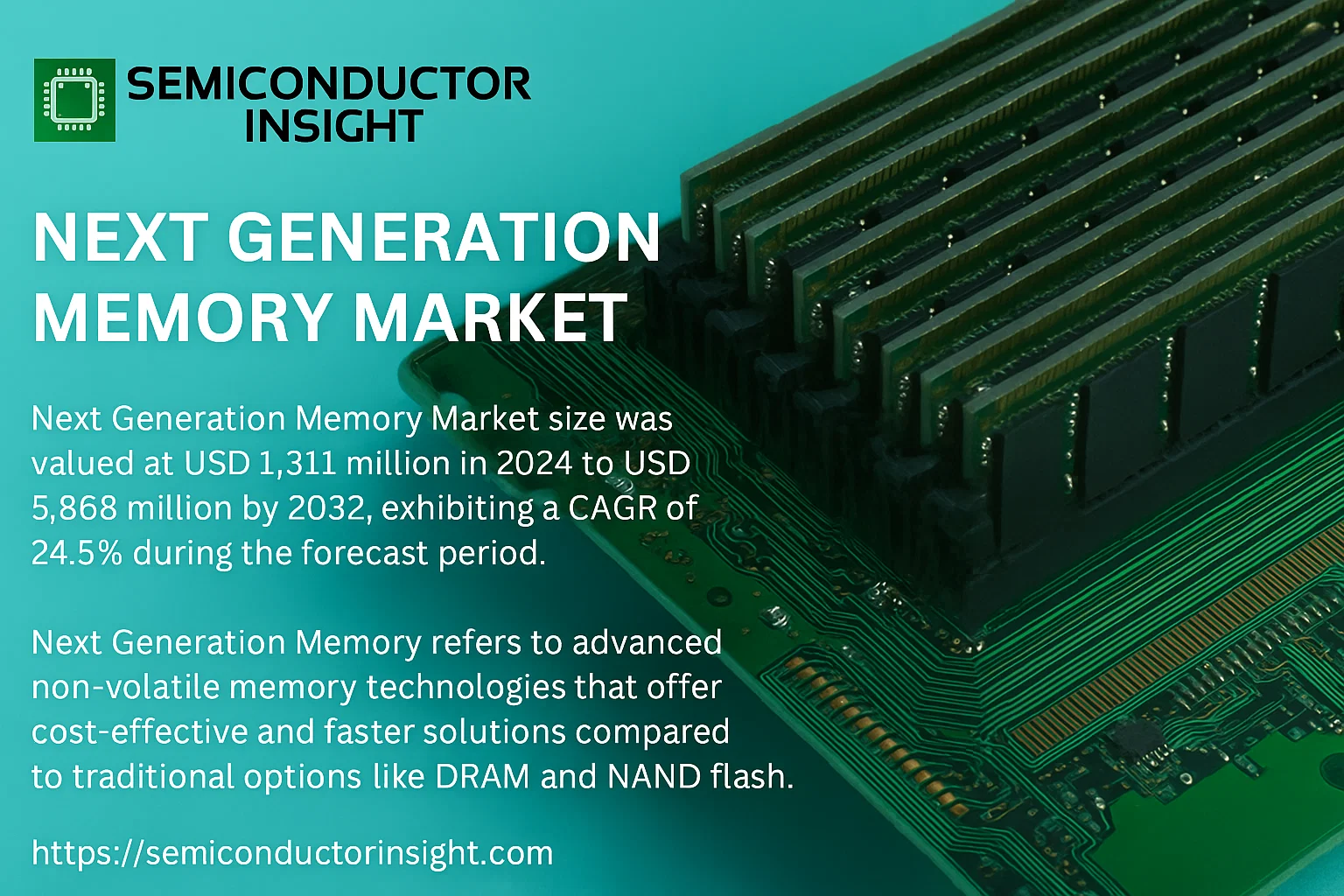
Global Next Generation Memory Market size was valued at USD 1,311 million in 2024 to USD 5,868 million by 2032, exhibiting a CAGR of 24.5% during the forecast period.
Next Generation Memory refers to advanced non-volatile memory technologies that offer cost-effective and faster solutions compared to traditional options like DRAM and NAND flash. These emerging memories overcome the limitations of older architectures, such as high power consumption and scaling deficiencies. They provide superior data transmission speeds and high storage capacity, often serving to supplement existing memory technology.
The market is experiencing rapid growth due to several factors, including the escalating demand for high-performance computing in data centers and the proliferation of artificial intelligence applications. Furthermore, the expansion of consumer electronics and the automotive sector’s need for robust memory solutions are contributing significantly to market expansion. Initiatives by key players in the market are also expected to fuel growth; for instance, companies are heavily investing in R&D for Phase Change Memory (PCM), which holds the largest product segment share at approximately 45%. Intel, Micron Technology, and Panasonic are some of the key players that operate in the market with a wide range of portfolios.
MARKET DRIVERS
The Unrelenting Data Demands of AI and HPC
The exponential growth of artificial intelligence, machine learning, and high-performance computing is creating an unprecedented need for memory that is both high-capacity and high-bandwidth. Conventional DRAM and NAND flash are reaching their physical limits, creating a critical performance bottleneck. Next-generation memory technologies like High Bandwidth Memory (HBM) and GDDR6 are essential to keep pace with the massive parallel processing requirements of modern data centers and AI accelerators.
The Proliferation of Edge Computing and IoT
The expansion of Internet of Things (IoT) devices and edge computing infrastructure demands memory solutions that offer low latency, low power consumption, and non-volatility. Emerging memories like Magnetoresistive RAM (MRAM) and Resistive RAM (ReRAM) are well-suited for these applications, enabling instant-on functionality and data retention during power loss, which is critical for smart sensors and autonomous systems at the edge.
➤ Global spending on semiconductors for AI workloads is projected to grow significantly, directly fueling demand for advanced memory architectures.
Furthermore, the ongoing digital transformation across industries, from automotive to healthcare, relies on faster and more reliable data processing. The transition to 5G and upcoming 6G networks also necessitates memory technologies that can handle increased data throughput and enable new, latency-sensitive applications.
MARKET CHALLENGES
Technological Complexity and High Manufacturing Costs
The fabrication of next-generation memory involves complex materials and novel architectures, such as 3D stacking, which present significant yield challenges. High initial capital expenditure for new fabrication facilities and equipment creates a high barrier to entry and can limit widespread adoption, especially for cost-sensitive applications.
Integrating these new memory types with existing processor and system architectures requires new design methodologies and interfaces, increasing development time and cost for system-on-chip (SoC) designers.
Other Challenges
Supply Chain Maturity and Scalability
The supply chain for materials and specialized manufacturing tools for technologies like MRAM and ReRAM is not as mature as for conventional memory, posing risks for volume production and scalability.
Standardization and Ecosystem Development
A lack of industry-wide standards for some emerging memory types can slow down adoption, as developers and manufacturers wait for stable specifications and a robust software ecosystem to mature.
MARKET RESTRAINTS
Economic Volatility and Cyclical Nature of the Semiconductor Industry
The semiconductor industry is inherently cyclical, with periods of oversupply and undersupply impacting pricing and profitability. Economic downturns or trade tensions can lead to reduced capital investment, delaying the funding necessary for the research, development, and scaling of next-generation memory technologies. This volatility makes long-term planning and investment risky for both established players and new entrants.
Competition from Evolving Conventional Memory
While next-generation memories offer superior performance, incumbent technologies like DDR5 DRAM and 3D NAND flash continue to evolve and improve, extending their relevance and competing on cost-effectiveness for many applications. This continuous advancement can slow the replacement cycle and limit the market share available to newer technologies in the short to medium term.
MARKET OPPORTUNITIESIn-Memory and Near-Memory Computing
Next-generation memory is a key enabler for in-memory computing architectures, which process data within the memory unit itself, dramatically reducing data movement and power consumption. Technologies like Compute Express Link (CXL) are creating new paradigms for memory pooling and expansion, opening vast opportunities for memory-centric computing in data centers.
Automotive and Industrial Applications
The rise of autonomous driving and advanced driver-assistance systems (ADAS) requires memory that is fast, reliable, and capable of operating in harsh environments. Non-volatile memories like STT-MRAM are ideal for critical data logging and fast boot times in vehicles. Similarly, industrial automation and robotics demand robust memory solutions for real-time control and data integrity.
There is also growing potential in neuromorphic computing, where memory elements that can mimic the behavior of biological synapses are essential for developing more efficient AI systems. This represents a frontier for long-term growth beyond traditional computing models.
Next Generation Memory Market Trends
Explosive Market Growth
Global Next Generation Memory Market is experiencing a period of unprecedented expansion, driven by the insatiable demand for faster, more efficient, and higher-capacity memory solutions. The market was valued at USD 1.31 billion in 2024 and is projected to surge to USD 5.87 billion by 2032, representing a formidable Compound Annual Growth Rate (CAGR) of 24.5% during the forecast period. This rapid growth is fueled by the limitations of traditional memory technologies like DRAM and NAND flash, which are approaching physical scaling boundaries and face challenges with power consumption. Next Generation Memory technologies offer a solution by providing superior data transmission speeds and significantly higher storage density, making them essential for advanced computing applications.
Other Trends
Dominance of PCM Technology and Consumer Electronics Application
Phase Change Memory (PCM) currently dominates the product landscape, holding a substantial market share of approximately 45%. Its non-volatility, high endurance, and speed position it as a leading technology. In terms of application, the Consumer Electronics segment is the largest driver of demand, followed closely by Enterprise Storage. The proliferation of smartphones, laptops, and other smart devices that require instant-on functionality and robust performance is a primary factor. The need for high-speed data processing in enterprise data centers to support cloud computing and big data analytics further propels the market.
Concentrated Competitive Landscape
The market is characterized by a consolidated competitive environment, with the top three manufacturers—Intel, Micron Technology, and Panasonic—collectively holding about 40% of Global market share. This concentration underscores the high barriers to entry, including significant R&D investment and advanced manufacturing capabilities required to produce these sophisticated memory solutions. Other key players such as Cypress Semiconductor, Fujitsu, and Everspin also contribute significantly to innovation and market development.
Regional Market Dynamics
Geographically, the United States is the largest market for Next Generation Memory, accounting for over 30% of Global share. This leadership is attributed to the presence of major technology companies and early adoption of advanced computing systems. Europe and Japan together represent a significant portion of the market, accounting for approximately 40% share. The Asia-Pacific region, particularly countries like China, Japan, and South Korea, is expected to witness substantial growth, driven by a strong manufacturing base for consumer electronics and increasing investments in telecommunications infrastructure. The regional analysis highlights a truly global market with diverse growth opportunities.
COMPETITIVE LANDSCAPE
Key Industry Players
An Industry Dominated by Established Tech Giants and Innovative Specialists
Global Next Generation Memory Market is characterized by a consolidated structure where the top three manufacturers—Intel, Micron Technology, and Panasonic—collectively hold a significant share of approximately 40%. Intel and Micron, in particular, leverage their immense scale and established positions in the semiconductor industry to drive development and adoption of advanced memory technologies like 3D XPoint (developed jointly by Intel and Micron) and other emerging solutions. These leaders are focusing on overcoming the scaling limitations of traditional DRAM and NAND flash by investing heavily in R&D for technologies such as Phase-Change Memory (PCM), which currently holds the largest market segment share. Their dominance is reinforced by strong relationships with major OEMs in the consumer electronics and enterprise storage sectors, the two largest application areas for next generation memory.
Beyond the major players, a diverse range of companies are carving out significant niches with specialized memory technologies. Fujitsu and Cypress Semiconductor (now part of Infineon Technologies) have long been active in Ferroelectric RAM (FeRAM). Everspin Technologies is a recognized leader in the production and commercialization of Magnetoresistive RAM (MRAM), supplying products for applications requiring high endurance and non-volatility in automotive, industrial, and aerospace markets. Companies like Adesto Technologies (acquired by Dialog Semiconductor) and Crossbar Inc. are key innovators in Resistive RAM (ReRAM), targeting ultra-low-power applications for the Internet of Things (IoT). Other semiconductor manufacturers, including ROHM, Samsung, SK Hynix, Toshiba, and Western Digital, are also crucial players, contributing to the competitive dynamics through their own advanced memory research and product portfolios.
List of Key Next Generation Memory Companies Profiled
- Intel
- Micron Technology
- Panasonic
- Cypress Semiconductor (Infineon Technologies)
- Fujitsu
- Everspin Technologies
- ROHM Semiconductor
- Adesto Technologies (Dialog Semiconductor)
- Crossbar Inc.
- Samsung Electronics
- SK Hynix
- Toshiba Corporation
- Western Digital
- IBM
Segment Analysis:
| Segment Category | Sub-Segments | Key Insights |
| By Type |
|
Phase Change Memory (PCM) dominates the market due to its superior scalability and its advantageous position as a high-performance, non-volatile solution that effectively bridges the gap between traditional DRAM and NAND flash. Its ability to offer fast read and write speeds coupled with high endurance makes it particularly compelling for applications requiring frequent data access. The technology’s maturity relative to other emerging options gives it a strong foothold as an initial supplement to overcome scaling deficiencies in existing memory architectures. |
| By Application |
|
Consumer Electronics represents the largest application segment, driven by the insatiable demand for higher performance, lower power consumption, and greater storage density in devices like smartphones, laptops, and gaming consoles. The segment’s leadership is fueled by the critical need for faster boot times, instant-on functionality, and enhanced user experiences. The cost-effective and high-speed nature of next-generation memory technologies aligns perfectly with the high-volume, feature-driven requirements of the consumer electronics industry, making it the primary growth engine. |
| By End User |
|
Original Equipment Manufacturers (OEMs) are the leading end-user segment, as they are the primary integrators of memory components into final products for both consumer and enterprise markets. Their dominance stems from the direct application of these advanced memories to differentiate their product offerings with superior performance and efficiency. The strategic imperative for OEMs to adopt next-generation memory is strong, as it enables them to meet evolving consumer expectations and gain a competitive edge through enhanced device capabilities and reliability. |
| By Integration Level |
|
Embedded Memory is the leading integration approach, as it offers significant advantages in power efficiency and performance by being integrated directly into system-on-chips (SoCs) and microcontrollers. This integration is crucial for applications in automotive electronics, IoT devices, and mobile platforms where space, power, and speed are paramount constraints. The growing trend towards more integrated and compact electronic systems strongly favors the adoption of embedded next-generation memory solutions over discrete alternatives. |
| By Volatility |
|
Non-Volatile Memory (NVM) is the dominant category, as the core value proposition of most next-generation memory technologies lies in their ability to retain data without power while offering performance characteristics that challenge volatile memories. This combination of persistence and speed is revolutionary, enabling new architectures for storage-class memory and providing instant-on capabilities for a wide range of devices. The industry’s focus is squarely on developing and scaling NVM solutions to create more efficient and reliable computing systems. |
Regional Analysis: Next Generation Memory Market
The region possesses the world’s most advanced semiconductor foundries and packaging facilities, specialized in the complex production processes required for next-generation memories. This includes capabilities for extreme ultraviolet lithography and advanced 3D stacking, which are critical for manufacturing high-density, high-performance memory chips. The established infrastructure provides a significant cost and time-to-market advantage.
Aggressive national strategies and substantial subsidies from governments, particularly in South Korea, Taiwan, and China, actively support memory technology development. This is matched by massive R&D investments from corporate giants, creating a powerful public-private partnership focused on achieving technological sovereignty and global leadership in the memory sector.
Proximity to the world’s largest consumer electronics manufacturing base and rapidly expanding data center markets in China and Southeast Asia creates immense, localized demand. This drives immediate adoption and provides local memory producers with a crucial first-mover advantage for testing and implementing new memory technologies in cutting-edge applications like AI and 5G.
A dense network of leading universities, corporate R&D centers, and specialized research institutes fosters a continuous pipeline of innovation. Collaborative projects focus on overcoming key challenges in materials science, architecture, and integration for memories like Resistive RAM and Ferroelectric RAM, ensuring the region stays ahead of the technology curve.
North America
North America remains a critical innovation hub for the Next Generation Memory Market, characterized by its strength in pioneering research, intellectual property creation, and design. The region is home to leading technology firms and startups focused on developing novel memory architectures and controller technologies. Strong venture capital funding fuels innovation in emerging memory types aimed at specialized applications in artificial intelligence, high-performance computing, and enterprise storage. Collaborative efforts between major hyperscalers and memory developers are driving the creation of tailored solutions optimized for next-generation data centers. While the region’s semiconductor manufacturing capacity is more limited compared to Asia-Pacific, its influence is profound through advanced chip design, standards development, and strategic partnerships that shape the direction of Global memory market.
Europe
Europe maintains a strong position in the Next Generation Memory landscape through its focus on specialized, high-reliability applications and collaborative research initiatives. The region excels in developing memory solutions for the automotive, industrial, and aerospace sectors, where requirements for robustness, longevity, and data integrity are paramount. Significant public funding through programs like the European Chips Act is aimed at bolstering the region’s strategic autonomy in semiconductor technologies, including memory. Leading research institutions and companies are active in exploring alternative memory technologies like STT-MRAM for embedded applications. Europe’s approach is characterized by a strong emphasis on quality, security, and sustainability, catering to niche but high-value markets that demand exceptional performance under demanding conditions.
South America
South America’s involvement in the Next Generation Memory Market is currently in a nascent stage, primarily characterized as a consumption region rather than a production or innovation hub. The market growth is driven by increasing adoption of advanced electronics, cloud services, and digital transformation initiatives across major economies like Brazil. While there is minimal local manufacturing or significant R&D activity in memory technologies, the region represents a growing end-market. Future growth potential hinges on economic stability and increased investment in technological infrastructure, which could eventually attract more attention from global memory suppliers looking to expand their presence in emerging markets.
Middle East & Africa
The Middle East & Africa region is emerging as a strategic growth area, particularly driven by massive investments in digital infrastructure and smart city projects in Gulf Cooperation Council countries. These nations are leveraging their financial resources to build state-of-the-art data centers and technology hubs, creating demand for high-performance memory solutions. There is a growing focus on developing local semiconductor ambitions, though these are in very early stages. The region’s role is evolving from a pure importer to a potential future partner in the value chain, with initiatives aimed at fostering technology transfer and building a knowledge-based economy that may include memory technology in the long term.
Report Scope
This market research report provides a comprehensive analysis of the Next Generation Memory Market, covering the forecast period 2025–2032. It offers detailed insights into market dynamics, technological advancements, competitive landscape, and key trends shaping the industry.
Key focus areas of the report include:
- Market Overview: The report begins with an overview outlining its current market scenario, key growth indicators, and industry transformation drivers. It discusses macroeconomic factors, demand–supply balance, regulatory landscape, and the strategic role of semiconductors in powering advancements across industries such as automotive, telecommunications, consumer electronics, and industrial automation.
- Market Size & Forecast: Historical data and future projections for revenue, unit shipments, and market value across major regions and segments.
- Segmentation Analysis: Detailed breakdown by product type, technology, application, and end-user industry to identify high-growth segments and investment opportunities.
- Regional Insights: Insights into market performance across North America, Europe, Asia-Pacific, Latin America, and the Middle East & Africa, including country-level analysis where relevant.
- Competitive Landscape: Profiles of leading market participants, including their product offerings, R&D focus, manufacturing capacity, pricing strategies, and recent developments such as mergers, acquisitions, and partnerships.
- Technology Trends & Innovation: Assessment of emerging technologies, integration of AI/IoT, semiconductor design trends, fabrication techniques, and evolving industry standards.
- Market Drivers & Restraints: Evaluation of factors driving market growth along with challenges, supply chain constraints, regulatory issues, and market-entry barriers.
- Stakeholder Insights: Insights for component suppliers, OEMs, system integrators, investors, and policymakers regarding the evolving ecosystem and strategic opportunities.
Primary and secondary research methods are employed, including interviews with industry experts, data from verified sources, and real-time market intelligence to ensure the accuracy and reliability of the insights presented.
FREQUENTLY ASKED QUESTIONS:
What is the current market size of Next Generation Memory Market?
-> Next Generation Memory Market size was valued at USD 1,311 million in 2024 to USD 5,868 million by 2032, exhibiting a CAGR of 24.5% during the forecast period.
Which key companies operate in Next Generation Memory Market?
-> Key players include Intel, Micron Technology, Panasonic, Cypress Semiconductor, Fujitsu, Everspin, ROHM Semiconductor, Adesto Technologies, and Crossbar, among others. Global top three manufacturers hold a share about 40%.
What are the key growth drivers?
-> Key growth drivers include the cost-effectiveness and faster performance of next-generation memory compared to older technologies, high data transmission speed, and high storage capacity. These memories supplement existing technologies to help overcome scaling deficiencies.
Which region dominates the market?
-> United States is the largest market, with a share over 30%, followed by Europe and Japan, which together have a share about 40%.
What are the emerging trends?
-> In terms of product, PCM is the largest segment, with a share about 45%. The largest application is Consumer Electronics, followed by Enterprise Storage, Automotive and Transportation, Military and Aerospace, and Telecommunications.

Get Sample Report PDF for Exclusive Insights
Report Sample Includes
- Table of Contents
- List of Tables & Figures
- Charts, Research Methodology, and more...