Neuromorphic Computing Chip Market Insights
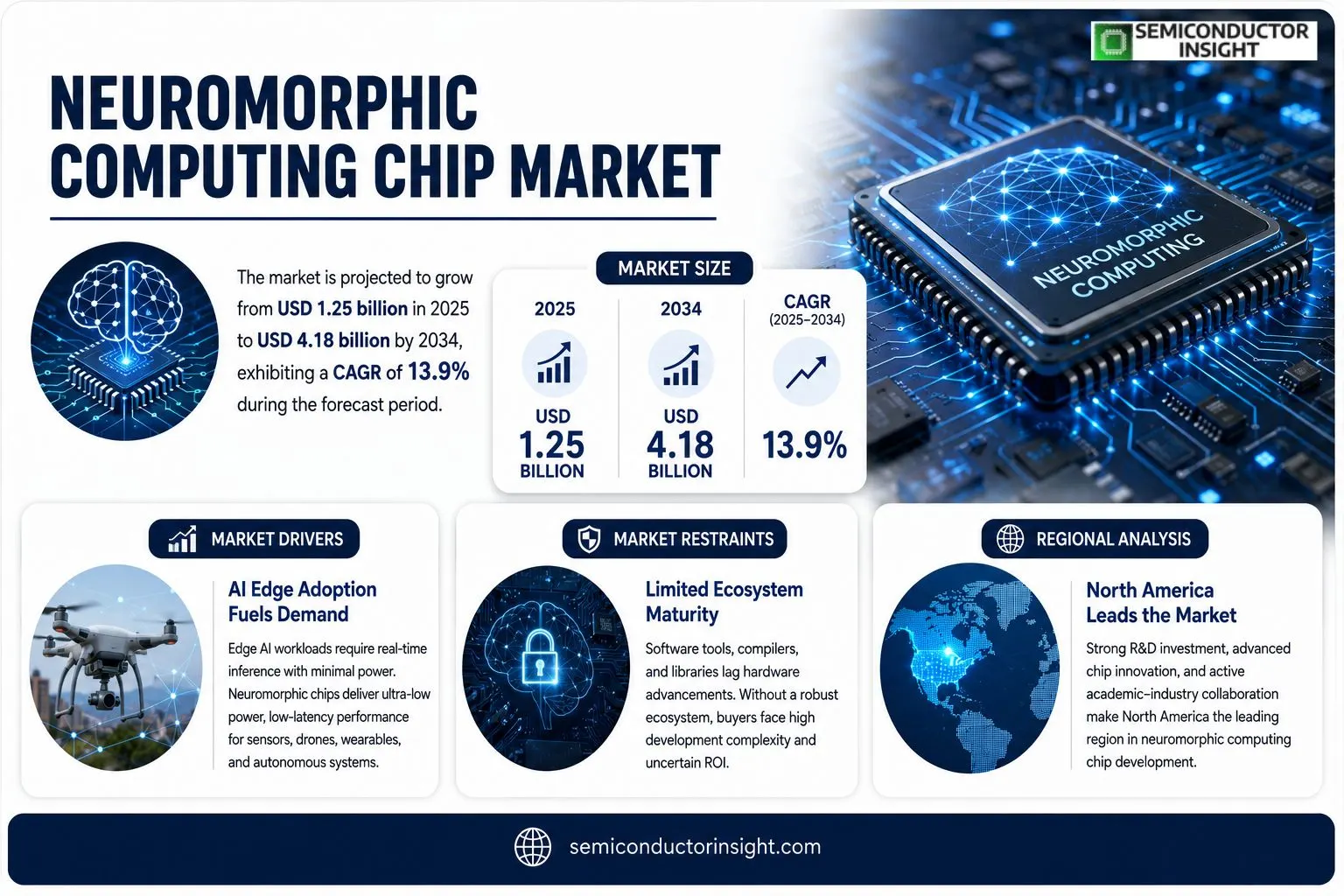
Neuromorphic Computing Chip Market size was valued at USD 1.12 billion in 2025. The market is projected to grow from USD 1.25 billion in 2025 to USD 4.18 billion by 2034, exhibiting a CAGR of 13.9% during the forecast period.
Neuromorphic computing chips are hardware components designed to emulate the architecture of biological neurons and synapses. By leveraging spiking‑neuron models and event‑driven processing, these chips deliver ultra‑low power consumption while handling parallel workloads typical of artificial intelligence applications.The sector is gaining momentum because AI workloads demand higher efficiency and edge devices require real‑time inference with minimal energy draw. Major players such as Intel (Loihi), IBM (TrueNorth), and Qualcomm have announced new silicon generations or strategic partnerships throughout 2023‑2024, reinforcing supply chains and expanding developer ecosystems. Moreover, government funding for brain‑inspired computing initiatives across Europe and Asia fuels research pipelines, which translates into broader commercial adoption.
MARKET DRIVERS
AI Edge Adoption Fuels Demand
The surge in edge‑centric artificial‑intelligence workloads is reshaping processor selection criteria. Companies seeking sub‑millisecond inference on battery‑powered devices are gravitating toward architectures that mimic neuronal firing patterns. This shift translates into a tangible lift for Neuromorphic Computing Chip Market, as OEMs integrate brain‑inspired silicon into sensors, drones, and wearables.
Energy‑Efficiency Imperatives Accelerate Innovation
Traditional von Neumann processors consume disproportionate power when handling sparse, event‑driven data. Neuromorphic chips, by design, activate only the synapses required for a given stimulus, cutting energy use by up to 90 % in benchmark tests. Enterprises facing tightening carbon‑footprint mandates therefore view these chips as a strategic lever for both cost control and sustainability compliance.
➤ “In scenarios where power is scarce, neuromorphic silicon becomes the only viable compute substrate,” noted a leading systems architect.
Beyond efficiency, the convergence of 5G latency requirements with real‑time analytics creates a fertile ground for neuromorphic solutions. As network slices demand on‑device processing, chipmakers that deliver ultra‑low‑latency, adaptive circuitry stand to capture a growing slice of the market.
MARKET CHALLENGES
Design Complexity Hinders Rapid Adoption
Neuromorphic architectures depart radically from familiar instruction‑set paradigms, forcing software teams to rewrite algorithms from the ground up. The steep learning curve translates into longer development cycles, which can discourage midsize firms from committing resources to pilot projects.
Other Challenges
Manufacturing Yield Variability
Fabricating spiking neuron arrays at high density remains a niche process. Yield fluctuations raise unit costs, making price‑sensitive segments hesitant to transition from conventional GPUs.
MARKET RESTRAINTS
Limited Ecosystem Maturity
The surrounding software stackcompilers, debuggers, and libraries lags behind hardware progress. Without a robust ecosystem, potential buyers struggle to quantify returns on investment, prompting a wait‑and‑see posture.
Regulatory Uncertainty in Safety‑Critical Domains
Automotive and medical applications demand exhaustive validation. Existing certification frameworks are tailored to deterministic processors, leaving neuromorphic chips without a clear compliance pathway, which stalls procurement in these high‑value markets.
MARKET OPPORTUNITIES
Specialized AI Accelerators for Robotics
Robotics firms are increasingly seeking processors that can handle sensor‑fusion and motor‑control loops without a cloud connection. Neuromorphic chips, with their event‑driven processing model, align perfectly with these requirements, opening a niche yet rapidly expanding revenue channel.
Collaboration with Academic Research Hubs
Partnerships between silicon vendors and leading neuroscience laboratories accelerate algorithmic breakthroughs. Such collaborations generate proprietary models that can be packaged as premium solutions, granting early‑mover advantage to firms that secure them.
Neuromorphic Computing Chip Market Trends
Energy‑Efficient AI at the Edge
The current wave of AI adoption stresses power budgets that traditional von Neumann processors struggle to meet. Neuromorphic chips, built around spiking‑neuron architectures, consume orders of magnitude less energy because they process information only when events occur. This event‑driven regime aligns naturally with sensor‑rich edge devices that require instant inference without draining batteries. Manufacturers are therefore prioritizing designs that marry ultra‑low latency with sub‑millivolt operation, allowing autonomous drones, wearable health monitors, and robotic vision modules to remain online for extended periods. The shift toward on‑device intelligence reduces reliance on cloud bandwidth, curtails data‑privacy concerns, and opens revenue streams for hardware vendors that can certify their silicon for real‑time, power‑constrained workloads. Neuromorphic Computing Chip Market is beginning to reflect this strategic re‑allocation of R&D spend toward edge‑centric solutions.
Other Trends
Strategic Alliances and Ecosystem Expansion
Major industry players have ratcheted up collaborations in the past two years. Intel’s Loihi platform received a partnership extension with a leading robotics firm, granting developers early access to a third‑generation array that doubles neuron count while preserving power envelope. IBM’s TrueNorth line entered a joint venture with a cloud‑native AI startup, delivering a software stack that abstracts spiking dynamics into familiar machine‑learning APIs. Qualcomm announced a cross‑licensing deal that integrates neuromorphic accelerators into its flagship mobile SoC, signaling confidence that such cores can coexist with conventional GPUs on a single die. These alliances not only accelerate prototype cycles but also seed a broader developer community, which in turn fuels demand for tools, libraries, and design‑time services.
Government‑Backed Brain‑Inspired Initiatives
Public funding across Europe and Asia has risen sharply as policymakers view brain‑inspired computing as a national priority. Multi‑year grants are being allocated to university labs that focus on synaptic plasticity models, while defense ministries are sponsoring prototyping programs that incorporate neuromorphic processors into autonomous surveillance platforms. The influx of capital shortens the commercialization timeline for research‑heavy prototypes, turning academic breakthroughs into market‑ready products within a few development cycles. As these programs mature, supply chains become more resilient, and standards bodies begin to codify interoperability guidelines, which together create a more predictable environment for commercial investors.
COMPETITIVE LANDSCAPE
Key Industry Players
Neuromorphic Computing Chip Market Competitive Overview
Intel’s Loihi family remains the benchmark for large‑scale neuromorphic silicon, leveraging a scalable crossbar architecture that accommodates thousands of spiking neurons on a single die. The company’s recent 2024 silicon refresh tightens energy per inference, positioning Loihi as the preferred platform for research labs that require open‑source toolchains and for OEMs exploring edge AI workloads. IBM’s TrueNorth, although no longer under active development, still anchors many legacy deployments in data‑center environments where dense, low‑latency inference is prized. Qualcomm’s Zeroth initiative, introduced alongside its Snapdragon line, injects neuromorphic primitives directly into mobile SoCs, creating a hybrid ecosystem where traditional digital blocks coexist with spiking cores. This triad of Intel, IBM, and Qualcomm defines the upper tier of the market, each leveraging extensive IP portfolios and deep supply‑chain relationships that deter new entrants from replicating their scale.The remainder of the landscape is populated by specialist firms that target niche segments such as automotive edge, robotics, and industrial IoT. BrainChip’s Akida processor, for example, emphasizes ultra‑low power operation for on‑device learning, attracting automotive OEMs seeking to off‑load perception tasks from central CPUs. European startups like Synsense and Myriad AI focus on mixed‑signal designs that blend analog event‑driven sensors with digital neuromorphic cores, catering to surveillance and autonomous drone markets. Asian playersincluding Horizon Robotics, Huawei’s Ascend Neuromorphic, and Samsung’s Neuromorphic Labbenefit from government‑backed research funds that accelerate prototype silicon transition to volume production. These companies differentiate themselves through proprietary neuron models, flexible programming APIs, or strategic partnerships with academic consortia, thereby enriching the developer ecosystem and expanding the addressable application space.
List of Key Neuromorphic Computing Chip Companies Profiled
- Intel
- IBM
- Qualcomm
- BrainChip
- Synsense
- Myriad AI
- Horizon Robotics
- Huawei
- Samsung
- Knowm
- Prophesee
- INIAD
- Spinverse
- NeuroSky
Segment Analysis:
| Segment Category | Sub-Segments | Key Insights |
| By Type |
|
Spiking Neural Network (SNN) Chips dominate early‑stage deployments because they most closely mimic biological neuron firing patterns, enabling ultra‑low power event‑driven processing.
|
| By Application |
|
Edge AI for Autonomous Sensors is the leading application because it capitalizes on the chips’ event‑driven, low‑latency nature.
|
| By End User |
|
Research Institutions drive the most innovative use‑cases, leveraging neuromorphic chips to explore brain‑inspired computing paradigms.
|
| By Architecture |
|
Analog‑Mixed Signal Designs are gaining traction because they naturally emulate synaptic plasticity with minimal circuitry.
|
| By Development Stage |
|
Early Commercialization represents the most dynamic segment as firms translate laboratory prototypes into productized chips.
|
Regional Analysis: Neuromorphic Computing Chip Market
North America
Leading firms allocate a sizable portion of their R&D budgets to neuromorphic architectures, prioritising mixed‑signal design and on‑chip learning circuits. This focus yields a pipeline of prototypes that can be tested in real‑time robotics labs, shortening the path from concept to silicon.
Partnerships between premier universities and chip manufacturers accelerate knowledge transfer, allowing theoretical models of spiking neurons to be validated on fabrication lines that would otherwise be inaccessible to pure academia.
An established semiconductor supply chain enables rapid sourcing of specialty materials required for analog neuromorphic components, reducing lead times and minimizing cost volatility for early‑stage projects.
Pro‑innovation policies and streamlined export licences encourage cross‑border collaboration, allowing North American designers to incorporate emerging standards without burdensome compliance delays.
Europe
European stakeholders approach Neuromorphic Computing Chip Market with a strong emphasis on sustainability and standards alignment. Horizon‑funded consortia bring together hardware designers, neuroscience institutes, and automotive OEMs to produce chips that meet strict power‑efficiency criteria demanded by EU climate goals. The region’s fragmented but highly skilled manufacturing base encourages niche specialization, where boutique fabs focus on low‑volume, high‑precision neuromorphic prototypes. Policy makers reinforce this direction through grants that tie capital to demonstrable reductions in energy consumption, prompting vendors to embed adaptive learning directly into edge sensors for smart‑city applications.
Asia‑Pacific
In Asia‑Pacific, rapid adoption of AI‑enabled consumer electronics fuels a parallel interest in neuromorphic chips that can operate under severe thermal constraints. Governments in China, Japan, and South Korea champion national roadmaps that position neuromorphic hardware as a cornerstone of next‑generation internet‑of‑things ecosystems. Local chipmakers leverage extensive foundry capacity to experiment with emerging memory technologies, such as resistive RAM, to emulate synaptic behavior at scale. The result is a vibrant incubation environment where startups receive accelerated market entry through government‑backed incubators, while incumbents explore integration with 5G edge nodes.
South America
South American markets are beginning to recognize the strategic relevance of neuromorphic processors for remote‑sensing and agritech solutions. Collaborative projects between regional universities and multinational chip firms aim to tailor low‑power neuromorphic designs for harsh field conditions, such as variable lighting and intermittent connectivity. Investment incentives focus on technology transfer, ensuring that local talent can maintain and evolve the hardware rather than relying solely on imported solutions. This approach nurtures a nascent ecosystem that could serve the broader Latin‑American demand for intelligent edge devices.
Middle East & Africa
The Middle East & Africa region leverages neuromorphic chip potential to address energy‑intensive challenges in oil‑field monitoring and desert‑environment robotics. Partnerships between regional research centers and chipset manufacturers are exploring spiking‑neuron models that can process sensor streams without constant cloud connectivity. Funding programs in the Gulf prioritize projects that demonstrate measurable reductions in data‑center cooling loads, positioning neuromorphic hardware as a catalyst for greener digital infrastructure across the continent.
Report Scope
This market research report provides a comprehensive analysis of the Neuromorphic Computing Chip Market , covering the forecast period 2026–2034. It offers detailed insights into market dynamics, technological advancements, competitive landscape, and key trends shaping the industry.
Key focus areas of the report include:
- Market Overview: The report begins with an overview outlining its current market scenario, key growth indicators, and industry transformation drivers. It discusses macroeconomic factors, demand–supply balance, regulatory landscape, and the strategic role of semiconductors in powering advancements across industries such as automotive, telecommunications, consumer electronics, and industrial automation.
- Market Size & Forecast: Historical data and future projections for revenue, unit shipments, and market value across major regions and segments.
- Segmentation Analysis: Detailed breakdown by product type, technology, application, and end-user industry to identify high-growth segments and investment opportunities.
- Regional Insights: Insights into market performance across North America, Europe, Asia-Pacific, Latin America, and the Middle East & Africa, including country-level analysis where relevant.
- Competitive Landscape: Profiles of leading market participants, including their product offerings, R&D focus, manufacturing capacity, pricing strategies, and recent developments such as mergers, acquisitions, and partnerships.
- Technology Trends & Innovation: Assessment of emerging technologies, integration of AI/IoT, semiconductor design trends, fabrication techniques, and evolving industry standards.
- Market Drivers & Restraints: Evaluation of factors driving market growth along with challenges, supply chain constraints, regulatory issues, and market-entry barriers.
- Stakeholder Insights: Insights for component suppliers, OEMs, system integrators, investors, and policymakers regarding the evolving ecosystem and strategic opportunities.
Primary and secondary research methods are employed, including interviews with industry experts, data from verified sources, and real-time market intelligence to ensure the accuracy and reliability of the insights presented.
FREQUENTLY ASKED QUESTIONS:
What is the current market size of Neuromorphic Computing Chip Market?
-> Neuromorphic Computing Chip Market was valued at USD 1.12 billion in 2025 and is expected to reach USD 4.18 billion by 2034, exhibiting a CAGR of 13.9%.
Which key companies operate in Neuromorphic Computing Chip Market?
-> Key players include Intel (Loihi), IBM (TrueNorth), Qualcomm, among others.
What are the key growth drivers?
-> Key growth drivers include rising AI workloads demanding higher efficiency, need for low‑power edge inference, and increased government funding for brain‑inspired computing initiatives.
Which region dominates the market?
-> Regional dominance details were not disclosed in the provided information.
What are the emerging trends?
-> Emerging trends include development of spiking‑neuron based architectures, event‑driven processing chips, and integration of neuromorphic processors into edge AI devices.
Get Sample Report PDF for Exclusive Insights
Report Sample Includes
- Table of Contents
- List of Tables & Figures
- Charts, Research Methodology, and more...
 Download Sample Report PDF