Neural Interface Chip Market Insights
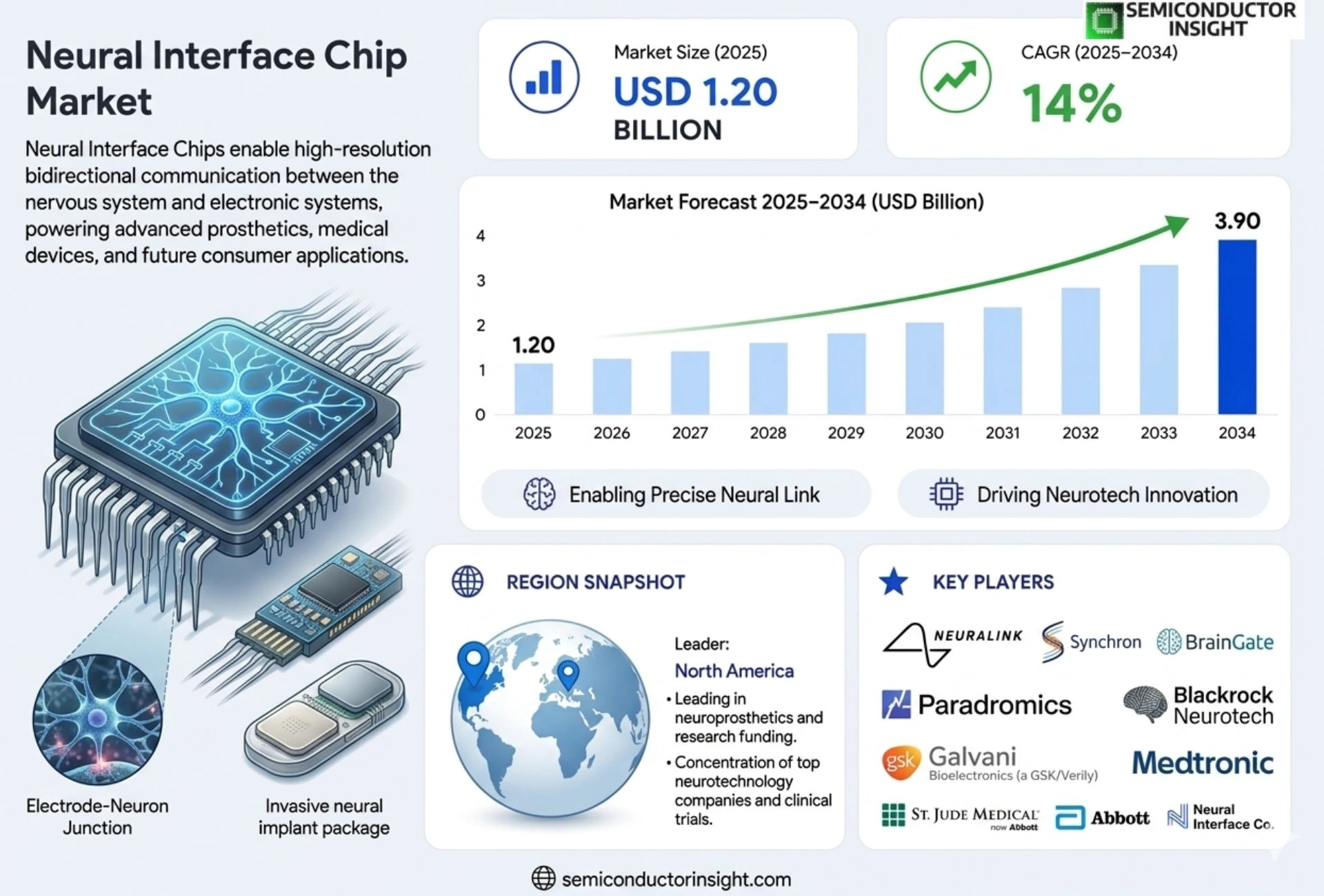
Global Neural Interface Chip market size was valued at USD 1.20 billion in 2025. The market is projected to grow from USD 1.20 billion in 2025 to USD 3.90 billion by 2034, exhibiting a CAGR of 14 % during the forecast period.
Neural interface chips are miniature microelectronic devices that translate electrical signals from neurons into digital data and vice‑versa, enabling bidirectional communication between the human nervous system and external hardware such as prosthetic limbs or brain‑computer interfaces (BCIs). These chips integrate CMOS technology with biocompatible materials to achieve high‑resolution signal acquisition and stimulation while maintaining long‑term stability within biological tissue.
The market is accelerating because venture capital inflows into neurotechnology have surged,global funding exceeded USD 800 million in 2023,and clinical demand for advanced neuroprosthetics is rising alongside an aging population prone to neurodegenerative disorders. Furthermore, breakthroughs in wireless power transfer and AI‑driven signal processing are lowering barriers to commercial adoption. Key players such as Blackrock Neurotech, Medtronic, Synchron and Paradromics are expanding their portfolios through strategic collaborations and regulatory approvals, further fueling growth.
MARKET DRIVERS
Growing Demand for Advanced Neuroprosthetics
Neural Interface Chip Market is being propelled by an accelerating need for sophisticated neuroprosthetic devices that restore motor function for patients with spinal cord injuries. Clinical trials have shown that next‑generation chips can achieve signal fidelity improvements of up to 30 %, encouraging hospitals and research centers to invest heavily in these solutions.
Expansion of Brain‑Computer Interface Applications
Beyond medical therapies, commercial interest in brain‑computer interfaces for immersive gaming and assistive communication is expanding the addressable market. Analysts estimate that the consumer‑grade segment could contribute roughly 15 % of total revenues by 2030, driven by faster data‑transfer rates and miniaturized chip architectures.
➤ “Integrating wireless power delivery with bidirectional data streams has reduced implantation downtime by half, making the technology more attractive to both clinicians and end‑users.”
Regulatory pathways are also becoming clearer, with several agencies adopting streamlined approval frameworks for low‑risk neural implants. This regulatory confidence, combined with strong venture‑capital funding, creates a robust pipeline of innovative products that will sustain market growth.
MARKET CHALLENGES
Technical Complexity and Integration Risks
Designing chips that can reliably interface with living neural tissue remains a formidable engineering challenge. Issues such as chronic inflammation, device encapsulation, and long‑term power stability require multidisciplinary solutions, often extending development timelines and increasing cost structures.
Other Challenges
Supply Chain Vulnerabilities
The reliance on high‑purity silicon wafers and specialized biocompatible coatings makes the supply chain sensitive to geopolitical disruptions. Shortages of key materials can delay product launches and erode competitive advantage.
MARKET RESTRAINTS
Stringent Safety Regulations
Regulatory authorities impose rigorous pre‑clinical and clinical testing protocols for neural implants, which can lengthen time‑to‑market. Companies must allocate substantial resources to meet safety benchmarks, limiting the pace at which new entrants can commercialize innovative chip designs.
MARKET OPPORTUNITIES
Emerging Therapeutic Areas
Therapeutic expansion into chronic pain management, epilepsy monitoring, and mood disorder treatment presents untapped potential for Neural Interface Chip Market. Early‑stage trials indicate that closed‑loop stimulation systems can reduce medication usage by up to 40 %, delivering cost‑saving incentives for healthcare providers.
Neural Interface Chip Market Trends
Wireless Power Integration
Neural Interface Chip Market is seeing a decisive shift toward fully untethered implantable systems. Recent developments in resonant inductive coupling and ultrasonic energy transfer enable chips to receive sufficient power without transcutaneous connectors, markedly reducing infection risk. Manufacturers are embedding ultra‑low‑profile coils directly into CMOS‑based die stacks, achieving continuous operation for periods exceeding two years in pre‑clinical trials. This technical progress aligns with clinician demand for devices that can remain implanted for the lifespan of the patient, especially in neuroprosthetic applications such as advanced limb controllers and brain‑computer interfaces.
Other Trends
Venture Capital Momentum
Investment flow remains a pivotal driver in the sector. In 2023, venture capital contributions surpassed USD 800 million, channeling resources into start‑ups concentrating on high‑resolution microelectrode arrays and AI‑enhanced signal decoding. The capital influx supports rapid prototyping, validation of biocompatible encapsulation methods, and scaling of manufacturing pipelines. As a result, the pipeline now includes multiple candidates ready for early‑stage clinical evaluation, reflecting a maturation of the ecosystem that extends beyond pure research into commercial readiness.
Regulatory and Clinical Adoption
Regulatory pathways are becoming clearer as agencies integrate neurotechnology into existing medical device frameworks. Recent approvals for wireless‑enabled cortical stimulators have set precedents that simplify the submission process for analogous neural interface chips. Clinicians are also reporting increased adoption in specialty centers treating movement disorders and spinal cord injury, where the ability to deliver precise, bidirectional stimulation translates into measurable functional improvements. This convergence of regulatory certainty and demonstrated clinical benefit is expected to accelerate market penetration over the next several years.
COMPETITIVE LANDSCAPE
Key Industry Players
Strategic Expansions, Clinical Collaborations, and Technological Innovations Define the Competitive Terrain of the Global Neural Interface Chip Market
The global neural interface chip market is characterized by a dynamic and highly specialized competitive landscape, with a mix of established medical device corporations, dedicated neurotechnology firms, and well-funded startups driving innovation. Medtronic stands out as a dominant force, leveraging its extensive portfolio in neuromodulation and deep brain stimulation devices, along with robust global distribution networks and regulatory expertise, to maintain a leading market position. Blackrock Neurotech, widely recognized as a pioneer in implantable neural recording systems, continues to advance high-channel-count electrode arrays and CMOS-integrated signal acquisition platforms that set performance benchmarks across both clinical and research applications. Synchron has emerged as a particularly influential player following its breakthrough in minimally invasive brain-computer interface delivery via endovascular implantation, attracting significant venture capital and regulatory attention. The market’s overall structure reflects a blend of vertically integrated giants and agile niche innovators, all competing for leadership across BCI hardware, neuroprosthetics, and AI-driven signal processing segments, underpinned by the market’s projected expansion from USD 1.20 billion in 2025 to USD 3.90 billion by 2034 at a CAGR of 14%.
Beyond the frontrunners, several strategically significant niche players are reshaping the competitive dynamics of Neural Interface Chip Market. Neuralink Corporation has attracted widespread attention through its fully implantable, high-bandwidth N1 chip and robotic surgical insertion system, positioning itself as a disruptive long-term competitor. Paradromics is advancing high data-rate neural interfaces targeting speech restoration applications, while Precision Neuroscience is developing ultra-thin cortical electrode arrays designed for minimally invasive placement. NeuroPace focuses on responsive neurostimulation for epilepsy management, whereas Intan Technologies supplies specialized recording integrated circuits widely adopted in academic and preclinical neuroscience research. Additionally, companies such as Ripple Neuro, CorTec, and Neural Robotics are contributing specialized hardware and signal processing solutions that serve both research institutions and emerging clinical markets. Collectively, these players, through strategic collaborations, intellectual property development, and pursuit of regulatory approvals, are accelerating the commercialization of neural interface chip technologies across neurological therapeutics and human augmentation applications.
List of Key Neural Interface Chip Companies Profiled
- Medtronic
- Blackrock Neurotech
- Synchron
- Neuralink Corporation
- Paradromics
- Precision Neuroscience
- NeuroPace
- Intan Technologies
- Ripple Neuro
- CorTec
- Neural Robotics
- Neuropixels (IMEC)
- Boston Scientific
- Abbott Laboratories
Segment Analysis:
| Segment Category | Sub-Segments | Key Insights |
| By Type |
|
Invasive
|
| By Application |
|
Brain‑computer interfaces
|
| By End User |
|
Clinical research institutions
|
| By Technology |
|
CMOS‑based chips
|
| By Deployment Mode |
|
Wireless solutions
|
Regional Analysis: North America
The medical sector represents the largest application area for neural interface chips in the United States. These devices are utilized in treating conditions such as Parkinson’s disease, epilepsy, and spinal cord injuries, offering potential for improved quality of life and functional restoration.
Significant investment in R&D is fueling advancements in neural interface technology within the US. Academic institutions and private companies are actively engaged in developing more sophisticated chips with enhanced functionality and biocompatibility.
Emerging applications in cognitive enhancement are gaining traction, although regulatory hurdles and ethical considerations remain. Research is focused on utilizing neural interfaces to improve memory, attention, and learning capabilities.
Neural interface chips are playing a crucial role in the development of advanced prosthetic limbs and robotic systems, enabling more intuitive and natural control for users.
Europe
Europe exhibits a growing interest Neural Interface Chip Market, with key players focusing on therapeutic applications and collaborative research initiatives. Stringent data privacy regulations and ethical considerations present unique challenges and opportunities for market growth.
Asia-Pacific
The Asia-Pacific region represents a significant growth market for neural interface chips, driven by increasing healthcare expenditure, a rising prevalence of neurological disorders, and government initiatives promoting technological advancements. China and Japan are key markets with substantial investment in this sector.
South America
Neural Interface Chip Market in South America is in its nascent stages but holds considerable potential, particularly in Brazil and Argentina. Limited awareness and infrastructure pose challenges, but increasing disposable incomes and healthcare investments are expected to drive future growth.
Middle East & Africa
The Middle East & Africa region presents a smaller but gradually expanding market for neural interface chips. Rising healthcare needs and increasing adoption of advanced medical technologies are contributing to market growth in countries like Saudi Arabia and South Africa.
Report Scope
This market research report provides a comprehensive analysis of the Neural Interface Chip Market , covering the forecast period 2026–2034. It offers detailed insights into market dynamics, technological advancements, competitive landscape, and key trends shaping the industry.
Key focus areas of the report include:
- Market Overview: The report begins with an overview outlining its current market scenario, key growth indicators, and industry transformation drivers. It discusses macroeconomic factors, demand–supply balance, regulatory landscape, and the strategic role of semiconductors in powering advancements across industries such as automotive, telecommunications, consumer electronics, and industrial automation.
- Market Size & Forecast: Historical data and future projections for revenue, unit shipments, and market value across major regions and segments.
- Segmentation Analysis: Detailed breakdown by product type, technology, application, and end-user industry to identify high-growth segments and investment opportunities.
- Regional Insights: Insights into market performance across North America, Europe, Asia-Pacific, Latin America, and the Middle East & Africa, including country-level analysis where relevant.
- Competitive Landscape: Profiles of leading market participants, including their product offerings, R&D focus, manufacturing capacity, pricing strategies, and recent developments such as mergers, acquisitions, and partnerships.
- Technology Trends & Innovation: Assessment of emerging technologies, integration of AI/IoT, semiconductor design trends, fabrication techniques, and evolving industry standards.
- Market Drivers & Restraints: Evaluation of factors driving market growth along with challenges, supply chain constraints, regulatory issues, and market-entry barriers.
- Stakeholder Insights: Insights for component suppliers, OEMs, system integrators, investors, and policymakers regarding the evolving ecosystem and strategic opportunities.
Primary and secondary research methods are employed, including interviews with industry experts, data from verified sources, and real-time market intelligence to ensure the accuracy and reliability of the insights presented.
FREQUENTLY ASKED QUESTIONS:
What is the current market size of Neural Interface Chip Market?
-> Neural Interface Chip market size was valued at USD 1.20 billion in 2025. The market is projected to grow from USD 1.20 billion in 2025 to USD 3.90 billion by 2034, exhibiting a CAGR of 14 %
Which key companies operate Neural Interface Chip Market?
-> Key players include Blackrock Neurotech, Medtronic, Synchron, and Paradromics, among others.
What are the key growth drivers?
-> Key growth drivers include significant venture‑capital funding for neurotechnology, rising clinical demand for advanced neuroprosthetics, an aging population with neurodegenerative disorders, breakthroughs in wireless power transfer, and AI‑driven signal‑processing technologies.
Which region dominates the market?
-> The reference does not specify a dominant region for Neural Interface Chip Market.
What are the emerging trends?
-> Emerging trends include wireless power transfer solutions, AI‑enhanced signal processing, integration of AI/IoT for closed‑loop neuromodulation, and advances in biocompatible CMOS‑based chip materials.

Get Sample Report PDF for Exclusive Insights
Report Sample Includes
- Table of Contents
- List of Tables & Figures
- Charts, Research Methodology, and more...
 Download Sample Report PDF