Narrowband Multispectral Filter Market Insights
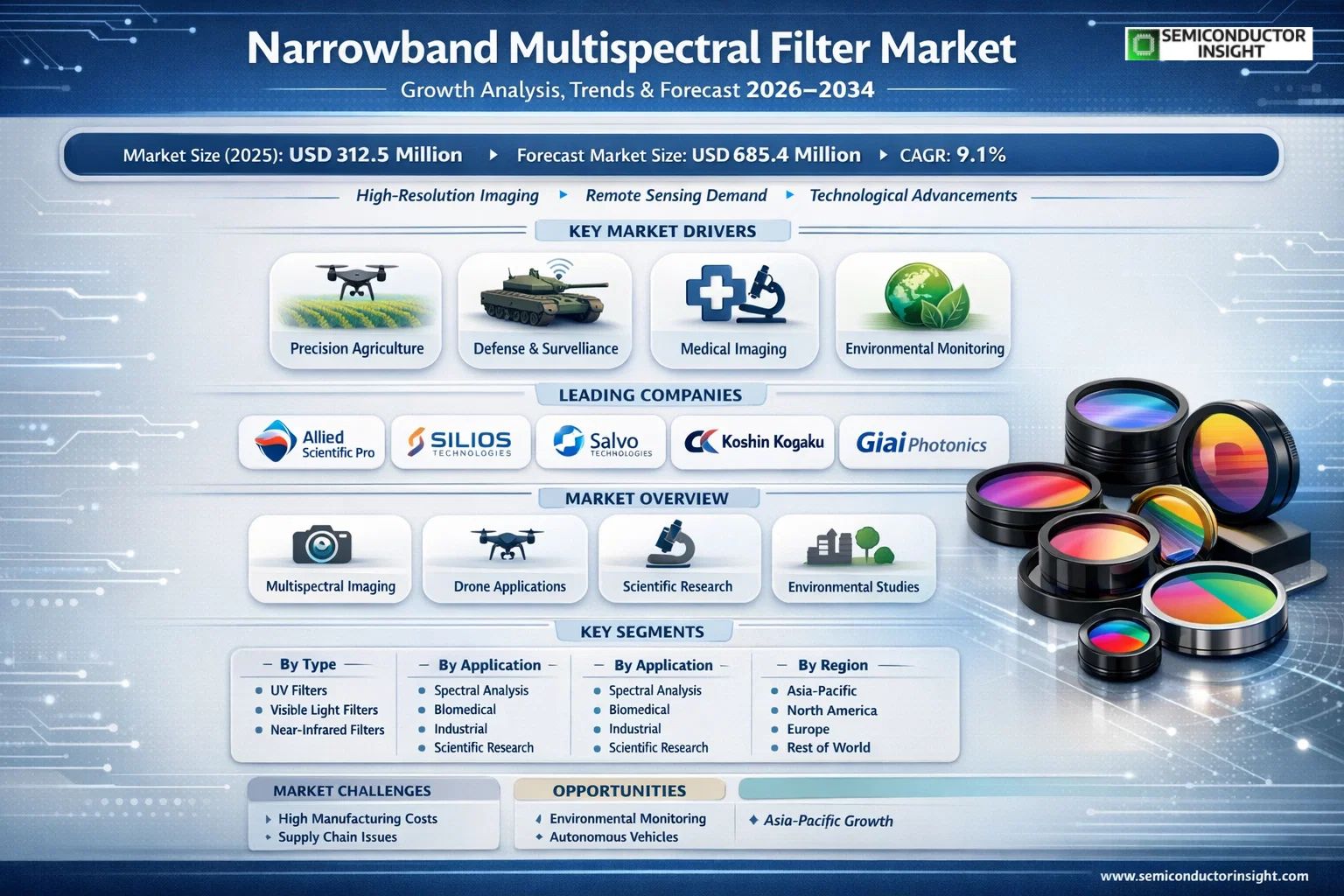
Global Narrowband Multispectral Filter market size was valued at USD 312.5 million in 2025. The market is projected to grow from USD 342.7 million in 2026 to USD 685.4 million by 2034, exhibiting a CAGR of 9.1% during the forecast period.
Narrowband Multispectral Filters are optical filters that selectively transmit light in specific narrow wavelength bands while blocking others. These filters are essential for precise spectral separation, enabling applications in multispectral imaging, remote sensing, medical imaging, environmental monitoring, and scientific research.
The market is experiencing strong growth due to surging demand for high-resolution imaging in agriculture, defense, and biomedical fields. Rising adoption of drones and satellites for remote sensing, coupled with advancements in fabrication techniques like thin-film deposition, further propel expansion. Key players such as Allied Scientific Pro, SILIOS Technologies, Salvo Technologies, Koshin Kogaku, Giai Photonics, Mloptic, Champion Optics, Daheng Optical Thin Film, and Shenzhen NMOT dominate with innovative portfolios, driving competition and technological progress.
MARKET DRIVERS
Precision Agriculture and Remote Sensing
Narrowband Multispectral Filter Market is propelled by increasing adoption in precision agriculture, where these filters enable detailed crop health monitoring through drone-based imaging systems. Farmers utilize narrowband filters to detect subtle variations in chlorophyll content and nutrient deficiencies, optimizing yields by up to 15-20% in major grain-producing regions.
Defense and Surveillance Applications
In defense sectors, demand surges for Narrowband Multispectral Filter Market due to enhanced target detection in low-light conditions and camouflage penetration. Military hyperspectral cameras equipped with these filters improve reconnaissance accuracy, contributing to a projected segment growth of over 10% annually through 2030.
➤ Integration with AI-driven analytics boosts real-time data processing, driving market expansion in autonomous systems.
Additionally, medical imaging advancements, such as fluorescence microscopy, further accelerate Narrowband Multispectral Filter Market by enabling precise disease diagnostics with minimal tissue damage.
MARKET CHALLENGES
High Manufacturing Complexity
Narrowband Multispectral Filter Market faces hurdles from intricate fabrication processes requiring ultra-precise thin-film deposition, leading to yields below 80% in high-volume production. This elevates costs, deterring small-scale adopters in emerging applications.
Other Challenges
Supply Chain Disruptions
Geopolitical tensions and raw material shortages, like specialty glass substrates, have increased lead times by 25-30%, impacting delivery in Narrowband Multispectral Filter Market.
Integration difficulties with existing multispectral camera systems also pose issues, necessitating custom calibrations that extend development cycles by several months. Competition from cost-effective broadband alternatives further pressures market penetration in consumer-grade devices.
MARKET RESTRAINTS
Regulatory and Standardization Barriers
Stringent regulatory approvals for medical and aerospace uses in Narrowband Multispectral Filter Market slow commercialization, with certification processes often spanning 18-24 months. Lack of universal wavelength standards across vendors complicates interoperability.
High initial investment for R&D in advanced coatings restrains smaller players, limiting innovation to dominant firms holding over 60% market share. Economic slowdowns in key regions also curb capital spending on high-end imaging equipment.
Environmental concerns over rare-earth materials used in filter production add compliance costs, potentially raising prices by 10-15% amid sustainability mandates.
MARKET OPPORTUNITIES
Expansion in Environmental Monitoring
Narrowband Multispectral Filter Market presents strong potential in environmental monitoring, where satellite and UAV deployments track deforestation and pollution with spectral precision, eyeing a 12% CAGR through 2028.
Emerging applications in autonomous vehicles for enhanced object detection in varied lighting open new avenues, integrating filters with LiDAR for safer navigation systems.
Asia-Pacific growth, driven by industrial automation and smart cities, could capture 25% additional market share, fueled by investments exceeding $5 billion in sensor technologies.
Narrowband Multispectral Filter Market Trends
Rising Integration in Biomedical and Scientific Applications
Narrowband Multispectral Filter Market is experiencing notable momentum driven by expanding use in biomedical imaging and scientific research. These filters enable precise light transmission in specific narrow wavelength bands, crucial for applications like spectral analysis and medical diagnostics. Demand surges as healthcare providers adopt advanced multispectral systems for non-invasive tissue analysis and disease detection, enhancing imaging accuracy over traditional broadband methods. In parallel, scientific research benefits from improved remote sensing capabilities, where Narrowband Multispectral Filter Market components facilitate detailed environmental monitoring and material characterization.
Other Trends
Advancements Across Filter Types
Shifts within product segments highlight UV Filters, Visible Light Filters, and Near-infrared Filters as key areas. UV Filters gain traction in industrial inspections for detecting surface defects, while Near-infrared Filters support applications in agriculture and night vision systems. This diversification strengthens Narrowband Multispectral Filter Market by addressing varied wavelength needs across industries.
Regional Expansion and Competitive Dynamics
Geographic trends underscore robust growth in Asia, particularly China and Japan, alongside established North American markets like the U.S. European regions, including Germany and the U.K., focus on precision manufacturing for scientific research. Leading players such as Allied Scientific Pro, SILIOS Technologies, and Salvo Technologies drive innovation through product developments and strategic collaborations, consolidating their positions. Narrowband Multispectral Filter Market sees intensified competition as suppliers like Koshin Kogaku and Giai Photonics expand offerings for industrial and biomedical sectors, fostering efficiency gains and cost optimizations. Emerging applications in environmental monitoring further propel adoption, with filters enabling hyperspectral data capture for climate studies and pollution tracking. Overall, these dynamics position Narrowband Multispectral Filter Market for sustained evolution, balancing technological refinement with broadening end-user integration.
COMPETITIVE LANDSCAPE
Key Industry Players
Leading Manufacturers in Narrowband Multispectral Filter Market
Narrowband Multispectral Filter Market features a moderately concentrated structure dominated by specialized optical component providers. Leading players such as Allied Scientific Pro and SILIOS Technologies command significant market share, with the global top five manufacturers collectively accounting for a substantial portion of revenue in 2025. These frontrunners excel in producing high-precision filters for applications in multispectral imaging, remote sensing, and scientific research, leveraging advanced thin-film deposition techniques. Their dominance stems from robust R&D investments, custom fabrication capabilities, and established supply chains serving defense, biomedical, and environmental monitoring sectors, fostering steady growth amid rising demand for narrowband precision optics.
Beyond the top tier, niche players contribute to a dynamic competitive landscape by addressing specialized needs. Companies like Salvo Technologies and Koshin Kogaku focus on innovative UV and near-infrared filters for industrial and biomedical uses, while Asian firms such as Giai Photonics, Mloptic, Champion Optics, Daheng Optical Thin Film, and Shenzhen NMOT gain ground through cost-competitive manufacturing and rapid customization. Emerging challengers, including Omega Optical and Andover Corporation, enhance market diversity with rugged designs for harsh environments. This fragmentation encourages collaboration and technological differentiation, with ongoing mergers and expansions signaling intensified rivalry as the market projects strong CAGR through 2034.
List of Key Narrowband Multispectral Filter Companies Profiled
- Allied Scientific Pro
- SILIOS Technologies
- Salvo Technologies
- Koshin Kogaku
- Giai Photonics
- Mloptic
- Champion Optics
- Daheng Optical Thin Film
- Shenzhen NMOT
- Omega Optical
- Andover Corporation
- Chroma Technology
- Thorlabs
- Edmund Optics
- Semrock (IDEX Health & Science)
Segment Analysis:
| Segment Category | Sub-Segments | Key Insights |
| By Type |
|
Near-infrared Filter leads due to its versatility across diverse applications.
|
| By Application |
|
Biomedical dominates with growing demand for precision diagnostics.
|
| By End User |
|
Research Institutions spearhead adoption for cutting-edge developments.
|
| By Technology |
|
Interference Filters prevail for their superior optical qualities.
|
| By Form Factor |
|
On-chip Integration gains traction for miniaturized systems.
|
Regional Analysis: Narrowband Multispectral Filter Market
North America
North America’s Narrowband Multispectral Filter Market thrives on pioneering R&D in thin-film coatings and photonic integration, enabling superior wavelength selectivity. Companies invest heavily in nanofabrication techniques, enhancing filter performance for defense reconnaissance and satellite imagery, setting global benchmarks for precision and durability.
Strong military spending fuels adoption in Narrowband Multispectral Filter Market, where filters support target detection and surveillance systems. Aerospace firms leverage these for earth observation, driving customization for harsh environments and propelling market leadership through reliable, high-resolution spectral solutions.
Precision farming applications dominate, with Narrowband Multispectral Filter Market filters aiding crop health monitoring and soil analysis via drones. Environmental agencies utilize them for pollution tracking, spurring eco-friendly innovations and sustainable practices unique to North American regulatory frameworks.
Industrial automation sees rising use of Narrowband Multispectral Filter Market components in quality inspection and robotics. Integration with IoT platforms enhances manufacturing efficiency, reflecting the region’s forward-thinking approach to Industry 4.0 transformations.
Europe
Europe’s Narrowband Multispectral Filter Market is characterized by a strong emphasis on research-driven growth and regulatory compliance. The region excels in automotive and medical imaging sectors, where filters enable advanced driver-assistance systems and non-invasive diagnostics. Collaborative EU-funded projects promote standardization and interoperability, accelerating adoption in renewable energy monitoring and cultural heritage preservation. Manufacturers focus on sustainable production methods, aligning with green initiatives that reduce environmental impact. Challenges include fragmented supply chains, yet proximity to key markets in Germany and France supports rapid prototyping. Emerging opportunities lie in space technology, with ESA partnerships enhancing filters for planetary exploration. Overall, Europe’s market dynamics reflect a balance of innovation and ethical considerations, positioning it as a key player in specialized Narrowband Multispectral Filter applications.
Asia-Pacific
Asia-Pacific exhibits rapid expansion in Narrowband Multispectral Filter Market, propelled by manufacturing prowess and tech adoption in China, Japan, and India. Electronics and semiconductor industries drive demand for high-precision filters in consumer devices and semiconductor inspection. Agricultural mechanization boosts usage in rice paddy monitoring and forestry management, leveraging cost-effective drone integrations. Government incentives for smart cities integrate these filters into urban surveillance and pollution control systems. Supply chain localization reduces import dependencies, fostering domestic innovation hubs. While competition intensifies, quality improvements and scalability position the region for substantial market share gains, particularly in consumer electronics and emerging biotech sectors.
South America
South America’s Narrowband Multispectral Filter Market is nascent but growing, centered on agriculture and mining in Brazil and Chile. Filters support precision farming in vast farmlands, enabling vegetation stress detection amid climate variability. Mining operations utilize them for mineral identification, enhancing resource extraction efficiency. Limited infrastructure poses challenges, yet international partnerships introduce advanced technologies. Biodiversity conservation efforts incorporate multispectral analysis for deforestation tracking, aligning with global sustainability goals. The market’s potential lies in expanding telecom and renewable energy applications, with gradual infrastructure improvements set to unlock broader adoption.
Middle East & Africa
The Middle East & Africa Narrowband Multispectral Filter Market focuses on oil & gas and defense sectors, with filters aiding pipeline inspection and border security in the Gulf and South Africa. Arid climate monitoring for water resources drives agricultural applications in Israel and Egypt. Defense modernization programs integrate advanced imaging, supported by sovereign wealth funds. Challenges include geopolitical tensions and skill gaps, but rising FDI in tech parks fosters local manufacturing. Opportunities in solar energy assessment and healthcare imaging promise steady growth, reflecting adaptive strategies to regional needs.
Report Scope
This market research report provides a comprehensive analysis of Narrowband Multispectral Filter Market, covering the forecast period 2026–2034. It offers detailed insights into market dynamics, technological advancements, competitive landscape, and key trends shaping the industry.
Key focus areas of the report include:
- Market Overview: The report begins with an overview outlining its current market scenario, key growth indicators, and industry transformation drivers. It discusses macroeconomic factors, demand–supply balance, regulatory landscape, and the strategic role of narrowband multispectral filters in powering advancements across industries such as multispectral imaging, remote sensing, medical imaging, environmental monitoring, and scientific research.
- Market Size & Forecast: Historical data and future projections for revenue, unit shipments, and market value across major regions and segments.
- Segmentation Analysis: Detailed breakdown by product type, technology, application, and end-user industry to identify high-growth segments and investment opportunities.
- Regional Insights: Insights into market performance across North America, Europe, Asia-Pacific, Latin America, and the Middle East & Africa, including country-level analysis where relevant.
- Competitive Landscape: Profiles of leading market participants, including their product offerings, R&D focus, manufacturing capacity, pricing strategies, and recent developments such as mergers, acquisitions, and partnerships.
- Technology Trends & Innovation: Assessment of emerging technologies, integration of AI/IoT, narrowband filter design trends, thin-film fabrication techniques, and evolving industry standards.
- Market Drivers & Restraints: Evaluation of factors driving market growth along with challenges, supply chain constraints, regulatory issues, and market-entry barriers.
- Stakeholder Insights: Insights for component suppliers, OEMs, system integrators, investors, and policymakers regarding the evolving ecosystem and strategic opportunities.
Primary and secondary research methods are employed, including interviews with industry experts, data from verified sources, and real-time market intelligence to ensure the accuracy and reliability of the insights presented.
FREQUENTLY ASKED QUESTIONS:
What is the current market size of Narrowband Multispectral Filter Market?
-> Narrowband Multispectral Filter Market was valued at USD 312.5 million in 2025 and is expected to reach USD 685.4 million by 2034, at a CAGR of 9.1% during the forecast period.
Which key companies operate in Narrowband Multispectral Filter Market?
-> Key players include Allied Scientific Pro, SILIOS Technologies, Salvo Technologies, Koshin Kogaku, Giai Photonics, Mloptic, Champion Optics, Daheng Optical Thin Film, Shenzhen NMOT, among others. In 2025, the global top five players had a share approximately % in terms of revenue.
What are the key growth drivers?
-> Key growth drivers include demand for multispectral imaging, remote sensing, medical imaging, environmental monitoring, and scientific research applications.
Which region dominates the market?
-> North America, with the U.S. market estimated at USD million in 2025, while Asia, particularly China projected to reach USD million, represents significant growth.
What are the emerging trends?
-> Emerging trends include growth in UV Filter segment to reach USD million by 2034 at a CAGR of % over the next six years, alongside expansions in biomedical, industrial, and scientific research applications.

Get Sample Report PDF for Exclusive Insights
Report Sample Includes
- Table of Contents
- List of Tables & Figures
- Charts, Research Methodology, and more...
 Download Sample Report PDF