Nanodielectrics Market Insights
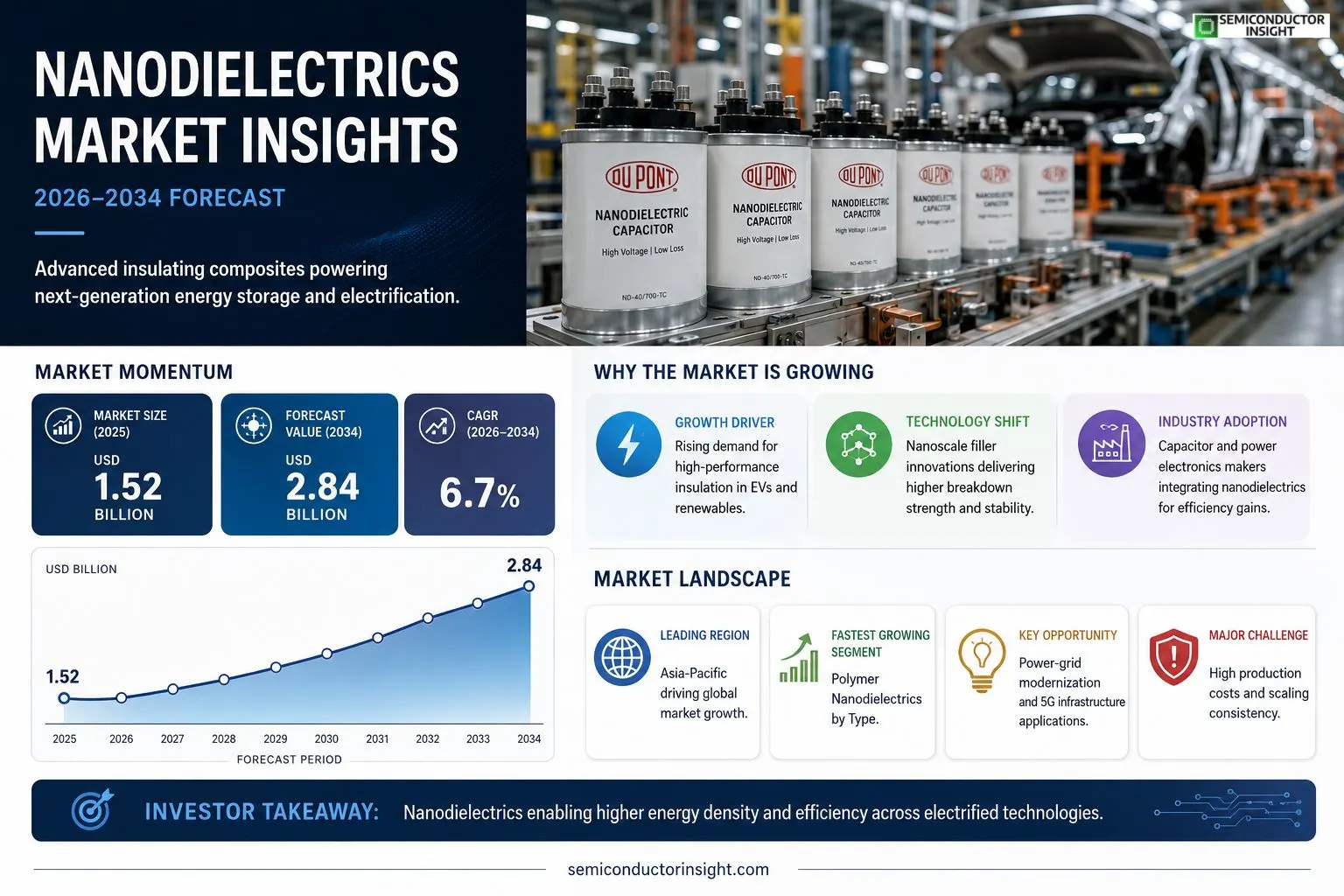
Global nanodielectrics market size was valued at USD 1.52 billion in 2025. The market is projected to grow from USD 1.52 billion in 2025 to USD 2.84 billion by 2034, exhibiting a CAGR of 6.7% during the forecast period.
Nanodielectrics are advanced insulating composites that integrate nanoscale filler particles,such as silica, alumina, or polymer‑based nanofibers,into traditional dielectric matrices to enhance electrical breakdown strength, thermal stability, and energy density. These materials are pivotal for next‑generation capacitors, high‑voltage power electronics, and emerging electric‑vehicle power‑train applications.The market is experiencing robust growth because demand for high‑performance energy storage solutions is accelerating across automotive and renewable‑energy sectors. However, challenges related to large‑scale manufacturing consistency remain. Furthermore, ongoing research collaborations among leading firms,including DuPont, 3M and Cabot Corporation,are driving innovation in filler technology and cost‑effective production methods, thereby reinforcing market expansion.
MARKET DRIVERS
Rising Demand for High‑Performance Insulation
The rapid expansion of electric vehicle (EV) production and offshore wind farms is fueling a need for materials that can operate at higher voltages with minimal loss. Nanodielectrics offer superior breakdown strength, enabling lighter and more compact designs, which directly propels Nanodielectrics Market forward.
Regulatory Push for Energy Efficiency
Stringent energy‑efficiency standards in Europe and Asia require transformers and capacitors to achieve lower dielectric losses. Manufacturers are therefore investing in nanocomposite dielectric solutions, creating a stable revenue stream for suppliers.
➤ Global nanodielectric shipments are projected to exceed 2.8 million units by 2030, driven by EV and renewable‑energy infrastructure growth.
In addition, the convergence of material science breakthroughs with advanced manufacturing techniques is reducing time‑to‑market, reinforcing the upward trajectory of the sector.
MARKET CHALLENGES
High Production Costs
Scaling laboratory‑grade nanodielectric formulations to commercial volumes involves sophisticated dispersion equipment and strict quality controls. These factors keep unit costs significantly higher than conventional polymer dielectrics, limiting price‑sensitive adoption.
Other Challenges
Supply Chain Constraints
The reliance on high‑purity nanoparticles such as alumina or silica creates vulnerability to raw‑material shortages, which can delay project timelines and increase procurement expenses.Moreover, the need for specialized expertise in nanocomposite processing raises barriers for smaller manufacturers seeking entry into the market.
MARKET RESTRAINTS
Stringent Safety and Certification Requirements
Regulatory bodies demand extensive testing for dielectric reliability under extreme conditions. The lengthy certification process can postpone product launches, especially for applications in aerospace and automotive sectors.Furthermore, concerns over nanoparticle health impacts necessitate additional environmental compliance measures, adding to the overall development timeline.
MARKET OPPORTUNITIES
Emerging Applications in Power‑Grid Modernization
Smart grid initiatives are creating demand for compact, high‑voltage equipment where nanodielectrics can reduce size while improving performance. This opens a sizable niche for innovative nanocomposite products.The convergence of 5G infrastructure and edge‑computing hardware also requires reliable high‑frequency dielectric materials, presenting untapped growth potential for Nanodielectrics Market.Strategic collaborations between material scientists and equipment manufacturers are expected to accelerate the rollout of next‑generation dielectric solutions across multiple industries.
Nanodielectrics Market Trends
Growth Fueled by Energy‑Storage Demand
The demand for high‑performance energy‑storage components is reshaping the landscape of advanced insulating composites. Automotive electric‑vehicle power‑train systems and renewable‑energy converters require capacitors with superior breakdown strength and thermal stability, prompting manufacturers to integrate nanoscale fillers such as silica and alumina into traditional dielectric matrices. This shift improves energy density while maintaining reliability under high voltage, creating a clear upward trajectory for the market. As utilities and original equipment manufacturers prioritize efficiency, the adoption rate of nanodielectric solutions is accelerating, providing a steady momentum that reinforces long‑term growth prospects.
Other Trends
Manufacturing Consistency and Scale‑up
Scaling nanodielectric production from lab‑scale to industrial volumes remains a critical hurdle. Uniform dispersion of nanoparticles within polymer matrices is essential to preserve electrical performance, yet variations in mixing techniques can lead to inconsistent breakdown characteristics. Cost‑effective synthesis routes are also under pressure, as high‑purity nano‑fillers increase material expenses. Companies are investing in advanced rheology monitoring and inline quality‑control systems to address these challenges, aiming to deliver repeatable product grades that meet stringent automotive and aerospace specifications.
Strategic Partnerships and Technology Innovation
Collaborative research among leading material firms,most notably DuPont, 3M, and Cabot Corporation,is accelerating the development of next‑generation filler technologies. Joint programs focus on surface‑functionalized nanoparticles that enhance interfacial bonding, reduce dielectric loss, and lower overall cost. These partnerships not only expand the innovation pipeline but also facilitate faster commercialization through shared manufacturing facilities. As a result, the sector benefits from a continual infusion of new material designs, reinforcing its competitive edge and supporting sustained expansion across high‑voltage power electronics and emerging EV applications.
COMPETITIVE LANDSCAPEKey Industry Players
Nanodielectrics Market Competitive Overview
DuPont remains the dominant force in the nanodielectrics arena, leveraging its extensive polymer chemistry platform and strategic R&D alliances with leading universities. The company’s flagship nanocomposite lines address high‑voltage power electronics and advanced automotive capacitors, positioning DuPont as the market’s primary supplier of volume‑ready solutions. Its deep integration with the broader energy‑storage ecosystem, combined with a strong IP portfolio around silica‑based filler technologies, creates a high entry barrier for newcomers and reinforces a relatively consolidated market structure.Beyond DuPont, a cadre of niche innovators contributes significant differentiation. 3M and Cabot Corporation drive filler‑technology breakthroughs, while AKZO Nobel and Bayer expand polymer‑matrix options for specialty applications. Asian leaders such as Sumitomo Chemical, LG Chem, and Samsung SDI focus on EV‑power‑train integration, whereas TDK, GOEPEL, Nanophase Technologies, and Shin‑Etsu provide precision nanofiber and ceramic nanodielectric products for high‑frequency devices. PPG Industries and Evonik round out the competitive set with advanced coating solutions that enhance thermal stability. These players collectively diversify the supply chain, foster collaborative research, and sustain incremental market growth despite scaling challenges.
List of Key Nanodielectrics Companies Profiled
- DuPont
- 3M
- Cabot Corporation
- AKZO Nobel
- Bayer AG
- Sumitomo Chemical
- LG Chem
- Samsung SDI
- TDK Corporation
- GOEPEL
- Nanophase Technologies
- Shin‑Etsu Chemical
- PPG Industries
- Evonik Industries
Segment Analysis:
| Segment Category | Sub-Segments | Key Insights |
| By Type |
|
Polymer Nanodielectrics are emerging as the preferred type for high‑energy‑density applications because:
|
| By Application |
|
Energy Storage Capacitors dominate the application landscape due to:
|
| By End User |
|
Automotive emerges as the most influential end‑user because:
|
| By Filler Material |
|
Silica Nanoparticles are pivotal because:
|
| By Innovation Focus |
|
High Breakdown Strength drives market momentum as:
|
Regional Analysis: North America
United States
The semiconductor sector is a primary driver for nanodielectrics in the United States, with growing requirements for low-loss materials in advanced chip designs. The trend towards smaller feature sizes and higher operating frequencies necessitates materials with precise dielectric constants and minimal signal attenuation.
The increasing complexity of electronic devices is fueling demand for advanced packaging technologies, where nanodielectrics play a crucial role in interconnects, thermal management, and signal integrity. 2.5D and 3D packaging architectures are particularly benefiting from the unique properties of these materials.
The aerospace and defense industries are exploring the use of nanodielectrics for lighter, more efficient, and more robust electronic systems. Applications include advanced radar systems, satellite communications, and electronic warfare technologies.
Nanodielectrics are finding applications in energy storage devices, such as batteries and supercapacitors, and in solar energy conversion technologies, contributing to enhanced efficiency and performance.
Europe
Nanodielectrics Market in Europe presents a steady growth trajectory, propelled by strong industrial bases and a focus on technological advancement. Germany, France, and the United Kingdom are key markets within the region, each with distinct strengths and application focuses. The automotive industry is a significant adopter of nanodielectrics, particularly for sensors, driver-assistance systems, and powertrain electronics. Furthermore, the increasing emphasis on energy efficiency and electric mobility is driving demand for these materials in battery technology. The European Union’s initiatives promoting innovation and research in advanced materials are also fostering market growth. The region’s commitment to sustainable manufacturing practices is influencing the development and adoption of eco-friendly nanodielectric solutions.
Asia-Pacific
The Asia-Pacific region is the fastest-growing market for Nanodielectrics, driven by rapid industrialization, significant investments in electronics manufacturing, and a burgeoning domestic demand. China is the dominant market, followed by Japan, South Korea, and Taiwan. The region’s electronics manufacturing hubs are major consumers of nanodielectrics for smartphones, consumer electronics, and automotive electronics. The expansion of 5G infrastructure across Asia-Pacific is further fueling demand for these materials. Government initiatives supporting the development of advanced manufacturing capabilities and the semiconductor industry are also contributing to market expansion. The growing adoption of electric vehicles and renewable energy technologies in the region presents additional growth opportunities.
South America
Nanodielectrics Market in South America is emerging, driven by the growth of the electronics and telecommunications sectors. Brazil is the largest market in the region, followed by Argentina and Chile. Demand is primarily focused on consumer electronics, industrial equipment, and automotive applications. The increasing adoption of IoT devices and the expansion of telecommunications infrastructure are contributing to market growth. However, the market faces challenges related to economic instability and limited domestic manufacturing capabilities.
Middle East & Africa
Nanodielectrics Market in the Middle East & Africa is in its early stages of development, with significant potential for growth. The increasing investments in infrastructure development, particularly in the telecommunications and energy sectors, are driving demand for these materials. The growth of the automotive industry in countries like Saudi Arabia and the United Arab Emirates is also contributing to market expansion. The region’s focus on technological diversification and the development of advanced manufacturing capabilities are expected to further stimulate market growth in the coming years.
Report Scope
This market research report provides a comprehensive analysis of the Nanodielectrics Market , covering the forecast period 2026–2034. It offers detailed insights into market dynamics, technological advancements, competitive landscape, and key trends shaping the industry.
Key focus areas of the report include:
- ✅ Market Overview: The report begins with an overview outlining its current market scenario, key growth indicators, and industry transformation drivers. It discusses macroeconomic factors, demand–supply balance, regulatory landscape, and the strategic role of semiconductors in powering advancements across industries such as automotive, telecommunications, consumer electronics, and industrial automation.
- ✅ Market Size & Forecast: Historical data and future projections for revenue, unit shipments, and market value across major regions and segments.
- ✅ Segmentation Analysis: Detailed breakdown by product type, technology, application, and end-user industry to identify high-growth segments and investment opportunities.
- ✅ Regional Insights: Insights into market performance across North America, Europe, Asia-Pacific, Latin America, and the Middle East & Africa, including country-level analysis where relevant.
- ✅ Competitive Landscape: Profiles of leading market participants, including their product offerings, R&D focus, manufacturing capacity, pricing strategies, and recent developments such as mergers, acquisitions, and partnerships.
- ✅ Technology Trends & Innovation: Assessment of emerging technologies, integration of AI/IoT, semiconductor design trends, fabrication techniques, and evolving industry standards.
- ✅ Market Drivers & Restraints: Evaluation of factors driving market growth along with challenges, supply chain constraints, regulatory issues, and market-entry barriers.
- ✅ Stakeholder Insights: Insights for component suppliers, OEMs, system integrators, investors, and policymakers regarding the evolving ecosystem and strategic opportunities.
Primary and secondary research methods are employed, including interviews with industry experts, data from verified sources, and real-time market intelligence to ensure the accuracy and reliability of the insights presented.
FREQUENTLY ASKED QUESTIONS:
What is the current market size of Nanodielectrics Market?
-> Nanodielectrics Market was valued at USD 1.52 billion in 2025 and is expected to reach USD 2.84 billion by 2034 with a CAGR of 6.7%.
Which key companies operate in Nanodielectrics Market?
-> Key players include DuPont, 3M and Cabot Corporation, among others.
What are the key growth drivers?
-> Key growth drivers include demand for high‑performance energy storage solutions in automotive and renewable‑energy sectors.
Which region dominates the market?
-> Asia-Pacific is a fast‑growing region, while Europe remains a significant market.
What are the emerging trends?
-> Emerging trends include advancements in nanoscale filler technology, cost‑effective large‑scale manufacturing, and integration into electric‑vehicle power‑train applications.

Get Sample Report PDF for Exclusive Insights
Report Sample Includes
- Table of Contents
- List of Tables & Figures
- Charts, Research Methodology, and more...