Multimeter IC Market Insights
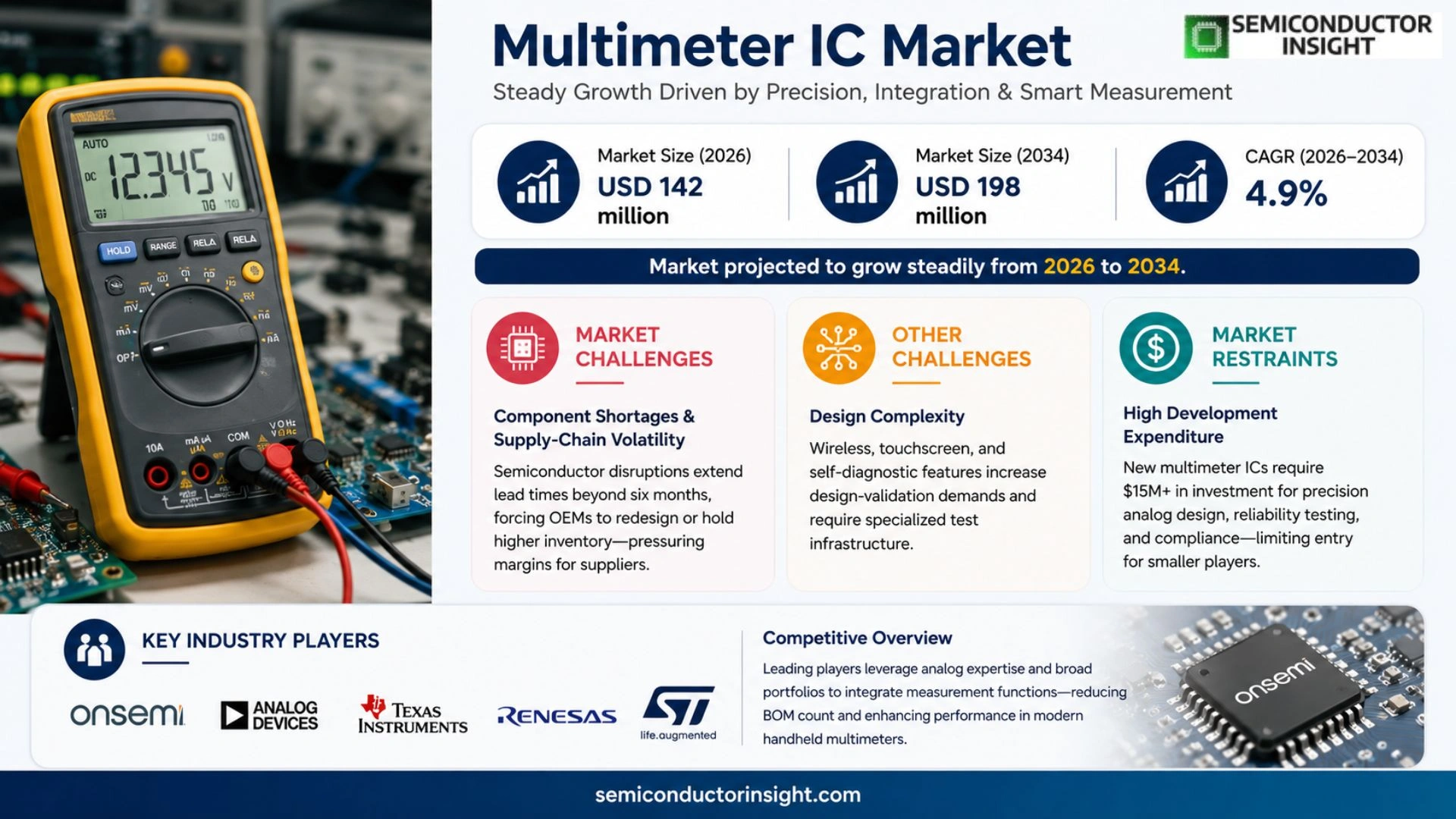
Multimeter IC market is projected to grow from USD 142 million in 2026 to USD 198 million by 2034, exhibiting a CAGR of 4.9% during the forecast period.
A multimeter integrated circuit consolidates processing functions such as jitter suppression, signal pickup mitigation, on/off switching, back‑light delay control, test sequencing and buzzer drive into a single silicon die. By eliminating discrete peripherals, the chip reduces bill‑of‑materials cost while enhancing reliability; average unit pricing stood at roughly USD 6 per chip for an estimated production volume of 26 million units in 2025.
The sector’s expansion is fueled by rising demand for compact, low‑power measurement tools across industrial and consumer electronics, coupled with advances in analog‑mixed‑signal design and high‑precision packaging. Concentration remains high among established suppliers,Onsemi, Texas Instruments, and domestic players such as Hong Kang Technology and Hangzhou Jinghua Microelectronics. Ongoing trends toward AI‑enabled diagnostics, IoT connectivity and energy‑efficient architectures are prompting manufacturers to pursue higher integration levels and stronger anti‑interference capabilities.
MARKET DRIVERS
Rising Adoption of Portable Test Equipment
Multimeter IC market benefits from a steady influx of field technicians who require lightweight, high‑precision instruments. As manufacturers embed more functionality into a single chip, device size shrinks while measurement accuracy improves, prompting procurement teams to replace legacy modules with newer, integrated solutions.
Stringent Regulatory Requirements
Global safety and emissions standards now mandate tighter tolerance levels for voltage and current measurements. Companies that can deliver ICs meeting those thresholds gain a competitive edge, because certification costs for end‑products rise dramatically when a design fails to comply.
➤ Integrating analog front‑end and digital processing reduces bill‑of‑materials by up to 30 % while preserving performance, a compelling value proposition for OEMs.
Beyond compliance, the push toward energy‑efficient appliances amplifies demand for multimeter ICs that support low‑power modes. Designers exploit these features to extend battery life in smart home devices, thereby feeding back into the market’s growth cycle.
MARKET CHALLENGES
Component Shortages and Supply‑Chain Volatility
Recent disruptions in semiconductor fabrication have narrowed the availability of high‑precision analog components. When lead times extend beyond six months, OEMs are forced to redesign products or accept higher inventory costs, which erodes margins for multimeter IC suppliers.
Other Challenges
Design Complexity
Modern multimeters now integrate wireless connectivity, touchscreen interfaces, and self‑diagnostic algorithms. Each added function raises the design‑validation burden, requiring specialized test rigs that many midsize firms cannot justify.
MARKET RESTRAINTS
High Development Expenditure
Bringing a new multimeter IC from concept to volume production often exceeds $15 million, driven by the need for precision analog layout, extensive reliability testing, and compliance verification. Smaller players lack the capital to sustain such programs, which narrows the competitive field and slows the entry of novel architectures.
MARKET OPPORTUNITIES
Automotive Electrification and On‑Board Diagnostics
The shift toward electric vehicles introduces a new class of high‑voltage measurement requirements. Multimeter ICs capable of handling 800 V ranges while delivering millivolt resolution are in short supply, presenting a clear opening for vendors that can certify safety‑critical performance.
Multimeter IC Market Trends
Integration and Power Efficiency Drive Design Evolution
The latest production data show that roughly 26 million units were fabricated in 2025, with an average selling price of about US$ 6 per chip. By embedding processing, jitter suppression, back‑light control and buzzer drive functions on a single die, the multimeter IC eliminates several peripheral components. This consolidation translates directly into lower bill‑of‑materials and a tighter reliability envelope, which in turn benefits OEMs that assemble portable testing equipment. The price‑performance balance created by this integration is reshaping buying criteria across Multimeter IC market, prompting design teams to prioritize chips that deliver both reduced power draw and higher accuracy without sacrificing manufacturability.
Other Trends
Manufacturing Complexity and Cost Management
The analog‑mixed‑signal nature of these chips obliges manufacturers to run more than twenty tightly controlled wafer‑process steps, from photolithography and ion implantation to thin‑film deposition and final packaging. Such depth of process adds overhead that can erode margins, especially when capacity utilisation fluctuates. Leading suppliers located in Europe, North America and Japan have responded by consolidating fab assets and investing in advanced packaging technologies that squeeze additional functionality into the same footprint. For smaller domestic players, the capital intensity of the flow forces strategic partnerships with upstream silicon‑wafer vendors, a dynamic that is reshaping the competitive topology of Multimeter IC market.
Emerging Application Segments Expand Demand
Rapid adoption of artificial‑intelligence edge nodes, 5G‑enabled sensors and automotive diagnostics is creating a pronounced appetite for multimeter chips that combine nanowatt‑level power consumption with sub‑percent measurement error. Internet‑of‑Things devices, in particular, require a sensor interface that can remain dormant for long periods yet deliver instant, high‑precision reads when activated. This shift is prompting design houses to explore chiplet‑based architectures and heterogeneous integration, which promise to accelerate time‑to‑market while keeping unit costs in check. Companies that can align their product roadmaps with these emerging use cases are likely to capture a disproportionate share of future revenue streams within Multimeter IC market.
COMPETITIVE LANDSCAPE
Key Industry Players
Multimeter IC Market – Competitive Overview
The multimeter IC arena is dominated by a handful of global powerhouses whose breadth of analog‑mixed‑signal portfolios allows them to embed measurement functionality directly into handheld devices. Onsemi leverages its extensive analog expertise to deliver integrated chips that combine jitter suppression, backlight control and buzzer drive, thereby reducing board‑level component count. Texas Instruments follows a similar strategy, monetizing its deep design‑for‑test capabilities to capture OEM contracts in North America and Europe. Renesas Electronics adds a strong automotive pedigree, positioning its devices as the preferred choice for rugged, low‑power field instruments. Together these firms command a sizable share of the $198 million market forecast for 2034, shaping pricing benchmarks and setting the technical bar for accuracy and interference immunity.
Beyond the three tier‑one firms, a diverse set of specialized players is expanding the competitive perimeter. Analog Devices and Maxim Integrated focus on ultra‑low‑power architectures tailored for IoT meters, while NXP and STMicroelectronics provide mixed‑signal solutions that integrate wireless connectivity for next‑generation smart tools. Emerging Asian manufacturers such as Hong Kang Technology, Hangzhou Jinghua Microelectronics, HYCON Technology, and Wuxi Semifree Microelectronics are increasingly competitive on cost, exploiting regional supply‑chain efficiencies to serve high‑volume domestic markets. The presence of niche innovators like 3PEAK, which emphasizes high‑resolution ADCs, adds depth to the ecosystem and forces incumbents to accelerate feature upgrades.
List of Key Multimeter IC Companies Profiled
- Onsemi
- Texas Instruments
- Renesas Electronics
- Analog Devices
- Maxim Integrated
- NXP Semiconductors
- STMicroelectronics
- 3PEAK
- Hong Kang Technology
- Hangzhou Jinghua Microelectronics
- HYCON Technology
- Wuxi Semifree Microelectronics
- China Resources Microelectronics
- Hangzhou SDIC Microelectronics
Segment Analysis:
| Segment Category | Sub-Segments | Key Insights |
| By Type |
|
Automatic Measurement
|
| By Application |
|
Commercial
|
| By End User |
|
OEM Manufacturers
|
| By Technology |
|
Mixed‑Signal Integration
|
| By Market Trend |
|
Advanced Packaging
|
Regional Analysis: Multimeter IC Market
North America
The concentration of R&D centres in Silicon Valley and Boston fuels a cycle of rapid prototyping, where novel mixed‑signal blocks are tested within months, lowering time‑to‑market for next‑generation multimeter ICs.
Near‑shore fabs in Canada and Mexico provide redundancy, allowing manufacturers to shift production quickly in response to logistic disruptions, thus preserving service levels for OEMs.
Harmonised UL/IEC testing procedures streamline certification, encouraging firms to embed advanced safety features in ICs without incurring prohibitive compliance costs.
Large industrial customers co‑develop firmware‑tuned analog front ends, ensuring that IC specifications match niche voltage‑range requirements across sectors like automotive testing.
Asia‑Pacific
The Asia‑Pacific region is emerging as a manufacturing powerhouse, leveraging cost‑effective fabs in Taiwan and South Korea. Local OEMs benefit from a dense network of component distributors, which shortens lead times for multimeter ICs. Yet, market fragmentation persists: while Japan focuses on high‑precision devices for semiconductor testing, China invests heavily in volume‑oriented products for construction and utilities. The divergent strategies create pockets of opportunity, prompting global vendors to adopt region‑specific road‑maps that balance performance with price sensitivity.
Europe
Europe’s Multimeter IC landscape is shaped by stringent energy‑efficiency standards and a strong tradition of electrical safety. German engineering firms demand ICs that can withstand extreme temperature swings, prompting suppliers to introduce ruggedized packages. Meanwhile, the EU’s push for circular economy practices encourages modular designs that enable end‑of‑life recycling. These regulatory pressures compel manufacturers to embed diagnostic self‑test capabilities within ICs, adding value for European multimeter makers seeking compliance and brand differentiation.
South America
In South America, market growth is driven by expanding infrastructure projects and a growing renewable‑energy sector. Brazil’s investment in smart‑grid technology creates a demand for multimeters that can accurately measure power quality, nudging IC vendors toward higher‑resolution analog‑to‑digital converters. However, import tariffs and currency volatility impose cost constraints, leading local assemblers to favour versatile ICs that can serve multiple measurement functions within a single chip.
Middle East & Africa
The Middle East & Africa region is characterised by rapid urbanisation and increasing adoption of oil‑field instrumentation. Multimeter ICs that can operate reliably in high‑temperature, dust‑laden environments are prized, prompting suppliers to develop hardened silicon die and protective packaging. In North Africa, emerging telecom networks demand precise voltage monitoring, encouraging a modest but steady transition toward digitally calibrated ICs that support remote firmware updates.
Report Scope
This market research report provides a comprehensive analysis of the Multimeter IC Market , covering the forecast period 2026–2034. It offers detailed insights into market dynamics, technological advancements, competitive landscape, and key trends shaping the industry.
Key focus areas of the report include:
- Market Overview: The report begins with an overview outlining its current market scenario, key growth indicators, and industry transformation drivers. It discusses macroeconomic factors, demand–supply balance, regulatory landscape, and the strategic role of semiconductors in powering advancements across industries such as automotive, telecommunications, consumer electronics, and industrial automation.
- Market Size & Forecast: Historical data and future projections for revenue, unit shipments, and market value across major regions and segments.
- Segmentation Analysis: Detailed breakdown by product type, technology, application, and end-user industry to identify high-growth segments and investment opportunities.
- Regional Insights: Insights into market performance across North America, Europe, Asia-Pacific, Latin America, and the Middle East & Africa, including country-level analysis where relevant.
- Competitive Landscape: Profiles of leading market participants, including their product offerings, R&D focus, manufacturing capacity, pricing strategies, and recent developments such as mergers, acquisitions, and partnerships.
- Technology Trends & Innovation: Assessment of emerging technologies, integration of AI/IoT, semiconductor design trends, fabrication techniques, and evolving industry standards.
- Market Drivers & Restraints: Evaluation of factors driving market growth along with challenges, supply chain constraints, regulatory issues, and market-entry barriers.
- Stakeholder Insights: Insights for component suppliers, OEMs, system integrators, investors, and policymakers regarding the evolving ecosystem and strategic opportunities.
Primary and secondary research methods are employed, including interviews with industry experts, data from verified sources, and real-time market intelligence to ensure the accuracy and reliability of the insights presented.
FREQUENTLY ASKED QUESTIONS:
What is the current market size of Multimeter IC Market?
-> Multimeter IC market is projected to grow from USD 142 million in 2026 to USD 198 million by 2034, exhibiting a CAGR of 4.9% during the forecast period.
Which key companies operate in Multimeter IC Market?
-> Key players include Onsemi, Texas Instruments, Hong Kang Technology, Hangzhou Jinghua Microelectronics, among others.
What are the key growth drivers?
-> Key growth drivers include rising demand for high‑performance, low‑power chips in AI, 5G, IoT and automotive electronics, as well as the need for higher accuracy, integration and anti‑interference capabilities in multimeter ICs, and the push for low‑power portable designs.
Which region dominates the market?
-> Europe and North America hold the largest market share, with strong concentration of manufacturers and high adoption rates, while Asia‑Pacific shows rapid growth potential.
What are the emerging trends?
-> Emerging trends include greater integration of functions, enhanced anti‑interference designs, low‑power architectures, chiplet technology and advanced packaging to improve performance and cost efficiency.

Get Sample Report PDF for Exclusive Insights
Report Sample Includes
- Table of Contents
- List of Tables & Figures
- Charts, Research Methodology, and more...