Market Insights
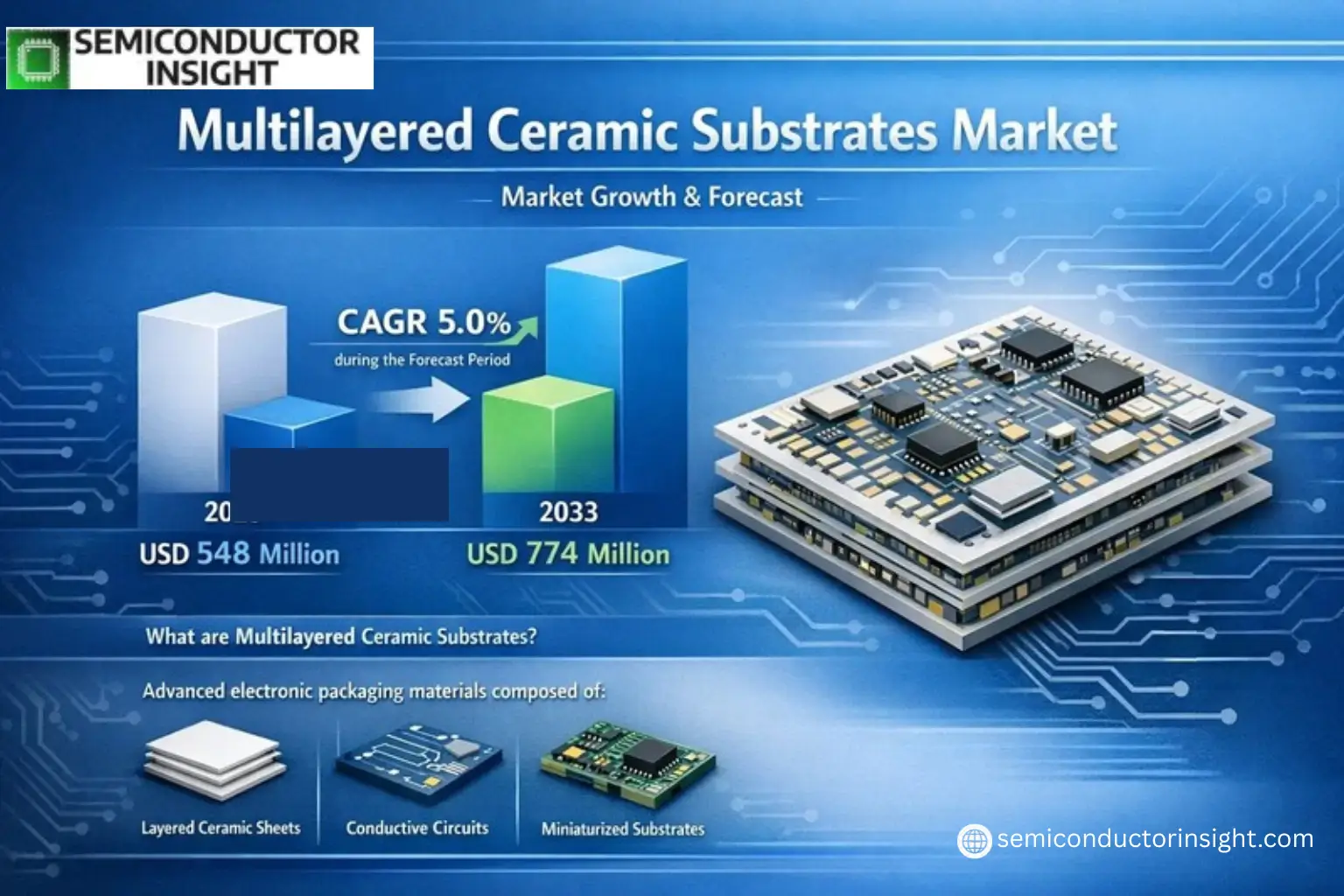
Global Multilayered Ceramic Substrates Market was valued at USD 548 million in 2025 and is projected to reach USD 774 million by 2033, exhibiting a CAGR of 5.0% during the forecast period.
Multilayered Ceramic Substrates are advanced electronic packaging materials composed of multiple layers of ceramic sheets that are stacked, patterned with conductive circuits, and co-fired to form highly integrated, miniaturized substrates. These substrates serve as platforms for mounting and interconnecting active and passive electronic components in a compact form factor. Based on firing temperatures and materials, they are primarily divided into Low Temperature Co-fired Ceramic (LTCC) and High Temperature Co-fired Ceramic (HTCC) types.
The market growth is driven by increasing demand for high-performance electronics in sectors such as telecommunications, automotive, aerospace, and industrial applications. The rise of 5G technology, autonomous vehicles, and IoT devices has further accelerated adoption due to their superior thermal management, electrical insulation, and reliability. Key players like Kyocera, Murata Manufacturing, and NGK/NTK dominate the market with continuous innovations in material science and manufacturing processes.
MARKET DRIVERS
Growing Demand in Electronics Industry
Multilayered Ceramic Substrates Market is primarily driven by the rapid expansion of the electronics sector, particularly in telecommunications and automotive applications. With the increasing miniaturization of electronic components, these substrates provide superior thermal management and high-frequency performance, making them indispensable in modern devices.
Advancements in 5G Technology
Global rollout of 5G networks has significantly boosted demand for multilayered ceramic substrates, as they are critical for high-frequency signal transmission in base stations and RF modules. The market is projected to grow at approximately 8.2% CAGR through 2028, fueled by telecom infrastructure investments.
The automotive industry’s shift toward electric vehicles and ADAS technologies further accelerates demand, as these substrates enable reliable performance in harsh operating conditions.
MARKET CHALLENGES
High Manufacturing Complexity
Producing multilayered ceramic substrates requires precision engineering and controlled environments, leading to significant capital expenditure for manufacturers. The sintering process alone accounts for nearly 35% of production costs, creating barriers for new entrants.
Other Challenges
Supply Chain Vulnerabilities
Raw material shortages, particularly for specialized ceramic powders, have caused price volatility across the Multilayered Ceramic Substrates Market. Geopolitical factors further exacerbate these supply disruptions.
MARKET RESTRAINTS
Competition from Alternative Substrates
Despite their advantages, multilayered ceramic substrates face competition from organic substrates and metal-core PCBs in cost-sensitive applications. Price pressure remains a key restraint, with some manufacturers opting for hybrid solutions to balance performance and cost.
MARKET OPPORTUNITIES
Emerging Applications in Power Electronics
The renewable energy sector presents substantial growth potential for multilayered ceramic substrates, particularly in solar inverters and wind turbine converters. Their ability to handle high voltages and temperatures positions them as ideal solutions for next-generation power modules.
Multilayered Ceramic Substrates Market Trends
5G and Automotive Electronics Driving Market Growth
Global Multilayered Ceramic Substrates Market, valued at USD 548 million in 2025, is projected to reach USD 774 million by 2033, growing at a 5.0% CAGR. This growth is primarily fueled by increasing demand in 5G infrastructure and advanced automotive electronics. LTCC substrates are witnessing significant adoption in mmWave applications for 5G base stations, while HTCC substrates are gaining traction in electric vehicle power modules due to their thermal stability.
Other Trends
Technological Advancements in Material Science
Manufacturers are focusing on developing ultra-thin dielectric layers and low-loss ceramic formulations to meet the demands of high-frequency applications. Recent innovations include substrates with improved thermal conductivity for power electronics and advanced compositions for better RF performance in communication systems.
Regional Competitive Landscape Shifts
While Japanese manufacturers like Kyocera and Murata currently dominate the market, Chinese and South Korean companies are rapidly expanding their production capabilities. This regional competition is driving cost reductions and spurring innovation in manufacturing processes, particularly for high-volume consumer electronics applications.
Supply Chain Optimization Strategies
Recent geopolitical tensions and tariff policies have prompted multinational companies to reevaluate their supply chains. Many manufacturers are establishing localized production facilities to mitigate risks, particularly in North America and Europe where demand for automotive and aerospace-grade substrates is growing steadily.
Sustainability and Regulatory Compliance
The industry is increasingly focusing on eco-friendly manufacturing processes and materials to comply with evolving environmental regulations. This includes development of lead-free compositions and energy-efficient production methods, particularly among European and Japanese manufacturers targeting premium market segments.
COMPETITIVE LANDSCAPE
Key Industry Players
Global Multilayered Ceramic Substrates Market: Dominance and Differentiation Strategies
Global Multilayered Ceramic Substrates Market is characterized by the dominance of Japanese players like Kyocera, Murata Manufacturing, and NGK/NTK, which collectively hold over 45% market share. These established manufacturers maintain leadership through advanced LTCC/HTCC technologies, vertical integration of ceramic materials production, and strategic partnerships with semiconductor giants. Kyocera leads in high-reliability HTCC substrates for aerospace and automotive, while Murata dominates RF-focused LTCC solutions for 5G applications.
Emerging Asian manufacturers, particularly Chinese firms like CETC 43rd Institute and Fenghua Advanced Technology, are rapidly gaining traction through government-backed R&D initiatives and cost-competitive production. European specialists such as IMST GmbH and NEO Tech focus on niche applications in medical and defense sectors, leveraging precision engineering capabilities. The market also sees increasing participation from Korean players like KOA (Via Electronic) in automotive electronics substrates.
List of Key Multilayered Ceramic Substrates Companies Profiled
- Kyocera
- Murata Manufacturing
- NGK/NTK
- Maruwa
- Yokowo
- KOA (Via Electronic)
- Proterial, Ltd
- Adamant Namiki
- IMST GmbH
- NEO Tech
- CETC 43rd Institute
- Fenghua Advanced Technology
- BDStar (Glead)
- Elit Fine Ceramics
- Shanghai Zenfocus Semi-Tech
Segment Analysis:
| Segment Category | Sub-Segments | Key Insights |
| By Type |
|
LTCC Ceramic Substrates are witnessing accelerated adoption due to:
|
| By Application |
|
Automobile Electronics represents the most dynamic growth area driven by:
|
| By End User |
|
OEMs dominate procurement due to:
|
| By Material Composition |
|
Aluminum Nitride substrates are gaining prominence because:
|
| By Technology Trend |
|
Advanced 3D Integration represents the technological frontier featuring:
|
Regional Analysis: Asia-Pacific Multilayered Ceramic Substrates Market
China: The Manufacturing Powerhouse
The Pearl River Delta region hosts the world’s largest concentration of electronics manufacturers dependent on multilayered ceramic substrates. This cluster drives innovation in substrate designs for consumer electronics applications.
China’s aggressive 5G rollout creates strong demand for high-frequency ceramic substrates. Domestic producers are developing specialized materials to meet the unique requirements of 5G base station components.
The booming electric vehicle market stimulates demand for ceramic substrates in power electronics. Local manufacturers are partnering with automakers to develop customized solutions for battery management systems.
Chinese research institutions are making breakthroughs in low-temperature co-fired ceramic (LTCC) technologies, reducing energy consumption in substrate production while maintaining performance standards.
Japan
Japan remains the technology leader in high-performance multilayered ceramic substrates, with companies like Kyocera and Murata Manufacturing setting global quality benchmarks. The market benefits from strong R&D capabilities and precision manufacturing traditions. Japanese producers focus on premium substrates for aerospace and medical applications, maintaining technical superiority through continuous material innovations.
South Korea
South Korea’s market thrives on its advanced semiconductor and display industries. The presence of electronics giants like Samsung creates steady demand for specialized ceramic substrates. Korean manufacturers excel in producing ultra-thin substrates for mobile devices and are investing heavily in next-generation packaging technologies.
Taiwan
Taiwan’s strategic position in the global electronics supply chain makes it a crucial market for ceramic substrates. The island’s foundries and packaging houses require increasingly sophisticated substrates to support advanced chip designs, driving local material innovation cycles.
India
India’s market shows the fastest growth potential in the region, fueled by expanding electronics manufacturing and government incentives. While currently import-dependent, domestic production capabilities are developing rapidly, particularly for automotive and industrial applications.
Report Scope
This market research report provides a comprehensive analysis of the Multilayered Ceramic Substrates Market , covering the forecast period 2025–2033. It offers detailed insights into market dynamics, technological advancements, competitive landscape, and key trends shaping the industry.
Key focus areas of the report include:
- Market Overview: The report begins with an overview outlining its current market scenario, key growth indicators, and industry transformation drivers. It discusses macroeconomic factors, demand–supply balance, regulatory landscape, and the strategic role of semiconductors in powering advancements across industries such as automotive, telecommunications, consumer electronics, and industrial automation.
- Market Size & Forecast: Historical data and future projections for revenue, unit shipments, and market value across major regions and segments.
- Segmentation Analysis: Detailed breakdown by product type, technology, application, and end-user industry to identify high-growth segments and investment opportunities.
- Regional Insights: Insights into market performance across North America, Europe, Asia-Pacific, Latin America, and the Middle East & Africa, including country-level analysis where relevant.
- Competitive Landscape: Profiles of leading market participants, including their product offerings, R&D focus, manufacturing capacity, pricing strategies, and recent developments such as mergers, acquisitions, and partnerships.
- Technology Trends & Innovation: Assessment of emerging technologies, integration of AI/IoT, semiconductor design trends, fabrication techniques, and evolving industry standards.
- Market Drivers & Restraints: Evaluation of factors driving market growth along with challenges, supply chain constraints, regulatory issues, and market-entry barriers.
- Stakeholder Insights: Insights for component suppliers, OEMs, system integrators, investors, and policymakers regarding the evolving ecosystem and strategic opportunities.
Primary and secondary research methods are employed, including interviews with industry experts, data from verified sources, and real-time market intelligence to ensure the accuracy and reliability of the insights presented.
FREQUENTLY ASKED QUESTIONS:
What is the current market size of Multilayered Ceramic Substrates Market?
-> Multilayered Ceramic Substrates Market was valued at USD 548 million in 2025 and is projected to reach USD 774 million by 2033, exhibiting a CAGR of 5.0% during the forecast period.
What is the expected CAGR for Multilayered Ceramic Substrates Market?
-> The market is expected to grow at a CAGR of 5.0% during the forecast period (2025-2033).
Which key companies operate in Multilayered Ceramic Substrates Market?
-> Key players include Kyocera, Murata Manufacturing, NGK/NTK, Maruwa, NIKKO COMPANY, and NEO Tech, among others.
What are the key segments of Multilayered Ceramic Substrates?
-> The market is segmented by type into HTCC Ceramic Substrates and LTCC Ceramic Substrates, and by application into Industrial & Consumer Electronics, Aerospace & Military, Optical Communication Package, and Automobile Electronics.
Which region dominates the Multilayered Ceramic Substrates Market?
-> Asia is the dominant market, with key contributions from China, Japan, and South Korea.

Get Sample Report PDF for Exclusive Insights
Report Sample Includes
- Table of Contents
- List of Tables & Figures
- Charts, Research Methodology, and more...
 Download Sample Report PDF