MARKET INSIGHTS
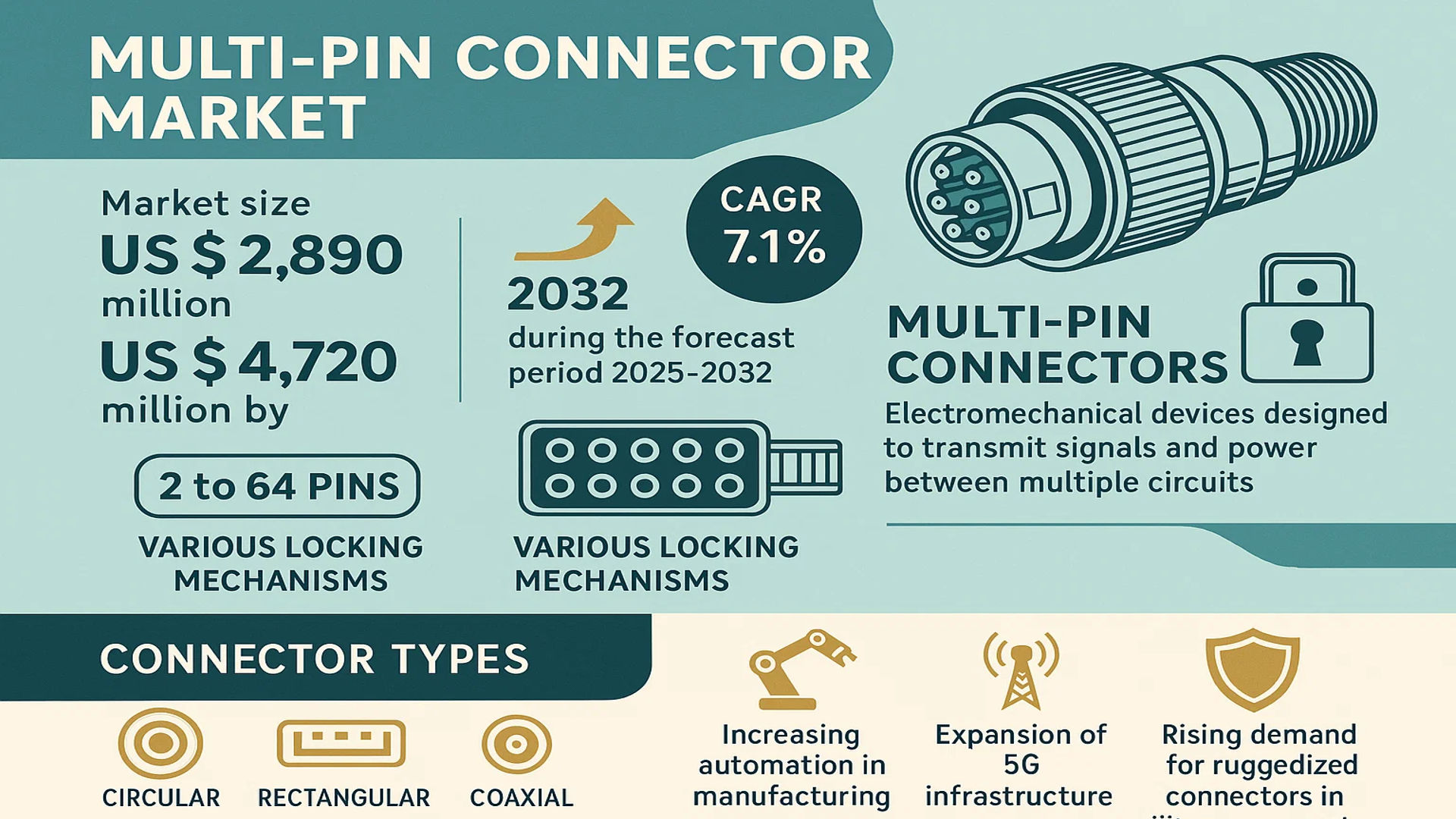
The global Multi Pin Connector Market size was valued at US$ 2,890 million in 2024 and is projected to reach US$ 4,720 million by 2032, at a CAGR of 7.1% during the forecast period 2025-2032.
Multi pin connectors are electromechanical devices designed to transmit signals and power between multiple circuits. These connectors facilitate secure and efficient electrical connections in harsh environments, featuring configurations ranging from 2 to 64 pins with various locking mechanisms. Key types include circular, rectangular, and coaxial connectors, with applications spanning industrial automation, telecommunications, and defense sectors.
Market growth is driven by increasing automation in manufacturing, expansion of 5G infrastructure, and rising demand for ruggedized connectors in military applications. The male connector segment accounted for over 60% market share in 2024, with industrial applications representing 42% of total consumption. Leading manufacturers like Amphenol, TE Connectivity, and Molex are investing in miniaturized and high-speed connector solutions to meet evolving industry requirements.
MARKET DYNAMICS
MARKET DRIVERS
Rising Demand for High-Performance Connectivity Solutions in Industrial and Automotive Sectors
The multi pin connector market is experiencing robust growth, primarily driven by increasing demand from industrial automation and automotive sectors. As industrial facilities transition towards Industry 4.0, there is a growing need for reliable, high-speed connectivity solutions that can withstand harsh environments. Multi pin connectors, with their ability to transmit power and data simultaneously while resisting vibrations and extreme temperatures, have become critical components in manufacturing equipment and robotics. This trend is further amplified by the automotive industry’s shift toward electric vehicles, where battery management systems and charging infrastructure heavily rely on robust multi pin connectors.
Technological Advancements in Miniaturization and High-Speed Data Transmission
Continued innovation in connector design is propelling market expansion. Manufacturers are developing compact, high-density multi pin connectors capable of handling increased data rates to meet the demands of 5G networks, IoT devices, and advanced medical equipment. These next-generation connectors maintain signal integrity while reducing footprint, making them ideal for space-constrained applications in aerospace and telecommunications. The market has observed a notable shift toward modular connector systems, allowing for customizable pin configurations that can be adapted for specialized applications. This flexibility is particularly valuable in defense systems and renewable energy installations where customized connectivity solutions are often required.
MARKET RESTRAINTS
Intense Competition and Price Sensitivity in Standardized Connector Segments
The multi pin connector market faces significant pricing pressures, particularly in standardized product categories where differentiation is minimal. Many connector types have become commoditized, leading to intensified competition among manufacturers and shrinking profit margins. While premium sectors like aerospace and medical devices continue to command higher prices for specialized connectors, industrial and consumer applications are increasingly price-driven. This dynamic makes it challenging for manufacturers to justify investments in R&D and advanced manufacturing capabilities without guaranteed returns, potentially slowing the pace of innovation in certain market segments.
Supply Chain Vulnerabilities for Rare Earth Materials
Multi pin connector production relies on specialized materials including high-performance alloys and rare earth metals, creating supply chain vulnerabilities. Geopolitical tensions and export restrictions on critical raw materials have led to price volatility and occasional shortages. The industry is particularly sensitive to disruptions in the nickel, copper, and gold markets—essential materials for connector contacts and plating. These challenges are compounded by regional concentration of mining operations and refining capacity, forcing manufacturers to either absorb cost increases or pass them to customers, potentially slowing market adoption in price-sensitive applications.
MARKET OPPORTUNITIES
Emerging Applications in Renewable Energy Infrastructure
The global transition to renewable energy presents significant growth opportunities for multi pin connector manufacturers. Large-scale solar farms, wind turbine installations, and energy storage systems require durable, high-current connectors capable of withstanding outdoor environmental conditions. The offshore wind sector, in particular, demands connectors with exceptional corrosion resistance and reliability, creating a premium market segment. Furthermore, smart grid implementations are driving demand for connectors that can integrate sensors and communication capabilities, enabling real-time monitoring of energy infrastructure.
Expansion of Robotics and Automated Manufacturing Systems
As factories worldwide accelerate automation to address labor shortages and improve efficiency, multi pin connectors are seeing increased adoption in robotic systems and automated guided vehicles (AGVs). Modern robotic workcells require high-density connectors that can handle both power distribution and high-speed data communication between sensors, controllers, and end effectors. The growing complexity of collaborative robots (cobots) that work alongside human operators creates additional demand for safety-rated connectors with advanced shielding and locking mechanisms. This sector is expected to maintain strong growth as manufacturing becomes increasingly flexible and automated.
MARKET CHALLENGES
Rapid Technological Obsolescence and Design Complexity
The connector industry faces mounting challenges from accelerating technology cycles. Traditional connector designs developed for previous-generation equipment often become obsolete before manufacturers can recoup development costs. This is particularly evident in data center and telecommunications applications where connector standards evolve rapidly to accommodate higher bandwidth requirements. The transition to 400G and 800G Ethernet, for example, has rendered some established connector types inadequate, forcing costly redesigns. This dynamic places significant pressure on R&D budgets and requires manufacturers to carefully balance innovation with backward compatibility.
Stringent Regulatory Compliance Across Multiple Industries
Multi pin connector manufacturers must navigate an increasingly complex regulatory landscape that varies by industry and geography. The medical sector imposes strict biocompatibility requirements, while automotive connectors must meet rigorous vibration and temperature cycling standards. Aerospace applications demand connectors certified to DO-160 or similar standards for electromagnetic compatibility and environmental resilience. These compliance requirements significantly extend product development timelines and testing costs. Additionally, evolving environmental regulations regarding restricted substances and recyclability are prompting complete re-engineering of connector materials and manufacturing processes across the industry.
MULTI PIN CONNECTOR MARKET TRENDS
Industry 4.0 and Smart Manufacturing Driving Demand for High-Performance Connectors
The rapid adoption of Industry 4.0 and smart manufacturing technologies has significantly increased demand for multi-pin connectors in industrial automation systems. These connectors play a critical role in ensuring reliable data and power transmission across complex machinery, robotic systems, and IoT-enabled devices. The growing emphasis on miniaturization while maintaining high signal integrity has led manufacturers to develop compact yet robust multi-pin solutions capable of handling higher data rates. Additionally, the emergence of 5G-enabled industrial applications has created new requirements for connectors that can support faster communication protocols while withstanding harsh factory environments.
Other Trends
Electrification Across Transportation Sectors
The global shift toward vehicle electrification is creating substantial opportunities for multi-pin connector manufacturers, particularly in automotive and aerospace applications. Electric vehicle production growth, projected to surpass 30 million units annually by 2030, requires specialized connectors for battery management systems and charging infrastructure. Similarly, the aerospace sector’s transition toward more-electric aircraft architectures has increased demand for lightweight, high-reliability connector solutions that can withstand extreme vibration and temperature conditions while ensuring flawless signal transmission in critical flight systems.
Renewable Energy Expansion Fueling Market Growth
The renewable energy sector has emerged as a key growth driver for multi-pin connectors, particularly in solar and wind power applications. As global investments in renewable energy infrastructure continue to rise, connectors must meet increasingly stringent requirements for outdoor durability and electrical performance. In wind turbines, for instance, multi-pin solutions enable reliable power transmission from nacelles to control systems while resisting harsh environmental factors like moisture, salt spray, and temperature fluctuations. Solar farm installations similarly demand connector solutions that maintain performance over decades of exposure to UV radiation and weather extremes, creating opportunities for innovation in material science and contact technology.
COMPETITIVE LANDSCAPE
Key Industry Players
Leading Players Focus on Innovation and Global Expansion to Capture Market Share
The global multi-pin connector market exhibits a highly competitive yet fragmented landscape, with established manufacturers and emerging players vying for dominance through technological advancements and strategic partnerships. Lemo SA emerges as a prominent leader, leveraging its Swiss precision engineering and extensive portfolio of rugged connectors—particularly in medical, industrial, and defense applications. The company’s global distribution network and focus on customization have cemented its position, especially in Europe and North America.
Amphenol Corporation and Hirose Electric Co., Ltd. also command substantial market share, driven by their diversified product lines tailored for high-performance environments like aerospace, automotive, and telecommunications. These companies excel in miniaturization and high-speed data transmission capabilities, aligning with the growing demand for compact, high-density connectors in IoT and 5G infrastructure.
Meanwhile, Neutrik AG and Radiall are strengthening their footholds through targeted innovations such as moisture-resistant and EMI-shielded connectors, catering to the oil & gas and marine sectors. The market is witnessing a surge in R&D investments to develop connectors with higher durability and lower insertion loss, particularly for harsh environments.
While pricing pressures remain a challenge, differentiation through material science (e.g., composite housings) and sustainability initiatives (e.g., lead-free plating) are becoming key competitive levers. Mergers, such as TE Connectivity’s strategic acquisitions, further intensify the race for market consolidation.
List of Key Multi-Pin Connector Manufacturers Profiled
- Lemo SA (Switzerland)
- Amphenol Corporation (U.S.)
- Hirose Electric Co., Ltd. (Japan)
- Neutrik AG (Liechtenstein)
- Radiall (France)
- TE Connectivity (Switzerland)
- Switchcraft (U.S.)
- Telegärtner Group (Germany)
- EDAC Inc. (U.S.)
- Eaton Corporation (Ireland)
Segment Analysis:
By Type
Male Connector Segment Leads Due to Widespread Use in Industrial and Harsh Environment Applications
The market is segmented based on type into:
- Male Connector
- Female Connector
By Application
Industrial Segment Dominates Owing to High Demand for Reliable Connectivity in Manufacturing Processes
The market is segmented based on application into:
- Mining
- Industrial
- Ocean
- Others
By End-User
Manufacturing Sector Accounts for Significant Share Due to Automation and Industry 4.0 Adoption
The market is segmented based on end-user into:
- Automotive
- Electronics
- Energy & Power
- Aerospace & Defense
- Others
Regional Analysis: Multi Pin Connector Market
Asia-Pacific
Asia-Pacific dominates the global multi-pin connector market, driven by China and India, where rapid industrialization and extensive manufacturing activities fuel demand. The region benefits from large-scale infrastructure projects and robust electronics production hubs, particularly in China, Japan, and South Korea. The demand is further amplified by the growing adoption of automation and Industry 4.0 technologies, requiring reliable high-density connectors for industrial applications. Despite cost sensitivity favoring conventional connectors, increasing investments in aerospace, telecommunications, and automotive sectors are pushing the market toward advanced, high-performance solutions.
North America
North America remains a key revenue generator due to technological advancements and significant investments in defense, medical, and aerospace sectors. The U.S. accounts for the majority of regional demand, supported by stringent performance standards and high adoption of modular connector systems in data centers and telecommunications. Leading manufacturers such as Amphenol and TE Connectivity focus on innovation, driving the adoption of miniaturized and ruggedized connectors for harsh environments. Government initiatives in infrastructure modernization, including 5G deployment, further support market expansion.
Europe
Europe’s market is characterized by a strong emphasis on sustainability and regulatory compliance, particularly in Germany and France. The region’s well-established automotive and renewable energy sectors require high-durability multi-pin connectors for electric vehicle (EV) charging systems and wind turbines. European manufacturers prioritize low-environmental-impact materials and circular economy principles, influencing product development. However, market growth is tempered by economic uncertainties and the gradual shift toward wireless solutions in some industries, though industrial automation remains a steady driver.
South America
The market in South America is growing steadily, led by Brazil and Argentina, where mining and industrial applications create demand for robust connectors. While economic volatility limits high-end adoption, sectors such as oil & gas and agricultural machinery sustain baseline demand. Local production is limited, making the region reliant on imports, though regional players are gradually expanding capabilities. Price competitiveness remains crucial, with customers prioritizing durability over advanced features.
Middle East & Africa
The Middle East & Africa market is niche but evolving, driven by infrastructure development in the UAE, Saudi Arabia, and South Africa. Oilfield equipment and renewable energy projects generate demand for connectors resistant to extreme conditions. While the market is constrained by lower industrialization levels compared to other regions, long-term growth is expected as smart city initiatives and telecom expansions gain momentum. Partnerships with global suppliers are crucial for technology transfer and supply chain stability in this emerging market.
Report Scope
This market research report provides a comprehensive analysis of the global and regional Multi Pin Connector markets, covering the forecast period 2024–2032. It offers detailed insights into market dynamics, technological advancements, competitive landscape, and key trends shaping the industry.
Key focus areas of the report include:
- Market Size & Forecast: Historical data and future projections for revenue, unit shipments, and market value across major regions and segments. The Global Multi Pin Connector market was valued at US$ 2,890 million in 2024 and is projected to reach US$ 4,720 million by 2032.
- Segmentation Analysis: Detailed breakdown by product type (Male Connector, Female Connector), application (Mining, Industrial, Ocean, Others), and end-user industry to identify high-growth segments and investment opportunities.
- Regional Outlook: Insights into market performance across North America, Europe, Asia-Pacific, Latin America, and the Middle East & Africa, including country-level analysis. The U.S. market size is estimated at USD million in 2024, while China is projected to reach USD million by 2032.
- Competitive Landscape: Profiles of leading market participants including Lemo, Neutrik, Hirose, Amphenol, Ten 47, Edac, Telegartner, Switchcraft, BTX Technologies, Radiall, among others. In 2024, the global top five players held approximately % market share in terms of revenue.
- Technology Trends & Innovation: Assessment of emerging technologies, integration of smart connectivity solutions, and evolving industry standards in multi-pin connector designs.
- Market Drivers & Restraints: Evaluation of factors driving market growth along with challenges, supply chain constraints, regulatory issues, and market-entry barriers.
- Stakeholder Analysis: Insights for component suppliers, OEMs, system integrators, investors, and policymakers regarding the evolving ecosystem and strategic opportunities.
Primary and secondary research methods are employed, including interviews with industry experts, data from verified sources, and real-time market intelligence to ensure the accuracy and reliability of the insights presented.
FREQUENTLY ASKED QUESTIONS:
What is the current market size of Global Multi Pin Connector Market?
-> Multi Pin Connector Market size was valued at US$ 2,890 million in 2024 and is projected to reach US$ 4,720 million by 2032, at a CAGR of 7.1% during the forecast period 2025-2032.
Which key companies operate in Global Multi Pin Connector Market?
-> Key players include Lemo, Neutrik, Hirose, Amphenol, Ten 47, Edac, Telegartner, Switchcraft, BTX Technologies, and Radiall, among others.
What are the key growth drivers?
-> Key growth drivers include increasing industrial automation, rising demand for reliable electrical connections in harsh environments, and growth in mining and marine applications.
Which region dominates the market?
-> Asia-Pacific is the fastest-growing region, while North America remains a significant market due to industrial and technological advancements.
What are the emerging trends?
-> Emerging trends include miniaturization of connectors, development of high-density multi-pin solutions, and increasing adoption of waterproof and corrosion-resistant designs.

Get Sample Report PDF for Exclusive Insights
Report Sample Includes
- Table of Contents
- List of Tables & Figures
- Charts, Research Methodology, and more...
 Download Sample Report PDF