
Market Insights
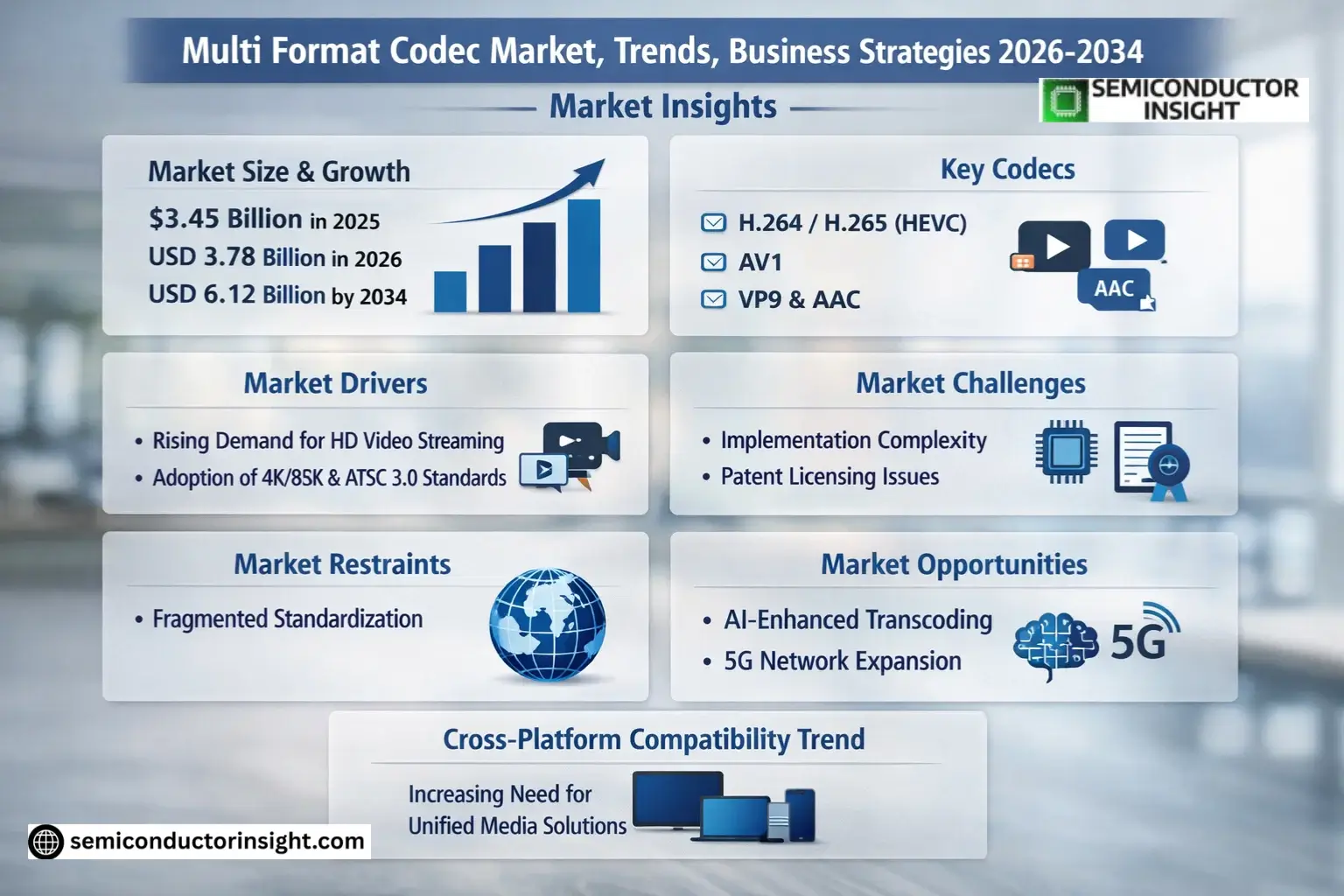
Global Multi Format Codec Market size was valued at USD 3.45 billion in 2025. The market is projected to grow from USD 3.78 billion in 2026 to USD 6.12 billion by 2034, exhibiting a CAGR of 7.2% during the forecast period.
Multi Format Codecs are hardware or software solutions that enable encoding and decoding of multiple audio and video formats, ensuring compatibility across diverse media platforms. These technologies are essential for seamless media processing, playback, and streaming, supporting formats such as H.264, H.265 (HEVC), AV1, VP9, and AAC.
The market growth is driven by increasing demand for high-quality video streaming, rising adoption of 4K/8K content, and advancements in cloud-based media processing. Key players like Socionext, Intel, and Cisco are investing in next-generation codecs to enhance compression efficiency and reduce bandwidth requirements. For instance, in Q1 2024, Intel launched its latest hardware-accelerated AV1 encoder to support real-time 8K video streaming.
MARKET DRIVERS
Growing Demand for High-Quality Video Streaming
Multi Format Codec Market is experiencing significant growth due to the exponential rise in demand for high-definition video streaming across platforms. Over 68% of internet traffic now consists of video content, driving adoption of advanced codecs that support multiple formats efficiently.
Adoption of Next-Gen Broadcasting Standards
Global transition to 4K/8K broadcasting and ATSC 3.0 standards is compelling broadcasters to adopt multi-format codec solutions. These technologies enable seamless format conversion while maintaining optimal bandwidth utilization and visual quality.
Device proliferation across different ecosystems further necessitates multi-format support, with smartphone manufacturers increasingly integrating versatile codec solutions to handle diverse content formats.
MARKET CHALLENGES
Implementation Complexity Across Platforms
Deploying multi-format codec solutions introduces technical challenges related to varying hardware capabilities across devices. Ensuring consistent performance while maintaining low power consumption remains a key industry hurdle.
Other Challenges
Patent Licensing Complexities
Multi Format Codec Market faces ongoing challenges with patent pools and royalty structures, particularly for solutions incorporating HEVC, AV1, and other proprietary technologies.
Computational Resource Requirements
Real-time transcoding across multiple formats demands significant processing power, creating barriers for resource-constrained devices in the Multi Format Codec Market ecosystem.
MARKET RESTRAINTS
Fragmented Standardization Landscape
The coexistence of multiple competing codec standards creates market fragmentation, slowing enterprise adoption. Regional variations in broadcasting requirements further complicate universal multi-format codec deployment strategies.
MARKET OPPORTUNITIES
Emergence of AI-Enhanced Transcoding
Multi Format Codec Market stands to benefit from AI-driven optimization techniques that dynamically select optimal formats and compression parameters. Market leaders are investing heavily in machine learning approaches to enhance multi-format performance.
5G Network Expansion
Global 5G rollout presents substantial opportunities for the Multi Format Codec Market, as mobile operators seek efficient solutions to deliver varied content formats across next-generation networks with minimal latency.
Multi Format Codec Market Trends
Growing Demand for Cross-Platform Compatibility
Multi Format Codec Market industry is experiencing significant growth due to increasing demand for solutions that support diverse audio and video formats. Major manufacturers like Socionext, Sony Semiconductor, and Intel are developing advanced codecs that enable seamless media playback across different platforms and devices. This trend is particularly prominent in commercial applications where unified multimedia processing is essential.
Other Trends
Shift Towards Hardware Acceleration
Hardware-based Multi Format Codecs are gaining traction due to their superior processing capabilities compared to software solutions. Global hardware codec segment continues to expand as demand grows for high-performance media processing in broadcasting, surveillance, and professional video production environments.
Regional Market Developments
The Asia-Pacific region, led by China and Japan, is emerging as a key growth area for Multi Format Codec technology. North America maintains strong demand, particularly from technology hubs in the United States. European markets are showing steady adoption across both residential and commercial sectors, with Germany and the UK leading implementation.
Integration with Emerging Technologies
Multi Format Codec manufacturers are increasingly focusing on compatibility with new technologies like 8K video streaming, VR content, and cloud-based media processing. This integration is creating new opportunities in content delivery networks and streaming platforms.
Industry Consolidation and Partnerships
The competitive landscape is evolving through strategic partnerships and mergers among key players. Companies like Cisco and RealNetworks are expanding their capabilities through acquisitions and technology sharing agreements to deliver comprehensive Multi Format Codec solutions.
COMPETITIVE LANDSCAPE
Key Industry Players
Innovation and Strategic Alliances Shape the Multi Format Codec Market
Global Multi Format Codec Market is dominated by established semiconductor and technology leaders, with Socionext, Sony Semiconductor, and Renesas Electronics collectively holding significant market share. These players leverage their expertise in video processing technologies and strategic partnerships with device manufacturers to maintain leadership positions. The landscape shows increasing vertical integration as chipset manufacturers expand into complete codec solutions.
Niche players like NetPosa Technologies specialize in region-specific optimizations, particularly for Asian markets, while software-focused companies such as RealNetworks compete through adaptive streaming innovations. Emerging competition comes from cloud service providers integrating native codec support into their media processing pipelines. Recent industry trends include accelerated adoption of AV1 codec support alongside traditional formats like H.264 and H.265.
List of Key Multi Format Codec Companies Profiled
- Socionext
- Sony Semiconductor
- Renesas Electronics
- Analog Devices
- Intel
- Cisco Systems
- NetPosa Technologies, Ltd.
- RealNetworks
- Matrox Electronic Systems
- AMD
- NVIDIA Corporation
- Ambarella
- Broadcom Inc.
- Teledyne DALSA
- Xilinx
Segment Analysis:
| Segment Category | Sub-Segments | Key Insights |
| By Type |
|
Hardware Codec dominates due to superior processing power and efficiency in enterprise applications:
|
| By Application |
|
Commercial Applications show strongest adoption driven by diverse format handling needs:
|
| By End User |
|
Media & Entertainment sector demonstrates strongest growth potential:
|
| By Technology |
|
Hybrid Solutions are gaining market preference for balanced performance:
|
| By Integration |
|
Cloud-Based integration shows fastest adoption trajectory:
|
Regional Analysis: Multi Format Codec Market
North America
The region benefits from robust CDN networks and cloud computing infrastructure that enable efficient multi-format codec deployment. Internet service providers actively participate in codec optimization initiatives.
Favorable intellectual property frameworks encourage licensing of newer codec technologies. Standardization bodies actively promote open-source codec adoption among content platforms.
Corporate sector demand grows for unified codec solutions in video conferencing and digital signage. Increasing hybrid work models accelerate needs for efficient multi-format video compression.
Hollywood studios and streaming services invest heavily in next-gen codecs to deliver premium experiences. OTT platforms drive demand for cross-platform compatible encoding solutions.
Europe
Europe follows closely in Multi Format Codec Market adoption with strong emphasis on open standards and interoperability. The region sees growing implementation of AV1 and VVC codecs across broadcast networks and OTT services. EU initiatives promote energy-efficient video compression to align with sustainability goals. Germany and UK emerge as key markets with advanced digital media infrastructure. Broadcasters prioritize hybrid codec solutions to serve traditional and streaming audiences simultaneously. Increasing smartphone penetration and improved broadband speeds create favorable conditions for codec market expansion.
Asia-Pacific
Asia-Pacific demonstrates fastest growth in the Multi Format Codec Market, driven by massive mobile video consumption. China leads with indigenous codec development alongside global standards adoption. India sees rapid codec deployment to support booming regional OTT platforms. Japan and South Korea pioneer advanced codec implementations in 8K broadcasting and VR content. The region’s diverse device ecosystem necessitates versatile codec solutions that accommodate varying hardware capabilities and network conditions.
South America
South America’s Multi Format Codec Market grows steadily with improving digital infrastructure. Brazil dominates regional adoption as streaming services expand across Portuguese-speaking markets. Mobile-first content consumption drives demand for efficient compression in bandwidth-constrained environments. Local content providers prioritize cost-effective codec solutions compatible with legacy devices. Increasing fiber optic deployments create opportunities for higher-quality codec implementations in urban centers.
Middle East & Africa
The Middle East & Africa show emerging potential in the Multi Format Codec Market with digital transformation initiatives. Gulf countries invest in advanced codec technologies for smart city applications and media hubs. Sub-Saharan Africa focuses on mobile-optimized codec solutions to address connectivity challenges. Regional OTT platforms drive demand for adaptive bitrate streaming technologies. Government-supported broadband projects create new opportunities for codec market growth across the region.
Report Scope
This market research report provides a comprehensive analysis of the Multi Format Codec Market , covering the forecast period 2025–2034. It offers detailed insights into market dynamics, technological advancements, competitive landscape, and key trends shaping the industry.
Key focus areas of the report include:
- Market Overview: The report begins with an overview outlining its current market scenario, key growth indicators, and industry transformation drivers. It discusses macroeconomic factors, demand–supply balance, regulatory landscape, and the strategic role of multi-format codecs in powering advancements across industries such as media processing, broadcasting, telecommunications, and consumer electronics.
- Market Size & Forecast: Historical data and future projections for revenue, unit shipments, and market value across major regions and segments.
- Segmentation Analysis: Detailed breakdown by product type (hardware vs software codecs), application, and end-user industry to identify high-growth segments and investment opportunities.
- Regional Insights: Insights into market performance across North America, Europe, Asia, South America, and Middle East & Africa, including country-level analysis where relevant.
- Competitive Landscape: Profiles of leading market participants, including their product offerings, R&D focus, manufacturing capacity, pricing strategies, and recent developments such as mergers, acquisitions, and partnerships.
- Technology Trends & Innovation: Assessment of emerging technologies, integration of AI/ML, evolving media standards, and fabrication techniques.
- Market Drivers & Restraints: Evaluation of factors driving market growth along with challenges, supply chain constraints, regulatory issues, and market-entry barriers.
- Stakeholder Insights: Insights for component suppliers, OEMs, system integrators, investors, and policymakers regarding the evolving ecosystem and strategic opportunities.
Primary and secondary research methods are employed, including interviews with industry experts, data from verified sources, and real-time market intelligence to ensure the accuracy and reliability of the insights presented.
FREQUENTLY ASKED QUESTIONS:
What is the current market size of Multi Format Codec Market?
-> Multi Format Codec Market size was valued at USD 3.45 billion in 2025. The market is projected to grow from USD 3.78 billion in 2026 to USD 6.12 billion by 2034, exhibiting a CAGR of 7.2% during the forecast period.
Which key companies operate in Multi Format Codec Market?
-> Key players include Socionext, Sony Semiconductor, Renesas Electronics, Analog Devices, Intel, Cisco, NetPosa Technologies, Ltd., and RealNetworks, among others. Global top five players held approximately % revenue share in 2025.
What are the key growth drivers?
-> Key growth drivers include increasing demand for cross-format media processing, rising adoption in broadcasting/streaming, and advancements in multimedia technologies.
Which region dominates the market?
-> Asia is anticipated to be the fastest-growing market, with China expected to reach USD million by 2034, while U.S. market size was estimated at USD million in 2025.
What are the emerging trends?
-> Emerging trends include integration with AI/ML for intelligent media processing, cloud-based codec solutions, and development of ultra-high efficiency codecs.
Get Sample Report PDF for Exclusive Insights
Report Sample Includes
- Table of Contents
- List of Tables & Figures
- Charts, Research Methodology, and more...
 Download Sample Report PDF


