MARKET INSIGHTS
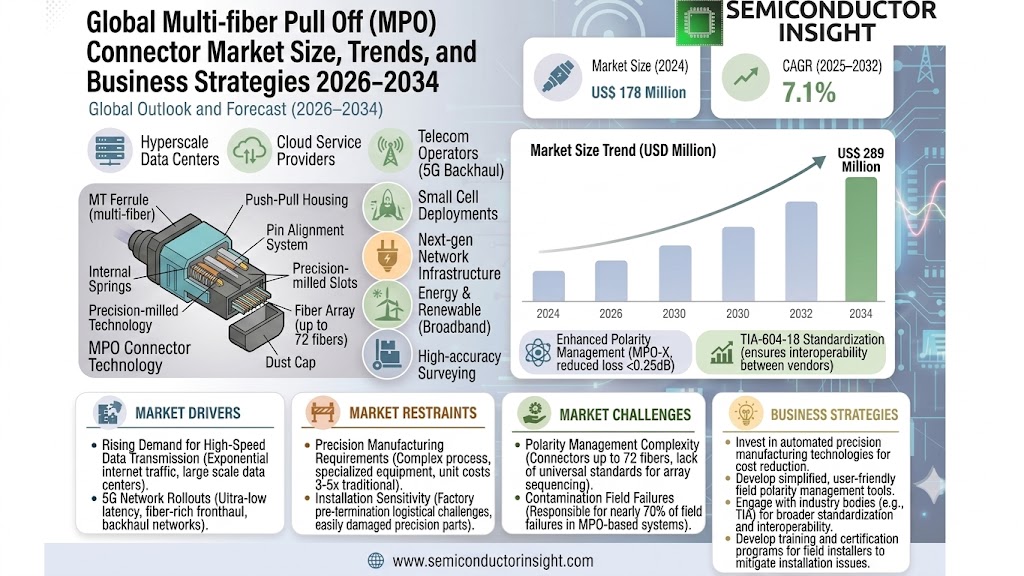
The global Multi-fiber Pull Off Connector Market size was valued at US$ 178 million in 2024 and is projected to reach US$ 289 million by 2032, at a CAGR of 7.1% during the forecast period 2025-2032.
Multi-fiber Pull Off (MPO) connectors are high-density fiber optic solutions designed for rapid deployment in data center and telecommunications applications. These connectors support multiple fiber connections (typically 12-24 fibers) in a single interface, significantly improving installation efficiency. The MPO connector system consists of precision-aligned ferrules, housing components, and keying mechanisms to ensure reliable optical performance.
The market growth is driven by escalating demand for high-bandwidth applications, expansion of 5G networks, and the proliferation of hyperscale data centers. While the U.S. market is projected to reach USD 480 million by 2025, China’s market is growing at a faster pace due to extensive digital infrastructure investments. The male head segment currently dominates the market, accounting for over 60% share, as these connectors are widely used in standard backbone cabling systems. Key players like Corning and Amphenol Corporation are continuously innovating to meet the rising demand for compact, high-performance connectivity solutions.
MARKET DYNAMICS
MARKET DRIVERS
Rising Demand for High-Speed Data Transmission to Boost Multi-fiber Pull Off Connector Adoption
The exponential growth in internet traffic and data center deployments is creating unprecedented demand for high-bandwidth fiber optic connectivity solutions. Multi-fiber Pull Off (MPO) connectors, capable of handling up to 72 fibers in a single interface, are becoming critical components in next-generation network infrastructure. Global IP traffic is projected to grow at a compound annual rate of nearly 30%, with hyperscale data centers alone requiring millions of fiber connections annually. This surge is driving telecom operators and cloud service providers to adopt MPO connectors for their space efficiency and rapid deployment capabilities in high-density environments.
5G Network Rollouts Accelerating Infrastructure Investments
The global transition to 5G networks represents a transformative opportunity for MPO connector manufacturers. 5G’s requirement for ultra-low latency and massive device connectivity necessitates fiber-rich fronthaul and backhaul networks, where MPO connectors provide the ideal interface solution. With over 400 commercial 5G networks expected to be operational worldwide by 2025, network operators are investing billions in fiber infrastructure. The compact design and high port density of MPO connectors make them particularly suitable for 5G small cell deployments, where space constraints challenge traditional connectivity solutions.
Additionally, standardization efforts by industry bodies are facilitating broader MPO adoption:
➤ The Telecommunications Industry Association (TIA) has strengthened MPO connector standards (TIA-604-18) to ensure interoperability between manufacturers’ products.
Major equipment vendors are responding to these market demands by introducing innovative MPO solutions. Several leading manufacturers have recently launched next-generation MPO connectors featuring enhanced polarity management and reduced insertion loss specifications below 0.25 dB.
MARKET RESTRAINTS
Precision Manufacturing Requirements Increase Production Costs
While MPO connectors offer significant deployment advantages, their complex manufacturing process presents substantial cost challenges. The tight tolerances required for multi-fiber alignment (typically within 1 micron) necessitate specialized production equipment and rigorous quality control measures. These factors contribute to unit costs that can be 3-5 times higher than traditional single-fiber connectors. For cost-sensitive network projects, particularly in developing markets, this price premium can delay or limit MPO adoption despite their technical advantages.
Installation Sensitivity Creates Deployment Challenges
The high fiber density of MPO connectors introduces unique installation challenges that restrain market growth. Unlike single-fiber connectors that can be field-terminated, MPO connectors typically require factory pre-termination due to their complex alignment requirements. This creates logistical challenges for network builders who must accurately predict cable lengths and connection points during design. Additionally, improper handling during installation can easily damage the precision alignment sleeves, with contamination being responsible for nearly 70% of field failures in MPO-based systems.
MARKET CHALLENGES
Polarity Management Complexity in High-density Deployments
MPO systems introduce unique polarity challenges absent in traditional duplex fiber connections. With connectors housing up to 72 fibers and multiple possible array configurations, maintaining proper transmit/receive pathways becomes exponentially more complex. Industry surveys indicate that polarity-related issues account for approximately 40% of MPO system deployment delays. The lack of universal standards for array sequencing across different manufacturers further complicates large-scale deployments involving multiple vendors’ equipment.
Other Challenges
Test and Measurement Limitations
Conventional fiber test equipment struggles with the high fiber density of MPO systems, requiring expensive adapters or specialized test sets. The inability to efficiently test all fibers simultaneously significantly increases deployment validation time and costs.
Long-term Reliability Concerns
The mechanical complexity of MPO connectors raises questions about long-term performance under repeated mating cycles. While manufacturers specify 500+ mating cycles, real-world deployments in harsh environments frequently experience degraded performance well below rated specifications.
MARKET OPPORTUNITIES
Emerging Applications in AI Infrastructure Create New Growth Avenues
The artificial intelligence revolution is driving unprecedented demand for high-speed interconnects in machine learning clusters and GPU arrays. Modern AI training systems require hundreds of high-bandwidth connections between compute nodes, with MPO-based optical solutions becoming the preferred choice. Leading cloud providers are designing next-generation AI infrastructure with MPO connectivity at its core, creating a potential market for millions of high-performance connectors annually.
Miniaturization Trend Opens New Application Spaces
Continued miniaturization of MPO connectors is enabling their adoption in previously inaccessible applications. Recent breakthroughs in micro-MPO technology have produced connectors with 40% smaller footprints while maintaining full fiber counts. This development is paving the way for MPO use in space-constrained environments like military avionics, medical imaging equipment, and autonomous vehicle sensor networks. The defense sector alone is projected to account for over 15% of specialty MPO connector demand by 2030.
MULTI-FIBER PULL OFF CONNECTOR MARKET TRENDS
Expansion of 5G and Fiber Optic Networks Driving Market Growth
The rising global deployment of 5G networks and fiber optic infrastructure is significantly boosting demand for multi-fiber pull off (MPO) connectors. These connectors enable high-density fiber connections crucial for modern telecom networks, with the global market projected to grow at a compound annual growth rate of approximately 8-10% through 2032. Major telecom operators are accelerating fiber-to-the-home (FTTH) deployments, requiring MPO connectors to accommodate increasing bandwidth demands. The connectors’ ability to support 12 to 144 fibers in a single interface makes them ideal for space-constrained data center applications, where their adoption has grown by over 25% annually in recent years.
Other Trends
High-Density Data Center Requirements
Modern hyperscale data centers are increasingly adopting MPO connectors to support cloud computing and AI workloads, with major cloud providers allocating 30-40% of their infrastructure budgets to fiber optic connectivity solutions. The shift toward higher fiber counts per rack unit in data centers is driving innovation in MPO connector designs, including smaller form factors and improved polarity management. These advancements help reduce installation time by up to 60% compared to traditional single-fiber solutions.
Military and Aerospace Applications Creating Niche Opportunities
The defense sector is emerging as a significant adopter of MPO connector technology, particularly for aircraft avionics and battlefield communication systems. Military applications demand ruggedized versions capable of withstanding extreme temperatures (-55°C to 125°C) and vibration levels exceeding 15G. Recent procurement contracts indicate defense spending on fiber optic connectivity solutions has grown by 12% year-over-year, with MPO connectors capturing an increasing share due to their reliability in harsh environments.
Material Innovation and Miniaturization Trends
Manufacturers are developing advanced polymer composites and precision-machined metal components to enhance MPO connector performance while reducing size and weight. Latest-generation connectors now achieve insertion losses below 0.3dB, meeting stringent requirements for 400G and emerging 800G Ethernet standards. The miniaturization trend has enabled 40% higher port density in data center patch panels compared to solutions available five years ago.
COMPETITIVE LANDSCAPE
Key Industry Players
Strategic Expansions and Innovations Drive Market Leadership
The global multi-fiber pull-off connector market exhibits a competitive yet fragmented structure, with prominent players like Corning and Amphenol Corporation dominating through technological expertise and wide-ranging product portfolios. The market, valued at millions in 2024, is projected to witness accelerated growth, driven by increasing demand in mobile communication and data center applications. The U.S. and China remain pivotal markets, with the male head connector segment expected to grow at a significant CAGR, reflecting strong demand in high-speed connectivity solutions.
Corning Incorporated leads the market, leveraging its robust distribution network and continuous innovation in fiber optic solutions. Its recent investments in high-density interconnect solutions have strengthened its position, particularly in North America and Europe. Meanwhile, Sumitomo Electric and TE Connectivity are gaining traction in Asia-Pacific, supported by their strategic partnerships with telecom giants and data center operators. These firms focus on scalability and reliability, addressing the rising need for seamless connectivity in 5G and cloud computing.
Additionally, niche players like Sun Rise Exact Industrial CO. and Vitex LLC are carving out specialized segments, particularly in defense and aerospace communications. Their ability to provide ruggedized, high-performance connectors has positioned them favorably among government and private-sector clients.
The competitive dynamics are further intensified by recent mergers and acquisitions, with companies like Broadcom Limited expanding their footprint through strategic collaborations. These moves not only enhance product offerings but also consolidate supply chains, ensuring better market penetration. While larger firms dominate revenue shares, smaller players innovate rapidly, introducing cost-effective solutions that challenge established norms.
List of Key Multi-fiber Pull-Off Connector Companies Profiled
- Corning (U.S.)
- Sun Rise Exact Industrial CO. (Taiwan)
- Vitex LLC (U.S.)
- Hitachi Ltd (Japan)
- Amphenol Corporation (U.S.)
- Broadcom Limited (U.S.)
- Sumitomo Electric (Japan)
- Diamond SA (Switzerland)
- TE Connectivity (Switzerland)
- Extron Electronics (U.S.)
Segment Analysis:
By Type
Male Head Connectors Dominate the Market Due to High Compatibility in Fiber Optic Networks
The market is segmented based on type into:
- Male Head
- Subtypes: SC, LC, MTP/MPO, and others
- Female Head
By Application
Internet Data Centers Lead Usage Due to High Demand for High-Speed Connectivity
The market is segmented based on application into:
- Mobile Communication
- Internet Data Center
- Defense Communications
- Others
By End User
Telecommunication Providers Drive Adoption for Network Expansion Projects
The market is segmented based on end user into:
- Telecommunication Service Providers
- Data Center Operators
- Military & Defense Organizations
- Enterprise Networks
Regional Analysis: Multi-fiber Pull Off Connector Market
North America
The North American Multi-fiber Pull Off (MPO) connector market is driven by rapid deployment of 5G infrastructure and investments in hyperscale data centers. The U.S. accounts for over 85% of regional demand, with major tech hubs like Silicon Valley fueling adoption through cloud computing expansion. Regulatory emphasis on high-speed connectivity standards ensures steady demand for reliable MPO solutions. However, supply chain disruptions and component shortages create intermittent challenges for manufacturers. Key players like Corning and Amphenol dominate with innovations in low-loss connectors suitable for next-gen telecom networks.
Europe
Europe maintains a strong focus on fiber-to-the-home (FTTH) deployments, particularly in Germany and the U.K., bolstering MPO connector installations. The EU’s Digital Decade policy targets universal gigabit connectivity by 2030, accelerating demand in data centers and enterprise networks. Strict product certification requirements (e.g., IEC standards) drive quality-focused competition among suppliers. While Western Europe leads adoption, Eastern Europe shows growth potential through increasing outsourcing of data storage facilities. Sustainability initiatives are pushing manufacturers toward recyclable connector materials without compromising signal integrity.
Asia-Pacific
As the fastest-growing regional market, APAC benefits from China’s “Digital Silk Road” investments and India’s BharatNet rural broadband project. MPO connectors see high-volume deployments in Chinese mega data centers, which house over 40% of Asia’s server capacity. Japan and South Korea prioritize miniaturized connectors for space-constrained applications like IoT devices. Cost sensitivity leads to price competition, though Tier-1 suppliers gain traction through partnerships with local telecom operators. The region also faces challenges like inconsistent fiber network quality, requiring robust connector designs to mitigate signal degradation.
South America
Market maturation is slower here due to limited fiber optic backbone infrastructure, but submarine cable projects along Brazil’s coast present opportunities. Argentina and Chile show incremental growth through enterprise network upgrades, though economic instability restricts large-scale investments. Local manufacturers struggle to compete with imported MPO connectors from U.S. and Chinese vendors, creating pricing pressure. The lack of standardized testing facilities further complicates quality assurance for end-users in the telecom sector. Nevertheless, niche demand emerges from oil & gas industries requiring ruggedized connectivity solutions.
Middle East & Africa
Gulf Cooperation Council (GCC) nations drive regional demand through smart city initiatives, with the UAE and Saudi Arabia accounting for 60% of MEA’s MPO connector usage. Africa’s market remains nascent but shows promise through undersea cable landings improving internet penetration. Challenges include scarce technical expertise for MPO system maintenance and reliance on foreign suppliers. Wireless infrastructure investments temporarily dampen fiber adoption in some areas, though high-capacity data center projects in Morocco and South Africa indicate long-term potential for MPO deployment.
Report Scope
This market research report provides a comprehensive analysis of the Global and regional Multi-fiber Pull Off Connector markets, covering the forecast period 2025–2032. It offers detailed insights into market dynamics, technological advancements, competitive landscape, and key trends shaping the industry.
Key focus areas of the report include:
- Market Size & Forecast: Historical data and future projections for revenue, unit shipments, and market value across major regions and segments. The global market was valued at US$ 178 million in 2024 and is projected to reach US$ 289 million by 2032.
- Segmentation Analysis: Detailed breakdown by product type (Male Head, Female Head), application (Mobile Communication, Internet Data Center, Defense Communications, Others), and end-user industry to identify high-growth segments.
- Regional Outlook: Insights into market performance across North America, Europe, Asia-Pacific, Latin America, and the Middle East & Africa, with country-level analysis for key markets like the U.S. and China.
- Competitive Landscape: Profiles of leading participants including Corning, Amphenol Corporation, Sumitomo Electric, TE Connectivity, and others, covering their market share, R&D focus, and strategic developments.
- Technology Trends & Innovation: Assessment of evolving connector technologies, miniaturization trends, and integration with high-speed data transmission systems.
- Market Drivers & Restraints: Evaluation of factors such as 5G deployment, data center expansion, and defense modernization alongside supply chain challenges and technical barriers.
- Stakeholder Analysis: Strategic insights for component manufacturers, OEMs, telecom operators, and investors regarding emerging opportunities.
The report employs primary and secondary research methodologies, including interviews with industry experts and analysis of verified market data, to ensure accuracy and reliability.
FREQUENTLY ASKED QUESTIONS:
What is the current market size of Global Multi-fiber Pull Off Connector Market?
->Multi-fiber Pull Off Connector Market size was valued at US$ 178 million in 2024 and is projected to reach US$ 289 million by 2032, at a CAGR of 7.1% during the forecast period 2025-2032.
Which key companies operate in this market?
-> Major players include Corning, Amphenol Corporation, Sumitomo Electric, TE Connectivity, Broadcom Limited, and Hitachi Ltd, with the top five companies holding approximately % market share in 2024.
What are the key growth drivers?
-> Primary growth drivers include 5G network expansion, hyperscale data center construction, and increasing defense communication requirements.
Which region dominates the market?
-> North America currently leads in market share, while Asia-Pacific is expected to exhibit the highest growth rate during the forecast period.
What are the emerging trends?
-> Emerging trends include development of high-density connectors, improved signal integrity solutions, and adoption in aerospace applications.

Get Sample Report PDF for Exclusive Insights
Report Sample Includes
- Table of Contents
- List of Tables & Figures
- Charts, Research Methodology, and more...
 Download Sample Report PDF