Multi-Channel Photon Counter Market Insights
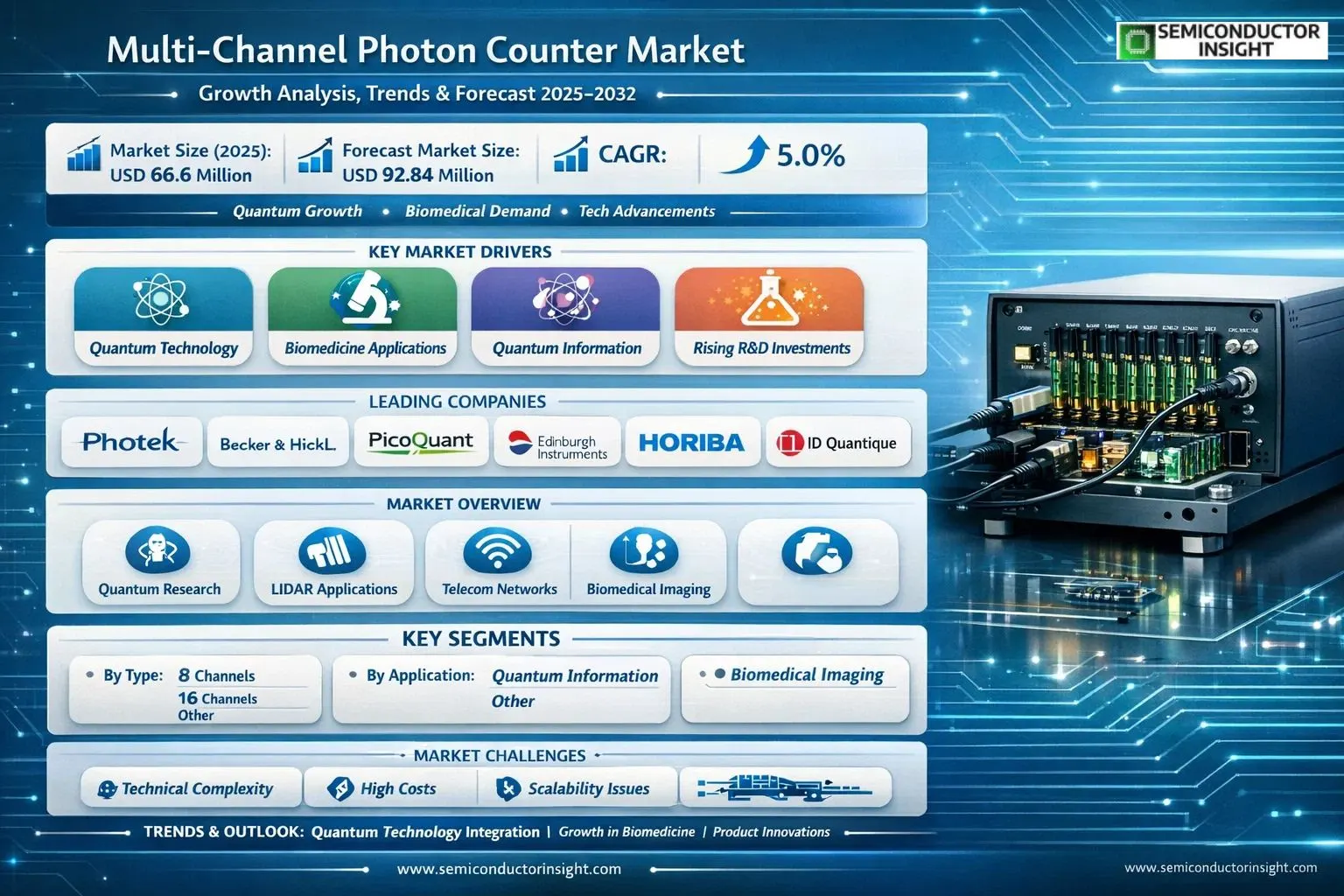
Global Multi-Channel Photon Counter market size was valued at USD 66.6 million in 2025. The market is projected to reach USD 92.84 million by 2032, exhibiting a CAGR of 5.0% during the forecast period.
The multi-channel photon counter is an instrument used to measure the number of photons. It utilizes the wave-particle duality of photons to achieve the photon counting function by dividing the photons into two paths and then remerging them. Its core technology is the detection and counting of photons, which enables efficient photon counting. Multi-channel photon counters play an important role in quantum technology. With the development of quantum technology, their functions and performance continue to improve and upgrade to adapt to more innovative application scenarios.
The market is experiencing steady growth due to several factors, including rising investments in quantum technologies, increasing demand in biomedicine, and expanding applications in quantum information processing. Additionally, advancements in photon detection capabilities are fueling further expansion. Key players such as Photek, Becker & Hickl, PicoQuant, Edinburgh Instruments, Excelitas, HORIBA, and ID Quantique operate in the market, offering robust portfolios and driving innovation through ongoing research and product enhancements.
MARKET DRIVERS
Advancements in Quantum Technologies
Multi-Channel Photon Counter Market is propelled by rapid progress in quantum computing and communication systems, where high-sensitivity detection of individual photons across multiple channels is essential. Institutions and tech firms are investing heavily, with quantum research funding reaching approximately $2.5 billion globally in 2023, driving demand for precise photon counting solutions.
Growth in LIDAR and Spectroscopy Applications
Expansion in autonomous vehicles and environmental monitoring utilizes multi-channel photon counters for enhanced LIDAR performance, enabling superior resolution in 3D mapping. The automotive LIDAR segment alone is projected to grow at 22% CAGR through 2028, underscoring the need for scalable detection technologies.
➤ Increased R&D investments in photonics have boosted market adoption by 15% annually in research labs worldwide.
Telecommunications advancements, particularly in quantum key distribution networks, further accelerate adoption, as multi-channel systems offer unparalleled timing resolution below 50 picoseconds, supporting secure data transmission over fiber optics.
MARKET CHALLENGES
Technical Complexity and Integration Hurdles
Developing multi-channel photon counters involves overcoming noise reduction and crosstalk issues in dense channel arrays, complicating integration into compact devices. Current systems often struggle with afterpulsing effects, limiting efficiency in high-flux environments like particle physics experiments.
Other Challenges
High Manufacturing Costs
Precision components such as superconducting nanowire detectors drive up production expenses, with average unit costs exceeding $50,000, hindering widespread commercialization in emerging markets.
Scalability Limitations
Achieving uniform performance across 32+ channels remains challenging, as yield rates in fabrication hover around 70%, impacting supply for large-scale quantum networks.
MARKET RESTRAINTS
Regulatory and Standardization Gaps
Multi-Channel Photon Counter Market faces restraints from inconsistent international standards for quantum devices, delaying certification and adoption in regulated sectors like aerospace. Compliance with varying export controls on sensitive technologies adds further barriers.Supply chain dependencies on rare earth materials for detector fabrication pose risks, with global shortages potentially constraining growth to under 12% annually in the near term.Additionally, limited skilled workforce in photonics engineering slows innovation, as specialized training programs lag behind technological demands in key regions.
MARKET OPPORTUNITIES
Emerging Quantum Computing Ecosystems
Opportunities abound in quantum computing platforms requiring multi-channel detection for error-corrected qubits, with the sector anticipated to expand to $10 billion by 2030. Partnerships between tech giants and startups are fostering hybrid systems.Advancements in space-based quantum communication satellites present niches for ruggedized photon counters, supporting global secure networks with detection efficiencies over 90%.Medical imaging innovations, such as time-of-flight PET scanners, offer growth potential, leveraging multi-channel precision for earlier disease detection.
Multi-Channel Photon Counter Market Trends
Integration with Quantum Technology Advancements
Multi-Channel Photon Counter Market is experiencing significant momentum driven by its pivotal role in quantum technology applications. These instruments leverage the wave-particle duality of photons to enable precise detection and counting across multiple channels, supporting complex experiments in quantum information processing. As quantum technologies evolve, multi-channel photon counters are being enhanced to deliver higher efficiency and sensitivity, adapting to demanding scenarios such as quantum key distribution and entanglement studies. Industry surveys indicate a surge in demand from research institutions focusing on scalable quantum systems, where multi-channel capabilities allow simultaneous photon measurements, reducing experimental timelines and improving data accuracy.
Other Trends
Growth in Biomedicine Applications
Multi-channel photon counters are increasingly adopted in biomedicine for fluorescence lifetime imaging and single-molecule detection. Their ability to handle 8-channel or 16-channel configurations provides researchers with detailed temporal resolution in biological processes, aiding advancements in drug discovery and cellular analysis. This trend reflects a shift toward integrated systems that combine photon counting with microscopy techniques, enhancing diagnostic precision in clinical settings.
Competitive Dynamics and Product Innovation
Leading manufacturers including Photek, Becker & Hickl, PicoQuant, Edinburgh Instruments, Excelitas, HORIBA, and ID Quantique are intensifying R&D efforts to refine multi-channel photon counter performance. The competitive landscape shows top players capturing substantial market shares through innovations like improved timing resolution and reduced dead times, catering to both quantum information and other emerging fields. Regional developments, particularly in North America and Asia, underscore a trend toward customized solutions for diverse applications, fostering market expansion while addressing challenges in photon detection efficiency and scalability.
COMPETITIVE LANDSCAPE
Key Industry Players
Leading Innovators Shaping Multi-Channel Photon Counter Market
Multi-Channel Photon Counter Market exhibits a moderately concentrated structure dominated by specialized manufacturers excelling in photon detection and time-correlated single photon counting (TCSPC) technologies. Key leaders like Photek, Becker & Hickl, and PicoQuant hold substantial revenue shares, driven by their advanced multi-channel systems supporting applications in quantum information and biomedicine. These top players benefit from the market’s projected growth from US$66.6 million in 2025 to US$92.84 million by 2032 at a 5.0% CAGR, capitalizing on rising demand for 8-channel and 16-channel configurations. Their competitive edge stems from superior sensitivity, low noise, and integration with quantum technologies, positioning them to capture larger portions amid industry consolidation through innovations and strategic partnerships.
Beyond the frontrunners, a cadre of niche significant players contributes specialized solutions, enhancing market diversity and spurring technological advancements. Companies such as Edinburgh Instruments, Excelitas Technologies, HORIBA, and ID Quantique focus on high-performance modules for precise photon counting in research settings, addressing segments like quantum optics and biomedical imaging. Emerging competitors like Hamamatsu Photonics and Swabian Instruments are intensifying rivalry with scalable systems, while others including Micro Photon Devices and Fast ComTec provide complementary components. This dynamic fosters continuous R&D, enabling adaptation to evolving needs in North America, Europe, and Asia-Pacific regions, where regional leaders tailor offerings to local quantum tech hubs.
List of Key Multi-Channel Photon Counter Companies Profiled
- Photek
- Becker & Hickl
- PicoQuant
- Edinburgh Instruments
- Excelitas Technologies
- HORIBA
- ID Quantique
- Hamamatsu Photonics
- Swabian Instruments
- Micro Photon Devices
- Fast ComTec
- Kentech Instruments
- Stanford Research Systems
- Thorlabs
- Laser Components
Segment Analysis:
| Segment Category | Sub-Segments | Key Insights |
| By Type |
|
8 Channels dominates as the leading segment, offering a versatile configuration for core photon counting needs.
|
| By Application |
|
Quantum Information leads the application segment, pivotal for emerging quantum technologies.
|
| By End User |
|
Academic and Research Institutions represent the primary end-user segment, fueling foundational advancements.
|
| By Detection Technology |
|
SPAD-based technology leads, prized for its single-photon sensitivity.
|
| By Form Factor |
|
Benchtop instruments prevail as the preferred form factor for precision work.
|
Regional Analysis: Multi-Channel Photon Counter Market
North America
North America’s Multi-Channel Photon Counter Market benefits from unparalleled research investments, with institutions pioneering low-noise detection and high-channel parallelism. This fosters breakthroughs in time-correlated single-photon counting, vital for fluorescence lifetime imaging and quantum key distribution.
Diverse sectors drive demand, including defense for secure communications and automotive for advanced sensing. Biomedical research leverages multi-channel precision for molecular analysis, while telecom advances fiber-optic networks with superior photon detection accuracy.
A vibrant network of suppliers and integrators supports seamless adoption. Strategic alliances enhance device interoperability, addressing needs in particle physics experiments and satellite-based remote sensing within Multi-Channel Photon Counter Market.
Emphasis on scalability positions the region for sustained growth, with innovations in cryogenic detectors and AI-enhanced signal processing. Export strengths amplify influence in the global Multi-Channel Photon Counter Market.
Europe
Europe’s Multi-Channel Photon Counter Market thrives on collaborative research frameworks and stringent quality standards. Institutions like CERN and Max Planck Society propel advancements in particle physics and quantum optics, demanding high-fidelity multi-channel systems for experiments. The automotive sector integrates these counters into LiDAR for smart mobility, while photonics hubs in Germany and France drive industrial applications. EU-funded programs emphasize sustainable manufacturing, fostering eco-friendly device designs. Competitive dynamics feature niche specialists focusing on modular architectures adaptable to spectroscopy and imaging. Regulatory harmony across member states facilitates cross-border trade, enhancing market fluidity. Growth is supported by rising investments in quantum technologies, positioning Europe as a key innovator despite supply chain dependencies.
Asia-Pacific
The Asia-Pacific Multi-Channel Photon Counter Market exhibits rapid momentum, fueled by manufacturing prowess and expanding R&D in China, Japan, and South Korea. Semiconductor giants integrate photon counters into next-gen displays and sensors, while quantum research initiatives in Singapore accelerate demand. Telecom infrastructure upgrades prioritize low-latency detection for 6G prototypes. Local production scales cost-effective solutions, capturing shares in biomedical and environmental monitoring. Government policies incentivize tech localization, mitigating import reliance. Intense competition spurs iterative improvements in channel density and thermal stability, aligning with regional focus on high-volume applications like consumer electronics testing.
South America
South America’s Multi-Channel Photon Counter Market is emerging, centered on academic and oil exploration applications in Brazil and Argentina. Universities adopt these devices for atmospheric studies and biodiversity research, highlighting needs for rugged, field-deployable units. Limited local manufacturing drives imports, but growing tech parks foster assembly capabilities. Energy sector demands support photon detection in geophysical surveys, with potential in agrotech for precision crop monitoring. Partnerships with global firms bridge expertise gaps, nurturing a nascent ecosystem poised for expansion through targeted investments.
Middle East & Africa
In the Middle East & Africa Multi-Channel Photon Counter Market, defense and resource exploration dominate, with UAE and South Africa leading adoption. Secure communication networks and surveillance systems require advanced photon counting for low-light performance. Research centers in Israel innovate in quantum sensing, influencing regional dynamics. Infrastructure challenges temper growth, yet oil-rich economies fund high-end procurements. Collaborative ventures with international suppliers enhance accessibility, focusing on durable designs for harsh environments. Strategic focus on diversification signals future opportunities in healthcare imaging and renewable energy monitoring.
Report Scope
This market research report provides a comprehensive analysis of Multi-Channel Photon Counter Market, covering the forecast period 2025–2032. It offers detailed insights into market dynamics, technological advancements, competitive landscape, and key trends shaping the industry.
Key focus areas of the report include:
- Market Overview: The report begins with an overview outlining its current market scenario, key growth indicators, and industry transformation drivers. It discusses macroeconomic factors, demand–supply balance, regulatory landscape, and the strategic role of multi-channel photon counters in powering advancements across industries such as biomedicine, quantum information, quantum technology, and photonics.
- Market Size & Forecast: Historical data and future projections for revenue, unit shipments, and market value across major regions and segments.
- Segmentation Analysis: Detailed breakdown by product type, technology, application, and end-user industry to identify high-growth segments and investment opportunities.
- Regional Insights: Insights into market performance across North America, Europe, Asia-Pacific, Latin America, and the Middle East & Africa, including country-level analysis where relevant.
- Competitive Landscape: Profiles of leading market participants, including their product offerings, R&D focus, manufacturing capacity, pricing strategies, and recent developments such as mergers, acquisitions, and partnerships.
- Technology Trends & Innovation: Assessment of emerging technologies, integration of AI/IoT, semiconductor design trends, fabrication techniques, and evolving industry standards.
- Market Drivers & Restraints: Evaluation of factors driving market growth along with challenges, supply chain constraints, regulatory issues, and market-entry barriers.
- Stakeholder Insights: Insights for component suppliers, OEMs, system integrators, investors, and policymakers regarding the evolving ecosystem and strategic opportunities.
Primary and secondary research methods are employed, including interviews with industry experts, data from verified sources, and real-time market intelligence to ensure the accuracy and reliability of the insights presented.
FREQUENTLY ASKED QUESTIONS:
What is the current market size of Multi-Channel Photon Counter Market?
-> Global Multi-Channel Photon Counter market was valued at USD 66.6 million in 2025 and is projected to reach USD 92.84 million by 2032, at a CAGR of 5.0% during the forecast period.
Which key companies operate in Multi-Channel Photon Counter Market?
-> Key players include Photek, Becker & Hickl, PicoQuant, Edinburgh Instruments, Excelitas, HORIBA, and ID Quantique, among others.
What are the key growth drivers?
-> Key growth drivers include development of quantum technology, demand in biomedicine and quantum information applications.
Which region dominates the market?
-> Asia is the fastest-growing region, while Europe remains a dominant market.
What are the emerging trends?
-> Emerging trends include improved functions and performance upgrades for quantum technology, adaptation to innovative application scenarios.

Get Sample Report PDF for Exclusive Insights
Report Sample Includes
- Table of Contents
- List of Tables & Figures
- Charts, Research Methodology, and more...