Multi-axis Force-torque Sensors Market, Trends, Business Strategies 2026-2034

Multi-axis Force-torque Sensors Market was valued at USD 749 million in 2025 and is expected to reach USD 1090 million by 2032, at a CAGR of 5.6% during the forecast period

PDF Icon Download Sample Report PDF
  • Quick Dispatch

    All Orders

  • Secure Payment

    100% Secure Payment

Price range: $1,500.00 through $4,250.00

Clear

Multi-axis Force-torque Sensors Market Insights

Global Multi-axis Force-torque Sensors market was valued at USD 749 million in 2025 and is projected to reach USD 1,090 million by 2032, exhibiting a CAGR of 5.6% during the forecast period.

A multi-axis force-torque sensor is a type of sensor capable of simultaneously measuring forces and torques in multiple directions, including tension and compression. It perceives force-torque components along different axes and converts this information into electrical signals. Typically featuring multiple measurement channels, each aligned to a specific axis, these sensors accurately capture multi-directional data. For instance, a three-axis model measures forces in x, y, and z directions, while a six-axis version also detects moments (Mx, My, Mz).

The market is experiencing steady growth driven by surging demand in robotics, automotive testing, and aerospace sectors. Advancements in precision manufacturing and the rise of collaborative robots further accelerate expansion, as does integration with AI for smarter automation. Competition remains intense among key players, who prioritize high precision, resolution, and dynamic response. Leading companies like ATI Industrial Automation, Kistler Group, and HBK (formerly HBM) hold strong positions, alongside domestic firms such as Changzhou Kunwei Sensing Technology offering cost advantages. These players continually innovate to meet evolving needs in intelligent manufacturing and beyond.
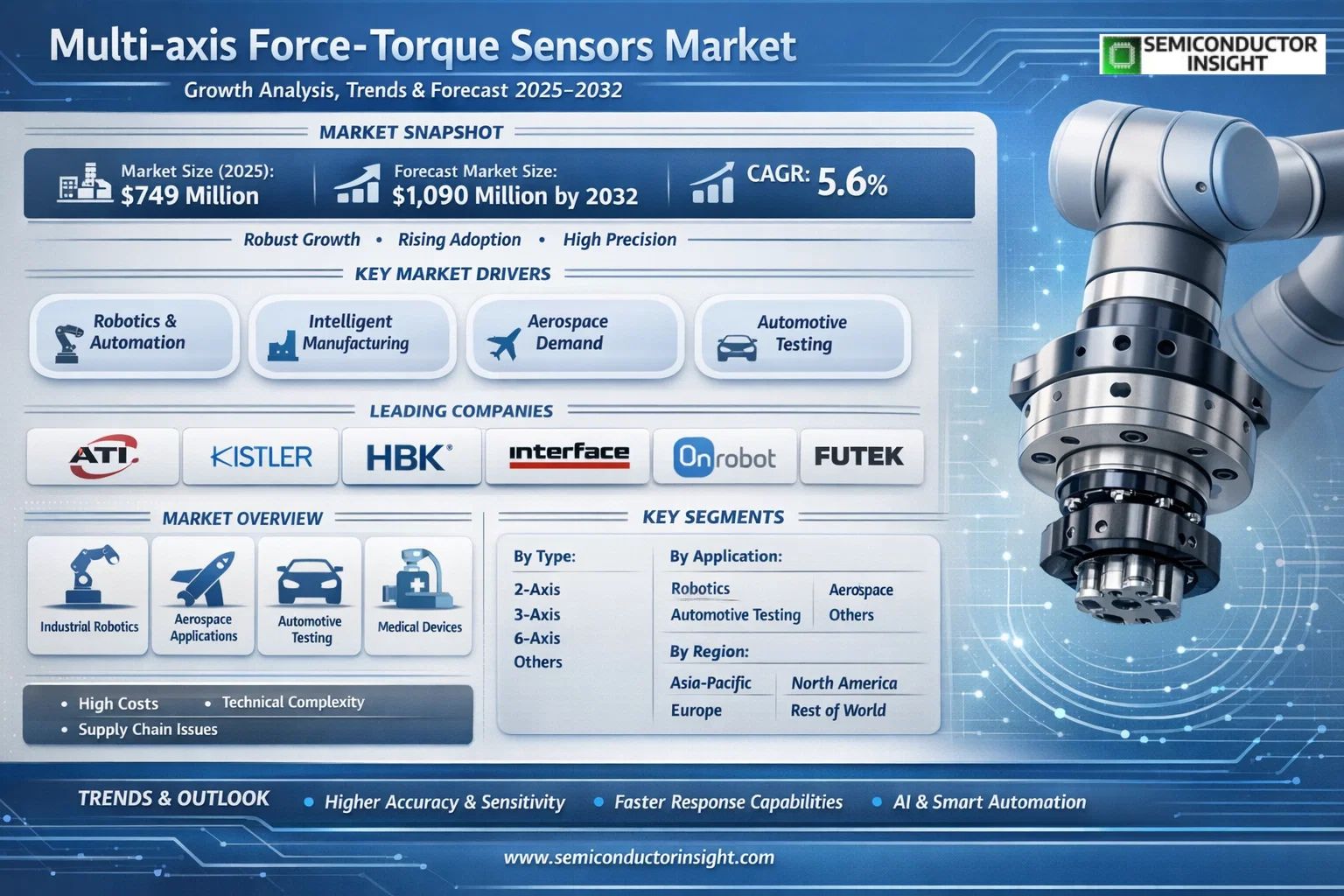
Multi-axis Force-torque Sensors Market

MARKET DRIVERS

Rising Adoption in Robotics and Automation

Multi-axis Force-torque Sensors Market is propelled by the exponential growth in industrial robotics, where these sensors enable precise force feedback for tasks like assembly and welding. Global robot installations reached over 500,000 units in 2023, driving demand for advanced sensing technologies that support collaborative robots (cobots) in manufacturing environments.

Industry 4.0 Integration

Integration with IoT and AI systems amplifies the need for multi-axis force-torque sensors, providing real-time data for predictive maintenance and process optimization. Sectors like automotive and electronics benefit from enhanced precision, with market growth projected at a CAGR of 8.5% through 2030.

Key industries including aerospace and medical robotics are investing heavily, as these sensors improve haptic feedback and safety protocols.

Furthermore, advancements in miniaturization allow deployment in surgical robots, expanding Multi-axis Force-torque Sensors Market into healthcare and boosting overall adoption rates.

MARKET CHALLENGES

High Development and Integration Costs

Developing high-precision multi-axis force-torque sensors involves complex calibration and materials, leading to elevated costs that hinder widespread adoption among SMEs. Initial integration into existing robotic systems can add 20-30% to project expenses.

Other Challenges

Technical Complexity in Signal Processing

Noise interference and drift in measurements pose issues, requiring sophisticated algorithms for accurate data interpretation in dynamic environments like high-speed assembly lines.Supply chain disruptions for rare-earth materials used in sensor components further complicate production scalability in Multi-axis Force-torque Sensors Market.

MARKET RESTRAINTS

Strict Regulatory Standards

Rigorous safety and calibration standards from bodies like ISO for industrial applications limit rapid innovation in Multi-axis Force-torque Sensors Market. Compliance testing extends time-to-market by up to 12 months.Additionally, limited awareness in emerging economies restrains penetration, as end-users prioritize cost over precision sensing capabilities.Competition from single-axis alternatives in low-precision applications caps growth in budget-constrained sectors, maintaining a fragmented market landscape.

MARKET OPPORTUNITIES

Expansion in Emerging Applications

Multi-axis Force-torque Sensors Market holds potential in humanoid robotics and exoskeletons, driven by advancements in battery tech enabling portable, high-fidelity sensing for rehabilitation devices.Growth in Asia-Pacific manufacturing hubs offers untapped potential, with investments in smart factories projected to increase sensor demand by 12% annually.AI-driven sensor fusion with vision systems opens avenues for autonomous systems, positioning multi-axis force-torque sensors as critical enablers in next-gen automation.

Multi-axis Force-torque Sensors Market Trends

Advancements in Measurement Precision and Sensitivity

In Multi-axis Force-torque Sensors Market, a primary trend is the relentless push toward higher measurement accuracy and sensitivity, particularly driven by demands from aerospace and precision medical care sectors. These sensors, capable of measuring force and torque across multiple axes such as three-axis for perpendicular directions or six-axis including moments, are evolving to meet stricter performance standards. Manufacturers are focusing on enhancing resolution and precision as core competitive differentiators, enabling more reliable data acquisition in complex environments.

Other Trends

Improved Dynamic Response and Anti-Interference Capabilities

Another key development involves faster response speeds and stronger anti-interference features, addressing challenges in dynamic applications like robotics and automotive testing. This trend supports multi-axis synchronous measurements, crucial for real-time force-torque feedback in automated production lines and intelligent manufacturing systems.

Integration of Intelligent Functionalities and Emerging Applications

Multi-axis Force-torque Sensors Market is witnessing growing integration with artificial intelligence, allowing sensors to automatically adjust parameters and process data onboard. This intelligent evolution extends to autonomous driving and intelligent transportation, improving safety through precise vehicle monitoring. Additionally, rising demand in robotics, alongside expanding prospects in medical care and sports, underscores the broadening application scope. Competition remains fierce, with international players like Kistler Group, HBK, and ATI Industrial Automation leveraging brand strength, while domestic firms such as Yuli Instrument and Kunwei Technology capitalize on cost advantages and supply chain efficiencies. Overall, these trends position multi-axis force-torque sensors, including 2-axis, 3-axis, 6-axis, and others, at the forefront of industrial innovation across regions like North America, Europe, Asia, and beyond.

COMPETITIVE LANDSCAPE

Key Industry Players

Dominating Forces in Multi-axis Force-torque Sensors Market

Multi-axis Force-torque Sensors Market, valued at US$ 749 million in 2025 and projected to reach US$ 1,090 million by 2032 at a 5.6% CAGR, features a fragmented yet intensely competitive landscape dominated by established international leaders. Key players such as ATI Industrial Automation, Kistler Group, and Hottinger Brüel & Kjær (HBK) command significant market share through superior precision, resolution, and multi-axis synchronous measurement capabilities. These firms excel in high-end applications like robotics, aerospace, and automotive testing, leveraging strong brand influence and advanced technologies for dynamic response and anti-interference performance. The market structure pits premium global incumbents against cost-competitive domestic manufacturers, fostering innovation in six-axis sensors that measure forces (Fx, Fy, Fz) and moments (Mx, My, Mz) simultaneously.

Beyond the frontrunners, a robust ecosystem of niche players including Forsentek Co., Limited, Interface, Inc., and Chinese firms like Changzhou Kunwei Sensing Technology contributes specialized solutions tailored for medical, sports, and intelligent manufacturing sectors. Domestic enterprises such as Yuli Instrument and Shenzhen XJCSENSOR Technology capitalize on lower costs and supply chain efficiencies, challenging international dominance in mid-tier segments like three-axis and two-axis sensors. Competition intensifies around intelligent features driven by AI integration, faster response speeds, and customization for autonomous systems, with ongoing mergers and R&D investments shaping future market dynamics in regions like North America, Europe, and Asia-Pacific.

List of Key Multi-axis Force-torque Sensors Companies Profiled

Segment Analysis:

Segment Category Sub-Segments Key Insights
By Type
  • 2-axis
  • 3-axis
  • 6-axis
  • Others
6-axis

  • Delivers comprehensive measurement of three orthogonal forces and three moments, enabling precise decoupling and control in multifaceted tasks.
  • Highly favored in advanced robotics for its ability to handle complex multi-directional interactions seamlessly.
  • Supports innovation in dynamic environments where simultaneous axis sensing is critical for operational accuracy and reliability.
By Application
  • Aerospace
  • Robots
  • Automotive Testing and Manufacturing
  • Others
Robots

  • Integral to robotic end-effectors, providing real-time force feedback for adaptive gripping and manipulation.
  • Fuels expansion in intelligent manufacturing through enhanced precision in assembly and handling processes.
  • Enables collaborative robots to interact safely with humans by sensing interaction forces accurately.
  • Drives automation trends across production lines with superior multi-axis responsiveness.
By End User
  • Industrial Manufacturers
  • Research Institutions
  • Healthcare Providers
  • Others
Industrial Manufacturers

  • Core to automated assembly and quality assurance, ensuring consistent force application in production.
  • Demonstrates robust integration with industrial robots for enhanced operational efficiency.
  • Prioritizes high-resolution sensing to meet stringent manufacturing tolerances effectively.
By Sensor Technology
  • Strain Gauge-based
  • Piezoelectric
  • Others
Strain Gauge-based

  • Excels in delivering stable and accurate measurements over extended periods in varied conditions.
  • Benefits from established supply chains and customization options for diverse industrial needs.
  • Maintains leadership through superior sensitivity and resistance to environmental interferences.
  • Supports broad adoption in precision testing and control systems seamlessly.
By Dynamics
  • Static
  • Dynamic
  • Hybrid
Dynamic

  • Addresses demands for rapid response times in high-velocity robotic and testing scenarios.
  • Enhances multi-axis synchronization crucial for real-time process optimization.
  • Aligns with technological pursuits in anti-interference and high-speed precision sensing.
  • Promotes advancements in AI-integrated systems for predictive control.

Regional Analysis: Multi-axis Force-torque Sensors Market

North America

North America dominates Multi-axis Force-torque Sensors Market, driven by advanced robotics and automation ecosystems. The region’s mature manufacturing sector, particularly in automotive and aerospace, heavily integrates these sensors for precision assembly and quality control. Leading tech hubs foster innovation, with companies developing high-precision sensors for collaborative robots and surgical systems. Strong R&D investments from government and private entities accelerate adoption in industries seeking enhanced force feedback. Supply chain resilience post-pandemic has prioritized local production, boosting demand. The market benefits from regulatory support for industrial safety standards, ensuring widespread deployment in warehouses and production lines. Emerging applications in humanoid robotics and virtual reality training further propel growth. Educational institutions collaborate with industry to skill up workforces, embedding sensor technologies in curricula. Overall, North America’s ecosystem positions it as a benchmark for Multi-axis Force-torque Sensors Market maturity, influencing global standards through pioneering deployments and continuous enhancements.

Robotics Leadership
North America’s robotics sector leads Multi-axis Force-torque Sensors Market integration, enabling safer human-robot collaboration through precise force detection. Factories deploy these sensors for adaptive gripping, reducing errors in dynamic environments and enhancing productivity across automotive assembly lines.
Aerospace Precision
Aerospace applications drive demand in Multi-axis Force-torque Sensors Market, with sensors critical for component testing and assembly. North American firms leverage them for lightweight designs, ensuring compliance with stringent safety protocols in aircraft manufacturing.
Medical Advancements
In healthcare, Multi-axis Force-torque Sensors Market sees growth via robotic surgery and prosthetics. North America’s innovation hubs develop haptic feedback systems, improving surgical outcomes and patient rehabilitation through intuitive control mechanisms.
Automotive Integration
Automotive giants in North America embed force-torque sensors for autonomous vehicle testing and EV battery assembly. This bolsters Multi-axis Force-torque Sensors Market by enabling real-time adjustments in production processes for higher efficiency.

Europe
Europe exhibits robust growth in Multi-axis Force-torque Sensors Market, fueled by Industry 4.0 initiatives and stringent automation regulations. Automotive powerhouses integrate these sensors for advanced driver-assistance systems and electric vehicle production, emphasizing precision in high-volume manufacturing. Aerospace and renewable energy sectors adopt them for wind turbine maintenance and satellite assembly, prioritizing durability in harsh conditions. Collaborative research programs across member states accelerate sensor miniaturization and wireless capabilities. Sustainability goals drive eco-friendly sensor designs, aligning with circular economy principles. Skilled labor forces and established supply chains support seamless adoption, while startups innovate in cobot applications for SMEs. Europe’s focus on worker safety standards further embeds these technologies in logistics and pharmaceuticals, positioning the region as a key player in refined Multi-axis Force-torque Sensors Market dynamics.

Asia-Pacific
Asia-Pacific emerges as a dynamic force in Multi-axis Force-torque Sensors Market, propelled by rapid industrialization and electronics manufacturing booms. China and Japan’s robotics dominance integrates sensors for semiconductor handling and consumer electronics assembly, enhancing yield rates. India’s growing automotive sector and South Korea’s shipbuilding industry demand versatile sensing solutions for complex tasks. Cost-effective production scales market penetration among SMEs, while government incentives for smart factories boost infrastructure investments. Supply chain localization reduces dependencies, fostering resilience. Emerging applications in agritech for precision farming and consumer drones diversify usage. The region’s tech-savvy workforce and aggressive R&D in AI synergy with sensors drive innovation, making Asia-Pacific pivotal for volume-driven Multi-axis Force-torque Sensors Market expansion.

South America
South America shows promising potential in Multi-axis Force-torque Sensors Market, centered on resource extraction and agriculture mechanization. Brazil’s agribusiness adopts sensors for robotic harvesters, optimizing delicate crop handling amid labor shortages. Mining operations in Chile integrate them for equipment monitoring, improving safety in rugged terrains. Automotive assembly in Argentina and Mexico benefits from trade agreements, facilitating technology transfers. Challenges like infrastructure gaps are offset by multinational investments in localized manufacturing. Educational partnerships build expertise, while sustainability pushes sensor use in biofuel production lines. Gradual digital transformation positions South America as an emerging hub in Multi-axis Force-torque Sensors Market, with growth tied to economic stabilization and industrial upgrades.

Middle East & Africa
The Middle East & Africa region advances in Multi-axis Force-torque Sensors Market through oil & gas automation and urban development projects. UAE and Saudi Arabia deploy sensors in smart city robotics and pipeline inspection drones, enhancing operational efficiency. South Africa’s manufacturing revival incorporates them in mining automation and automotive sectors. Renewable energy initiatives, like solar panel assembly, demand precise force measurement for quality assurance. Government visions for diversification spur tech adoption, bridging skill gaps via training programs. Harsh environmental adaptations drive rugged sensor innovations. Strategic partnerships with global firms accelerate market maturity, establishing Middle East & Africa as a niche contender in Multi-axis Force-torque Sensors Market with tailored applications.

Report Scope

This market research report provides a comprehensive analysis of Multi-axis Force-torque Sensors Market, covering the forecast period 2025–2032. It offers detailed insights into market dynamics, technological advancements, competitive landscape, and key trends shaping the industry.

Key focus areas of the report include:

  • Market Overview: The report begins with an overview outlining its current market scenario, key growth indicators, and industry transformation drivers. It discusses macroeconomic factors, demand–supply balance, regulatory landscape, and the strategic role of multi-axis force-torque sensors in powering advancements across industries such as robotics, aerospace, automotive testing and manufacturing, and precision medical care.
  • Market Size & Forecast: Historical data and future projections for revenue, unit shipments, and market value across major regions and segments.
  • Segmentation Analysis: Detailed breakdown by product type, technology, application, and end-user industry to identify high-growth segments and investment opportunities.
  • Regional Insights: Insights into market performance across North America, Europe, Asia-Pacific, Latin America, and the Middle East & Africa, including country-level analysis where relevant.
  • Competitive Landscape: Profiles of leading market participants, including their product offerings, R&D focus, manufacturing capacity, pricing strategies, and recent developments such as mergers, acquisitions, and partnerships.
  • Technology Trends & Innovation: Assessment of emerging technologies, integration of AI/IoT, semiconductor design trends, fabrication techniques, and evolving industry standards.
  • Market Drivers & Restraints: Evaluation of factors driving market growth along with challenges, supply chain constraints, regulatory issues, and market-entry barriers.
  • Stakeholder Insights: Insights for component suppliers, OEMs, system integrators, investors, and policymakers regarding the evolving ecosystem and strategic opportunities.

Primary and secondary research methods are employed, including interviews with industry experts, data from verified sources, and real-time market intelligence to ensure the accuracy and reliability of the insights presented.

FREQUENTLY ASKED QUESTIONS:

What is the current market size of Multi-axis Force-torque Sensors Market?

-> Multi-axis Force-torque Sensors Market was valued at USD 749 million in 2025 and is expected to reach USD 1090 million by 2032, at a CAGR of 5.6% during the forecast period.

Which key companies operate in Multi-axis Force-torque Sensors Market?

-> Key players include Kistler Group, HBK (Hottinger Brüel & Kjær), ATI Industrial Automation, Interface, Inc., OnRobot A/S, and FUTEK, among others.

What are the key growth drivers?

-> Key growth drivers include expansion of robotics and automated production lines, intelligent manufacturing, and rising demand in aerospace and automotive testing.

Which region dominates the market?

-> Asia is the fastest-growing region, while North America remains a dominant market.

What are the emerging trends?

-> Emerging trends include higher measurement accuracy and sensitivity, integration with AI for intelligent functionalities, faster response speeds, and applications in autonomous driving and precision medical care.

Multi-axis Force-torque Sensors Market, Trends, Business Strategies 2026-2034

Get Sample Report PDF for Exclusive Insights

Report Sample Includes

  • Table of Contents
  • List of Tables & Figures
  • Charts, Research Methodology, and more...

PDF Icon Download Sample Report PDF
SKU: 25ded963d55b
Category:
License Type

Corporate License, Excel License, PDF and Excel Databook License

Download Sample Report

Table of Content

1 Introduction to Research & Analysis Reports
1.1 Multi-axis Force-torque Sensors Market Definition
1.2 Market Segments
1.2.1 Segment by Type
1.2.2 Segment by Application
1.3 Global Multi-axis Force-torque Sensors Market Overview
1.4 Features & Benefits of This Report
1.5 Methodology & Sources of Information
1.5.1 Research Methodology
1.5.2 Research Process
1.5.3 Base Year
1.5.4 Report Assumptions & Caveats
2 Global Multi-axis Force-torque Sensors Overall Market Size
2.1 Global Multi-axis Force-torque Sensors Market Size: 2025 VS 2032
2.2 Global Multi-axis Force-torque Sensors Market Size, Prospects & Forecasts: 2021-2032
2.3 Global Multi-axis Force-torque Sensors Sales: 2021-2032
3 Company Landscape
3.1 Top Multi-axis Force-torque Sensors Players in Global Market
3.2 Top Global Multi-axis Force-torque Sensors Companies Ranked by Revenue
3.3 Global Multi-axis Force-torque Sensors Revenue by Companies
3.4 Global Multi-axis Force-torque Sensors Sales by Companies
3.5 Global Multi-axis Force-torque Sensors Price by Manufacturer (2021-2026)
3.6 Top 3 and Top 5 Multi-axis Force-torque Sensors Companies in Global Market, by Revenue in 2025
3.7 Global Manufacturers Multi-axis Force-torque Sensors Product Type
3.8 Tier 1, Tier 2, and Tier 3 Multi-axis Force-torque Sensors Players in Global Market
3.8.1 List of Global Tier 1 Multi-axis Force-torque Sensors Companies
3.8.2 List of Global Tier 2 and Tier 3 Multi-axis Force-torque Sensors Companies
4 Sights by Type
4.1 Overview
4.1.1 Segment by Type – Global Multi-axis Force-torque Sensors Market Size Markets, 2025 & 2032
4.1.2 2-axis
4.1.3 3-axis
4.1.4 6-axis
4.1.5 Others
4.2 Segment by Type – Global Multi-axis Force-torque Sensors Revenue & Forecasts
4.2.1 Segment by Type – Global Multi-axis Force-torque Sensors Revenue, 2021-2026
4.2.2 Segment by Type – Global Multi-axis Force-torque Sensors Revenue, 2027-2032
4.2.3 Segment by Type – Global Multi-axis Force-torque Sensors Revenue Market Share, 2021-2032
4.3 Segment by Type – Global Multi-axis Force-torque Sensors Sales & Forecasts
4.3.1 Segment by Type – Global Multi-axis Force-torque Sensors Sales, 2021-2026
4.3.2 Segment by Type – Global Multi-axis Force-torque Sensors Sales, 2027-2032
4.3.3 Segment by Type – Global Multi-axis Force-torque Sensors Sales Market Share, 2021-2032
4.4 Segment by Type – Global Multi-axis Force-torque Sensors Price (Manufacturers Selling Prices), 2021-2032
5 Sights by Application
5.1 Overview
5.1.1 Segment by Application – Global Multi-axis Force-torque Sensors Market Size, 2025 & 2032
5.1.2 Aerospace
5.1.3 Robots
5.1.4 Automotive Testing and Manufacturing
5.1.5 Others
5.2 Segment by Application – Global Multi-axis Force-torque Sensors Revenue & Forecasts
5.2.1 Segment by Application – Global Multi-axis Force-torque Sensors Revenue, 2021-2026
5.2.2 Segment by Application – Global Multi-axis Force-torque Sensors Revenue, 2027-2032
5.2.3 Segment by Application – Global Multi-axis Force-torque Sensors Revenue Market Share, 2021-2032
5.3 Segment by Application – Global Multi-axis Force-torque Sensors Sales & Forecasts
5.3.1 Segment by Application – Global Multi-axis Force-torque Sensors Sales, 2021-2026
5.3.2 Segment by Application – Global Multi-axis Force-torque Sensors Sales, 2027-2032
5.3.3 Segment by Application – Global Multi-axis Force-torque Sensors Sales Market Share, 2021-2032
5.4 Segment by Application – Global Multi-axis Force-torque Sensors Price (Manufacturers Selling Prices), 2021-2032
6 Sights Region
6.1 By Region – Global Multi-axis Force-torque Sensors Market Size, 2025 & 2032
6.2 By Region – Global Multi-axis Force-torque Sensors Revenue & Forecasts
6.2.1 By Region – Global Multi-axis Force-torque Sensors Revenue, 2021-2026
6.2.2 By Region – Global Multi-axis Force-torque Sensors Revenue, 2027-2032
6.2.3 By Region – Global Multi-axis Force-torque Sensors Revenue Market Share, 2021-2032
6.3 By Region – Global Multi-axis Force-torque Sensors Sales & Forecasts
6.3.1 By Region – Global Multi-axis Force-torque Sensors Sales, 2021-2026
6.3.2 By Region – Global Multi-axis Force-torque Sensors Sales, 2027-2032
6.3.3 By Region – Global Multi-axis Force-torque Sensors Sales Market Share, 2021-2032
6.4 North America
6.4.1 By Country – North America Multi-axis Force-torque Sensors Revenue, 2021-2032
6.4.2 By Country – North America Multi-axis Force-torque Sensors Sales, 2021-2032
6.4.3 United States Multi-axis Force-torque Sensors Market Size, 2021-2032
6.4.4 Canada Multi-axis Force-torque Sensors Market Size, 2021-2032
6.4.5 Mexico Multi-axis Force-torque Sensors Market Size, 2021-2032
6.5 Europe
6.5.1 By Country – Europe Multi-axis Force-torque Sensors Revenue, 2021-2032
6.5.2 By Country – Europe Multi-axis Force-torque Sensors Sales, 2021-2032
6.5.3 Germany Multi-axis Force-torque Sensors Market Size, 2021-2032
6.5.4 France Multi-axis Force-torque Sensors Market Size, 2021-2032
6.5.5 U.K. Multi-axis Force-torque Sensors Market Size, 2021-2032
6.5.6 Italy Multi-axis Force-torque Sensors Market Size, 2021-2032
6.5.7 Russia Multi-axis Force-torque Sensors Market Size, 2021-2032
6.5.8 Nordic Countries Multi-axis Force-torque Sensors Market Size, 2021-2032
6.5.9 Benelux Multi-axis Force-torque Sensors Market Size, 2021-2032
6.6 Asia
6.6.1 By Region – Asia Multi-axis Force-torque Sensors Revenue, 2021-2032
6.6.2 By Region – Asia Multi-axis Force-torque Sensors Sales, 2021-2032
6.6.3 China Multi-axis Force-torque Sensors Market Size, 2021-2032
6.6.4 Japan Multi-axis Force-torque Sensors Market Size, 2021-2032
6.6.5 South Korea Multi-axis Force-torque Sensors Market Size, 2021-2032
6.6.6 Southeast Asia Multi-axis Force-torque Sensors Market Size, 2021-2032
6.6.7 India Multi-axis Force-torque Sensors Market Size, 2021-2032
6.7 South America
6.7.1 By Country – South America Multi-axis Force-torque Sensors Revenue, 2021-2032
6.7.2 By Country – South America Multi-axis Force-torque Sensors Sales, 2021-2032
6.7.3 Brazil Multi-axis Force-torque Sensors Market Size, 2021-2032
6.7.4 Argentina Multi-axis Force-torque Sensors Market Size, 2021-2032
6.8 Middle East & Africa
6.8.1 By Country – Middle East & Africa Multi-axis Force-torque Sensors Revenue, 2021-2032
6.8.2 By Country – Middle East & Africa Multi-axis Force-torque Sensors Sales, 2021-2032
6.8.3 Turkey Multi-axis Force-torque Sensors Market Size, 2021-2032
6.8.4 Israel Multi-axis Force-torque Sensors Market Size, 2021-2032
6.8.5 Saudi Arabia Multi-axis Force-torque Sensors Market Size, 2021-2032
6.8.6 UAE Multi-axis Force-torque Sensors Market Size, 2021-2032
7 Manufacturers & Brands Profiles
7.1 Sunrise Instruments
7.1.1 Sunrise Instruments Company Summary
7.1.2 Sunrise Instruments Business Overview
7.1.3 Sunrise Instruments Multi-axis Force-torque Sensors Major Product Offerings
7.1.4 Sunrise Instruments Multi-axis Force-torque Sensors Sales and Revenue in Global (2021-2026)
7.1.5 Sunrise Instruments Key News & Latest Developments
7.2 Althen Sensors and Controls
7.2.1 Althen Sensors and Controls Company Summary
7.2.2 Althen Sensors and Controls Business Overview
7.2.3 Althen Sensors and Controls Multi-axis Force-torque Sensors Major Product Offerings
7.2.4 Althen Sensors and Controls Multi-axis Force-torque Sensors Sales and Revenue in Global (2021-2026)
7.2.5 Althen Sensors and Controls Key News & Latest Developments
7.3 OnRobot A/S
7.3.1 OnRobot A/S Company Summary
7.3.2 OnRobot A/S Business Overview
7.3.3 OnRobot A/S Multi-axis Force-torque Sensors Major Product Offerings
7.3.4 OnRobot A/S Multi-axis Force-torque Sensors Sales and Revenue in Global (2021-2026)
7.3.5 OnRobot A/S Key News & Latest Developments
7.4 Interface, Inc.
7.4.1 Interface, Inc. Company Summary
7.4.2 Interface, Inc. Business Overview
7.4.3 Interface, Inc. Multi-axis Force-torque Sensors Major Product Offerings
7.4.4 Interface, Inc. Multi-axis Force-torque Sensors Sales and Revenue in Global (2021-2026)
7.4.5 Interface, Inc. Key News & Latest Developments
7.5 Hottinger Brüel & Kjær (HBK)
7.5.1 Hottinger Brüel & Kjær (HBK) Company Summary
7.5.2 Hottinger Brüel & Kjær (HBK) Business Overview
7.5.3 Hottinger Brüel & Kjær (HBK) Multi-axis Force-torque Sensors Major Product Offerings
7.5.4 Hottinger Brüel & Kjær (HBK) Multi-axis Force-torque Sensors Sales and Revenue in Global (2021-2026)
7.5.5 Hottinger Brüel & Kjær (HBK) Key News & Latest Developments
7.6 Forsentek Co., Limited
7.6.1 Forsentek Co., Limited Company Summary
7.6.2 Forsentek Co., Limited Business Overview
7.6.3 Forsentek Co., Limited Multi-axis Force-torque Sensors Major Product Offerings
7.6.4 Forsentek Co., Limited Multi-axis Force-torque Sensors Sales and Revenue in Global (2021-2026)
7.6.5 Forsentek Co., Limited Key News & Latest Developments
7.7 ATI Industrial Automation, Inc.
7.7.1 ATI Industrial Automation, Inc. Company Summary
7.7.2 ATI Industrial Automation, Inc. Business Overview
7.7.3 ATI Industrial Automation, Inc. Multi-axis Force-torque Sensors Major Product Offerings
7.7.4 ATI Industrial Automation, Inc. Multi-axis Force-torque Sensors Sales and Revenue in Global (2021-2026)
7.7.5 ATI Industrial Automation, Inc. Key News & Latest Developments
7.8 Changzhou Kunwei Sensing Technology Co.,Ltd.
7.8.1 Changzhou Kunwei Sensing Technology Co.,Ltd. Company Summary
7.8.2 Changzhou Kunwei Sensing Technology Co.,Ltd. Business Overview
7.8.3 Changzhou Kunwei Sensing Technology Co.,Ltd. Multi-axis Force-torque Sensors Major Product Offerings
7.8.4 Changzhou Kunwei Sensing Technology Co.,Ltd. Multi-axis Force-torque Sensors Sales and Revenue in Global (2021-2026)
7.8.5 Changzhou Kunwei Sensing Technology Co.,Ltd. Key News & Latest Developments
7.9 PM Instrumentation
7.9.1 PM Instrumentation Company Summary
7.9.2 PM Instrumentation Business Overview
7.9.3 PM Instrumentation Multi-axis Force-torque Sensors Major Product Offerings
7.9.4 PM Instrumentation Multi-axis Force-torque Sensors Sales and Revenue in Global (2021-2026)
7.9.5 PM Instrumentation Key News & Latest Developments
7.10 BCM Sensor
7.10.1 BCM Sensor Company Summary
7.10.2 BCM Sensor Business Overview
7.10.3 BCM Sensor Multi-axis Force-torque Sensors Major Product Offerings
7.10.4 BCM Sensor Multi-axis Force-torque Sensors Sales and Revenue in Global (2021-2026)
7.10.5 BCM Sensor Key News & Latest Developments
7.11 GTM Testing and Metrology GmbH
7.11.1 GTM Testing and Metrology GmbH Company Summary
7.11.2 GTM Testing and Metrology GmbH Business Overview
7.11.3 GTM Testing and Metrology GmbH Multi-axis Force-torque Sensors Major Product Offerings
7.11.4 GTM Testing and Metrology GmbH Multi-axis Force-torque Sensors Sales and Revenue in Global (2021-2026)
7.11.5 GTM Testing and Metrology GmbH Key News & Latest Developments
7.12 Kistler Group
7.12.1 Kistler Group Company Summary
7.12.2 Kistler Group Business Overview
7.12.3 Kistler Group Multi-axis Force-torque Sensors Major Product Offerings
7.12.4 Kistler Group Multi-axis Force-torque Sensors Sales and Revenue in Global (2021-2026)
7.12.5 Kistler Group Key News & Latest Developments
7.13 Applied Measurements Ltd
7.13.1 Applied Measurements Ltd Company Summary
7.13.2 Applied Measurements Ltd Business Overview
7.13.3 Applied Measurements Ltd Multi-axis Force-torque Sensors Major Product Offerings
7.13.4 Applied Measurements Ltd Multi-axis Force-torque Sensors Sales and Revenue in Global (2021-2026)
7.13.5 Applied Measurements Ltd Key News & Latest Developments
7.14 FUTEK
7.14.1 FUTEK Company Summary
7.14.2 FUTEK Business Overview
7.14.3 FUTEK Multi-axis Force-torque Sensors Major Product Offerings
7.14.4 FUTEK Multi-axis Force-torque Sensors Sales and Revenue in Global (2021-2026)
7.14.5 FUTEK Key News & Latest Developments
7.15 JR4 Inc.
7.15.1 JR4 Inc. Company Summary
7.15.2 JR4 Inc. Business Overview
7.15.3 JR4 Inc. Multi-axis Force-torque Sensors Major Product Offerings
7.15.4 JR4 Inc. Multi-axis Force-torque Sensors Sales and Revenue in Global (2021-2026)
7.15.5 JR4 Inc. Key News & Latest Developments
7.16 Shenzhen XJCSENSOR Technology Co., Ltd
7.16.1 Shenzhen XJCSENSOR Technology Co., Ltd Company Summary
7.16.2 Shenzhen XJCSENSOR Technology Co., Ltd Business Overview
7.16.3 Shenzhen XJCSENSOR Technology Co., Ltd Multi-axis Force-torque Sensors Major Product Offerings
7.16.4 Shenzhen XJCSENSOR Technology Co., Ltd Multi-axis Force-torque Sensors Sales and Revenue in Global (2021-2026)
7.16.5 Shenzhen XJCSENSOR Technology Co., Ltd Key News & Latest Developments
8 Global Multi-axis Force-torque Sensors Production Capacity, Analysis
8.1 Global Multi-axis Force-torque Sensors Production Capacity, 2021-2032
8.2 Multi-axis Force-torque Sensors Production Capacity of Key Manufacturers in Global Market
8.3 Global Multi-axis Force-torque Sensors Production by Region
9 Key Market Trends, Opportunity, Drivers and Restraints
9.1 Market Opportunities & Trends
9.2 Market Drivers
9.3 Market Restraints
10 Multi-axis Force-torque Sensors Supply Chain Analysis
10.1 Multi-axis Force-torque Sensors Industry Value Chain
10.2 Multi-axis Force-torque Sensors Upstream Market
10.3 Multi-axis Force-torque Sensors Downstream and Clients
10.4 Marketing Channels Analysis
10.4.1 Marketing Channels
10.4.2 Multi-axis Force-torque Sensors Distributors and Sales Agents in Global
11 Conclusion
12 Appendix
12.1 Note
12.2 Examples of Clients
12.3 DisclaimerList of Tables
Table 1. Key Players of Multi-axis Force-torque Sensors in Global Market
Table 2. Top Multi-axis Force-torque Sensors Players in Global Market, Ranking by Revenue (2025)
Table 3. Global Multi-axis Force-torque Sensors Revenue by Companies, (US$, Mn), 2021-2026
Table 4. Global Multi-axis Force-torque Sensors Revenue Share by Companies, 2021-2026
Table 5. Global Multi-axis Force-torque Sensors Sales by Companies, (K Units), 2021-2026
Table 6. Global Multi-axis Force-torque Sensors Sales Share by Companies, 2021-2026
Table 7. Key Manufacturers Multi-axis Force-torque Sensors Price (2021-2026) & (US$/Unit)
Table 8. Global Manufacturers Multi-axis Force-torque Sensors Product Type
Table 9. List of Global Tier 1 Multi-axis Force-torque Sensors Companies, Revenue (US$, Mn) in 2025 and Market Share
Table 10. List of Global Tier 2 and Tier 3 Multi-axis Force-torque Sensors Companies, Revenue (US$, Mn) in 2025 and Market Share
Table 11. Segment by Type – Global Multi-axis Force-torque Sensors Revenue, (US$, Mn), 2025 & 2032
Table 12. Segment by Type – Global Multi-axis Force-torque Sensors Revenue (US$, Mn), 2021-2026
Table 13. Segment by Type – Global Multi-axis Force-torque Sensors Revenue (US$, Mn), 2027-2032
Table 14. Segment by Type – Global Multi-axis Force-torque Sensors Sales (K Units), 2021-2026
Table 15. Segment by Type – Global Multi-axis Force-torque Sensors Sales (K Units), 2027-2032
Table 16. Segment by Application – Global Multi-axis Force-torque Sensors Revenue, (US$, Mn), 2025 & 2032
Table 17. Segment by Application – Global Multi-axis Force-torque Sensors Revenue, (US$, Mn), 2021-2026
Table 18. Segment by Application – Global Multi-axis Force-torque Sensors Revenue, (US$, Mn), 2027-2032
Table 19. Segment by Application – Global Multi-axis Force-torque Sensors Sales, (K Units), 2021-2026
Table 20. Segment by Application – Global Multi-axis Force-torque Sensors Sales, (K Units), 2027-2032
Table 21. By Region – Global Multi-axis Force-torque Sensors Revenue, (US$, Mn), 2025 & 2032
Table 22. By Region – Global Multi-axis Force-torque Sensors Revenue, (US$, Mn), 2021-2026
Table 23. By Region – Global Multi-axis Force-torque Sensors Revenue, (US$, Mn), 2027-2032
Table 24. By Region – Global Multi-axis Force-torque Sensors Sales, (K Units), 2021-2026
Table 25. By Region – Global Multi-axis Force-torque Sensors Sales, (K Units), 2027-2032
Table 26. By Country – North America Multi-axis Force-torque Sensors Revenue, (US$, Mn), 2021-2026
Table 27. By Country – North America Multi-axis Force-torque Sensors Revenue, (US$, Mn), 2027-2032
Table 28. By Country – North America Multi-axis Force-torque Sensors Sales, (K Units), 2021-2026
Table 29. By Country – North America Multi-axis Force-torque Sensors Sales, (K Units), 2027-2032
Table 30. By Country – Europe Multi-axis Force-torque Sensors Revenue, (US$, Mn), 2021-2026
Table 31. By Country – Europe Multi-axis Force-torque Sensors Revenue, (US$, Mn), 2027-2032
Table 32. By Country – Europe Multi-axis Force-torque Sensors Sales, (K Units), 2021-2026
Table 33. By Country – Europe Multi-axis Force-torque Sensors Sales, (K Units), 2027-2032
Table 34. By Region – Asia Multi-axis Force-torque Sensors Revenue, (US$, Mn), 2021-2026
Table 35. By Region – Asia Multi-axis Force-torque Sensors Revenue, (US$, Mn), 2027-2032
Table 36. By Region – Asia Multi-axis Force-torque Sensors Sales, (K Units), 2021-2026
Table 37. By Region – Asia Multi-axis Force-torque Sensors Sales, (K Units), 2027-2032
Table 38. By Country – South America Multi-axis Force-torque Sensors Revenue, (US$, Mn), 2021-2026
Table 39. By Country – South America Multi-axis Force-torque Sensors Revenue, (US$, Mn), 2027-2032
Table 40. By Country – South America Multi-axis Force-torque Sensors Sales, (K Units), 2021-2026
Table 41. By Country – South America Multi-axis Force-torque Sensors Sales, (K Units), 2027-2032
Table 42. By Country – Middle East & Africa Multi-axis Force-torque Sensors Revenue, (US$, Mn), 2021-2026
Table 43. By Country – Middle East & Africa Multi-axis Force-torque Sensors Revenue, (US$, Mn), 2027-2032
Table 44. By Country – Middle East & Africa Multi-axis Force-torque Sensors Sales, (K Units), 2021-2026
Table 45. By Country – Middle East & Africa Multi-axis Force-torque Sensors Sales, (K Units), 2027-2032
Table 46. Sunrise Instruments Company Summary
Table 47. Sunrise Instruments Multi-axis Force-torque Sensors Product Offerings
Table 48. Sunrise Instruments Multi-axis Force-torque Sensors Sales (K Units), Revenue (US$, Mn) and Average Price (US$/Unit) & (2021-2026)
Table 49. Sunrise Instruments Key News & Latest Developments
Table 50. Althen Sensors and Controls Company Summary
Table 51. Althen Sensors and Controls Multi-axis Force-torque Sensors Product Offerings
Table 52. Althen Sensors and Controls Multi-axis Force-torque Sensors Sales (K Units), Revenue (US$, Mn) and Average Price (US$/Unit) & (2021-2026)
Table 53. Althen Sensors and Controls Key News & Latest Developments
Table 54. OnRobot A/S Company Summary
Table 55. OnRobot A/S Multi-axis Force-torque Sensors Product Offerings
Table 56. OnRobot A/S Multi-axis Force-torque Sensors Sales (K Units), Revenue (US$, Mn) and Average Price (US$/Unit) & (2021-2026)
Table 57. OnRobot A/S Key News & Latest Developments
Table 58. Interface, Inc. Company Summary
Table 59. Interface, Inc. Multi-axis Force-torque Sensors Product Offerings
Table 60. Interface, Inc. Multi-axis Force-torque Sensors Sales (K Units), Revenue (US$, Mn) and Average Price (US$/Unit) & (2021-2026)
Table 61. Interface, Inc. Key News & Latest Developments
Table 62. Hottinger Brüel & Kjær (HBK) Company Summary
Table 63. Hottinger Brüel & Kjær (HBK) Multi-axis Force-torque Sensors Product Offerings
Table 64. Hottinger Brüel & Kjær (HBK) Multi-axis Force-torque Sensors Sales (K Units), Revenue (US$, Mn) and Average Price (US$/Unit) & (2021-2026)
Table 65. Hottinger Brüel & Kjær (HBK) Key News & Latest Developments
Table 66. Forsentek Co., Limited Company Summary
Table 67. Forsentek Co., Limited Multi-axis Force-torque Sensors Product Offerings
Table 68. Forsentek Co., Limited Multi-axis Force-torque Sensors Sales (K Units), Revenue (US$, Mn) and Average Price (US$/Unit) & (2021-2026)
Table 69. Forsentek Co., Limited Key News & Latest Developments
Table 70. ATI Industrial Automation, Inc. Company Summary
Table 71. ATI Industrial Automation, Inc. Multi-axis Force-torque Sensors Product Offerings
Table 72. ATI Industrial Automation, Inc. Multi-axis Force-torque Sensors Sales (K Units), Revenue (US$, Mn) and Average Price (US$/Unit) & (2021-2026)
Table 73. ATI Industrial Automation, Inc. Key News & Latest Developments
Table 74. Changzhou Kunwei Sensing Technology Co.,Ltd. Company Summary
Table 75. Changzhou Kunwei Sensing Technology Co.,Ltd. Multi-axis Force-torque Sensors Product Offerings
Table 76. Changzhou Kunwei Sensing Technology Co.,Ltd. Multi-axis Force-torque Sensors Sales (K Units), Revenue (US$, Mn) and Average Price (US$/Unit) & (2021-2026)
Table 77. Changzhou Kunwei Sensing Technology Co.,Ltd. Key News & Latest Developments
Table 78. PM Instrumentation Company Summary
Table 79. PM Instrumentation Multi-axis Force-torque Sensors Product Offerings
Table 80. PM Instrumentation Multi-axis Force-torque Sensors Sales (K Units), Revenue (US$, Mn) and Average Price (US$/Unit) & (2021-2026)
Table 81. PM Instrumentation Key News & Latest Developments
Table 82. BCM Sensor Company Summary
Table 83. BCM Sensor Multi-axis Force-torque Sensors Product Offerings
Table 84. BCM Sensor Multi-axis Force-torque Sensors Sales (K Units), Revenue (US$, Mn) and Average Price (US$/Unit) & (2021-2026)
Table 85. BCM Sensor Key News & Latest Developments
Table 86. GTM Testing and Metrology GmbH Company Summary
Table 87. GTM Testing and Metrology GmbH Multi-axis Force-torque Sensors Product Offerings
Table 88. GTM Testing and Metrology GmbH Multi-axis Force-torque Sensors Sales (K Units), Revenue (US$, Mn) and Average Price (US$/Unit) & (2021-2026)
Table 89. GTM Testing and Metrology GmbH Key News & Latest Developments
Table 90. Kistler Group Company Summary
Table 91. Kistler Group Multi-axis Force-torque Sensors Product Offerings
Table 92. Kistler Group Multi-axis Force-torque Sensors Sales (K Units), Revenue (US$, Mn) and Average Price (US$/Unit) & (2021-2026)
Table 93. Kistler Group Key News & Latest Developments
Table 94. Applied Measurements Ltd Company Summary
Table 95. Applied Measurements Ltd Multi-axis Force-torque Sensors Product Offerings
Table 96. Applied Measurements Ltd Multi-axis Force-torque Sensors Sales (K Units), Revenue (US$, Mn) and Average Price (US$/Unit) & (2021-2026)
Table 97. Applied Measurements Ltd Key News & Latest Developments
Table 98. FUTEK Company Summary
Table 99. FUTEK Multi-axis Force-torque Sensors Product Offerings
Table 100. FUTEK Multi-axis Force-torque Sensors Sales (K Units), Revenue (US$, Mn) and Average Price (US$/Unit) & (2021-2026)
Table 101. FUTEK Key News & Latest Developments
Table 102. JR4 Inc. Company Summary
Table 103. JR4 Inc. Multi-axis Force-torque Sensors Product Offerings
Table 104. JR4 Inc. Multi-axis Force-torque Sensors Sales (K Units), Revenue (US$, Mn) and Average Price (US$/Unit) & (2021-2026)
Table 105. JR4 Inc. Key News & Latest Developments
Table 106. Shenzhen XJCSENSOR Technology Co., Ltd Company Summary
Table 107. Shenzhen XJCSENSOR Technology Co., Ltd Multi-axis Force-torque Sensors Product Offerings
Table 108. Shenzhen XJCSENSOR Technology Co., Ltd Multi-axis Force-torque Sensors Sales (K Units), Revenue (US$, Mn) and Average Price (US$/Unit) & (2021-2026)
Table 109. Shenzhen XJCSENSOR Technology Co., Ltd Key News & Latest Developments
Table 110. Multi-axis Force-torque Sensors Capacity of Key Manufacturers in Global Market, 2024-2026 (K Units)
Table 111. Global Multi-axis Force-torque Sensors Capacity Market Share of Key Manufacturers, 2024-2026
Table 112. Global Multi-axis Force-torque Sensors Production by Region, 2021-2026 (K Units)
Table 113. Global Multi-axis Force-torque Sensors Production by Region, 2027-2032 (K Units)
Table 114. Multi-axis Force-torque Sensors Market Opportunities & Trends in Global Market
Table 115. Multi-axis Force-torque Sensors Market Drivers in Global Market
Table 116. Multi-axis Force-torque Sensors Market Restraints in Global Market
Table 117. Multi-axis Force-torque Sensors Raw Materials
Table 118. Multi-axis Force-torque Sensors Raw Materials Suppliers in Global Market
Table 119. Typical Multi-axis Force-torque Sensors Downstream
Table 120. Multi-axis Force-torque Sensors Downstream Clients in Global Market
Table 121. Multi-axis Force-torque Sensors Distributors and Sales Agents in Global Market

List of Figures
Figure 1. Multi-axis Force-torque Sensors Product Picture
Figure 2. Multi-axis Force-torque Sensors Segment by Type in 2025
Figure 3. Multi-axis Force-torque Sensors Segment by Application in 2025
Figure 4. Global Multi-axis Force-torque Sensors Market Overview: 2025
Figure 5. Key Caveats
Figure 6. Global Multi-axis Force-torque Sensors Market Size: 2025 VS 2032 (US$, Mn)
Figure 7. Global Multi-axis Force-torque Sensors Revenue: 2021-2032 (US$, Mn)
Figure 8. Multi-axis Force-torque Sensors Sales in Global Market: 2021-2032 (K Units)
Figure 9. The Top 3 and 5 Players Market Share by Multi-axis Force-torque Sensors Revenue in 2025
Figure 10. Segment by Type – Global Multi-axis Force-torque Sensors Revenue, (US$, Mn), 2025 & 2032
Figure 11. Segment by Type – Global Multi-axis Force-torque Sensors Revenue Market Share, 2021-2032
Figure 12. Segment by Type – Global Multi-axis Force-torque Sensors Sales Market Share, 2021-2032
Figure 13. Segment by Type – Global Multi-axis Force-torque Sensors Price (US$/Unit), 2021-2032
Figure 14. Segment by Application – Global Multi-axis Force-torque Sensors Revenue, (US$, Mn), 2025 & 2032
Figure 15. Segment by Application – Global Multi-axis Force-torque Sensors Revenue Market Share, 2021-2032
Figure 16. Segment by Application – Global Multi-axis Force-torque Sensors Sales Market Share, 2021-2032
Figure 17. Segment by Application -Global Multi-axis Force-torque Sensors Price (US$/Unit), 2021-2032
Figure 18. By Region – Global Multi-axis Force-torque Sensors Revenue, (US$, Mn), 2025 & 2032
Figure 19. By Region – Global Multi-axis Force-torque Sensors Revenue Market Share, 2021 VS 2025 VS 2032
Figure 20. By Region – Global Multi-axis Force-torque Sensors Revenue Market Share, 2021-2032
Figure 21. By Region – Global Multi-axis Force-torque Sensors Sales Market Share, 2021-2032
Figure 22. By Country – North America Multi-axis Force-torque Sensors Revenue Market Share, 2021-2032
Figure 23. By Country – North America Multi-axis Force-torque Sensors Sales Market Share, 2021-2032
Figure 24. United States Multi-axis Force-torque Sensors Revenue, (US$, Mn), 2021-2032
Figure 25. Canada Multi-axis Force-torque Sensors Revenue, (US$, Mn), 2021-2032
Figure 26. Mexico Multi-axis Force-torque Sensors Revenue, (US$, Mn), 2021-2032
Figure 27. By Country – Europe Multi-axis Force-torque Sensors Revenue Market Share, 2021-2032
Figure 28. By Country – Europe Multi-axis Force-torque Sensors Sales Market Share, 2021-2032
Figure 29. Germany Multi-axis Force-torque Sensors Revenue, (US$, Mn), 2021-2032
Figure 30. France Multi-axis Force-torque Sensors Revenue, (US$, Mn), 2021-2032
Figure 31. U.K. Multi-axis Force-torque Sensors Revenue, (US$, Mn), 2021-2032
Figure 32. Italy Multi-axis Force-torque Sensors Revenue, (US$, Mn), 2021-2032
Figure 33. Russia Multi-axis Force-torque Sensors Revenue, (US$, Mn), 2021-2032
Figure 34. Nordic Countries Multi-axis Force-torque Sensors Revenue, (US$, Mn), 2021-2032
Figure 35. Benelux Multi-axis Force-torque Sensors Revenue, (US$, Mn), 2021-2032
Figure 36. By Region – Asia Multi-axis Force-torque Sensors Revenue Market Share, 2021-2032
Figure 37. By Region – Asia Multi-axis Force-torque Sensors Sales Market Share, 2021-2032
Figure 38. China Multi-axis Force-torque Sensors Revenue, (US$, Mn), 2021-2032
Figure 39. Japan Multi-axis Force-torque Sensors Revenue, (US$, Mn), 2021-2032
Figure 40. South Korea Multi-axis Force-torque Sensors Revenue, (US$, Mn), 2021-2032
Figure 41. Southeast Asia Multi-axis Force-torque Sensors Revenue, (US$, Mn), 2021-2032
Figure 42. India Multi-axis Force-torque Sensors Revenue, (US$, Mn), 2021-2032
Figure 43. By Country – South America Multi-axis Force-torque Sensors Revenue Market Share, 2021-2032
Figure 44. By Country – South America Multi-axis Force-torque Sensors Sales, Market Share, 2021-2032
Figure 45. Brazil Multi-axis Force-torque Sensors Revenue, (US$, Mn), 2021-2032
Figure 46. Argentina Multi-axis Force-torque Sensors Revenue, (US$, Mn), 2021-2032
Figure 47. By Country – Middle East & Africa Multi-axis Force-torque Sensors Revenue, Market Share, 2021-2032
Figure 48. By Country – Middle East & Africa Multi-axis Force-torque Sensors Sales, Market Share, 2021-2032
Figure 49. Turkey Multi-axis Force-torque Sensors Revenue, (US$, Mn), 2021-2032
Figure 50. Israel Multi-axis Force-torque Sensors Revenue, (US$, Mn), 2021-2032
Figure 51. Saudi Arabia Multi-axis Force-torque Sensors Revenue, (US$, Mn), 2021-2032
Figure 52. UAE Multi-axis Force-torque Sensors Revenue, (US$, Mn), 2021-2032
Figure 53. Global Multi-axis Force-torque Sensors Production Capacity (K Units), 2021-2032
Figure 54. The Percentage of Production Multi-axis Force-torque Sensors by Region, 2025 VS 2032
Figure 55. Multi-axis Force-torque Sensors Industry Value Chain
Figure 56. Marketing Channels