Key Statistics
Key Takeaways
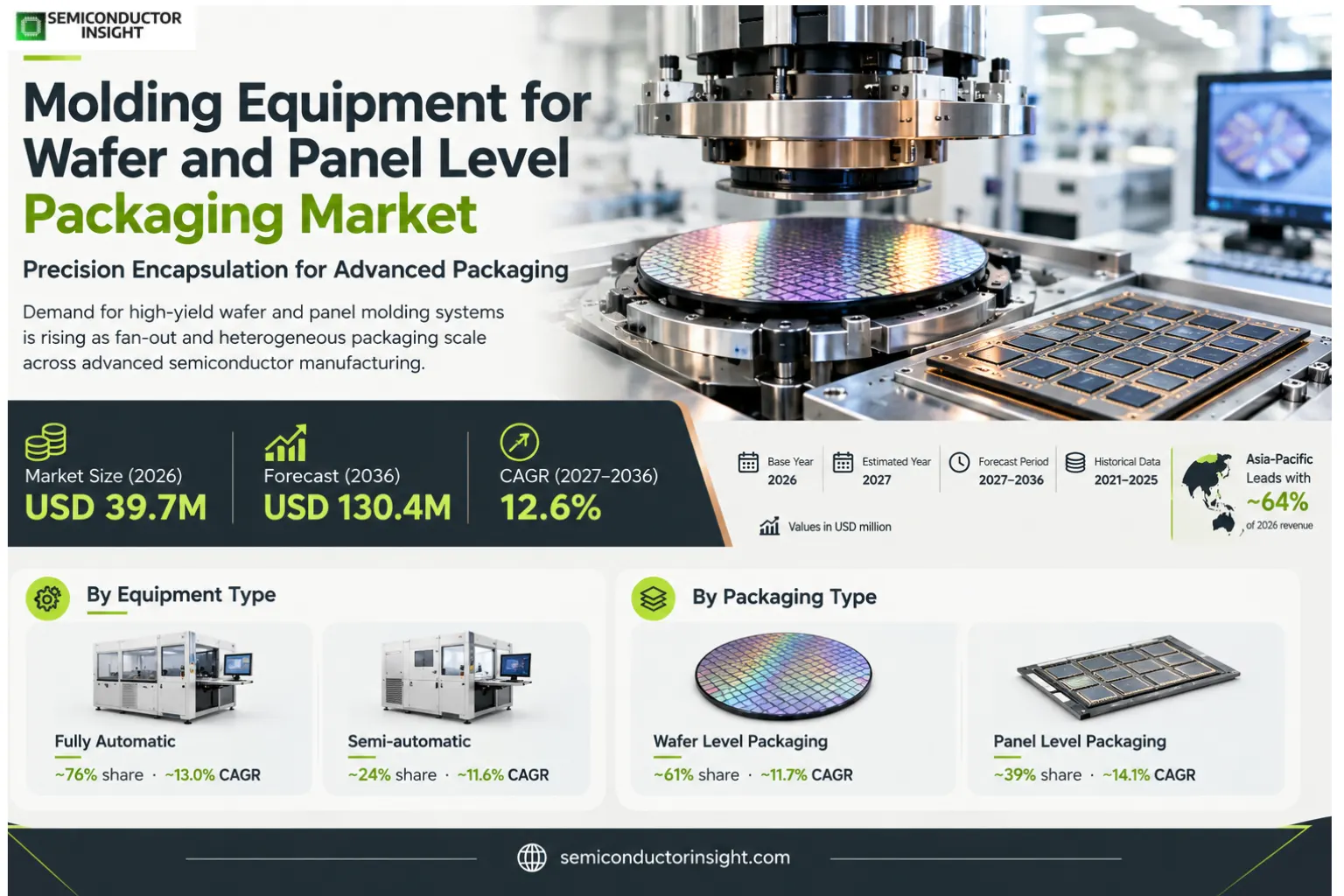
- Market trajectory: Molding Equipment for Wafer and Panel Level Packaging records USD 39.7 million in 2026 and is projected to reach USD 130.4 million by 2036, equivalent to 12.6% growth during 2027–2036. The investment case is linked to wafer and panel encapsulation, advanced fan-out packaging and qualified automation rather than generic injection-molding equipment.
- Fully Automatic: the largest type with an estimated ~76% of 2026 revenue, reflects automated wafer and panel handling with integrated resin dispensing and process control. Its growth path is modeled at ~13.0% CAGR, with process qualification determining realized orders.
- Wafer Level Packaging (WLP): the leading application with an estimated ~61% of 2026 revenue, depends on 300 mm wafer handling and established fan-out process flows. Adjacent applications have different process requirements, so equipment and material revenue cannot be treated as interchangeable.
- Asia-Pacific: the largest region at an estimated ~64% of 2026 sales, combines concentrated outsourced packaging and equipment demand The other four regions differ in manufacturing capacity, investment timing and technical qualification requirements.
- Commercial qualification: Panel warpage, resin flow control and package reliability can limit the yield benefits of larger carrier formats. Buyers distinguish qualified production tools and materials from research demonstrations, and they do not infer market revenue directly from broader semiconductor capital spending.
Molding Equipment for Wafer and Panel Level Packaging Market Overview
The molding equipment for wafer and panel level packaging reached USD 39.7 million in 2026 and is projected to attain USD 130.4 million by 2036, representing a CAGR of 12.6% during 2027–2036. Asia-Pacific accounted for an estimated ~64% of base-year revenue, supported by concentrated outsourced packaging and equipment demand.
Wafer- and panel-level molding equipment encapsulates semiconductor dice or reconstituted carriers with protective polymer compounds before redistribution, singulation or final assembly. The defined market includes transfer and compression molding systems configured for wafer-level packaging and panel-level packaging, along with their integrated handling and process controls. It excludes conventional plastic injection presses, general semiconductor fabrication tools and the value of finished packages. The scope is equipment revenue, not the total cost of outsourced assembly services.
Compression molding places resin into a cavity and controls pressure and temperature to encapsulate delicate structures with reduced resin flow. TOWA lists CPM1080 systems for 300 mm wafers and 320 × 320 mm panels, and CPM1180 variants for panels up to 625 × 620 mm. These formats illustrate the engineering challenge of uniform resin distribution across a large area. The commercial result depends on mold thickness variation, carrier warpage, void control and repeatable handling at production speed.
Transfer molding remains relevant where process geometry, exposed die or molded-underfill requirements favor a different resin flow path. Besi describes its Fico Molding Line for 200–305 mm wafers and panels up to 300 × 340 mm, with low cap heights and fine gaps between dice. The ability to support multiple package configurations can reduce qualification cost for a factory, but no single machine architecture is optimal for every compound and device type.
Advanced packaging is the broader demand environment. SEMI reported USD 135.1 billion in global semiconductor manufacturing equipment billings in 2025, with assembly and packaging equipment sales rising 21% year on year. Its July 2026 forecast projected USD 6.7 billion of assembly and packaging equipment sales in 2026. These are contextual figures covering many tool categories; only qualifying wafer and panel molding systems fall within the narrower market analyzed here.
Customers purchase molding presses against package-specific process windows rather than simply selecting the largest panel dimension. ASE describes fan-out packaging using reconstituted wafers and rectangular panels, while Amkor documents high-density fan-out and through-mold interconnect structures. The growing complexity of heterogeneous packages raises requirements for encapsulation uniformity, void prevention and thermal-mechanical reliability. Equipment suppliers compete on yield, automation, resin compatibility, throughput and field service.
Segment Analysis: By Type
By type, Fully Automatic leads at an estimated ~76% of 2026 revenue, while Semi-automatic represents ~24%. The modeled annual growth rates of ~13.0% and ~11.6% reflect different investment patterns and process requirements. The classification follows the equipment or substrate actually sold and excludes adjacent materials or machinery not performing the defined market function.
| Type | Function | Market position |
|---|---|---|
| Fully Automatic | Fully Automatic performs automated press loading, recipe control, mold handling and inspection while minimizing operator intervention. TOWA CPM1180 and Besi Fico AMS systems demonstrate the range of automated configurations for high-volume packaging. In the Fully Automatic type, the economic impact depends on qualified throughput, material compatibility, production yield and equipment uptime rather than the nominal capability of a demonstration. The Fully Automatic process is assessed against the 2026 revenue share estimate of ~76% and the ~13.0% CAGR trajectory. Buyers considering the Fully Automatic type compare validated process windows and local service support before committing capital. | An estimated ~76% of 2026 revenue is associated with Fully Automatic, with ~13.0% CAGR. Production customers prioritize repeatability and uptime, especially where package yield depends on accurate resin placement, controlled vacuum and uniform clamping across large carriers. In Fully Automatic procurement, the economic impact depends on qualified throughput, material compatibility, production yield and equipment uptime rather than the nominal capability of a demonstration. For Fully Automatic, qualification criteria differ from those of Semi-automatic and influence how customers evaluate throughput and operating cost. Buyers considering Fully Automatic procurement compare validated process windows and local service support before committing capital. |
| Semi-automatic | Semi-automatic performs operator-assisted carrier loading combined with controlled molding pressure and resin supply. TOWA CPM1080 semi-automatic systems and Besi manual MMS variants illustrate development and low-volume alternatives to fully integrated lines. In the Semi-automatic type, the economic impact depends on qualified throughput, material compatibility, production yield and equipment uptime rather than the nominal capability of a demonstration. The Semi-automatic process is assessed against the 2026 revenue share estimate of ~24% and the ~11.6% CAGR trajectory. Buyers considering the Semi-automatic type compare validated process windows and local service support before committing capital. | An estimated ~24% of 2026 revenue is associated with Semi-automatic, with ~11.6% CAGR. The segment serves process development and smaller manufacturing programs where recipe changes and tooling flexibility outweigh the throughput advantage of fully automatic wafer or panel lines. In Semi-automatic procurement, the economic impact depends on qualified throughput, material compatibility, production yield and equipment uptime rather than the nominal capability of a demonstration. For Semi-automatic, qualification criteria differ from those of Fully Automatic and influence how customers evaluate throughput and operating cost. Buyers considering Semi-automatic procurement compare validated process windows and local service support before committing capital. |
Fully Automatic
Fully Automatic is commercially differentiated by automated wafer and panel handling with integrated resin dispensing and process control. The Fully Automatic technical requirements include stable processing windows and reliable interfaces to adjacent production stages. In Fully Automatic process integration, the economic impact depends on qualified throughput, material compatibility, production yield and equipment uptime rather than the nominal capability of a demonstration. Its estimated ~76% share should be interpreted as a revenue allocation within the exact market. Buyers considering Fully Automatic process integration compare validated process windows and local service support before committing capital.
The growth outlook for Fully Automatic is ~13.0% annually from the 2026 base. The Fully Automatic production case is assessed through a combination of tool utilization, qualified yield and compatibility with established manufacturing recipes. A supplier of Fully Automatic must also demonstrate that equipment maintains process consistency when carrier dimensions, material formulations or package complexity change.
Semi-automatic
Semi-automatic is commercially differentiated by flexible engineering runs and lower-volume packaging programs. The Semi-automatic technical requirements include stable processing windows and reliable interfaces to adjacent production stages. In Semi-automatic process integration, the economic impact depends on qualified throughput, material compatibility, production yield and equipment uptime rather than the nominal capability of a demonstration. Its estimated ~24% share should be interpreted as a revenue allocation within the exact market. Buyers considering Semi-automatic process integration compare validated process windows and local service support before committing capital.
The growth outlook for Semi-automatic is ~11.6% annually from the 2026 base. The Semi-automatic production case is assessed through a combination of tool utilization, qualified yield and compatibility with established manufacturing recipes. A supplier of Semi-automatic must also demonstrate that equipment maintains process consistency when carrier dimensions, material formulations or package complexity change.
Segment Analysis: By Application
Applications are led by Wafer Level Packaging (WLP) at an estimated ~61% of 2026 revenue, followed by Panel Level Packaging (PLP) at ~39%. Their modeled growth rates are ~11.7% and ~14.1% respectively. Application mix depends on the relative value of qualified process steps rather than the number of finished chips or packages alone.
| Application | Demand characteristics |
|---|---|
| Wafer Level Packaging (WLP) | Wafer Level Packaging (WLP) represents an estimated ~61% of 2026 demand and ~11.7% CAGR. Wafer-level packaging requires encapsulation of whole wafers or reconstituted wafer carriers with controlled thickness and die protection. Equipment must integrate with downstream redistribution and singulation while managing wafer bow, resin flow and package coplanarity. In the Wafer Level Packaging (WLP) application, the economic impact depends on qualified throughput, material compatibility, production yield and equipment uptime rather than the nominal capability of a demonstration. 300 mm wafer handling and established fan-out process flows. Buyers considering the Wafer Level Packaging (WLP) application compare validated process windows and local service support before committing capital. |
| Panel Level Packaging (PLP) | Panel Level Packaging (PLP) represents an estimated ~39% of 2026 demand and ~14.1% CAGR. Panel-level packaging extends fan-out and other assembly processes to rectangular carriers, increasing usable area but complicating resin uniformity and warpage control. TOWA describes systems reaching 625 × 620 mm panels, while ASE details 300 × 300 mm and 600 × 600 mm fan-out formats. |
Wafer Level Packaging (WLP) is a distinct demand pool because 300 mm wafer handling and established fan-out process flows. The modeled base-year share is ~61%, with ~11.7% CAGR through 2036. In Wafer Level Packaging (WLP) commercialization, the economic impact depends on qualified throughput, material compatibility, production yield and equipment uptime rather than the nominal capability of a demonstration. Investment in Wafer Level Packaging (WLP) is governed by process yield, application-specific reliability and production capacity rather than generic semiconductor market growth. Buyers considering Wafer Level Packaging (WLP) commercialization compare validated process windows and local service support before committing capital.
Panel Level Packaging (PLP) is a distinct demand pool because large rectangular carriers and the pursuit of better area utilization. The modeled base-year share is ~39%, with ~14.1% CAGR through 2036. In Panel Level Packaging (PLP) commercialization, the economic impact depends on qualified throughput, material compatibility, production yield and equipment uptime rather than the nominal capability of a demonstration. Investment in Panel Level Packaging (PLP) is governed by process yield, application-specific reliability and production capacity rather than generic semiconductor market growth. Buyers considering Panel Level Packaging (PLP) commercialization compare validated process windows and local service support before committing capital.
Regional Analysis
Asia-Pacific holds an estimated ~64% share of Molding Equipment for Wafer and Panel Level Packaging revenue in 2026, followed by North America (~17%) and Europe (~12%). The remaining regions account for ~4% and ~3%. Regional growth varies with installed semiconductor packaging capacity, customer qualification programs, materials supply and investment in advanced manufacturing.
What drives regional demand for molding equipment for wafer and panel level packaging?
Asia-Pacific is the main concentration of wafer- and panel-level packaging capacity, equipment demand and semiconductor assembly investment. TOWA manufactures specialized compression molding systems in Japan, while regional OSAT and device-manufacturing clusters create opportunities for both automated production lines and process development. North America and Europe contribute technology qualification, advanced package R&D and equipment design, but supplier headquarters should not be confused with the location of end-user equipment installation.
The 2026 allocation assigns Asia-Pacific an estimated ~64% share with ~13.0% CAGR, North America ~17% with ~12.0%, Europe ~12% with ~11.0%, South America ~4% with ~12.0%, and Middle East & Africa ~3% with ~11.0%. These estimates refer to molding equipment for wafer and panel packaging only. They do not reproduce the regional distribution of all semiconductor manufacturing equipment or of downstream electronics production.
SEMI reported that China, Taiwan and Korea accounted for 79% of global semiconductor equipment spending in 2025. The figure supports the importance of Asian manufacturing investment but includes fabrication, test and other equipment classes. Supplier selection for molding is more specific: buyers evaluate panel size, resin dispensing, clamping force, vacuum quality, automation, uptime and the ability to maintain package yield during production ramp-up.
| Region | Position | Growth outlook | Demand profile | What decides supplier selection |
|---|---|---|---|---|
| Asia-Pacific | Estimated ~64% of 2026 revenue | ~13.1% CAGR | Concentrated outsourced packaging and equipment demand | In Asia-Pacific, customers prioritize regional packaging lines in china, taiwan, south korea and japan create the largest customer pool for molding presses and associated process tooling.. The regional share of ~64% and growth rate of ~13.1% reflect qualification and production investment patterns. In Asia-Pacific vendor selection, the economic impact depends on qualified throughput, material compatibility, production yield and equipment uptime rather than the nominal capability of a demonstration. Buyers in Asia-Pacific compare process support and the economic return from equipment or substrate procurement. Buyers considering Asia-Pacific vendor selection compare validated process windows and local service support before committing capital. |
| North America | Estimated ~17% of 2026 revenue | ~12.2% CAGR | Advanced packaging capacity and domestic R&D | In North America, customers prioritize united states packaging investment and technology qualification drive specialized demand, although a large portion of equipment manufacturing remains offshore.. The regional share of ~17% and growth rate of ~12.2% reflect qualification and production investment patterns. In North America vendor selection, the economic impact depends on qualified throughput, material compatibility, production yield and equipment uptime rather than the nominal capability of a demonstration. Buyers in North America compare process support and the economic return from equipment or substrate procurement. Buyers considering North America vendor selection compare validated process windows and local service support before committing capital. |
| Europe | Estimated ~12% of 2026 revenue | ~11.2% CAGR | Equipment engineering and automotive reliability | In Europe, customers prioritize european demand reflects specialty packaging, power electronics and manufacturing equipment expertise with emphasis on repeatable quality and lifecycle support.. The regional share of ~12% and growth rate of ~11.2% reflect qualification and production investment patterns. In Europe vendor selection, the economic impact depends on qualified throughput, material compatibility, production yield and equipment uptime rather than the nominal capability of a demonstration. Buyers in Europe compare process support and the economic return from equipment or substrate procurement. Buyers considering Europe vendor selection compare validated process windows and local service support before committing capital. |
| South America | Estimated ~4% of 2026 revenue | ~12.2% CAGR | Selective electronics assembly and industrial demand | In South America, customers prioritize south american demand is concentrated in specialist assembly and imported equipment with smaller wafer-level packaging infrastructure than asian production centers.. The regional share of ~4% and growth rate of ~12.2% reflect qualification and production investment patterns. In South America vendor selection, the economic impact depends on qualified throughput, material compatibility, production yield and equipment uptime rather than the nominal capability of a demonstration. Buyers in South America compare process support and the economic return from equipment or substrate procurement. Buyers considering South America vendor selection compare validated process windows and local service support before committing capital. |
| Middle East & Africa | Estimated ~3% of 2026 revenue | ~11.2% CAGR | Emerging semiconductor investment and specialized assembly | In Middle East & Africa, customers prioritize regional demand is linked to industrial diversification, electronics research and limited semiconductor packaging infrastructure rather than a broad installed panel-level molding base.. The regional share of ~3% and growth rate of ~11.2% reflect qualification and production investment patterns. In Middle East & Africa vendor selection, the economic impact depends on qualified throughput, material compatibility, production yield and equipment uptime rather than the nominal capability of a demonstration. Buyers in Middle East & Africa compare process support and the economic return from equipment or substrate procurement. Buyers considering Middle East & Africa vendor selection compare validated process windows and local service support before committing capital. |
Competitive Landscape and Supplier Positioning
Competition is concentrated among specialist semiconductor packaging equipment suppliers. TOWA provides compression and transfer molding systems for wafer and panel applications; Besi supplies Fico molding equipment; ASMPT offers encapsulation platforms including ORCAS and 3Ge. Packaging providers such as ASE and Amkor are important customers and process references, not automatically equipment manufacturers. Supplier qualification is based on actual molding capabilities and after-sales support.
TOWA differentiates its CPM compression molding family through granular and liquid resin handling, modular configurations and large-panel capability. Its CPM1180 models support panels up to 625 × 620 mm, while CPM1080 addresses 300 mm wafers and smaller panels. These are manufacturer specifications and should not be mistaken for installed machine counts. The commercial advantage depends on matching a qualified process window to customer package designs and resin chemistry.
Besi offers automated and manual Fico molding platforms. Its Fico Molding Line is designed for wafer and panel transfer molding, while AMS systems serve higher-volume encapsulation of substrate-based packages. The equipment family spans process optimization and production operation, allowing customers to qualify recipes before scaling. The distinction between transfer and compression approaches matters because exposed die, low cap heights and compound flow can change the preferred tool.
Yamaha Robotics offers the APIC YAMADA series of molding systems and precision tools, while Xinsheng Semiconductor documents automated and manual wafer-level molding equipment. These suppliers broaden the qualified manufacturer set beyond the three largest international brands. ASMPT describes ORCAS as a configurable encapsulation system for fan-out wafer- and panel-level packaging, and its 3Ge platform offers high-density molding with vacuum and smart-factory functions. These products broaden the equipment choice beyond a single press architecture. Customers evaluate how equipment integrates with upstream die placement, carrier handling and downstream redistribution, and whether the supplier can support process changes during package qualification.
ASE and Amkor illustrate the downstream packaging processes that drive equipment requirements. ASE explains fan-out packaging on reconstituted wafers and panels, and Amkor SWIFT uses high-density redistribution and through-mold interconnect technology. Their disclosed packaging capabilities do not establish direct equipment sales by these companies. Revenue attribution must remain with qualifying molding equipment suppliers rather than finished-package manufacturers or resin vendors.
Tier structure
| Tier | Companies | Basis of competition |
|---|---|---|
| Compression molding specialists | TOWA | Suppliers of wafer and panel compression molding equipment with direct process and tool documentation, including granular and liquid resin options, large carrier handling and high-precision clamping. In Compression molding specialists competitive tier, the economic impact depends on qualified throughput, material compatibility, production yield and equipment uptime rather than the nominal capability of a demonstration. The Compression molding specialists distinction separates actual in-scope suppliers from adjacent value-chain participants and customers. Buyers considering Compression molding specialists competitive tier compare validated process windows and local service support before committing capital. |
| Transfer and multi-format molding | Besi; ASMPT | Equipment manufacturers offering transfer or encapsulation platforms for wafer, panel and substrate packaging, with configurable press automation and vacuum control. In Transfer and multi-format molding competitive tier, the economic impact depends on qualified throughput, material compatibility, production yield and equipment uptime rather than the nominal capability of a demonstration. The Transfer and multi-format molding distinction separates actual in-scope suppliers from adjacent value-chain participants and customers. Buyers considering Transfer and multi-format molding competitive tier compare validated process windows and local service support before committing capital. |
| Downstream packaging demand | ASE; Amkor | Outsourced assembly companies whose wafer and panel fan-out processes create equipment requirements but whose package revenue is excluded from molding equipment sales. In Downstream packaging demand competitive tier, the economic impact depends on qualified throughput, material compatibility, production yield and equipment uptime rather than the nominal capability of a demonstration. The Downstream packaging demand distinction separates actual in-scope suppliers from adjacent value-chain participants and customers. Buyers considering Downstream packaging demand competitive tier compare validated process windows and local service support before committing capital. |
Key companies profiled
- TOWA
- Besi
- ASMPT
- Yamaha Robotics (APIC YAMADA Series)
- Xinsheng Semiconductor
Compression, Transfer Molding and Process Qualification
Molding process selection depends on carrier geometry, resin rheology, required cap thickness and device fragility. Compression systems can reduce resin flow over delicate chips, while transfer molding may better accommodate certain exposed-die and underfill configurations. Panel expansion adds challenges in warpage, uniform dispense, clamp force and automated handling, making process engineering a substantial part of equipment value.
TOWA specifies its CPM1080 for 300 mm wafers and 320 × 320 mm panels and the CPM1180 for panels as large as 625 × 620 mm. The company also describes modular press configurations and release-film reduction. These design choices influence throughput and material cost, but production yield depends on the actual compound, package layout and temperature profile used by the customer.
Besi describes the Fico Molding Line as a transfer system that can process wafers up to 305 mm and panels up to 300 × 340 mm. The machine is designed to support overmolded and exposed-die products, with thin cap heights and narrow die spacing. Customers must qualify resin fill, void behavior and carrier distortion before extrapolating manufacturer specifications to production performance.
ASMPT presents 3Ge encapsulation equipment with smart-factory options and high-density processing, while ASE documents wafer- and panel-level fan-out architectures. Together these sources show that molding equipment is only one step in a complex packaging flow. Tool selection must account for upstream placement accuracy, downstream redistribution alignment, inspection and singulation as well as the encapsulation operation itself.
Market Dynamics, Constraints and Opportunities
Equipment demand is driven by advanced packaging complexity, increased carrier area and the shift to repeatable automated processes. The principal barriers are capital intensity, warpage, resin compatibility and long customer qualification cycles. Market expansion therefore depends on real assembly capacity additions rather than broad semiconductor sales alone. A purchase decision also requires verification of package-specific reliability, resin supply, tool uptime and process integration with the customer’s existing manufacturing line.
MARKET DRIVERS
Drivers Impact Analysis*
| Driver | (~) % impact on CAGR forecast | Geographic relevance | Impact timeline |
|---|---|---|---|
| Advanced fan-out adoption | +2.1% | Asia-Pacific and North America | 2027–2033 |
| Panel-size expansion | +1.6% | Asia-Pacific | 2027–2036 |
| Automation and yield | +1.2% | Global | 2027–2034 |
Advanced fan-out packaging
ASE and Amkor document packaging architectures that require controlled encapsulation around dense interconnects and multi-die structures. As package designs become more complex, molding equipment must manage resin placement and dimensional stability without damaging delicate features. The purchasing driver is not simply package volume but the need for a qualified process that maintains yield across higher-value devices and heterogeneous assemblies.
Larger wafer and panel formats
TOWA describes compression molding for 300 mm wafers and 625 × 620 mm panels, showing the direction of carrier scaling. Larger panels can improve area utilization, but resin uniformity and mechanical handling become more difficult as size increases. Equipment suppliers gain opportunities when they can prove repeatable molding quality at large formats and integrate presses with automated material transport.
Automation and production economics
Fully automatic systems reduce manual handling and improve recipe repeatability in high-volume operations. Besi Fico AMS and TOWA CPM variants demonstrate options for integrated loading, clamping and resin delivery. Customers evaluate the gain against equipment cost, uptime and maintenance requirements. The highest-value orders are tied to production lines with sustained utilization and qualified process windows.
MARKET RESTRAINTS
Restraints Impact Analysis*
| Restraint | (~) % impact on CAGR forecast | Geographic relevance | Impact timeline |
|---|---|---|---|
| High initial capital cost | −1.2% | Global | 2027–2036 |
| Warpage and void control | −1.0% | Large-panel lines | 2027–2035 |
| Long qualification cycles | −0.9% | Advanced packaging | 2027–2036 |
Capital expenditure and utilization
A molding press is one component of a wafer or panel packaging line that also requires die placement, redistribution, inspection and singulation. Buying the largest automated system is not economical without sustained throughput. Semi-automatic tools remain relevant for research and low-volume programs, but their lower capital requirement comes with different labor and capacity trade-offs.
Warpage and resin uniformity
Large panels increase the challenge of maintaining consistent mold thickness, cavity vacuum and thermal profiles. Resin viscosity, die distribution and carrier stiffness affect void formation and distortion. A supplier must demonstrate yield with the customer’s actual compound and package design rather than relying on nominal panel dimensions. Qualification failures can delay orders or shift demand toward smaller carriers.
Customer-specific process qualification
Each packaging architecture has its own resin, geometry, reliability and downstream integration requirements. Changing a molding tool or material can trigger repeated thermal, mechanical and electrical validation. This makes sales cycles longer than those for generic factory equipment and increases the value of local engineering support. Buyers may delay capital commitments until the complete packaging flow is proven.
MARKET OPPORTUNITIES
Panel-level fan-out commercialization
Rectangular panels offer a path to higher area utilization in selected fan-out applications. ASE describes panel fan-out options, and TOWA lists large-panel compression systems. Equipment demand can grow where manufacturers solve warpage and redistribution alignment at scale. The commercial opportunity remains conditional on validated yield and package cost, not on panel dimensions alone.
Flexible production and prototyping
Manual and semi-automatic molding systems support package qualification, specialty devices and smaller production programs. Besi Fico MMS and TOWA CPM variants provide examples of configurable equipment. Suppliers can capture development-stage revenue while customers refine resin formulations and mold designs. Conversion to automated production depends on a later investment decision and sustained order volumes.
HBM and heterogeneous packages
SEMI identifies advanced memory and AI packaging as drivers of backend equipment investment. TOWA positions CPM1080-HP for HBM, 2.5D, 3D and chiplet applications. These architectures require careful encapsulation around dense assemblies, creating an opportunity for process-specific tooling. Demand must be tied to actual qualified molding steps rather than the total value of high-bandwidth memory devices.
Molding Equipment Supply Chain and Packaging Integration
The value chain includes precision presses, molds, vacuum systems, dispensing, carrier handling, resin materials and service engineering. Equipment suppliers must coordinate with package manufacturers and encapsulation compound vendors. Production economics depend on yield, uptime and material consumption across the complete assembly line rather than on the molding press purchase price alone.
Equipment manufacturing. Specialist molding suppliers compete on precision press design, process controls and long-term serviceability. TOWA and Besi product disclosures show different ways to combine clamping, vacuum and handling. Tool availability and replacement parts matter because unplanned downtime can disrupt a qualified packaging line and increase the effective cost per package. In Equipment manufacturing supply-chain issue, the economic impact depends on qualified throughput, material compatibility, production yield and equipment uptime rather than the nominal capability of a demonstration. Commercial results for Equipment manufacturing depend on customer acceptance, materials availability and repeatable production yield. Buyers considering Equipment manufacturing supply-chain issue compare validated process windows and local service support before committing capital.
Materials compatibility. Resin rheology and cure behavior influence fill uniformity, voids and final package stress. TOWA describes systems accepting both granular and liquid resins, while transfer molding tools address other process geometries. Customers qualify each material and mold combination because a change in compound can alter warpage and reliability even if nominal press settings remain unchanged.
Panel handling and automation. A larger carrier improves potential area utilization but increases requirements for flatness, transport and process uniformity. TOWA CPM1180 and Besi Fico Molding Line demonstrate different supported dimensions and architectures. The economic advantage must be measured after scrap, rework and cycle time, not simply by counting packages that fit on a panel. In Panel handling and automation supply-chain issue, the economic impact depends on qualified throughput, material compatibility, production yield and equipment uptime rather than the nominal capability of a demonstration. Commercial results for Panel handling and automation depend on customer acceptance, materials availability and repeatable production yield. Buyers considering Panel handling and automation supply-chain issue compare validated process windows and local service support before committing capital.
Customer qualification and service. Molding equipment enters production only after customers validate package reliability, equipment uptime and integration with adjacent tools. Local process engineers support recipe optimization, resin changes and maintenance. The commercial lifecycle can extend well beyond initial delivery, so buyers consider training, spare-parts logistics and upgrade capability when comparing suppliers. In Customer qualification and service supply-chain issue, the economic impact depends on qualified throughput, material compatibility, production yield and equipment uptime rather than the nominal capability of a demonstration. Commercial results for Customer qualification and service depend on customer acceptance, materials availability and repeatable production yield. Buyers considering Customer qualification and service supply-chain issue compare validated process windows and local service support before committing capital.
Recent Developments in Molding Equipment for Wafer and Panel Level Packaging
- 14 July 2026 INDUSTRY OUTLOOK
SEMI projected USD 6.7 billion in worldwide assembly and packaging equipment sales for 2026 and further growth through 2028. The forecast provides context for advanced packaging investment but covers many tool categories beyond molding. The commercial implication is stronger customer interest in qualified backend capacity, not a direct estimate of wafer and panel molding press revenue. Source - 7 April 2026 EQUIPMENT SPENDING
SEMI reported global semiconductor manufacturing equipment billings of USD 135.1 billion in 2025, with assembly and packaging equipment sales increasing 21% year on year. The announcement documents a broader backend recovery relevant to molding tool suppliers. Direct demand still depends on specific encapsulation process investment, material qualification and actual line installation. In 7 April 2026 EQUIPMENT SPENDING event, the economic impact depends on qualified throughput, material compatibility, production yield and equipment uptime rather than the nominal capability of a demonstration. The 7 April 2026 EQUIPMENT SPENDING event provides technology or industry context and does not by itself measure direct market revenue. Buyers considering 7 April 2026 EQUIPMENT SPENDING event compare validated process windows and local service support before committing capital. Source - 16 December 2025 BACKEND FORECAST
SEMI issued its 2025 year-end semiconductor equipment forecast, identifying advanced packaging and high-bandwidth memory as important drivers of backend spending. The release points to investment conditions that can support molding system orders. It should not be interpreted as a purchase announcement by any individual wafer or panel packaging customer. In 16 December 2025 BACKEND FORECAST event, the economic impact depends on qualified throughput, material compatibility, production yield and equipment uptime rather than the nominal capability of a demonstration. The 16 December 2025 BACKEND FORECAST event provides technology or industry context and does not by itself measure direct market revenue. Buyers considering 16 December 2025 BACKEND FORECAST event compare validated process windows and local service support before committing capital. Source - 22 July 2025 CAPITAL EQUIPMENT
SEMI forecast growth in semiconductor assembly and packaging equipment sales in its 2025 mid-year outlook. The projection linked backend equipment demand to advanced device architectures and manufacturing transitions. Molding tool suppliers may benefit where these transitions require new encapsulation processes, but the published industry category includes other assembly machinery and cannot serve as the molding market total. Source - 9 April 2025 HISTORICAL BASE
SEMI reported USD 117.1 billion of global semiconductor equipment billings in 2024, including a recovery in backend equipment. The announcement establishes an investment baseline for packaging suppliers before subsequent 2025 and 2026 spending growth. The historical aggregate includes fabrication and test systems and therefore must not be treated as direct wafer or panel molding revenue. Source
REPORT SCOPE & SEGMENTATION
| Attribute | Details |
|---|---|
| Report title | Molding Equipment for Wafer and Panel Level Packaging Market Trends, Business Strategies 2026–2036 |
| Base year | 2026: USD 39.7 million |
| Estimated year | 2027: USD 44.7 million |
| Forecast year | 2036: USD 130.4 million |
| Forecast CAGR | 12.6% during 2027–2036 |
| Revenue boundary | New semiconductor wafer-level and panel-level molding equipment, including transfer/compression molding presses and integrated dispensing, vacuum and handling functions. Excludes conventional plastics machinery, resin sales, finished package revenue and other backend tool categories. |
| Study period | 2021–2036, with 2021–2025 historical context and 2027–2036 forecast |
| By Type | Fully Automatic · Semi-automatic |
| By Application | Wafer Level Packaging (WLP) · Panel Level Packaging (PLP) |
| By Molding Process | Compression Molding · Transfer Molding |
| By Customer Type | OSAT Providers · Integrated Device Manufacturers · Research and Specialty Packaging |
| By Region | Five-region 2026 revenue allocation; shares are estimates within the defined market. Asia-PacificTaiwan, China, Japan North AmericaUnited States, Canada, Mexico EuropeNetherlands, Germany, France South AmericaBrazil, Argentina, Chile Middle East & AfricaIsrael, United Arab Emirates, South Africa |
| Key Companies Profiled | TOWA · Besi · ASMPT · Yamaha Robotics (APIC YAMADA Series) · Xinsheng Semiconductor |
| Customization Scope | Process technology, carrier size, automation, resin compatibility, customer qualification, packaging integration and regional investment analysis. |
Frequently Asked Questions
How large is the wafer and panel molding equipment market?
The global molding equipment market was USD 39.7 million in 2026 and is projected to reach USD 130.4 million by 2036, implying 12.6% annual growth. The revenue boundary includes qualifying semiconductor encapsulation presses and integrated process handling, not conventional plastic molding machinery, encapsulation materials or the total value of advanced packaging services.
Which equipment type leads the market?
Fully automatic molding equipment accounts for an estimated ~76% of 2026 revenue, compared with ~24% for semi-automatic systems. High-volume packaging operations favor integrated carrier handling, recipe control and consistent resin distribution. Semi-automatic equipment remains relevant for process development and lower-volume production where flexibility can outweigh maximum throughput. In Which equipment type leads the market?, the economic impact depends on qualified throughput, material compatibility, production yield and equipment uptime rather than the nominal capability of a demonstration. The interpretation applies only to the defined molding equipment for wafer and panel level packaging revenue boundary and should not be extended to unrelated semiconductor equipment or materials. Buyers considering Which equipment type leads the market? compare validated process windows and local service support before committing capital.
Which application has the largest revenue share?
Wafer Level Packaging leads with an estimated ~61% of 2026 molding equipment revenue, while Panel Level Packaging accounts for ~39%. Wafer formats have an established process base, whereas larger rectangular panels create an opportunity for area utilization but also greater challenges in warpage and resin uniformity. These are estimated equipment revenue allocations, not package unit shares.
Which region dominates molding equipment demand?
Asia-Pacific holds an estimated ~64% of 2026 revenue, reflecting the concentration of semiconductor assembly and packaging investment. North America follows at ~17% and Europe at ~12%. SEMI industry data show substantial equipment spending in China, Taiwan and Korea, but the wider equipment distribution cannot be directly substituted for the narrower molding equipment shares.
What is the difference between compression and transfer molding?
Compression molding places resin in a mold cavity and uses controlled pressure to encapsulate the package, often with limited resin flow over delicate structures. Transfer molding forces resin through gates and channels and may suit other package geometries. The choice depends on resin properties, exposed-die requirements, mold thickness, void control and qualified production yield.
Why are larger panel sizes important?
Large panels can improve carrier area utilization in selected fan-out packaging processes, potentially reducing cost per package. TOWA lists compression molding systems for panels up to 625 × 620 mm. However, larger area increases the difficulty of uniform resin distribution, clamping, handling and warpage control, so commercial benefits require demonstrated yield rather than nominal size alone.
Which suppliers have documented molding equipment?
TOWA, Besi and ASMPT have official product or technology documentation covering semiconductor encapsulation equipment. TOWA offers compression and transfer systems, Besi supplies Fico molding platforms and ASMPT describes ORCAS and 3Ge encapsulation solutions. Packaging companies such as ASE and Amkor illustrate end-use demand but should not automatically be counted as molding press manufacturers.
What constrains adoption of fully automatic systems?
Capital cost, process qualification and equipment utilization constrain adoption. Fully automated molding is attractive where production volume supports integrated handling and stable recipes, but lower-volume projects may prefer manual or semi-automatic systems. Customers also require local service, reliable resin supply and demonstrated yield across the complete package process before committing to production equipment.
How does advanced fan-out packaging affect demand?
Fan-out wafer and panel packaging can require precise encapsulation around dense redistribution structures and multiple dice. ASE and Amkor document advanced fan-out technologies that create these requirements. Equipment demand rises when manufacturers qualify new package architectures, but the value of completed packages is separate from the sale of the molding machinery used in production.
How should buyers compare molding equipment suppliers?
Buyers should test actual package designs, compounds and carrier formats for voids, warpage, mold thickness uniformity, throughput and uptime. TOWA, Besi and ASMPT systems offer different press and automation capabilities. The total cost comparison should include material consumption, scrap, service, training, spare parts and integration with die placement and downstream redistribution equipment.
Research Sources & Evidence Base

Get Sample Report PDF for Exclusive Insights
Report Sample Includes
- Table of Contents
- List of Tables & Figures
- Charts, Research Methodology, and more...
 Download Sample Report PDF