MARKET INSIGHTS
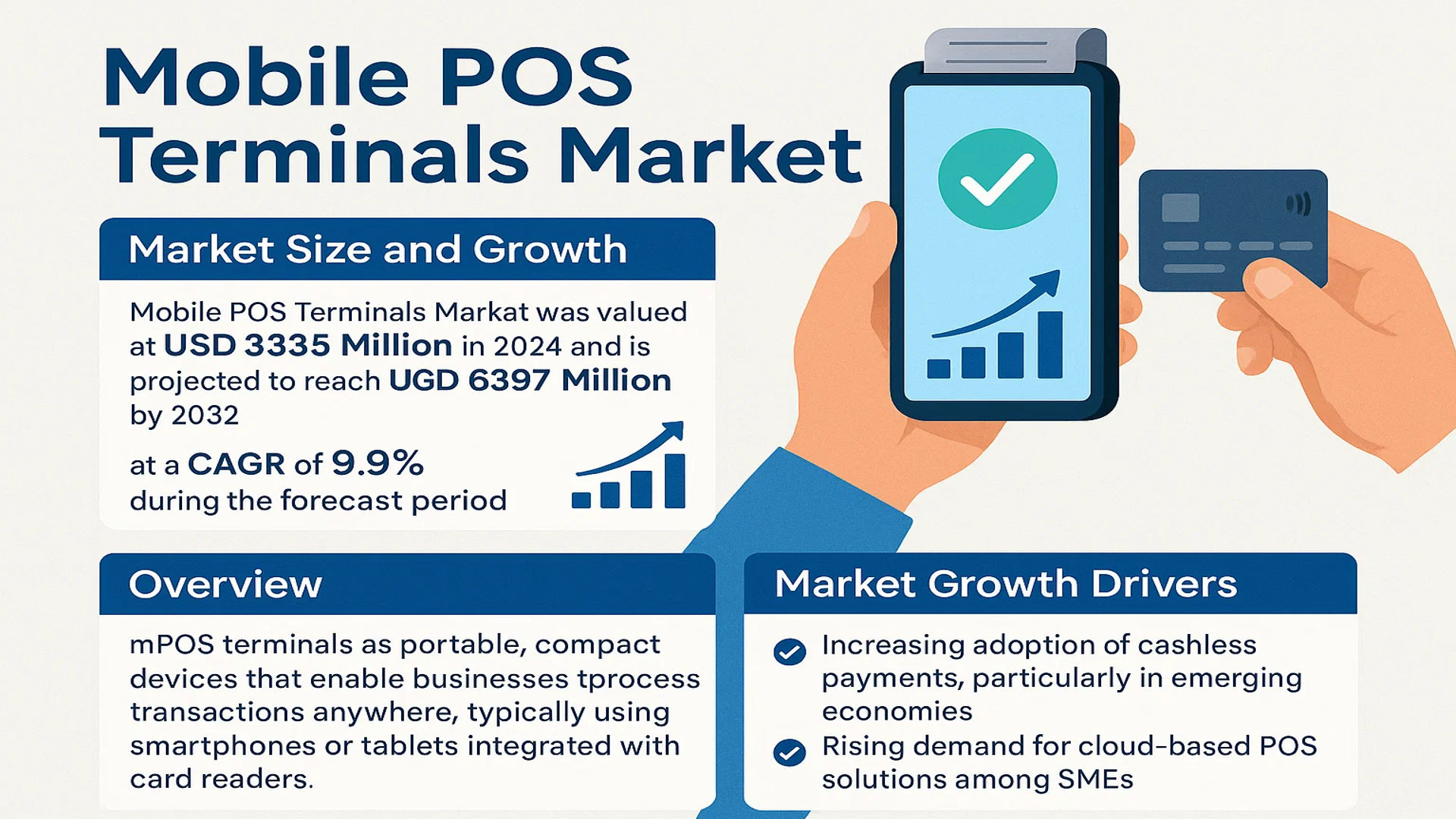
The global Mobile POS Terminals Market was valued at 3335 million in 2024 and is projected to reach US$ 6397 million by 2032, at a CAGR of 9.9% during the forecast period.
Mobile POS (Point of Sale) terminals are portable, compact devices that enable businesses to process transactions anywhere, typically using smartphones or tablets integrated with card readers. These terminals offer flexibility for retail, restaurants, hospitality, and event-based businesses by eliminating the need for fixed checkout counters. Modern mPOS systems support various payment methods including contactless (NFC), EMV chip cards, and mobile wallets like Apple Pay and Google Pay.
The market growth is driven by the increasing adoption of cashless payments, particularly in emerging economies, and the rising demand for cloud-based POS solutions among SMEs. The COVID-19 pandemic accelerated the shift toward contactless transactions, with NFC-enabled mobile POS terminals seeing a 58% adoption increase in 2022 according to industry data. Leading players such as Verifone, Ingenico (Worldline), and Square dominate the market with advanced security features like end-to-end encryption and biometric authentication.
MARKET DYNAMICS
MARKET DRIVERS
Rising Adoption of Contactless Payments to Fuel Mobile POS Terminal Demand
The global shift toward contactless payments has been a primary driver behind the mobile POS terminal market’s expansion. Consumer preferences have notably shifted towards NFC-enabled tap-and-go transactions due to their convenience, speed, and enhanced hygiene benefits. Statistics indicate that contactless payment adoption surged by over 40% worldwide between 2021 and 2024, prompting businesses across retail, hospitality, and event management sectors to rapidly adopt mobile POS solutions. The COVID-19 pandemic accelerated this trend, as businesses sought to minimize physical contact through touchless transactions. Mobile POS terminals supporting Apple Pay, Google Pay, and contactless EMV cards have now become essential for merchants aiming to meet evolving customer expectations.
Growing Preference for Cloud-Based Solutions Among SMEs
Small and medium-sized enterprises are increasingly turning to cloud-based mobile POS systems due to their affordability, scalability, and remote management capabilities. Unlike traditional POS terminals that require substantial upfront investment, cloud-based mobile solutions offer flexible subscription models, reducing operational costs significantly. Research highlights that cloud-based POS adoption among SMEs grew by approximately 30% annually between 2020 and 2024. These systems enable businesses to seamlessly manage inventory, sales analytics, and customer loyalty programs from any location, making them indispensable for food trucks, pop-up stores, and independent retailers who prioritize mobility and real-time data access.
➤ Modern mobile POS solutions now integrate CRM tools, allowing businesses to track purchase history and personalize marketing campaigns, further enhancing customer engagement.
Additionally, the integration of advanced features such as real-time reporting and AI-driven inventory management has elevated the efficiency of mobile POS systems, driving wider acceptance across industries. As digital transformation accelerates, mobile POS adoption is expected to grow exponentially among businesses seeking operational agility.
Expansion of E-Commerce and Omnichannel Retailing
The rapid growth of omnichannel retail strategies is another key driver for mobile POS terminals. Retailers are increasingly adopting these devices to bridge the gap between online and in-store shopping experiences. Mobile POS systems facilitate seamless transactions on the shop floor, curbside pickups, and even during delivery, ensuring a cohesive customer journey. The global retail sector’s shift toward unified commerce has reinforced mobile POS terminals as vital tools for enhancing operational flexibility and customer satisfaction.
MARKET RESTRAINTS
Data Security Concerns Pose Significant Adoption Challenges
Despite the growing adoption of mobile POS terminals, concerns over payment security remain a major restraint. As transactions increasingly shift to mobile platforms, the risk of data breaches, fraudulent transactions, and cyber threats has escalated. Although EMV chip standards and end-to-end encryption provide robust protection, many small businesses lack the expertise to implement advanced security protocols effectively. Instances of skimming and phishing attacks on less-secure mobile POS devices have raised skepticism among some merchants and consumers, slowing adoption in sectors where payment security is paramount.
Regulatory and Compliance Complexities
The evolving regulatory landscape surrounding digital payments creates compliance challenges for mobile POS providers. Regions such as Europe and North America enforce stringent data protection laws, including GDPR and PCI-DSS, which mandate strict security measures for transaction processing. Ensuring compliance while maintaining cost-effectiveness can be particularly challenging for smaller providers. Additionally, inconsistent regulations across emerging markets further complicate expansion efforts for global vendors, creating fragmented adoption rates in developing economies.
MARKET OPPORTUNITIES
Emerging Markets Present High Growth Potential for Mobile POS Adoption
Emerging economies in Asia Pacific, Latin America, and Africa represent untapped opportunities for mobile POS providers, where cash-based transactions still dominate. Increased smartphone penetration and government initiatives promoting digital payments are accelerating the transition toward mobile POS systems in these regions. Mobile POS solutions are especially advantageous in areas with limited banking infrastructure, offering businesses and consumers an accessible alternative to traditional card terminals.
Integration with AI and Advanced Analytics
The incorporation of artificial intelligence and predictive analytics into mobile POS systems is opening new revenue streams. AI-driven demand forecasting, automated inventory tracking, and sentiment analysis for customer feedback are transforming mobile POS terminals into intelligent business tools. These innovations enable merchants to optimize pricing strategies, reduce stockouts, and enhance customer retention, presenting lucrative opportunities for technology providers to differentiate their offerings.
MARKET CHALLENGES
System Interoperability Issues Continue to Hinder Seamless Adoption
A persistent challenge in the mobile POS market is the lack of standardized integration across different platforms and payment gateways. Many businesses struggle with compatibility issues when attempting to synchronize mobile POS systems with ERP, accounting, or CRM software. Fragmented APIs and proprietary vendor ecosystems lead to operational inefficiencies, requiring custom development that increases implementation costs and delays deployment timelines.
Battery Life and Hardware Limitations
The reliance on battery-powered mobile POS devices introduces reliability concerns, especially for merchants operating in high-volume environments. Frequent charging requirements and hardware failures can disrupt transaction processing, affecting business continuity. Additionally, the rapid evolution of mobile technology necessitates frequent hardware upgrades, posing financial constraints for small businesses with limited capital expenditure budgets.
MOBILE POS TERMINALS MARKET TRENDS
Contactless Payment Adoption Accelerates Market Growth
The global Mobile POS (mPOS) terminals market is witnessing significant growth driven by the rapid adoption of contactless payment technologies, particularly NFC (Near Field Communication). Following the COVID-19 pandemic, consumers and businesses have prioritized hygiene and convenience, leading to a surge in demand for tap-to-pay solutions. Mobile POS systems now widely support NFC-enabled credit cards, smartphones (such as Apple Pay and Google Pay), and wearables, facilitating seamless transactions. In addition to speed and convenience, retailers benefit from reduced checkout friction, improving overall customer experience. The shift toward cashless economies in regions like Europe and North America further reinforces this trend, with countries like Sweden and the UK reporting over 80% penetration of contactless transactions in retail environments.
Other Trends
Cloud-Based Mobile POS Solutions Gain Traction
Cloud-based mobile POS systems are increasingly adopted due to their flexibility, scalability, and lower upfront costs compared to traditional POS hardware. Businesses with multiple locations—such as restaurant chains, retail stores, and service providers—leverage cloud solutions for real-time inventory management, sales analytics, and customer relationship management (CRM). Subscription-based pricing models further enhance accessibility for small and medium-sized enterprises (SMEs), enabling them to compete with larger players. Additionally, cloud integrations allow businesses to synchronize data across platforms, reducing operational inefficiencies and improving decision-making. The rise of Software-as-a-Service (SaaS) models has been particularly influential, with many providers offering all-in-one solutions that combine payment processing with business management tools.
Integration of Business Management Features
Modern mobile POS systems are evolving beyond payment processing to incorporate advanced business management functionalities. Features such as real-time inventory tracking, advanced CRM integration, and AI-powered sales analytics help retailers optimize operations and personalize customer engagement. For instance, integrated loyalty programs leverage purchasing data to offer targeted promotions, increasing repeat business. The hospitality sector has particularly benefited from these advancements, with restaurants using POS systems to manage reservations, table turnover, and kitchen workflows. Furthermore, the adoption of open API architectures enables businesses to customize their systems with third-party apps, creating tailored solutions that enhance efficiency and customer retention. The growing emphasis on omnichannel retail strategies further drives demand for POS solutions that unify in-store and online sales channels.
COMPETITIVE LANDSCAPE
Key Industry Players
Market Leaders Expand Solutions to Address Rising Demand for Seamless Transactions
The global mobile POS terminals market features a dynamic competitive environment with dominant players, emerging innovators, and specialized vendors competing across retail, hospitality, and service industries. Verifone and Ingenico (now Worldline) currently lead the market, leveraging their decades of payment technology expertise and extensive distribution networks across North America and Europe. These companies consistently enhance their offerings with contactless, cloud-integrated solutions to address evolving merchant needs.
PAX Technology and Newland NPT have significantly expanded their market presence by focusing on cost-effective Android-based smart POS devices tailored for SMEs. Their growth is further driven by aggressive expansion in emerging markets like Southeast Asia and Latin America, where adoption of mobile payment solutions is accelerating rapidly.
Meanwhile, disruptive players like Square and BBPOS are reshaping the industry through innovative software-centric models. Square’s ecosystem approach—integrating payments with business analytics—has made it a preferred choice for micro-merchants and pop-up retailers. The company has also expanded into advanced features like offline transaction modes and cryptocurrency payments.
Chinese manufacturers such as Shenzhen Xinguodu Technology and Wuhan Tianyu are gaining traction by offering competitive hardware optimized for high-volume transactions, particularly in domestic markets. Their ability to deliver rugged, affordable devices has enabled strong positioning in price-sensitive segments.
List of Key Mobile POS Terminal Companies Profiled
- Verifone (U.S.)
- Ingenico (Worldline) (France)
- PAX Technology (China)
- Newland NPT (China)
- Square (U.S.)
- BBPOS (Hong Kong)
- Shenzhen Xinguodu Technology (China)
- Wuhan Tianyu Information (China)
- NCR Voyix (U.S.)
- Advantech-AURES (France)
Segment Analysis:
By Type
Smart POS Segment Dominates the Market Due to Advanced Features and Connectivity
The market is segmented based on type into:
- Smart POS
- Subtypes: Android-based, iOS-based, and others
- Non-smart POS
By Application
Retail Segment Leads Due to Increased Adoption for Seamless Checkout Experiences
The market is segmented based on application into:
- Retail
- Restaurant
- Hospitality
- Entertainment
- Other
By Connectivity
Wi-Fi-Enabled Terminals Gain Traction for Cloud-Based Transactions
The market is segmented based on connectivity into:
- Bluetooth
- Wi-Fi
- 4G/LTE
- NFC
By Component
Integrated POS Systems Provide Comprehensive Business Solutions
The market is segmented based on component into:
- Hardware
- Subtypes: Card readers, scanners, printers, and others
- Software
- Services
Regional Analysis: Mobile POS Terminals Market
North America
North America leads the global Mobile POS (mPOS) market, driven by high smartphone penetration, widespread adoption of contactless payments, and strong digital payment infrastructure. The U.S. dominates with a nearly 65% market share in the region, fueled by small and medium-sized enterprises (SMEs) rapidly adopting cloud-based mPOS solutions. The emphasis on security, with stringent PCI DSS compliance norms, has accelerated the shift toward EMV-enabled and NFC-compatible terminals. Additionally, the booming gig economy and demand for mobile payment solutions in retail and quick-service restaurants (QSRs) contribute to market growth. While Canada follows closely, Mexico’s market is expanding due to increasing urbanization and government initiatives promoting digital payments.
Europe
Europe’s mPOS market thrives on regulatory support, particularly PSD2 and GDPR, ensuring secure and transparent digital transactions. The U.K. and Germany are frontrunners, with widespread NFC adoption and growing preference for cashless payments. Scandinavia, known for its high cashless transaction rates, has further accelerated mPOS adoption in hospitality and retail sectors. Southern Europe, including Italy and Spain, is experiencing steady growth as SMEs transition from traditional terminals to affordable mPOS solutions. However, fragmentation in payment regulations across EU countries poses integration challenges for providers. Nonetheless, innovations in AI-driven payment analytics and biometric authentication are reshaping the region’s competitive landscape.
Asia-Pacific
The Asia-Pacific region is the fastest-growing mPOS market, propelled by digital transformation in China, India, and Southeast Asia. China, with its massive e-commerce and mobile payment penetration (led by Alipay and WeChat Pay), accounts for over 40% of regional revenue. India’s market is expanding due to government-backed initiatives like UPI and rising smartphone usage among small merchants. Southeast Asian nations, particularly Indonesia and Vietnam, are witnessing accelerated mPOS adoption, supported by thriving tourism and retail sectors. While Japan and South Korea focus on high-tech smart POS systems, price-sensitive markets prioritize cost-effective, non-smart POS variants. The region’s unbanked population is a key driver, with mPOS bridging gaps in financial inclusion.
South America
South America’s mPOS market shows promising growth, led by Brazil, where fintech innovation and regulatory reforms foster cashless transactions. Over 50% of regional transactions are processed via mobile POS systems, with retail and food service sectors being primary adopters. Argentina and Colombia follow, though economic instability and currency fluctuations occasionally hinder investment. The region’s informal economy presents unique opportunities for affordable mPOS solutions, yet low banking penetration in rural areas remains a challenge. Secure, offline-capable terminals are gaining traction to cater to connectivity issues in remote locations.
Middle East & Africa
The Middle East & Africa (MEA) market is emerging, with the UAE and Saudi Arabia at the forefront due to government-led digital payment initiatives like Saudi Vision 2030. Mobile POS adoption is rising in hospitality and luxury retail sectors, catering to international tourists preferring contactless payments. Africa’s growth is driven by mobile money platforms (e.g., M-Pesa in Kenya), with mPOS terminals enabling SMEs to accept card payments. However, infrastructure constraints and low merchant awareness in sub-Saharan Africa slow broader adoption. As fintech partnerships expand, the region holds long-term potential for scalable mPOS solutions.
Report Scope
This market research report provides a comprehensive analysis of the global Mobile POS Terminals market, covering the forecast period 2024–2032. It offers detailed insights into market dynamics, technological advancements, competitive landscape, and key trends shaping the industry.
Key focus areas of the report include:
- Market Size & Forecast: Historical data and future projections for revenue, unit shipments, and market value across major regions and segments. The global Mobile POS Terminals market was valued at USD 3,335 million in 2024 and is projected to reach USD 6,397 million by 2032, growing at a CAGR of 9.9%.
- Segmentation Analysis: Detailed breakdown by product type (Smart POS and Non-smart POS), application (Retail, Restaurant, Hospitality, Entertainment, Others), and end-user industry to identify high-growth segments and investment opportunities.
- Regional Outlook: Insights into market performance across North America, Europe, Asia-Pacific, Latin America, and the Middle East & Africa, including country-level analysis where relevant. Asia-Pacific is expected to be the fastest-growing region due to rapid digital payment adoption.
- Competitive Landscape: Profiles of leading market participants, including their product offerings, R&D focus, manufacturing capacity, pricing strategies, and recent developments such as mergers, acquisitions, and partnerships. Key players include Verifone, Ingenico (Worldline), PAX Technology, and Square.
- Technology Trends & Innovation: Assessment of emerging technologies including NFC-based contactless payments, cloud-based POS solutions, integration with business management tools, and advanced security features like biometric authentication.
- Market Drivers & Restraints: Evaluation of factors driving market growth (rising demand for contactless payments, SME adoption) along with challenges (cybersecurity concerns, regulatory compliance).
- Stakeholder Analysis: Insights for payment solution providers, hardware manufacturers, software developers, investors, and policymakers regarding the evolving ecosystem and strategic opportunities.
Primary and secondary research methods are employed, including interviews with industry experts, data from verified sources, and real-time market intelligence to ensure the accuracy and reliability of the insights presented.
FREQUENTLY ASKED QUESTIONS:
What is the current market size of Global Mobile POS Terminals Market?
-> Mobile POS Terminals Market was valued at 3335 million in 2024 and is projected to reach US$ 6397 million by 2032, at a CAGR of 9.9% during the forecast period.
Which key companies operate in Global Mobile POS Terminals Market?
-> Key players include Verifone, Ingenico (Worldline), PAX Technology, Square, Newland NPT, and BBPOS, among others.
What are the key growth drivers?
-> Key growth drivers include rising demand for contactless payments, increasing SME adoption, and digital payment infrastructure development.
Which region dominates the market?
-> North America currently leads the market, while Asia-Pacific is the fastest-growing region.
What are the emerging trends?
-> Emerging trends include cloud-based POS solutions, integration with business management tools, biometric authentication, and NFC technology adoption.

Get Sample Report PDF for Exclusive Insights
Report Sample Includes
- Table of Contents
- List of Tables & Figures
- Charts, Research Methodology, and more...
 Download Sample Report PDF