Mobile 6-Axis IMU Market Insights
Mobile 6-Axis IMU market size was valued at USD 729 million in 2025. The market is projected to grow from USD 729 million in 2025 to USD 1050 million by 2034, exhibiting a CAGR of 5.4 % during the forecast period.
A mobile 6‑axis inertial measurement unit (IMU) combines a 3‑axis accelerometer and a 3‑axis gyroscope on a single MEMS chip. It continuously delivers linear‑acceleration and angular‑velocity data while meeting strict power‑budget and footprint constraints of smartphones, wearables, TWS earbuds and AR/VR headsets. Typical implementations feature low‑power sensing structures, on‑chip signal conditioning, programmable full‑scale ranges, FIFO buffers, interrupt engines and temperature compensation; many models also embed step‑counting or raise‑to-wake logic. Because the sensor output can be fused with algorithms for gesture recognition, screen rotation, camera stabilization and context awareness, manufacturers sell the device as a SiP or LGA package together with driver software and reference designs to differentiate end‑product experiences.
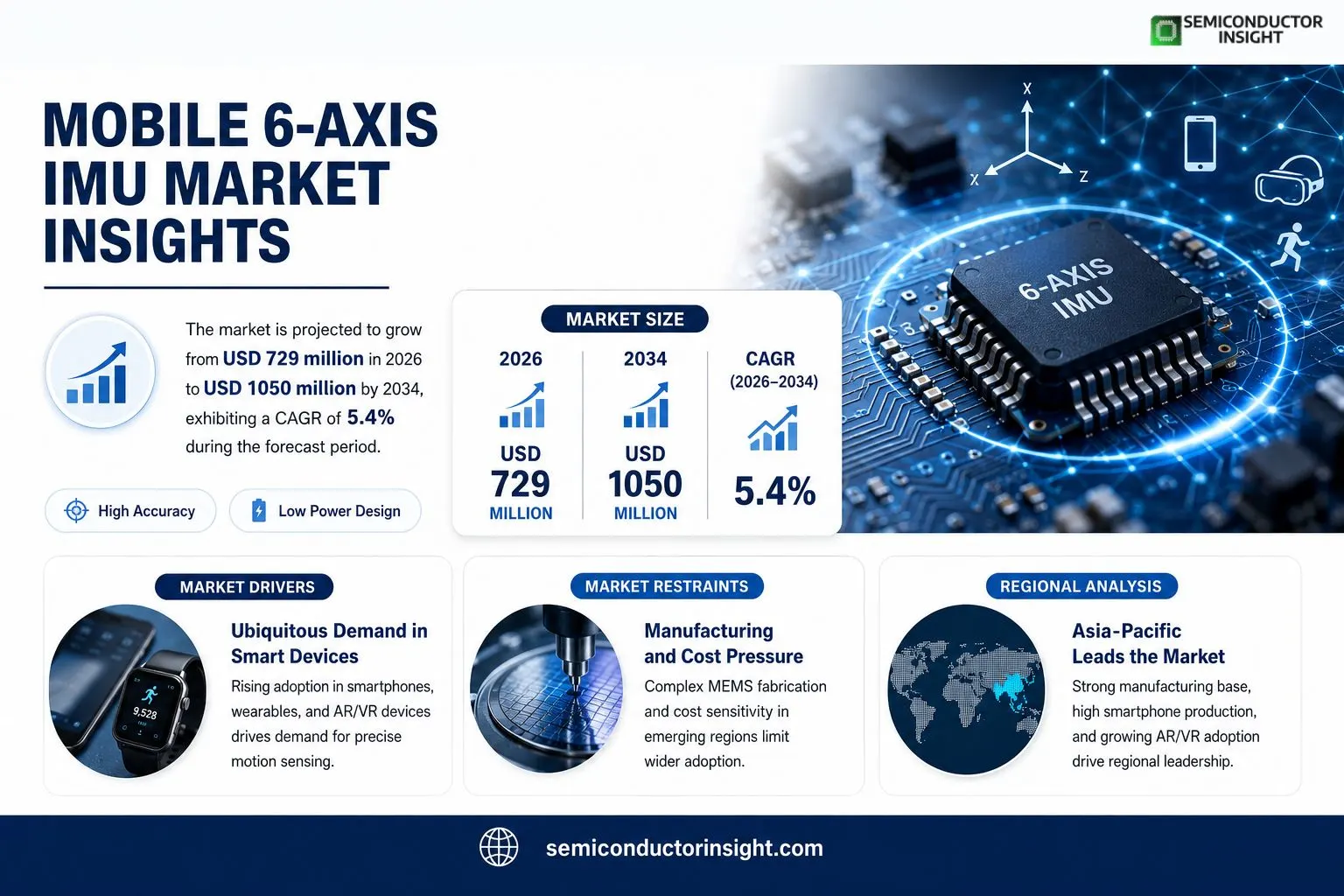
MARKET DRIVERS
Ubiquitous Sensor Integration in Consumer Devices
The proliferation of augmented‑reality applications and high‑precision gaming experiences has forced smartphone manufacturers to embed more capable inertial measurement units. A 6‑axis IMU delivers simultaneous accelerometer and gyroscope data, enabling smoother motion tracking without compromising battery life. This technical advantage fuels OEMs’ decisions to replace legacy sensors with integrated modules.
Miniaturization Trends in Wearable Technology
Wearable health monitors and fitness trackers demand compact, low‑noise motion sensing. The shrink‑size of MEMS components allows designers to place a Mobile 6‑Axis IMU within tight form factors, delivering the accuracy required for activity classification and fall‑detection algorithms. As users seek ever‑more discreet devices, manufacturers respond by scaling down the sensor package.
➤ “Every new smartphone generation now ships with an IMU that can resolve sub‑degree rotations, which directly translates into richer user experiences for navigation and gaming.”
Beyond consumer gadgets, automotive telematics units are adopting mobile‑grade IMUs to complement vehicle‑level navigation systems. By leveraging the same sensor architecture, fleet operators gain cost‑effective motion data, supporting predictive maintenance and driver‑behavior analytics.
MARKET CHALLENGES
Manufacturing Yield Constraints
High‑precision MEMS fabrication remains a bottleneck; even minor deviations in etching can lower sensor reliability. As volume orders climb, suppliers must balance yield optimization with the need to keep unit costs attractive for price‑sensitive markets.
Other Challenges
Supply Chain Vulnerabilities
The reliance on specialized silicon wafers and rare‑earth alloys introduces exposure to geopolitical fluctuations. Recent semiconductor shortages have already forced some OEMs to adjust production schedules, highlighting the fragility of the upstream ecosystem.Furthermore, the integration of IMU data into AI‑driven applications demands robust software stacks, yet many developers still grapple with calibration drift, leading to inconsistent user experiences across device generations.
MARKET RESTRAINTS
Cost Sensitivity in Emerging Regions
In markets where disposable income is limited, the premium attached to a high‑performance 6‑axis IMU can deter adoption, especially when competing devices offer acceptable performance at lower price points. Manufacturers must therefore engineer cost‑efficient variants without sacrificing core accuracy.The need for rigorous regulatory complianceparticularly in medical‑grade wearablesadds additional testing overhead. Certification processes extend time‑to‑market, which can dampen momentum for new entrants aiming to capture niche segments.
MARKET OPPORTUNITIES
Expansion into Industrial IoT Applications
Factories are increasingly deploying mobile robots for material handling, and these platforms benefit from the precise orientation data a 6‑axis IMU supplies. By tailoring sensor firmware for harsh environmentssuch as vibration‑resistant packagingvendors can open a revenue stream beyond consumer electronics.Another promising avenue lies in the integration of IMUs with edge‑AI processors. When motion data is processed locally, latency drops dramatically, enabling real‑time gesture recognition for smart home controls or on‑device health monitoring.Finally, partnerships between sensor manufacturers and chipset designers could yield system‑in‑package solutions, consolidating power management and data conversion. Such co‑design efforts would reduce board‑level complexity, making the technology more attractive to original design manufacturers seeking rapid time‑to‑market.
Mobile 6-Axis IMU Market Trends
Integration of Sensor Fusion and Power Management
Mobile 6-Axis IMU Market is seeing manufacturers embed advanced sensor‑fusion algorithms directly into the silicon. By handling data alignment, noise reduction and posture inference on‑chip, devices can lower CPU load and extend battery lifetwo constraints that dominate handheld and wearable design. This shift is not merely a technical tweak; it reshapes product road‑maps because OEMs now evaluate IMUs on the richness of their software stack as much as on raw performance numbers. Consequently, vendors that bundle calibrated firmware, step‑counting libraries and raise‑to‑wake detection with the hardware enjoy faster adoption cycles and higher margins.
Other Trends
Shift Toward System‑Level Functionality
Beyond raw acceleration and angular velocity, the newest generation of 6‑axis units offers built‑in features such as FIFO buffering, interrupt engines and temperature compensation. These capabilities allow device designers to offload routine taskslike pedometer calculations or screen‑orientation triggersto the sensor itself. The practical upshot is a slimmer PCB layout and reduced firmware complexity, which translates into shorter time‑to‑market for new smartphones, true‑wireless earbuds and AR headsets. As user interfaces demand ever tighter latency, the ability of the IMU to pre‑process motion data becomes a differentiator rather than an optional add‑on.
Competitive Landscape and Regional Shifts
The competitive field is bifurcated between established players and fast‑growing Chinese suppliers. Companies such as Bosch, STMicroelectronics and TDK retain leadership in premium segments by leveraging mature MEMS processes and extensive validation programs. Meanwhile, firms like MEMSIC, QST and Silan are capturing market share in cost‑sensitive categories through flexible I²C/SPI/I³C interfaces and aggressive pricing. This divergence is reflected in the regional rollout: North American and European flagship devices continue to favor legacy vendors, whereas Asian mid‑range smartphones and TWS earbuds increasingly adopt the newer Chinese solutions. For investors, the implication is clearsuccess will hinge on the ability to marry high‑accuracy silicon with scalable software support that matches the aspirations of each market tier.
COMPETITIVE LANDSCAPEKey Industry Players
Mobile 6‑Axis IMU Competitive Overview
The market is anchored by a handful of multinational MEMS specialistsBosch Sensortec, STMicroelectronics, TDK (including its InvenSense unit), and Murata Manufacturing. These firms dominate the high‑volume smartphone and premium wearable segments thanks to deep sensor‑fusion expertise, proven low‑power designs, and extensive OEM relationships that span the globe. Their product lines combine accurate gyroscopes with accelerometers in SiP formats, offering integrated features such as FIFO buffers and step‑count engines that reduce host‑processor load. This breadth of capability creates a barrier to entry for newcomers and reinforces a tiered market where large‑scale buyers gravitate toward the stability and long‑term supply guarantees these veterans provide.Chinese suppliersMEMSIC, QST, Senodia, Hangzhou Silan, and a growing cohort of niche innovatorshave carved out a substantial share in mid‑range devices, true‑wireless earbuds, and emerging AR/VR accessories. By tailoring interface options, compressing form factors, and delivering cost‑effective pricing, they address the price‑sensitivity of volume‑driven segments while still meeting the functional expectations of next‑generation user experiences. Their rapid adoption of advanced packaging and algorithmic support positions them as credible challengers, especially as OEMs seek diversified sources to mitigate supply risk and accelerate time‑to‑market for novel form factors.
List of Key Mobile 6‑Axis IMU Companies Profiled
- Bosch Sensortec GmbH
- STMicroelectronics
- TDK Corporation (including InvenSense)
- Murata Manufacturing Co., Ltd.
- Seiko Epson Corporation
- Hangzhou Silan Microelectronics Co., Ltd.
- MEMSIC Semiconductor Co., Ltd.
- QST Corporation Limited
- Senodia Technologies (Shaoxing) Co., Ltd.
- Analog Devices, Inc.
- Invensense (TDK subsidiary)
- ROHM Semiconductor
- TDK Invensense
- Omron Electronics
- Infineon Technologies AG
Segment Analysis:
| Segment Category | Sub-Segments | Key Insights |
| By Type |
|
Integrated Sensor Fusion
|
| By Application |
|
Experience‑Centric Design
|
| By End User |
|
Strategic Partnerships
|
| By Interface Configuration |
|
Flexibility Through Interfaces
|
| By Performance Orientation |
|
Performance‑Driven Innovation
|
Regional Analysis: Mobile 6-Axis IMU Market
North America
Tier‑1 suppliers leverage the region’s advanced testing infrastructure to embed 6‑axis IMUs into next‑generation driver assistance systems, emphasizing reliability under varied climatic conditions.
Smartphone and wearable manufacturers capitalize on the high consumer expectation for immersive AR experiences, prompting tighter collaboration with sensor vendors.
A dense network of fabs and assembly plants reduces lead times, enabling rapid prototyping cycles that keep product roadmaps aggressive.
Stringent safety standards drive early adoption of higher‑accuracy modules, reinforcing the market’s emphasis on durability and precision.
Europe
European manufacturers benefit from a collaborative research environment, where universities and industry consortia co‑develop sensor fusion techniques. This synergy lowers the barrier for niche players to enter the market, especially in sectors such as medical wearables and precision robotics. While the regulatory climate is equally demanding, it pushes firms toward robust calibration practices, translating into higher perceived product quality among end‑users. The combined effect is a steady stream of innovative applications that keep Europe competitive despite a slightly smaller domestic production base compared with North America.
Asia‑Pacific
The Asia‑Pacific region exhibits a rapid transition from cost‑focused production to value‑added design, spurred by burgeoning demand for smart mobility solutions in megacities. Local OEMs are increasingly integrating 6‑axis IMUs to enhance navigation accuracy for electric scooters and autonomous delivery bots. Coupled with government incentives for advanced manufacturing, the ecosystem is maturing, prompting multinational sensor firms to establish R&D hubs that tailor algorithms to regional use‑cases, such as dense‑urban mapping and low‑visibility navigation.
South America
In South America, the market trajectory is shaped by a growing appetite for rugged consumer devices capable of withstanding diverse environmental conditions. Device makers are turning to 6‑axis IMUs to differentiate products in the competitive smartphone segment, emphasizing features like enhanced motion‑based gaming and outdoor activity tracking. Though the supply chain remains less localized, partnerships with North American distributors are facilitating technology transfer and fostering a nascent ecosystem of integrators.
Middle East & Africa
The Middle East & Africa region is witnessing early‑stage adoption of mobile 6‑axis IMU technology, primarily driven by defense and aerospace projects that require precise inertial navigation. Parallelly, emerging consumer markets are exploring IMU‑enabled health monitoring wearables, attracted by the promise of remote patient monitoring. While infrastructure constraints limit large‑scale manufacturing, the region’s strategic investments in smart‑city initiatives promise to expand the demand for reliable motion‑sensing solutions.
Report Scope
This market research report provides a comprehensive analysis of the Mobile 6-Axis IMU Market , covering the forecast period 2026–2034. It offers detailed insights into market dynamics, technological advancements, competitive landscape, and key trends shaping the industry.
Key focus areas of the report include:
- Market Overview: The report begins with an overview outlining its current market scenario, key growth indicators, and industry transformation drivers. It discusses macroeconomic factors, demand–supply balance, regulatory landscape, and the strategic role of semiconductors in powering advancements across industries such as automotive, telecommunications, consumer electronics, and industrial automation.
- Market Size & Forecast: Historical data and future projections for revenue, unit shipments, and market value across major regions and segments.
- Segmentation Analysis: Detailed breakdown by product type, technology, application, and end-user industry to identify high-growth segments and investment opportunities.
- Regional Insights: Insights into market performance across North America, Europe, Asia-Pacific, Latin America, and the Middle East & Africa, including country-level analysis where relevant.
- Competitive Landscape: Profiles of leading market participants, including their product offerings, R&D focus, manufacturing capacity, pricing strategies, and recent developments such as mergers, acquisitions, and partnerships.
- Technology Trends & Innovation: Assessment of emerging technologies, integration of AI/IoT, semiconductor design trends, fabrication techniques, and evolving industry standards.
- Market Drivers & Restraints: Evaluation of factors driving market growth along with challenges, supply chain constraints, regulatory issues, and market-entry barriers.
- Stakeholder Insights: Insights for component suppliers, OEMs, system integrators, investors, and policymakers regarding the evolving ecosystem and strategic opportunities.
Primary and secondary research methods are employed, including interviews with industry experts, data from verified sources, and real-time market intelligence to ensure the accuracy and reliability of the insights presented.
FREQUENTLY ASKED QUESTIONS:
What is the current market size of Mobile 6-Axis IMU Market?
-> Mobile 6-Axis IMU Market was valued at USD 729 million in 2025 and is expected to reach USD 1050 million by 2034.
Which key companies operate in Mobile 6-Axis IMU Market?
-> Key players include Bosch Sensortec GmbH, STMicroelectronics, TDK Corporation, MEMSIC Semiconductor Co., Ltd., QST Corporation Limited, Senodia Technologies (Shaoxing) Co., Ltd., Hangzhou Silan Microelectronics Co., Ltd.
What are the key growth drivers?
-> Key growth drivers include rise of AR/VR applications, increasing demand for image stabilization in smartphones, expanding wearables and TWS earbuds market, need for low‑power high‑accuracy motion sensing, and advancements in MEMS processes.
Which region dominates the market?
-> Asia holds the largest market share, driven by major smartphone and wearable production hubs, while also showing rapid growth in AR/VR and IoT devices.
What are the emerging trends?
-> Emerging trends include integration of sensor‑fusion algorithms, added functionalities such as step counting and raise‑to‑wake detection, advanced FIFO and interrupt engine designs, and expanding use in lightweight robotics and IoT edge devices.
Get Sample Report PDF for Exclusive Insights
Report Sample Includes
- Table of Contents
- List of Tables & Figures
- Charts, Research Methodology, and more...