mmWave Semiconductor Market Insights
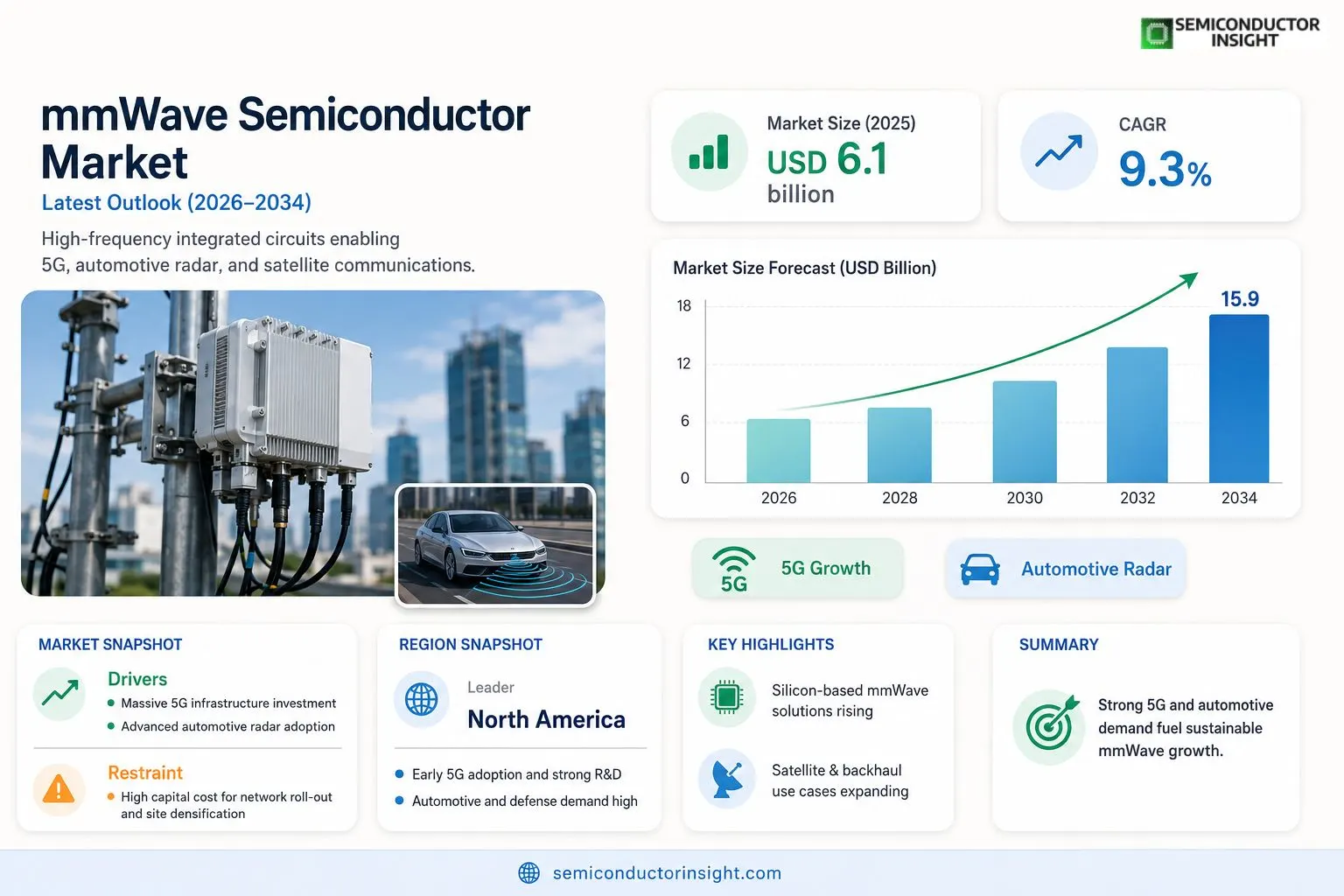
Global mmWave semiconductor market size was valued at USD 6.1 billion in 2025. The market is projected to grow from USD 6.4 billion in 2026 to USD 15.9 billion by 2034, exhibiting a CAGR of 9.3% during the forecast period.
mmWave semiconductors are high‑frequency integrated circuits that operate in the millimeter‑wave spectrum (30‑300 GHz). They enable advanced applications such as 5G NR FR2, automotive radar, satellite communications, and high‑speed wireless backhaul by providing low‑loss signal transmission and beam‑forming capabilities.The market is experiencing rapid growth because telecom operators are rolling out extensive 5G networks, while automotive manufacturers increase adoption of advanced driver‑assistance systems that rely on radar sensors. Furthermore, government initiatives supporting spectrum allocation and substantial R&D investments by leading players such as Qualcomm, NXP Semiconductors, and Skyworks Solutions are accelerating demand for mmWave semiconductor solutions.
MARKET DRIVERS
Rising 5G Infrastructure Investment
mmWave Semiconductor Market is being propelled by massive capital deployment in 5G networks, particularly in urban cores where high‑frequency bands are essential for capacity expansion. Network operators are upgrading base stations with mmWave modules to meet escalating data traffic, creating a steady demand pipeline for semiconductor suppliers.
Emergence of Advanced Automotive Radar
Automakers are integrating mmWave radar for adaptive cruise control and collision avoidance, which drives component orders for high‑frequency transceivers. The convergence of autonomous‑vehicle initiatives and regulatory safety mandates ensures a robust growth catalyst for the semiconductor segment.
➤ Industry analysts forecast that mmWave components will account for over 20% of total 5G chipset revenue by 2027.
In addition, the proliferation of edge‑computing devices that rely on low‑latency, high‑bandwidth links reinforces the need for mmWave technology, positioning the market for sustained expansion.
MARKET CHALLENGES
Manufacturing Yield Constraints
Producing mmWave devices requires advanced lithography and precise material handling. Yield rates remain lower than those for lower‑frequency semiconductors, leading to higher unit costs and supply‑chain pressure.
Other Challenges
Regulatory Spectrum Allocation
Complex international coordination on spectrum licensing can delay deployments, especially in regions where mmWave bands overlap with existing services.
MARKET RESTRAINTS
High Capital Expenditure for Network Roll‑Out
Deploying dense mmWave antenna arrays entails significant infrastructure investment. Telecom operators often prioritize macro‑cell upgrades over costly small‑cell densification, which can temper short‑term demand for mmWave semiconductors.Furthermore, the limited propagation range of mmWave signals necessitates a larger number of sites to achieve coverage parity with lower‑frequency bands, adding to the financial barrier for many service providers.
MARKET OPPORTUNITIES
Integration with AI‑Driven Edge Devices
The convergence of AI processing at the edge with mmWave connectivity opens new revenue streams for semiconductor manufacturers. Devices that require real‑time inferencesuch as smart cameras and industrial sensorsbenefit from the low latency and high throughput that mmWave links provide.Additionally, ongoing research into silicon‑based mmWave platforms promises cost reductions and higher integration densities, which could democratize access to the technology across mid‑market applications.
mmWave Semiconductor Market Trends
5G Network Expansion Drives Demand
The rollout of fifth‑generation mobile networks is accelerating the adoption of high‑frequency integrated circuits that operate in the millimeter‑wave spectrum. These components provide the low‑loss signal paths and advanced beam‑forming needed for 5G NR FR2 deployments, enabling multi‑gigabit throughput in dense urban zones. Telecom operators are upgrading base‑station infrastructure with mmWave arrays, creating a sustained uplift in demand for mmWave Semiconductor Market. Design firms are also optimizing power‑efficiency to meet the energy constraints of dense antenna panels, reinforcing the trend toward widespread commercial deployment.
Other Trends
Automotive Radar Evolution
Advanced driver‑assistance systems rely increasingly on high‑resolution radar that can distinguish pedestrians, cyclists and other vehicles at short distances. Millimeter‑wave radar chips supply the necessary bandwidth and angular accuracy, prompting automotive OEMs to integrate these sensors across new model lines. Leading semiconductor suppliers are delivering compact, automotive‑grade packages that meet strict reliability standards, driving a measurable uptick in mmWave Semiconductor Market within the automotive sector. The convergence of autonomous‑driving research and safety‑regulation pressures further consolidates this growth pathway.
Satellite and Backhaul Applications
Satellite communications and high‑capacity wireless backhaul are benefiting from the same low‑loss, high‑gain characteristics of millimeter‑wave semiconductors. Operators are leveraging these devices to transmit large volumes of data between remote sites and core networks, reducing latency and expanding coverage in underserved regions. The ability to pack multiple channels into a narrow frequency band supports cost‑effective spectrum utilization, making the technology attractive for both commercial and government‑run satellite constellations. As network operators seek to diversify backhaul options beyond fiber, mmWave Semiconductor Market sees additional traction from this vertical.
Government Policy and R&D Investments
Regulatory bodies worldwide are allocating additional spectrum in the 24 GHz to 40 GHz range, creating a policy environment that encourages broader deployment of millimeter‑wave solutions. Concurrently, public‑private partnerships are funding research initiatives focused on improving material efficiency and thermal management of mmWave chips. These investments reduce time‑to‑market for next‑generation devices and lower barriers for smaller suppliers to enter the ecosystem. The combined effect of supportive policy and targeted R&D sustains a positive outlook for mmWave Semiconductor Market over the next several years.
COMPETITIVE LANDSCAPEKey Industry Players
mmWave Semiconductor Market Competitive Landscape Overview
mmWave Semiconductor Market is dominated by a handful of vertically integrated giants that control both design and high‑volume manufacturing. Qualcomm leads the ecosystem with its Snapdragon X series, leveraging deep R&D investment to deliver integrated mmWave front‑ends for 5G NR FR2 and automotive radar. NXP Semiconductors and Skyworks Solutions follow closely, offering a broad portfolio of RF front‑end modules, power amplifiers, and beam‑forming ICs that address the same high‑frequency spectrum. Qorvo, Analog Devices, and Infineon contribute strong RF‑power and mixed‑signal expertise, enabling high‑gain, low‑noise solutions for backhaul and satellite links. Intel’s acquisition of wireless‑RF assets and Broadcom’s expansion into mmWave transceivers further tighten the competitive core, creating a market structure characterized by high barriers to entry, intensive IP protection, and economies of scale that favor large, diversified chipmakers.Beyond the core incumbents, a range of niche and emerging players enrich the supply chain with specialized technologies. Murata Manufacturing provides compact, high‑Q ceramic filters and antenna modules that complement larger RF blocks. MACOM and STMicroelectronics focus on GaAs and SiGe processes for low‑noise amplifiers and mixers, addressing precise performance niches. Renesas Electronics supplies automotive‑grade radar ICs, while Taiwan Semiconductor Manufacturing Company (TSMC) offers advanced foundry services that enable new design entrants to fabricate mmWave silicon. Start‑ups such as Lattice Semiconductor and Acacia Communications are introducing silicon‑photonic and programmable RF solutions, gradually expanding the competitive landscape through innovative architectures and rapid time‑to‑market capabilities.
List of Key mmWave Semiconductor Companies Profiled
- Qualcomm
- NXP Semiconductors
- Skyworks Solutions
- Qorvo
- Analog Devices
- Infineon Technologies
- Intel
- Broadcom Inc.
- Murata Manufacturing
- MACOM Technology Solutions
- STMicroelectronics
- Renesas Electronics
- Taiwan Semiconductor Manufacturing Company (TSMC)
- Lattice Semiconductor
- Acacia Communications
Segment Analysis:
| Segment Category | Sub-Segments | Key Insights |
| By Type |
|
Power Amplifiers
|
| By Application |
|
5G New‑Radio (FR2)
|
| By End User |
|
Telecom Operators
|
| By Frequency Band |
|
30‑60 GHz
|
| By Integration Level |
|
Hybrid Modules
|
Regional Analysis: North America
North America
The ongoing rollout of 5G networks across North America is a primary driver for mmWave semiconductor demand. This necessitates substantial investments in base stations, small cells, and backhaul infrastructure, all relying on advanced mmWave components. Business strategies focus on optimizing component performance for challenging deployment environments and ensuring seamless integration with existing network architectures.
The automotive industry is increasingly adopting mmWave radar for advanced driver-assistance systems (ADAS) and autonomous driving capabilities. This segment demands high-reliability and high-performance mmWave semiconductors. Business strategies emphasize miniaturization, power efficiency, and enhanced signal processing for automotive-grade applications.
The proliferation of industrial IoT (IIoT) applications, requiring reliable and high-bandwidth wireless connectivity, is creating significant demand for mmWave semiconductors. These components enable real-time data transmission and control in various industrial settings. Business strategies focus on developing robust and secure mmWave solutions tailored for harsh industrial environments.
The aerospace and defense sectors are leveraging mmWave technology for secure and high-throughput communication systems. This segment requires specialized mmWave semiconductors with stringent performance and reliability requirements. Business strategies prioritize high-frequency performance, low latency, and robust security features.
North America
The North American mmWave semiconductor market is characterized by a strong focus on innovation and technological advancement. Key trends include the development of advanced beamforming techniques, integration of mmWave with other wireless technologies, and increasing adoption in emerging applications like virtual reality and augmented reality. Business strategies emphasize strategic partnerships, vertical integration, and a strong emphasis on intellectual property protection. The region is also witnessing a growing trend towards open RAN architectures, which are expected to further drive demand for mmWave components.
Europe
Europe’s mmWave semiconductor market is steadily gaining traction, driven by government initiatives promoting 5G deployment and increasing investments in digital infrastructure. The region is focusing on developing energy-efficient and cost-effective mmWave solutions. Business strategies emphasize collaboration between research institutions, industry players, and government agencies to accelerate innovation and address market challenges.
Asia-Pacific
Asia-Pacific represents the largest and fastest-growing market for mmWave semiconductors globally. The region’s rapid 5G rollout, the burgeoning IoT ecosystem, and strong manufacturing capabilities are key drivers of this growth. Business strategies focus on leveraging local manufacturing resources, catering to the specific needs of the regional market, and developing cost-competitive solutions.
South America
mmWave Semiconductor Market in South America is in its early stages of development but holds significant potential. Increasing investments in telecommunications infrastructure and the growing adoption of 5G are expected to drive future growth. Business strategies emphasize affordability and tailored solutions for the regional market’s specific requirements.
Middle East & Africa
The Middle East & Africa region presents a promising growth opportunity for mmWave Semiconductor Market. Government initiatives aimed at digital transformation and investments in advanced infrastructure are fueling demand for high-speed wireless communication. Business strategies focus on providing cost-effective and scalable solutions to meet the region’s evolving connectivity needs.
Report Scope
This market research report provides a comprehensive analysis of the mmWave Semiconductor Market , covering the forecast period 2026–2034. It offers detailed insights into market dynamics, technological advancements, competitive landscape, and key trends shaping the industry.
Key focus areas of the report include:
- Market Overview: The report begins with an overview outlining its current market scenario, key growth indicators, and industry transformation drivers. It discusses macroeconomic factors, demand–supply balance, regulatory landscape, and the strategic role of semiconductors in powering advancements across industries such as automotive, telecommunications, consumer electronics, and industrial automation.
- Market Size & Forecast: Historical data and future projections for revenue, unit shipments, and market value across major regions and segments.
- Segmentation Analysis: Detailed breakdown by product type, technology, application, and end-user industry to identify high-growth segments and investment opportunities.
- Regional Insights: Insights into market performance across North America, Europe, Asia-Pacific, Latin America, and the Middle East & Africa, including country-level analysis where relevant.
- Competitive Landscape: Profiles of leading market participants, including their product offerings, R&D focus, manufacturing capacity, pricing strategies, and recent developments such as mergers, acquisitions, and partnerships.
- Technology Trends & Innovation: Assessment of emerging technologies, integration of AI/IoT, semiconductor design trends, fabrication techniques, and evolving industry standards.
- Market Drivers & Restraints: Evaluation of factors driving market growth along with challenges, supply chain constraints, regulatory issues, and market-entry barriers.
- Stakeholder Insights: Insights for component suppliers, OEMs, system integrators, investors, and policymakers regarding the evolving ecosystem and strategic opportunities.
Primary and secondary research methods are employed, including interviews with industry experts, data from verified sources, and real-time market intelligence to ensure the accuracy and reliability of the insights presented.
FREQUENTLY ASKED QUESTIONS:
What is the current market size of mmWave Semiconductor Market?
-> mmWave Semiconductor Market was valued at USD 6.1 billion in 2025 and is expected to reach USD 15.9 billion by 2034, reflecting a robust growth trajectory.
Which key companies operate in mmWave Semiconductor Market?
-> Key players include Qualcomm, NXP Semiconductors, Skyworks Solutions, MediaTek, and Qorvo, among others.
What are the key growth drivers?
-> Key growth drivers include global 5G network roll‑out, rising demand for automotive radar in advanced driver‑assistance systems, governmental spectrum allocation initiatives, and substantial R&D investments by leading semiconductor manufacturers.
Which region dominates the market?
-> North America leads in terms of market value due to early 5G adoption, while Asia‑Pacific shows the fastest growth rate driven by strong automotive and telecom investments.
What are the emerging trends?
-> Emerging trends include integration of AI/IoT for smart beam‑forming, development of silicon‑based mmWave solutions, and increasing adoption of heterogeneous integration techniques to enhance performance and reduce cost.
Get Sample Report PDF for Exclusive Insights
Report Sample Includes
- Table of Contents
- List of Tables & Figures
- Charts, Research Methodology, and more...
 Download Sample Report PDF