MARKET INSIGHTS
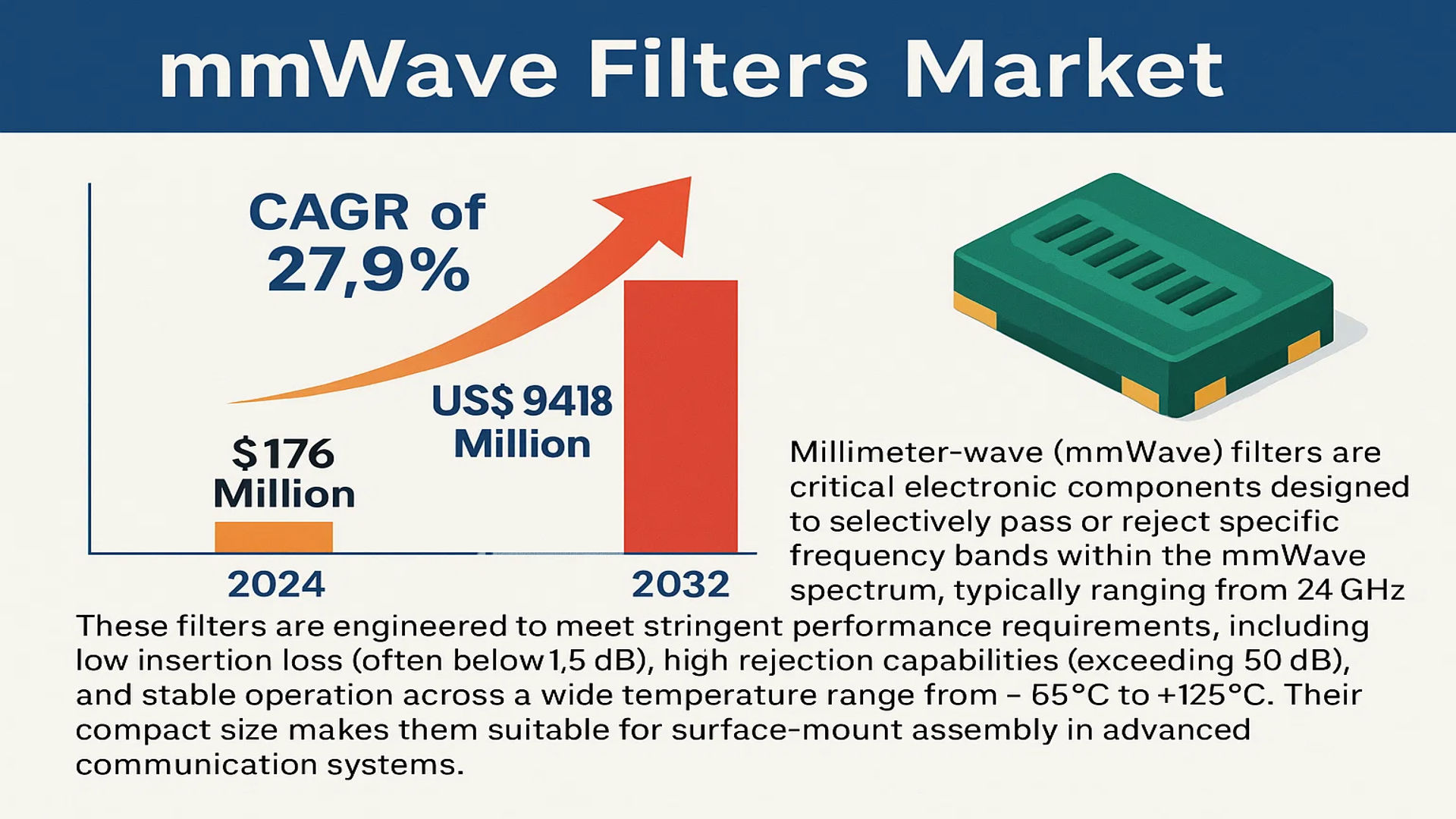
The global mmWave Filters Market was valued at 176 million in 2024 and is projected to reach US$ 948 million by 2032, at a CAGR of 27.9% during the forecast period.
Millimeter-wave (mmWave) filters are critical electronic components designed to selectively pass or reject specific frequency bands within the mmWave spectrum, typically ranging from 24 GHz to 100 GHz. These filters are engineered to meet stringent performance requirements, including low insertion loss (often below 1.5 dB), high rejection capabilities (exceeding 50 dB), and stable operation across a wide temperature range from -55°C to +125°C. Their compact size makes them suitable for surface-mount assembly in advanced communication systems.
The market is experiencing exponential growth, primarily driven by the global rollout of 5G infrastructure, particularly in the n257, n258, n260, and n261 frequency bands. The increasing demand for higher data rates and lower latency in mobile networks necessitates these sophisticated filters. Furthermore, adoption in military, VSAT, and satellite communication applications contributes significantly to market expansion. Key industry players, such as TDK Corporation and Knowles Precision Devices, are actively engaged in research and development to introduce more efficient and miniaturized filter solutions, further propelling the market forward.
MARKET DYNAMICS
MARKET DRIVERS
Accelerated Global 5G Network Deployments to Drive mmWave Filter Demand
The rapid expansion of 5G networks worldwide is significantly driving the mmWave filters market. With over 300 commercial 5G networks deployed globally and more than 1.5 billion 5G subscriptions active, the demand for high-frequency components continues to surge. mmWave spectrum bands between 24 GHz and 40 GHz are becoming increasingly critical for delivering the multi-gigabit speeds and ultra-low latency promised by 5G technology. These filters enable precise frequency selection and interference mitigation, allowing network operators to maximize spectral efficiency while maintaining signal integrity. The ongoing infrastructure investments exceeding $200 billion annually in 5G deployment create sustained demand for advanced filtering solutions that can handle the complex frequency arrangements and stringent performance requirements of modern wireless systems.
Growing Adoption of mmWave Technology in Consumer Electronics to Boost Market Growth
The integration of mmWave technology into consumer devices represents a major growth driver for the filter market. Smartphone manufacturers are increasingly incorporating mmWave capabilities into flagship devices, with over 45% of premium smartphones now supporting mmWave frequencies. This trend is driven by consumer demand for faster download speeds, improved streaming quality, and enhanced mobile gaming experiences. The miniaturization of mmWave filters has been crucial for their adoption in space-constrained mobile devices, where component size reduction of approximately 60% over the past three years has enabled seamless integration without compromising device aesthetics or functionality. The consumer electronics segment’s relentless pursuit of higher performance and connectivity features ensures continued filter innovation and market expansion.
Furthermore, the emergence of new applications such as augmented reality and virtual reality headsets that require high-bandwidth connectivity is creating additional demand for advanced filtering solutions. These applications typically require data rates exceeding 5 Gbps, which can only be achieved through mmWave technology and its associated filtering components.
➤ For instance, recent industry testing has demonstrated that mmWave-enabled devices can achieve peak download speeds of 4 Gbps in commercial networks, representing a 400% improvement over sub-6 GHz 5G implementations.
Moreover, the increasing number of regulatory approvals for mmWave spectrum usage across multiple countries provides additional momentum for market growth, as network operators and device manufacturers gain confidence in the long-term viability of mmWave technology.
MARKET CHALLENGES
High Manufacturing Complexity and Yield Challenges to Hinder Market Progress
The mmWave filters market faces significant manufacturing challenges that impact production scalability and cost efficiency. The precision required in fabricating these components demands advanced lithography techniques and specialized materials, leading to manufacturing yields that typically range between 65-75% for complex filter designs. This relatively low yield rate compared to conventional RF components increases production costs and creates supply chain constraints. The requirement for extremely tight tolerances—often within micrometer ranges—and the need for specialized packaging solutions further complicate mass production. These manufacturing complexities represent a substantial barrier to meeting the growing demand while maintaining competitive pricing, particularly for high-volume consumer applications.
Other Challenges
Thermal Management Issues
Managing heat dissipation in mmWave filters presents ongoing technical challenges. The high power density in these components can lead to temperature variations that affect filter performance characteristics, including center frequency drift and insertion loss changes. Maintaining stable operation across the required temperature range of -40°C to +85°C requires sophisticated thermal design and materials with low thermal expansion coefficients, adding complexity and cost to the manufacturing process.
Signal Integrity Maintenance
Preserving signal integrity at millimeter-wave frequencies remains a persistent challenge. The minute physical dimensions of filter structures make them susceptible to manufacturing variations that can significantly impact performance. Even sub-micrometer deviations can cause impedance mismatches, increased return loss, and degraded rejection characteristics, requiring extensive testing and calibration procedures that add to production time and costs.
MARKET RESTRAINTS
Limited Range and Propagation Challenges to Restrain Market Adoption
mmWave technology faces inherent physical limitations that restrain broader market adoption. The shorter wavelengths that enable high data rates also result in significantly reduced propagation characteristics, with signal attenuation increasing approximately 20 dB per 100 meters compared to lower frequency bands. This limitation necessitates dense network deployments with smaller cell sizes, increasing infrastructure costs and deployment complexity. The challenges of signal penetration through obstacles such as buildings and vegetation further complicate widespread deployment scenarios, particularly in urban environments where these obstacles are prevalent. These propagation characteristics currently limit mmWave applications to specific use cases such as fixed wireless access and high-density urban coverage, rather than comprehensive mobile network coverage.
Additionally, the oxygen absorption peak at 60 GHz creates additional attenuation of approximately 15 dB/km, making this frequency range particularly challenging for long-distance communications. While this characteristic can be beneficial for frequency reuse in dense deployments, it restricts the applicability of these bands for certain communication scenarios.
Furthermore, the need for precise beamforming and alignment in mmWave systems adds complexity to both infrastructure and device design, requiring sophisticated antenna systems and signal processing algorithms that increase overall system cost and power consumption.
MARKET OPPORTUNITIES
Emerging Applications in Automotive Radar and Satellite Communications to Create New Growth Avenues
The expansion of mmWave technology into automotive radar and satellite communication systems presents significant growth opportunities for filter manufacturers. The automotive industry’s increasing adoption of advanced driver assistance systems (ADAS) and autonomous driving technologies is driving demand for high-performance radar systems operating in the 77-81 GHz range. This segment is projected to grow at approximately 23% annually, creating substantial opportunities for specialized filter solutions that can meet the stringent automotive reliability requirements. Similarly, the satellite communication market is experiencing rapid growth with the deployment of low-earth orbit constellations requiring sophisticated mmWave filtering for inter-satellite links and ground station communications. These applications demand filters with exceptional performance characteristics, including very high rejection ratios exceeding 60 dB and excellent temperature stability, creating opportunities for premium filter solutions.
Additionally, the ongoing research and development in integrated filter technologies that combine multiple functions into single components is opening new market segments. The development of reconfigurable filters that can dynamically adjust their frequency response presents opportunities for more flexible and efficient system designs. These advanced filter technologies enable better spectrum utilization and adaptive interference management, particularly valuable in crowded radio frequency environments.
Furthermore, the increasing demand for high-capacity backhaul solutions for 5G networks creates additional opportunities for mmWave filter applications. The need for multi-gigabit wireless connections between base stations requires sophisticated filtering to manage interference and ensure reliable operation in licensed and unlicensed mmWave bands.
MMWAVE FILTERS MARKET TRENDS
Accelerated 5G Network Deployments Driving mmWave Filter Demand
The global rollout of 5G networks, particularly in the high-frequency mmWave spectrum, is the primary catalyst for market expansion. mmWave filters are critical components that ensure signal integrity by isolating specific frequency bands—such as n258 (24.25–27.5 GHz), n257 (26.5–29.5 GHz), and n261 (27.5–28.35 GHz)—while suppressing out-of-band interference and noise. These filters must exhibit exceptional performance characteristics, including insertion loss below 1.5 dB, rejection exceeding 50 dB, and stable operation across temperature ranges from –55°C to +125°C. The miniaturization of these components is equally vital to accommodate the space constraints in modern 5G smartphones and base stations, leading to increased adoption of advanced acoustic wave and integrated filter solutions. With over 300 operators investing in 5G mmWave spectrum globally and more than 45 countries having allocated mmWave bands for commercial use, the demand for high-performance filters is projected to grow substantially.
Other Trends
Integration of Advanced Materials and Fabrication Techniques
Innovations in materials science and thin-film fabrication are significantly enhancing mmWave filter performance and reducing form factors. The use of piezoelectric materials like lithium niobate and aluminum nitride, combined with sophisticated deposition techniques such as sputtering and chemical vapor deposition, allows for the production of filters with higher quality factors and improved power handling capabilities. Furthermore, the trend towards System-in-Package (SiP) and heterogenous integration enables the co-packaging of filters with other RF components, reducing overall module size and improving signal path efficiency. This is particularly important for mobile devices, where board space is at a premium and every millimeter counts towards achieving slimmer designs without compromising on 5G performance.
Expansion into Non-Telecom Applications
While 5G remains the dominant application, mmWave filters are increasingly being adopted in other high-frequency sectors such as automotive radar, satellite communications, and military systems. In automotive applications, 77–81 GHz radar systems rely on these filters for precise object detection and collision avoidance, with the market for automotive radar sensors expected to see double-digit growth. Satellite communication systems, including Very Small Aperture Terminals (VSAT) and low-earth orbit (LEO) constellations, utilize mmWave filters in the Ka-band (26.5–40 GHz) and Q/V-band (40–75 GHz) to manage signal traffic and minimize interference. These applications often demand filters capable of handling higher power levels—sometimes exceeding 10 watts—and exhibiting even lower insertion loss, driving innovation in cavity and waveguide filter designs alongside more traditional acoustic solutions.
COMPETITIVE LANDSCAPE
Key Industry Players
Companies Strive to Strengthen their Product Portfolio to Sustain Competition
The global mmWave Filters market exhibits a dynamic and semi-consolidated competitive structure, characterized by the presence of established electronics giants, specialized component manufacturers, and emerging technology firms. TDK Corporation stands as a dominant force, leveraging its extensive expertise in electronic components and strong relationships with major smartphone OEMs and telecommunications infrastructure providers. The company’s significant investment in Surface Acoustic Wave (SAW) and Bulk Acoustic Wave (BAW) filter technologies has cemented its leadership position, particularly for 5G mmWave smartphone applications.
Knowles Precision Devices (a division of Knowles Corporation) and Kyocera AVX also command considerable market share, a position reinforced by their innovative portfolios addressing the stringent requirements of both consumer electronics and defense applications. Their growth is heavily driven by robust R&D pipelines focused on miniaturization and enhancing performance metrics like insertion loss and power handling. For instance, recent product launches targeting the n258 (24.25–27.5 GHz) and n260 (37.0–40.0 GHz) 5G bands demonstrate their commitment to capturing high-growth segments.
Furthermore, these leading players are aggressively pursuing growth through strategic initiatives. Geographic expansion into high-growth regions like Asia-Pacific, coupled with strategic partnerships with semiconductor foundries and contract manufacturers, is a key tactic to scale production and reduce costs. New product launches featuring integrated passive devices and Low-Temperature Co-fired Ceramic (LTCC)-based filters are expected to significantly bolster their market share over the forecast period, addressing the critical need for compact, high-performance solutions.
Meanwhile, other significant participants like Mini-Circuits and Johanson Technology, Inc. are strengthening their market presence through a focus on niche applications. Their strategy involves significant investments in R&D for high-reliability filters suited for military, VSAT, and satellite communications, where performance often outweighs cost sensitivity. This focus on specialized, high-margin segments ensures their continued relevance and growth within the broader competitive landscape.
List of Key mmWave Filters Companies Profiled
- TDK Corporation (Japan)
- Knowles Precision Devices (Knowles Corporation) (U.S.)
- Mini-Circuits (U.S.)
- Johanson Technology, Inc. (U.S.)
- Kyocera AVX (U.S.)
- Wainwright Instruments GmbH (Germany)
- Anhui Yunta Electronic Technology Co Ltd (China)
- Pasternack (U.S.)
- Benchmark Lark Technology (U.S.)
- Mi-Wave (U.S.)
- TMY Technology Inc. (Taiwan)
Segment Analysis:
By Type
n258 Band Filters Lead the Market Due to Critical Role in High-Frequency 5G Deployments
The market is segmented based on type into:
- n258
- Subtypes: Bandpass, Bandstop, and others
- n257
- Subtypes: Bandpass, Bandstop, and others
- n260
- Subtypes: Bandpass, Bandstop, and others
- n261
- Subtypes: Bandpass, Bandstop, and others
By Application
5G mmWave Smart Phone Segment Dominates Owing to Massive Consumer Device Production
The market is segmented based on application into:
- 5G mmWave Smart Phone
- 5G mmWave Base Station
- Military, VSAT & Satellite
By Technology
Acoustic Wave Filters Hold Major Share Due to Superior Performance in Compact Form Factors
The market is segmented based on technology into:
- Acoustic Wave Filters
- Subtypes: Surface Acoustic Wave (SAW), Bulk Acoustic Wave (BAW)
- Electromagnetic Filters
- Subtypes: Waveguide, Cavity, Planar
- Integrated Passive Devices
By End User
Telecommunications Sector Commands Largest Market Share Driven by Global 5G Infrastructure Rollouts
The market is segmented based on end user into:
- Telecommunications
- Defense & Aerospace
- Satellite Communication
- Automotive
- Others
Regional Analysis: mmWave Filters Market
Asia-Pacific
The Asia-Pacific region is the dominant force in the global mmWave filters market, driven by its position as the epicenter of 5G deployment and consumer electronics manufacturing. China, South Korea, and Japan are at the forefront, with China alone accounting for over 60% of the world’s 5G base stations. This massive infrastructure build-out, coupled with the high-volume production of 5G-enabled smartphones from giants like Huawei, Xiaomi, and Samsung, creates immense demand for compact, high-performance filters operating in bands like n257 (28 GHz) and n258 (26 GHz). While cost-competition is fierce, leading to a focus on highly integrated and cost-effective solutions, the region is also a hub for R&D. Local manufacturers are increasingly competing with established global players, innovating in thin-film acoustic filter technology to meet the stringent size and performance requirements of mobile devices. The sheer scale of urban population centers and government-backed digitalization initiatives ensure this region will remain the primary volume driver for the foreseeable future.
North America
Characterized by early and aggressive commercialization of 5G mmWave spectrum, North America is a key high-value market for advanced filter solutions. The United States, in particular, has seen major carriers like Verizon and AT&T deploy mmWave networks in dense urban areas and high-traffic venues, necessitating filters for both network infrastructure and mobile handsets. The regulatory environment, led by the Federal Communications Commission (FCC), has been proactive in allocating high-frequency spectrum, fostering a competitive market. Demand is heavily skewed towards premium applications requiring filters with exceptional performance metrics, such as very high rejection (>50 dB) and low insertion loss, for both consumer and defense sectors. The presence of leading technology firms and a strong defense industry, which utilizes mmWave filters for radar and satellite communications, further solidifies the region’s position as an innovation and adoption leader for cutting-edge filter technologies.
Europe
The European market for mmWave filters is growing steadily, propelled by a methodical approach to 5G rollout and strong industrial and automotive sectors. The European Union’s harmonized spectrum strategy has allocated key mmWave bands, driving demand from network equipment suppliers. However, the pace of consumer device adoption has been more measured compared to Asia and North America. A significant portion of demand stems from non-consumer applications, including industrial IoT, automotive radar (for advanced driver-assistance systems), and satellite communication ground segments. European manufacturers and research institutions are deeply involved in pioneering next-generation filter technologies, including advanced acoustic wave and cavity filters, focusing on achieving high power handling and thermal stability for these demanding industrial use cases. Strict compliance with EU regulations and a focus on quality and reliability are hallmarks of the regional market.
South America
The mmWave filters market in South America is in a nascent stage of development, largely trailing behind other regions. The primary growth catalyst is the gradual expansion of 5G networks, with countries like Brazil and Chile leading the initial deployments. However, the focus for most mobile network operators remains on sub-6 GHz 5G due to its broader coverage and lower deployment costs. Consequently, the immediate addressable market for mmWave filters is currently limited to specific urban hotspots and specialized applications. Economic volatility and infrastructure challenges can delay large-scale investments in mmWave technology. Nonetheless, the long-term potential is recognized, and the market is expected to grow as the broader 5G ecosystem matures and the need for enhanced network capacity in major cities becomes more pressing.
Middle East & Africa
This region presents a mixed and emerging picture for mmWave filter adoption. Select wealthy nations in the Gulf Cooperation Council (GCC), such as the UAE and Saudi Arabia, are actively deploying 5G mmWave networks to support smart city initiatives and high-density venues like stadiums and airports. These projects drive demand for high-quality infrastructure filters. In contrast, across most of Africa, the telecommunications focus remains on expanding basic 4G coverage and sub-6 GHz 5G, making mmWave a longer-term prospect. The market is therefore characterized by high-growth potential in specific affluent pockets, while broader regional adoption is constrained by economic factors and infrastructure readiness. The defense sector also represents a stable, albeit niche, source of demand for high-performance mmWave filters used in specialized communication and radar systems.
Report Scope
This market research report provides a comprehensive analysis of the global and regional Semiconductor and Electronics markets, covering the forecast period 2025–2032. It offers detailed insights into market dynamics, technological advancements, competitive landscape, and key trends shaping the industry.
Key focus areas of the report include:
- Market Size & Forecast: Historical data and future projections for revenue, unit shipments, and market value across major regions and segments.
- Segmentation Analysis: Detailed breakdown by product type, technology, application, and end-user industry to identify high-growth segments and investment opportunities.
- Regional Outlook: Insights into market performance across North America, Europe, Asia-Pacific, Latin America, and the Middle East & Africa, including country-level analysis where relevant.
- Competitive Landscape: Profiles of leading market participants, including their product offerings, R&D focus, manufacturing capacity, pricing strategies, and recent developments such as mergers, acquisitions, and partnerships.
- Technology Trends & Innovation: Assessment of emerging technologies, integration of AI/IoT, semiconductor design trends, fabrication techniques, and evolving industry standards.
- Market Drivers & Restraints: Evaluation of factors driving market growth along with challenges, supply chain constraints, regulatory issues, and market-entry barriers.
- Stakeholder Analysis: Insights for component suppliers, OEMs, system integrators, investors, and policymakers regarding the evolving ecosystem and strategic opportunities.
Primary and secondary research methods are employed, including interviews with industry experts, data from verified sources, and real-time market intelligence to ensure the accuracy and reliability of the insights presented.
FREQUENTLY ASKED QUESTIONS:
What is the current market size of Global mmWave Filters Market?
-> mmWave Filters Market was valued at 176 million in 2024 and is projected to reach US$ 948 million by 2032, at a CAGR of 27.9% during the forecast period..
Which key companies operate in Global mmWave Filters Market?
-> Key players include TDK Corporation, Knowles Precision Devices (DLI), Mini-Circuits, Johanson Technology, Inc., Kyocera AVX, Wainwright Instruments GmbH, Anhui Yunta Electronic Technology Co Ltd, Pasternack, Benchmark Lark Technology, Mi-Wave, and TMY Technology Inc, among others.
What are the key growth drivers?
-> Key growth drivers include global 5G network deployment, increasing demand for high-frequency communication systems, and advancements in radar and satellite communication technologies.
Which region dominates the market?
-> Asia-Pacific is the fastest-growing region, driven by substantial 5G infrastructure investments in China, Japan, and South Korea, while North America remains a dominant market due to early mmWave adoption and strong defense sector demand.
What are the emerging trends?
-> Emerging trends include development of acoustic filters using advanced thin-film processes, integration of AI for filter optimization, reflectionless filter designs, and EM-acoustic co-design for next-generation mmWave applications.

Get Sample Report PDF for Exclusive Insights
Report Sample Includes
- Table of Contents
- List of Tables & Figures
- Charts, Research Methodology, and more...