Military Intelligent Sensors Market Insights
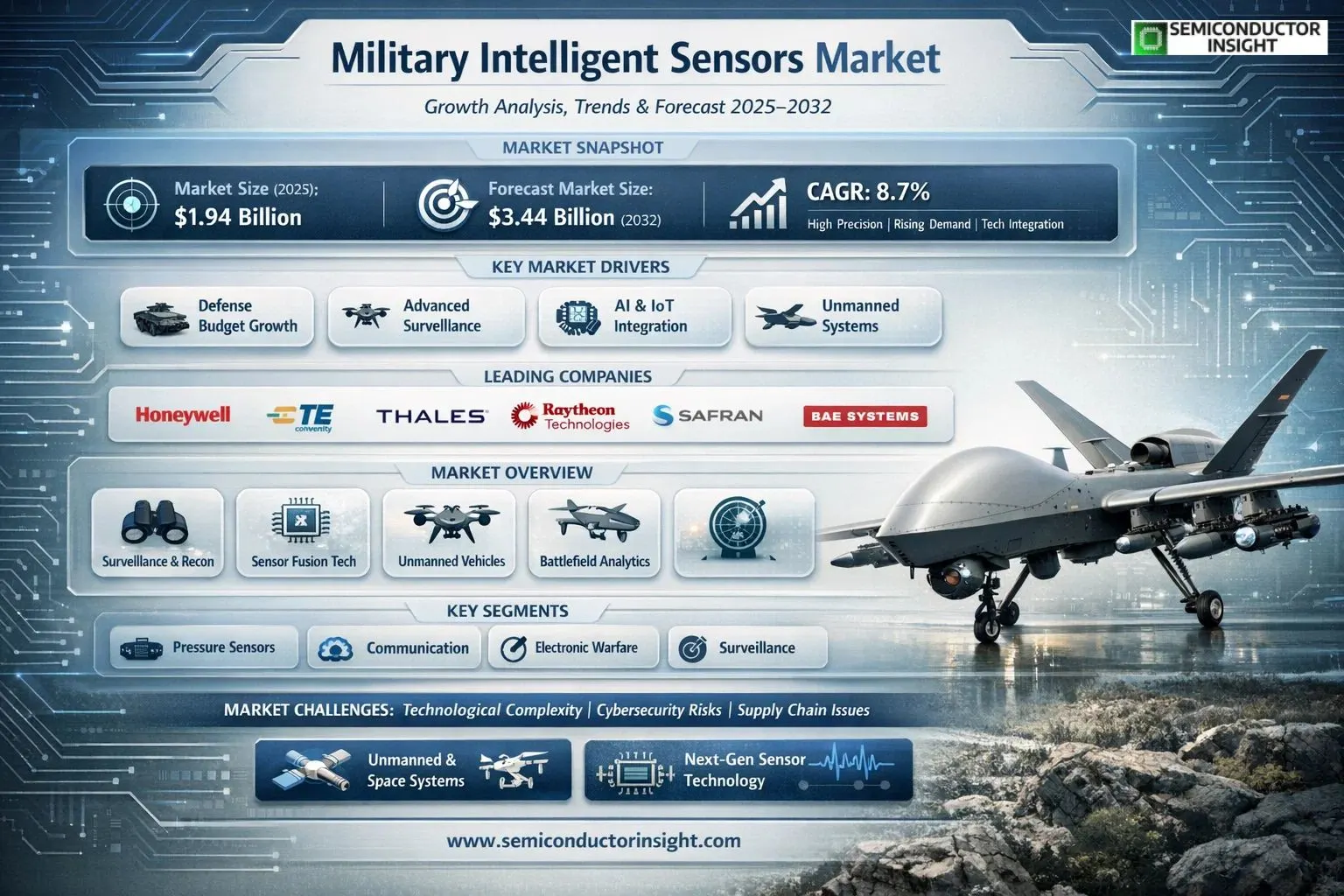
Global Military Intelligent Sensors market size was valued at USD 1.94 billion in 2025 and is projected to reach USD 3.44 billion by 2032, exhibiting a CAGR of 8.7% during the forecast period.
Military intelligent sensors refer to sensors with information detection, information processing, information memory, logical thinking and judgment functions. They combine the technology of microcomputers and sensors, and not only have various functions of traditional sensors, but also have multiple functions such as data processing, fault diagnosis, nonlinear processing, self-correction, self-adjustment and human-computer communication. Military intelligent sensors have the characteristics of high precision, high reliability, high stability and strong anti-interference ability, and can accurately and quickly obtain target information in complex military environments. These sensors include pressure sensors, temperature sensors, LiDAR sensors, accelerometers, vibration sensors, and others.
The market is experiencing rapid growth due to several factors, including surging global defense budgets, rising demand for advanced surveillance and reconnaissance capabilities, and an increasing focus on unmanned systems and autonomous vehicles. Additionally, advancements in AI integration and sensor fusion technologies are contributing to market expansion. Initiatives by key players are also expected to fuel further growth. For instance, major defense contractors continue to innovate with next-generation sensor platforms for enhanced battlefield awareness. Honeywell, TE Connectivity, Thales, Raytheon Technologies, Safran, and BAE Systems are some of the key players operating in the market with diverse portfolios.
MARKET DRIVERS
Geopolitical Tensions and Defense Modernization
Military Intelligent Sensors Market is propelled by escalating global geopolitical tensions, prompting nations to invest heavily in advanced surveillance and reconnaissance capabilities. With conflicts in regions like Eastern Europe and the Indo-Pacific driving demand, governments are prioritizing sensor technologies for real-time threat detection and situational awareness.
AI and IoT Integration Advancements
Integration of artificial intelligence and Internet of Things (IoT) into intelligent sensors enhances data processing speeds and accuracy, enabling autonomous decision-making on the battlefield. The market benefits from a projected growth rate of over 8% CAGR through 2030, fueled by these technologies in platforms like unmanned aerial vehicles (UAVs).
➤ Military spending reached $2.2 trillion globally in 2023, with sensors accounting for a significant portion of electronics budgets.
Furthermore, the shift toward networked warfare systems amplifies the need for interoperable military intelligent sensors, ensuring seamless data fusion across air, land, and sea domains for superior operational effectiveness.
MARKET CHALLENGES
Technological Complexity and Integration Hurdles
Military Intelligent Sensors Market faces challenges from the intricate integration of sensors into legacy platforms, requiring extensive testing to ensure reliability under extreme combat conditions. Compatibility issues with existing military infrastructures slow adoption rates.
Other Challenges
Cybersecurity Vulnerabilities
Rising cyber threats pose risks to connected intelligent sensors, necessitating robust encryption and anti-jamming measures that increase development timelines and costs. Supply chain disruptions, particularly for rare earth materials, further complicate procurement.
MARKET RESTRAINTS
High Development Costs and Budget Limitations
Prohibitive research and development expenses for advanced military intelligent sensors restrain market expansion, especially in emerging economies with constrained defense budgets. Initial investments often exceed hundreds of millions per program.Strict export controls and international regulations limit technology transfers, hindering global market penetration and collaboration among allies. These factors contribute to prolonged procurement cycles, averaging 5-7 years for deployment.Aging fleets in some militaries delay upgrades, as funds are diverted to maintenance rather than next-generation sensor acquisitions, capping growth in certain segments.
MARKET OPPORTUNITIES
Unmanned Systems and Space Domain Expansion
Military Intelligent Sensors Market presents opportunities in proliferating unmanned systems, where compact, AI-enabled sensors enhance autonomy and endurance. Demand surges with UAV fleets expected to double by 2030.Expansion into space-based sensors for missile warning and satellite protection opens new avenues, supported by investments in hypersonic defense technologies. Emerging markets in Asia-Pacific offer partnerships for localized production.Advancements in edge computing allow for lighter, more efficient sensors, reducing SWaP (size, weight, and power) constraints and enabling applications in next-gen fighters and submarines.
Military Intelligent Sensors Market Trends
Advancements in Sensor Intelligence and Integration
Military intelligent sensors represent a fusion of sensor technology with microcomputer capabilities, enabling functions such as information detection, processing, memory, logical thinking, and judgment. These sensors surpass traditional models by incorporating data processing, fault diagnosis, nonlinear processing, self-correction, self-adjustment, and human-computer communication. In Military Intelligent Sensors Market, their high precision, reliability, stability, and strong anti-interference abilities allow accurate and rapid target information acquisition in complex military environments. Recent developments highlight ongoing enhancements in these features, driven by surveys among manufacturers, suppliers, and industry experts focusing on product types, applications, and latest plans.
Other Trends
Diversification Across Product Segments
Key product segments including pressure sensors, temperature sensors, LiDAR sensors, accelerometers, vibration sensors, and others are shaping Military Intelligent Sensors Market dynamics. Pressure sensors and LiDAR sensors, in particular, are noted for their roles in demanding military applications, with manufacturers like Honeywell, TE Connectivity, and Thales advancing designs for improved performance. Industry feedback reveals trends toward multi-functionality, where these sensors address specific needs in data acquisition and processing, supporting broader adoption without compromising environmental resilience.
Growth in Application-Specific Deployments
Applications such as communication, navigation, surveillance and reconnaissance, electronic warfare, and others drive demand in Military Intelligent Sensors Market. Surveillance and reconnaissance applications stand out, leveraging sensors’ advanced capabilities for real-time decision-making. Leading players including Raytheon Technologies, Safran, BAE Systems, and Kongsberg Gruppen are prioritizing these areas, with recent developments in integration for electronic warfare enhancing operational effectiveness. Regional breakdowns show North America, Europe, and Asia-Pacific as focal points, where country-level advancements in countries like the US, Germany, China, and Japan align sensor innovations with strategic military needs. Competitive landscapes indicate top manufacturers holding significant positions, fostering trends in mergers, acquisitions, and tailored product evolutions.
COMPETITIVE LANDSCAPE
Key Industry Players
Top Manufacturers Dominating Military Intelligent Sensors Market
Military Intelligent Sensors Market exhibits an oligopolistic structure, led by established defense and aerospace giants such as Honeywell, TE Connectivity, Thales, Raytheon Technologies, and Safran. These top five players command a significant revenue share, approximately 40-50% of the global market as of 2025, driven by their advanced capabilities in integrating microcomputer technology with sensors for high-precision detection, processing, and self-correction in harsh military environments. Their dominance stems from substantial R&D investments, long-standing contracts with major militaries like the U.S. Department of Defense, and expertise in segments like pressure, temperature, and LiDAR sensors for applications in navigation and surveillance. This concentration fosters innovation but also creates high entry barriers for newcomers due to regulatory compliance and technological complexity.
Beyond the frontrunners, niche players like BAE Systems, Curtiss-Wright, and Kongsberg Gruppen provide specialized intelligent sensors for electronic warfare and vibration monitoring, carving out competitive edges through targeted innovations and regional strengths, particularly in Europe and North America. Emerging contributors including CETC, Meggitt, Eaton, Sensata Technologies, Aerospace Electronics, and Gaohua Technology focus on cost-effective solutions and Asia-Pacific growth, enhancing market diversity. Esterline complements with ruggedized accelerometers for reconnaissance. This layered competitive landscape drives advancements in anti-interference reliability and fault diagnosis, with ongoing mergers and developments intensifying rivalry amid a projected CAGR of 8.7% through 2032.
List of Key Military Intelligent Sensors Companies Profiled
- Honeywell
- TE Connectivity
- Thales
- Raytheon Technologies
- Safran
- Esterline
- Curtiss-Wright
- BAE Systems
- Kongsberg Gruppen
- Aerospace Electronics
- CETC
- Meggitt
- Eaton
- Sensata Technologies
- Gaohua Technology
Segment Analysis:
| Segment Category | Sub-Segments | Key Insights |
| By Type |
|
Pressure Sensor leads the segment owing to its versatile deployment across various military platforms.
|
| By Application |
|
Surveillance And Reconnaissance dominates applications due to its pivotal role in modern intelligence gathering.
|
| By End User |
|
Air Force represents the foremost end user, leveraging sensors for superior aerial dominance.
|
| By Platform |
|
Airborne Platforms lead platform integration with intelligent sensors for dynamic aerial missions.
|
| By Component |
|
Sensing Elements form the core component, driving overall system intelligence and precision.
|
Regional Analysis: Military Intelligent Sensors Market
North America
North America’s tech corridors host cutting-edge R&D for Military Intelligent Sensors Market, emphasizing AI-driven processing and miniaturization. Collaborations between academia and defense firms yield breakthroughs in edge computing for sensors.
Seamless integration into platforms like fighter jets and drones defines North America’s Military Intelligent Sensors Market approach, enhancing reconnaissance and targeting precision through adaptive algorithms.
A mature supply chain ensures reliable sourcing of components for military intelligent sensors, mitigating disruptions and supporting high-volume production for diverse applications.
Prioritizing secure-by-design sensors combats cyber threats in Military Intelligent Sensors Market, incorporating encryption and anti-jamming features for mission-critical reliability.
Europe
Europe exhibits steady growth in Military Intelligent Sensors Market, fueled by collaborative defense initiatives across NATO members. Nations prioritize interoperable sensors for joint operations, focusing on electro-optical and hyperspectral technologies for border surveillance and maritime security. Regional strengths lie in precision engineering and regulatory frameworks that promote ethical AI use in military applications. Investments in dual-use technologies bridge civilian and defense sectors, accelerating advancements in low-light imaging and vibration sensors. Challenges include harmonizing standards among diverse manufacturers, yet programs like the European Defence Fund drive sensor fusion capabilities for networked forces. Overall, Europe’s emphasis on sustainability and modularity shapes a resilient market landscape.
Asia-Pacific
The Asia-Pacific region surges in Military Intelligent Sensors Market amid rising geopolitical tensions, with nations enhancing sensor networks for territorial defense. Rapid indigenous development of radar and sonar sensors supports naval and aerial superiority. Focus areas include swarm intelligence for unmanned vehicles and resilient communications in contested environments. Local firms partner with international players to adopt advanced photonics and neuromorphic computing. Infrastructure modernization bolsters demand for ground-based intelligent sensors in urban warfare scenarios. Despite supply chain dependencies, strategic self-reliance initiatives propel innovation, positioning the region as a dynamic contender.
South America
South America’s Military Intelligent Sensors Market grows through modernization efforts, emphasizing affordable sensors for jungle and riverine operations. Countries invest in thermal and acoustic detection for asymmetric threats, leveraging cost-effective AI integration. Regional collaborations foster technology transfers, enhancing border monitoring and disaster response capabilities. Challenges like budget constraints spur innovative, low-power designs suitable for remote deployments. Gradual adoption of smart munitions and vehicle-mounted sensors reflects evolving defense priorities in this emerging market.
Middle East & Africa
In the Middle East & Africa, Military Intelligent Sensors Market expands via counter-terrorism and energy security needs, deploying advanced perimeter sensors and UAV payloads. Harsh environments demand durable, dust-resistant designs with long-range detection. Gulf states lead in importing high-end systems, while Africa focuses on counter-insurgency tools like wearable sensors. Regional alliances promote knowledge sharing, boosting local assembly and customization. Increasing focus on electronic warfare-resistant sensors underscores adaptive strategies in volatile theaters.
Report Scope
This market research report provides a comprehensive analysis of the Military Intelligent Sensors Market , covering the forecast period 2025–2032. It offers detailed insights into market dynamics, technological advancements, competitive landscape, and key trends shaping the industry.
Key focus areas of the report include:
- Market Overview: The report begins with an overview outlining its current market scenario, key growth indicators, and industry transformation drivers. It discusses macroeconomic factors, demand–supply balance, regulatory landscape, and the strategic role of intelligent sensors in powering advancements across industries such as defense, aerospace, surveillance, and electronic warfare.
- Market Size & Forecast: Historical data and future projections for revenue, unit shipments, and market value across major regions and segments.
- Segmentation Analysis: Detailed breakdown by product type, technology, application, and end-user industry to identify high-growth segments and investment opportunities.
- Regional Insights: Insights into market performance across North America, Europe, Asia-Pacific, Latin America, and the Middle East & Africa, including country-level analysis where relevant.
- Competitive Landscape: Profiles of leading market participants, including their product offerings, R&D focus, manufacturing capacity, pricing strategies, and recent developments such as mergers, acquisitions, and partnerships.
- Technology Trends & Innovation: Assessment of emerging technologies, integration of AI/IoT, sensor design trends, fabrication techniques, and evolving industry standards.
- Market Drivers & Restraints: Evaluation of factors driving market growth along with challenges, supply chain constraints, regulatory issues, and market-entry barriers.
- Stakeholder Insights: Insights for component suppliers, OEMs, system integrators, investors, and policymakers regarding the evolving ecosystem and strategic opportunities.
Primary and secondary research methods are employed, including interviews with industry experts, data from verified sources, and real-time market intelligence to ensure the accuracy and reliability of the insights presented.
FREQUENTLY ASKED QUESTIONS:
What is the current market size of Military Intelligent Sensors Market?
-> Global Military Intelligent Sensors market was valued at USD 1,938 million in 2025 and is projected to reach USD 3,438 million by 2032, at a CAGR of 8.7% during the forecast period.
Which key companies operate in Military Intelligent Sensors Market?
-> Key players include Honeywell, TE Connectivity, Thales, Raytheon Technologies, Safran, and BAE Systems, among others.
What are the key growth drivers?
-> Key growth drivers include demand for high precision and anti-interference sensors, technological integration of microcomputers, and rising needs in surveillance and reconnaissance applications.
Which region dominates the market?
-> North America dominates the market, while Asia remains the fastest-growing region.
What are the emerging trends?
-> Emerging trends include self-correction and fault diagnosis functions, enhanced data processing and human-computer communication, and advancements in pressure, lidar, and vibration sensors.

Get Sample Report PDF for Exclusive Insights
Report Sample Includes
- Table of Contents
- List of Tables & Figures
- Charts, Research Methodology, and more...
 Download Sample Report PDF