MARKET INSIGHTS
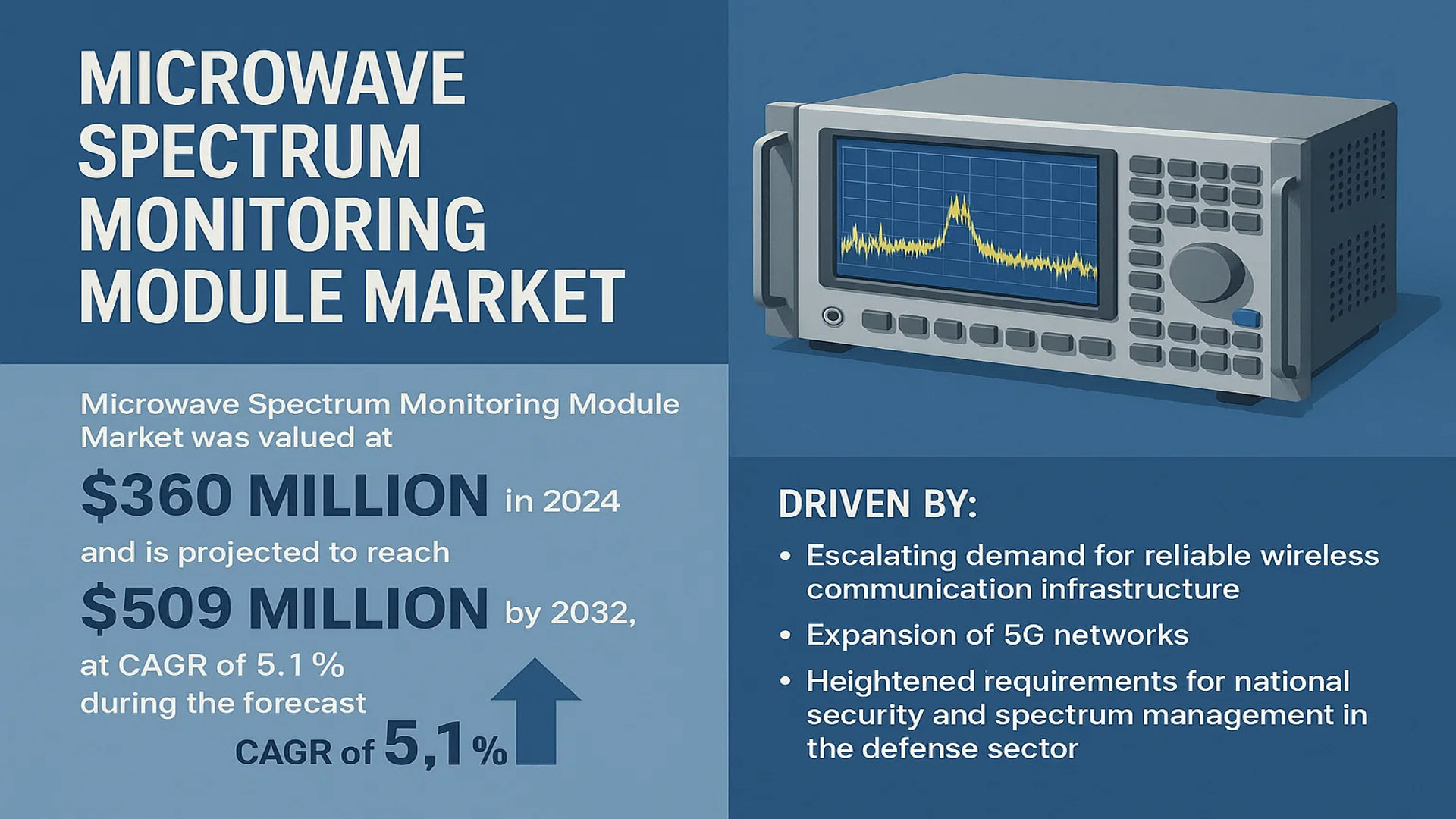
The global Microwave Spectrum Monitoring Module Market was valued at 360 million in 2024 and is projected to reach US$ 509 million by 2032, at a CAGR of 5.1% during the forecast.
A Microwave Spectrum Monitoring Module is a critical electronic device or subsystem designed to capture, analyze, and display the spectral characteristics of signals within the microwave frequency band. These modules are typically integrated into larger test, measurement, or communication systems to provide real-time monitoring and analysis of key signal parameters such as frequency, power, and bandwidth. They are indispensable for ensuring spectrum efficiency, identifying interference, and maintaining the integrity of wireless communications.
Market growth is primarily driven by the escalating demand for reliable wireless communication infrastructure, the expansion of 5G networks, and heightened requirements for national security and spectrum management in the defense sector. The United States represents a significant market, while China is projected to exhibit substantial growth, fueled by its aggressive investments in telecommunications and aerospace. Leading the competitive landscape are established players such as Anritsu, Keysight Technologies, and Rohde & Schwarz, who collectively hold a major share of the global revenue.
MARKET DYNAMICS
MARKET DRIVERS
Rising Demand for 5G Network Deployment and Expansion to Accelerate Market Growth
The global rollout of 5G networks represents a primary catalyst for the microwave spectrum monitoring module market. 5G technology operates across multiple frequency bands, including microwave spectrum ranges such as 24 GHz to 40 GHz and higher, necessitating advanced monitoring solutions to ensure network integrity, avoid interference, and optimize performance. With over 300 commercial 5G networks deployed worldwide and more than 1.3 billion 5G subscriptions active, the demand for precise spectrum monitoring has surged. These modules are critical for telecom operators and equipment manufacturers to conduct real-time spectrum analysis, detect unauthorized transmissions, and maintain compliance with stringent regulatory standards. The continuous expansion of 5G infrastructure, particularly in urban and high-density areas, directly fuels the adoption of advanced monitoring technologies to safeguard spectrum efficiency and quality of service.
Increasing Military and Defense Expenditures on Electronic Warfare to Boost Market Expansion
National security concerns and modernization of defense systems are significantly driving the adoption of microwave spectrum monitoring modules in military applications. Electronic warfare (EW) and signals intelligence (SIGINT) operations rely heavily on the ability to monitor, analyze, and counter adversarial communications and radar systems operating in the microwave frequency range. Global military electronics spending is projected to exceed $200 billion annually, with a substantial portion allocated to spectrum dominance and surveillance capabilities. For instance, recent conflicts have underscored the importance of spectrum awareness for electronic countermeasures (ECM) and communication security (COMSEC), prompting defense agencies to invest in portable and fixed monitoring solutions. These modules enable forces to detect, identify, and locate hostile emissions, thereby enhancing situational awareness and mission effectiveness in contested electromagnetic environments.
Growth in Satellite Communication and Space Exploration to Propel Market Demand
The proliferation of satellite communication systems and increasing investments in space exploration are creating robust demand for microwave spectrum monitoring modules. Commercial satellite constellations, such as those for global broadband internet services, operate extensively in Ku-band and Ka-band microwave frequencies, requiring continuous spectrum surveillance to prevent interference and ensure reliable service delivery. The number of active satellites has grown exponentially, surpassing 5,000 in orbit, with thousands more planned for launch in the coming years. Additionally, government space agencies and private aerospace companies are deploying advanced monitoring systems to support deep-space communication, Earth observation, and navigation missions. These modules are integral to ground station operations, enabling precise signal analysis and management across expansive and crowded frequency bands, thereby supporting the scalability and reliability of modern satellite infrastructure.
MARKET CHALLENGES
High Development and Implementation Costs to Challenge Widespread Adoption
Despite the growing demand, the microwave spectrum monitoring module market faces significant challenges related to high development and implementation costs. Advanced monitoring systems require sophisticated hardware components, such as high-frequency oscillators, low-noise amplifiers, and high-speed analog-to-digital converters, alongside complex software algorithms for signal processing and analysis. The research and development investment for these technologies is substantial, often running into millions of dollars for cutting-edge solutions. Furthermore, system integration, calibration, and maintenance add to the total cost of ownership, making it difficult for smaller organizations and price-sensitive markets to adopt these technologies. While large defense contractors and telecom giants can absorb these expenses, the high cost barrier limits penetration into emerging economies and niche application segments, potentially restraining overall market growth.
Other Challenges
Technical Complexity in High-Frequency Operations
Operating effectively in the upper microwave frequency bands, such as those above 40 GHz, presents considerable technical hurdles. At these frequencies, signal propagation is highly susceptible to atmospheric attenuation, rain fade, and other environmental factors, which can degrade monitoring accuracy. Designing modules that maintain sensitivity and precision across a broad spectrum while minimizing noise and power consumption requires specialized expertise and advanced materials. Additionally, the need for real-time processing of wide bandwidths demands high computational power, leading to challenges in heat dissipation and system miniaturization. These technical complexities can delay product development cycles and increase failure rates, posing significant challenges for manufacturers aiming to deliver reliable and efficient monitoring solutions.
Regulatory and Standardization Hurdles
Navigating diverse and evolving regulatory frameworks across different regions and applications complicates market expansion. Spectrum allocation policies, emission standards, and certification requirements vary significantly between countries and sectors, such as telecommunications, aerospace, and defense. Compliance with these regulations often necessitates customizations and repeated testing, increasing time-to-market and development costs. Moreover, the lack of global standardization in spectrum management practices can lead to interoperability issues and fragmented market dynamics. Companies must invest heavily in regulatory affairs and adapt their products to meet local requirements, which can deter innovation and slow down the adoption of new monitoring technologies in international markets.
MARKET RESTRAINTS
Shortage of Skilled RF Engineers and Technicians to Limit Market Growth
The microwave spectrum monitoring module industry is grappling with a significant shortage of skilled professionals proficient in radio frequency (RF) engineering and spectrum analysis. The design, deployment, and maintenance of these systems require deep expertise in electromagnetic theory, signal processing, and software-defined radio (SDR) technologies. However, the pool of qualified RF engineers and technicians is not keeping pace with industry demand, exacerbated by an aging workforce and insufficient educational focus on these specialized fields. This talent gap can lead to prolonged development cycles, higher labor costs, and suboptimal system performance. Without adequate human resources, companies may struggle to innovate and support complex customer requirements, ultimately restraining market growth and technological advancement in critical applications such as 5G networks and electronic warfare.
Cybersecurity Vulnerabilities in Monitoring Systems to Deter Market Confidence
As microwave spectrum monitoring modules become increasingly software-defined and network-connected, they are exposed to heightened cybersecurity risks. Unauthorized access to these systems could lead to manipulation of spectrum data, false alarms, or even disruption of critical communications and defense operations. The integration of IoT and cloud-based analytics further expands the attack surface, requiring robust encryption, authentication, and intrusion detection mechanisms. However, implementing comprehensive cybersecurity measures adds layers of complexity and cost to product development. Concerns over potential vulnerabilities may make end-users, particularly in government and military sectors, cautious about adopting new monitoring technologies, especially if they perceive risks to national security or operational integrity. This restraint is particularly relevant as adversaries develop advanced electronic warfare capabilities aimed at exploiting weaknesses in spectrum management infrastructure.
Economic Volatility and Budget Constraints to Impede Investment
Global economic uncertainties and budget constraints in key end-user industries are acting as restraints on the microwave spectrum monitoring module market. Defense budgets, while substantial, are subject to political shifts and fiscal pressures, leading to potential delays or reductions in procurement programs. Similarly, telecommunications operators may defer investments in spectrum monitoring infrastructure during economic downturns or periods of cost optimization. The capital-intensive nature of these systems means that organizations often prioritize essential expenditures over advanced monitoring solutions, especially in developing regions where funding is limited. This economic sensitivity can result in fluctuating demand and elongated sales cycles, challenging manufacturers to maintain steady growth and forecast accurately in a volatile market environment.
MARKET OPPORTUNITIES
Emergence of Smart Cities and IoT Ecosystems to Unlock New Growth Avenues
The rapid development of smart city initiatives and IoT ecosystems worldwide presents significant opportunities for the microwave spectrum monitoring module market. Smart cities rely on a multitude of wireless sensors, connected devices, and communication networks that operate across various microwave frequencies. Efficient spectrum management is crucial to prevent interference and ensure seamless operation of critical infrastructure, such as intelligent transportation systems, public safety networks, and utility monitoring. With the number of IoT devices projected to exceed 25 billion globally, the need for continuous spectrum surveillance will grow exponentially. Microwave monitoring modules can be deployed to provide real-time insights into spectrum usage, optimize network performance, and enhance security. This expanding application area offers vendors the chance to develop tailored solutions for urban environments, driving innovation and revenue growth in the coming years.
Advancements in AI and Machine Learning for Spectrum Analytics to Create Competitive Edge
Integration of artificial intelligence (AI) and machine learning (ML) technologies into spectrum monitoring systems is opening new frontiers for market players. AI-enhanced modules can autonomously detect patterns, predict interference, and classify signals with higher accuracy and speed than traditional methods. These capabilities are particularly valuable in crowded spectrum environments, such as urban areas or battlefields, where manual analysis is impractical. By leveraging AI, companies can offer predictive maintenance, automated threat detection, and dynamic spectrum access features, providing significant value to customers in telecommunications, defense, and public safety. Investments in AI-driven analytics are increasing, with many leading manufacturers incorporating these technologies into their latest product offerings. This trend not only differentiates advanced monitoring solutions but also creates opportunities for software upgrades and service-based revenue models, enhancing long-term customer engagement and market positioning.
Expansion into Emerging Markets and New Application Segments to Fuel Growth
Geographical expansion into emerging markets and diversification into new application segments represent promising opportunities for industry participants. Countries across Asia, Latin America, and Africa are investing heavily in telecommunications infrastructure, defense modernization, and space programs, driving demand for spectrum monitoring solutions. Additionally, non-traditional sectors such as automotive (for vehicle-to-everything communication), aviation (for drone traffic management), and scientific research (for radio astronomy) are increasingly adopting microwave monitoring technologies. By tailoring products to meet the specific needs and budget constraints of these diverse markets, companies can tap into previously underserved customer bases. Strategic partnerships with local distributors, customized pricing models, and region-specific product features can facilitate entry and growth in these expanding markets, providing a robust pipeline for future revenue generation.
MICROWAVE SPECTRUM MONITORING MODULE MARKET TRENDS
5G Network Rollouts and Spectrum Scarcity Drive Demand for Advanced Monitoring
The global proliferation of 5G networks represents the most significant catalyst for the microwave spectrum monitoring module market. As nations allocate new frequency bands for 5G services, particularly in the mid-band (3.5-3.8 GHz) and high-band (24-28 GHz) spectrum, the need for precise monitoring to prevent interference and ensure efficient spectrum utilization has become paramount. This is not merely about launching new services; it is about managing an increasingly crowded and valuable resource. Regulatory bodies worldwide are mandating stricter compliance and more sophisticated monitoring solutions to avoid costly service disruptions. The transition to 5G standalone (SA) architectures, which rely heavily on microwave backhaul links, further amplifies this need. Consequently, telecom operators and government agencies are investing heavily in real-time spectrum monitoring modules capable of detecting even minor anomalies across wide bandwidths, a key factor propelling the market’s projected growth from a valuation of 360 million in 2024.
Other Trends
Military and Defense Modernization Programs
Geopolitical tensions and the modernization of armed forces are accelerating investments in electronic warfare (EW) and signals intelligence (SIGINT) capabilities, which are fundamentally dependent on advanced microwave spectrum monitoring. Nations are prioritizing the detection, identification, and location of hostile or unauthorized transmissions to protect critical infrastructure and gain a tactical advantage. This has led to a surge in procurement of portable, ruggedized spectrum monitoring modules that can be deployed in field operations. These systems are required to operate across a vast frequency range, often from 1 GHz to 40 GHz or higher, with high sensitivity and rapid scanning speeds to identify fleeting signals. This defense sector demand is a major, stable driver for specialized manufacturers focusing on high-performance, secure, and robust monitoring solutions.
Integration of Artificial Intelligence and Machine Learning for Automated Analysis
A transformative trend reshaping the market is the deep integration of Artificial Intelligence (AI) and Machine Learning (ML) into spectrum monitoring systems. The sheer volume and complexity of data generated by wideband monitoring are far beyond the capacity for manual analysis. AI algorithms are now being deployed to automatically classify signal types, detect patterns of interference, predict potential conflicts, and even identify unauthorized or rogue transmitters. This shift from monitoring to intelligent management allows for proactive spectrum governance. For instance, an AI-powered module can learn the normal spectrum footprint of a given area and instantly flag anomalies, drastically reducing response times to interference events. This capability is becoming a standard requirement for new system deployments, pushing manufacturers to innovate beyond hardware and develop sophisticated software analytics platforms, thereby adding significant value to their offerings.
COMPETITIVE LANDSCAPE
Key Industry Players
Technological Innovation and Strategic Expansion Drive Market Leadership
The global microwave spectrum monitoring module market exhibits a semi-consolidated competitive structure, characterized by the presence of established multinational corporations, specialized technology firms, and emerging regional players. Keysight Technologies and Rohde & Schwarz are recognized as dominant forces, collectively holding a significant portion of the 2024 market revenue. Their leadership is anchored in extensive R&D investments, comprehensive product portfolios covering both sweep frequency and real-time analysis modules, and a robust global distribution network that serves critical sectors including military communications, aerospace, and civil wireless infrastructure.
Anritsu maintains a strong competitive position, particularly in the Asia-Pacific region, due to its high-precision instruments and long-standing relationships with telecommunications operators and government agencies. Similarly, National Instruments (now part of Emerson Electric Co.) leverages its software-defined approach and modular instrumentation to address the growing demand for flexible, scalable spectrum monitoring solutions, especially in research and development applications.
The competitive intensity is further heightened by strategic initiatives undertaken by key players. For instance, recent developments include Viavi Solutions launching enhanced portable spectrum analyzers for field deployment in 5G network rollout and interference hunting. Meanwhile, companies like ThinkRF and Signal Hound are competing effectively by offering cost-competitive, software-centric solutions that appeal to a broader customer base, including smaller enterprises and educational institutions.
Chinese manufacturers, such as ZTE and Chengdu Jiujin Technology, are rapidly expanding their influence, supported by domestic technological advancement policies and growing internal demand for spectrum management in one of the world’s largest wireless markets. Their growth strategy often combines aggressive pricing with technology partnerships, aiming to increase their international market share over the forecast period.
List of Key Microwave Spectrum Monitoring Module Companies Profiled
- Anritsu Corporation (Japan)
- Keysight Technologies (U.S.)
- Rohde & Schwarz GmbH & Co. KG (Germany)
- National Instruments Corp. (U.S.)
- Tektronix, Inc. (U.S.)
- ZTE Corporation (China)
- ThinkRF Corp. (Canada)
- Agilent Technologies, Inc. (U.S.)
- Viavi Solutions Inc. (U.S.)
- Giga-tronics Incorporated (U.S.)
- Signal Hound, Inc. (U.S.)
- Aaronia AG (Germany)
- Dechen Technology Co., Ltd. (China)
- Kunheng Shunwei Technology Co., Ltd. (China)
- Si Chuang Electronics Co., Ltd. (China)
- Chengdu Jiujin Technology Co., Ltd. (China)
- Zhongdian Cosine Technology Co., Ltd. (China)
- Beijing Puyuan Precision Electronics Co., Ltd. (China)
Segment Analysis:
By Type
Real-time Segment Leads Due to Critical Need for Instantaneous Signal Analysis in Modern Networks
The market is segmented based on type into:
- Sweep Frequency
- Real-time
By Application
Military Communications Segment Commands Significant Share Owing to National Security and Spectrum Superiority Requirements
The market is segmented based on application into:
- Military Communications
- Aerospace
- Civil Wireless Communications
- Other
By End User
Government and Defense Agencies are Primary End Users Due to Strategic Importance of Spectrum Monitoring
The market is segmented based on end user into:
- Government and Defense Agencies
- Telecommunication Service Providers
- Research and Academic Institutions
- Commercial Enterprises
By Frequency Range
C-Band and X-Band Modules are Highly Sought After for Their Pervasive Use in Radar and Satellite Systems
The market is segmented based on frequency range into:
- L-Band
- S-Band
- C-Band
- X-Band
- Ku-Band and Above
Regional Analysis: Microwave Spectrum Monitoring Module Market
Asia-Pacific
The Asia-Pacific region dominates the global market, driven by massive investments in telecommunications infrastructure and rapid 5G deployment. China, a global manufacturing and technology hub, is the largest consumer, with its market projected to reach a significant valuation by 2032. India’s market is expanding rapidly due to government initiatives like ‘Digital India’ and increasing private sector investment in network modernization. Japan and South Korea are mature markets focused on next-generation technologies, including 6G research and advanced satellite communications. The widespread adoption of IoT devices and smart city projects across Southeast Asian nations further fuels demand for real-time spectrum monitoring solutions to manage increasingly congested airwaves.
North America
North America represents a highly advanced and regulated market, characterized by stringent spectrum management policies enforced by the Federal Communications Commission (FCC) in the U.S. and Innovation, Science and Economic Development Canada (ISED). The region’s well-established defense sector is a major consumer, utilizing these modules for secure military communications and electronic warfare applications. Significant commercial demand stems from ongoing 5G network expansions and the need to protect critical infrastructure from interference. Leading global manufacturers, including Keysight Technologies and Anritsu, have a strong presence here, driving innovation in high-performance, software-defined monitoring systems.
Europe
Europe’s market is shaped by strict regulatory harmonization led by the European Conference of Postal and Telecommunications Administrations (CEPT) and the European Telecommunications Standards Institute (ETSI). The region’s focus is on ensuring efficient spectrum allocation to support the digital single market and safeguard against unauthorized transmissions. Countries like Germany, the U.K., and France are at the forefront, with significant demand from both civil wireless communications and aerospace & defense sectors. The push for technological sovereignty within the EU is also fostering local innovation and development of sophisticated monitoring solutions to ensure compliance and security.
Middle East & Africa
This region presents an emerging but rapidly growing market, primarily driven by ambitious national visions and economic diversification plans in Gulf Cooperation Council (GCC) countries like Saudi Arabia and the UAE. Investments in smart city projects, such as NEOM and Dubai’s Smart City initiative, are creating substantial demand for spectrum monitoring to manage new wireless networks and IoT ecosystems. However, growth in other parts of Africa is more gradual, often hindered by limited infrastructure investment and regulatory challenges. Nonetheless, the long-term potential is significant as digital transformation efforts gain momentum across the continent.
South America
The South American market is developing steadily, with Brazil and Argentina being the primary contributors. Growth is fueled by gradual modernization of telecommunications infrastructure and increasing mobile broadband penetration. Regulatory bodies are working to improve spectrum oversight, but the market’s expansion is sometimes tempered by economic volatility and budgetary constraints. The adoption of advanced monitoring modules is currently more prevalent among major network operators and government agencies, with slower uptake in other sectors due to cost sensitivity.
Report Scope
This market research report provides a comprehensive analysis of the global Microwave Spectrum Monitoring Module market, covering the forecast period 2025–2032. It offers detailed insights into market dynamics, technological advancements, competitive landscape, and key trends shaping the industry.
Key focus areas of the report include:
- Market Size & Forecast: Historical data and future projections for revenue, unit shipments, and market value across major regions and segments.
- Segmentation Analysis: Detailed breakdown by product type, technology, application, and end-user industry to identify high-growth segments and investment opportunities.
- Regional Outlook: Insights into market performance across North America, Europe, Asia-Pacific, Latin America, and the Middle East & Africa, including country-level analysis where relevant.
- Competitive Landscape: Profiles of leading market participants, including their product offerings, R&D focus, manufacturing capacity, pricing strategies, and recent developments such as mergers, acquisitions, and partnerships.
- Technology Trends & Innovation: Assessment of emerging technologies, integration of AI/IoT, semiconductor design trends, fabrication techniques, and evolving industry standards.
- Market Drivers & Restraints: Evaluation of factors driving market growth along with challenges, supply chain constraints, regulatory issues, and market-entry barriers.
- Stakeholder Analysis: Insights for component suppliers, OEMs, system integrators, investors, and policymakers regarding the evolving ecosystem and strategic opportunities.
Primary and secondary research methods are employed, including interviews with industry experts, data from verified sources, and real-time market intelligence to ensure the accuracy and reliability of the insights presented.
FREQUENTLY ASKED QUESTIONS:
What is the current market size of Global Microwave Spectrum Monitoring Module Market?
-> Microwave Spectrum Monitoring Module Market was valued at 360 million in 2024 and is projected to reach US$ 509 million by 2032, at a CAGR of 5.1% during the forecast.
Which key companies operate in Global Microwave Spectrum Monitoring Module Market?
-> Key players include Anritsu, Keysight Technologies, Rohde & Schwarz, National Instruments, Tektronix, ZTE, ThinkRF, Agilent Technologies, Viavi Solutions, and Giga-tronics, among others.
What are the key growth drivers?
-> Key growth drivers include increasing demand for wireless communication infrastructure, rising security concerns in military communications, and advancements in 5G technology deployment.
Which region dominates the market?
-> North America holds the largest market share, while Asia-Pacific is expected to witness the fastest growth during the forecast period.
What are the emerging trends?
-> Emerging trends include integration of artificial intelligence for spectrum analysis, development of compact and portable monitoring solutions, and increasing adoption in satellite communication systems.

Get Sample Report PDF for Exclusive Insights
Report Sample Includes
- Table of Contents
- List of Tables & Figures
- Charts, Research Methodology, and more...