MARKET INSIGHTS
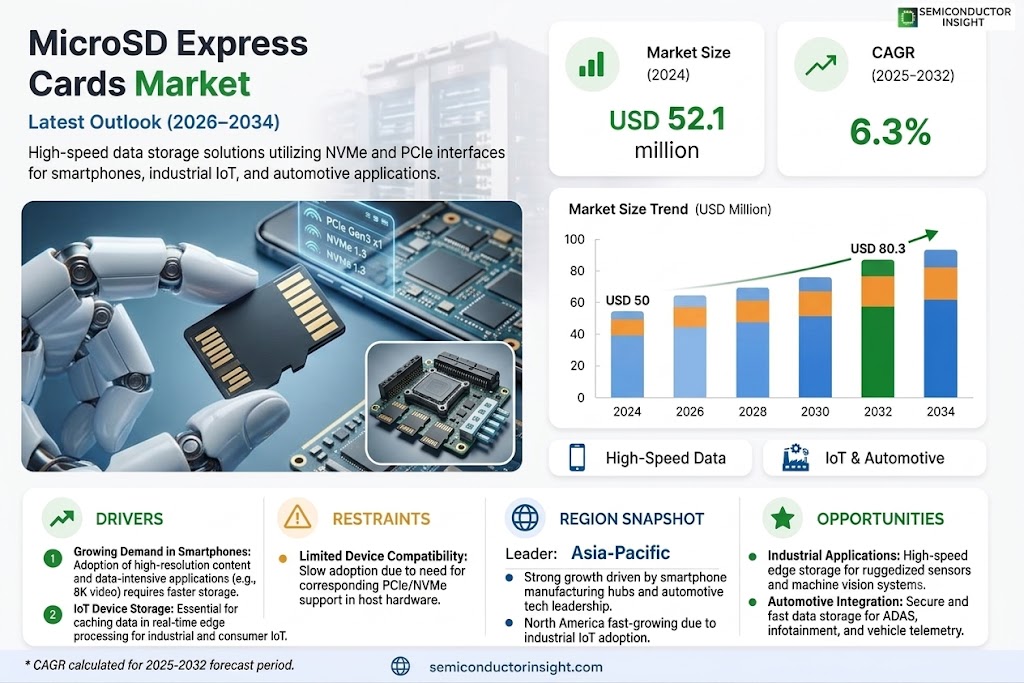
The global MicroSD Express Cards Market was valued at 52.1 million in 2024 and is projected to reach US$ 80.3 million by 2032, at a CAGR of 6.3% during the forecast period.
MicroSD Express Cards represent a next-generation storage solution leveraging PCIe (Peripheral Component Interconnect Express) and NVMe (Non-Volatile Memory Express) protocols to achieve SSD-level performance in a compact form factor. These high-speed cards deliver sequential read/write speeds up to 985 MB/s, significantly outperforming conventional UHS-I microSD cards which typically max out at 104 MB/s. The technology enables seamless 4K video capture, mobile gaming, and rapid file transfers for smartphones, drones, and action cameras.
Market growth is driven by escalating demand for high-performance mobile storage across consumer electronics and enterprise applications. Key industry players like SanDisk and Samsung have accelerated product development, with the 128GB capacity segment projected to dominate through 2032. However, adoption faces challenges including higher price points (~2-3x premium over UHS-II cards) and limited device compatibility currently restricted to premium smartphones and cameras supporting the SD 7.1 specification.
MARKET DYNAMICS
MARKET DRIVERS
Growing Demand for High-Speed Data Storage in Smartphones and IoT Devices to Accelerate Market Expansion
The rising adoption of high-resolution content and data-intensive applications in smartphones is driving demand for faster storage solutions like MicroSD Express Cards. With smartphone OEMs increasingly integrating support for 4K video recording and AI-driven features, the need for low-latency, high-bandwidth storage has grown significantly. Concurrently, IoT deployments are expanding rapidly, requiring reliable and swift data capture capabilities. The combination of these trends creates strong tailwinds for PCIe/NVMe-based microSD solutions that offer SSD-like performance in compact form factors.
Emergence of 5G Networks Creating New Use Cases for High-Performance Removable Storage
5G network rollouts worldwide are unlocking new applications that benefit from MicroSD Express capabilities. The ability to achieve 985 MB/s transfer speeds makes these cards ideal for edge computing scenarios where temporary high-speed storage augmentation is required. Mobile gaming represents another high-growth segment, with modern titles exceeding 10GB in size and requiring rapid asset loading. As 5G enables richer mobile experiences, content creators and app developers are designing solutions that leverage the enhanced capabilities of Express Cards.
Continuous Innovation in Semiconductor Technology Driving Performance Improvements
Advancements in 3D NAND flash memory and controller technologies have enabled manufacturers to push the boundaries of removable storage performance. The transition to more advanced nanometer processes has allowed for higher density chips that maintain thermal efficiency – a critical factor for small form factor storage. Recent product launches demonstrate sequential read speeds approaching PCIe 3.0 x1 lane limitations, with potential for further gains as the ecosystem matures. These technological improvements directly translate to better user experiences in photography, videography, and mobile productivity applications.
MARKET RESTRAINTS
Limited Device Compatibility Slows Down widescale Adoption of MicroSD Express
Despite their performance advantages, MicroSD Express Cards face significant market penetration challenges due to limited hardware support. The majority of current smartphones and tablets still utilize traditional UHS-II interfaces, creating a chicken-and-egg scenario where manufacturers hesitate to adopt the new standard without proven demand. Industry estimates suggest fewer than 15% of mobile devices shipping in 2024 natively support the Express format, representing a substantial barrier to market expansion.
Higher Price Point Compared to Conventional microSD Cards Impacts Mass Market Appeal
The premium performance of MicroSD Express comes at a cost premium that limits broader adoption. Current pricing for 256GB Express Cards remains approximately 2-3 times higher than equivalent capacity UHS-I cards. While the price gap is expected to narrow as production scales, the current differential makes it challenging to convince casual users to upgrade, particularly in price-sensitive emerging markets. This pricing dynamic significantly impacts volume growth potential in the near term.
Thermal Management Challenges in Compact Form Factors
The high-performance operation of MicroSD Express Cards generates more heat than traditional solutions, creating engineering challenges for device manufacturers. Sustained high-speed transfers can lead to thermal throttling, reducing real-world performance gains. Managing this heat in slim mobile devices requires careful thermal design that not all OEMs have prioritized. This technical limitation affects reliability perceptions and may slow enterprise adoption where consistent performance is paramount.
MARKET OPPORTUNITIES
Expansion into Industrial and Automotive Applications Presents New Growth Frontiers
Beyond consumer electronics, MicroSD Express technology holds significant potential in industrial IoT and automotive applications. The automotive sector in particular represents a promising vertical, with next-generation infotainment systems and autonomous driving platforms requiring robust, high-speed removable storage for data logging and map updates. Industrial applications including edge AI inference and machine vision systems could similarly benefit from the combination of compact size and PCIe performance that these cards provide.
Cloud Storage Acceleration Creates Complementary Use Cases
The growing trend of hybrid cloud storage solutions opens opportunities for MicroSD Express as a local acceleration tier. By serving as a high-performance cache for cloud storage services, these cards could significantly improve the user experience in bandwidth-constrained environments. This application becomes increasingly relevant as more consumers and businesses adopt cloud-native workflows but still require responsive local access to frequently used files and applications.
Content Creation Market Transition to Mobile-First Workflows
The professional content creation market is gradually shifting toward mobile-first workflows, driven by improvements in smartphone camera technology and mobile editing software. This transition creates demand for storage solutions that can handle high-bitrate professional video formats and large raw image files. MicroSD Express Cards are well-positioned to capture this segment once camera manufacturers begin adopting the standard in prosumer and professional mobile imaging equipment.
MARKET CHALLENGES
Fragmented Standards Ecosystem Creates Consumer Confusion
The storage market currently suffers from multiple competing standards (UHS-II, UFS, Express) which creates end-user confusion about performance characteristics and compatibility. This fragmentation makes it difficult to communicate the value proposition of MicroSD Express to mainstream consumers who may not understand the technical differences between interface protocols. Educating the market represents a significant challenge that requires coordinated effort across the industry.
NAND Flash Supply Chain Volatility Impacts Production Consistency
Global NAND flash memory markets experience periodic supply-demand imbalances that can affect MicroSD Express production capacity and pricing. Recent industry fluctuations have demonstrated how geopolitical factors and manufacturing capacity changes can disrupt supply chains. These dynamics make it challenging for manufacturers to maintain stable pricing and may delay planned capacity expansions for newer technologies like Express Cards.
Competition from Embedded Storage Solutions
The growing popularity of embedded UFS (Universal Flash Storage) in premium smartphones presents competitive pressure for removable storage solutions. Some device manufacturers are opting to eliminate external storage slots entirely in favor of larger internal UFS capacities. This trend threatens to limit the addressable market for MicroSD Express, particularly in high-end devices where performance concerns might otherwise drive adoption.
MICROSD EXPRESS CARDS MARKET TRENDS
Growing Demand for High-Speed Storage Solutions to Drive Market Expansion
The global MicroSD Express Cards market is witnessing robust growth, driven primarily by the increasing demand for high-speed data storage solutions across multiple industries. The integration of PCIe (Peripheral Component Interconnect Express) and NVMe (Non-Volatile Memory Express) protocols in these cards enables significantly faster read and write speeds compared to traditional microSD cards. With data transfer speeds comparable to SSDs, the technology is gaining traction in applications like 4K video recording, high-resolution gaming, and high-performance mobile computing. Recent reports estimate that the market was valued at $52.1 million in 2024, and it is projected to grow at a CAGR of 6.3%, reaching $80.3 million by 2032. Additionally, advancements in semiconductor technology and increasing adoption of 5G-enabled devices are further accelerating the need for high-bandwidth storage solutions like MicroSD Express.
Other Trends
Rising Popularity of High-Capacity Storage
The shift toward higher-capacity storage solutions is another key trend fueling market growth. Storage-intensive applications such as AI-driven analytics, real-time video processing, and IoT data logging demand larger-capacity storage options. The 128 GB segment is estimated to witness significant adoption, while 256 GB and 512 GB variants are projected to gain momentum in enterprise and professional use cases. The industry is also seeing a trend toward energy-efficient storage solutions, as power consumption remains a critical factor in battery-dependent devices like smartphones and portable gaming consoles.
Increasing Adoption in Smartphones and Gaming Consoles
Smartphone manufacturers and gaming console developers are increasingly incorporating MicroSD Express compatibility into their flagship devices, further driving market penetration. Leading OEMs are leveraging the enhanced speed and reliability of these cards to offer seamless 4K video capture, faster app load times, and smoother gameplay experiences. The gaming segment, in particular, shows strong growth potential, with an increasing number of handheld and console manufacturers supporting MicroSD Express as a standard feature. At the same time, the integration of these cards into IoT devices and action cameras is expanding their application scope, reinforcing their position as a versatile high-performance storage solution.
COMPETITIVE LANDSCAPE
Key Industry Players
Leading Manufacturers Drive Innovation in High-Speed Storage Solutions
The global MicroSD Express Cards market features a competitive landscape dominated by established memory technology providers, with a mix of multinational corporations and specialized storage manufacturers vying for market share. The market is characterized by rapid technological advancements and increasing demand for high-performance storage in mobile devices, creating both opportunities and challenges for industry players.
SanDisk (Western Digital) and Samsung Electronics collectively held approximately 45% of the global market share in 2024, leveraging their established brand recognition and extensive distribution networks. These industry leaders have been at the forefront of introducing high-capacity MicroSD Express Cards with impressive read/write speeds exceeding 900MB/s, positioning them as preferred choices for professional users and enthusiasts alike.
Emerging players like Nextorage, a Sony-affiliated company, are making significant strides by focusing on specialized applications such as 8K video recording and gaming. Their strategic emphasis on reliability and sustained performance under heavy workloads has allowed them to carve out a growing niche in the professional content creation segment.
Meanwhile, Kingmax and Lexar (a brand under Longsys) are strengthening their market positions through aggressive pricing strategies and expanded compatibility testing with major device manufacturers. These companies are investing heavily in R&D to develop more energy-efficient designs that address the thermal challenges associated with high-speed data transfer in compact form factors.
List of Key MicroSD Express Cards Manufacturers
- SanDisk (Western Digital Corp.) (U.S.)
- Samsung Electronics (South Korea)
- Nextorage Corporation (Japan)
- Kingmax Technology Inc. (Taiwan)
- Lexar (Longsys Electronics) (China)
- Toshiba Memory Corporation (Japan)
- Micron Technology (U.S.)
- PNY Technologies (U.S.)
- ADATA Technology (Taiwan)
The competitive landscape continues to evolve as companies explore new form factors and implementations of the SD Express standard. While the current market is dominated by established storage brands, the growing demand for high-performance mobile storage may attract new entrants from adjacent sectors such as SSD manufacturers or mobile processor companies seeking vertical integration opportunities.
Segment Analysis:
By Type
128 GB Segment Leads the Market Owing to Widespread Compatibility and Affordability
The market is segmented based on type into:
- 128 GB
- 256 GB
- 512 GB
- Others
- Subtypes: 64 GB, 1 TB, and custom variants
By Application
Smartphones and Tablets Segment Dominates Due to Expanding Mobile Storage Needs
The market is segmented based on application into:
- Smartphones and Tablets
- Gaming Consoles
- Action Cameras
- IoT Devices
- Others
- Subtypes: Drones, Automotive systems, and industrial applications
By Speed Class
PCIe Gen 3 Segment Prevails with Balanced Performance and Energy Efficiency
The market is segmented based on speed class into:
- PCIe Gen 3
- PCIe Gen 4
- PCIe Gen 5
By End User
Consumer Electronics Sector Drives Adoption for High-Speed Storage Solutions
The market is segmented based on end user into:
- Consumer Electronics
- Enterprise Storage
- Industrial Applications
- Others
- Subtypes: Automotive, Medical, and Military
Regional Analysis: MicroSD Express Cards Market
Asia-Pacific
The Asia-Pacific region dominates the MicroSD Express Cards market, driven by strong consumer electronics demand and rapid technological adoption in countries like China, Japan, and South Korea. China, as the world’s largest producer of smartphones and IoT devices, accounts for over 40% of global demand. The region benefits from established semiconductor manufacturing ecosystems, with key players like Samsung investing heavily in high-speed memory solutions. Growing mobile gaming markets in Southeast Asia and India further propel demand, though price sensitivity remains a challenge for premium storage products. The shift toward 5G-enabled devices creates additional opportunities for high-performance storage solutions.
North America
North America represents the second-largest market for MicroSD Express Cards, with the U.S. leading in adoption due to early technology integration and high consumer spending on advanced electronics. The region shows strong demand for high-capacity (512GB+) cards among professional content creators and gamers. Major OEMs like Western Digital (SanDisk) drive innovation, though market penetration faces challenges from cloud storage alternatives. The increasing use of action cameras and drones in recreational activities contributes to steady growth, with applications like 8K video recording requiring faster write speeds.
Europe
European demand centers around premium storage solutions with Germany, France, and the U.K. as key markets. Strict data protection regulations encourage local storage adoption over cloud-based alternatives in certain sectors. While smartphone sales have plateaued, niche applications like industrial IoT and automotive dashcams present growth avenues. The market faces slower adoption rates compared to Asia due to higher price points and longer device replacement cycles. However, partnerships between storage manufacturers and automotive companies for in-vehicle systems may unlock new opportunities.
Middle East & Africa
This emerging market shows potential with increasing smartphone penetration and improving digital infrastructure. While current adoption of MicroSD Express Cards remains limited by low awareness and budget constraints, countries like UAE and Saudi Arabia demonstrate stronger uptake in gaming and professional applications. The lack of local manufacturing results in import dependency, affecting pricing competitiveness. However, the region’s young, tech-savvy population and expanding eSports market suggest long-term growth prospects as device capabilities improve.
South America
Economic instability and currency fluctuations hinder widespread MicroSD Express Cards adoption, though Brazil and Argentina show pockets of demand. The market remains largely focused on budget storage options, with consumers prioritizing basic functionality over high-speed performance. Growing smartphone ownership in the region provides a baseline for future growth, but infrastructure limitations and low disposable incomes slow the transition to advanced storage solutions. Localized pricing strategies by global brands may help stimulate market development.
Report Scope
This market research report provides a comprehensive analysis of the global MicroSD Express Cards market, covering the forecast period 2024–2032. It offers detailed insights into market dynamics, technological advancements, competitive landscape, and key trends shaping the industry.
Key focus areas of the report include:
- Market Size & Forecast: Historical data and future projections for revenue, unit shipments, and market value across major regions and segments.
- Segmentation Analysis: Detailed breakdown by storage capacity (128GB, 256GB, 512GB), application (smartphones, gaming consoles, IoT devices), and end-user industries.
- Regional Outlook: Insights into market performance across North America, Europe, Asia-Pacific, Latin America, and the Middle East & Africa.
- Competitive Landscape: Profiles of leading manufacturers including SanDisk, Samsung, and Lexar, covering product portfolios, market shares, and strategic initiatives.
- Technology Trends: Assessment of PCIe/NVMe interface adoption, performance benchmarks, and compatibility with next-gen devices.
- Market Drivers & Restraints: Analysis of demand drivers like 4K content creation and gaming, alongside challenges such as device compatibility and price sensitivity.
- Stakeholder Analysis: Strategic insights for memory manufacturers, device OEMs, and investors regarding market opportunities.
The research methodology combines primary interviews with industry experts and analysis of verified market data to ensure accuracy and reliability.
FREQUENTLY ASKED QUESTIONS:
What is the current market size of Global MicroSD Express Cards Market?
-> MicroSD Express Cards Market was valued at 52.1 million in 2024 and is projected to reach US$ 80.3 million by 2032, at a CAGR of 6.3% during the forecast period.
Which key companies operate in Global MicroSD Express Cards Market?
-> Key players include SanDisk, Samsung, Nextorage, Kingmax, and Lexar.
What are the key growth drivers?
-> Key growth drivers include rising demand for high-speed storage in mobile devices, growth of 4K/8K content creation, and expanding gaming applications.
Which region dominates the market?
-> Asia-Pacific leads in both production and consumption, while North America shows strongest growth potential.
What are the emerging trends?
-> Emerging trends include higher capacity cards (1TB+), improved thermal management, and broader device compatibility.

Get Sample Report PDF for Exclusive Insights
Report Sample Includes
- Table of Contents
- List of Tables & Figures
- Charts, Research Methodology, and more...
 Download Sample Report PDF