
Market Insights
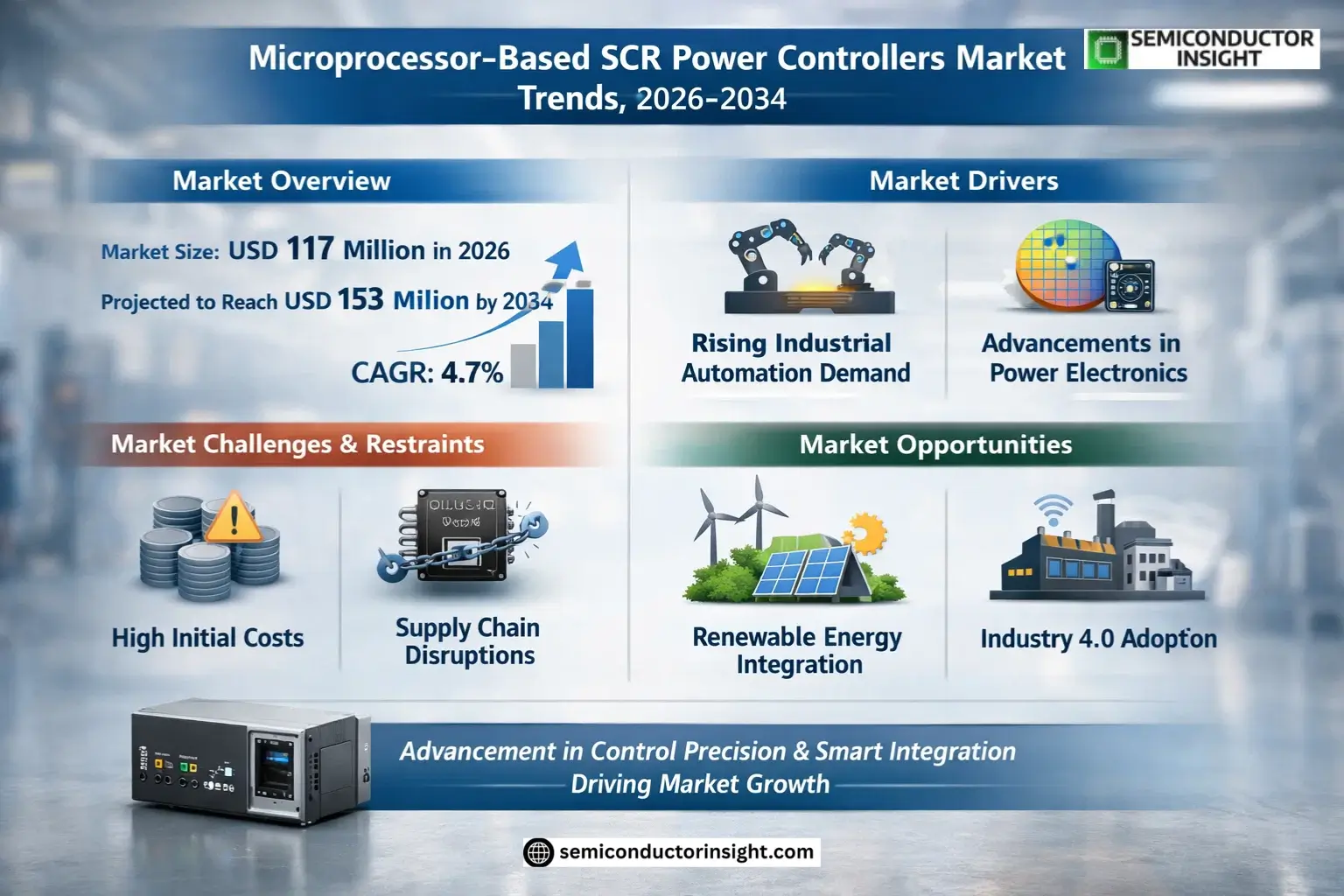
Global Microprocessor-based SCR Power Controllers Market size was valued at USD 112 million in 2025. The market is projected to grow from USD 117 million in 2026 to USD 153 million by 2034, exhibiting a CAGR of 4.7% during the forecast period.
Microprocessor-based SCR power controllers are advanced devices designed for precise energy management in industrial heating applications. These controllers utilize silicon-controlled rectifiers (SCRs) with microprocessor intelligence to regulate power delivery, ensuring stable temperature control and improved efficiency. Key features include adaptive triggering algorithms, real-time diagnostics, and communication capabilities for integration with automation systems.
Market growth is driven by increasing demand for energy-efficient industrial heating solutions across sectors like glass manufacturing, semiconductor production, and furnace operations. The transition from analog to digital control systems and Industry 4.0 adoption further accelerates deployment. Leading manufacturers are focusing on developing compact, high-performance controllers with IoT connectivity, though supply chain constraints for semiconductor components present temporary challenges.
MARKET DRIVERS
Growing Industrial Automation Demand
Microprocessor-based SCR Power Controllers Market is experiencing robust growth due to increasing adoption in industrial automation. These controllers provide precise power regulation for heating applications in sectors like semiconductor manufacturing and food processing. Global push for energy-efficient solutions has accelerated demand by 12% annually over the past five years.
Advancements in Power Electronics
Recent technological improvements in silicon-controlled rectifiers (SCRs) have enhanced the performance of microprocessor-based power controllers. Modern units now offer faster response times and better thermal management, making them ideal for critical temperature control applications.
Stringent energy efficiency regulations across North America and Europe are further driving replacement of legacy systems with advanced microprocessor-controlled SCR units.
MARKET CHALLENGES
High Initial Investment Costs
While microprocessor-based SCR power controllers offer long-term savings, their sophisticated design leads to 40-60% higher upfront costs compared to conventional alternatives. This pricing barrier limits adoption among small and medium enterprises.
Other Challenges
Technical Complexity
The integration of microprocessor-based SCR controllers requires specialized expertise, creating workforce training challenges in emerging markets where skilled technicians are scarce.
MARKET RESTRAINTS
Supply Chain Disruptions
Global semiconductor shortage has significantly impacted production lead times for microprocessor-based SCR power controllers, with average delivery periods extending from 8 to 18 weeks. This disruption has constrained market growth by an estimated 7-9% in 2023.
MARKET OPPORTUNITIES
Renewable Energy Integration
The transition to renewable energy sources presents significant growth potential for microprocessor-based SCR power controllers. These devices play a crucial role in power conversion and stabilization for solar and wind energy systems. Emerging applications in battery management systems are expected to create a $280 million revenue opportunity by 2026.
Industry 4.0 Adoption
The integration of microprocessor-based SCR controllers with IoT-enabled smart factories is creating new value propositions. Real-time monitoring and predictive maintenance capabilities are driving 20% year-over-year growth in this segment.
Microprocessor-based SCR Power Controllers Market Trends
Advancements in Control Precision Driving Market Growth
Modern microprocessor-based SCR power controllers are incorporating advanced triggering algorithms and enhanced diagnostic capabilities. This technological evolution enables tighter temperature control in industrial heating applications such as semiconductor manufacturing and glass production. The integration of smart communication interfaces allows real-time monitoring and remote adjustments, significantly improving operational efficiency in critical processes.
Other Trends
Growing Adoption in Semiconductor Manufacturing
The semiconductor industry’s stringent temperature control requirements are accelerating demand for high-precision SCR power controllers. Microprocessor-based systems provide the necessary stability for delicate semiconductor fabrication processes where temperature variations as small as ±0.5°C can impact yield rates.
Shift Toward Energy-Efficient Industrial Solutions
Manufacturers are increasingly prioritizing energy optimization in heating systems. Modern SCR controllers with microprocessor intelligence can achieve up to 98% power conversion efficiency while minimizing harmonic distortion. This aligns with global sustainability initiatives while reducing operational costs for industrial facilities.
Market Consolidation Among Key Players
The competitive landscape shows increased M&A activity as major players like Spang & Company and Watlow expand their product portfolios through strategic acquisitions. This consolidation is driving standardization in control protocols while intensifying competition in the microprocessor-based SCR power controller space.
Regional Demand Variations Emerging
Asia-Pacific markets demonstrate particularly strong growth due to rapid industrialization, while North America maintains steady demand for advanced controller upgrades. Europe shows increasing adoption in renewable energy applications where precise power regulation is critical for grid stability.
COMPETITIVE LANDSCAPE
Key Industry Players
Strategic Positioning in the Evolving SCR Power Control Market
Microprocessor-based SCR Power Controllers Market size was valued at USD 112 million in 2025. The market is projected to grow from USD 117 million in 2026 to USD 153 million by 2034, exhibiting a CAGR of 4.7% during the forecast period. is dominated by established players like Spang & Company and Watlow, who collectively hold a significant market share. These industry leaders leverage advanced microprocessor technology to deliver precision-controlled power regulation for industrial heating applications. The market structure exhibits moderate consolidation, with the top five players accounting for a substantial portion of global revenues, while numerous regional players compete in niche segments.
Specialized manufacturers like Eurotherm and Advanced Energy are gaining traction by offering networked control solutions with diagnostic capabilities. Emerging competitors in Asia-Pacific, particularly CD Automation and Autonics, are expanding their footprint through competitive pricing and localized support. The competitive landscape is further diversified by technology providers offering integrated control systems for semiconductor manufacturing and industrial furnace applications.
List of Key Microprocessor-based SCR Power Controller Companies Profiled
- Spang & Company
- Control Concepts
- Advanced Energy
- Chromalox
- Watlow
- Autonics
- Eurotherm
- CD Automation
- Motortronics
- Microener
- ControlTek
- Omron
- Siemens
- MKS Instruments
- Lumel
Segment Analysis:
| Segment Category | Sub-Segments | Key Insights |
| By Type |
|
Three Phase dominates due to superior power handling capabilities and efficiency in industrial settings:
|
| By Application |
|
Industrial Furnace applications show strongest demand due to:
|
| By End User |
|
Heavy Industries represent the most significant adoption segment because:
|
| By Control Technology |
|
Advanced Hybrid Control demonstrates growing preference as it:
|
| By Communication Interface |
|
Industrial Ethernet interfaces show strongest growth due to:
|
Regional Analysis: Microprocessor-based SCR Power Controllers Market
Surging automation across electronics and automotive manufacturing drives 40% of regional SCR controller adoption. Smart factory initiatives prioritize energy-efficient power regulation systems.
Solar and wind power projects increasingly incorporate advanced SCR controllers for grid stabilization. Government incentives boost renewable sector adoption of microprocessor-controlled solutions.
Regional semiconductor manufacturers supply 60% of global SCR components. Established supply chains enable competitive pricing for controller system integrators.
Smart city projects across China and India deploy SCR controllers in building automation. Municipal power management systems increasingly adopt microprocessor-based regulation technologies.
North America
The mature North American market demonstrates steady growth in microprocessor-based SCR power controller adoption, led by modernization of industrial facilities and stringent energy regulations. The U.S. accounts for the majority of regional demand with advanced manufacturing and data center applications. Canadian market growth stems from upgrades to aging power infrastructure. Technological partnerships between semiconductor manufacturers and energy companies drive innovation in intelligent power control systems. The region sees increasing SCR controller integration in oil & gas operations and commercial HVAC systems.
Europe
European demand focuses on high-precision SCR power controllers for specialized industrial applications and renewable energy projects. Germany remains the technology leader with its robust manufacturing sector investing in Industry 4.0 solutions. Stringent EU energy efficiency directives accelerate replacement of aging power control systems. Scandinavia shows remarkable adoption in district heating systems and marine applications. The market benefits from strong R&D collaboration between universities and industrial automation providers developing next-gen SCR control algorithms.
Middle East & Africa
The region experiences growing SCR controller demand primarily from large-scale industrial projects and power infrastructure development. GCC countries lead adoption through smart city initiatives and oil refinery modernization programs. South Africa’s mining sector presents significant opportunities for robust power control solutions. Market growth faces challenges from price sensitivity and reliance on imported components, though local assembly operations are emerging.
South America
Brazil dominates the regional microprocessor-based SCR power controller market with expanding industrial production and energy infrastructure investments. Mining and agriculture sectors drive demand for durable power regulation systems. Argentina and Chile show increasing adoption in renewable energy projects, particularly solar power plants. Market growth remains constrained by economic volatility but benefits from regional trade agreements facilitating technology transfer.
Report Scope
This market research report provides a comprehensive analysis of the Microprocessor-based SCR Power Controllers Market , covering the forecast period 2026–2034. It offers detailed insights into market dynamics, technological advancements, competitive landscape, and key trends shaping the industry.
Key focus areas of the report include:
- Market Overview: The report begins with an overview outlining its current market scenario, key growth indicators, and industry transformation drivers. It discusses macroeconomic factors, demand–supply balance, regulatory landscape, and the strategic role of semiconductors in powering advancements across industries such as automotive, telecommunications, consumer electronics, and industrial automation.
- Market Size & Forecast: Historical data and future projections for revenue, unit shipments, and market value across major regions and segments.
- Segmentation Analysis: Detailed breakdown by product type, technology, application, and end-user industry to identify high-growth segments and investment opportunities.
- Regional Insights: Insights into market performance across North America, Europe, Asia-Pacific, Latin America, and the Middle East & Africa, including country-level analysis where relevant.
- Competitive Landscape: Profiles of leading market participants, including their product offerings, R&D focus, manufacturing capacity, pricing strategies, and recent developments such as mergers, acquisitions, and partnerships.
- Technology Trends & Innovation: Assessment of emerging technologies, integration of AI/IoT, semiconductor design trends, fabrication techniques, and evolving industry standards.
- Market Drivers & Restraints: Evaluation of factors driving market growth along with challenges, supply chain constraints, regulatory issues, and market-entry barriers.
- Stakeholder Insights: Insights for component suppliers, OEMs, system integrators, investors, and policymakers regarding the evolving ecosystem and strategic opportunities.
Primary and secondary research methods are employed, including interviews with industry experts, data from verified sources, and real-time market intelligence to ensure the accuracy and reliability of the insights presented.
FREQUENTLY ASKED QUESTIONS:
What is the current market size of Microprocessor-based SCR Power Controllers Market?
-> Microprocessor-based SCR Power Controllers Market size was valued at USD 112 million in 2025. The market is projected to grow from USD 117 million in 2026 to USD 153 million by 2034, exhibiting a CAGR of 4.7% during the forecast period.
Which key companies operate in Microprocessor-based SCR Power Controllers Market?
-> Key players include Spang & Company, Control Concepts, Advanced Energy, Chromalox, Watlow, Autonics, Eurotherm, CD Automation, and Motortronics.
What are the key growth drivers?
-> Key growth drivers include rising demand for precise energy management, stable temperature control in heating systems, and advanced microprocessor-based diagnostic features.
Which region dominates the market?
-> North America holds a significant share with the U.S. market estimated at USD million in 2025, while China is projected to reach USD million.
What are the key application segments?
-> The market is segmented by application into Glass, Industrial Furnace, Semiconductors, and Others.
Get Sample Report PDF for Exclusive Insights
Report Sample Includes
- Table of Contents
- List of Tables & Figures
- Charts, Research Methodology, and more...
 Download Sample Report PDF



