SEMICONDUCTOR INSIGHT
MARKET RESEARCH REPORT

Mg-SiC Composite Materials for IGBT Modules

2026 to 2034
MARKET INTELLIGENCE
ACROSS KEY REGIONS
2026 EDITION
DIELECTRIC MATERIALS Semiconductor Market Research

Mg-SiC Composite Materials for IGBT Modules

◷
UPDATED 19 November 2026
▤
REPORT LENGTH Detailed Report
▣
REPORT CODE a5787a8f801c
▯
FORMATS PDF

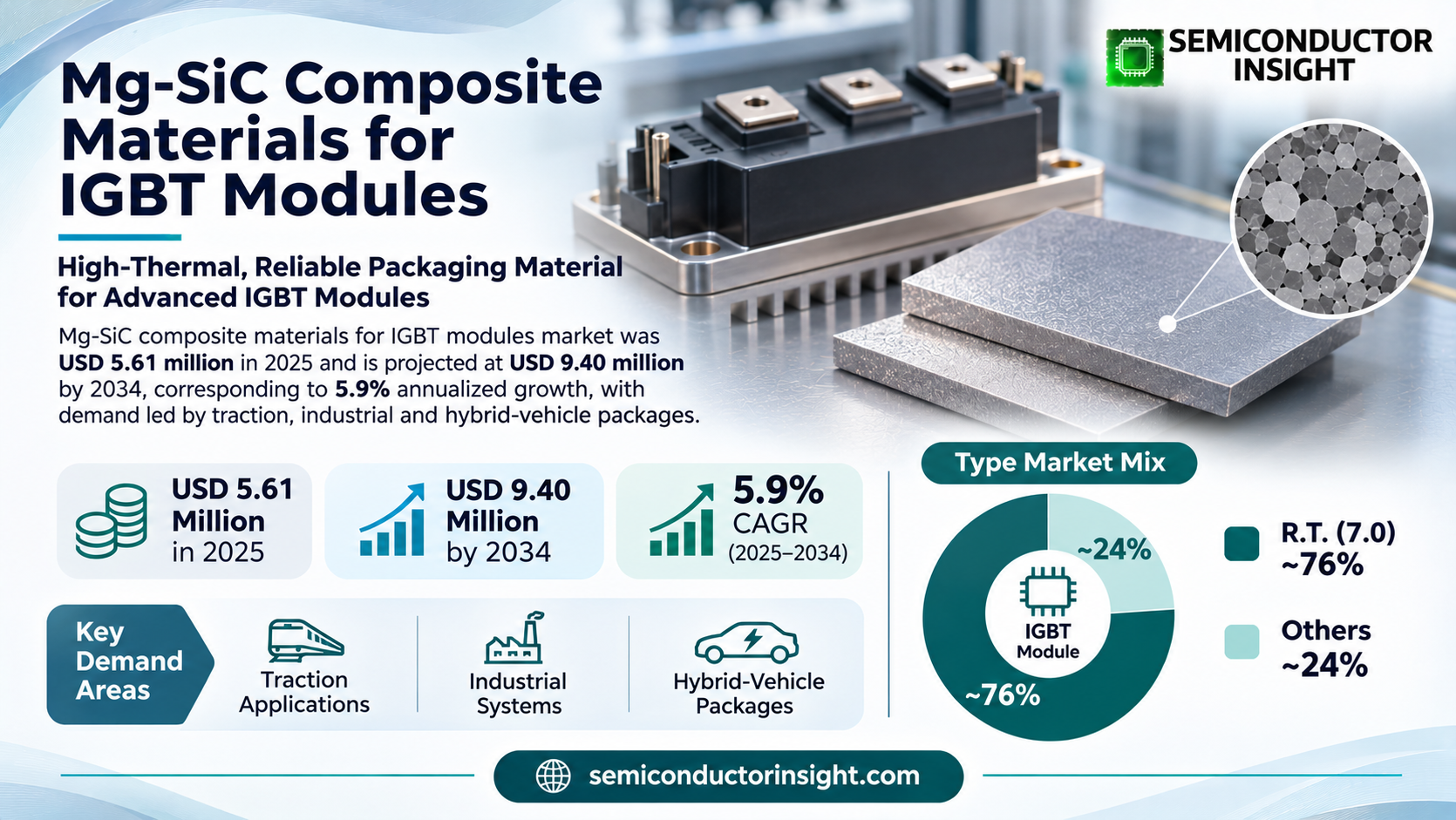
Mg-SiC composite materials for IGBT modules market was USD 5.61 million in 2025 and is projected at USD 9.40 million by 2034, corresponding to 5.9% annualized growth. Demand is led by traction, industrial and hybrid-vehicle packages that require an engineered heat-dissipation plate. A high-performance IGBT installation needs more than a thermally efficient bulk material: interface quality and structural reliability determine its useful lifetime.

Get the sample PDF with study scope, segmentation and methodology details.

Key Statistics

2025 Market Size
USD 5.61 million
2034 Projected Size
USD 9.40 million
CAGR (2026–2034)
5.9%
Largest Market in 2025
Asia-Pacific (~48%)

Key Takeaways

  • IGBT packaging, not the entire composite-material trade: The addressed Mg-SiC product stream is worth USD 5.61 million in 2025 and is expected to reach USD 9.40 million by 2034, with 5.9% annual compound growth. The commercial object is the specialized magnesium-silicon-carbide heat-dissipation material supplied for insulated-gate bipolar transistor modules. A converter assembled around the plate may be many times more valuable, but its chips, housings and control systems do not enter this narrow materials category.
  • Traction drives provide the clearest application reference: Electric Railway holds an estimated ~42% of application sales. A.L.M.T. documents MAGSIC heatspreaders for railway IGBT modules that drive powerful traction motors. Its thermal-management products are engineered for dimensional stability when equipment repeatedly heats and cools. Modules used in trains face unusually demanding maintenance expectations, which can make approved replacement plate specifications commercially significant over long service periods.
  • A defined thermal-expansion grade anchors purchasing: R.T. (7.0) is assigned an estimated ~76% Type share, reflecting the practical acceptance of low-expansion base plates with the manufacturer’s 7.0 ppm/K reference characteristic and 230 W/(m K) conductivity. The rest of the Type category, Others at ~24%, covers different specification choices. These are engineering grade descriptions, not warranties that every machined plate in a large rail assembly will exhibit identical test performance.
  • Factory geography differs from final train installation: Asia-Pacific leads the regional picture with an estimated ~48% of component value. Europe follows at ~21% and North America ~19%, while Middle East & Africa holds ~7% and South & Central America ~5%. Japan is important for specialized spreader manufacture, whereas China, Germany and other industrial regions generate demand through traction and factory equipment. Imported plate value is a much narrower measurement than the cost of rolling stock.
  • Competing package construction is the key risk: Infineon lists traction-class IGBT modules with an AlSiC base plate, and Semikron Danfoss describes baseplate-less module assemblies. Both are genuine alternatives to an Mg-SiC heatspreader in appropriate designs. For a supplier of magnesium-rich plates, the opportunity is to prove lower joint stress, manageable mass and long-life heat flow in a specific package; generic growth in IGBT shipments alone does not guarantee a material design win.

Mg-SiC Composite Materials for IGBT Modules Market Overview

Mg-SiC composite materials for IGBT modules market was USD 5.61 million in 2025 and is projected at USD 9.40 million by 2034, corresponding to 5.9% annualized growth. Demand is led by traction, industrial and hybrid-vehicle packages that require an engineered heat-dissipation plate. A high-performance IGBT installation needs more than a thermally efficient bulk material: interface quality and structural reliability determine its useful lifetime.

Base year: 2025 · Estimated year: 2026 · Forecast period: 2026–2034 · Historical period: 2020–2024 · Value basis: USD million

The revenue object is magnesium-silicon-carbide composite sold as a heatspreader or baseplate for IGBT power modules, including standard and tailored plate specifications represented by the source Type categories. The end-use boundary follows electric rail traction, industrial motor machinery and hybrid-electric automobiles. It excludes the semiconductor dies, gate-driver circuits, insulating ceramics when sold independently, full packaged IGBT modules, power-converter cabinets and locomotives. Structural Mg-SiC components that have no IGBT-package role belong outside this narrower product definition.

In a traction power stage, a flat composite plate conducts heat from the switching package toward a cooler and must tolerate repeated temperature excursions without stressing bonding interfaces. A.L.M.T. identifies a MAGSIC magnesium-infiltrated SiC preform design and reports standard properties near 230 W/(m K) thermal conductivity and 7.0 ppm/K expansion. The engineering attraction is an adjustable combination of heat transport and dimensional behavior rather than merely the lowest possible weight. A plate is qualified as part of a multi-material assembly.

The need for caution is visible in contemporary competing modules. Infineon specifies an AlSiC baseplate and aluminum-nitride substrate on its traction-rated FZ1600R33HE4, while another established package family achieves thermal contact without a baseplate through pressure. This means the designer has real architectural choices even before considering an expensive magnesium composite. The appropriate comparison concerns lifetime power cycling, contact pressure, production scrap, replaceability and customer maintenance expectations.

A manufacturing route can be commercially credible without a publicly disclosed annual quantity of finished plates. A.L.M.T. describes large-format production capability, but the number of acceptable surfaces after machining and testing depends on customer geometry. New technical work on magnesium-reinforced SiC broadens understanding of thermal interfaces without proving unit costs or contracted material volumes. Rail electrification, factory automation and vehicle electrification establish possible design opportunities; only a purchased Mg-SiC plate is part of this market.

Segment Analysis: By Type

The Type segmentation isolates the R.T. (7.0) reference material from customized or alternative compositions. R.T. (7.0) leads with an estimated ~76% value position because specified thermal expansion can guide module package design and has a recognizable commercial product example. Others makes up ~24%, addressing different dimensions, ceramic volume fractions and expansion requirements. The choice of grade affects both how a baseplate is made and whether it can be welded, brazed, mounted or otherwise joined with the rest of an IGBT stack.

Type Function Market position
R.T. (7.0) The standard designation is associated with a low expansion benchmark around 7.0 ppm/K between room and elevated temperature in A.L.M.T. literature, alongside reference heat conduction of 230 W/(m K). With an estimated ~76% share, it provides a common starting point for high-duty baseplate discussions. Manufacturers still need to specify thickness, surface metallization, flatness and the permitted temperature range. Thermal-fatigue evidence from the intended package, not a ceramic recipe label, supports final acceptance. Operators that rely on longstanding traction equipment care about the ability to reproduce an approved heat-dissipation plate after a service interval. An established low-expansion grade helps the engineering team compare multiple builds without reopening every property decision. However, even a nominally equivalent plate may introduce bending when mounting-hole placement changes. Buyer specifications therefore attach dimensional records and qualification procedures to the material order itself.
Others This group contains an estimated ~24% of specialized IGBT-plate demand and may include altered Mg-to-SiC compositions or customer-specified geometries that do not follow the nominal 7.0 reference grade. Different coefficient targets can be relevant when the package changes its isolation substrate or bonding layer. A supplier can only confirm performance after fabricating and testing actual representative parts. Small-batch demand can incur a premium for separate handling and inspection arrangements. Nonstandard components often arise during retrofit or platform redevelopment when an inverter enclosure cannot be altered easily. They offer a route for material makers to sell engineering support together with finished spreaders, but make repeat orders less predictable. Qualification of a tailored recipe must cover metal-ceramic interface quality, thermal cycling, coating integrity and repair logistics. The customer may instead select a standard AlSiC or copper assembly if the new design becomes difficult to maintain.

Segment Analysis: By Application

Application demand follows three defined classes: Electric Railway at an estimated ~42%, Industrial Machinery at ~33% and Automotive (HEV) at ~25%. This split emphasizes high-power switching stacks for which an added thermal plate can have a measurable influence on package durability. Railway buyers are exposed to long installed lifetimes, plant-automation customers emphasize productive uptime, and hybrid-electric vehicle programs balance compactness with strict unit-cost targets. Engineering suitability differs even when all three use IGBT-based conversion.

Application Demand characteristics
Electric Railway Train traction drives must convert high-power electrical energy into controlled motor current, generating heat in semiconductor switches during service cycles. The baseplate beneath an IGBT module is one part of the thermal path and must remain compatible with the fastening and insulation scheme. A.L.M.T. publicly names railway IGBT heatspreaders as a MAGSIC use. An estimated ~42% of market value is associated with this application, with sales typically linked to qualified original equipment and spare programs.
Industrial Machinery Industrial robots, manufacturing lines and large servo systems depend on high-availability motor drives. Their power modules operate under varied load profiles, so thermal fatigue can be influenced by cycling frequency rather than peak temperature alone. Mg-SiC plates may be specified for a tightly constrained converter design, although many drives retain copper-based or baseplate-less solutions. The industrial application comprises an estimated ~33%, reflecting multiple machinery sectors without assuming that all inverters contain this composite.
Automotive (HEV) Hybrid electric vehicles use power electronics to manage propulsion assistance, regeneration and other high-current functions in limited packaging space. An engineered Mg-SiC spreader could support a thermal module when lower expansion or mass provides a system-level advantage. The estimated ~25% share remains constrained by automotive cost targets, vibration tests and supply-chain stability requirements. Infineon documents alternative direct-cooled IGBT module baseplate configurations, illustrating that vehicle electrification need not produce one uniform material choice.

An equipment manufacturer can purchase identical semiconductor chip technology inside several thermal architectures. Rail modules prioritize maintainability and thermal cycling over years of repeated use, factory drives often require predictable repair downtime, and automotive power stages face far more aggressive platform pricing. Whether a magnesium-rich plate succeeds therefore depends on the specified mounting scheme, expected acceleration of temperature transitions and the ability to support the package once the original product release has passed.
Mg-SiC Composite Materials for IGBT Modules Size

Regional Analysis

The regional allocation reflects where qualified traction and industrial IGBT packages are bought or integrated. Asia-Pacific represents an estimated ~48% of 2025 material value, Europe ~21%, North America ~19%, Middle East & Africa ~7%, and South & Central America ~5%. Rail operators, inverter brands and material factories sit in different locations, and a component may enter several supply contracts before a final equipment installation is completed.

Where will low-expansion heatspreader plates enter IGBT procurement programs?

Heatspreader demand is driven more by the semiconductor package bill of materials than by the country where a train or motor happens to be operating. Japanese manufacturing knowledge supports Asian availability, but European rail-engineering companies and North American industrial suppliers can establish their own thermal specifications. Material sourcing follows the approved plate drawing and vendor qualification. In regions with limited local fabrication, replacement assemblies arrive through international distributors rather than as independently purchased magnesium-rich preforms.

Region Position Growth outlook Demand profile What decides supplier selection
Asia-Pacific Estimated ~48% share Indicative ~6.7% CAGR Rail traction supply and module manufacturing Batch consistency; thermal cycling records
Europe Estimated ~21% share Indicative ~5.4% CAGR High-speed rail engineering and industrial automation Approved service life and package compatibility
North America Estimated ~19% share Indicative ~5.2% CAGR Factory drives and transit fleet maintenance Supplier lifecycle and mounting tolerances
Middle East & Africa Estimated ~7% share Indicative ~4.9% CAGR Rail electrification and industrial imported systems Harsh-environment validation and authorized spares
South & Central America Estimated ~5% share Indicative ~4.5% CAGR Heavy-duty drives, urban rail and power infrastructure Delivery logistics, exact replacement geometry

Asia-Pacific ESTIMATED · ~48% SHARE · 2025

Why are Asian IGBT supply chains important for specialized plates?

Asia-Pacific controls an estimated ~48% of demand and has an indicative ~6.7% CAGR across the planning horizon. Japan is the clearest origin of published magnesium-SiC heatspreader product specifications, while China and South Korea host major users of power conversion. The opportunity is reinforced by traction electrification and industrial power electronics, but the extent of actual Mg-SiC adoption cannot be inferred from vehicle output. For 2026–2034, repeatability of approved package materials remains central to procurement.

Market position~48% share
Growth outlookIndicative ~6.7% CAGR
Demand profileJapan materials; China rail; Korea vehicles
Market access gateLot traceability and heat-cycle flatness
Country Position in region What drives demand
Japan Specialist IGBT spreader fabrication Japanese engineers work with dedicated heat-dissipation materials for traction power modules. A.L.M.T. presents magnesium-infiltrated SiC as a possible large-format plate, and buyers can request measurements on the machined component. The important commercial milestone is approval within an insulated power stack, not merely fabrication of an ingot. Across 2026–2034, new traction-platform designs can generate component opportunities while legacy platforms demand compatible replacements.
China Rail traction and converter assembly China has extensive railway power-electronics assembly and equipment maintenance activities that could use premium thermal structures. The decision to adopt Mg-SiC is made at module and original-equipment level, where thermal resistance, solder fatigue and material cost are evaluated together. A part delivered from abroad may be assembled locally. The 2026–2034 procurement window will therefore depend on the power package generations selected for both new and existing rail programs.
South Korea HEV module quality engineering South Korean automotive suppliers assess different ways of moving heat from vehicle power semiconductors into a compact cooling package. A Mg-SiC plate is one possible element, although direct-cooled aluminum and copper designs can meet many needs. Product teams must perform vibration and thermal-cycle validation before awarding orders. Between 2026 and 2034, purchasing will follow named platform approvals rather than total volumes of cars manufactured in the country.

Market instances

  • A Japanese module maker changes its thermal stack. A design group compares a large low-expansion magnesium composite plate with its prior baseplate during power cycling of an IGBT assembly. It checks bowing, attachment condition and cooler contact after multiple tests. An initial 230 W/(m K) bulk conductivity claim cannot substitute for these measurements. A 2026–2034 supply plan would become commercial only when the approved drawing and production process are both locked.
  • A Chinese traction buyer specifies replacement parts. A train maintenance contractor asks the approved module maker for a replacement plate that matches the existing traction converter. The supplier must show dimension and material compatibility rather than offer a raw composite piece in isolation. Servicing the fleet through 2034 makes production continuity valuable, but component costs remain only a small fraction of a complete rail maintenance program starting in 2026.
  • A Korean HEV prototype meets cooling limits. The vehicle engineering team measures the baseplate beneath a high-current IGBT power stage while checking hot spots and mounting stresses. Engineers may reject a magnesium-SiC candidate if a simpler cooling arrangement meets their warranty targets. A material that survives a 2026 trial still needs volume-process approval for later model years through 2034. Vehicle battery size and drivetrain sales figures do not describe the plate order.
In the full report: Japan, China, South Korea, India, Taiwan and other Asian IGBT package and traction equipment markets.

Europe ESTIMATED · ~21% SHARE · 2025

How do rail procurement standards shape European plate requirements?

An estimated ~21% of 2025 IGBT-plate material sales are associated with Europe, with indicative ~5.4% annual expansion. Train makers and power-electronics firms frequently require documented lifetime performance, long spare availability and controlled component change processes. The thermal package may already specify AlSiC, copper or a pressure-contact architecture, creating a demanding approval threshold for Mg-SiC. Between 2026 and 2034, the most credible orders will arise from designs that explicitly need lower expansion without sacrificing heat flow.

Market position~21% share
Growth outlookIndicative ~5.4% CAGR
Demand profileGermany and France traction; Italy automation
Market access gateLifetime evidence and converter redesign cost
Country Position in region What drives demand
Germany Rail power modules and drive design German industrial engineering includes manufacturers and integrators of high-voltage motor drives for trains and machinery. Infineon specifies traction modules using AlSiC baseplates, proving that alternative package choices are already commercial. A magnesium-SiC supplier must establish a reliability or mass advantage in the same mechanical footprint. Through 2026–2034, each new contract depends on a converter design authorization and an accepted component supplier, not on composite terminology alone.
France Electrical traction and rail fleet support French rolling-stock engineering relies on rugged high-power switches that perform over extensive service intervals. A specialty spreader might be attractive when it reduces joint stress near the switching devices, yet compatibility with existing isolation ceramics is critical. Field-service technicians cannot simply substitute a chemically similar plate after a failure. The 2026–2034 replacement outlook favors precisely specified thermal parts delivered through the original module maker.
Italy Machine-tool and industrial inverter production Italian industrial equipment makers select power modules for rotating machinery, robotics and process-control facilities. A customer may seek a lower-deformation composite under a large IGBT die, but total drive cost and thermal interface quality remain decisive. Engineering teams test a proposed plate against conventional metals under identical fixtures. During 2026–2034, specialized purchasing is likely to follow the timing of motor-controller platform refreshes rather than factory construction headlines.

Market instances

  • A German traction firm qualifies against an AlSiC baseline. The test department puts two otherwise similar IGBT stacks through temperature cycling and examines fatigue at the bond between baseplate and substrate. A magnesium-rich alternative gains attention only if the resulting lifetime and assembly process justify its cost. An established AlSiC design offers a strong reference. Performance evidence accumulated in 2026 can influence procurement through 2034, but a later plate substitution may require a complete new acceptance campaign.
  • A French fleet engineer manages original-part specifications. A transit authority plans maintenance on traction converters and requests information from its certified component suppliers. Even when a magnesium-SiC plate is technically attractive, the operator cannot change the material without verifying thermal-mechanical compatibility. Over the 2026–2034 operating period, a reliable source of exactly matching replacement parts can be more valuable than a modest laboratory improvement. Vehicle service contracts remain separate from material purchases.
  • An Italian drive supplier evaluates finishing yield. A converter manufacturer receives a prototype heatspreader with excellent thermal measurements but finds that its mounting surface requires extra grinding. The production team compares the scrap and tooling consequences of this change with the expected reduction in package stress. A small 2026 engineering run can inform a 2034 platform plan, yet commercial use requires repeatable finishing and a supplier willing to support the drawing.
In the full report: Germany, France, Italy, United Kingdom, Spain and other European rail and machinery centers.

North America ESTIMATED · ~19% SHARE · 2025

What is the role of North American industrial IGBT customers?

North America is assigned an estimated ~19% share with indicative ~5.2% CAGR. Production equipment, transit fleets and specialized power-conversion assemblies generate demanding thermal service situations, but many regional purchases occur through integrated module imports. The plate market is affected by the customer’s selected module architecture and authorized spare channels. From 2026 through 2034, quality documentation and warranty obligations are likely to drive decisions more strongly than the nominal weight saving of the composite.

Market position~19% share
Growth outlookIndicative ~5.2% CAGR
Demand profileUS drives; Canada transit; Mexico vehicle supply
Market access gateMechanical interface quality and approved sourcing
Country Position in region What drives demand
United States Industrial converter system design US businesses design high-current switching stages for automated plants, grid support and transport equipment. The same IGBT rating may be offered in packages with different baseplate construction, so a material supplier must address the specific assembly and cooler interface. A customer usually requires thermal impedance and power-cycle documentation before approving a new plate material. For 2026–2034, adoption depends on accepted module drawings and controlled production changes.
Canada Rail equipment reliability and maintenance Canadian transportation operators use power-conversion equipment exposed to variable ambient conditions and extended replacement schedules. A heat-dissipation substrate must maintain fastening and contact integrity despite repeated changes in load. Buyers may not see the Mg-SiC component separately if it comes inside a certified replacement module. The 2026–2034 outlook therefore includes smaller, episodic material orders aligned with overhaul needs rather than smooth growth from track kilometers.
Mexico Automotive electronics assembly channels Mexican manufacturing plants participate in North American vehicle and electrical-equipment supply chains. Components are frequently purchased according to engineering specifications established at multinational product centers. An Mg-SiC IGBT plate can be present in a qualified imported module without local composite processing. Between 2026 and 2034, bill-of-material control, inspections and delivery lead time will shape demand more directly than the growth of total vehicle assembly output.

Market instances

  • A US energy-equipment vendor checks package stress. After changing a cooling system, engineers monitor baseplate temperatures and inspect IGBT attachment integrity under repeated load changes. The team compares thermal and mechanical outcomes for different candidate materials without presuming one will outperform all others. A 2026 qualification could permit components to enter later service programs through 2034. The material order is limited to accepted baseplate products, irrespective of the value of the finished inverter.
  • A Canadian rail maintainer requests a certified spare. The maintenance shop identifies a thermal base component within a traction module and consults its original equipment catalog. A substitute plate has to reproduce attachment dimensions and expansion behavior as well as heat removal. For a train expected to remain active between 2026 and 2034, a dependable approved part can prevent a lengthy outage. The supplier cannot infer new material demand from the overall fleet size without the component design details.
  • A Mexican assembly line investigates component variation. Quality technicians test incoming high-power modules and discover small mechanical differences in the cooler contact areas. They ask the foreign baseplate supplier for flatness tolerances, cycle results and lot identification. In 2026–2034, an approved material source may be favored because changes cause rework and delays. The purchase price of an integrated automotive drivetrain remains beyond the value of the specialty magnesium-SiC input.
In the full report: United States, Canada, Mexico and nearby North American industrial power markets.

Middle East & Africa ESTIMATED · ~7% SHARE · 2025

Why is Middle Eastern and African Mg-SiC consumption mainly indirect?

Middle East & Africa receives an estimated ~7% of 2025 demand and an indicative ~4.9% CAGR. Converter packages are frequently procured within imported transit, energy or heavy-machinery systems rather than from a local metal-matrix plant. Elevated operating temperatures heighten attention to heat transfer, while sand, humidity and service access affect broader equipment reliability. During 2026–2034, customers will usually rely on vendor-approved modules and documented spare access rather than specifying raw composite chemistry directly.

Market position~7% share
Growth outlookIndicative ~4.9% CAGR
Demand profileGulf infrastructure; Africa industrial service
Market access gateAuthorized imports and environmental validation
Country Position in region What drives demand
United Arab Emirates Urban transit and power equipment Major transport and building infrastructure projects in the United Arab Emirates use sophisticated conversion hardware assembled through international supply chains. If an IGBT manufacturer uses Mg-SiC below its devices, a local operator would generally buy the approved replacement module rather than individual composite blanks. Maintenance contractors request operating-temperature limits and supplier continuity. For 2026–2034, accessibility of replacement stock is likely to be the dominant procurement consideration.
Saudi Arabia Industrial drives and railway investment Saudi Arabian projects involve large motors, rail equipment and electrical power systems that can carry high-current switching modules. A magnesium-SiC thermal component may enter through a qualified supplier’s equipment package where the application calls for low bowing after cycling. The local installer must manage service logistics and harsh conditions. Between 2026 and 2034, capital projects form possible demand channels but do not themselves reveal component-material volumes.
South Africa Mining machinery and traction refurbishment South African heavy-industry workshops repair inverter-based drives and rail propulsion equipment under demanding duty cycles. The engineering team needs a plate that matches the original power module’s cooling and mounting requirements, not simply a promising bulk conductivity figure. Imported parts can lengthen repair times when the material is uncommon. Through 2026–2034, spare-part authorization and operating cost determine the feasibility of Mg-SiC substitution.

Market instances

  • A UAE rail supplier validates hot-weather module operation. The supplier reviews the temperature margin of an imported inverter package for an urban transport installation. Engineers assess heat-sink performance, plate alignment and environmental sealing as a single system. An Mg-SiC material claim might enter the comparison only after confirmation from the original package manufacturer. Service plans from 2026 to 2034 value long-term spare availability, while station construction cost has no place in the materials revenue figure.
  • A Saudi plant examines the warranty risk of a replacement. A large industrial motor drive has reached a scheduled maintenance point, prompting a review of its power-stage thermal components. The owner requests exact replacement construction and documented high-temperature operation before authorizing a new baseplate grade. Over 2026–2034, a qualified component could be stocked for urgent repairs. Generic infrastructure expansion is insufficient proof of actual magnesium-SiC plate shipments.
  • A South African mine chooses between module repairs. A field engineer finds a failed IGBT power assembly in a motor controller and considers ordering a newer module. One proposed replacement incorporates an alternative cooling architecture; another retains a composite baseplate. The team weighs lead time and the cost of reconfiguring the enclosure. The 2026–2034 procurement decision concerns a tested part within the installation, not a stand-alone sale of silicon carbide powder.
In the full report: United Arab Emirates, Saudi Arabia, South Africa, Egypt and other regional power-equipment markets.

South & Central America ESTIMATED · ~5% SHARE · 2025

How can Latin American industrial installations purchase the material?

South & Central America contributes an estimated ~5% of global IGBT-specific Mg-SiC value and shows indicative ~4.5% CAGR. Industrial electrical drives and urban transport projects are plausible buyers, usually through overseas module makers or distributors. Specialty plate sourcing is constrained by approved designs, freight expense and supplier support. From 2026 through 2034, market progress is likely to appear in small qualified order programs rather than a large standalone composite manufacturing sector.

Market position~5% share
Growth outlookIndicative ~4.5% CAGR
Demand profileBrazil production; Chile mining; Argentina repairs
Market access gateInterchangeability and importer continuity
Country Position in region What drives demand
Brazil Industrial electrical drives and transit Brazilian equipment factories and rail operators use sophisticated power switches in machinery and transport. The use of an Mg-SiC baseplate depends on a particular module supplier, as a conventional copper or AlSiC platform may already be qualified. Procurement prioritizes warranty responsibility and available replacements. For 2026–2034, targeted module upgrades can create niche component orders, while the total national investment in electric motors measures something broader.
Chile Mining converters and remote maintenance Chilean industrial sites operate drives that can be expensive to repair when power semiconductors fail. Improved thermal mechanical design can reduce some reliability risks, but a ceramic-reinforced magnesium plate must be assessed with the insulation and cooling system. Local distributors may lack the exact geometry in stock. Between 2026 and 2034, converter overhaul schedules and reliable import channels are more informative than the tonnage of minerals produced.
Argentina Installed equipment maintenance networks Argentine electrical maintenance companies service industrial inverters from multiple overseas product generations. A replacement IGBT package can use a different thermal plate technology than its predecessor, requiring careful enclosure and coolant-interface checks. For 2026–2034, the market opportunity is limited to those designs which already call for or successfully qualify Mg-SiC. Currency costs and supplier lifecycle support may delay substitution even when a laboratory sample performs well.

Market instances

  • A Brazilian transit workshop obtains an exact baseplate drawing. To repair an out-of-service traction converter, a workshop asks the authorized component manufacturer for the correct thermal interface specification. An Mg-SiC alternative is reviewed but cannot be installed solely because its conductivity is attractive. A design change during 2026–2034 requires checks on insulation, torque and heat cycling. The resulting specialty plate purchase is separate from the transport operator’s full maintenance expenditure.
  • A Chilean industrial drive integrator compares failure modes. The integrator models temperature differences across an IGBT assembly and examines whether baseplate deformation has contributed to solder damage. The proposal includes a specialty metal-ceramic option, but the supplier must demonstrate that it fits the required fixtures. Over 2026–2034, replacement reliability may matter more than a small mass reduction. Mining power-system upgrades remain external demand context rather than counted materials sales.
  • An Argentine importer reviews shelf and service life. The importer receives an inquiry for an unusual heat-dissipation plate and checks the original manufacturer code before quoting a new part. A customer may accept a longer delivery only with traceable composition and factory-backed quality assurance. A 2026–2034 support agreement can help a small fleet retain access to compatible modules. The IGBT chip itself and its surrounding power supply are priced separately from the plate.
In the full report: Brazil, Chile, Argentina, Colombia, Peru and neighboring South and Central American countries.

Key Mg-SiC Composite Materials for IGBT Modules Manufacturers and Competitive Landscape

Direct magnesium-SiC heatspreader supply is highly specialized. A.L.M.T. Corp. has a documented product for power modules; the Sumitomo Electric group identifies corresponding heat-management properties. Other companies, including makers of aluminum-silicon-carbide plates, copper thermal structures and baseplate-less packages, compete at the specification level without necessarily manufacturing this exact magnesium composite. Infineon and Semikron Danfoss demonstrate the diversity of IGBT packaging choices, but their finished modules are downstream products rather than sales of the named material.

A.L.M.T. combines preform manufacture, infiltration and machining to create thermal parts marketed for rail propulsion and industrial controls. Its engineering argument highlights the pairing of heat conduction with reduced deformation under thermal cycling, and its standard grade is offered as a reference for configurable expansion. A power module maker still determines whether that plate can be integrated into a particular housing. The route to revenue is an approved module bill of materials with reproducible component supply, not a generic association with all IGBT production. A supplier qualification begun in 2026 may need drawing-control provisions covering replacement parts through 2034.

The wider competitor set illustrates a different constraint. Infineon publishes traction module products using AlSiC baseplates, while Semikron Danfoss has a pressure-contact design that dispenses with the conventional soldered baseplate. Mitsubishi Electric announced new 4.5 kV rail and industrial HVIGBT modules in December 2025, without establishing use of Mg-SiC in them. These facts show a demanding thermal packaging market with several accepted solutions. Direct Mg-SiC supplier market shares cannot be inferred from the semiconductor vendors’ module catalogs.

A.L.M.T. holds the clearest named commercial reference in this specific material family, whereas thermal ceramics, engineered metal plates and cooler designers affect competitive pricing indirectly. Buyers may evaluate composite preforms, plated spreaders and preassembled module parts at different procurement stages. The qualification responsibility can reside with a rail equipment firm or with the module manufacturer itself. For this reason, claimed competitive reach should distinguish a qualified plate shipment from a research patent or an unconnected material-processing capability.

Tier structure

Tier Companies Basis of competition
Specialist Mg-SiC supply A.L.M.T. Corp. / Sumitomo Electric Documented MAGSIC thermal plate and custom expansion engineering
Packaging alternatives Infineon and other AlSiC module vendors Traction package architectures that use different baseplate substrates
Architectural substitutes Semikron Danfoss and associated cooler suppliers Pressure-contact and baseplate-free thermal interface strategies

Key companies profiled

  • A.L.M.T. Corp. (Sumitomo Electric group)
  • Infineon Technologies (alternative traction packages)
  • Semikron Danfoss (alternative pressure-contact packages)
  • Mitsubishi Electric (downstream IGBT equipment context)

Mg-SiC Composite Materials for IGBT Modules Production Capacity Analysis

Manufacturing capacity for Mg-SiC IGBT baseplates is controlled by ceramic-preform handling, metal infiltration and subsequent precision finishing. Public catalog material confirms that large plates can be made at industrial scale, yet does not disclose a verified annual output measured as pieces or kilograms for this subset. Real capacity is the number of dimensionally acceptable plates delivered to an approved package maker, not the theoretical mass of metal that can be heated. Each customer drawing can create a separate operational bottleneck.

A SiC network is prepared to accept molten magnesium, after which the composite is cooled and processed into the required baseplate geometry. Engineers must avoid incomplete infiltration, unwanted reactions and distortion that can become more visible on large contact surfaces. Before shipment, the plate may undergo controlled grinding, inspection, coating and mounting-hole machining. The tight tolerances of an IGBT substrate stack mean that a production line with ample raw-material throughput may still be constrained by finished-surface measurement and accepted-lot yield.

Demand for traction components can be episodic because locomotive programs and inverter platform changes are scheduled over long periods. A supplier may keep special tooling available for small replacement batches rather than continuously producing an identical plate. Qualification results for a particular 130 mm package cannot automatically be transferred to another dimension or insulating substrate. More compact semiconductor assemblies can also reduce the area of a required plate, creating a tension between higher device power and material usage per module. For a 2026 preproduction project, an equipment maker may require guaranteed replacement compatibility after 2034.

Future process improvements could lower scrap, yet a newer formulation must still be tested for mechanical strain in the complete package. An experimental 2026 Mg/SiC particulate study reported different expansion and conductivity from the standard thermal plate reference, demonstrating why material recipes matter. Any claim of large-scale output needs confirmation from production disclosures or customer supply records. In the absence of these, descriptions of available processes are more defensible than invented manufacturing-capacity numbers.

Mg-SiC Composite Materials for IGBT Modules Market Dynamics: Drivers, Restraints and Opportunities

The IGBT-specific composite market grows when a customer has a durable reason to adopt low-expansion thermal plates within a certified traction or industrial package. Higher switching power and more demanding operating cycles support interest, while mature AlSiC, Cu-Mo and pressure-contact alternatives restrain penetration. The impact table expresses the contributions of these pressures in percentage points against the annual headline growth path. None of the downstream module revenue is imported into this materials calculation.

MARKET DRIVERS

Drivers Impact Analysis*

Market Drivers Impact Rank CAGR Contribution (%) 2026–2028 2029–2031 2032–2034
Thermal reliability needs of high-voltage traction IGBTs High +3.00% High High High
Industrial drive upgrades and motor automation Medium-High +2.20% High High Medium
Hybrid vehicle compact power-stage demands Medium +1.70% Medium High High
Improved preform and baseplate process economics Low-Medium +1.30% Low Medium High
Others (service parts and packaging design upgrades) Low +0.70% Low Medium Medium

Traction semiconductor packaging values dimensional control

Electric railway IGBT modules endure repeated current changes, thermal excursions and demanding service conditions. A material that distributes heat while holding a predictable shape can reduce a source of mechanical mismatch within the package. Manufacturer literature for MAGSIC directly associates the design with traction use, offering a documented reference rather than a speculative sector link. Final adoption requires module-level strain and thermal tests because conductivity measured in the composite alone cannot predict package lifetime.

Modernized industrial drives need reliable conversion stages

Large industrial motors and automation equipment are being updated for efficiency, control precision and reduced downtime. Their IGBT modules convert energy in a tightly coupled thermal environment, where package damage can interrupt valuable production. An alternative baseplate can earn a place when the design group identifies a clear failure-mode improvement. In 2026–2034, qualification of specific controller families is a more reliable business trigger than broad spending announcements about smart factories.

Hybrid vehicle propulsion creates demanding thermal design tasks

A hybrid-electric vehicle must fit power stages into a compact assembly while managing repeated acceleration and regeneration. A low-expansion spreader could help one package arrangement, but vehicle makers also use direct liquid cooling and conventional metal bases. Infineon documents 150°C junction operation and varied baseplate shapes in automotive IGBT packaging. That technical diversity means that increasing HEV sales create candidate opportunities, not a fixed percentage conversion to magnesium-SiC consumption.

MARKET RESTRAINTS

Restraints Impact Analysis*

Market Restraints Impact Rank CAGR Contribution (%) 2026–2028 2029–2031 2032–2034
Alternative baseplates and baseplate-free architectures High -1.30% High High High
Cost of thermal cycling qualification and finishing Medium-High -0.90% High Medium Medium
High concentration of proven direct Mg-SiC suppliers Medium -0.50% Medium Medium Low
Others (cooler compatibility and service complexity) Low -0.30% Low Low Medium
*CAGR contribution shows the percentage points each factor adds to or removes from the forecast CAGR for 2026–2034; driver contributions less restraint contributions equal the market CAGR. Period columns rate the strength of each factor in that window.

Existing traction products use competitive materials

Infineon identifies an AlSiC baseplate in a 3,300 V, 1,600 A traction IGBT module, and Semikron Danfoss describes a module family without a traditional baseplate. Both approaches illustrate that Mg-SiC is an optional design path rather than an essential ingredient. A buyer changing a qualified component bears testing and service costs, so an incremental material benefit must be substantial enough to justify extensive package redesign.

Reliable plates require expensive final acceptance

The spreader is located at a critical thermal and mechanical interface. Defects in flatness, plating, porosity or fastening dimensions may not become evident until a module fails cycling tests. Such risks increase inspection effort and can raise the rejected share of small customer batches. Even where the base material offers excellent bulk properties, finishing and package validation can reduce the economic return from switching away from a familiar production process.

Parts supply must match long equipment lives

A rail operator may expect replacement power modules many years after the original platform launch. Specialist composite supplies require documented recipes and tooling retention to satisfy that obligation. If the supplier cannot guarantee the required configuration, the equipment maker may prefer a conventional plate with a broader sourcing base. Long-life support can therefore slow adoption even when an evaluation sample shows favorable thermal behavior.

MARKET OPPORTUNITIES

Higher-density traction power packages

New rail power converters can operate within constrained envelopes, giving system designers reason to reconsider the mass and thermal expansion of a large baseplate. A composite supplier could gain additional programs by demonstrating robust performance under repeated thermal loads. The opportunity is most credible when developed jointly with an IGBT module manufacturer. A rail-network expansion statistic does not itself prove that a different heatspreader has passed the necessary component approval.

Better heat-cycle evidence for configured plate geometries

Material makers can build a stronger technical offering by publishing package-relevant results for different plate sizes, mounting schemes and temperature ranges. A standard 7.0 ppm/K product characteristic helps begin the discussion, but acceptance depends on measured behavior after actual assembly cycling. Reducing the time spent in requalification can improve commercial economics for a niche material with long contract intervals. More comprehensive evidence may also help address industrial motor-drive designs beyond rail.

Replacement parts for equipment already qualified

A thermal plate accepted years earlier can generate recurring aftermarket orders as high-power modules are repaired. This opportunity requires production continuity rather than a new market-wide breakthrough. The supplier must retain drawings, metallization standards and process documents for the approved baseplate. While a finished replacement module includes semiconductor die and electrical connectors, the relevant transaction in this market remains the magnesium-SiC heatspreader material embodied in it.

Mg-SiC Composite Materials for IGBT Modules Supply Chain Analysis

An IGBT thermal baseplate connects specialist composite fabrication with established semiconductor packaging and heavy-equipment maintenance networks. The chain begins with controlled SiC ceramic bodies and magnesium feedstock, continues through metallurgical infiltration and flatness-sensitive finishing, and ends inside a qualified module. The module can then be sold to a traction drive maker or hybrid-vehicle supplier. Since switching companies must accept the entire package design, sourcing decisions are often made several steps downstream from the material producer. From 2026 to 2034, component traceability can matter more than an unverified claim about raw-material abundance.

Ceramic and magnesium inputsControlled silicon-carbide powder, magnesium charge, preform tooling and protective processing media.
Thermal composite manufactureCeramic filling, infiltration, process control, blank inspection and graded baseplate fabrication.
IGBT package integrationMachined and plated spreader, insulating substrate, semiconductor die, bonding and cooler contact.
Qualified equipment deliveryRail propulsion drives, industrial motor systems, hybrid vehicles and lifetime replacement programs.

Incoming process materials. A plate producer needs ceramic powder and metal chemistry that reproduce the expected microstructure and infiltration behavior. Variations in ceramic packing can alter porosity or local metal distribution after processing. Incoming checks therefore focus on characteristics that affect finished surface stability instead of treating the ingredients as unrestricted commodity inputs. A supply chain with two acceptable raw-material sources may still need a controlled recipe because alternate powders behave differently during casting.

Precision fabrication. The composite blank is formed before its final thermal interface dimensions can be established. Controlled removal of material creates a planar mounting face and any bolt holes required by the power module. Surface treatment must also be compatible with the attachment system and operating environment. Tight mechanical tolerances increase the importance of machining capability, and rejected plates from late-stage inspection can raise cost even if the infiltration stage had acceptable bulk yield.

Semiconductor assembly. The module maker stacks semiconductor switching chips, insulating components and heat-transfer elements around the baseplate. An otherwise excellent magnesium-SiC part may fail if its geometry causes uneven clamping or its coating does not bond reliably. Power-cycle testing provides evidence about the assembled stack rather than just one material. Competing semiconductor packages can choose AlSiC or pressure-contact cooling, so materials procurement must follow the selected assembly design and its authorized change process.

Long-service equipment procurement. Rail and industrial customers obtain an approved power stage through a converter or machinery supplier, then seek compatible spares throughout the life of the equipment. Replacement orders may be small and require exact dimensional reproduction. A magnesium-SiC producer can benefit from such repeat demand when documentation and tooling are maintained. The total price of a rail traction inverter, however, also includes numerous items not measured by specialty composite material sales.

Recent Developments in the Mg-SiC Composite Materials for IGBT Modules Market

  • 2026-04-29 Patent
    A.L.M.T.-related European patent records show an April 2026 publication stage for a magnesium-based composite heat-dissipation substrate invention. The filings describe approaches involving magnesium and silicon carbide in semiconductor heat management. Patent publication is technical evidence of continuing engineering work, not confirmation of production capacity, the start of new factory output, or a measured change in IGBT module-material revenue. Source
  • 2026-04 Research
    A 2026 Journal of Magnesium and Alloys paper investigated an experimental SiC particle-reinforced magnesium composite and examined interfacial thermal transport. Its specific materials and measured properties differ from a finished commercial MAGSIC plate. The study adds process-relevant scientific evidence for designers of thermally conductive composite structures, but it is not a supplier announcement for rail-ready IGBT components. Source
  • 2026 Industry outlook
    Global EV Outlook 2026 describes the scale of electric vehicle demand following more than 20 million sales during 2025. HEV and plug-in vehicle power electronics may evaluate thermal solutions, but module construction is not uniform and many products bypass magnesium-SiC completely. This downstream indicator supports customer context and is deliberately separate from the revenue of heat-dissipation plates. Source
  • 2025-12-02 Module launch
    Mitsubishi Electric announced 4.5 kV and 1,200 A XB series high-voltage IGBT modules intended for railcars and large industrial equipment, with launch planned in December 2025. The news documents continuing demand for rugged switching assemblies and moisture-resistant packages. The announcement does not establish that the modules use magnesium-SiC, so it must be treated as a downstream competitive-development reference. Source
  • 2025-04-30 Patent disclosure
    A European patent publication assigned to A.L.M.T. describes a silicon-carbide-containing magnesium composite material and heat-dissipation substrate. This records a material-design pathway relevant to advanced semiconductor packaging. Intellectual-property activity is not proof of a new plant or incremental plate sales. Prospective buyers still need physical product qualification, pricing and a stable delivery schedule before changing a traction module. Source

REPORT SCOPE & SEGMENTATION

Attribute Details
Study Period 2020–2034
Base Year 2025
Estimated Year 2026
Forecast Period 2026–2034
Historical Period 2020–2024
Market Size 2025 USD 5.61 million
Market Size 2026 USD 5.94 million
Market Size 2034 USD 9.40 million
Growth Rate 5.9%
Unit USD million
Segmentation By Type, By Application and By Region
By Type R.T. (7.0) (an estimated ~76%); Others (an estimated ~24%)
By Application Electric Railway (an estimated ~42%); Industrial Machinery (an estimated ~33%); Automotive (HEV) (an estimated ~25%)
By Region Countries relevant to IGBT heat-dissipation component sourcing and qualified converter installation:
Asia-PacificJapan, China, South Korea, Taiwan, India and other countries
EuropeGermany, France, Italy, United Kingdom and additional European markets
North AmericaUnited States, Canada, Mexico and other countries
Middle East & AfricaUnited Arab Emirates, Saudi Arabia, South Africa, Egypt and others
South & Central AmericaBrazil, Chile, Argentina, Colombia and surrounding markets
Key Companies Profiled A.L.M.T. Corp. / Sumitomo Electric; Infineon Technologies (AlSiC competitor); Semikron Danfoss (baseplate-less alternative); Mitsubishi Electric (downstream IGBT maker)
Customization Scope Rail, industrial and hybrid-vehicle IGBT thermal plate application, thermal-expansion grade, supplier, plate process, package and country.

Frequently Asked Questions

How large is the IGBT-specific Mg-SiC heatspreader market?

The covered global product is valued at USD 5.61 million in 2025, has an estimated 2026 level of USD 5.94 million, and is projected to reach USD 9.40 million in 2034. That path corresponds to a 5.9% compound annual rate on the rebased horizon. The market includes appropriate composite baseplate material for IGBT assemblies, not the overall price of the semiconductor, housing, motor drive or vehicle.

Why would a traction module require a special thermal plate?

Switching losses create heat at the semiconductor die, while the surrounding ceramic and metallic elements expand differently during operation. A low-expansion, heat-conducting baseplate can reduce one source of mechanical strain and help distribute heat toward the cooler. The benefit must be measured with the actual attachment and package design. Some approved traction packages already use AlSiC, so Mg-SiC is an alternative choice rather than a universal industry requirement. A rail package qualified in 2026 can remain in service to 2034 only if its original thermal interfaces remain supportable.

What do the two specified material types represent?

The Type axis separates R.T. (7.0), with an estimated ~76% share, from Others at ~24%. R.T. (7.0) denotes a commercial thermal expansion grade associated with a 7.0 ppm/K reference. Alternative compositions or geometric requirements can call for different production controls. Both material variants must pass application-level reliability and dimensional tests before being included in an accepted IGBT module design. Design teams reviewing the 2026 catalog may specify another thermal grade for replacement assemblies planned through 2034.

Which application accounts for the greatest share?

Electric Railway leads the application mix at an estimated ~42%, because traction converter packages face high current, significant heat and demanding mechanical endurance. Industrial Machinery represents about ~33%, while Automotive (HEV) makes up ~25%. The categories describe who specifies the thermal component; a rail investment figure or a count of HEV powertrains cannot be treated as the materials producer’s sales volume. Converter tenders initiated in 2026 may reach physical deliveries in 2034 after a long development and certification cycle.

Where is the largest market for these IGBT plates?

Asia-Pacific has an estimated ~48% of component demand, supported by Japanese specialty-material expertise and extensive Asian power-conversion manufacturing. Europe follows with ~21%, reflecting rail technology and industrial drives, while North America has ~19%. The remaining value comes from smaller regions with imported installations and replacement programs. Regional market exposure is based on the component purchasing chain and is not proportional to total electric railway route length. A component designed in Japan during 2026 could ultimately be fitted to equipment maintained abroad through 2034.

What companies can document the specific technology?

A.L.M.T. publicly presents MAGSIC magnesium-infiltrated silicon-carbide heatspreaders for IGBT power modules, and Sumitomo Electric provides reference properties for the material. Several power semiconductor manufacturers publish products with different baseplate constructions, which serve as commercial substitutes but are not evidence that they sell Mg-SiC. A finished module producer should be distinguished from a specialist metal-matrix component maker. Buyers examining a product sheet in 2026 should request fresh supply confirmation for maintenance obligations extending to 2034.

What thermal properties make this product relevant?

The commercial benchmark combines a thermal conductivity around 230 W/(m K) with expansion around 7.0 ppm/K for the standard composition. This pairing is intended to improve heat spreading without causing unnecessary thermomechanical mismatch. Actual module outcomes also depend on size, surface finish, insulation and thermal interface materials. Designers need both steady-state resistance tests and repeated cycling data to verify the claimed advantage under the operating duty cycle. Laboratory performance measured in 2026 must be distinguished from installed-pack endurance after years of operation reaching 2034.

Are modules with no baseplate a direct substitute?

In some designs they are. Semikron Danfoss describes pressure-contact module architectures that avoid a traditional baseplate and its associated solder joint. These designs change the thermal path and mounting requirements, and therefore compete with a specialized heatspreader in the overall package decision. They do not represent sales of magnesium-silicon-carbide composite; their relevance is the potential to displace a customer requirement for such a plate. A baseplate-free architecture validated in 2026 can influence procurement decisions for multiple equipment revisions through 2034.

What manufacturing step is most difficult to control?

Getting a ceramic-rich preform uniformly infiltrated is necessary but not sufficient. A finished IGBT baseplate must then be machined and treated so its surface fits a very specific package geometry. Uneven contact can create local heating despite favorable bulk conductivity. Large-area dimensional repeatability, porosity control and process traceability are key sources of yield risk, particularly where acceptance tests are prolonged by rail-industry durability needs. A machining bottleneck identified in 2026 may limit finished-part deliveries well before wider adoption reaches its 2034 horizon.

How can adoption increase during the forecast period?

A material supplier can broaden acceptance by demonstrating reproducible performance across different plate sizes and by retaining certified tooling for aftermarket orders. Traction converters, factory drives and hybrid power modules each offer potential, but suppliers must address their different cost and reliability standards. Competition from established aluminum-silicon-carbide and copper structures remains strong, so a new approval will generally require a documented improvement in the full assembled thermal system. A supply agreement signed in 2026 does not establish that all potential customers will migrate to the material by 2034.

Research Sources & Evidence Base

View research sources used for this overview
  1. A.L.M.T.. MAGSIC for railway IGBT, infiltration and large-format plate specifications
  2. A.L.M.T.. Heatspreader technology, manufacturing process and thermal benchmarks
  3. A.L.M.T.. Thermal applications, power modules, rail traction and industrial machinery
  4. A.L.M.T.. Power device thermal plates, MAGSIC baseplate and contrasting buffer options
  5. Sumitomo Electric. Mg-SiC product range, group supplier material characteristics
  6. A.L.M.T.. MAGSIC technical data, dimension and heat-cycle design context
  7. A.L.M.T.. Thermal materials catalog, comparison among AlSiC, aluminum nitride and copper alloys
  8. A.L.M.T.. PCIM technical exhibit, historical confirmation of IGBT module applications
  9. Mitsubishi Electric. HVIGBT module announcement, December 2025 rail and industry module developments
  10. Infineon Technologies. FZ1600R33HE4 traction module, AlSiC alternative 3,300 V IGBT packaging example
  11. Infineon Technologies. High-current traction IGBT, alternative 2,400 A module package
  12. Semikron Danfoss. SKiiP pressure-contact modules, baseplate-less package alternative
  13. Infineon Technologies. HybridPACK IGBT architecture, automotive module and thermal baseplate alternatives
  14. International Energy Agency. Global EV Outlook 2026, vehicle demand context rather than material sales
  15. European Patent Office. Mg composite substrate patent, ALMT technical development and patent publication
  16. Journal of Magnesium and Alloys. Mg-SiC research experiment, experimental interface-property contrast
Mg-SiC Composite Materials for IGBT Modules Size, Share & Industry Analysis, By Type, and Regional Forecast, 2026–2034

Get Sample Report PDF for Exclusive Insights

Report Sample Includes

  • Table of Contents
  • List of Tables & Figures
  • Charts, Research Methodology, and more...

PDF Icon Download Sample Report PDF

Download Sample Report

Table of Content

Table of Contents
1 Research Methodology and Statistical Scope
1.1 Market Definition and Statistical Scope of Mg-SiC Composite Materials for IGBT Modules
1.2 Key Market Segments
1.2.1 Mg-SiC Composite Materials for IGBT Modules Segment by Type
1.2.2 Mg-SiC Composite Materials for IGBT Modules Segment by Application
1.3 Methodology & Sources of Information
1.3.1 Research Methodology
1.3.2 Research Process
1.3.3 Market Breakdown and Data Triangulation
1.3.4 Base Year
1.3.5 Report Assumptions & Caveats
2 Mg-SiC Composite Materials for IGBT Modules Market Overview
2.1 Global Market Overview
2.1.1 Global Mg-SiC Composite Materials for IGBT Modules Market Size (M USD) Estimates and Forecasts (2026-2034)
2.1.2 Global Mg-SiC Composite Materials for IGBT Modules Sales Estimates and Forecasts (2026-2034)
2.2 Market Segment Executive Summary
2.3 Global Market Size by Region
3 Mg-SiC Composite Materials for IGBT Modules Market Competitive Landscape
3.1 Global Mg-SiC Composite Materials for IGBT Modules Sales by Manufacturers (2019-2025)
3.2 Global Mg-SiC Composite Materials for IGBT Modules Revenue Market Share by Manufacturers (2019-2025)
3.3 Mg-SiC Composite Materials for IGBT Modules Market Share by Company Type (Tier 1, Tier 2, and Tier 3)
3.4 Global Mg-SiC Composite Materials for IGBT Modules Average Price by Manufacturers (2019-2025)
3.5 Manufacturers Mg-SiC Composite Materials for IGBT Modules Sales Sites, Area Served, Product Type
3.6 Mg-SiC Composite Materials for IGBT Modules Market Competitive Situation and Trends
3.6.1 Mg-SiC Composite Materials for IGBT Modules Market Concentration Rate
3.6.2 Global 5 and 10 Largest Mg-SiC Composite Materials for IGBT Modules Players Market Share by Revenue
3.6.3 Mergers & Acquisitions, Expansion
4 Mg-SiC Composite Materials for IGBT Modules Industry Chain Analysis
4.1 Mg-SiC Composite Materials for IGBT Modules Industry Chain Analysis
4.2 Market Overview of Key Raw Materials
4.3 Midstream Market Analysis
4.4 Downstream Customer Analysis
5 The Development and Dynamics of Mg-SiC Composite Materials for IGBT Modules Market
5.1 Key Development Trends
5.2 Driving Factors
5.3 Market Challenges
5.4 Market Restraints
5.5 Industry News
5.5.1 New Product Developments
5.5.2 Mergers & Acquisitions
5.5.3 Expansions
5.5.4 Collaboration/Supply Contracts
5.6 Industry Policies
6 Mg-SiC Composite Materials for IGBT Modules Market Segmentation by Type
6.1 Evaluation Matrix of Segment Market Development Potential (Type)
6.2 Global Mg-SiC Composite Materials for IGBT Modules Sales Market Share by Type (2019-2025)
6.3 Global Mg-SiC Composite Materials for IGBT Modules Market Size Market Share by Type (2019-2025)
6.4 Global Mg-SiC Composite Materials for IGBT Modules Price by Type (2019-2025)
7 Mg-SiC Composite Materials for IGBT Modules Market Segmentation by Application
7.1 Evaluation Matrix of Segment Market Development Potential (Application)
7.2 Global Mg-SiC Composite Materials for IGBT Modules Market Sales by Application (2019-2025)
7.3 Global Mg-SiC Composite Materials for IGBT Modules Market Size (M USD) by Application (2019-2025)
7.4 Global Mg-SiC Composite Materials for IGBT Modules Sales Growth Rate by Application (2019-2025)
8 Mg-SiC Composite Materials for IGBT Modules Market Segmentation by Region
8.1 Global Mg-SiC Composite Materials for IGBT Modules Sales by Region
8.1.1 Global Mg-SiC Composite Materials for IGBT Modules Sales by Region
8.1.2 Global Mg-SiC Composite Materials for IGBT Modules Sales Market Share by Region
8.2 North America
8.2.1 North America Mg-SiC Composite Materials for IGBT Modules Sales by Country
8.2.2 U.S.
8.2.3 Canada
8.2.4 Mexico
8.3 Europe
8.3.1 Europe Mg-SiC Composite Materials for IGBT Modules Sales by Country
8.3.2 Germany
8.3.3 France
8.3.4 U.K.
8.3.5 Italy
8.3.6 Russia
8.4 Asia Pacific
8.4.1 Asia Pacific Mg-SiC Composite Materials for IGBT Modules Sales by Region
8.4.2 China
8.4.3 Japan
8.4.4 South Korea
8.4.5 India
8.4.6 Southeast Asia
8.5 South America
8.5.1 South America Mg-SiC Composite Materials for IGBT Modules Sales by Country
8.5.2 Brazil
8.5.3 Argentina
8.5.4 Columbia
8.6 Middle East and Africa
8.6.1 Middle East and Africa Mg-SiC Composite Materials for IGBT Modules Sales by Region
8.6.2 Saudi Arabia
8.6.3 UAE
8.6.4 Egypt
8.6.5 Nigeria
8.6.6 South Africa
9 Key Companies Profile
9.1 A.L.M.T. Corp (Sumitomo Electric Industries)
9.1.1 A.L.M.T. Corp (Sumitomo Electric Industries) Mg-SiC Composite Materials for IGBT Modules Basic Information
9.1.2 A.L.M.T. Corp (Sumitomo Electric Industries) Mg-SiC Composite Materials for IGBT Modules Product Overview
9.1.3 A.L.M.T. Corp (Sumitomo Electric Industries) Mg-SiC Composite Materials for IGBT Modules Product Market Performance
9.1.4 A.L.M.T. Corp (Sumitomo Electric Industries) Business Overview
9.1.5 A.L.M.T. Corp (Sumitomo Electric Industries) Mg-SiC Composite Materials for IGBT Modules SWOT Analysis
9.1.6 A.L.M.T. Corp (Sumitomo Electric Industries) Recent Developments
9.2 AMT Advanced Materials Technology GmbH
9.2.1 AMT Advanced Materials Technology GmbH Mg-SiC Composite Materials for IGBT Modules Basic Information
9.2.2 AMT Advanced Materials Technology GmbH Mg-SiC Composite Materials for IGBT Modules Product Overview
9.2.3 AMT Advanced Materials Technology GmbH Mg-SiC Composite Materials for IGBT Modules Product Market Performance
9.2.4 AMT Advanced Materials Technology GmbH Business Overview
9.2.5 AMT Advanced Materials Technology GmbH Mg-SiC Composite Materials for IGBT Modules SWOT Analysis
9.2.6 AMT Advanced Materials Technology GmbH Recent Developments
10 Mg-SiC Composite Materials for IGBT Modules Market Forecast by Region
10.1 Global Mg-SiC Composite Materials for IGBT Modules Market Size Forecast
10.2 Global Mg-SiC Composite Materials for IGBT Modules Market Forecast by Region
10.2.1 North America Market Size Forecast by Country
10.2.2 Europe Mg-SiC Composite Materials for IGBT Modules Market Size Forecast by Country
10.2.3 Asia Pacific Mg-SiC Composite Materials for IGBT Modules Market Size Forecast by Region
10.2.4 South America Mg-SiC Composite Materials for IGBT Modules Market Size Forecast by Country
10.2.5 Middle East and Africa Forecasted Consumption of Mg-SiC Composite Materials for IGBT Modules by Country
11 Forecast Market by Type and by Application (2025-2030)
11.1 Global Mg-SiC Composite Materials for IGBT Modules Market Forecast by Type (2025-2030)
11.1.1 Global Forecasted Sales of Mg-SiC Composite Materials for IGBT Modules by Type (2025-2030)
11.1.2 Global Mg-SiC Composite Materials for IGBT Modules Market Size Forecast by Type (2025-2030)
11.1.3 Global Forecasted Price of Mg-SiC Composite Materials for IGBT Modules by Type (2025-2030)
11.2 Global Mg-SiC Composite Materials for IGBT Modules Market Forecast by Application (2025-2030)
11.2.1 Global Mg-SiC Composite Materials for IGBT Modules Sales (K Units) Forecast by Application
11.2.2 Global Mg-SiC Composite Materials for IGBT Modules Market Size (M USD) Forecast by Application (2025-2030)
12 Conclusion and Key FindingsList of Tables
Table 1. Introduction of the Type
Table 2. Introduction of the Application
Table 3. Market Size (M USD) Segment Executive Summary
Table 4. Mg-SiC Composite Materials for IGBT Modules Market Size Comparison by Region (M USD)
Table 5. Global Mg-SiC Composite Materials for IGBT Modules Sales (K Units) by Manufacturers (2019-2025)
Table 6. Global Mg-SiC Composite Materials for IGBT Modules Sales Market Share by Manufacturers (2019-2025)
Table 7. Global Mg-SiC Composite Materials for IGBT Modules Revenue (M USD) by Manufacturers (2019-2025)
Table 8. Global Mg-SiC Composite Materials for IGBT Modules Revenue Share by Manufacturers (2019-2025)
Table 9. Company Type (Tier 1, Tier 2, and Tier 3) & (based on the Revenue in Mg-SiC Composite Materials for IGBT Modules as of 2022)
Table 10. Global Market Mg-SiC Composite Materials for IGBT Modules Average Price (USD/Unit) of Key Manufacturers (2019-2025)
Table 11. Manufacturers Mg-SiC Composite Materials for IGBT Modules Sales Sites and Area Served
Table 12. Manufacturers Mg-SiC Composite Materials for IGBT Modules Product Type
Table 13. Global Mg-SiC Composite Materials for IGBT Modules Manufacturers Market Concentration Ratio (CR5 and HHI)
Table 14. Mergers & Acquisitions, Expansion Plans
Table 15. Industry Chain Map of Mg-SiC Composite Materials for IGBT Modules
Table 16. Market Overview of Key Raw Materials
Table 17. Midstream Market Analysis
Table 18. Downstream Customer Analysis
Table 19. Key Development Trends
Table 20. Driving Factors
Table 21. Mg-SiC Composite Materials for IGBT Modules Market Challenges
Table 22. Global Mg-SiC Composite Materials for IGBT Modules Sales by Type (K Units)
Table 23. Global Mg-SiC Composite Materials for IGBT Modules Market Size by Type (M USD)
Table 24. Global Mg-SiC Composite Materials for IGBT Modules Sales (K Units) by Type (2019-2025)
Table 25. Global Mg-SiC Composite Materials for IGBT Modules Sales Market Share by Type (2019-2025)
Table 26. Global Mg-SiC Composite Materials for IGBT Modules Market Size (M USD) by Type (2019-2025)
Table 27. Global Mg-SiC Composite Materials for IGBT Modules Market Size Share by Type (2019-2025)
Table 28. Global Mg-SiC Composite Materials for IGBT Modules Price (USD/Unit) by Type (2019-2025)
Table 29. Global Mg-SiC Composite Materials for IGBT Modules Sales (K Units) by Application
Table 30. Global Mg-SiC Composite Materials for IGBT Modules Market Size by Application
Table 31. Global Mg-SiC Composite Materials for IGBT Modules Sales by Application (2019-2025) & (K Units)
Table 32. Global Mg-SiC Composite Materials for IGBT Modules Sales Market Share by Application (2019-2025)
Table 33. Global Mg-SiC Composite Materials for IGBT Modules Sales by Application (2019-2025) & (M USD)
Table 34. Global Mg-SiC Composite Materials for IGBT Modules Market Share by Application (2019-2025)
Table 35. Global Mg-SiC Composite Materials for IGBT Modules Sales Growth Rate by Application (2019-2025)
Table 36. Global Mg-SiC Composite Materials for IGBT Modules Sales by Region (2019-2025) & (K Units)
Table 37. Global Mg-SiC Composite Materials for IGBT Modules Sales Market Share by Region (2019-2025)
Table 38. North America Mg-SiC Composite Materials for IGBT Modules Sales by Country (2019-2025) & (K Units)
Table 39. Europe Mg-SiC Composite Materials for IGBT Modules Sales by Country (2019-2025) & (K Units)
Table 40. Asia Pacific Mg-SiC Composite Materials for IGBT Modules Sales by Region (2019-2025) & (K Units)
Table 41. South America Mg-SiC Composite Materials for IGBT Modules Sales by Country (2019-2025) & (K Units)
Table 42. Middle East and Africa Mg-SiC Composite Materials for IGBT Modules Sales by Region (2019-2025) & (K Units)
Table 43. A.L.M.T. Corp (Sumitomo Electric Industries) Mg-SiC Composite Materials for IGBT Modules Basic Information
Table 44. A.L.M.T. Corp (Sumitomo Electric Industries) Mg-SiC Composite Materials for IGBT Modules Product Overview
Table 45. A.L.M.T. Corp (Sumitomo Electric Industries) Mg-SiC Composite Materials for IGBT Modules Sales (K Units), Revenue (M USD), Price (USD/Unit) and Gross Margin (2019-2025)
Table 46. A.L.M.T. Corp (Sumitomo Electric Industries) Business Overview
Table 47. A.L.M.T. Corp (Sumitomo Electric Industries) Mg-SiC Composite Materials for IGBT Modules SWOT Analysis
Table 48. A.L.M.T. Corp (Sumitomo Electric Industries) Recent Developments
Table 49. AMT Advanced Materials Technology GmbH Mg-SiC Composite Materials for IGBT Modules Basic Information
Table 50. AMT Advanced Materials Technology GmbH Mg-SiC Composite Materials for IGBT Modules Product Overview
Table 51. AMT Advanced Materials Technology GmbH Mg-SiC Composite Materials for IGBT Modules Sales (K Units), Revenue (M USD), Price (USD/Unit) and Gross Margin (2019-2025)
Table 52. AMT Advanced Materials Technology GmbH Business Overview
Table 53. AMT Advanced Materials Technology GmbH Mg-SiC Composite Materials for IGBT Modules SWOT Analysis
Table 54. AMT Advanced Materials Technology GmbH Recent Developments
Table 55. Global Mg-SiC Composite Materials for IGBT Modules Sales Forecast by Region (2025-2030) & (K Units)
Table 56. Global Mg-SiC Composite Materials for IGBT Modules Market Size Forecast by Region (2025-2030) & (M USD)
Table 57. North America Mg-SiC Composite Materials for IGBT Modules Sales Forecast by Country (2025-2030) & (K Units)
Table 58. North America Mg-SiC Composite Materials for IGBT Modules Market Size Forecast by Country (2025-2030) & (M USD)
Table 59. Europe Mg-SiC Composite Materials for IGBT Modules Sales Forecast by Country (2025-2030) & (K Units)
Table 60. Europe Mg-SiC Composite Materials for IGBT Modules Market Size Forecast by Country (2025-2030) & (M USD)
Table 61. Asia Pacific Mg-SiC Composite Materials for IGBT Modules Sales Forecast by Region (2025-2030) & (K Units)
Table 62. Asia Pacific Mg-SiC Composite Materials for IGBT Modules Market Size Forecast by Region (2025-2030) & (M USD)
Table 63. South America Mg-SiC Composite Materials for IGBT Modules Sales Forecast by Country (2025-2030) & (K Units)
Table 64. South America Mg-SiC Composite Materials for IGBT Modules Market Size Forecast by Country (2025-2030) & (M USD)
Table 65. Middle East and Africa Mg-SiC Composite Materials for IGBT Modules Consumption Forecast by Country (2025-2030) & (Units)
Table 66. Middle East and Africa Mg-SiC Composite Materials for IGBT Modules Market Size Forecast by Country (2025-2030) & (M USD)
Table 67. Global Mg-SiC Composite Materials for IGBT Modules Sales Forecast by Type (2025-2030) & (K Units)
Table 68. Global Mg-SiC Composite Materials for IGBT Modules Market Size Forecast by Type (2025-2030) & (M USD)
Table 69. Global Mg-SiC Composite Materials for IGBT Modules Price Forecast by Type (2025-2030) & (USD/Unit)
Table 70. Global Mg-SiC Composite Materials for IGBT Modules Sales (K Units) Forecast by Application (2025-2030)
Table 71. Global Mg-SiC Composite Materials for IGBT Modules Market Size Forecast by Application (2025-2030) & (M USD)
List of Figures
Figure 1. Product Picture of Mg-SiC Composite Materials for IGBT Modules
Figure 2. Data Triangulation
Figure 3. Key Caveats
Figure 4. Global Mg-SiC Composite Materials for IGBT Modules Market Size (M USD), 2026-2034
Figure 5. Global Mg-SiC Composite Materials for IGBT Modules Market Size (M USD) (2026-2034)
Figure 6. Global Mg-SiC Composite Materials for IGBT Modules Sales (K Units) & (2026-2034)
Figure 7. Evaluation Matrix of Segment Market Development Potential (Type)
Figure 8. Evaluation Matrix of Segment Market Development Potential (Application)
Figure 9. Evaluation Matrix of Regional Market Development Potential
Figure 10. Mg-SiC Composite Materials for IGBT Modules Market Size by Country (M USD)
Figure 11. Mg-SiC Composite Materials for IGBT Modules Sales Share by Manufacturers in 2023
Figure 12. Global Mg-SiC Composite Materials for IGBT Modules Revenue Share by Manufacturers in 2023
Figure 13. Mg-SiC Composite Materials for IGBT Modules Market Share by Company Type (Tier 1, Tier 2 and Tier 3): 2023
Figure 14. Global Market Mg-SiC Composite Materials for IGBT Modules Average Price (USD/Unit) of Key Manufacturers in 2023
Figure 15. The Global 5 and 10 Largest Players: Market Share by Mg-SiC Composite Materials for IGBT Modules Revenue in 2023
Figure 16. Evaluation Matrix of Segment Market Development Potential (Type)
Figure 17. Global Mg-SiC Composite Materials for IGBT Modules Market Share by Type
Figure 18. Sales Market Share of Mg-SiC Composite Materials for IGBT Modules by Type (2019-2025)
Figure 19. Sales Market Share of Mg-SiC Composite Materials for IGBT Modules by Type in 2023
Figure 20. Market Size Share of Mg-SiC Composite Materials for IGBT Modules by Type (2019-2025)
Figure 21. Market Size Market Share of Mg-SiC Composite Materials for IGBT Modules by Type in 2023
Figure 22. Evaluation Matrix of Segment Market Development Potential (Application)
Figure 23. Global Mg-SiC Composite Materials for IGBT Modules Market Share by Application
Figure 24. Global Mg-SiC Composite Materials for IGBT Modules Sales Market Share by Application (2019-2025)
Figure 25. Global Mg-SiC Composite Materials for IGBT Modules Sales Market Share by Application in 2023
Figure 26. Global Mg-SiC Composite Materials for IGBT Modules Market Share by Application (2019-2025)
Figure 27. Global Mg-SiC Composite Materials for IGBT Modules Market Share by Application in 2023
Figure 28. Global Mg-SiC Composite Materials for IGBT Modules Sales Growth Rate by Application (2019-2025)
Figure 29. Global Mg-SiC Composite Materials for IGBT Modules Sales Market Share by Region (2019-2025)
Figure 30. North America Mg-SiC Composite Materials for IGBT Modules Sales and Growth Rate (2019-2025) & (K Units)
Figure 31. North America Mg-SiC Composite Materials for IGBT Modules Sales Market Share by Country in 2023
Figure 32. U.S. Mg-SiC Composite Materials for IGBT Modules Sales and Growth Rate (2019-2025) & (K Units)
Figure 33. Canada Mg-SiC Composite Materials for IGBT Modules Sales (K Units) and Growth Rate (2019-2025)
Figure 34. Mexico Mg-SiC Composite Materials for IGBT Modules Sales (Units) and Growth Rate (2019-2025)
Figure 35. Europe Mg-SiC Composite Materials for IGBT Modules Sales and Growth Rate (2019-2025) & (K Units)
Figure 36. Europe Mg-SiC Composite Materials for IGBT Modules Sales Market Share by Country in 2023
Figure 37. Germany Mg-SiC Composite Materials for IGBT Modules Sales and Growth Rate (2019-2025) & (K Units)
Figure 38. France Mg-SiC Composite Materials for IGBT Modules Sales and Growth Rate (2019-2025) & (K Units)
Figure 39. U.K. Mg-SiC Composite Materials for IGBT Modules Sales and Growth Rate (2019-2025) & (K Units)
Figure 40. Italy Mg-SiC Composite Materials for IGBT Modules Sales and Growth Rate (2019-2025) & (K Units)
Figure 41. Russia Mg-SiC Composite Materials for IGBT Modules Sales and Growth Rate (2019-2025) & (K Units)
Figure 42. Asia Pacific Mg-SiC Composite Materials for IGBT Modules Sales and Growth Rate (K Units)
Figure 43. Asia Pacific Mg-SiC Composite Materials for IGBT Modules Sales Market Share by Region in 2023
Figure 44. China Mg-SiC Composite Materials for IGBT Modules Sales and Growth Rate (2019-2025) & (K Units)
Figure 45. Japan Mg-SiC Composite Materials for IGBT Modules Sales and Growth Rate (2019-2025) & (K Units)
Figure 46. South Korea Mg-SiC Composite Materials for IGBT Modules Sales and Growth Rate (2019-2025) & (K Units)
Figure 47. India Mg-SiC Composite Materials for IGBT Modules Sales and Growth Rate (2019-2025) & (K Units)
Figure 48. Southeast Asia Mg-SiC Composite Materials for IGBT Modules Sales and Growth Rate (2019-2025) & (K Units)
Figure 49. South America Mg-SiC Composite Materials for IGBT Modules Sales and Growth Rate (K Units)
Figure 50. South America Mg-SiC Composite Materials for IGBT Modules Sales Market Share by Country in 2023
Figure 51. Brazil Mg-SiC Composite Materials for IGBT Modules Sales and Growth Rate (2019-2025) & (K Units)
Figure 52. Argentina Mg-SiC Composite Materials for IGBT Modules Sales and Growth Rate (2019-2025) & (K Units)
Figure 53. Columbia Mg-SiC Composite Materials for IGBT Modules Sales and Growth Rate (2019-2025) & (K Units)
Figure 54. Middle East and Africa Mg-SiC Composite Materials for IGBT Modules Sales and Growth Rate (K Units)
Figure 55. Middle East and Africa Mg-SiC Composite Materials for IGBT Modules Sales Market Share by Region in 2023
Figure 56. Saudi Arabia Mg-SiC Composite Materials for IGBT Modules Sales and Growth Rate (2019-2025) & (K Units)
Figure 57. UAE Mg-SiC Composite Materials for IGBT Modules Sales and Growth Rate (2019-2025) & (K Units)
Figure 58. Egypt Mg-SiC Composite Materials for IGBT Modules Sales and Growth Rate (2019-2025) & (K Units)
Figure 59. Nigeria Mg-SiC Composite Materials for IGBT Modules Sales and Growth Rate (2019-2025) & (K Units)
Figure 60. South Africa Mg-SiC Composite Materials for IGBT Modules Sales and Growth Rate (2019-2025) & (K Units)
Figure 61. Global Mg-SiC Composite Materials for IGBT Modules Sales Forecast by Volume (2026-2034) & (K Units)
Figure 62. Global Mg-SiC Composite Materials for IGBT Modules Market Size Forecast by Value (2026-2034) & (M USD)
Figure 63. Global Mg-SiC Composite Materials for IGBT Modules Sales Market Share Forecast by Type (2025-2030)
Figure 64. Global Mg-SiC Composite Materials for IGBT Modules Market Share Forecast by Type (2025-2030)
Figure 65. Global Mg-SiC Composite Materials for IGBT Modules Sales Forecast by Application (2025-2030)
Figure 66. Global Mg-SiC Composite Materials for IGBT Modules Market Share Forecast by Application (2025-2030)