Metalens for Mobile Phone Market Insights
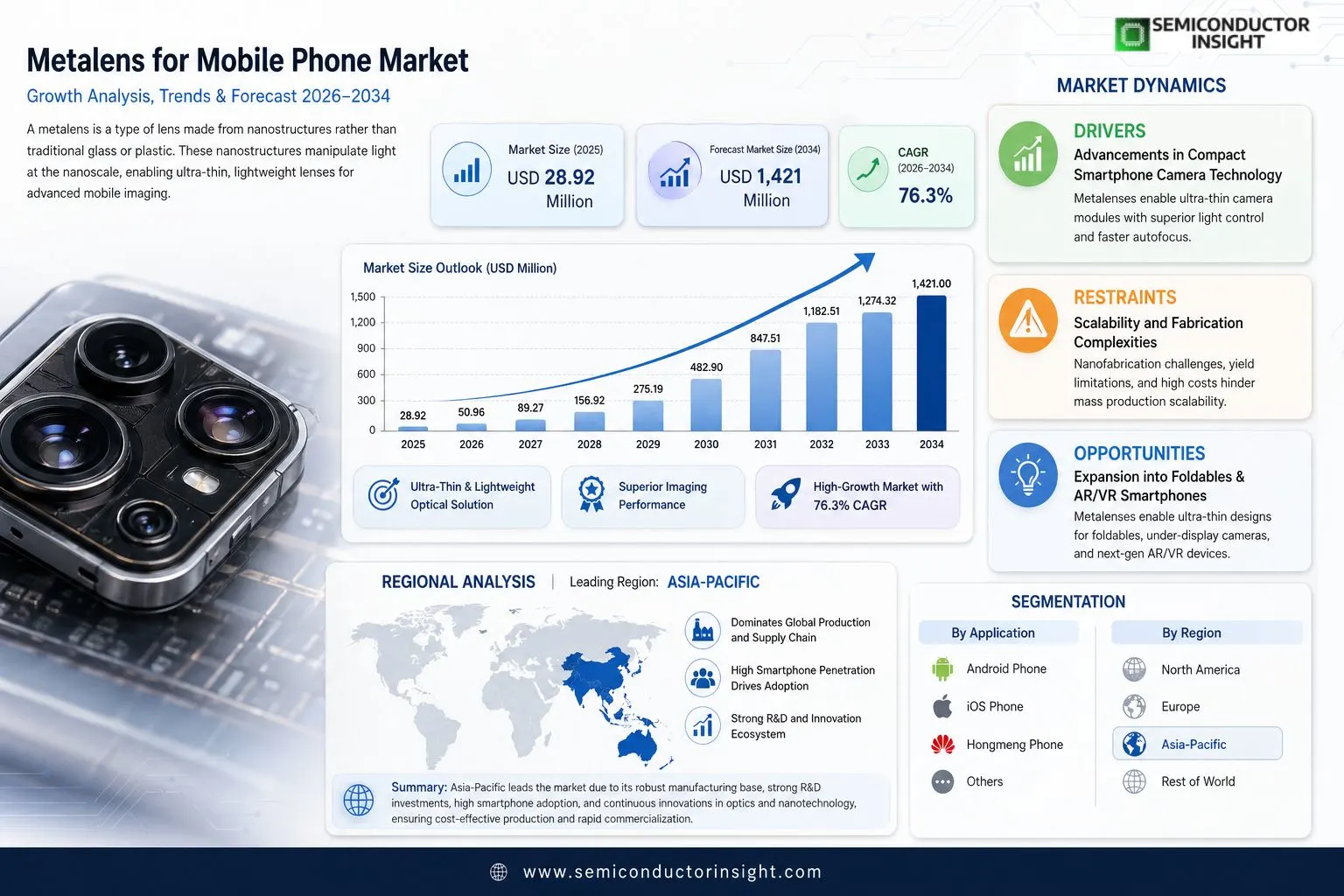
Global Metalens for Mobile Phone market size was valued at USD 28.92 million in 2025. The market is projected to reach USD 1,421 million by 2034, exhibiting a CAGR of 76.3% during the forecast period.
A metalens is a type of lens made from nanostructures rather than traditional glass or plastic. These nanostructures are designed to manipulate light at the nanoscale, allowing for the creation of lenses that are much thinner and lighter than traditional lenses. Metalenses have the potential to revolutionize a wide range of optical technologies, including cameras, microscopes, and virtual reality devices.
Metalens for Mobile Phone Market is experiencing rapid growth due to several factors, including increased investment in nanotechnology and optics, rising demand for compact imaging in smartphones, and the drive for slimmer devices without compromising performance. Additionally, advancements in nanofabrication techniques are contributing to market expansion. Initiatives by key players are expected to fuel further growth. For instance, major developers are partnering with smartphone OEMs to enable mass production. Metalenz, Inc., Radiant Opto-Electronics (NIL Technology), MetaLenX, Hangzhou Najing Technology, and SHPHOTONICS are some of the key players operating in the market with innovative portfolios.
MARKET DRIVERS
Advancements in Compact Smartphone Camera Technology
Metalens for Mobile Phone Market is propelled by the relentless pursuit of thinner, higher-performance camera modules in smartphones. Traditional lenses rely on multiple glass elements, contributing to bulky designs, whereas metalenses leverage metasurfaces to achieve superior light manipulation in ultra-thin profiles, aligning perfectly with the slim form factors demanded by modern devices.
Rising Consumer Demand for Superior Imaging
With global smartphone shipments exceeding 1.15 billion units in 2023 and camera quality remaining a top purchase driver, metalenses offer diffraction-limited performance and wide-angle capabilities without mechanical zoom complexity. This supports the shift toward multi-camera arrays, enhancing computational photography in Metalens for Mobile Phone Market.
➤ Metalenses reduce camera module thickness by up to 90%, enabling foldable phones and under-display cameras projected to capture 15% market share by 2027.
Integration with AI-driven image processing further amplifies adoption, as metalenses provide aberration-free imaging that boosts night mode and portrait effects, driving OEM investments in this transformative technology.
MARKET CHALLENGES
Scalability and Fabrication Complexities
Metalens for Mobile Phone Market faces significant hurdles in mass-producing nanoscale structures required for metalenses, where nanofabrication yields currently hover around 70-80% for prototypes, limiting cost-effective scaling for high-volume smartphone assembly lines.
Other Challenges
Performance Consistency Across Wavelengths
Metalenses exhibit chromatic dispersion issues, necessitating hybrid designs with traditional optics, which complicates integration and increases validation time for Metalens for Mobile Phone Market.Supply chain dependencies on advanced lithography equipment pose additional risks, as geopolitical tensions could disrupt access to EUV tools essential for precise metasurface patterning.
Integration with Existing Supply Chains
Retrofitting metalenses into current CMOS sensor pipelines requires extensive redesign, delaying time-to-market for flagship devices and challenging Metalens for Mobile Phone Market’s growth trajectory.
MARKET RESTRAINTS
Technical Limitations in Efficiency and FOV
Despite promising prototypes, metalenses in Metalens for Mobile Phone Market struggle with light efficiency below 85% compared to aspheric lenses, impacting low-light performance critical for smartphones.Restricted field-of-view angles, often limited to 60-70 degrees, hinder wide-angle lens replacements, confining adoption to telephoto modules initially.Environmental durability remains a concern, as metasurfaces degrade under humidity and temperature fluctuations, necessitating protective coatings that add to overall module costs.
MARKET OPPORTUNITIES
Expansion into Foldables and AR/VR Smartphones
Metalens for Mobile Phone Market holds substantial potential in foldable smartphones, expected to reach 50 million units annually by 2028, where ultra-thin lenses enable seamless hinge mechanisms.Partnerships between metalens innovators and major OEMs like Samsung and Apple pave the way for premium segment penetration, with pilot integrations anticipated in 2025 flagships.Emerging AR glasses and mixed-reality devices, projected to grow at 45% CAGR, offer secondary avenues as metalenses minimize bulk for always-on wearables tied to mobile ecosystems.
Metalens for Mobile Phone Market Trends
Shift Toward Compact Optical Solutions in Smartphones
Metalenses, leveraging nanostructures to manipulate light, are driving a fundamental shift in Metalens for Mobile Phone Market by enabling thinner and lighter camera modules. This technology addresses the growing demand for slimmer smartphone designs without sacrificing imaging performance. As consumers prioritize high-quality photography and videography, metalenses provide superior focusing capabilities and faster autofocus compared to traditional glass or plastic lenses. Major manufacturers are accelerating development to integrate these into next-generation devices, marking a transition from customized prototypes to broader applications.
Other Trends
Advancements in Manufacturing Scalability
Metalens for Mobile Phone Market is witnessing progress from early-stage customization to potential mass production, fueled by innovations in nanotechnology and optics. Leading companies such as Metalenz, Inc. and Radiant Opto-Electronics are investing in scalable fabrication techniques, which will support widespread adoption in compact imaging, sensing, and display systems for mobile phones. This evolution positions metalenses as key enablers for enhanced functionalities in Android, iOS, and emerging platforms like Hongmeng phones.
Regional Innovation and Adoption Dynamics
In Metalens for Mobile Phone Market, the United States leads in technological innovation and R&D investment, influencing global trends in mobile optics. Meanwhile, manufacturing powerhouses like China and Japan dominate production due to high smartphone penetration and rapid technology uptake. These regions are focusing on visible light and infrared metalenses to meet diverse application needs, from main cameras to specialized sensors. Stringent manufacturing regulations are pushing further innovation, creating opportunities for metalenses to penetrate high-end devices across North America, Asia, and Europe. As the technology matures, it promises to reshape smartphone design paradigms, combining high performance with ultra-compact form factors.
COMPETITIVE LANDSCAPE
Key Industry Players
Leading Innovators Driving Metalens for Mobile Phone Market Growth
Metalens for Mobile Phone Market remains in early commercialization, dominated by a select group of innovators pioneering nanostructure optics for compact smartphone cameras. Metalenz, Inc. stands out as the frontrunner, advancing flat metalens designs compatible with mass production and securing partnerships for integration into next-generation devices like Android flagships. This nascent oligopoly features high barriers to entry due to nanotechnology expertise, with the market structure emphasizing customized solutions evolving toward scalable visible and infrared metalens for enhanced imaging in slim profiles, fueled by a remarkable 76.3% CAGR projection to 2034.
Supporting the leaders are specialized niche players accelerating metalens fabrication and deployment. NIL Technology excels in nanoimprint lithography critical for precise nanostructures, while Radiant Opto-Electronics collaborates on hybrid optical modules. Chinese firms Hangzhou Najing Technology and SHPHOTONICS leverage regional manufacturing prowess for cost-effective scaling, positioning for broader adoption in iOS, Android, and emerging Hongmeng ecosystems. Traditional optics powerhouses such as Sunny Optical Technology and Largan Precision are strategically investing to transition from refractive lenses, heightening competition and spurring innovations in autofocus speed, aberration correction, and ultra-thin camera stacks.
List of Key Metalens for Mobile Phone Companies Profiled
- Metalenz, Inc.
- NIL Technology
- Radiant Opto-Electronics Corp.
- MetaLenX
- Hangzhou Najing Technology
- SHPHOTONICS
- Sunny Optical Technology
- LG Innotek
- AAC Technologies
- Ofilm Group Co., Ltd.
- Largan Precision Co., Ltd.
- Genius Electronic Optical Co., Ltd.
- Asia Optical Co., Inc.
- Sekonix Co., Ltd.
- ALPS Alpine Co., Ltd.
Segment Analysis:
| Segment Category | Sub-Segments | Key Insights |
| By Type |
|
Visible Light Metalens
|
| By Application |
|
Android Phone
|
| By End User |
|
Flagship Devices
|
| By Camera Function |
|
Main Camera
|
| By Production Scale |
|
Customized Design
|
Regional Analysis: Metalens for Mobile Phone Market
Asia-Pacific
Asia-Pacific’s metalens for mobile phone market benefits from world-class fabrication facilities in China and Taiwan, enabling high-volume production of nanoscale metasurfaces. This proximity to assembly lines reduces lead times, supporting agile responses to smartphone refresh cycles and fostering cost-competitive solutions for premium imaging modules.
Collaborative R&D hubs in South Korea and Japan drive breakthroughs in metalens design for wide-angle and zoom capabilities. Universities and firms co-develop algorithms optimizing metalens performance, integrating seamlessly with mobile AI for real-time image processing and elevating user experiences in photography-heavy applications.
High smartphone penetration and tech-savvy populations fuel adoption of metalens-enabled devices for superior low-light and portrait modes. Market trends show premium brands leveraging metalens to differentiate, with business strategies targeting mid-range segments to broaden accessibility across diverse urban markets.
Partnerships between metalens developers and mobile OEMs in Asia-Pacific streamline supply, with joint ventures focusing on customization for foldable and multi-camera systems. These alliances enhance scalability and market penetration, aligning with long-term strategies for optics evolution in Metalens for Mobile Phone Market.
North America
North America’s metalens for mobile phone market thrives on cutting-edge research from tech hubs in the United States and Canada, where startups and universities pioneer diffractive optics for next-gen cameras. Focus lies on high-end devices integrating metalens for AR/VR and hyperspectral imaging, supported by venture capital fueling prototypes. Business strategies emphasize IP protection and software-hardware synergies, yet manufacturing offshoring limits scale. Growth hinges on domestic incentives for reshoring, with trends toward AI-enhanced metalens positioning the region as an innovation leader despite import dependencies.
Europe
Europe’s metalens for mobile phone market is characterized by stringent quality standards and emphasis on sustainable optics production in Germany, France, and the Netherlands. Premium smartphone brands incorporate metalens for eco-friendly, aberration-free lenses, aligning with regulatory pushes for reduced rare-earth materials. Collaborative EU-funded projects drive precision nanofabrication, while strategies target luxury segments with customizable modules. Challenges include higher costs, but expanding 5G ecosystems and privacy-focused imaging bolster adoption through 2034.
South America
In South America, Metalens for Mobile Phone Market emerges amid rising middle-class demand for affordable advanced cameras in Brazil and Mexico. Local assembly partners import metalens components, integrating into budget devices for better zoom and stabilization. Business strategies prioritize localization to cut tariffs, with trends toward e-commerce-driven sales. Infrastructure improvements aid smartphone upgrades, though economic volatility poses hurdles; potential lies in regional tech parks fostering metalens adaptation for diverse photography needs.
Middle East & Africa
The Middle East & Africa metalens for mobile phone market grows with smartphone proliferation in UAE, South Africa, and Nigeria, where metalens enhance selfie and night modes for social media users. Gulf investments fund R&D for heat-resistant designs suiting harsh climates, while strategies focus on distribution partnerships. Emerging trends include fintech-mobile integrations demanding compact optics, overcoming supply chain gaps through Asia-Pacific ties and positioning the region for accelerated uptake in digital transformation eras.
Report Scope
This market research report provides a comprehensive analysis of Metalens for Mobile Phone Market, covering the forecast period 2026–2034. It offers detailed insights into market dynamics, technological advancements, competitive landscape, and key trends shaping the industry.
Key focus areas of the report include:
- Market Overview: The report begins with an overview outlining its current market scenario, key growth indicators, and industry transformation drivers. It discusses macroeconomic factors, demand–supply balance, regulatory landscape, and the strategic role of metalenses in powering advancements across industries such as mobile imaging, consumer electronics, AR/VR devices, and compact optics.
- Market Size & Forecast: Historical data and future projections for revenue, unit shipments, and market value across major regions and segments.
- Segmentation Analysis: Detailed breakdown by product type, technology, application, and end-user industry to identify high-growth segments and investment opportunities.
- Regional Insights: Insights into market performance across North America, Europe, Asia-Pacific, Latin America, and the Middle East & Africa, including country-level analysis where relevant.
- Competitive Landscape: Profiles of leading market participants, including their product offerings, R&D focus, manufacturing capacity, pricing strategies, and recent developments such as mergers, acquisitions, and partnerships.
- Technology Trends & Innovation: Assessment of emerging technologies, integration of AI/IoT, semiconductor design trends, fabrication techniques, and evolving industry standards.
- Market Drivers & Restraints: Evaluation of factors driving market growth along with challenges, supply chain constraints, regulatory issues, and market-entry barriers.
- Stakeholder Insights: Insights for component suppliers, OEMs, system integrators, investors, and policymakers regarding the evolving ecosystem and strategic opportunities.
Primary and secondary research methods are employed, including interviews with industry experts, data from verified sources, and real-time market intelligence to ensure the accuracy and reliability of the insights presented.
FREQUENTLY ASKED QUESTIONS:
What is the current market size of Metalens for Mobile Phone Market?
-> Metalens for Mobile Phone Market was valued at USD 28.92 million in 2025 and is expected to reach USD 1421 million by 2034, at a CAGR of 76.3% during the forecast period.
Which key companies operate in Metalens for Mobile Phone Market?
-> Key players include Metalenz, Inc., Radiant Opto-Electronics (NIL Technology), MetaLenX, Hangzhou Najing Technology, SHPHOTONICS, among others.
What are the key growth drivers?
-> Key growth drivers include advancements in nanotechnology and optics, demand for slimmer mobile phones with superior imaging performance, consumer expectations for higher image quality, and faster autofocus capabilities.
Which region dominates the market?
-> Asia, particularly China and Japan, dominates as manufacturing hubs with high smartphone penetration, while North America (US) leads in technological innovation.
What are the emerging trends?
-> Emerging trends include shift to mass production of metalenses, integration in high-end smartphones, nanostructured surfaces for thinner designs, and enhanced compact imaging applications.

Get Sample Report PDF for Exclusive Insights
Report Sample Includes
- Table of Contents
- List of Tables & Figures
- Charts, Research Methodology, and more...