Metal Current Sensing Resistor Market Insights
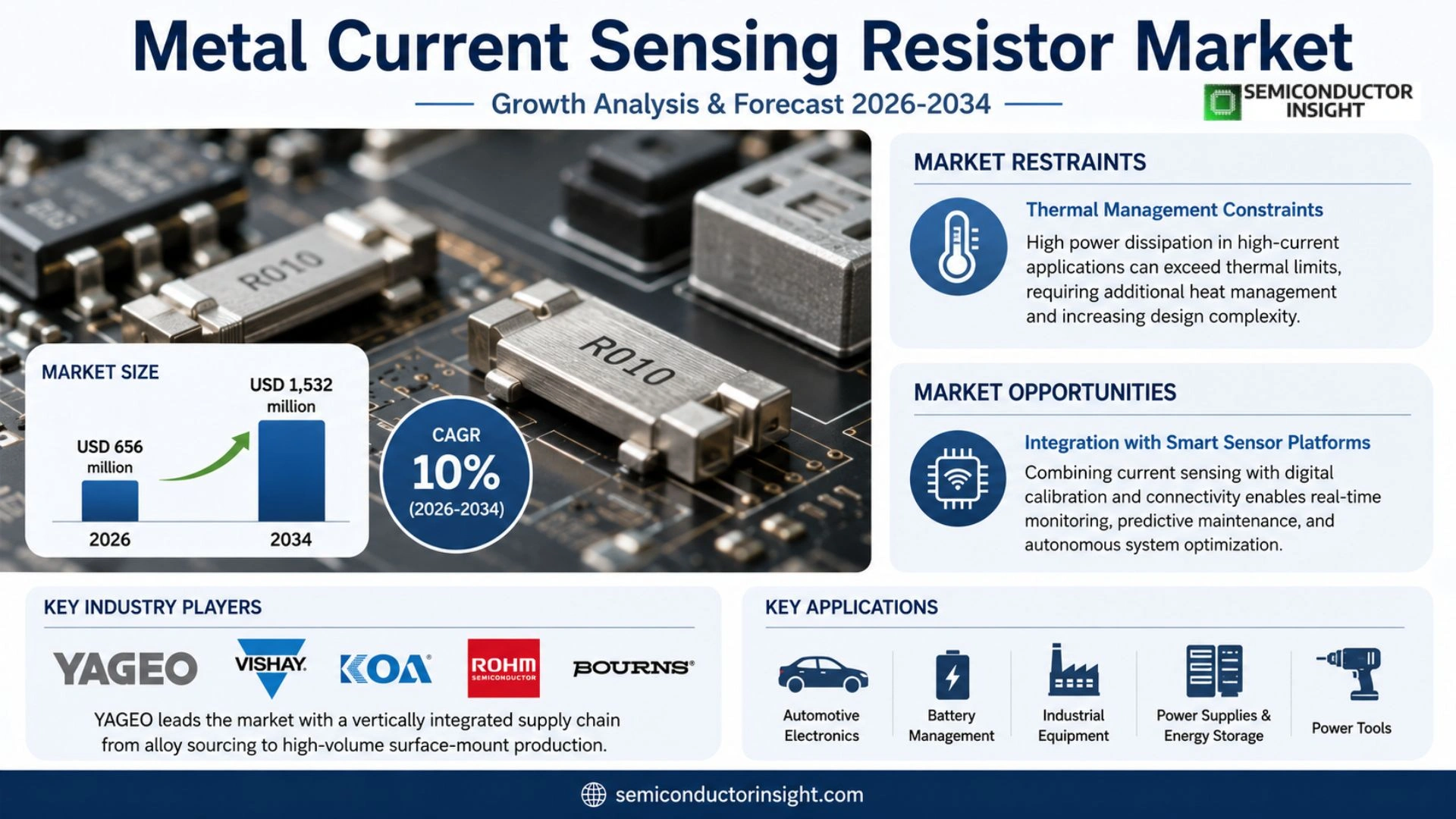
Metal Current Sensing Resistor market will rise from USD 656 million in 2026 to roughly USD 1,532 million by 2034, reflecting an implied compound annual growth rate of about 10 percent over the period.
Metal Current Sensing Resistor is a chip‑type resistor,also referred to as a metal sampling or current‑sensing resistor,designed primarily for current collection within circuits. Its resistance values typically range from 0.2 mΩ to 750 mΩ, and alloy‑based constructions are favored for their high precision, low temperature coefficient and stable performance.
The upward trend is driven by expanding demand in automotive electrification, where alloy resistors support battery‑management and motor‑control systems, as well as growing adoption in consumer electronics such as smartphones and fast‑charging accessories. Moreover, cost advantages of alloy‑film variants,about ten percent cheaper than pure‑alloy counterparts,make them attractive for volume‑driven markets, while premium applications continue to rely on pure alloy devices for superior thermal stability.
MARKET DRIVERS
Rising Demand for High‑Precision Power Management
Metal Current Sensing Resistor Market is being propelled by the surge in electric‑vehicle platforms and grid‑scale renewable installations, both of which require sub‑milliohm accuracy for safe power conversion. As manufacturers tighten efficiency targets, designers turn to metal‑film resistors because they provide a stable voltage drop across a wide temperature range, reducing the need for complex calibration loops.
Advances in Thin‑Film Metallurgy
Recent breakthroughs in sputtering and annealing processes have lowered the temperature coefficient of resistance (TCR) to below 10 ppm/°C, making metal resistors viable for high‑current, low‑noise applications. These process improvements also drive down unit costs, allowing OEMs to replace legacy shunt‑type sensors with slimmer, more reliable metal elements without sacrificing performance.
➤ “Design cycles shrink when engineers can rely on a resistor that remains linear from –55 °C to 150 °C, cutting both prototyping time and validation expense.”
Collectively, the push for tighter efficiency standards and the technical maturation of metal‑film technologies translate into a stronger purchasing case for Metal Current Sensing Resistor Market, encouraging suppliers to expand capacity and diversify product portfolios.
MARKET CHALLENGES
Cost Sensitivity in Volume Production
Although metal resistors deliver superior performance, their price point remains higher than that of conventional carbon or metal‑oxide alternatives. End‑users operating under tight bill‑of‑materials constraints often evaluate trade‑offs between accuracy and cost, leading some to opt for less precise sensing schemes in lower‑margin product lines.
Other Challenges
Supply Chain Volatility
Raw material shortages, particularly for high‑purity nickel and platinum, have introduced price swings that can erode margins. Manufacturers must therefore maintain safety stocks or negotiate longer contracts, both of which impact cash flow and can delay new product introductions.
MARKET RESTRAINTS
Thermal Management Constraints
Metal current sensing resistors dissipate power proportional to the square of the measured current. In high‑current busbars, the resulting heat can exceed the thermal budget of compact modules, forcing designers to add heat sinks or redesign layouts. This added complexity can deter adoption in space‑constrained applications such as portable power tools.
MARKET OPPORTUNITIES
Integration with Smart Sensor Platforms
Emerging smart‑sensor architectures embed current‑sensing resistors alongside digital calibration and communication blocks, enabling real‑time diagnostics over industrial IoT networks. Companies that can package metal resistors within these integrated modules stand to capture a growing share of deployments in predictive‑maintenance systems and autonomous vehicle power‑train monitoring.
Metal Current Sensing Resistor Market Trends
Alloy Film Resistors Capture Mid‑Range Value
The mid‑range segment of Metal Current Sensing Resistor Market is increasingly dominated by alloy‑film designs. Manufacturers achieve roughly a ten‑percent reduction in bill of materials by substituting pure‑alloy substrates with a thin alloy‑film coating, while still meeting the 0.2 mR–750 mR resistance range required for most consumer‑grade devices. This cost advantage aligns with the pricing pressure in product categories such as true‑wireless earbuds and wearable fitness trackers, where unit margins are thin and volume forecasts are aggressive. Suppliers that have invested in high‑throughput sputtering lines are now able to offer tighter tolerance grades at a price point that pure‑alloy parts cannot match, reshaping supplier‑buyer negotiations in the small‑electronics supply chain.
Other Trends
Packaging Size Shift Toward 1206 Form Factor
From a logistical perspective, the 1206 surface‑mount package now commands about 65 % of all orders for current‑sensing resistors. Its footprint balances low thermal resistance with a power rating suited to emerging low‑power domains, such as Bluetooth earphones and compact smart‑bracelets. Even though the 0805 size remains popular for ultra‑compact boards, the marginal increase in board‑area cost is outweighed by the reliability gain of a larger thermal mass. For high‑current applications,on‑board chargers in new‑energy vehicles,the larger 2512 variant is gaining traction, but the bulk of demand continues to flow to the 1206 format, prompting fab houses to prioritize inventory of this size.
Automotive Electrification Spurs Alloy Resistor Demand
Electric‑vehicle powertrains rely heavily on precise current feedback for battery‑management and motor‑control circuits. As EV penetration deepens in China and spreads across Europe, OEMs are specifying pure‑alloy resistors for high‑precision nodes, while alloy‑film parts serve auxiliary functions such as auxiliary‑battery monitoring and fast‑charging interfaces. The shift is not merely technical; it translates into a strategic imperative for component suppliers to secure long‑term contracts with automotive OEMs, diversify material sourcing, and certify production lines against automotive quality standards. Companies that can demonstrate superior overload capacity and minimal temperature drift are positioning themselves as preferred partners, thereby turning a technical requirement into a competitive moat.
COMPETITIVE LANDSCAPE
Key Industry Players
Competitive Overview of Metal Current Sensing Resistor Market
YAGEO commands the largest share of the metal current‑sensing resistor segment, leveraging a vertically integrated supply chain that spans alloy sourcing to high‑volume surface‑mount production. Its extensive catalog of alloy‑film devices, combined with aggressive pricing and a deep network of automotive and consumer‑electronics OEMs, has entrenched the company as the benchmark for price‑sensitive projects. Rohm and Vishay follow closely, each differentiating through advanced pure‑alloy offerings that deliver tighter temperature coefficients for high‑performance applications such as electric‑vehicle power‑train control. TT Electronics adds a niche strength in customized shunt solutions for industrial power supplies, while its strategic acquisitions have broadened its footprint across Europe and North America, reinforcing a moderately concentrated market hierarchy.
Beyond the top tier, a constellation of specialized manufacturers fuels competitive dynamics. Uni‑Royal and TA‑I Technology focus on miniaturized 0805 and 1206 formats, targeting wearable‑device manufacturers that demand low‑power footprints. Fenghua Advanced Technology and Juneway Electronics excel in bulk‑size alloy shunts, supplying battery‑management systems for emerging EV platforms. Viking and Everohms maintain strong positions in the Asian consumer‑electronics segment through cost‑effective alloy‑film lines. Companies such as Susumu, Isabellenhütte, and Samsung diversify the field by injecting proprietary substrate technologies that improve overload tolerance. Smaller yet agile firms,Cyntec, Sartfuse, Shenzhen Yezhan Electronics, and C&B Eureka,capture fragmented regional demand, often through localized distribution agreements that give them a foothold in fast‑growing markets like Southeast Asia and Eastern Europe.
List of Key Metal Current Sensing Resistor Companies Profiled
- YAGEO
- Rohm
- Vishay
- TT Electronics
- Uni‑Royal
- TA‑I Technology
- Fenghua Advanced Technology
- Juneway Electronics
- Susumu
- Isabellenhütte
- Samsung
- C&B Eureka
Segment Analysis:
| Segment Category | Sub-Segments | Key Insights |
| By Type |
|
Alloy Film Resistor is widely regarded as the versatile workhorse in the market. – Offers a balanced cost‑performance profile that appeals to volume manufacturers. – Provides sufficient precision for most consumer‑grade electronic systems. – Supports a broad temperature range, making it suitable for both portable devices and stationary equipment. – Enables straightforward integration into standard PCB footprints, simplifying design cycles. |
| By Application |
|
Automotive Electronics drives much of the strategic focus for designers. – Requires high reliability to meet vehicle safety standards. – Demands tight temperature stability for under‑hood environments. – Supports critical functions such as battery management and motor control. – Aligns with the broader shift toward electrified powertrains, reinforcing the need for robust current sensing. |
| By End User |
|
Electric Vehicles represent a focal point for future growth. – Current sensing is integral to battery management systems, ensuring safe charge/discharge cycles. – Precise sensing supports motor drive efficiency and regenerative braking performance. – The high‑current environment of on‑board chargers benefits from robust resistor designs that mitigate thermal drift. |
| By Performance |
|
High Precision is the most valued attribute for demanding applications. – Enables accurate current feedback in sensitive control loops. – Reduces calibration effort across product families. – Enhances overall system stability, especially in high‑frequency switching environments. – Aligns with designers’ preference for components that minimize error propagation. |
| By Packaging Size |
|
1206 Package dominates low‑power designs. – Compact footprint fits densely populated wearable electronics. – Handles modest power levels while preserving signal integrity. – Offers a cost‑effective option for high‑volume consumer products. – Serves as a baseline for designers transitioning to larger formats for higher‑current needs. |
Regional Analysis: Metal Current Sensing Resistor Market
North America
Vehicle manufacturers are standardising on metal‑based sensing resistors to meet stricter power‑train efficiency targets, while data‑center operators seek devices that remain stable under continuous high‑current draw, pushing broader market uptake.
Domestic metal‑alloy sourcing combined with advanced thin‑film processes reduces exposure to geopolitical disruptions, allowing North American firms to maintain tighter inventory buffers than competitors.
Energy‑efficiency legislation across the United States and Canada penalises excessive power loss, incentivising the adoption of low‑tolerance sensing resistors that optimise system-wide performance.
The convergence of IoT sensors with metal current‑sensing elements creates new use‑cases in smart manufacturing, where real‑time current monitoring improves predictive maintenance strategies.
Europe
European manufacturers are leveraging Metal Current Sensing Resistor Market to satisfy stringent emissions standards that dictate tighter control over power conversion losses. The automotive sector, particularly in Germany and France, favours metal‑based devices for their ability to sustain accurate sensing during rapid acceleration and deceleration cycles. Energy‑utility providers are also incorporating these resistors into grid‑balancing equipment, driven by European Union directives that reward reduced transmission inefficiencies. As local suppliers adapt to fragmented regulatory environments, they are differentiating through modular designs that can be retrofitted into legacy infrastructure, allowing customers to upgrade without extensive system overhauls.
Asia‑Pacific
In Asia‑Pacific, rapid expansion of consumer electronics and aggressive rollout of renewable‑energy projects are reshaping Metal Current Sensing Resistor Market. Chinese and Indian manufacturers are scaling production to meet the surge in low‑cost power‑management modules required for smartphones and portable devices, where compactness and thermal stability are prized. Simultaneously, renewable‑energy developers in Japan and South Korea are integrating metal sensing resistors into inverter architectures to enhance fault detection during variable load conditions. The region’s emphasis on cost efficiency is prompting manufacturers to experiment with alternative metal alloys that preserve performance while lowering material expenses.
South America
South American growth in Metal Current Sensing Resistor Market is anchored by expanding renewable‑energy capacity and a nascent electric‑vehicle ecosystem. Brazil’s investment in wind and solar farms has highlighted the need for reliable current‑monitoring components that can operate in high‑humidity environments. Local automotive assemblers, eager to capture early market share in electric mobility, are trialling metal‑based sensing solutions to meet durability expectations unique to the region’s diverse climate zones. Partnerships between regional universities and component makers are fostering research into corrosion‑resistant metal formulations, positioning the market for longer product lifespans.
Middle East & Africa
The Middle East & Africa segment is characterised by a dual focus on high‑temperature resilience and infrastructure modernization. Oil‑and‑gas facilities across the Gulf are adopting metal current‑sensing resistors to improve safety monitoring in harsh thermal environments, where conventional silicon devices often degrade. Meanwhile, emerging smart‑grid initiatives in South Africa and the United Arab Emirates are creating demand for sensing components that can reliably handle fluctuating loads while maintaining low drift. Supplier strategies centre on delivering ruggedised packages that withstand both desert heat and occasional sand ingress, aligning product attributes with the region’s operational realities.
Report Scope
This market research report provides a comprehensive analysis of the Metal Current Sensing Resistor Market , covering the forecast period 2026–2034. It offers detailed insights into market dynamics, technological advancements, competitive landscape, and key trends shaping the industry.
Key focus areas of the report include:
- Market Overview: The report begins with an overview outlining its current market scenario, key growth indicators, and industry transformation drivers. It discusses macroeconomic factors, demand–supply balance, regulatory landscape, and the strategic role of semiconductors in powering advancements across industries such as automotive, telecommunications, consumer electronics, and industrial automation.
- Market Size & Forecast: Historical data and future projections for revenue, unit shipments, and market value across major regions and segments.
- Segmentation Analysis: Detailed breakdown by product type, technology, application, and end-user industry to identify high-growth segments and investment opportunities.
- Regional Insights: Insights into market performance across North America, Europe, Asia-Pacific, Latin America, and the Middle East & Africa, including country-level analysis where relevant.
- Competitive Landscape: Profiles of leading market participants, including their product offerings, R&D focus, manufacturing capacity, pricing strategies, and recent developments such as mergers, acquisitions, and partnerships.
- Technology Trends & Innovation: Assessment of emerging technologies, integration of AI/IoT, semiconductor design trends, fabrication techniques, and evolving industry standards.
- Market Drivers & Restraints: Evaluation of factors driving market growth along with challenges, supply chain constraints, regulatory issues, and market-entry barriers.
- Stakeholder Insights: Insights for component suppliers, OEMs, system integrators, investors, and policymakers regarding the evolving ecosystem and strategic opportunities.
Primary and secondary research methods are employed, including interviews with industry experts, data from verified sources, and real-time market intelligence to ensure the accuracy and reliability of the insights presented.
FREQUENTLY ASKED QUESTIONS:
What is the current market size of Metal Current Sensing Resistor Market?
-> Metal Current Sensing Resistor market will rise from USD 656 million in 2026 to roughly USD 1,532 million by 2034, a CAGR of about 10 percent
Which key companies operate in Metal Current Sensing Resistor Market?
-> Key players include YAGEO, UNI-ROYAL, TA-I Technology, Fenghua Advanced Technology, Juneway Electronics, Viking, Everohms, Susumu, Lizgroup, ROHM, Vishay, TT Electronics, Samsung, Cyntec, Isabellenhütte, Sartfuse, Shenzhen Yezhan Electronics, C&B Eureka.
What are the key growth drivers?
-> Key growth drivers include rapid expansion of electric vehicles and battery management systems, increasing demand for high‑precision alloy resistors in consumer electronics, cost advantages of alloy‑film resistors, and growing adoption of 1206 package size in IoT wearables.
Which region dominates the market?
-> Asia holds the largest market share, driven by strong EV adoption in China and a robust manufacturing base, while Europe and North America follow.
What are the emerging trends?
-> Emerging trends include shift towards alloy‑film resistors for cost‑sensitive applications, increased use of high‑power 2512 packages in on‑board chargers, and integration of resistors in fast‑charging and battery management technologies.

Get Sample Report PDF for Exclusive Insights
Report Sample Includes
- Table of Contents
- List of Tables & Figures
- Charts, Research Methodology, and more...
 Download Sample Report PDF