
MEMS Silicon-Based Semiconductor Strain Gauges Market Insights
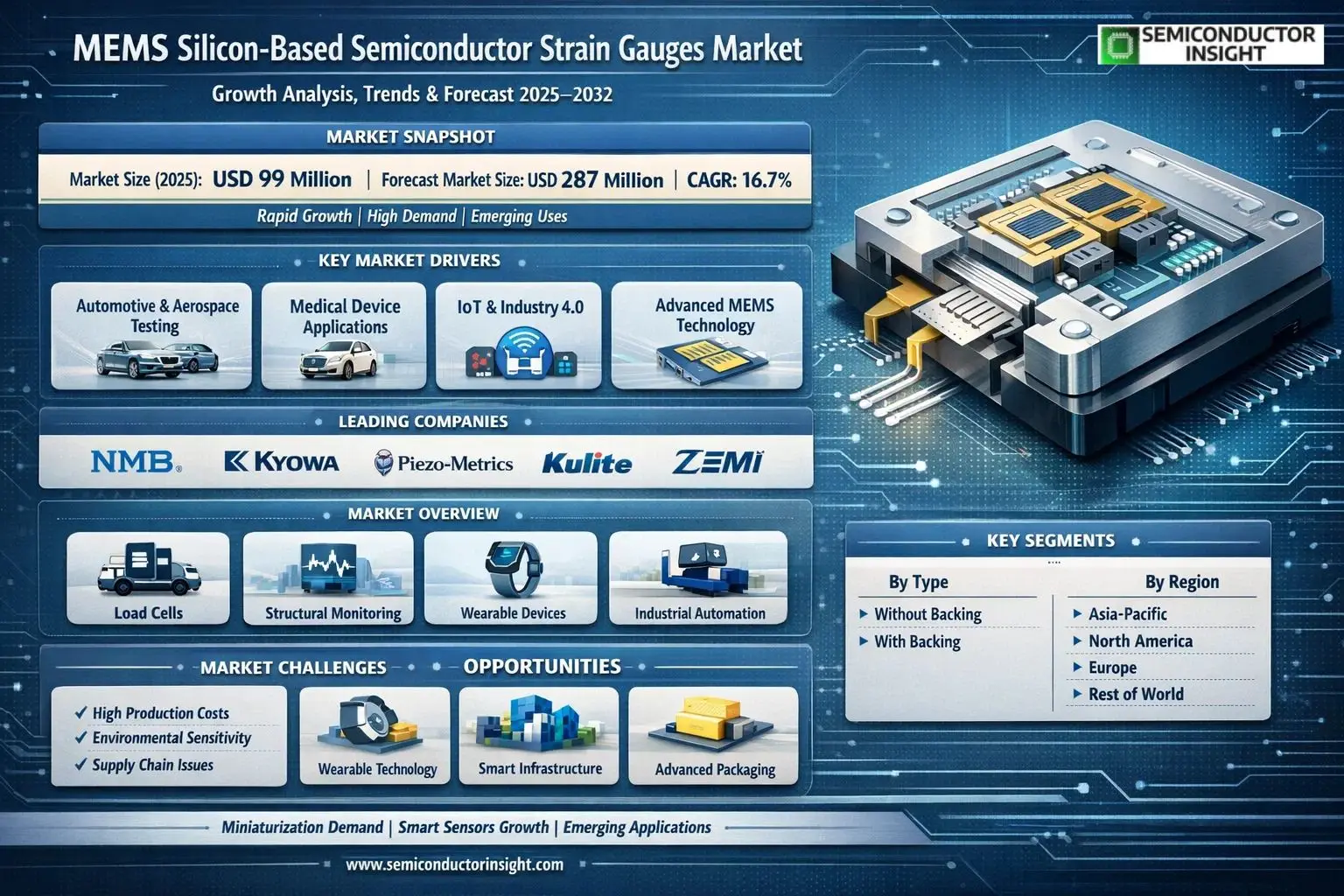
Global MEMS Silicon-Based Semiconductor Strain Gauges market size was valued at USD 99 million in 2025. The market is projected to reach USD 287 million by 2032, exhibiting a CAGR of 16.7% during the forecast period.
MEMS Silicon-Based Semiconductor Strain Gauges are highly sensitive strain-sensing devices fabricated using Micro-Electro-Mechanical Systems (MEMS) technology, leveraging the piezoresistive properties of silicon to measure strain. These strain gauges are commonly integrated into compact, precise, and high-performance sensing applications.
The market is experiencing rapid growth due to several factors, including surging demand in automotive testing, aerospace structural monitoring, and medical devices, alongside advancements in MEMS fabrication for miniaturization. Furthermore, expanding applications in load cells and stress analysis sensors are driving expansion. Initiatives by key players are fueling further innovation. NMB, Kyowa Electronic Instruments, Piezo-Metrics, Kulite Semiconductor Products, Zhonghang Electronic Measuring Instruments, and Anhui Tianguang Sensor are among the leading companies with diverse product portfolios.
MARKET DRIVERS
Advancements in Miniaturization and Precision Sensing
MEMS Silicon-Based Semiconductor Strain Gauges Market is propelled by the increasing demand for high-precision sensors in automotive and aerospace applications. These devices offer superior sensitivity and compact form factors, enabling real-time structural health monitoring in vehicles and aircraft. With global automotive production exceeding 90 million units annually, integration of these gauges in engine components and suspension systems drives significant growth.
IoT and Industry 4.0 Integration
Rapid adoption of Internet of Things (IoT) platforms has boosted the need for reliable strain measurement in smart manufacturing. MEMS silicon-based strain gauges provide accurate data for predictive maintenance, reducing downtime by up to 30% in industrial settings. The convergence of 5G technology further enhances data transmission, expanding their utility across sectors like consumer electronics and healthcare.
➤ Market growth is underscored by a projected CAGR of 9.2% through 2030, fueled by automotive electrification trends.
Additionally, rising investments in renewable energy infrastructure, such as wind turbine monitoring, leverage the durability and low power consumption of these semiconductors, solidifying their role in sustainable technologies.
MARKET CHALLENGES
Manufacturing Complexity and Cost Pressures
MEMS Silicon-Based Semiconductor Strain Gauges Market faces hurdles from intricate fabrication processes involving cleanroom environments and precise lithography. These requirements elevate production costs, making it challenging for small-scale manufacturers to compete, with average unit prices remaining 20-25% higher than traditional foil gauges.
Other Challenges
Environmental Sensitivity
Temperature fluctuations can induce drift in piezoresistive elements, necessitating advanced compensation circuits that add to design complexity. Calibration inconsistencies across batches further complicate scalability for high-volume automotive deployments.
MARKET RESTRAINTS
Supply Chain Vulnerabilities and Material Dependencies
Geopolitical tensions disrupt the global supply of high-purity silicon wafers essential for MEMS silicon-based semiconductor strain gauges, leading to production delays. Over 60% of raw materials originate from concentrated regions, exposing the market to shortages that have increased lead times by 40% in recent years.Strict regulatory standards in medical and aerospace sectors demand extensive validation testing, slowing market entry for new players. Compliance with ISO 13485 and AS9100 certifications raises barriers, limiting innovation pace.Competition from alternative sensing technologies, such as optical fiber gauges, restrains growth in niche applications where cost trumps precision, capturing nearly 15% of potential market share.
MARKET OPPORTUNITIES
Expansion into Wearables and Consumer Electronics
MEMS Silicon-Based Semiconductor Strain Gauges Market holds promise in wearable health devices for continuous vital sign monitoring, with the wearables sector projected to surpass 500 million units shipped yearly. Their biocompatibility and micro-scale integration enable non-invasive strain detection for fitness tracking.Emerging applications in structural monitoring for smart cities and bridges offer untapped potential, as governments allocate billions to infrastructure resilience. Hybrid MEMS systems combining strain gauges with accelerometers could capture 25% of this expanding segment.Advancements in wafer-level packaging reduce costs by 15-20%, opening doors for penetration into consumer-grade robotics and drones, where lightweight, high-gauge factor sensors are critical.
MEMS Silicon-Based Semiconductor Strain Gauges Market Trends
Integration into Compact Precision Sensing Applications
MEMS Silicon-Based Semiconductor Strain Gauges Market is experiencing growth driven by the demand for highly sensitive strain-sensing devices that utilize piezoresistive properties of silicon. These devices, fabricated through Micro-Electro-Mechanical Systems technology, enable precise measurements in compact formats suitable for high-performance applications. The shift toward miniaturized sensors is prominent, as industries seek enhanced accuracy and reliability in strain detection.
Other Trends
Product Type Segmentation
MEMS Silicon-Based Semiconductor Strain Gauges Market features distinct segments including Without Backing and With Backing types. Without Backing variants are gaining traction for their flexibility in direct integration, while With Backing options provide added structural support for demanding environments. This bifurcation allows manufacturers to address diverse needs in precision instrumentation.
Application-Driven Expansion
Key applications such as Load Cell and Stress Analysis Sensor dominate MEMS Silicon-Based Semiconductor Strain Gauges Market, with Load Cells leading due to their widespread use in force measurement systems. The Others category encompasses emerging uses in specialized sensors, reflecting broader adoption across industrial monitoring and structural health assessments. Regional dynamics show strong potential in North America, Europe, and Asia, particularly China and Japan, where manufacturing hubs drive innovation.
Competitive pressures from leading players like NMB, Kyowa Electronic Instruments, Kulite Semiconductor Products, and others are fostering advancements in product development and market positioning. The focus on sales, revenue, and latest developments underscores a trend toward strategic mergers and enhanced supply chains to meet global demand.
COMPETITIVE LANDSCAPE
Key Industry Players
Top Manufacturers in MEMS Silicon-Based Semiconductor Strain Gauges Market
MEMS Silicon-Based Semiconductor Strain Gauges Market features a concentrated competitive landscape where leading manufacturers dominate through advanced piezoresistive MEMS technology and high-precision fabrication. Key players such as NMB Technologies, Kyowa Electronic Instruments, and Kulite Semiconductor Products command significant market shares, with the global top five manufacturers collectively accounting for a substantial revenue portion in 2025. This structure supports rapid innovation in compact, sensitive strain sensors for critical applications including load cells and stress analysis, amid a market projected to grow from US$99 million in 2025 to US$287 million by 2032 at a 16.7% CAGR.
Complementing the market leaders, several niche and regional players contribute to diversification and specialization, particularly in Asia-Pacific and North America. Companies like Piezo-Metrics, Zhonghang Electronic Measuring Instruments, and Anhui Tianguang Sensor focus on customized solutions, cost efficiencies, and integration for emerging uses in automotive and aerospace testing. This competitive dynamic intensifies R&D efforts, price competition, and supply chain resilience, enabling broader adoption of MEMS silicon-based strain gauges across industrial segments.
List of Key MEMS Silicon-Based Semiconductor Strain Gauges Companies Profiled
- NMB Technologies Corporation
- Kyowa Electronic Instruments Co., Ltd.
- Kulite Semiconductor Products, Inc.
- Piezo-Metrics, Inc.
- Zhonghang Electronic Measuring Instruments Co., Ltd.
- Anhui Tianguang Sensor Technology Co., Ltd.
- Vishay Precision Group
- HBK (Hottinger Brüel & Kjær)
- Micron Instruments
- Strainsert Company
- Futek Advanced Sensor Technology, Inc.
- BCM Sensor Technologies bvba
- Omega Engineering, Inc.
- RDP Electrosense, Inc.
Segment Analysis:
| Segment Category | Sub-Segments | Key Insights |
| By Type |
|
Without Backing
|
| By Application |
|
Load Cell
|
| By End User |
|
Aerospace & Defense
|
| By Mounting Type |
|
Bonded
|
| By Pattern Type |
|
Linear Pattern
|
Regional Analysis: MEMS Silicon-Based Semiconductor Strain Gauges Market
North America
North America’s Silicon Valley and Boston corridors lead in MEMS Silicon-Based Semiconductor Strain Gauges Market advancements, with cutting-edge fabs specializing in silicon micromachining. Research institutions pioneer doping techniques for enhanced piezoresistive properties, yielding gauges with unmatched signal-to-noise ratios for precision engineering.
Aerospace and automotive sectors propel growth in MEMS Silicon-Based Semiconductor Strain Gauges Market, utilizing these sensors for real-time fatigue detection in aircraft wings and vehicle chassis. Integration into electric vehicle batteries enhances safety monitoring, capitalizing on the region’s automotive electrification push.
Venture capital and government grants fuel expansion in North America’s MEMS Silicon-Based Semiconductor Strain Gauges Market, supporting scalable production lines. Partnerships with defense contractors emphasize ruggedized designs for military applications, ensuring sustained R&D momentum amid evolving industrial needs.
Integrated supply chains in MEMS Silicon-Based Semiconductor Strain Gauges Market provide reliable access to high-purity silicon wafers and cleanroom facilities. This vertical integration minimizes lead times, enabling North American firms to meet surging demands from consumer electronics and robotics sectors effectively.
Europe
Europe exhibits steady growth in MEMS Silicon-Based Semiconductor Strain Gauges Market, anchored by automotive giants and precision engineering expertise. Countries like Germany and France lead with stringent quality standards, integrating these gauges into advanced driver-assistance systems and wind turbine monitoring for optimal structural integrity. Collaborative EU-funded projects accelerate MEMS process refinements, focusing on sustainability through energy-efficient fabrication. The region’s emphasis on Industry 4.0 initiatives drives adoption in smart factories, where strain gauges enable predictive maintenance. Challenges include navigating diverse regulations, yet strong patent portfolios and skilled workforce sustain competitiveness. Emerging focus on renewable energy applications positions Europe as a key player for durable, environmentally resilient sensors.
Asia-Pacific
Asia-Pacific emerges as a dynamic force in MEMS Silicon-Based Semiconductor Strain Gauges Market, propelled by massive electronics manufacturing bases in China, Japan, and South Korea. High-volume production capabilities lower costs, making high-precision gauges accessible for consumer devices and industrial robotics. Rapid urbanization fuels demand in infrastructure projects requiring vibration and load sensing. Local innovation centers develop hybrid MEMS solutions, blending silicon-based gauges with flexible substrates for wearables. Supply chain localization reduces dependencies, while government incentives for semiconductor self-sufficiency enhance market penetration. Intense competition spurs iterative improvements in miniaturization and wireless integration.
South America
South America shows promising potential in MEMS Silicon-Based Semiconductor Strain Gauges Market, driven by expanding mining, agriculture, and energy sectors. Brazil and Chile prioritize rugged sensors for equipment strain monitoring in harsh terrains, supporting resource extraction efficiency. Partnerships with international firms introduce advanced MEMS technologies, bridging technological gaps. Growing automotive assembly lines incorporate these gauges for enhanced vehicle performance. Infrastructure investments under regional development programs boost adoption in bridge and dam surveillance. Local R&D is nascent but gaining traction through university collaborations, focusing on cost-effective adaptations to tropical climates.
Middle East & Africa
The Middle East & Africa region advances in MEMS Silicon-Based Semiconductor Strain Gauges Market amid oilfield modernization and smart city developments. Gulf nations deploy high-temperature tolerant gauges for pipeline integrity monitoring in extreme conditions. Africa’s burgeoning renewable energy landscape, particularly solar farms, utilizes strain sensing for structural reliability. Import reliance persists, but emerging fab initiatives in UAE and South Africa aim for self-reliance. Defense and aerospace diversification efforts integrate these sensors into unmanned systems. Skill development programs foster gradual ecosystem maturity.
Report Scope
This market research report provides a comprehensive analysis of MEMS Silicon-Based Semiconductor Strain Gauges Market, covering the forecast period 2025–2032. It offers detailed insights into market dynamics, technological advancements, competitive landscape, and key trends shaping the industry.
Key focus areas of the report include:
- Market Overview: The report begins with an overview outlining its current market scenario, key growth indicators, and industry transformation drivers. It discusses macroeconomic factors, demand–supply balance, regulatory landscape, and the strategic role of semiconductors in powering advancements across industries such as automotive, telecommunications, consumer electronics, and industrial automation.
- Market Size & Forecast: Historical data and future projections for revenue, unit shipments, and market value across major regions and segments.
- Segmentation Analysis: Detailed breakdown by product type, technology, application, and end-user industry to identify high-growth segments and investment opportunities.
- Regional Insights: Insights into market performance across North America, Europe, Asia-Pacific, Latin America, and the Middle East & Africa, including country-level analysis where relevant.
- Competitive Landscape: Profiles of leading market participants, including their product offerings, R&D focus, manufacturing capacity, pricing strategies, and recent developments such as mergers, acquisitions, and partnerships.
- Technology Trends & Innovation: Assessment of emerging technologies, integration of AI/IoT, semiconductor design trends, fabrication techniques, and evolving industry standards.
- Market Drivers & Restraints: Evaluation of factors driving market growth along with challenges, supply chain constraints, regulatory issues, and market-entry barriers.
- Stakeholder Insights: Insights for component suppliers, OEMs, system integrators, investors, and policymakers regarding the evolving ecosystem and strategic opportunities.
Primary and secondary research methods are employed, including interviews with industry experts, data from verified sources, and real-time market intelligence to ensure the accuracy and reliability of the insights presented.
FREQUENTLY ASKED QUESTIONS:
What is the current market size of MEMS Silicon-Based Semiconductor Strain Gauges Market?
-> MEMS Silicon-Based Semiconductor Strain Gauges Market was valued at USD 99 million in 2025 and is expected to reach USD 287 million by 2032, at a CAGR of 16.7% during the forecast period.
Which key companies operate in MEMS Silicon-Based Semiconductor Strain Gauges Market?
-> Key players include NMB, Kyowa Electronic Instruments, Piezo-Metrics, Kulite Semiconductor Products, Zhonghang Electronic Measuring Instruments, Anhui Tianguang Sensor, among others.
What are the key growth drivers?
-> Key growth drivers include demand for compact, precise, and high-performance strain sensing devices, leveraging piezoresistive properties of silicon in MEMS technology, and applications in load cells and stress analysis sensors.
Which region dominates the market?
-> Asia is the fastest-growing region, while North America remains a dominant market.
What are the emerging trends?
-> Emerging trends include Without Backing and With Backing product types, expansion in applications such as Load Cell, Stress Analysis Sensor, and Others, and detailed regional analysis covering US, China, and other countries.

Get Sample Report PDF for Exclusive Insights
Report Sample Includes
- Table of Contents
- List of Tables & Figures
- Charts, Research Methodology, and more...
 Download Sample Report PDF


