Key Statistics
Key Takeaways
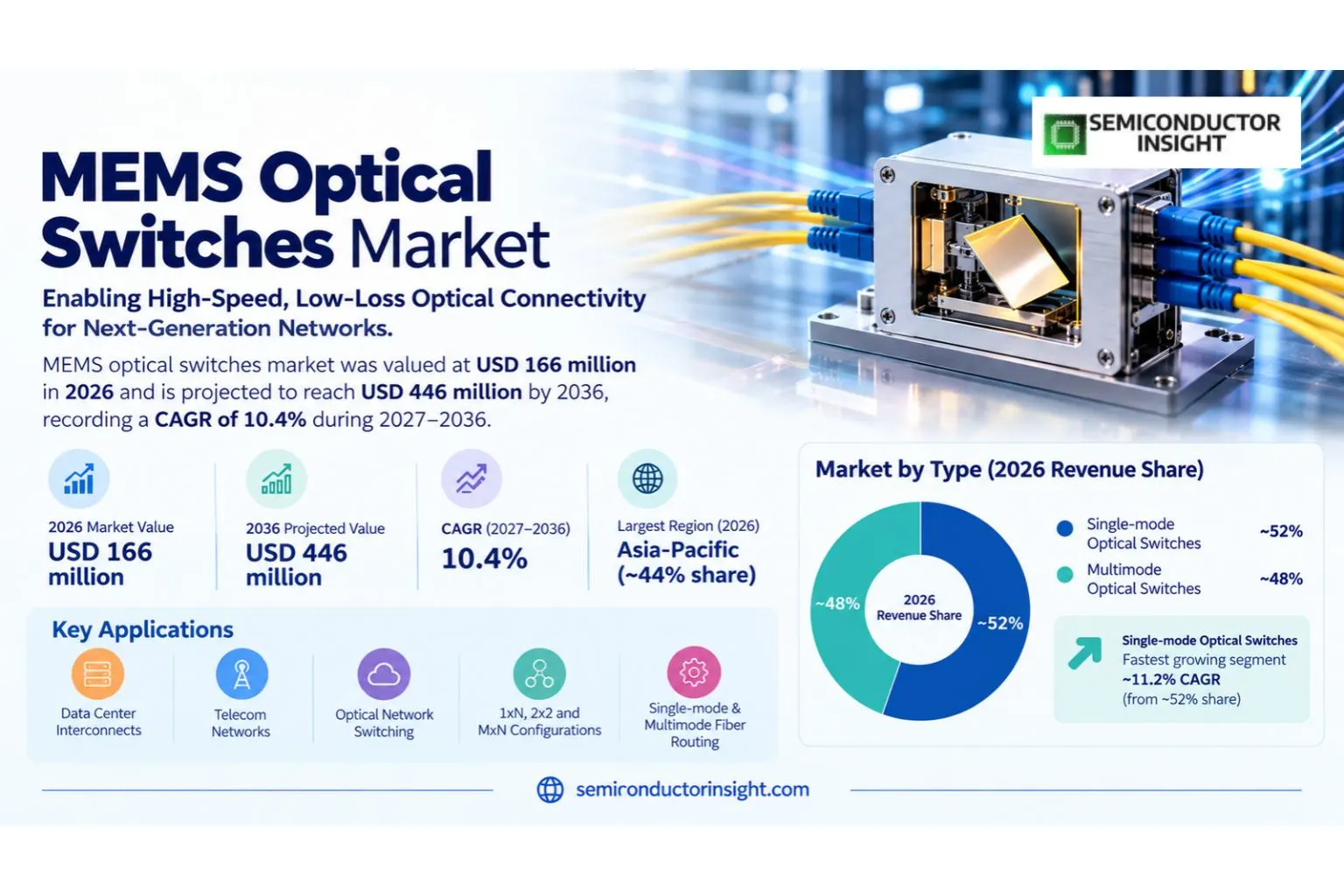
- Market trajectory: The global mems optical switches market reached USD 166 million in 2026 and is projected to reach USD 446 million by 2036 at 10.4% CAGR over 2027–2036. Demand follows the actual sale of microfabricated tilting-mirror switching modules that direct light between single-mode and multimode fibers, including 1xN fan-outs, 2×2 bypasses and MxN optical matrix configurations, rather than the full revenue of adjacent digital infrastructure.
- Single-mode Optical Switches leadership: Single-mode Optical Switches has the largest estimated type share at ~52% in 2026. The fastest-growing type is Single-mode Optical Switches, at ~11.2% CAGR from an estimated ~52% share. Single-mode MEMS optical switches route one spatial optical mode at a time, supporting long-reach telecom fibers, low-loss WDM paths, precise test fixtures and polarization-sensitive qualification.
- Fiber Optical Communication System demand: Fiber Optical Communication System leads application revenue at an estimated ~92% in 2026, while Test Equipment grows most rapidly near ~12.9% CAGR. Carrier networks and cloud-network cross-connect systems employ MEMS routing for fiber restoration, monitoring, bypass and optical circuit switching; some use switch matrix fabrics rather than simple 1xN devices. Within MEMS optical switches, for end-use systems in 2027, the purchase decision depends on explicit equipment compatibility, verifiable component performance and whether the supplier can sustain replacement support throughout the planned service interval.
- Asia-Pacific position: Asia-Pacific represents the largest regional revenue pool at an estimated ~44% in 2026. Asia-Pacific has the highest regional modeled growth at ~11.0% CAGR. China and Japan combine fiber network equipment production, automated module assembly and dense 5G network investment. MEMS matrix switches serve transceiver qualification racks and optical transport testing; singlemode products are favored for carrier optics, while multimode devices support short-reach manufacturing tests. Qualified equipment supply and pricing drive a substantial fraction of procurement.
- Principal constraint: MEMS mirror packaging and vibration sensitivity is a fundamental restraint. Purchase decisions are also affected by optical insertion loss and crosstalk limits. For MEMS optical switches, both conditions limit the speed at which a promising optical product can move into enduring installations; careful lifecycle support remains vital. In MEMS optical switches, in the adoption barriers setting, an engineering advantage becomes a sale only after procurement teams review validation evidence, inventory risk, maintenance requirements and the operating economics of the intended deployment.
MEMS Optical Switches Market Overview
MEMS optical switches market was valued at USD 166 million in 2026 and is projected to reach USD 446 million by 2036, recording a CAGR of 10.4% during 2027–2036. Asia-Pacific was the largest region in 2026 at an estimated ~44% share. The market centers on microfabricated tilting-mirror switching modules that direct light between single-mode and multimode fibers, including 1xN fan-outs, 2×2 bypasses and MxN optical matrix configurations.
MEMS Optical Switches encompasses microfabricated tilting-mirror switching modules that direct light between single-mode and multimode fibers, including 1xN fan-outs, 2×2 bypasses and MxN optical matrix configurations. Across MEMS optical switches, the optical interaction carries or secures the functional payload, but the device must also include appropriately designed mechanical, electronic and service interfaces. Among MEMS optical switches, customers primarily pay for a qualified system that performs consistently in field conditions, rather than a technical principle demonstrated only at prototype level.
The defined commercial boundary includes microelectromechanical tilting-mirror and compatible optical switching modules or assemblies for fiber path routing and automated optical testing; excludes mechanical shutter systems and whole telecom networks. When buying MEMS optical switches, this distinction prevents a finished datacenter, networking service or unrelated electronic product from being mistaken for direct sales of the specialized component. For suppliers of MEMS optical switches, supplier comparisons are meaningful only when the invoiced product and its value contribution fall within the stated market boundary.
At the engineering level, microfabricated tilting-mirror switching modules that direct light between single-mode and multimode fibers, including 1xN fan-outs, 2×2 bypasses and MxN optical matrix configurations. During qualification of MEMS optical switches, designing this technology for 2026 production requires material and mechanical stability, test coverage, procurement planning and the ability to identify a component that has begun to fail. Within MEMS optical switches, qualification routines can be more costly than the core material in demanding installations.
Demand develops through carrier optical-network maintenance teams, transceiver manufacturers, laboratory qualification engineers, data-center network operators and automated fiber test system integrators. For MEMS optical switches, those purchasers differ in the volumes they order, the length of their evaluation cycle and the documentation they require. The leading applications are Fiber Optical Communication System, Test Equipment; their spending patterns cannot simply be extrapolated from wider electronics or digital-storage demand.
Technology priorities are evolving toward more reliable and serviceable optical architectures. In MEMS optical switches, single-mode MEMS optical switches route one spatial optical mode at a time, supporting long-reach telecom fibers, low-loss WDM paths, precise test fixtures and polarization-sensitive qualification. Across MEMS optical switches, the commercial challenge is to turn those technical characteristics into repeat purchasing, while addressing loss of compatibility, changing interfaces and the long-term economics of support.
Segment Analysis: By Type
By type, the mems optical switches market comprises Single-mode Optical Switches, Multimode Optical Switches. Single-mode Optical Switches leads with an estimated ~52% revenue share in 2026; Single-mode Optical Switches expands most rapidly at about ~11.2% CAGR from a ~52% share. Among MEMS optical switches, different physical designs lead to different suppliers, levels of qualification and possible expansion rates.
| Type | Function | Market position |
|---|---|---|
| Single-mode Optical Switches | When buying Single-mode Optical Switches MEMS optical switches, single-mode MEMS optical switches route one spatial optical mode at a time, supporting long-reach telecom fibers, low-loss WDM paths, precise test fixtures and polarization-sensitive qualification. For suppliers of Single-mode Optical Switches MEMS optical switches, each product specification maps to a different material bill, operating environment and qualification procedure. Suppliers therefore need to establish how the Single-mode Optical Switches variant affects installation requirements and ongoing service. | Estimated ~52% of 2026 revenue and ~11.2% CAGR. Single-mode Optical Switches is the largest type by value, with demand linked to the particular requirements of its buyers. During qualification of Single-mode Optical Switches MEMS optical switches, single-mode MEMS optical switches route one spatial optical mode at a time, supporting long-reach telecom fibers, low-loss WDM paths, precise test fixtures and polarization-sensitive qualification. Within Single-mode Optical Switches MEMS optical switches, procurement teams evaluate component availability, unit cost and the necessary test records. |
| Multimode Optical Switches | Multimode MEMS devices support larger-core short-reach optical cables and automated manufacturing tests, where insertion-loss uniformity and compatibility with 50/125 or 62.5/125 fiber matter. For Multimode Optical Switches MEMS optical switches, each product specification maps to a different material bill, operating environment and qualification procedure. Suppliers therefore need to establish how the Multimode Optical Switches variant affects installation requirements and ongoing service. | Estimated ~48% of 2026 revenue and ~9.5% CAGR. Multimode Optical Switches is a distinct product category, with demand linked to the particular requirements of its buyers. In Multimode Optical Switches MEMS optical switches, multimode MEMS devices support larger-core short-reach optical cables and automated manufacturing tests, where insertion-loss uniformity and compatibility with 50/125 or 62.5/125 fiber matter. Across Multimode Optical Switches MEMS optical switches, procurement teams evaluate component availability, unit cost and the necessary test records. |
Segment Analysis: By Application
Application segments are Fiber Optical Communication System, Test Equipment. Fiber Optical Communication System takes the largest estimated 2026 revenue share at ~92%, whereas Test Equipment is the fastest-growing application at ~12.9% CAGR. Among MEMS optical switches, channel structure, end-user servicing needs and purchasing cadence create distinct addressable opportunities despite shared underlying optical technologies. This matters for application overview, because the technically feasible option must also be installable, serviceable and properly documented across the operating life of the equipment and its supporting software.
| Application | Demand characteristics |
|---|---|
| Fiber Optical Communication System | Estimated ~92% of 2026 revenue and ~10.2% CAGR. Carrier networks and cloud-network cross-connect systems employ MEMS routing for fiber restoration, monitoring, bypass and optical circuit switching; some use switch matrix fabrics rather than simple 1xN devices. When buying Fiber Optical Communication System MEMS optical switches, purchasers assess the entire cost of deploying and operating the optical function, including testability, compatible equipment and procurement lead times. |
| Test Equipment | Estimated ~8% of 2026 revenue and ~12.9% CAGR. Test laboratories and optical module factories use MEMS matrices to connect many devices under test to shared optical meters, with remote SCPI commands, repeatability and test throughput central to procurement. For suppliers of Test Equipment MEMS optical switches, purchasers assess the entire cost of deploying and operating the optical function, including testability, compatible equipment and procurement lead times. |
The commercial channel is shaped by carrier optical-network maintenance teams, transceiver manufacturers, laboratory qualification engineers, data-center network operators and automated fiber test system integrators. During qualification of MEMS optical switches, direct equipment purchase, specialist distributor supply and OEM qualification have different order economics. Within MEMS optical switches, volume can be won through stable specifications and documented reliability, while replacement sales depend on spare availability and retained interface compatibility over the 2027–2036 period.
Regional Analysis
Asia-Pacific leads global revenue with an estimated ~44% share in 2026. North America follows at ~27% and Europe at ~21%. Asia-Pacific has the fastest growth at ~11.0% CAGR. For MEMS optical switches, regional purchases and supplier manufacturing footprints must be distinguished for market comparisons. A commercial evaluation of regional lead therefore compares the cost of qualified materials, process yield, lead times, quality assurance and post-installation support rather than product specifications alone.
How do regional purchasing patterns differ in mems optical switches?
Asia-Pacific: China and Japan combine fiber network equipment production, automated module assembly and dense 5G network investment. In MEMS optical switches, mEMS matrix switches serve transceiver qualification racks and optical transport testing; singlemode products are favored for carrier optics, while multimode devices support short-reach manufacturing tests. Qualified equipment supply and pricing drive a substantial fraction of procurement. North America: US cloud operators and optical module labs purchase MEMS cross-connect and test switches for repeatable equipment validation. DiCon offers MEMS matrices extending to 192×192 ports, and EXFO markets related automation configurations. A large carrier backbone does not automatically imply comparable switch revenue; laboratory throughput and AI-network reconfiguration determine the addressable hardware requirements. Across MEMS optical switches, europe has distinct qualification and network compliance requirements; South America and the Middle East and Africa rely more heavily on imported products and local distribution service.
| Region | Position | Growth outlook | Demand profile | What decides supplier selection |
|---|---|---|---|---|
| Asia-Pacific | Largest (~44%) | ~11.0% CAGR | Asia-Pacific buying patterns for MEMS optical switches depend on The switch selection hinges on single-mode versus multimode fiber, insertion loss, port-count configuration, switching endurance and optical-power handling. Among Asia-Pacific MEMS optical switches buyers, application mix and supplier origin differ between lab-scale development and volume production, so hardware procurement must be evaluated against the actual system that incorporates the optical device. Remote control interoperability and traceable calibration can be essential for repeatable automated transceiver tests. | When buying Asia-Pacific MEMS optical switches buyers, buyers in Asia-Pacific require engineering fit, credible warranty conditions, appropriate import arrangements, and a qualified local service path. For microfabricated tilting-mirror switching modules that direct light between single-mode and multimode fibers, including 1xN fan-outs, 2×2 bypasses and MxN optical matrix configurations, interface stability and the availability of replacement products can determine whether a promising order proceeds beyond initial evaluation. |
| North America | Second (~27%) | ~10.3% CAGR | North America buying patterns for MEMS optical switches depend on The switch selection hinges on single-mode versus multimode fiber, insertion loss, port-count configuration, switching endurance and optical-power handling. For suppliers of North America MEMS optical switches buyers, application mix and supplier origin differ between lab-scale development and volume production, so hardware procurement must be evaluated against the actual system that incorporates the optical device. During qualification of North America MEMS optical switches buyers, remote control interoperability and traceable calibration can be essential for repeatable automated transceiver tests. | Within North America MEMS optical switches buyers, buyers in North America require engineering fit, credible warranty conditions, appropriate import arrangements, and a qualified local service path. For North America MEMS optical switches buyers, for microfabricated tilting-mirror switching modules that direct light between single-mode and multimode fibers, including 1xN fan-outs, 2×2 bypasses and MxN optical matrix configurations, interface stability and the availability of replacement products can determine whether a promising order proceeds beyond initial evaluation. |
| Europe | Third (~21%) | ~9.8% CAGR | Europe buying patterns for MEMS optical switches depend on The switch selection hinges on single-mode versus multimode fiber, insertion loss, port-count configuration, switching endurance and optical-power handling. In Europe MEMS optical switches buyers, application mix and supplier origin differ between lab-scale development and volume production, so hardware procurement must be evaluated against the actual system that incorporates the optical device. Across Europe MEMS optical switches buyers, remote control interoperability and traceable calibration can be essential for repeatable automated transceiver tests. | Among Europe MEMS optical switches buyers, buyers in Europe require engineering fit, credible warranty conditions, appropriate import arrangements, and a qualified local service path. When buying Europe MEMS optical switches buyers, for microfabricated tilting-mirror switching modules that direct light between single-mode and multimode fibers, including 1xN fan-outs, 2×2 bypasses and MxN optical matrix configurations, interface stability and the availability of replacement products can determine whether a promising order proceeds beyond initial evaluation. |
| South America | Fourth (~4%) | ~8.7% CAGR | South America buying patterns for MEMS optical switches depend on The switch selection hinges on single-mode versus multimode fiber, insertion loss, port-count configuration, switching endurance and optical-power handling. For suppliers of South America MEMS optical switches buyers, application mix and supplier origin differ between lab-scale development and volume production, so hardware procurement must be evaluated against the actual system that incorporates the optical device. During qualification of South America MEMS optical switches buyers, remote control interoperability and traceable calibration can be essential for repeatable automated transceiver tests. | Within South America MEMS optical switches buyers, buyers in South America require engineering fit, credible warranty conditions, appropriate import arrangements, and a qualified local service path. For South America MEMS optical switches buyers, for microfabricated tilting-mirror switching modules that direct light between single-mode and multimode fibers, including 1xN fan-outs, 2×2 bypasses and MxN optical matrix configurations, interface stability and the availability of replacement products can determine whether a promising order proceeds beyond initial evaluation. |
| Middle East & Africa | Fifth (~4%) | ~8.7% CAGR | Middle East & Africa buying patterns for MEMS optical switches depend on The switch selection hinges on single-mode versus multimode fiber, insertion loss, port-count configuration, switching endurance and optical-power handling. In Middle East & Africa MEMS optical switches buyers, application mix and supplier origin differ between lab-scale development and volume production, so hardware procurement must be evaluated against the actual system that incorporates the optical device. Across Middle East & Africa MEMS optical switches buyers, remote control interoperability and traceable calibration can be essential for repeatable automated transceiver tests. | Among Middle East & Africa MEMS optical switches buyers, buyers in Middle East & Africa require engineering fit, credible warranty conditions, appropriate import arrangements, and a qualified local service path. When buying Middle East & Africa MEMS optical switches buyers, for microfabricated tilting-mirror switching modules that direct light between single-mode and multimode fibers, including 1xN fan-outs, 2×2 bypasses and MxN optical matrix configurations, interface stability and the availability of replacement products can determine whether a promising order proceeds beyond initial evaluation. |
Competitive Landscape
Competition is led by firms with relevant microfabricated tilting-mirror switching modules that direct light between single-mode and multimode fibers, including 1xN fan-outs, 2×2 bypasses and MxN optical matrix configurations. Across MEMS optical switches suppliers, the competitive field includes established manufacturers, original equipment suppliers and historical product brands whose present scope differs. Among MEMS optical switches suppliers, buyers compare product-specific technical evidence and order terms instead of total corporate turnover, because an optical component represents only part of a finished digital system.
DiCon Fiberoptics and II-VI Incorporated illustrate different capabilities within the sector. When buying MEMS optical switches suppliers, their product portfolios, production locations and support arrangements cannot be assumed identical. For suppliers of MEMS optical switches suppliers, procurement departments typically request specification sheets, samples, aging or thermal data and a long-term sourcing plan before designating a manufacturing source for a multi-year contract. The 2027–2036 opportunity in manufacturer capability is linked to deployment timing and customer acceptance, with supplier selection reflecting reliability, supply continuity, interface requirements and actual unit economics.
ADAMANT, Thorlabs, Agiltron (Photonwares), Sercalo Microtechnology, Accelink appear in the wider manufacturer and distributor field. During qualification of MEMS optical switches suppliers, the roles of those entities require separation: media production, component housing manufacture, systems integration and distribution do not produce the same category of invoice. Within MEMS optical switches suppliers, market rivalry occurs at the level of the particular sold device, not across unrelated corporate divisions.
Other suppliers and historical business names include Flyin Optronics, Zhongshan Meisu Technolody, Anfiber, Opneti Communications Co.. For MEMS optical switches suppliers, legacy corporate names and regional branches may persist in industry directories, while actual current production must be checked against updated company disclosures. In MEMS optical switches suppliers, product-life-cycle changes can alter sourcing qualification even if an installed system continues to function with existing spare inventories.
Across MEMS optical switches suppliers, for 2027–2036, vendor differentiation will depend on manufacturing yield, documentation, reliable delivery and compatibility with demanding optical interfaces. Among MEMS optical switches suppliers, price competition may intensify in mature configurations, whereas new package geometries or archival media offer specialized margins. When buying MEMS optical switches suppliers, a customer switching supplier must weigh requalification, sample validation and operational interruption against lower unit costs. For competitive economics in 2032, the purchase decision depends on explicit equipment compatibility, verifiable component performance and whether the supplier can sustain replacement support throughout the planned service interval.
Tier structure
| Tier | Companies | Basis of competition |
|---|---|---|
| Tier 1 | DiCon Fiberoptics; II-VI Incorporated; ADAMANT | For suppliers of MEMS optical switches suppliers, direct manufacturers with published optical product or packaging activities differentiate through established process control and established technical catalogs. The first technical gate is the ability to supply microfabricated tilting-mirror switching modules that direct light between single-mode and multimode fibers, including 1xN fan-outs, 2×2 bypasses and MxN optical matrix configurations in a documented, reproducible format, followed by customer qualification and reliable lead times. |
| Tier 2 | Thorlabs; Agiltron (Photonwares); Sercalo Microtechnology; Accelink | During qualification of MEMS optical switches suppliers, regional producers and equipment suppliers compete through specialized configurations, responsive design assistance and local service. Within MEMS optical switches suppliers, customers generally request traceable quality records and samples in the exact form factor they need. For MEMS optical switches suppliers, lower production scale can be balanced by shorter engineering response times or customization of critical interfaces. In MEMS optical switches suppliers, in the tier 2 setting, an engineering advantage becomes a sale only after procurement teams review validation evidence, inventory risk, maintenance requirements and the operating economics of the intended deployment. |
| Tier 3 | EXFO; HUBER+SUHNER; Pickering Interfaces; HYGJ Communication; GLsun Science and Tech; O-Net; HYC; Gezhi Photonics; Flyin Optronics; Zhongshan Meisu Technolody; Anfiber; Opneti Communications Co. | Across MEMS optical switches suppliers, the broader value chain includes historical participants, distributors, integrators and component companies with adjacent expertise. Among MEMS optical switches suppliers, their names may appear in sector coverage without establishing that each currently sells an identical qualified device. When buying MEMS optical switches suppliers, product applicability is determined by specific device families, production status and customer approvals. For suppliers of MEMS optical switches suppliers, this matters for tier 3, because the technically feasible option must also be installable, serviceable and properly documented across the operating life of the equipment and its supporting software. |
Key companies profiled
- DiCon Fiberoptics
- II-VI Incorporated
- ADAMANT
- Thorlabs
- Agiltron (Photonwares)
- Sercalo Microtechnology
- Accelink
- EXFO
- HUBER+SUHNER
- Pickering Interfaces
- HYGJ Communication
- GLsun Science and Tech
- O-Net
- HYC
- Gezhi Photonics
- Flyin Optronics
- Zhongshan Meisu Technolody
- Anfiber
- Opneti Communications Co.
Production Capacity Analysis
Production capacity relies on specialized manufacturing and testing for microfabricated tilting-mirror switching modules that direct light between single-mode and multimode fibers, including 1xN fan-outs, 2×2 bypasses and MxN optical matrix configurations. During qualification of MEMS optical switches, effective output is constrained by qualified material lots, process yield, equipment availability and completion of electrical, optical and environmental tests. Within MEMS optical switches, announced industrial capability should not be equated automatically with installed sales or usable nameplate capacity.
Initial manufacturing operations include microfabricated tilting-mirror switching modules that direct light between single-mode and multimode fibers, including 1xN fan-outs, 2×2 bypasses and MxN optical matrix configurations. For MEMS optical switches, yield is influenced by each fabrication and assembly stage, while changes in materials or process equipment can require formal requalification. In MEMS optical switches, japan, China and other Asia-Pacific manufacturing centers support considerable supplier capacity, although customer purchasing decisions may originate elsewhere.
Across MEMS optical switches, diversified capacity can reduce country-of-origin exposure and help supply different qualification requirements. Among MEMS optical switches, however, transferring tooling and process knowledge between plants takes time, and products made in new locations may require fresh qualification. When buying MEMS optical switches, strong inventory controls and component traceability are important during a period of changing designs and volatile customer orders. For suppliers of MEMS optical switches, a commercial evaluation of capacity diversification therefore compares the cost of qualified materials, process yield, lead times, quality assurance and post-installation support rather than product specifications alone.
During qualification of MEMS optical switches, upstream constraints include materials, specialized assembly equipment and trained optical manufacturing staff. For mems optical switches, packaging, testing and maintenance infrastructure shape the ability to convert a technical design into reproducible revenue. Within MEMS optical switches, companies should distinguish capacity for direct in-scope products from headline capacity for the much larger adjacent electronics manufacturing market. For MEMS optical switches, the 2027–2036 opportunity in capacity bottlenecks is linked to deployment timing and customer acceptance, with supplier selection reflecting reliability, supply continuity, interface requirements and actual unit economics.
Market Dynamics
Demand is driven by dense fiber-network test and monitoring demand and automated optical transceiver factory qualification. In MEMS optical switches lead, growth depends on matching the optical product to qualification requirements, logistics and total ownership cost. Supplier economics also reflect the negative impact of mems mirror packaging and vibration sensitivity, particularly when customers require long operational support. For dynamics lead in 2027, the purchase decision depends on explicit equipment compatibility, verifiable component performance and whether the supplier can sustain replacement support throughout the planned service interval.
MARKET DRIVERS
Drivers Impact Analysis*
| Driver | (~) % impact on CAGR forecast | Geographic relevance | Impact timeline |
|---|---|---|---|
| Dense fiber-network test and monitoring demand | +1.8% | Asia-Pacific | 2027–2036 |
| Automated optical transceiver factory qualification | +1.4% | Global | 2028–2034 |
| Hyperscale optical circuit switching interest | +1.1% | North America | 2027–2031 |
| Expansion of 5G fiber transport and reliability testing | +0.9% | Europe | 2029–2036 |
| High port-count reconfigurable test racks | +0.7% | Global | 2028–2035 |
Dense fiber-network test and monitoring demand
Dense fiber-network test and monitoring demand supports specialized purchases for mems optical switches. microfabricated tilting-mirror switching modules that direct light between single-mode and multimode fibers, including 1xN fan-outs, 2×2 bypasses and MxN optical matrix configurations must be integrated into customer processes, inspected and supported. Across MEMS optical switches drivers, the growth effect is directional, not a separate addition to the headline CAGR. Among MEMS optical switches drivers, actual adoption depends on confirmed orders, service requirements and the lifecycle of equipment already installed.
Automated optical transceiver factory qualification
Automated optical transceiver factory qualification supports specialized purchases for mems optical switches. microfabricated tilting-mirror switching modules that direct light between single-mode and multimode fibers, including 1xN fan-outs, 2×2 bypasses and MxN optical matrix configurations must be integrated into customer processes, inspected and supported. When buying MEMS optical switches drivers, the growth effect is directional, not a separate addition to the headline CAGR. For suppliers of MEMS optical switches drivers, actual adoption depends on confirmed orders, service requirements and the lifecycle of equipment already installed.
Hyperscale optical circuit switching interest
Hyperscale optical circuit switching interest supports specialized purchases for mems optical switches. microfabricated tilting-mirror switching modules that direct light between single-mode and multimode fibers, including 1xN fan-outs, 2×2 bypasses and MxN optical matrix configurations must be integrated into customer processes, inspected and supported. During qualification of MEMS optical switches drivers, the growth effect is directional, not a separate addition to the headline CAGR. Within MEMS optical switches drivers, actual adoption depends on confirmed orders, service requirements and the lifecycle of equipment already installed.
Expansion of 5G fiber transport and reliability testing
Expansion of 5G fiber transport and reliability testing supports specialized purchases for mems optical switches. microfabricated tilting-mirror switching modules that direct light between single-mode and multimode fibers, including 1xN fan-outs, 2×2 bypasses and MxN optical matrix configurations must be integrated into customer processes, inspected and supported. For MEMS optical switches drivers, the growth effect is directional, not a separate addition to the headline CAGR. In MEMS optical switches drivers, actual adoption depends on confirmed orders, service requirements and the lifecycle of equipment already installed.
MARKET RESTRAINTS
Restraints Impact Analysis*
| Restraint | (~) % impact on CAGR forecast | Geographic relevance | Impact timeline |
|---|---|---|---|
| MEMS mirror packaging and vibration sensitivity | −1.5% | Global | 2027–2036 |
| Optical insertion loss and crosstalk limits | −1.1% | Europe and North America | 2027–2034 |
| Competition from thermo-optic integrated switches | −0.8% | Asia-Pacific | 2028–2035 |
| System software integration and qualification costs | −0.6% | Global | 2029–2036 |
MEMS mirror packaging and vibration sensitivity
MEMS mirror packaging and vibration sensitivity increases the effort required to qualify or replace mems optical switches. Across MEMS optical switches restraints, a technical disadvantage can translate into delayed procurement, more maintenance work or poorer economics for the user. Among MEMS optical switches restraints, suppliers that demonstrate stable performance and clear service processes may offset some of this commercial risk, but the constraint remains important for 2027–2036 forecasts. In the MEMS mirror packaging and vibration sensitivity restraint setting, an engineering advantage becomes a sale only after procurement teams review validation evidence, inventory risk, maintenance requirements and the operating economics of the intended deployment.
Optical insertion loss and crosstalk limits
Optical insertion loss and crosstalk limits increases the effort required to qualify or replace mems optical switches. When buying MEMS optical switches restraints, a technical disadvantage can translate into delayed procurement, more maintenance work or poorer economics for the user. For suppliers of MEMS optical switches restraints, suppliers that demonstrate stable performance and clear service processes may offset some of this commercial risk, but the constraint remains important for 2027–2036 forecasts. This matters for Optical insertion loss and crosstalk limits restraint, because the technically feasible option must also be installable, serviceable and properly documented across the operating life of the equipment and its supporting software.
Competition from thermo-optic integrated switches
Competition from thermo-optic integrated switches increases the effort required to qualify or replace mems optical switches. During qualification of MEMS optical switches restraints, a technical disadvantage can translate into delayed procurement, more maintenance work or poorer economics for the user. Within MEMS optical switches restraints, suppliers that demonstrate stable performance and clear service processes may offset some of this commercial risk, but the constraint remains important for 2027–2036 forecasts. A commercial evaluation of Competition from thermo-optic integrated switches restraint therefore compares the cost of qualified materials, process yield, lead times, quality assurance and post-installation support rather than product specifications alone.
System software integration and qualification costs
System software integration and qualification costs increases the effort required to qualify or replace mems optical switches. For MEMS optical switches restraints, a technical disadvantage can translate into delayed procurement, more maintenance work or poorer economics for the user. In MEMS optical switches restraints, suppliers that demonstrate stable performance and clear service processes may offset some of this commercial risk, but the constraint remains important for 2027–2036 forecasts. The 2027–2036 opportunity in System software integration and qualification costs restraint is linked to deployment timing and customer acceptance, with supplier selection reflecting reliability, supply continuity, interface requirements and actual unit economics.
MARKET OPPORTUNITIES
MEMS matrices for shared AI interconnect fabrics
MEMS matrices for shared AI interconnect fabrics creates an opportunity to improve deployment or the supplier value proposition. The relevant engineering work concerns microfabricated tilting-mirror switching modules that direct light between single-mode and multimode fibers, including 1xN fan-outs, 2×2 bypasses and MxN optical matrix configurations. Across MEMS optical switches opps, buyers still require evidence of stable operation, a practical purchasing channel, training and a predictable replacement schedule. Among MEMS optical switches opps, the commercial impact is strongest where those requirements can be standardized across several customers.
Remote-control optical test instruments
Remote-control optical test instruments creates an opportunity to improve deployment or the supplier value proposition. When buying MEMS optical switches opps, the relevant engineering work concerns microfabricated tilting-mirror switching modules that direct light between single-mode and multimode fibers, including 1xN fan-outs, 2×2 bypasses and MxN optical matrix configurations. For suppliers of MEMS optical switches opps, buyers still require evidence of stable operation, a practical purchasing channel, training and a predictable replacement schedule. During qualification of MEMS optical switches opps, the commercial impact is strongest where those requirements can be standardized across several customers.
Network restoration and monitoring applications
Network restoration and monitoring applications creates an opportunity to improve deployment or the supplier value proposition. Within MEMS optical switches opps, the relevant engineering work concerns microfabricated tilting-mirror switching modules that direct light between single-mode and multimode fibers, including 1xN fan-outs, 2×2 bypasses and MxN optical matrix configurations. For MEMS optical switches opps, buyers still require evidence of stable operation, a practical purchasing channel, training and a predictable replacement schedule. In MEMS optical switches opps, the commercial impact is strongest where those requirements can be standardized across several customers.
Custom low-power polarization maintaining switches
Custom low-power polarization maintaining switches creates an opportunity to improve deployment or the supplier value proposition. Across MEMS optical switches opps, the relevant engineering work concerns microfabricated tilting-mirror switching modules that direct light between single-mode and multimode fibers, including 1xN fan-outs, 2×2 bypasses and MxN optical matrix configurations. Among MEMS optical switches opps, buyers still require evidence of stable operation, a practical purchasing channel, training and a predictable replacement schedule. When buying MEMS optical switches opps, the commercial impact is strongest where those requirements can be standardized across several customers.
Supply Chain Analysis
The supply chain links specialized raw materials, device fabrication, verification, system integration and servicing for mems optical switches. A failure at any stage can invalidate the qualified end product. For suppliers of MEMS optical switches channels, vendor selection is therefore affected by more than selling price: replacement-component availability, inspection data, lead time and the ability to support legacy interfaces are commercially significant.
Upstream materials. In MEMS optical switches channels, materials and optical substrates required for microfabricated tilting-mirror switching modules that direct light between single-mode and multimode fibers, including 1xN fan-outs, 2×2 bypasses and MxN optical matrix configurations; inspection before assembly. For mems optical switches, controlling change across this stage enables traceability, reliability and repeatable delivery. Across MEMS optical switches channels, purchasing teams demand technical records that explain product behavior and clarify responsibility if a component fails after deployment.
Manufacturing. Fabrication, alignment, sealing or recording operations matched to the market boundary. Among MEMS optical switches channels, for mems optical switches, controlling change across this stage enables traceability, reliability and repeatable delivery. When buying MEMS optical switches channels, purchasing teams demand technical records that explain product behavior and clarify responsibility if a component fails after deployment. This matters for Manufacturing chain, because the technically feasible option must also be installable, serviceable and properly documented across the operating life of the equipment and its supporting software.
Channels. For suppliers of MEMS optical switches channels, oEM engineering contracts, technical distributors and integrated storage or optical equipment vendors. During qualification of MEMS optical switches channels, for mems optical switches, controlling change across this stage enables traceability, reliability and repeatable delivery. Within MEMS optical switches channels, purchasing teams demand technical records that explain product behavior and clarify responsibility if a component fails after deployment. A commercial evaluation of Channels chain therefore compares the cost of qualified materials, process yield, lead times, quality assurance and post-installation support rather than product specifications alone.
Downstream users. For MEMS optical switches channels, carrier optical-network maintenance teams, transceiver manufacturers, laboratory qualification engineers, data-center network operators and automated fiber test system integrators; qualification, deployment and lifecycle support. In MEMS optical switches channels, for mems optical switches, controlling change across this stage enables traceability, reliability and repeatable delivery. Across MEMS optical switches channels, purchasing teams demand technical records that explain product behavior and clarify responsibility if a component fails after deployment for the 28 publication.
Recent Developments
- 2026 Published
EXFO detailed specifications for its MXS-9200 MEMS optical switch family, including high-port-count configurations and automated operation. Optical module manufacturers use remotely configured matrices to move fiber paths between shared instruments and multiple devices under test, improving repeatability and lab utilization; procurement still depends on insertion loss and test throughput. The 2027–2036 opportunity in MEMS Optical Switches development 2026 is linked to deployment timing and customer acceptance, with supplier selection reflecting reliability, supply continuity, interface requirements and actual unit economics. Source - 2026 Published
DiCon published a technical specification for a multimode 16×16 MEMS three-dimensional matrix switch card. The module redirects optical signals between many channels using micromirrors and targets shared test equipment. It indicates product-line development beyond simple single-path switches and reinforces a distinct market for automated production test routing. For MEMS Optical Switches development 2026 in 2032, the purchase decision depends on explicit equipment compatibility, verifiable component performance and whether the supplier can sustain replacement support throughout the planned service interval. Source - 16 June 2026 Published
Ericsson forecast strong growth in Indian 5G subscriptions in its 2026 mobility outlook. Higher transport throughput creates greater need for optical module reliability and maintenance diagnostics, although subscription forecasts are not a count of MEMS switches purchased. Vendors need to translate network investment into measurable test or optical-path orders. In the MEMS Optical Switches development 16 June 2026 setting, an engineering advantage becomes a sale only after procurement teams review validation evidence, inventory risk, maintenance requirements and the operating economics of the intended deployment. Source - 18 July 2025 Published
HUBER+SUHNER highlighted the 25-year development history of POLATIS optical circuit switching. The update emphasizes operational know-how in fiber switching and service, a factor that matters when cloud operators compare optical switching technologies against electrical fabrics with mature management and maintenance workflows. A commercial evaluation of MEMS Optical Switches development 18 July 2025 therefore compares the cost of qualified materials, process yield, lead times, quality assurance and post-installation support rather than product specifications alone. Source - 12 June 2025 Announced
HUBER+SUHNER opened a POLATIS optical circuit switch production facility in Pisary, Poland, and described plans to increase production capacity at least fivefold. The initiative was linked to growing AI-data-center demand for optical path switching, showing a meaningful industrial commitment rather than an isolated laboratory optical switch prototype. This matters for MEMS Optical Switches development 12 June 2025, because the technically feasible option must also be installable, serviceable and properly documented across the operating life of the equipment and its supporting software. Source - 2025 Published
The European Commission 5G Observatory tracked changes in 5G coverage and operator deployment across Europe. Additional optical front-haul and transport needs can support monitoring and optical test switch purchases, but wireless coverage itself is not a direct proxy for MEMS unit shipments or vendor market share. The 2027–2036 opportunity in MEMS Optical Switches development 2025 is linked to deployment timing and customer acceptance, with supplier selection reflecting reliability, supply continuity, interface requirements and actual unit economics. Source - 2025 Published
The European 3PEAT program documented photonic switching integration and demonstrator work involving multiple waveguide and control technologies. It provides technical evidence that solid-state and integrated-optical alternatives can compete with MEMS switches in selected systems, limiting the assumption that every future optical fabric will use micromirrors. For MEMS Optical Switches development 2025 in 2027, the purchase decision depends on explicit equipment compatibility, verifiable component performance and whether the supplier can sustain replacement support throughout the planned service interval. Source - 2025 Published
The ITU reported continuing global internet adoption and persistent gaps in connectivity. Fiber network expansion creates a need for installation tests and maintenance, where MEMS switches can automate measurement paths, but actual device revenue depends on laboratory and network operating budgets rather than the total user count. In the MEMS Optical Switches development 2025 setting, an engineering advantage becomes a sale only after procurement teams review validation evidence, inventory risk, maintenance requirements and the operating economics of the intended deployment. Source
REPORT SCOPE & SEGMENTATION
| Attribute | Details |
|---|---|
| Study Period | 2021–2036 |
| Base Year | 2026 |
| Estimated Year | 2027 |
| Forecast Period | 2027–2036 |
| Historical Period | 2021–2025 |
| Base Year Market Size | USD 166 million |
| Estimated Year Market Size | USD 183 million |
| Forecast Year Market Size | USD 446 million |
| CAGR | 10.4% |
| Unit | USD million |
| Market Definition | microelectromechanical tilting-mirror and compatible optical switching modules or assemblies for fiber path routing and automated optical testing; excludes mechanical shutter systems and whole telecom networks |
| By Type | Single-mode Optical Switches · Multimode Optical Switches |
| By Application | Fiber Optical Communication System · Test Equipment |
| By Region | Asia-Pacific telecom and optical-equipment production, North American cloud-network qualification and European automation laboratories create distinct purchasing patterns for high-port-count MEMS optical switches. Asia-PacificChina · Japan · India · South Korea North AmericaUnited States · Canada · Mexico EuropeGermany · United Kingdom · France South AmericaBrazil · Chile · Argentina Middle East & AfricaSaudi Arabia · United Arab Emirates · South Africa |
| Key Companies Profiled | DiCon Fiberoptics; II-VI Incorporated; ADAMANT; Thorlabs; Agiltron (Photonwares); Sercalo Microtechnology; Accelink; EXFO; HUBER+SUHNER; Pickering Interfaces; HYGJ Communication; GLsun Science and Tech; O-Net; HYC; Gezhi Photonics; Flyin Optronics; Zhongshan Meisu Technolody; Anfiber; Opneti Communications Co. |
| Customization Scope | Supplier, type, application and regional price analysis for mems optical switches; estimated market shares in 2026 and differentiated growth paths for 2027–2036. |
Frequently Asked Questions
What is the global mems optical switches market size?
The global mems optical switches market is valued at USD 166 million in 2026 and is forecast to reach USD 446 million by 2036, with 10.4% CAGR during 2027–2036. Among MEMS optical switches purchasers, the demand boundary is specific to the optical equipment and technology defined here rather than the full revenue of all data-center, media, automotive or electronics systems.
Which geographic region is the largest market?
Asia-Pacific is the leading 2026 regional market with an estimated ~44% of revenue. North America and Europe follow at ~27% and ~21%, respectively. When buying MEMS optical switches purchasers, differences in OEM manufacturing locations and customer purchasing geography can otherwise distort region comparisons. This matters for FAQ 2, because the technically feasible option must also be installable, serviceable and properly documented across the operating life of the equipment and its supporting software.
Which region has the fastest growth rate?
Asia-Pacific has the highest estimated regional expansion at ~11.0% CAGR through 2036. For suppliers of MEMS optical switches purchasers, china and Japan combine fiber network equipment production, automated module assembly and dense 5G network investment. During qualification of MEMS optical switches purchasers, mEMS matrix switches serve transceiver qualification racks and optical transport testing; singlemode products are favored for carrier optics, while multimode devices support short-reach manufacturing tests. Qualified equipment supply and pricing drive a substantial fraction of procurement. Within MEMS optical switches purchasers, the rate is linked to equipment deployment, supplier qualification and the technology mix, rather than broad GDP growth alone.
Which type holds the largest revenue share?
Single-mode Optical Switches represents an estimated ~52% of the 2026 market. For MEMS optical switches purchasers, single-mode MEMS optical switches route one spatial optical mode at a time, supporting long-reach telecom fibers, low-loss WDM paths, precise test fixtures and polarization-sensitive qualification. In MEMS optical switches purchasers, buyers need to verify its performance, equipment compatibility and the available delivery chain before treating it as an interchangeable substitute for another optical format.
Which type is projected to expand fastest?
Single-mode Optical Switches carries the strongest estimated type growth at ~11.2% CAGR, from around ~52% of 2026 revenue. Across MEMS optical switches purchasers, the product mix changes as users adopt performance-enhancing configurations, but engineering qualification and lifecycle servicing determine how quickly that potential converts into orders. A commercial evaluation of FAQ 5 therefore compares the cost of qualified materials, process yield, lead times, quality assurance and post-installation support rather than product specifications alone.
What is the leading application?
Fiber Optical Communication System is the largest application at approximately ~92% of 2026 revenue. Among MEMS optical switches purchasers, carrier networks and cloud-network cross-connect systems employ MEMS routing for fiber restoration, monitoring, bypass and optical circuit switching; some use switch matrix fabrics rather than simple 1xN devices. When buying MEMS optical switches purchasers, procurement specifications depend on actual operating conditions; total revenue in the wider user industry is not a direct proxy for the value of optical equipment purchased.
Which application grows fastest?
Test Equipment is projected to grow at ~12.9% CAGR from approximately ~8% of 2026 revenue. Test laboratories and optical module factories use MEMS matrices to connect many devices under test to shared optical meters, with remote SCPI commands, repeatability and test throughput central to procurement. For suppliers of MEMS optical switches purchasers, growth is affected by price changes and supplier qualification as well as physical unit demand.
Which companies are included?
The profiled market participants include DiCon Fiberoptics, II-VI Incorporated, ADAMANT, Thorlabs, Agiltron (Photonwares), Sercalo Microtechnology. During qualification of MEMS optical switches purchasers, these companies may operate in different parts of the value chain and in some cases retain historical naming. Within MEMS optical switches purchasers, comparisons need to distinguish direct in-scope equipment manufacturing from distribution, materials and wider group revenues. The 2027–2036 opportunity in FAQ 8 is linked to deployment timing and customer acceptance, with supplier selection reflecting reliability, supply continuity, interface requirements and actual unit economics.
What restrains adoption?
MEMS mirror packaging and vibration sensitivity is a notable limitation, alongside optical insertion loss and crosstalk limits. Customers must also examine service cost, quality-control requirements and purchasing terms. For MEMS optical switches purchasers, technical improvement will not necessarily produce corresponding annual revenue growth without reproducible production and access to qualified buyers. For FAQ 9 in 2032, the purchase decision depends on explicit equipment compatibility, verifiable component performance and whether the supplier can sustain replacement support throughout the planned service interval.
What is the study period and segmentation scope?
In MEMS optical switches purchasers, the base year is 2026, the estimated year is 2027, and the forecast runs through 2036 with historical context from 2021–2025. Segmentation by type covers Single-mode Optical Switches, Multimode Optical Switches and by application covers Fiber Optical Communication System, Test Equipment. Five geographic regions are included. In the FAQ 10 setting, an engineering advantage becomes a sale only after procurement teams review validation evidence, inventory risk, maintenance requirements and the operating economics of the intended deployment.
Research Sources & Evidence Base
Get Sample Report PDF for Exclusive Insights
Report Sample Includes
- Table of Contents
- List of Tables & Figures
- Charts, Research Methodology, and more...
 Download Sample Report PDF