MARKET INSIGHTS
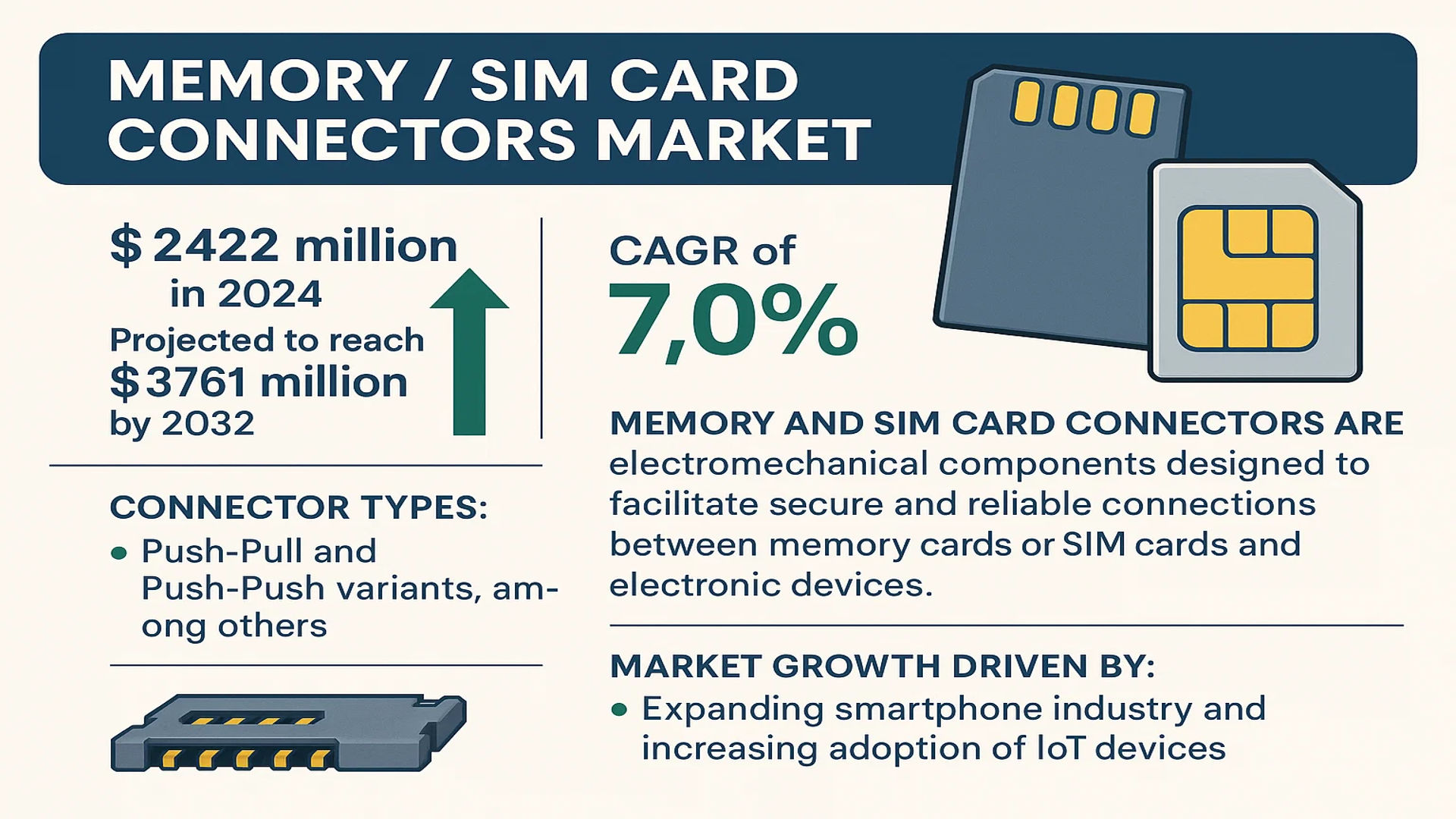
The global Memory / SIM Card Connectors Market was valued at 2422 million in 2024 and is projected to reach US$ 3761 million by 2032, at a CAGR of 7.0% during the forecast period.
Memory and SIM card connectors are electromechanical components designed to facilitate secure and reliable connections between memory cards or SIM cards and electronic devices. These interfaces play a critical role in ensuring stable electrical contact for data storage, processing, and communication functions across various applications. The connector types include Push-Pull and Push-Push variants, among others, with each offering distinct mechanical advantages for different device configurations.
The market growth is primarily driven by the expanding smartphone industry and increasing adoption of IoT devices, both of which require high-performance connectivity solutions. While the communications sector remains the dominant application area, financial and healthcare segments are showing accelerated demand due to rising security requirements for transactions and medical data. Major manufacturers like TE Connectivity, Molex, and Amphenol continue to innovate with compact, high-durability designs to meet evolving industry standards for miniaturization and performance.
MARKET DRIVERS
Proliferation of Smartphone and IoT Devices to Fuel Demand for Memory/SIM Card Connectors
The global smartphone market surpassed 1.4 billion unit shipments in 2024, with emerging markets driving continuous growth. This rapid adoption is directly increasing demand for reliable memory and SIM card connectivity solutions. Moreover, the Internet of Things (IoT) ecosystem is expanding significantly, with over 30 billion connected devices projected by 2030. These devices increasingly incorporate removable storage and connectivity options, requiring robust connector solutions to ensure data integrity and seamless communication.
Advancements in 5G Technology Accelerating Market Expansion
The global rollout of 5G networks is transforming connectivity requirements across industries. 5G-enabled devices demand higher performance memory connectors capable of supporting faster data transfer rates exceeding 10 Gbps. Network operators worldwide are rapidly deploying 5G infrastructure, with coverage expected to reach 60% of the global population by 2030. This infrastructure development is driving the need for enhanced SIM card connectors that can support embedded SIM (eSIM) technologies while maintaining backward compatibility with traditional SIM formats.
Growing Automotive Electronics Market Creating New Opportunities
Modern vehicles now incorporate numerous electronic control units requiring reliable data storage solutions. The automotive electronics market is projected to grow at a CAGR of 7.5% through 2032, with connected car technologies being a significant growth driver. Memory card connectors in automotive applications must meet stringent durability requirements, capable of withstanding vibrations, temperature extremes, and long operational lifespans. The transition to electric vehicles, which feature 40-50% more electronic components than conventional vehicles, is further amplifying this demand.
MARKET CHALLENGES
Miniaturization Demands Increasing Design Complexity
As consumer electronics continue shrinking in size, connector manufacturers face mounting challenges in maintaining reliability while reducing footprint. Today’s smartphones allocate less than 2% of their internal volume to SIM and memory card components, compared to 5% a decade ago. This compression necessitates innovative contact designs and materials that can deliver consistent performance despite reduced mechanical tolerances.
Other Challenges
Material Cost Volatility
The connector market is particularly sensitive to fluctuations in precious metal prices, as many contact designs rely on gold plating for corrosion resistance. Recent geopolitical tensions have created supply chain uncertainties for these specialized materials, with gold prices experiencing 20% volatility in 2024 alone.
Standardization Fragmentation
The industry continues to grapple with competing memory card form factors and evolving SIM standards. While the SD Association maintains SD card specifications, proprietary formats from major manufacturers create compatibility challenges. Similarly, the transition from nano-SIM to eSIM adoption varies significantly by region and carrier.
MARKET RESTRAINTS
Cloud Storage Adoption Impacting Removable Media Demand
The global cloud storage market is growing at 22% annually, reducing reliance on physical storage media in many applications. Enterprise adoption of cloud solutions has reached 94% among Fortune 500 companies, with many eliminating removable storage options from corporate devices due to security concerns. While consumer devices still incorporate memory card slots, their utilization rates have declined by 35% compared to 2015 levels as streaming and cloud synchronization become ubiquitous.
Supply Chain Disruptions Affecting Production Capacity
The precision manufacturing required for memory and SIM connectors makes the industry vulnerable to supply chain interruptions. Recent semiconductor shortages have cascaded into connector component availability, with lead times for certain connector types extending beyond 30 weeks in 2024. This volatility creates challenges for manufacturers balancing inventory costs with delivery commitments, particularly for low-margin, high-volume connector products.
MARKET OPPORTUNITIES
Expansion of Industrial IoT Creating New Application Verticals
Industrial IoT deployments are growing at 24% annually, with smart manufacturing applications driving demand for ruggedized memory solutions. These environments require connectors that can withstand harsh conditions while maintaining data integrity. Industrial applications now represent 15% of the total memory connector market, up from 8% five years ago, with further growth expected as Industry 4.0 adoption accelerates.
Emerging Markets Present Untapped Growth Potential
Developing regions in Asia and Africa continue to show strong demand for affordable smartphones and feature phones that rely on removable storage. These markets accounted for 65% of global SIM card shipments in 2024, with prepaid services dominating mobile subscriptions. Manufacturers developing cost-optimized connector solutions for these price-sensitive markets can capitalize on this ongoing growth opportunity.
MEMORY / SIM CARD CONNECTORS MARKET TRENDS
Growing Demand for Miniaturized Connectors in Smart Devices
The rapid adoption of compact and high-performance electronic devices is driving the demand for miniaturized memory and SIM card connectors. With smartphones, IoT devices, and wearables becoming smaller yet more powerful, manufacturers are focusing on ultra-thin and space-saving connector designs. Push-pull connectors, which dominate the market, accounted for over 40% share in 2024, while innovations in push-push connectors are gaining traction in enterprise and industrial applications. The global market is projected to grow at a 7.0% CAGR, reaching $3.76 billion by 2032, primarily fueled by advancements in 5G-enabled devices requiring robust SIM card integration.
Other Trends
Expansion of 5G and IoT Ecosystems
The deployment of 5G networks and IoT infrastructure is accelerating the need for reliable SIM card connectors capable of high-speed data transmission. As telecom operators worldwide upgrade their infrastructure, dual-interface SIM connectors (combining traditional contact-based and NFC functionalities) are witnessing a surge in demand. The Asia-Pacific region, particularly China and South Korea, leads in adoption due to aggressive 5G rollouts, contributing to over 35% of the global SIM card connector market revenue. Meanwhile, industrial IoT applications are driving demand for ruggedized memory connectors resistant to vibration and environmental stress.
Technological Advancements in Contact Materials
Connector manufacturers are investing in novel contact materials to improve durability and signal integrity. Gold-plated contacts, while premium-priced, are gaining preference in high-end applications due to their oxidation resistance and consistent performance. Recent developments include the use of palladium-cobalt alloys in SIM card connectors, offering 30-40% longer lifespan compared to traditional nickel contacts. Additionally, advancements in automated manufacturing have enabled precision assembly of connectors with 0.2mm pitch designs, meeting the demands of next-generation memory cards and embedded SIM solutions.
Shift Toward Embedded SIM (eSIM) Technology
The transition from physical SIM cards to embedded SIM solutions is reshaping the connector market landscape. While this poses challenges for traditional SIM card connector suppliers, it creates opportunities for innovative connector designs in M2M (Machine-to-Machine) applications. Automotive OEMs are particularly driving this shift, with over 60% of new connected vehicles expected to adopt eSIM technology by 2027. However, the persistent need for removable memory in professional cameras, industrial equipment, and legacy devices ensures continued demand for robust memory card connectors despite the eSIM disruption.
COMPETITIVE LANDSCAPE
Key Industry Players
Market Leaders Focus on Innovation to Capture Expanding Global Demand
The global Memory/SIM Card Connectors market exhibits a moderately consolidated competitive landscape, with established electronics component manufacturers holding significant shares. TE Connectivity and Molex currently dominate the market through their comprehensive connector solutions portfolio and strong relationships with device manufacturers. TE Connectivity maintains about 18% market share in the connector segment as of 2024, benefitting from its vertical integration capabilities.
Japanese manufacturers Hosiden Corporation and JAE Electronics hold strong positions in Asia-Pacific markets, collectively accounting for approximately 22% of regional sales. Their growth stems from precision engineering capabilities and partnerships with major smartphone manufacturers. Meanwhile, Amphenol continues to expand its footprint through strategic acquisitions, including recent purchases of smaller connector specialists in Europe.
The market sees intense competition in miniaturization technologies as companies race to develop smaller, more reliable connectors for next-generation mobile devices. Yamaichi Electronics, for instance, recently launched its ultra-low profile SIM card connector series, gaining traction among wearable device makers. Other players like Hirose Electric focus on high-durability solutions for industrial applications, creating distinct market niches.
Emerging competition comes from Chinese manufacturers such as Kingmax Semiconductor, which leverages cost advantages to penetrate budget device segments. However, quality concerns and intellectual property issues continue to challenge these newer entrants when competing for premium applications.
List of Key Memory/SIM Card Connector Manufacturers
- TE Connectivity Ltd. (Switzerland)
- Molex LLC (U.S.)
- Hosiden Corporation (Japan)
- JAE Electronics, Inc. (Japan)
- Amphenol Corporation (U.S.)
- Yamaichi Electronics Co., Ltd. (Germany)
- Hirose Electric Co., Ltd. (Japan)
- Kingmax Semiconductor Inc. (China)
- Transcend Information, Inc. (Taiwan)
- Panasonic Corporation (Japan)
Recent industry movements include TE Connectivity’s expansion of its Malaysian production facility and Molex’s collaboration with a major smartphone OEM to develop custom SIM tray solutions. These developments indicate the market’s direction toward specialized, application-specific connector solutions as differentiation becomes increasingly critical.
Segment Analysis:
By Type
Push-Pull Connectors Dominate the Market Due to Their Secure and Durable Design
The market is segmented based on type into:
- Push-Pull Connectors
- Subtypes: Standard push-pull, slim push-pull, and others
- Push-Push Connectors
- Subtypes: Auto-eject, manual-eject, and others
- Others
- Subtypes: Hinged, sliding, and spring-loaded connectors
By Application
Communications Segment Leads Due to High Adoption in Smartphones and IoT Devices
The market is segmented based on application into:
- Communications
- Subtypes: Smartphones, tablets, wearables, and IoT devices
- Financial
- Subtypes: Payment terminals, banking cards, and secure ID cards
- Industrial
- Subtypes: Automation systems, embedded systems, and testing equipment
- Healthcare
- Subtypes: Medical devices, diagnostic equipment, and telemedicine solutions
- Others
By End User
Consumer Electronics Segment Holds Significant Market Share
The market is segmented based on end user into:
- Consumer Electronics
- Subtypes: Smartphone manufacturers, tablet makers, and wearable producers
- Telecommunications
- Subtypes: Network equipment providers and telecommunication service providers
- Healthcare Providers
- Subtypes: Medical device manufacturers and healthcare institutions
- Financial Institutions
- Subtypes: Banks, payment processors, and financial technology companies
- Others
Regional Analysis: Memory / SIM Card Connectors Market
Asia-Pacific
The Asia-Pacific region dominates the global Memory / SIM Card Connectors market, accounting for the largest revenue share in 2024. This leadership position is driven by China’s robust electronics manufacturing sector and India’s rapidly expanding smartphone adoption. The region benefits from strong demand across smartphone, automotive, and IoT applications, with China alone representing over 60% of the global production capacity for memory connectors. Countries like Japan and South Korea contribute significantly through technological innovation, hosting major manufacturers like Panasonic Corporation and Yamaichi Electronics. While cost-competitive solutions drive volume growth, the region is also seeing increased demand for high-reliability connectors in 5G infrastructure and industrial automation.
North America
North America maintains a strong position in the Memory / SIM Card Connectors market through its focus on high-value applications and R&D leadership. The presence of global players like TE Connectivity and Molex has fostered innovation in miniaturized and high-speed connectors, particularly for aerospace, defense, and medical applications. The U.S. market benefits from substantial investments in telecommunications infrastructure upgrades and the growing adoption of industrial IoT solutions. However, shifting manufacturing bases to Asia and higher production costs pose challenges to the regional market’s growth rate compared to Asia-Pacific.
Europe
Europe’s Memory / SIM Card Connectors market is characterized by stringent quality standards and specialization in automotive and industrial applications. Germany, as the region’s largest market, demonstrates strong demand from its automotive sector’s transition towards connected vehicles. Major manufacturers like Hirose Electric Co. and JAE Electronics are expanding their European operations to serve the growing eSIM and M2M communication markets. The region’s emphasis on product reliability and durability creates opportunities for premium connector solutions, though this focus on quality over price sometimes limits market expansion compared to Asia’s volume-driven approach.
Middle East & Africa
The Middle East & Africa region is emerging as a growth market for Memory / SIM Card Connectors, fueled by digital transformation initiatives in Gulf Cooperation Council (GCC) countries. The United Arab Emirates and Saudi Arabia are leading adopters of smart city technologies that require robust connectivity solutions. While the market base remains relatively small, the telecom sector’s expansion and increasing smartphone penetration create long-term opportunities. Infrastructure limitations and economic diversification challenges in non-oil dependent nations continue to moderate the pace of development compared to more mature markets.
South America
South America’s Memory / SIM Card Connectors market shows steady growth potential despite economic volatility across the region. Brazil represents the largest national market, with demand driven by mobile device adoption and financial technology applications. The region’s developing electronics manufacturing sector presents opportunities for connector suppliers, though reliance on imports for high-end components persists. Currency fluctuations and inconsistent regulatory environments create barriers to market expansion, limiting the region’s competitiveness against Asian manufacturing hubs.
Report Scope
This market research report provides a comprehensive analysis of the global Memory / SIM Card Connectors market, covering the forecast period 2024–2032. It offers detailed insights into market dynamics, technological advancements, competitive landscape, and key trends shaping the industry.
Key focus areas of the report include:
- Market Size & Forecast: Historical data and future projections for revenue, unit shipments, and market value across major regions and segments. The global Memory / SIM Card Connectors market was valued at USD 2,422 million in 2024 and is projected to reach USD 3,761 million by 2032, growing at a CAGR of 7.0%.
- Segmentation Analysis: Detailed breakdown by product type (Push-Pull Connectors, Push-Push Connectors, Others), application (Communications, Financial, Industrial, Healthcare, Others), and end-user industry to identify high-growth segments.
- Regional Outlook: Insights into market performance across North America, Europe, Asia-Pacific, Latin America, and the Middle East & Africa. Asia-Pacific dominates the market, driven by high electronics manufacturing activity in China, Japan, and South Korea.
- Competitive Landscape: Profiles of leading market participants including Hosiden Corporation, TE Connectivity, Molex, Amphenol, and Panasonic Corporation, covering their product portfolios, market share, and strategic initiatives.
- Technology Trends & Innovation: Assessment of emerging connector technologies, miniaturization trends, and evolving standards for high-speed data transfer in mobile devices and IoT applications.
- Market Drivers & Restraints: Evaluation of factors such as increasing smartphone penetration, growth of 5G networks, and IoT expansion, along with challenges like pricing pressures and supply chain disruptions.
- Stakeholder Analysis: Strategic insights for component manufacturers, OEMs, system integrators, and investors regarding market opportunities and competitive positioning.
The research employs both primary and secondary methodologies, including interviews with industry experts, analysis of company financials, and verification of market data from authoritative sources to ensure accuracy and reliability.
FREQUENTLY ASKED QUESTIONS:
What is the current market size of Global Memory / SIM Card Connectors Market?
-> Memory / SIM Card Connectors Market was valued at 2422 million in 2024 and is projected to reach US$ 3761 million by 2032, at a CAGR of 7.0% during the forecast period.
Which key companies operate in Global Memory / SIM Card Connectors Market?
-> Key players include Hosiden Corporation, TE Connectivity, Molex, Amphenol, Yamaichi Electronics, JAE, Hirose Electric, and Panasonic Corporation.
What are the key growth drivers?
-> Key growth drivers include increasing smartphone adoption, expansion of 5G networks, growth in IoT devices, and rising demand for high-speed data connectivity.
Which region dominates the market?
-> Asia-Pacific is the largest market, accounting for over 45% of global revenue in 2024, driven by electronics manufacturing hubs in China, Japan, and South Korea.
What are the emerging trends?
-> Emerging trends include miniaturization of connectors, development of waterproof/durable designs, integration with advanced packaging technologies, and adoption of high-speed interfaces.

Get Sample Report PDF for Exclusive Insights
Report Sample Includes
- Table of Contents
- List of Tables & Figures
- Charts, Research Methodology, and more...
 Download Sample Report PDF