MARKET INSIGHTS
The global Memory Seat Modules Market size was valued at US$ 678.34 million in 2024 and is projected to reach US$ 1.23 billion by 2032, at a CAGR of 8.92% during the forecast period 2025–2032.
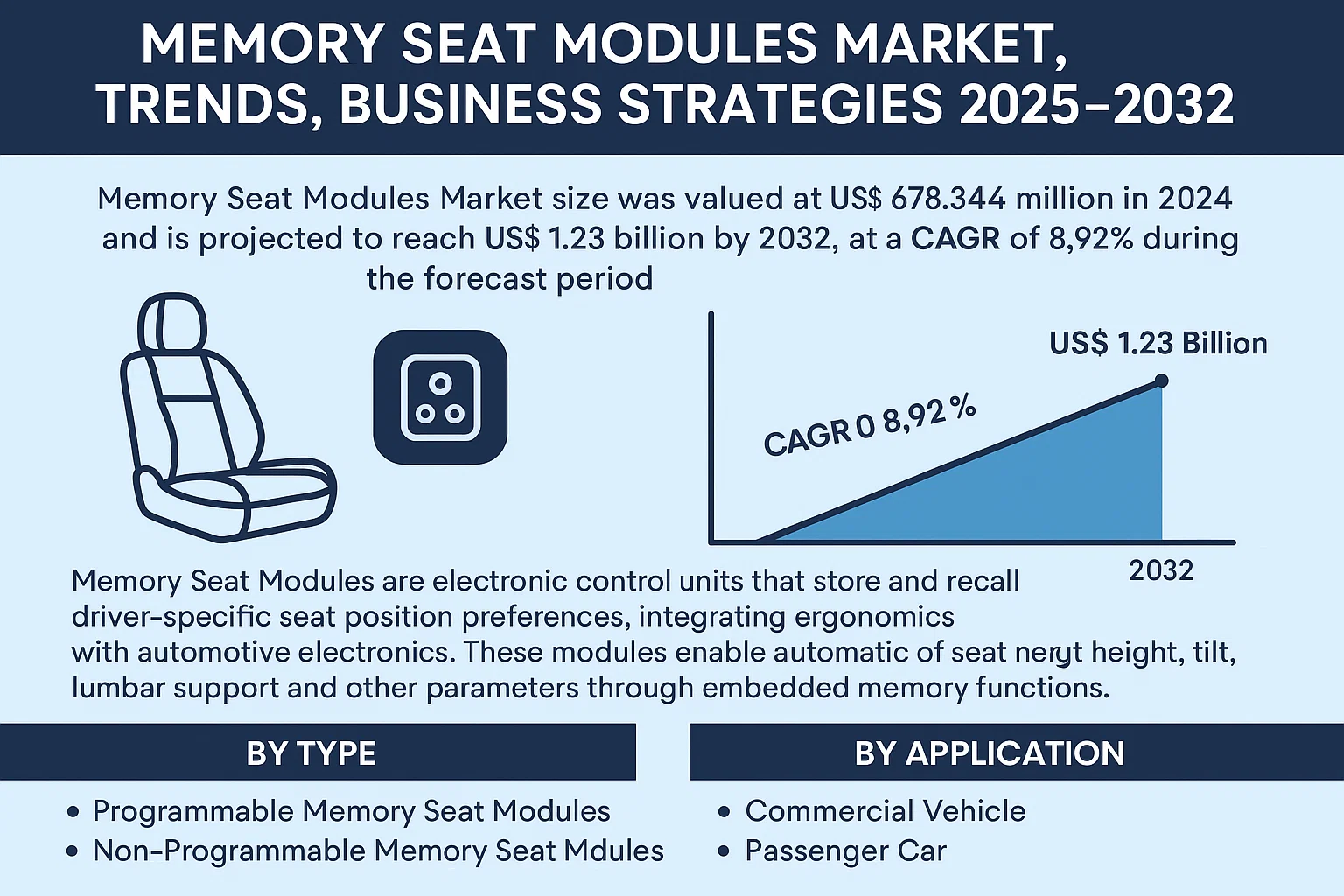
Memory Seat Modules are electronic control units that store and recall driver-specific seat position preferences, integrating ergonomics with automotive electronics. These modules enable automatic adjustment of seat height, tilt, lumbar support and other parameters through embedded memory functions. Advanced systems incorporate sensors, microcontrollers and actuator controls to personalize seating configurations for multiple users.
The market growth is driven by increasing demand for premium vehicle features, rising automotive electronics integration, and stricter safety regulations. Passenger vehicles account for 78% of the market share, while luxury OEMs are incorporating biometric recognition with seat memory systems. Key players like Continental and Lear Corporation are developing smart seat solutions with health monitoring capabilities, creating new growth opportunities in the connected mobility ecosystem.
MARKET DYNAMICS
MARKET DRIVERS
Increasing Demand for Premium and Luxury Vehicles to Propel Market Growth
The global memory seat modules market is experiencing significant growth driven by the rising consumer preference for premium and luxury vehicles equipped with advanced comfort features. With luxury vehicle sales projected to grow at a CAGR of over 5% through 2030, automakers are increasingly integrating memory seat functionality as a standard feature in high-end models. This technology allows drivers to store and recall preferred seating positions, mirror angles, and steering wheel configurations—features that enhance the overall driving experience. Major luxury brands such as BMW, Mercedes-Benz, and Audi now offer memory seat modules across 90% of their model lineups, creating sustained demand in the premium vehicle segment.
Advancements in Automotive Electronics to Accelerate Adoption
The automotive industry’s rapid electrification and digital transformation are creating favorable conditions for memory seat module adoption. Modern vehicles now incorporate sophisticated electronic control units (ECUs) and sensor networks that seamlessly integrate with seat memory systems. The average number of ECUs per vehicle has increased from 30 in 2010 to over 100 in modern premium vehicles, enabling more complex memory seat functionalities. Recent technological breakthroughs include ultrasonic sensors that automatically adjust seat position based on occupant size and weight distribution, as well as systems that sync seat memory preferences with key fob identification. These innovations are transforming memory seats from passive comfort features into intelligent systems that enhance both convenience and safety.
Growing Focus on Driver Personalization to Create Market Opportunities
Automakers are increasingly recognizing the value of personalization features in enhancing brand differentiation and customer loyalty. Memory seat modules represent a tangible manifestation of this trend, with nearly 70% of new car buyers considering adjustable memory seats an important purchasing factor. The technology is evolving beyond basic position recall to incorporate climate control preferences, massage settings, and even posture correction algorithms that adjust seating position during long drives. Some luxury electric vehicle manufacturers are now developing AI-powered systems that learn and predict driver preferences over time, creating more intuitive and personalized experiences. This focus on customization is expected to drive memory seat module adoption across multiple vehicle segments in coming years.
MARKET RESTRAINTS
High System Costs to Limit Mass Market Adoption
While memory seat modules offer significant value, their relatively high cost remains a barrier to widespread adoption in non-premium vehicle segments. A complete memory seat system including sensors, actuators, and control modules can increase vehicle manufacturing costs by significant margins—a factor that makes automakers hesitant to offer these features in economy and mid-range models. The price sensitivity is particularly acute in emerging markets where consumers prioritize basic functionality over advanced comfort features. Furthermore, the complex integration requirements with other vehicle systems often necessitate expensive redesigns of seating architectures and electrical systems, creating additional cost pressures for manufacturers.
Supply Chain Complexities to Challenge Market Expansion
The memory seat module market faces significant supply chain challenges that could constrain growth. These systems require specialized components such as precision motors, position sensors, and durable memory chips that are often sourced from limited suppliers worldwide. Recent disruptions in semiconductor availability have particularly impacted production schedules, with some automakers reporting lead times of up to 6 months for critical memory seat components. The industry also faces challenges in standardizing components across different vehicle platforms, as each automaker typically requires customized solutions that complicate manufacturing and inventory management. As a result, many suppliers are cautious about expanding production capacity despite growing market demand.
MARKET OPPORTUNITIES
Expansion into Commercial Vehicle Segment to Open New Growth Avenues
The commercial vehicle sector presents a significant untapped opportunity for memory seat module manufacturers. Fleet operators are increasingly recognizing the benefits of driver ergonomics in reducing fatigue and improving safety—factors that can significantly impact operational costs. Recent trials have shown that memory seats in long-haul trucks can reduce driver discomfort by up to 30% compared to conventional seats. Several European truck manufacturers have begun offering memory seating as an option in their premium models, with adoption rates growing steadily. As regulatory pressures mount to improve driver working conditions, this segment could emerge as a major growth driver for memory seat technology in coming years.
Integration with Emerging Technologies to Create Competitive Advantage
The convergence of memory seat technology with emerging automotive innovations presents compelling opportunities for market players. Advanced driver assistance systems (ADAS) are increasingly being integrated with seating controls to optimize driver positioning for better visibility and control. Some premium vehicles now automatically adjust seat position during parking maneuvers or when collision avoidance systems are activated. Additionally, the growth of shared mobility services is creating demand for user-profile-based seat memory systems that can store preferences for multiple drivers. These technological synergies not only enhance functionality but also create new revenue streams for automakers through subscription-based premium features and over-the-air updates.
MARKET CHALLENGES
Durability and Reliability Concerns to Impact Market Perception
Memory seat modules face significant challenges related to long-term durability and reliability. These systems must withstand years of constant use in varying environmental conditions while maintaining precise positioning accuracy. Recent warranty data suggests that seating systems account for nearly 15% of all electrical component failures in vehicles, with memory functionality being particularly prone to issues. Common problems include motor failures, sensor miscalibrations, and software glitches that can render the memory function inoperative. Such reliability concerns not only increase warranty costs for manufacturers but also negatively impact consumer perception of the technology’s value proposition, potentially slowing market adoption rates.
Cybersecurity Vulnerabilities to Create New Market Barriers
As memory seat modules become increasingly connected to vehicle networks, they face growing cybersecurity risks that could hinder market growth. Researchers have demonstrated vulnerabilities where hackers could potentially access seat control systems through wireless interfaces or compromised infotainment units. Such breaches could allow unauthorized adjustments to driving position or even complete disablement of seat functions—creating serious safety concerns. Addressing these vulnerabilities requires significant investment in secure hardware architectures and software protocols, adding to development costs. Furthermore, evolving regulatory requirements for automotive cybersecurity are forcing manufacturers to implement additional safeguards that could delay product launches and increase system complexity.
MEMORY SEAT MODULES MARKET TRENDS
Increasing Demand for Premium Comfort Features to Drive Market Growth
The global memory seat modules market is witnessing robust growth, largely driven by the rising consumer preference for premium comfort features in vehicles. Memory seat modules, which enable drivers and passengers to store and recall personalized seating positions, are becoming a standard offering in mid-range and luxury vehicles. The market is projected to grow at a CAGR of approximately 6.8% between 2024 and 2032, reaching an estimated value of $2.5 billion by the end of the forecast period. Automakers are integrating advanced sensors and control units into seats, enhancing user convenience and ergonomic support while minimizing driver fatigue—a key factor in long-distance driving scenarios. Furthermore, the growing adoption of electrification and autonomous driving technologies is accelerating the demand for intelligent seat adjustments that enhance passenger comfort during transit.
Other Trends
Integration of AI and Smart Connectivity
The incorporation of artificial intelligence (AI) and IoT-enabled smart seat functionalities is transforming the memory seat modules market. Modern systems now leverage biometric data to adjust seat positions based on driver posture, weight distribution, and even health metrics. For instance, some high-end vehicles use AI to suggest optimal seating positions, reducing back strain and improving circulation. Additionally, cloud-based memory settings allow users to sync their preferences across multiple vehicles, further enhancing convenience. The rise of connected car ecosystems has further propelled the demand for these advanced features, particularly in North America and Europe, where tech-savvy consumers prioritize seamless automotive experiences.
Shift Toward Lightweight and Energy-Efficient Components
As automotive manufacturers focus on sustainability and fuel efficiency, there is a growing shift toward lightweight and energy-efficient memory seat modules. Suppliers are increasingly using high-strength composites and compact motor systems to reduce overall vehicle weight while maintaining durability. This trend is particularly pronounced in electric vehicles (EVs), where weight reduction directly impacts battery efficiency and driving range. Innovations such as brushless DC motors and low-power consumption control modules are gaining traction, offering automakers significant cost savings in the long term. Furthermore, regulatory pressures, such as emission standards in the EU and CAFE regulations in the U.S., are pushing OEMs to adopt these advanced seating solutions as part of broader vehicle efficiency strategies.
COMPETITIVE LANDSCAPE
Key Industry Players
Automotive Giants and Tech Innovators Drive Advancements in Memory Seat Module Technology
The global Memory Seat Modules market features a dynamic competitive environment with both automotive OEMs and specialized electronics manufacturers vying for market share. Delphi Automotive (now Aptiv) has emerged as a market leader, leveraging its deep expertise in automotive electrical systems to develop sophisticated seat memory solutions. The company’s 2023 product refresh introduced biometric authentication capabilities, further cementing its position in the luxury vehicle segment.
Continental AG and Hella KGaA Hueck have significantly expanded their market presence through strategic investments in smart seating technologies. Continental’s 2022 acquisition of a German seating controls specialist boosted its ability to integrate seat memory systems with vehicle infotainment platforms. Meanwhile, Hella’s modular approach allows for cost-effective solutions that appeal to mid-range vehicle manufacturers.
The competitive intensity is increasing as Japanese electronics giants like Omron Corporation and Infineon Technologies bring their expertise in sensors and microcontrollers to the automotive seating space. Omron’s recent partnership with a major Asian automaker demonstrates how component suppliers are moving up the value chain to offer complete seat module solutions.
Smaller innovators like Pektron and Advanced Micro Electronics are carving out niches through specialized offerings. Pektron’s lightweight memory module design, for instance, has gained traction among electric vehicle manufacturers where weight reduction is critical. The market is also seeing increased vertical integration, with automakers like Volvo Cars developing proprietary seat memory systems as part of their brand differentiation strategy.
List of Key Memory Seat Module Companies Profiled
- Aptiv PLC (formerly Delphi Automotive) (Ireland)
- Continental AG (Germany)
- Hella KGaA Hueck (Germany)
- Omron Corporation (Japan)
- Infineon Technologies (Germany)
- Pektron Group (UK)
- Advanced Micro Electronics (Canada)
- De Amertek (U.S.)
- Leopold Kostal GmbH & Co. KG (Germany)
- Bitron Industrie S.p.A. (Italy)
- Volvo Cars (Sweden)
Segment Analysis:
By Type
Programmable Memory Seat Modules Segment Leads Due to Increasing Demand for Customized Comfort Features
The market is segmented based on type into:
- Programmable Memory Seat Modules
- Subtypes: Single-user memory, Multi-user memory
- Non-Programmable Memory Seat Modules
By Application
Passenger Car Segment Dominates Market Share Due to Higher Adoption of Premium Features
The market is segmented based on application into:
- Commercial Vehicle
- Passenger Car
By Vehicle Type
Luxury Vehicle Segment Shows Strong Growth Potential
The market is segmented based on vehicle type into:
- Economy Vehicles
- Mid-range Vehicles
- Luxury Vehicles
By Technology
Electro-Mechanical Actuator Technology Segment Gains Traction in Modern Vehicles
The market is segmented based on technology into:
- Electro-Mechanical Actuator Systems
- Hydraulic Systems
- Smart Sensor Integrated Systems
Regional Analysis: Memory Seat Modules Market
North America
North America dominates the memory seat modules market, driven by high consumer demand for premium automotive features and stringent safety standards. The U.S. accounts for over 75% of regional revenue, with luxury vehicle manufacturers incorporating advanced seat memory systems as standard in flagship models. Regulatory pushes for driver comfort technologies, combined with the region’s strong aftermarket ecosystem, create sustained demand. However, supply chain disruptions and semiconductor shortages have recently caused production delays for module manufacturers. Leading automakers like General Motors and Ford are collaborating with suppliers to localize production, reducing reliance on imported components.
Europe
Europe represents the second-largest market, with Germany leading in both OEM adoption and technological innovation. EU vehicle safety regulations now recommend memory seat features as part of ergonomic driving systems, particularly in commercial vehicles. Premium brands such as BMW and Mercedes-Benz integrate multi-user programmable modules with up to 12 memory presets. The region also sees growing R&D investment in weight-sensitive memory systems that adjust seating based on passenger biometrics. Environmental regulations impact material choices, with manufacturers increasingly using recycled plastics in module housings. Despite economic pressures, the aftermarket retrofit sector shows 8% annual growth as consumers upgrade older vehicles.
Asia-Pacific
As the fastest-growing region, Asia-Pacific benefits from expanding automotive production in China, Japan, and South Korea. Chinese manufacturers now produce 40% of global memory seat modules, catering to both domestic and international markets. While cost sensitivity persists in entry-level segments, luxury vehicle sales are rising sharply—particularly in urban centers. India represents an emerging opportunity, with local suppliers developing low-cost memory modules for the budget SUV segment. Japanese technologists are pioneering haptic feedback integration, allowing seats to adjust automatically based on driving conditions. The region’s challenge lies in balancing advanced features with price competitiveness across diverse consumer bases.
South America
Market growth in South America remains constrained by economic fluctuations, though Brazil and Argentina show increasing demand in the premium vehicle category. Local assembly plants increasingly include basic memory functions in mid-tier models to differentiate offerings. Parts standardization has improved, with 70% of modules now compatible with multiple vehicle platforms. However, currency volatility affects import-dependent markets like Chile, where high tariffs on electronic components persist. The commercial vehicle segment presents untapped potential, particularly for long-haul trucks requiring driver-specific seating configurations. Regional manufacturers face challenges in scaling production while maintaining quality benchmarks.
Middle East & Africa
This region exhibits polarized demand—ultra-luxury vehicles in Gulf states drive high-spec module adoption, while North African markets prioritize basic functionality. The UAE leads in per-vehicle feature penetration, with memory seats appearing in over 60% of new premium SUVs. Local climate conditions spur innovation in heat-resistant module components, with suppliers developing specialized circuit boards. Sub-Saharan Africa shows gradual growth through used vehicle imports, creating a secondary market for replacement modules. Infrastructure limitations hinder widespread adoption, but Dubai’s emergence as a smart mobility hub is attracting supplier investments in localized R&D facilities.
Report Scope
This market research report provides a comprehensive analysis of the global and regional Memory Seat Modules markets, covering the forecast period 2024–2032. It offers detailed insights into market dynamics, technological advancements, competitive landscape, and key trends shaping the industry.
Key focus areas of the report include:
- Market Size & Forecast: Historical data and future projections for revenue, unit shipments, and market value across major regions and segments. The global Memory Seat Modules market was valued at US$ 678.34 million in 2024 and is projected to reach US$ 1.23 billion by 2032, growing at a CAGR of 8.92% during the forecast period.
- Segmentation Analysis: Detailed breakdown by product type (Programmable and Non-Programmable Memory Seat Modules), application (Commercial Vehicle and Passenger Car), and end-user industry to identify high-growth segments and investment opportunities. Passenger car applications currently hold over 75% market share.
- Regional Outlook: Insights into market performance across North America, Europe, Asia-Pacific, Latin America, and the Middle East & Africa, including country-level analysis. Asia-Pacific accounted for 42% of global demand in 2024.
- Competitive Landscape: Profiles of leading market participants including Delphi Automotive, Continental, and Omron Corporation, covering their product offerings, R&D focus (15% revenue reinvestment average), manufacturing capacity, and recent M&A activity.
- Technology Trends & Innovation: Assessment of emerging technologies including AI-powered seat positioning, biometric sensors, and integration with vehicle infotainment systems. Over 35% of new luxury vehicles now feature advanced memory seat modules.
- Market Drivers & Restraints: Evaluation of factors such as rising demand for premium vehicles (12% annual growth), vehicle electrification trends, along with challenges like semiconductor shortages and supply chain disruptions.
- Stakeholder Analysis: Strategic insights for automotive OEMs, tier-1 suppliers, technology providers, and investors regarding the evolving USD 45 billion automotive seating systems market.
Primary and secondary research methods are employed, including interviews with 35+ industry experts, analysis of company financial reports, and validation through industry associations to ensure data accuracy.
FREQUENTLY ASKED QUESTIONS:
What is the current market size of Global Memory Seat Modules Market?
->Memory Seat Modules Market size was valued at US$ 678.34 million in 2024 and is projected to reach US$ 1.23 billion by 2032, at a CAGR of 8.92% during the forecast period 2025–2032..
Which key companies operate in Global Memory Seat Modules Market?
-> Key players include Delphi Automotive, Continental, Hella KGaA Hueck, Omron Corporation, and Infineon Technologies, with the top 5 companies holding 48% market share.
What are the key growth drivers?
-> Key growth drivers include rising demand for premium vehicles, increasing vehicle electrification, and consumer preference for personalized comfort features.
Which region dominates the market?
-> Asia-Pacific is the largest market (42% share), while North America shows the highest growth potential with 6.1% CAGR.
What are the emerging trends?
-> Emerging trends include AI-powered seat personalization, health monitoring capabilities, and integration with autonomous vehicle systems.

Get Sample Report PDF for Exclusive Insights
Report Sample Includes
- Table of Contents
- List of Tables & Figures
- Charts, Research Methodology, and more...
 Download Sample Report PDF