Market Insights
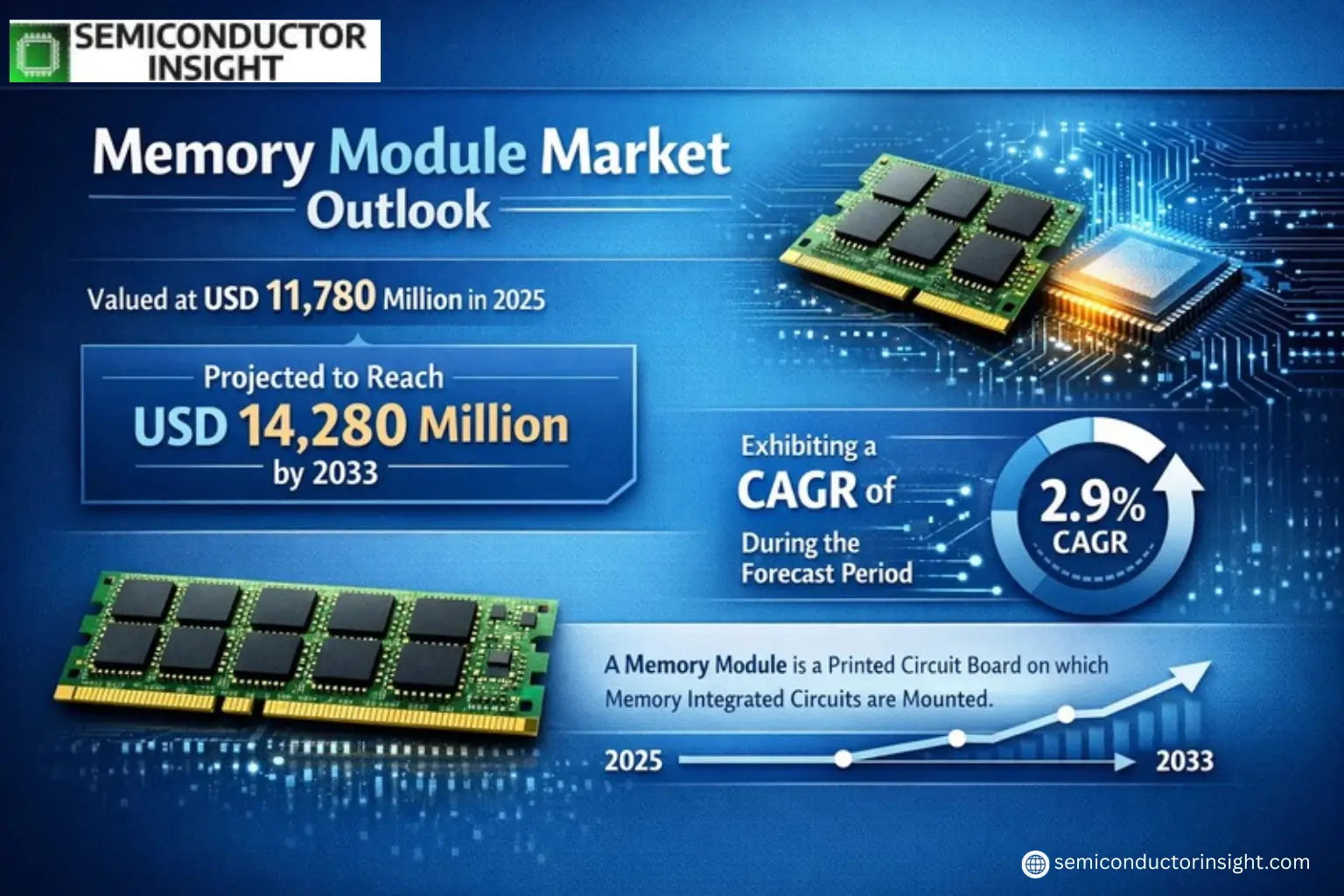
Global Memory Module Market was valued at USD 11,780 million in 2025 and is projected to reach USD 14,280 million by 2033, exhibiting a CAGR of 2.9% during the forecast period.
Memory Module Market is a printed circuit board on which memory integrated circuits are mounted. These modules enable easy installation and replacement in electronic systems, particularly in computers such as personal computers, workstations, and servers. Initially, memory modules were proprietary designs specific to individual computer models from manufacturers. Over time, standardization by organizations like JEDEC allowed compatibility across multiple systems.
The market is experiencing steady growth due to technological advancements such as the transition from DDR4 to DDR5 modules, which offer higher bandwidth and lower power consumption. Additionally, emerging applications in artificial intelligence (AI), data centers, and high-performance computing are driving demand for advanced memory solutions. Key players like Kingston, Samsung, and Micron continue to dominate the market with innovations tailored for diverse industry needs.
MARKET DRIVERS
Increasing Demand for High-Performance Computing
Memory Module Market is experiencing strong growth due to rising demand for high-speed data processing in data centers, gaming PCs, and AI applications. Annual shipments of DDR5 memory modules grew by over 40% in 2023, reflecting this trend. Enterprises are upgrading infrastructure to handle larger datasets, directly benefiting memory module manufacturers.
Mobile Device Proliferation
With smartphone production exceeding 1.4 billion units annually, the demand for high-density LPDDR memory modules continues to surge. Manufacturers are developing power-efficient modules to meet OEM requirements for next-gen devices while maintaining performance benchmarks.
Cloud service providers represent another key driver, with hyperscalers investing heavily in server infrastructure upgrades that require advanced memory solutions.
MARKET CHALLENGES
Supply Chain Vulnerabilities
Memory Module Market faces significant lead time challenges, with DRAM chip shortages causing 12-16 week delays for some configurations. Geopolitical factors and export controls have further complicated the component procurement process for module assemblers.
Other Challenges
Price Volatility
DRAM spot prices fluctuated by ±18% in Q1 2023, creating margin pressure for memory module manufacturers while making long-term contracts difficult to negotiate.
MARKET RESTRAINTS
Technology Transition Costs
Migration to DDR5 memory modules requires significant system redesigns, with motherboard compatibility issues delaying adoption in some segments. End users face 20-30% premium costs for DDR5 systems versus DDR4 equivalents, slowing upgrade cycles in price-sensitive markets.
MARKET OPPORTUNITIES
AI-Optimized Memory Solutions
Memory Module Market is seeing strong demand for high-bandwidth memory (HBM) stacks, with AI accelerator shipments driving 65% year-over-year growth in this segment. Module manufacturers partnering with GPU vendors achieve 15-20% higher ASPs for these specialized products.
Automotive Applications
Advanced driver assistance systems (ADAS) in vehicles now require up to 16GB of automotive-grade memory modules per unit. This emerging sector represents a $1.2 billion revenue opportunity for memory module suppliers meeting stringent quality certifications.
Memory Module Market Trends
Technology Transition from DDR4 to DDR5 Gains Momentum
Memory Module Market is experiencing a significant shift from DDR4 to DDR5 technology, driven by increasing demand for higher bandwidth and energy efficiency. DDR5 modules deliver approximately 50% more bandwidth while consuming 20% less power compared to DDR4, making them ideal for data centers and AI applications. Industry projections indicate DDR5 will capture over 40% market share by 2026 as production costs decline.
Other Trends
Emerging Memory Technologies Reshaping the Landscape
High Bandwidth Memory (HBM) is gaining traction in specialized applications requiring extreme performance, particularly in AI and graphics processing. Global HBM market is projected to grow at 25% CAGR through 2030. Meanwhile, hybrid memory cube technologies are being adopted for high-performance computing environments where latency reduction is critical.
Regional Market Dynamics Create New Opportunities
Asia-Pacific dominates memory module production with 65% market share, led by China, South Korea and Taiwan. North America shows strong growth in high-performance modules for data centers, while Europe demonstrates increasing demand for industrial and automotive-grade memory solutions. The Middle East and Africa are emerging as fast-growing markets with 15% annual growth in memory module imports.
Supply Chain Diversification Strategies Intensify
Major manufacturers are establishing redundant production facilities across multiple regions to mitigate geopolitical risks. This has led to increased investment in Southeast Asian production capacities, with Vietnam and Malaysia seeing 30% annual growth in memory module manufacturing facilities since 2022.
Customization and Specialization Drive Product Innovation
Memory module manufacturers are developing application-specific solutions for gaming, AI, and IoT devices. The gaming memory segment is growing at 18% annually, while industrial-grade modules with extended temperature ranges account for 12% of the total market. Custom-configured modules now represent 25% of enterprise memory sales.
COMPETITIVE LANDSCAPE
Key Industry Players
Global Memory Module Market Dominated by Technology Leaders and Niche Specialists
Memory Module Market is characterized by intense competition between established semiconductor giants and specialized module manufacturers. Samsung Electronics and SK Hynix maintain dominant positions as integrated DRAM producers, leveraging their wafer fabrication advantages to supply both bulk memory and finished modules. Kingston Technology has emerged as the world’s leading independent memory module vendor, commanding significant market share through its ValueRAM and HyperX product lines. The competitive landscape continues to evolve with the DDR5 transition, where early movers like Micron (Crucial) and Corsair are gaining traction in high-performance computing segments.
Beyond these major players, regional specialists and application-focused manufacturers are carving out profitable niches. Companies like Ramaxel in China and Apacer in industrial applications have demonstrated strong growth by addressing specific market needs. The gaming memory segment has seen particular innovation from brands such as Team Group and G.Skill, while enterprise solutions are being driven by Innodisk and ATP Electronics. The market also features strong competition in cost-optimized segments from manufacturers like Kimtigo and Transcend, particularly in emerging markets.
List of Key Memory Module Companies Profiled
- Kingston Technology
- Samsung Electronics
- SK Hynix
- Micron Technology (Crucial)
- ADATA Technology
- Ramaxel
- Transcend Information
- Corsair
- Team Group
- Apacer Technology
- Kimtigo
- Kingmax Semiconductor
- Innodisk
- ATP Electronics
- G.Skill International
Segment Analysis:
| Segment Category | Sub-Segments | Key Insights |
| By Type |
|
DDR5 is emerging as the leading segment due to:
|
| By Application |
|
Server applications demonstrate strongest growth momentum:
|
| By End User |
|
Enterprise/Data Centers dominate due to:
|
| By Technology Generation |
|
HBM shows greatest innovation potential:
|
| By Supply Chain Position |
|
Module Manufacturers maintain critical role:
|
Regional Analysis: Memory Module Market
Asia-Pacific hosts world’s largest memory module production facilities with complete supply chain integration. China’s Yangtze Memory Technologies and South Korea’s semiconductor clusters exemplify regional manufacturing dominance.
The region leads in developing advanced memory technologies including HBM and DDR5 modules. Taiwan’s R&D centers collaborate closely with global tech firms to push performance boundaries in memory solutions.
Proximity to component suppliers and efficient logistics networks give Asian manufacturers 15-20% cost advantages in memory module production compared to Western competitors.
Growing demand from India and Southeast Asian countries diversifies the regional Memory Module Market beyond traditional manufacturing powerhouses, creating new growth opportunities.
North America
North America remains the second-largest Memory Module Market, driven by strong enterprise demand and cloud computing growth. The U.S. leads in high-performance computing applications that require premium memory solutions. Major hyperscalers and data center operators maintain strategic partnerships with memory module suppliers to secure supply. The region shows strong adoption of next-generation memory technologies for AI/ML workloads. Government initiatives to reshore semiconductor manufacturing are gradually strengthening domestic memory module capabilities.
Europe
Europe’s Memory Module Market benefits from automotive and industrial sector demand, particularly for specialized memory solutions. Germany and France lead in memory module consumption for automotive electronics. The region shows increasing investments in semiconductor sovereignty projects to reduce Asian supply chain dependence. Strict environmental regulations drive innovation in energy-efficient memory modules across European data centers and IoT applications.
South America
South America’s Memory Module Market is growing steadily, primarily serving consumer electronics and mobile device markets. Brazil represents the largest regional market, with increasing memory module demand from enterprise IT infrastructure upgrades. Local assembly operations are expanding to meet regional demand, though most high-end modules remain imported. Economic volatility continues to impact memory module pricing strategies in the region.
Middle East & Africa
The MEA region shows fastest-growing memory module demand, driven by digital infrastructure development and smartphone penetration. Gulf countries invest heavily in data centers requiring memory modules, while African markets benefit from mobile-first digital ecosystems. The region presents untapped potential as local manufacturing capabilities begin emerging in UAE and South Africa.
Report Scope
This market research report provides a comprehensive analysis of the Memory Module Market , covering the forecast period 2025–2033. It offers detailed insights into market dynamics, technological advancements, competitive landscape, and key trends shaping the industry.
Key focus areas of the report include:
- Market Overview: The report begins with an overview outlining its current market scenario, key growth indicators, and industry transformation drivers. It discusses macroeconomic factors, demand–supply balance, regulatory landscape, and the strategic role of semiconductors in powering advancements across industries such as automotive, telecommunications, consumer electronics, and industrial automation.
- Market Size & Forecast: Historical data and future projections for revenue, unit shipments, and market value across major regions and segments.
- Segmentation Analysis: Detailed breakdown by product type, technology, application, and end-user industry to identify high-growth segments and investment opportunities.
- Regional Insights: Insights into market performance across North America, Europe, Asia-Pacific, Latin America, and the Middle East & Africa, including country-level analysis where relevant.
- Competitive Landscape: Profiles of leading market participants, including their product offerings, R&D focus, manufacturing capacity, pricing strategies, and recent developments such as mergers, acquisitions, and partnerships.
- Technology Trends & Innovation: Assessment of emerging technologies, integration of AI/IoT, semiconductor design trends, fabrication techniques, and evolving industry standards.
- Market Drivers & Restraints: Evaluation of factors driving market growth along with challenges, supply chain constraints, regulatory issues, and market-entry barriers.
- Stakeholder Insights: Insights for component suppliers, OEMs, system integrators, investors, and policymakers regarding the evolving ecosystem and strategic opportunities.
Primary and secondary research methods are employed, including interviews with industry experts, data from verified sources, and real-time market intelligence to ensure the accuracy and reliability of the insights presented.
FREQUENTLY ASKED QUESTIONS:
What is the current market size of Memory Module Market?
-> Memory Module Market was valued at USD 11,780 million in 2025 and is projected to reach USD 14,280 million by 2033, exhibiting a CAGR of 2.9% during the forecast period.
What is the growth rate of Memory Module Market?
-> The market is projected to grow at a CAGR of 2.9% during the forecast period 2025-2033.
Which key companies operate in Memory Module Market?
-> Key players include Kingston, Samsung, SK Hynix, Micron (Crucial), ADATA, Ramaxel, and Corsair, among others.
What are the key growth drivers?
-> Key growth drivers include technology iteration from DDR4 to DDR5, demand for high-performance computing, AI applications, and increasing customization needs.
Which region dominates the market?
-> Asia is the dominant market, with strong presence of manufacturers and growing demand in China, Japan, and South Korea.
What are the emerging trends?
-> Emerging trends include DDR5 adoption, HBM (high bandwidth memory) development, and increasing demand for server and data center applications.
Get Sample Report PDF for Exclusive Insights
Report Sample Includes
- Table of Contents
- List of Tables & Figures
- Charts, Research Methodology, and more...
 Download Sample Report PDF