MARKET INSIGHTS
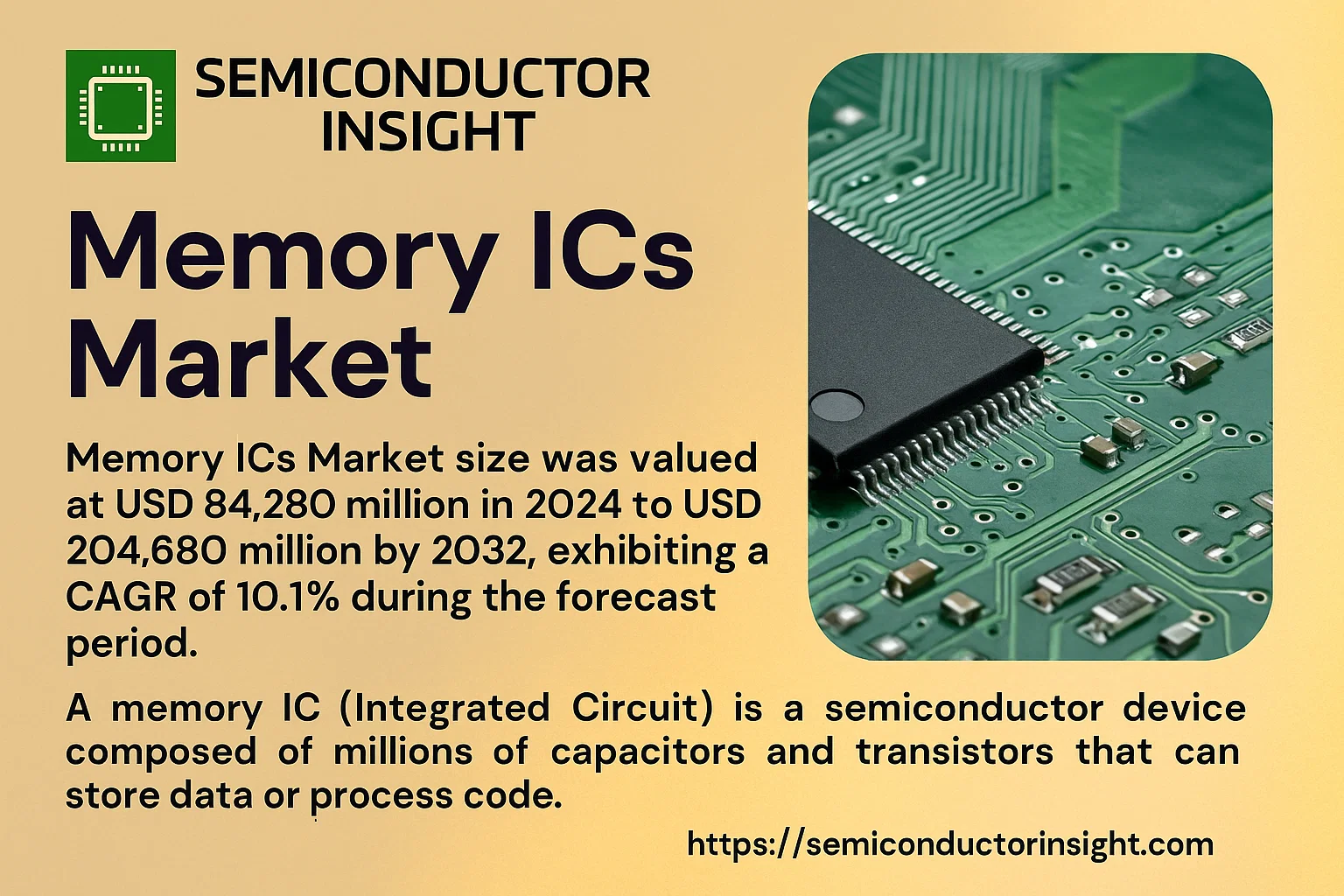
Global Memory ICs Market size was valued at USD 84,280 million in 2024 to USD 204,680 million by 2032, exhibiting a CAGR of 10.1% during the forecast period.
A memory IC (Integrated Circuit) is a semiconductor device composed of millions of capacitors and transistors that can store data or process code. These chips hold memory either temporarily through volatile memory like Random Access Memory (RAM), or permanently through non-volatile memory such as Read Only Memory (ROM). ROM contains permanently stored data that a processor can read but cannot modify. Memory chips are essential components in computers and electronic devices where data storage plays a critical role.
The market is experiencing substantial growth driven by several key factors, including the rapid development of technologies such as big data, cloud computing, and the Internet of Things (IoT), which have created unprecedented demand for data storage. The growing need for enhanced data storage and processing capabilities from enterprises and service providers continues to drive demand for higher performance and larger capacity chips. Furthermore, artificial intelligence and machine learning applications require processing and storing massive datasets, placing increased performance demands on memory technology. The proliferation of consumer electronics including smartphones, tablets, and laptops continues to fuel market expansion, particularly with high-end devices requiring advanced storage solutions. The automotive sector represents another significant growth driver as autonomous driving systems and vehicle connectivity require sophisticated memory solutions with faster data processing speeds and greater reliability.
MARKET DRIVERS
Proliferation of Data-Intensive Applications
The exponential growth in data generation from cloud computing, artificial intelligence, machine learning, and the Internet of Things (IoT) is a primary driver for the Memory IC market. These technologies require vast amounts of high-speed, high-density memory for processing and storage. The demand for advanced memory solutions like High Bandwidth Memory (HBM) and DDR5 is surging to support AI training workloads and real-time data analytics, pushing manufacturers to innovate and increase production capacity.
Expansion of Smartphones and Consumer Electronics
The continuous consumer demand for more powerful smartphones, laptops, and gaming consoles with higher resolution displays, faster processors, and advanced features necessitates higher-capacity and faster memory. The transition to 5G connectivity further accelerates this need, as it enables richer mobile experiences and cloud gaming, directly fueling demand for NAND flash and LPDDR memory.
➤ The automotive sector is emerging as a significant growth vector, with modern vehicles incorporating dozens of memory chips for infotainment, advanced driver-assistance systems (ADAS), and autonomous driving capabilities.
Furthermore, the build-out of hyperscale data centers worldwide to support cloud services and digital transformation across enterprises is creating sustained, long-term demand for server DRAM and NAND flash memory, establishing a robust foundation for market growth.
MARKET CHALLENGES
Cyclical Nature and Price Volatility
The Memory IC market is notoriously cyclical, characterized by periods of oversupply leading to price collapses and periods of undersupply causing price spikes. This volatility makes it challenging for manufacturers to plan long-term investments in new fabrication facilities, which require billions of dollars and years to build. Price wars can severely impact profitability across the industry.
Other Challenges
Increasing Technical Complexity and R&D Costs
As process nodes shrink towards physical limits, the technical challenges and associated R&D costs for developing next-generation memory technologies (e.g., sub-10nm DRAM, 200+ layer NAND) are escalating dramatically. This high barrier to entry consolidates the market among a few major players.
Supply Chain Fragility and Geopolitical Tensions
The highly concentrated global supply chain, particularly for advanced semiconductor manufacturing equipment and materials, creates vulnerability. Geopolitical tensions and trade restrictions can disrupt the flow of critical components, leading to production delays and supply shortages for memory chips.
MARKET RESTRAINTS
High Capital Expenditure and Manufacturing Costs
The capital intensity of semiconductor manufacturing acts as a significant restraint. Building and equipping a state-of-the-art memory fabrication plant (fab) can cost over $20 billion. This enormous financial commitment limits new entrants and pressures existing players to maintain high utilization rates to achieve economies of scale, often exacerbating the cyclicality of the market.
Technical and Physical Scaling Limitations
Following Moore’s Law is becoming increasingly difficult and expensive. As memory cells approach atomic scales, issues like electron leakage, quantum tunneling, and heat dissipation become major obstacles. This physical limitation on traditional scaling restrains the pace of density increases and performance improvements, forcing the industry to explore more complex and costly architectural innovations.
MARKET OPPORTUNITIES
Emergence of New Memory Technologies
The development of next-generation non-volatile memory technologies like Storage Class Memory (SCM), which includes 3D XPoint and MRAM, presents a significant opportunity. These technologies bridge the performance gap between DRAM and NAND flash, enabling new system architectures for data centers and high-performance computing that are faster and more energy-efficient.
Growth in Automotive and Industrial IoT
The rapid electrification and automation of vehicles, along with the expansion of Industrial IoT (IIoT), require robust, reliable, and high-temperature memory solutions. This creates a growing, high-value segment for specialized memory ICs, including NOR flash for firmware and MRAM for data logging in harsh environments, offering diversified revenue streams beyond traditional consumer electronics.
Demand for Advanced Packaging
With traditional scaling challenges, advanced packaging technologies like 2.5D and 3D integration (e.g., HBM, chiplets) are becoming critical. This shift offers opportunities for memory makers and outsourced semiconductor assembly and test (OSAT) companies to add value by creating heterogeneously integrated systems that offer superior performance in a smaller footprint.
Memory ICs Market Trends
Exponential Growth Driven by Data-Centric Technologies
The global Memory ICs market is on a significant growth trajectory, having been valued at $84,280 million in 2024 and projected to reach $204,680 million by 2032. This expansion, representing a compound annual growth rate (CAGR) of 10.1%, is fundamentally driven by the insatiable demand for data storage and processing. As the backbone of modern electronics, Memory ICs, which include RAM for temporary storage and ROM for permanent data, are essential components in everything from personal computers to complex server infrastructures. The proliferation of big data, cloud computing, and the Internet of Things (IoT) has created an unprecedented surge in the need for higher performance and larger capacity chips to manage vast datasets.
Other Trends
Artificial Intelligence and High-Performance Consumer Electronics
The advancement of artificial intelligence (AI) and machine learning applications places stringent performance and capacity demands on storage chips, requiring rapid processing of massive data volumes. Concurrently, the consumer electronics sector remains a powerful driver. High-end smartphones, tablets, and laptops demand ever-increasing storage performance. The gaming industry, including consoles, PCs, and virtual reality devices, is particularly influential, fueling market demand for high-speed, high-capacity solid-state drives (SSDs) and associated memory chips.
Automotive Sector Emerges as Key Growth Engine
A major emerging trend is the growing demand from the automotive industry, fueled by the development of autonomous driving, connected vehicles (Internet of Vehicles), and new energy vehicles. The progression of intelligent driving technology necessitates memory chips with faster data processing speeds and significantly larger storage capacities to handle environmental perception data from numerous sensors and microcontrollers (MCUs). This evolution results in a massive increase in the requirement for high-performance non-volatile memory devices, establishing the automotive sector as a critical new growth pillar for the Memory ICs market.
COMPETITIVE LANDSCAPE
Key Industry Players
An Oligopolistic Market Driven by Technological Prowess and High Capital Investment
The global Memory ICs market is characterized by a highly concentrated and intensely competitive structure, dominated by a select few major players who command a significant portion of the market share. South Korean giants Samsung and SK Hynix, along with US-based Micron Technology, form the triumvirate that leads the industry, particularly in the high-volume DRAM and NAND flash memory segments. These companies maintain their leadership through massive, continuous investment in research and development and relentless pursuit of process node miniaturization, such as the transition to advanced nodes like 1-alpha and 1-beta nm for DRAM and the stacking of over 200 layers in 3D NAND flash. The competitive dynamics are heavily influenced by cyclical supply-demand imbalances, which can lead to significant price fluctuations. Market leadership is sustained by the ability to efficiently manage these cycles, secure long-term supply agreements with major OEMs in the smartphone, server, and PC industries, and pioneer next-generation technologies like DDR5, LPDDR5X, and high-bandwidth memory (HBM) for AI applications.
Beyond the dominant top three, the competitive landscape includes several other significant players that have carved out substantial niches. Companies like Kioxia and Western Digital are key forces in the NAND flash memory market, often collaborating through joint ventures. In the specialized NOR flash and DRAM segments, companies such as Winbond, Nanya Technology, and Macronix hold important positions, catering to specific applications in automotive electronics, industrial systems, and consumer devices that require high reliability and lower densities. Emerging players, most notably China’s Yangtze Memory Technologies Corp (YMTC), are investing heavily to gain market share, adding another layer of competition and geopolitical consideration to the market dynamics. The industry is further populated by fabless companies and design houses like GigaDevice, which focus on specific memory product designs. The high barriers to entry, including immense capital expenditure for state-of-the-art fabrication facilities and complex intellectual property, continue to shape this competitive environment.
List of Key Memory ICs Companies Profiled
- Samsung
- SK Hynix
- Micron Technology
- Kioxia
- Western Digital
- Winbond
- Nanya Technology
- Macronix
- GigaDevice
- YMTC (Yangtze Memory Technologies Corp)
- ISSI (Integrated Silicon Solution Inc.)
- Powerchip Semiconductor Manufacturing Corp. (PSMC)
- Cypress Semiconductor (Infineon Technologies)
- Adesto Technologies (Dialog Semiconductor)
- EMemory Technology Inc.
Segment Analysis:
| Segment Category | Sub-Segments | Key Insights |
| By Type |
|
NAND Flash represents a leading segment, driven by its critical role in high-density storage solutions essential for modern computing. The segment is propelled by the explosive growth in data generation and the transition from traditional hard drives to solid-state drives across consumer electronics, enterprise storage, and data centers. Technological advancements, such as the ongoing evolution towards higher-layer 3D NAND architectures, are crucial for meeting the demand for greater capacity and performance. While DRAM remains vital for high-speed processing in computing systems, the persistent need for non-volatile, high-capacity storage solutions solidifies NAND’s dominant market position. |
| By Application |
|
Servers constitute the leading application segment, underpinning the digital infrastructure of the global economy. This dominance is fueled by the relentless expansion of cloud computing, big data analytics, and the infrastructure required for artificial intelligence and machine learning workloads, all of which demand immense and high-performance memory resources. The server segment requires memory ICs that offer not only high capacity and speed but also exceptional reliability for continuous operation. The automotive sector is emerging as a particularly high-growth area, with increasing memory content per vehicle driven by advanced driver-assistance systems and in-vehicle infotainment, yet the sheer scale of data center investments keeps the server segment at the forefront. |
| By End User |
|
Enterprise & Cloud Service Providers are the leading end-user segment, acting as the primary drivers for advanced memory technologies. Their insatiable demand is a direct consequence of the global shift towards digitalization, remote work models, and the proliferation of data-intensive services, which necessitate robust and scalable data center infrastructure. These users prioritize memory solutions that deliver high throughput, low latency, and energy efficiency to support critical applications and massive datasets. While the consumer electronics segment represents a massive volume market, the strategic importance, technological requirements, and scale of procurement from large enterprises and hyperscalers give this segment its leading influence over market dynamics and innovation directions. |
| By Technology Feature |
|
Non-Volatile Memory is the clear leader in this segmentation due to its fundamental role in persistent data storage across virtually all electronic systems. The dominance of NAND flash, in particular, is reinforced by its application in everything from smartphones and USB drives to enterprise SSDs, which are critical for modern data storage architectures. The demand for non-volatile memory is structurally embedded in the need for permanent data retention, even when power is disconnected. Although volatile memory like DRAM is indispensable for active processing tasks, the expansive and growing need for data archiving, boot code storage, and mass storage ensures the non-volatile segment’s superior market footprint and continuous innovation pipeline focused on increasing density and endurance. |
| By Performance Tier |
|
High-Performance Tier memory ICs are the leading segment, setting the pace for technological advancement and capturing significant value. This segment is critical for applications where speed, bandwidth, and reliability are paramount, such as artificial intelligence training, high-performance computing, and enterprise servers. The development of next-generation standards like DDR5 for DRAM and PCIe interfaces for SSDs is largely driven by the requirements of this tier. While the mainstream segment serves the largest volume of devices, the high-performance segment commands premium pricing and dictates the R&D roadmap for the entire industry, as innovations eventually trickle down to broader markets, making it the most influential category. |
Regional Analysis: Memory ICs Market
Asia-Pacific is home to the most advanced memory fabrication plants (fabs) globally, offering unparalleled economies of scale. The region’s mature ecosystem includes leading-edge process technology for 3D NAND and advanced DRAM nodes. This concentration of manufacturing expertise and capacity creates a significant barrier to entry for other regions, securing a long-term supply advantage.
Local demand is a key driver, fueled by the world’s largest markets for smartphones, PCs, and consumer electronics. The rapid construction of hyperscale data centers across the region to support cloud computing and AI workloads provides a massive and growing market for high-performance memory, ensuring consistent consumption of the products manufactured locally.
Governments in key countries like South Korea, China, and Taiwan have implemented strong industrial policies and provided substantial subsidies to bolster their domestic semiconductor industries. These initiatives aim to achieve technological self-sufficiency and protect a sector deemed critical for national and economic security, fostering a favorable environment for investment and innovation.
The region possesses a deeply integrated and resilient supply chain for semiconductor materials, chemicals, and manufacturing equipment. This vertical integration from raw materials to finished chips reduces logistical complexities and costs, providing a significant competitive edge. Proximity to key suppliers also allows for faster response times and collaborative development.
North America
North America remains a critical region in the Memory ICs market, characterized by its strong focus on high-value design, R&D, and leadership in demand from the data center and enterprise sectors. Home to leading technology companies and cloud service providers, the region drives demand for cutting-edge memory solutions required for AI training, high-performance computing, and enterprise storage. While its domestic manufacturing capacity for memory is more limited compared to Asia-Pacific, its influence stems from intellectual property, design innovation, and strategic investments aimed at reshoring semiconductor production. The market dynamics are shaped by a highly sophisticated customer base that prioritizes performance, reliability, and security, pushing memory suppliers to continuously innovate.
Europe
The European Memory ICs market is defined by its specialization in automotive, industrial, and high-reliability applications. The region’s strong automotive industry, with its shift towards electric and autonomous vehicles, creates significant demand for specialized memory ICs that can operate in harsh environments and meet stringent safety standards. While Europe does not host major volume memory manufacturers, it has a strong presence in research institutions and companies focused on emerging memory technologies. The European Chips Act aims to bolster the region’s strategic autonomy by incentivizing investment in semiconductor manufacturing, including memory, to reduce external dependencies and secure supply for its key industrial sectors.
South America
The South American market for Memory ICs is a developing region primarily driven by consumer electronics imports and a growing IT services sector. The market dynamics are influenced by economic fluctuations and currency volatility, which can impact purchasing power and investment in technology infrastructure. Demand is largely met through imports, with local manufacturing being minimal. Growth potential exists in the expansion of mobile networks and data centers in major economies like Brazil, but the region remains a price-sensitive market where cost-competitiveness is a key factor for memory suppliers. The focus is predominantly on mainstream memory products for smartphones, computers, and basic server applications.
Middle East & Africa
The Memory ICs market in the Middle East & Africa is emerging, with growth centered on digital transformation initiatives and infrastructure development, particularly in Gulf Cooperation Council (GCC) countries and parts of North Africa. Strategic investments in smart city projects, government digitalization, and large-scale data centers are creating new demand for memory semiconductors. The region’s dynamics are characterized by a heavy reliance on imports and a focus on establishing itself as a technology hub. While the overall market size is smaller, the ambition to diversify economies away from hydrocarbons is leading to increased investment in the technology sector, presenting future growth opportunities for memory ICs in specific, high-value applications.
Report Scope
This market research report provides a comprehensive analysis of the Memory ICs Market , covering the forecast period 2025–2032. It offers detailed insights into market dynamics, technological advancements, competitive landscape, and key trends shaping the industry.
Key focus areas of the report include:
- Market Overview: The report begins with an overview outlining its current market scenario, key growth indicators, and industry transformation drivers. It discusses macroeconomic factors, demand–supply balance, regulatory landscape, and the strategic role of semiconductors in powering advancements across industries such as automotive, telecommunications, consumer electronics, and industrial automation.
- Market Size & Forecast: Historical data and future projections for revenue, unit shipments, and market value across major regions and segments.
- Segmentation Analysis: Detailed breakdown by product type, technology, application, and end-user industry to identify high-growth segments and investment opportunities.
- Regional Insights: Insights into market performance across North America, Europe, Asia-Pacific, Latin America, and the Middle East & Africa, including country-level analysis where relevant.
- Competitive Landscape: Profiles of leading market participants, including their product offerings, R&D focus, manufacturing capacity, pricing strategies, and recent developments such as mergers, acquisitions, and partnerships.
- Technology Trends & Innovation: Assessment of emerging technologies, integration of AI/IoT, semiconductor design trends, fabrication techniques, and evolving industry standards.
- Market Drivers & Restraints: Evaluation of factors driving market growth along with challenges, supply chain constraints, regulatory issues, and market-entry barriers.
- Stakeholder Insights: Insights for component suppliers, OEMs, system integrators, investors, and policymakers regarding the evolving ecosystem and strategic opportunities.
Primary and secondary research methods are employed, including interviews with industry experts, data from verified sources, and real-time market intelligence to ensure the accuracy and reliability of the insights presented.
FREQUENTLY ASKED QUESTIONS:
What is the current market size of Memory ICs Market?
-> Global Memory ICs Market was valued at USD 84,280 million in 2024 and is projected to reach USD 204,680 million by 2032, exhibiting a CAGR of 10.1% during the forecast period.
Which key companies operate in Memory ICs Market?
-> Key players include Samsung, SK Hynix, Micron, Kioxia, Western Digital, Winbond, Nanya, Macronix, GigaDevice, and YMTC, among others.
What are the key growth drivers?
-> Key growth drivers include the surging demand for data storage from big data, cloud computing, and IoT, the popularity of high-performance consumer electronics and gaming devices, and the increasing memory requirements from the automotive industry for autonomous and connected vehicles.
Which region dominates the market?
-> Asia is a dominant market, with key contributions from countries such as China, Japan, and South Korea.
What are the emerging trends?
-> Emerging trends include the development of high-performance technologies like 3D NAND and DDR5 and the increasing integration of memory chips in automotive intelligence systems.

Get Sample Report PDF for Exclusive Insights
Report Sample Includes
- Table of Contents
- List of Tables & Figures
- Charts, Research Methodology, and more...
 Download Sample Report PDF