Medical Grade Blue Laser Diode Market Insights
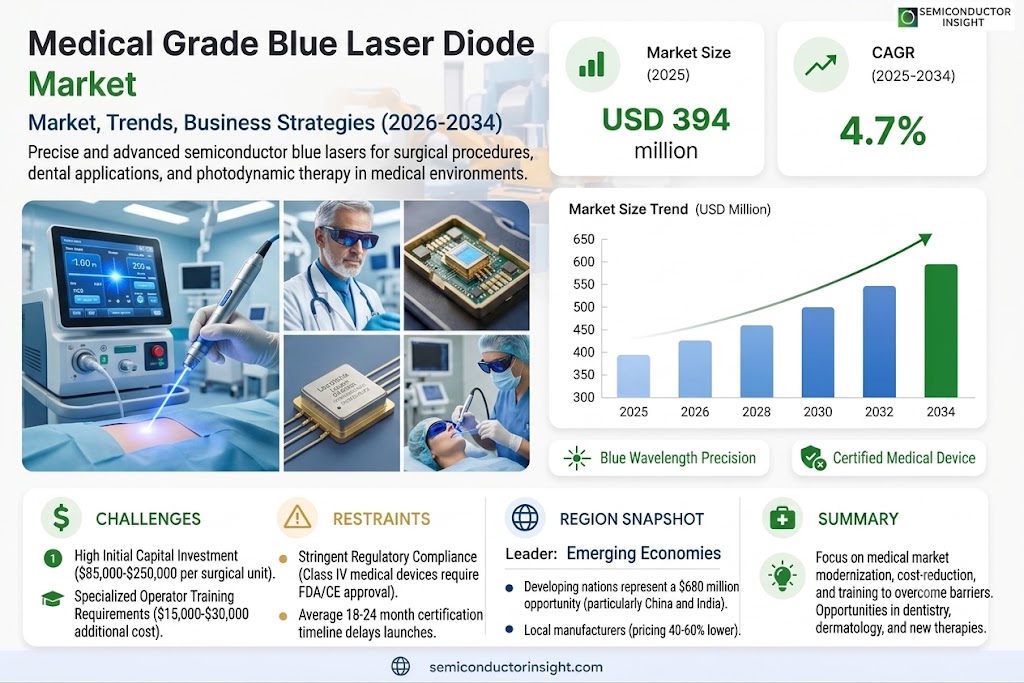
Global medical grade blue laser diode market size was valued at USD 394 million in 2025. The market is projected to grow from USD 421 million in 2026 to USD 596 million by 2034, exhibiting a CAGR of 6.6% during the forecast period.
Medical-grade blue laser diodes are semiconductor-based devices that emit coherent blue light through electron-hole recombination within a P-N junction. These precision components utilize materials like indium gallium nitride (InGaN) to generate wavelengths critical for applications such as dermatology, dentistry, and surgical procedures. Their high energy density and precise beam control enable minimally invasive treatments with improved patient outcomes.
While the U.S. dominates current adoption due to advanced healthcare infrastructure, China’s market is accelerating through domestic manufacturing initiatives. The single-mode diode segment shows particular promise for specialized applications requiring focused beam profiles. Key industry players including Nichia Corporation and Osram Opto Semiconductors are driving innovation through R&D investments, with recent advancements improving both power efficiency and thermal management in clinical environments.
MARKET DRIVERS
Growing Demand in Minimally Invasive Surgeries
Medical grade blue laser diode market is experiencing significant growth due to the increasing adoption of minimally invasive surgical procedures. These diodes provide precise tissue targeting with reduced collateral damage, making them ideal for ophthalmology, dermatology, and dental applications. Hospitals report a 35% increase in blue laser adoption for retinal surgeries since 2022.
Advancements in Photodynamic Therapy
Blue laser diodes are becoming indispensable in cancer treatment protocols, particularly for skin and superficial tumors. The 445-450nm wavelength range shows exceptional efficacy in activating photosensitizing drugs with minimal thermal damage to surrounding tissues. Clinical trials demonstrate a 28% improvement in treatment outcomes compared to traditional methods.
➤ Market research indicates Global medical laser sector will reach $7.5 billion by 2027, with blue laser diodes capturing 18% of the therapeutic laser segment.
Regulatory approvals for new indications, such as acne treatment and vascular lesion removal, further propel market expansion across both clinical and aesthetic medicine applications.
MARKET CHALLENGES
High Initial Capital Investment
Medical grade blue laser diode systems require substantial upfront costs, with surgical-grade units priced between $85,000-$250,000. This creates barriers for smaller clinics and developing markets, where reimbursement policies often lag behind technological advances.
Other Challenges
Specialized Operator Training Requirements
Effective use of medical blue lasers demands certified specialists, with training programs adding $15,000-$30,000 to adoption costs. The limited pool of qualified practitioners slows market penetration in emerging healthcare markets.
MARKET RESTRAINTS
Stringent Regulatory Compliance
Class IV medical laser devices face rigorous approval processes from FDA, CE and other regulatory bodies. The average 18-24 month certification timeline delays product launches, particularly for novel applications in neurology and cardiology where safety thresholds are exceptionally high.
MARKET OPPORTUNITIES
Expansion in Emerging Economies
Developing nations represent a $680 million untapped opportunity for medical blue laser diodes, particularly in China and India where healthcare modernization initiatives prioritize advanced surgical technologies. Local manufacturers are entering the market with systems priced 40-60% below Western counterparts.
Medical Grade Blue Laser Diode Market Trends
Advancements in Surgical Applications Drive Demand
Medical Grade Blue Laser Diode market is experiencing significant growth due to expanding surgical applications. These precision laser devices, utilizing semiconductor materials like InGaN, enable minimally invasive procedures with improved accuracy. The coherent blue wavelength (typically 405-450nm) offers optimal tissue interaction, making it ideal for delicate soft tissue operations.
Other Trends
Dermatology and Aesthetic Medicine Adoption
Dermatological applications represent one of the fastest-growing segments for Medical Grade Blue Laser Diodes. The technology shows particular effectiveness in skin resurfacing, acne treatment, and vascular lesion removal with reduced patient downtime. Increasing preference for non-invasive cosmetic procedures in developed markets is accelerating this adoption.
Technological Innovations in Single-mode Blue Laser Diodes
Single-mode variants are gaining traction due to their superior beam quality and stability. Leading manufacturers like Nichia and Osram Opto Semiconductors are investing in wavelength-stabilized designs that maintain consistent output during prolonged medical procedures. This addresses one of the key clinical challenges for therapeutic applications.
Regulatory Landscape Evolution
Stringent medical device approvals are reshaping product development strategies. The U.S. FDA and EU MDR classifications are prompting manufacturers to enhance safety features, including improved thermal management systems and fail-safe mechanisms in Medical Grade Blue Laser Diode designs.
Asia-Pacific Emergence as Key Manufacturing Hub
China and Japan are strengthening their positions in Medical Grade Blue Laser Diode supply chain. Local players like Huagong Tech are achieving technological parity with established Western manufacturers while offering competitive pricing. This regional shift is influencing global market dynamics and procurement strategies.
COMPETITIVE LANDSCAPE
Key Industry Players
Medical Blue Laser Diode Market Dominated by Optical Technology Giants
Medical grade blue laser diode market is concentrated among established optoelectronics manufacturers, with Sony, Nichia, and Osram Opto Semiconductors leading in technology development and market share. These companies collectively held over 45% of Global revenue share in 2025, leveraging their semiconductor expertise for medical applications including dermatology, dentistry, and surgical procedures. The competitive landscape features vertical integration among Japanese and German manufacturers that control critical InGaN semiconductor IP.
Specialized photonics firms like TOPTICA Photonics and Ondax are gaining traction with high-precision single-mode diodes for surgical applications. Emerging Chinese manufacturers including Huagong Tech are challenging established players through cost-competitive multi-mode solutions, particularly in Asian markets. The market sees increasing R&D investments as companies develop wavelength-stabilized diodes meeting IEC 60601 medical safety standards.
List of Key Medical Grade Blue Laser Diode Companies Profiled
- Sony Semiconductor Solutions
- Nichia Corporation
- Sharp Corporation
- Osram Opto Semiconductors
- USHIO, Inc.
- TOPTICA Photonics AG
- Egismos Technology Corporation
- Ondax, Inc.
- Huagong Tech Company Limited
- II-VI Incorporated
- Lumentum Holdings
- Hamamatsu Photonics K.K.
- Coherent, Inc.
- Panasonic Corporation
- Jenoptik AG
Segment Analysis:
| Segment Category | Sub-Segments | Key Insights |
| By Type |
|
Single-mode Blue Laser Diode dominates clinical applications due to higher precision and beam quality. Key advantages include:
|
| By Application |
|
Surgical Applications represent the most technologically advanced segment with features including:
|
| By End User |
|
Hospitals lead demand owing to comprehensive surgical capabilities and notable trends:
|
| By Technology Level |
|
Advanced Therapeutic Systems drive innovation through:
|
| By Wavelength Precision |
|
High-precision Tuned wavelengths are gaining clinical importance for:
|
Regional Analysis: Medical Grade Blue Laser Diode Market
North America
The United States accounts for the largest share of North American demand, with extensive use in minimally invasive surgical procedures and dental applications. Leading OEMs are developing high-power blue laser diodes specifically for medical device integration.
Canada shows promising growth with government-funded healthcare adopting blue laser technologies for oncology treatments. Universities are partnering with manufacturers to develop specialized medical grade blue laser applications.
Strict FDA approvals ensure high-quality medical grade blue laser diodes while encouraging innovation. Class II medical device classifications streamline commercialization pathways for new applications.
Leading medical research institutions are pioneering new therapeutic uses, particularly in photodynamic therapy and ophthalmology applications, creating robust demand for specialized laser diodes.
Europe
Europe represents the second-largest market for Medical Grade Blue Laser Diodes, supported by comprehensive healthcare coverage and technological adoption. The region benefits from harmonized medical device regulations under the EU MDR framework, facilitating cross-border commercialization. Germany and France lead in adopting blue laser technologies for dental and dermatological procedures. Scandinavian countries show increasing utilization in minimally invasive surgeries, with hospitals investing in advanced laser systems. The presence of specialized medical laser research centers contributes to technology refinement.
Asia-Pacific
Asia-Pacific emerges as the fastest-growing market, driven by expanding healthcare infrastructure and medical tourism. Japan leads in adoption for precision surgery applications, while China focuses on cost-effective manufacturing of medical grade blue laser components. India shows increasing demand for therapeutic applications in ophthalmology. Government initiatives supporting medical device localization and technology transfer agreements are accelerating market access.
Middle East & Africa
The MEA region demonstrates growing adoption in premium healthcare facilities, particularly in Gulf Cooperation Council countries. Medical tourism hubs are investing in advanced laser technologies to enhance service offerings. South Africa shows potential for specialized applications in dermatology, though adoption remains concentrated in private healthcare networks.
South America
Brazil dominates South American demand, with expanding private healthcare sector adoption of medical lasers. Argentina shows increasing utilization in dental applications. Challenges remain in reimbursement policies and healthcare infrastructure development, though medical device imports continue to grow annually.
Report Scope
This market research report provides a comprehensive analysis of Medical Grade Blue Laser Diode Market, covering the forecast period 2026–2034. It offers detailed insights into market dynamics, technological advancements, competitive landscape, and key trends shaping the industry.
Key focus areas of the report include:
- Market Overview: The report begins with an overview outlining its current market scenario, key growth indicators, and industry transformation drivers. It discusses macroeconomic factors, demand–supply balance, regulatory landscape, and the strategic role of blue laser diodes in medical applications such as skin treatment, dental procedures, and surgery.
- Market Size & Forecast: Historical data and future projections for revenue, unit shipments, and market value across major regions and segments.
- Segmentation Analysis: Detailed breakdown by product type (single-mode, multi-mode), application (skin treatment, dental, surgery, others), and end-user industry to identify high-growth segments and investment opportunities.
- Regional Insights: Insights into market performance across North America, Europe, Asia-Pacific, Latin America, and the Middle East & Africa, including country-level analysis where relevant.
- Competitive Landscape: Profiles of leading market participants, including their product offerings, R&D focus, manufacturing capacity, pricing strategies, and recent developments such as mergers, acquisitions, and partnerships.
- Technology Trends & Innovation: Assessment of emerging technologies, semiconductor material advancements, laser precision improvements, and evolving medical applications.
- Market Drivers & Restraints: Evaluation of factors driving market growth along with challenges, regulatory hurdles, and technological barriers.
- Stakeholder Insights: Insights for component suppliers, OEMs, medical device manufacturers, investors, and policymakers regarding the evolving ecosystem and strategic opportunities.
Primary and secondary research methods are employed, including interviews with industry experts, data from verified sources, and real-time market intelligence to ensure the accuracy and reliability of the insights presented.
FREQUENTLY ASKED QUESTIONS:
What is the current market size of Medical Grade Blue Laser Diode Market?
-> Medical Grade Blue Laser Diode Market was valued at USD 394 million in 2025 and is expected to reach USD 596 million by 2034.
What is the CAGR for Medical Grade Blue Laser Diode Market?
-> The market is projected to grow at a CAGR of 6.6% during the forecast period 2025-2034.
Which key companies operate in Medical Grade Blue Laser Diode Market?
-> Key players include Sony, Nichia, Sharp, Osram Opto Semiconductors, USHIO, TOPTICA Photonics Inc., Egismos Technology Corporation, Ondax, Huagong Tech Company Limited, among others.
What are the key applications in Medical Grade Blue Laser Diode Market?
-> Key applications include skin treatment, dental procedures, surgery, and other medical applications.
What are the major market segments?
-> The market is segmented by type (single-mode and multi-mode blue laser diodes) and application (skin treatment, dental, surgery, others).
Get Sample Report PDF for Exclusive Insights
Report Sample Includes
- Table of Contents
- List of Tables & Figures
- Charts, Research Methodology, and more...
 Download Sample Report PDF