Medical Grade Back‑illuminated CMOS Image Sensor Market Insights
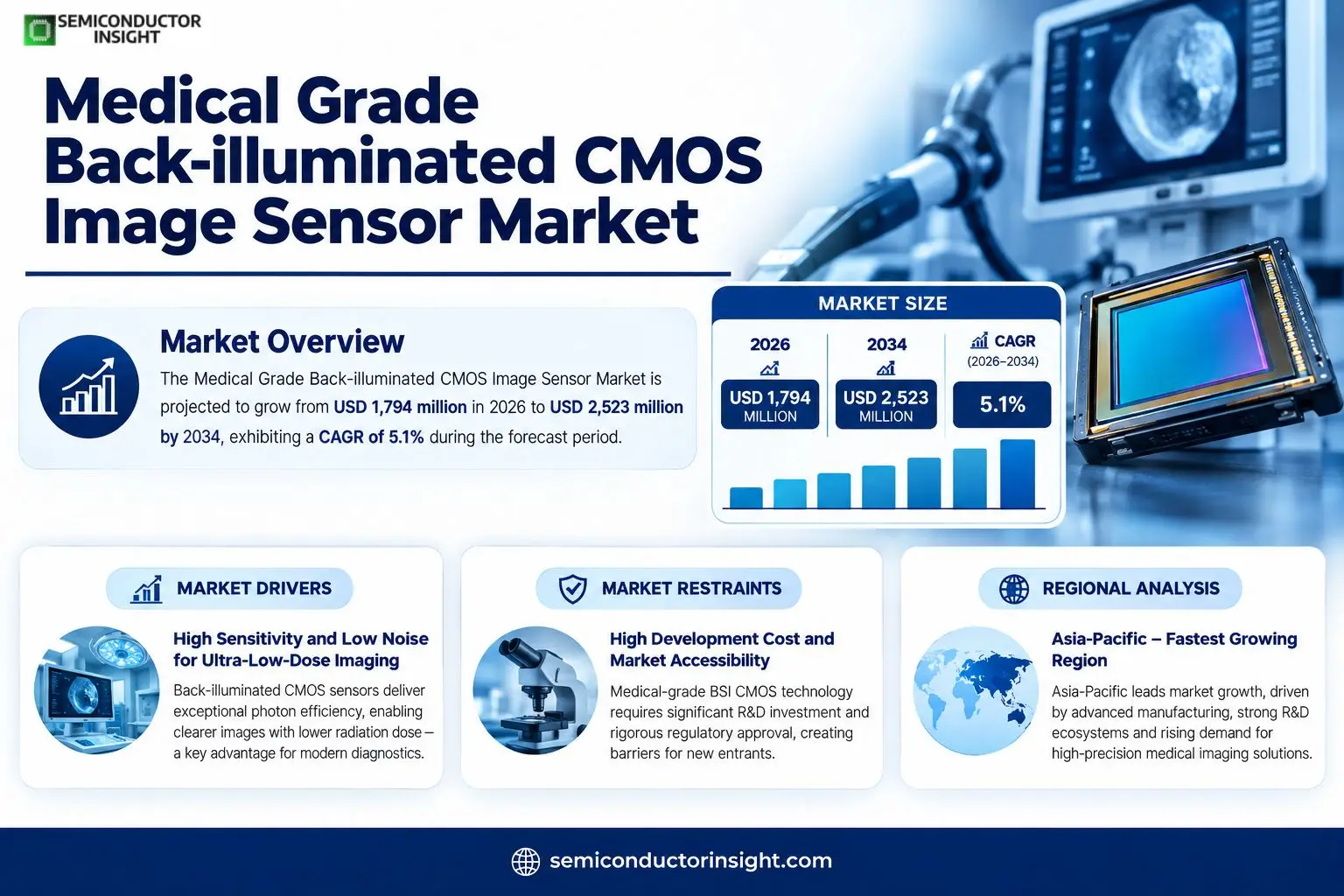
Medical Grade Back‑illuminated CMOS Image Sensor Market was valued at USD 1,794 million in 2026 to USD 2,523 million by 2034, exhibiting a CAGR of 5.1% during the forecast period.
In that same year production reached approximately 302 million units, with an average selling price of about USD 6.50 per unit.A medical‑grade back‑illuminated CMOS image sensor is a solid‑state imaging device engineered for clinical use; it places photodiodes on the wafer backside to maximise quantum efficiency while meeting ISO 13485 and IEC 60601 standards, thereby delivering high sensitivity and low noise essential for accurate diagnosis and minimally invasive procedures.The adoption of advanced packaging such as flip‑chip or wafer‑level techniques further shrinks form factor without compromising thermal performance or reliability.
MARKET DRIVERS
High Sensitivity and Low Noise for Ultra‑Low‑Dose Imaging
Medical grade back‑illuminated CMOS sensors deliver photon‑starved performance that is unmatched by complementary metal‑oxide‑semiconductor (CMOS) counterparts. The reduced pixel pitch and advanced microlens arrays translate into ultra-low‑dose acquisition, a benefit that is increasingly attractive in ophthalmology and interventional radiology where patient safety is paramount.
Market Consolidation and Cost Efficiency
Consolidation among electronics providers has driven down per‑unit costs while maintaining tight product validation standards. Healthcare systems are embracing bundled procurement models, enabling cost‑efficiency gains that accelerate sensor adoption across diagnostic suites.
➤ Early adopters in retinal imaging are reducing exposure times by up to 30 %
Such improvements shorten procedure times, freeing up clinical capacity and encouraging wider deploymentincluding in ambulatory settings where turnaround speed is critical.
MARKET CHALLENGES
Calibration Complexity and Vendor Lock‑in
Achieving pixel‑level sensitivity demands elaborate calibration routines that can be tightly coupled to proprietary firmware. This leads to vendor lock‑in, complicating system upgrades and discouraging incremental updates from hospital IT teams.
Other Challenges
Capital Constraints
High upfront investment for acquisition and integration of back‑illuminated modules limits quick uptake in smaller practices.
Limited Peripheral Integration
Inadequate support from imaging hard‑ware peripherals hampers full‑system benefits, limiting the return on sensor deployment.
MARKET RESTRAINTS
High Development Cost and Market Accessibility
Developing medical‑grade back‑illuminated CMOS technology involves multi‑year R&D cycles and sizable investment in process control. The capital intensity makes it difficult for mid‑tier manufacturers to enter the niche, thereby constraining market access.Regulatory scrutiny adds another layer of cost, as each sensor platform must undergo a rigorous approval pathway that can extend release cycles. Compliance with sterilization and electromagnetic compatibility specifications further raises the barrier for new entrants.Limited geographic distribution of manufacturing facilities forces health facilities in emerging economies to rely on long supply chains, increasing lead times and exposing the market to trade‑policy volatility.
MARKET OPPORTUNITIES
Growing Demand in Remote Diagnostics and AI‑Driven Imaging
Telemedicine platforms are seeking higher fidelity image capture to support remote diagnostics. Back‑illuminated CMOS sensors provide the resolution and noise performance required for AI algorithms that detect subtle pathology, creating an opportunity for sensor vendors to partner with software providers.The convergence of high‑speed data links and edge‑computing nodes encourages the integration of sensors into portable diagnostic kits. This shift unlocks new revenue streams for manufacturers that can deliver ready‑to‑deploy, compliant imaging bundles to field applications.Finally, the push toward personalized medicine creates a demand for high‑clarity imagery in point‑of‑care settings. Sensor developers who can deliver robust, low‑power modules suited for implantable or wearable devices stand to capture a new segment within the medical image sensor ecosystem.
Medical Grade Back-illuminated CMOS Image Sensor Market Trends
The Medical Grade Back-illuminated CMOS Image Sensor Market is shifting from high‑resolution desktop imaging to real‑time, in‑situ diagnostics. Increasing prevalence of chronic conditions and the push for repeatable, low‑dose procedures compel imaging platforms to adopt sensors that combine high quantum efficiency with stringent compliance standards. Consequently, vendors are concentrating R&D on global shutter designs with frame rates that match endoscopic motion, while simultaneously tightening ISO 13485 validation workflows. The convergence of miniaturization requirements and tighter safety mandates curates a niche yet rapidly expanding demand curve that outpaces generic silicon photonics applications. For medical device integrators, forging partnerships with suppliers that can deliver BSI CMOS units under a single shipments strategy can reduce redesign cycles and lower long‑term cost of ownership.
Other Trends
Advanced Packaging for Mini‑Scale Applications
Flip‑chip and wafer‑level packaging solutions are redefining the form factor of medical imaging devices. By eliminating wire‑bonding constraints, manufacturers can achieve sub‑millimeter sensor envelopes that fit comfortably into endoscopic scopes and handheld probes. The integration of low‑profile thermal interfaces supports continuous‑mode operation, critical for procedures that demand extended imaging intervals. Vendors that invest in chip‑scale packaging (CSP) and two‑layer interposers are positioned to capture early adopters in minimally invasive cardiology and neurosurgery, where space and heat dissipation are paramount.
Consolidated Production Capacity Amidst Geographic Concentration
Capacity consolidation is concentrating advanced manufacturing capabilities within a handful of East Asian and North American foundries. This concentration amplifies bargaining power for material suppliers but also heightens vulnerability to geopolitical disruptions. Companies that can secure long‑term agreements or invest in in‑house fabrication facilities mitigate lead‑time risks while maintaining supply chain resilience. As demand for Medical Grade Back-illuminated CMOS Image Sensor Market units climbs, distributors must adjust inventory strategies to balance the benefits of bulk purchasing against the need for rapid replacement in high‑volume surgical environments. The interplay of regional concentration and capacity expansion presents a critical strategic advisory point for investors and OEMs alike.
COMPETITIVE LANDSCAPE
Key Industry Players
Analysis of the Competitive Arena in Medical Grade Back‑Illuminated CMOS Image Sensor Market
The market is dominated by a triad of integrated device manufacturersSony Semiconductor Solutions, Samsung Electronics, and OmniVision. Their strong ownership of the entire value chain from pixel‑level design to wafer fabrication gives them economies of scale and a robust pipeline of next‑generation BSI devices. Sony’s dedicated stacked CMOS line, Samsung’s 45‑nm advanced process, and OmniVision’s global‑shutter portfolio are all positioned to meet the demanding ISO 13485 and IEC 60601 certifications that define the medical grade segment. Crucially, their investment in high‑resolution, low‑noise architectures keeps unit prices around USD 6.5 while delivering the quantum efficiency gains that future minimally invasive procedures require. Market share concentration at this tier creates a low‑margin, high‑volume reality; however, the rapid adoption of BSI imaging in endoscopic platforms and portable diagnostics fuels a calculated push toward higher dynamic range offerings, compelling these leaders to accelerate R&D spend and secure supply contracts with key medical equipment OEMs.Beyond the core giants, a cohort of niche players is carving out differentiated niches through specialized packaging and targeted application focus. STMicroelectronics, On Semiconductor, and GalaxyCore emphasize industrial‑grade global shutter solutions that match the requirements of high‑frame‑rate, precision applications such as machine‑vision inspection and radiosurgical imaging. Panasonic’s compact, low‑leakage BSI modules cater to portable ultrasound systems, while Smartsens Technology delivers cost‑effective sensors for lower‑cost point‑of‑care diagnostics. Canon and SOI remain focused on imaging optics integration, offering signatures of high lateral resolution for advanced endoscopic cameras. These firms, often operating with tighter margins, rely on strategic partnerships and agile design cycles to respond to emerging regulatory changes and to capture market share in high‑margin sub‑segments such as orthopedics and gastroenterology where specialized sensor geometry and reduced radiation dose are paramount.
List of Key Medical Grade Back‑Illuminated CMOS Image Sensor Companies Profiled
- Sony Semiconductor Solutions
- Samsung Electronics
- OmniVision
Segment Analysis:
| Segment Category | Sub-Segments | Key Insights |
| By Type |
|
Stacked BSI Sensors are the primary choice for high‑resolution, low‑noise medical imaging. They deliver superior quantum efficiency and low‑light performance, enabling minimally invasive procedures. Key advantages include: – Enhanced sensitivity through backside illumination. – The stacked architecture allows integration of advanced processing circuits within the chip. – Reduced form factor supporting compact endoscopic tools. |
| By Application |
|
Endoscopic Imaging is the fastest growing application due to the need for ultra‑small, high‑sensitivity sensors in minimally invasive surgeries. Readiness of BSI sensors for low‑light environments supports real‑time visualization. Advantages include: – Improved image clarity with high quantum efficiency. – Lower radiation exposure thanks to sensor sensitivity. – Compact designs complement advanced surgical robotics. |
| By End User |
|
Hospitals – Surgical Suites drive demand for precision imaging with minimal patient exposure. BSI CMOS sensors provide high fidelity under low illumination, essential for critical diagnostic procedures. Key factors: – Reliable operation under sterile conditions. – Compatibility with robotic surgical platforms. – Compliance with stringent safety certifications. |
| By Device Form Factor |
|
Miniaturized devices meet the escalating requirement for handheld diagnostics and wearable health monitors. They excel in low‑power consumption and slim integration. Distinctive benefits: – Enables unobtrusive patient monitoring. – Facilitates deployment in resource‑constrained settings. – Designs complement fiber‑optic connectivity for telemedicine. |
| By Certification Alignment |
|
ISO 13485 Compliance is the cornerstone for medical device manufacturers adopting BSI sensors. It guarantees process control, traceability, and risk management. Advantages include: – Ensures consistent sensor quality across production batches. – Facilitates market entry in regulated regions. – Enhances customer confidence for critical diagnostic equipment. |
Regional Analysis: Medical Grade Back-illuminated CMOS Image Sensor Market
American medical device developers consistently prioritize the integration of back‑illuminated CMOS sensors to secure optical performance that rivals or surpasses legacy CCDs. The result is a steady uptick in sensor payloads across imaging suites, reinforcing the United States’ role as an ecosystems catalyst for optical innovation. This trend fuels demand for higher pixel densities, fast read‑out pathways, and adaptive gain controlall for the arduous diagnostic tasks that define core medicine today.
The U.S. market is calibrated by a dual‑layered spectrum of incumbents and emergent startups. Legacy equipment vendors harness established back‑illumination techniques to maintain market share, while venture‑backed specialists push into edge‑sensor configurations that exploit machine‑learning read‑out. The dynamic of this rivalry compels revisions to compliance pathways and accelerates feature cycles, working in tandem to raise the baseline of performance expected across the medical imaging continuum.
Regulatory expectations in the United States shape sensor evolution by demanding rigorous electromagnetic compatibility and biocompatibility testing. The convergence of FDA and IEEE standards establishes a stringent approval funnel that filters unreliability at early design stages. Manufacturers adopt a proactive compliance strategy, reducing time‑to‑market and securing institutional trust for high‑stakes clinical applications.
Key innovation drivers here include micro‑optics fabrication, on‑chip auto‑exposure control, and the integration of neuromorphic‑inspired processing units. These elements collectively lower the power envelope of back‑illuminated CMOS sensors, enabling their deployment in wearable diagnostics and bedside monitoring where energy stewardship is essential.
North America
Beyond the United States, Canada and Mexico contribute to the broader North American profile through siloed sensor development and cross‑border data‑exchange agreements. Canadian research institutions focus on fabricating high‑resolution pixel arrays, whereas Mexican logistics frameworks enhance parts distribution to U.S. heartlands. Collectively, the region values early supplier relationships and standardised testing procedures, ensuring that all sensors arriving on the North American soil meet the tight tolerances demanded by premium diagnostic applications.
Europe
Europe’s sensor market is defined by a commitment to data privacy, rigorous certification and a competitive manufacturing base that supplies a range of back‑illuminated solutions tailored to imaging platforms used across hospitals. SMEs in Germany and France provide custom packages that fuse optical lenses with sensor modules, while regulatory bodies like the CE mark enforce strict safety and electromagnetic standards that shape product rollout timelines. The result is a market that balances cost sensitivity with stringent compliance, favoring transactions that optimise financial performance without sacrificing safety.
Asia-Pacific
In the Asia‑Pacific zone, countries such as Japan, South Korea, and China drive supply chain concentration and large‑scale fabrication capabilities. Their focus lies in developing high‑dpi back‑illuminated CMOS arrays for real‑time intraoperative imaging and rapid analysis of tissue samples. National research programmes support domestic semiconductor fabs, reducing dependency on external supply chains. Meanwhile, regional collaboration accelerates standardisation, allowing producers to meet global calibers rapidly while retaining local responsiveness to emerging diagnostic procedures.
Middle East & Africa
The Middle East & Africa region is emerging as a strategic captive market, drawing on regional investment in hospital infrastructure and government‑backed health programmes. Here, sensor adoption often hinges on cost‑effectiveness and serviceability, leading to a preference for stabilized platforms that can be upgraded over time. Cooperative agreements with manufacturer”s support after‑sales training, ensuring that medical professionals can harness the full potential of back‑illuminated cameras within complicated clinical workflows.
Report Scope
This market research report provides a comprehensive analysis of the Medical Grade Back-illuminated CMOS Image Sensor Market , covering the forecast period 2026–2034. It offers detailed insights into market dynamics, technological advancements, competitive landscape, and key trends shaping the industry.
Key focus areas of the report include:
- Market Overview: The report begins with an overview outlining its current market scenario, key growth indicators, and industry transformation drivers. It discusses macroeconomic factors, demand–supply balance, regulatory landscape, and the strategic role of semiconductors in powering advancements across industries such as automotive, telecommunications, consumer electronics, and industrial automation.
- Market Size & Forecast: Historical data and future projections for revenue, unit shipments, and market value across major regions and segments.
- Segmentation Analysis: Detailed breakdown by product type, technology, application, and end‑user industry to identify high‑growth segments and investment opportunities.
- Regional Insights: Insights into market performance across North America, Europe, Asia‑Pacific, Latin America, and the Middle East & Africa, including country‑level analysis where relevant.
- Competitive Landscape: Profiles of leading market participants, including their product offerings, R&D focus, manufacturing capacity, pricing strategies, and recent developments such as mergers, acquisitions, and partnerships.
- Technology Trends & Innovation: Assessment of emerging technologies, integration of AI/IoT, semiconductor design trends, fabrication techniques, and evolving industry standards.
- Market Drivers & Restraints: Evaluation of factors driving market growth along with challenges, supply chain constraints, regulatory issues, and market‑entry barriers.
- Stakeholder Insights: Insights for component suppliers, OEMs, system integrators, investors, and policymakers regarding the evolving ecosystem and strategic opportunities.
Primary and secondary research methods are employed, including interviews with industry experts, data from verified sources, and real‑time market intelligence to ensure the accuracy and reliability of the insights presented.
FREQUENTLY ASKED QUESTIONS:
What is the current market size of Medical Grade Back‑illuminated CMOS Image Sensor Market?
-> Medical Grade Back‑illuminated CMOS Image Sensor Market was valued at USD 1794 million in 2026 and is expected to reach USD 2523 million by 2034.
Which key companies operate in Medical Grade Back‑illuminated CMOS Image Sensor Market?
-> Key players include SONY, Samsung, OmniVision, STMicroelectronics, On Semiconductor, GalaxyCore, Panasonic, Smartsens Technology, Canon, SOI, among others.
What are the key growth drivers?
-> Key growth drivers include high sensitivity, low noise, miniaturization of medical imaging sensors, compliance with ISO 13485, IEC 60601 and AEC‑Q100 standards, and increasing adoption of minimally invasive procedures.
Which region dominates the market?
-> Asia‑Pacific is the fastest‑growing region, while Europe remains a dominant market.
What are the emerging trends?
-> Emerging trends include increasing use of back‑illuminated and stacked CMOS sensors in endoscopes and dental imaging, integration of AI for image analysis, and development of high‑resolution, low‑light medical imaging devices.
Get Sample Report PDF for Exclusive Insights
Report Sample Includes
- Table of Contents
- List of Tables & Figures
- Charts, Research Methodology, and more...
 Download Sample Report PDF