Magnetostrictive Displacement Sensors Market, Trends, Business Strategies 2026-2034

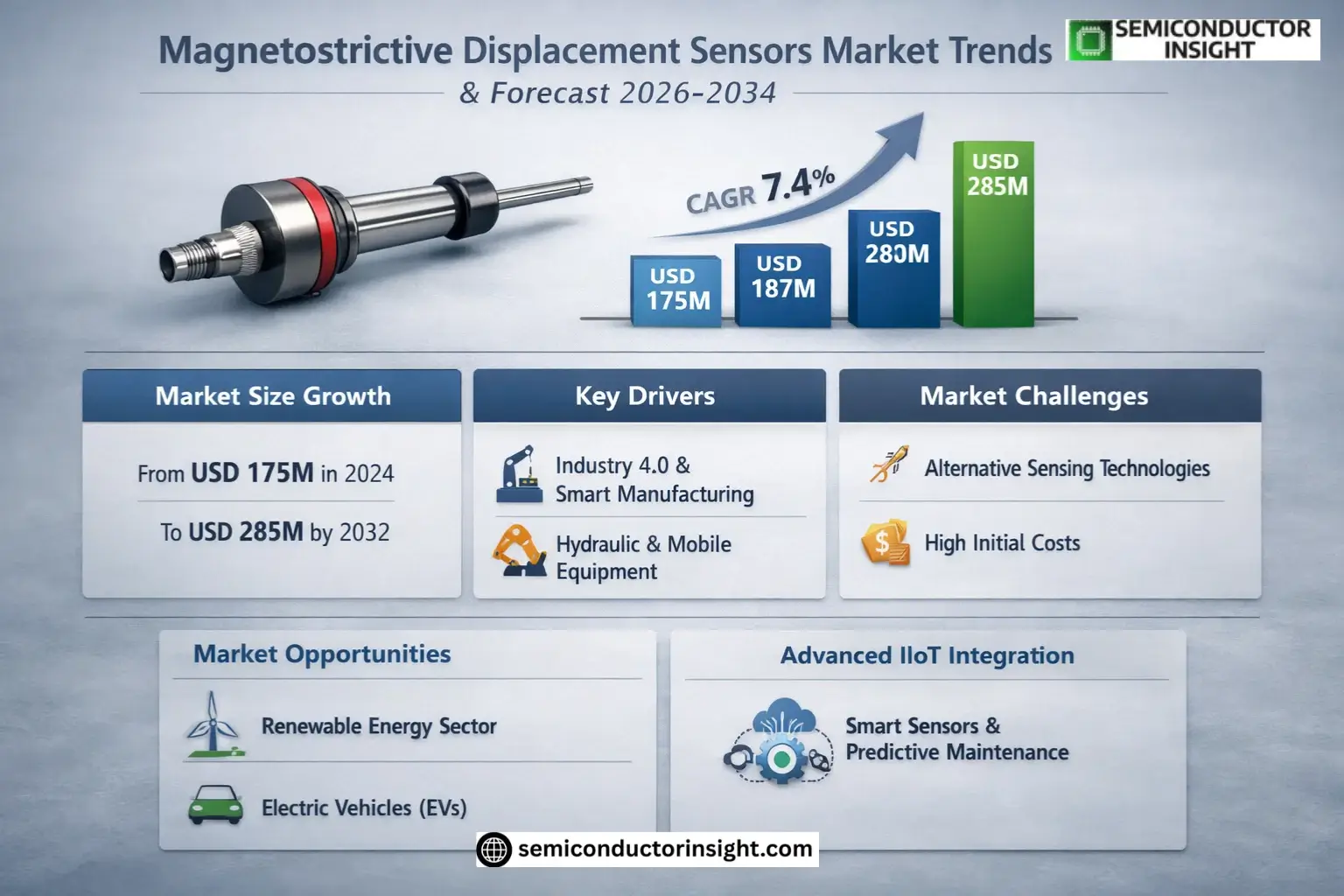
Magnetostrictive Displacement Sensors Market was valued at USD 175 million in 2024. The market is projected to grow from USD 187 million in 2025 to USD 285 million by 2032, exhibiting a CAGR of 7.4% during the forecast period.

PDF Icon Download Sample Report PDF
  • Quick Dispatch

    All Orders

  • Secure Payment

    100% Secure Payment

Price range: $1,500.00 through $4,250.00

Clear

Market Insights

Global Magnetostrictive Displacement Sensors Market was valued at USD 175 million in 2024. The market is projected to grow from USD 187 million in 2025 to USD 285 million by 2032, exhibiting a CAGR of 7.4% during the forecast period.

Magnetostrictive displacement sensors (MDS) are precision measurement devices that utilize the magnetostrictive effect a phenomenon where certain materials change shape in response to magnetic fields. These sensors provide non-contact, high-accuracy linear position measurements by detecting torsional stress waves generated along a magnetostrictive waveguide. Their ability to maintain performance in extreme conditions makes them indispensable for industrial automation applications.

The market growth is driven by increasing adoption in Industry 4.0 implementations and smart manufacturing systems requiring reliable position feedback. Key sectors fueling demand include hydraulic cylinder positioning, factory automation equipment, and renewable energy systems where MDS sensors outperform traditional LVDTs and potentiometers. Recent technological advancements have enhanced resolution capabilities below 1 micron while expanding temperature operating ranges beyond 150°C, further broadening application potential.
Magnetostrictive Displacement Sensors Market Share

MARKET DRIVERS

Demand for High-Accuracy Industrial Automation

Global push towards Industry 4.0 and smart manufacturing is a primary driver for the Magnetostrictive Displacement Sensors Market. These sensors provide non-contact, absolute position measurement with resolutions down to the micron level, which is critical for precision automation in applications like robotic arms, CNC machines, and hydraulic cylinder feedback. Their long-term reliability and durability under harsh industrial conditions make them indispensable in modern factories aiming for zero-defect production.

Growth in Heavy Machinery and Mobile Equipment

The expansion of the construction, agriculture, and mining sectors fuels demand for robust mobile hydraulic equipment. Magnetostrictive displacement sensors are extensively used for position and level sensing in hydraulic and pneumatic cylinders on excavators, tractors, and forestry machinery. Their ability to withstand extreme shock, vibration, and contaminants ensures operational safety and efficiency, driving market adoption.

Furthermore, stringent safety and performance regulations in industries such as aviation and railway transportation mandate the use of highly reliable feedback systems, bolstering the need for these advanced sensors. The inherent fail-safe design of many magnetostrictive sensors makes them a preferred choice for safety-critical applications.

MARKET CHALLENGES

Competition from Alternative Sensing Technologies

A key challenge for the Magnetostrictive Displacement Sensors Market is the strong competition from other non-contact position sensing technologies, such as LVDT, laser, and capacitive sensors. While magnetostrictive sensors offer excellent accuracy and reliability, alternative technologies can sometimes provide a lower-cost solution for applications with less demanding specifications, creating price pressure.

Other Challenges

System Complexity and Integration
Integrating magnetostrictive sensors into complex machinery requires expertise in electronics and signal conditioning. This can pose a challenge for smaller OEMs or end-users with limited technical resources, potentially slowing down adoption rates compared to simpler sensor types.

Economic Sensitivity
The market for these sensors is closely tied to capital expenditure in manufacturing and heavy industries. Economic downturns or reduced investment in industrial automation can lead to cyclical demand fluctuations, presenting a persistent challenge for market stability.

MARKET RESTRAINTS

High Initial Cost Compared to Basic Sensors

The primary restraint on the Magnetostrictive Displacement Sensors Market is the higher initial unit cost compared to simpler potentiometric or inductive sensors. For applications where extreme precision is not a critical requirement, the cost-benefit analysis may favor cheaper alternatives, limiting market penetration in price-sensitive segments. This is particularly evident in cost-competitive industries and emerging economies.

Technical Limitations in Extreme Environments

Although robust, the performance of magnetostrictive technology can be affected by extremely strong external magnetic fields, which may interfere with the sensor’s operation. This imposes restrictions on their use in specific applications, such as near large motors or generators, acting as a niche-specific restraint for the Magnetostrictive Displacement Sensors Market.

MARKET OPPORTUNITIES

Expansion into Renewable Energy and Electric Vehicles

The rapid growth of the renewable energy and electric vehicle (EV) sectors presents significant opportunities. Magnetostrictive displacement sensors are ideal for precision control in hydrogen compressor valves for fuel cells, battery manufacturing automation, and hydraulic systems in wind turbine pitch control. The transition to green technology creates new, high-value application areas for the Magnetostrictive Displacement Sensors Market.

Advancements in Industry 4.0 and IIoT

The integration of Industrial Internet of Things (IIoT) capabilities is a major growth frontier. Next-generation magnetostrictive sensors with built-in IO-Link and predictive maintenance features enable real-time data analytics and remote monitoring. This allows for condition-based maintenance, reducing downtime and opening up new service-based revenue models for sensor manufacturers in the Magnetostrictive Displacement Sensors Market.
Magnetostrictive Displacement Sensors Market Trends

Rising Demand Fueled by Industrial Automation

A primary trend shaping the Magnetostrictive Displacement Sensors Market is the accelerating global adoption of industrial automation and smart manufacturing. These sensors provide high-precision, non-contact measurement methods, making them particularly suitable for fields that demand high reliability and precision, such as liquid level monitoring, precise control, robotic positioning, and automated production lines. Global market was valued at USD 175 million in 2024 and is projected to reach USD 285 million by 2032, growing at a CAGR of 7.4%. This growth is underpinned by the sensor’s superior performance in harsh industrial environments where traditional contact sensors are prone to failure.

Other Trends

Integration with IIoT and Smart Systems

The development of the Industrial Internet of Things (IIoT) represents a significant trend for the Magnetostrictive Displacement Sensors Market. In smart manufacturing environments, precise sensor data is critical for real-time monitoring and optimization of production processes. The high accuracy and stability of MDS sensors perfectly meet these needs, leading to their increased application in integrated systems for pressure measurement, machine vision, and advanced automation control, further driving market expansion.

Technological Advancements and Competitive Landscape

Continuous technological improvement is another key trend. Enhancements in sensor design and manufacturing have led to a gradual decrease in the cost of magnetostrictive sensors while simultaneously enhancing their performance and robustness. This trend promotes broader market adoption across various sectors. The competitive landscape features key players like MTS Sensors, BALLUFF, and TURCK, who are focused on innovation. The market sees a segmentation by ingress protection ratings like IP67, IP68, and IP69, catering to diverse environmental demands, with major applications in Petrochemical, Automotive, and Aerospace industries.

COMPETITIVE LANDSCAPE

Key Industry Players

An analysis of market leaders and emerging contenders shaping the future of precision measurement.

Magnetostrictive Displacement Sensors Market is characterized by the presence of established global leaders who have secured their positions through technological expertise, extensive product portfolios, and strong brand recognition. Companies such as MTS Sensors, Balluff, and TURCK dominate a significant portion of the market share. Their competitive edge is derived from continuous innovation, offering sensors with high durability, precision, and advanced communication protocols suitable for demanding IIoT and Industry 4.0 applications. The market structure is moderately concentrated, with the top players leveraging their global distribution networks and long-standing relationships with major industrial clients in sectors like automotive, petrochemical, and aerospace. Recent strategic developments have included mergers and acquisitions aimed at expanding technological capabilities and geographical reach, reinforcing their market leadership.

Beyond the dominant players, a tier of specialized and regional companies competes effectively by focusing on niche applications or offering cost-competitive solutions. Firms such as ASM Sensor, MEGATRON, and TSM SENSORS SRL have carved out significant positions by providing specialized sensors for particular environmental conditions or industry-specific requirements. Other notable participants, including GEFRAN and AMETEK Gemco, support the market’s breadth with reliable components for industrial automation systems. This diverse ecosystem ensures robust competition, drives innovation in sensor performance and integration features, and provides end-users with a wide range of options tailored to different performance and budget needs across various global regions.

List of Key Magnetostrictive Displacement Sensors Companies Profiled

  • MTS Sensors
  • BALLUFF
  • ASM Sensor
  • MEGATRON
  • TURCK
  • AMETEK Gemco
  • TSM SENSORS SRL
  • GEFRAN
  • SICK AG
  • Baumer Group
  • Pepperl+Fuchs
  • ifm electronic
  • Leuze electronic
  • HYDAC
  • Micro-Epsilon

Segment Analysis:

Segment Category Sub-Segments Key Insights
By Type
  • IP67
  • IP68
  • IP69
  • Others
IP68 sensors represent the leading segment, primarily due to their superior balance of performance and protection. These sensors offer complete protection against dust ingress and prolonged immersion in water under pressure, making them highly sought after for demanding industrial environments.

  • This rating is considered the industry standard for heavy-duty applications, offering a reliable solution for continuous operation in wash-down areas and humid conditions common in food processing and chemical plants.
  • The robust sealing ensures long-term reliability and minimizes maintenance downtime, which is a critical factor for automated production lines where sensor failure can cause significant operational disruptions.
  • Manufacturers are increasingly standardizing on IP68 for new product designs to cater to the broadest range of harsh environment applications without the cost premium associated with the more extreme IP69K rating.
By Application
  • Petrochemical
  • Automotive & Transportation
  • Aerospace & Defense
  • Telecommunications
  • Others
Petrochemical applications are the dominant segment, driven by the critical need for safety and precision in hazardous environments. The non-contact, high-accuracy measurement capability of magnetostrictive sensors is essential for monitoring liquid levels in storage tanks and controlling valves in refining processes.

  • Their ability to function reliably in high-temperature and corrosive atmospheres, where traditional sensors would fail, makes them indispensable for ensuring operational safety and preventing environmental incidents.
  • The drive towards digitalization and predictive maintenance in the oil and gas industry fuels demand for sensors that provide stable, real-time data for asset integrity management systems.
  • Applications extend beyond simple level detection to include precise positioning of actuators and robotic systems used in pipeline maintenance and automated loading/unloading operations.
By End User
  • Original Equipment Manufacturers (OEMs)
  • System Integrators
  • End-User Industries (Direct)
Original Equipment Manufacturers (OEMs) constitute the leading end-user segment, as they incorporate these sensors directly into their machinery and automated systems. The demand is propelled by the integration of smart sensor technology into new industrial equipment designed for Industry 4.0.

  • OEMs value the long-term reliability and minimal maintenance requirements of magnetostrictive sensors, which enhance the overall value proposition and reduce the total cost of ownership for their customers.
  • There is a strong trend towards sourcing sensors with digital outputs and compatibility with industrial communication protocols, allowing for seamless integration into sophisticated control networks.
  • Collaboration between sensor manufacturers and OEMs is increasing to develop customized solutions for specific applications, such as hydraulic cylinder positioning in heavy machinery or precision robotics.
By Measurement Technology
  • Absolute Position Sensing
  • Incremental Position Sensing
  • Linear Velocity Sensing
Absolute Position Sensing is the predominant technology, valued for its ability to provide an exact position reading immediately upon power-up without the need for a reference point. This characteristic is crucial for systems where safety and operational continuity are paramount.

  • This technology eliminates the risk of positional errors that can occur with incremental systems after a power loss, making it essential for applications like aircraft control surfaces and automated guided vehicles.
  • The high resolution and repeatability of absolute magnetostrictive sensors support complex automation tasks that require precise coordination between multiple moving parts.
  • Demand is growing in smart manufacturing environments where data integrity is critical for digital twin simulations and real-time process optimization.
By Sales Channel
  • Direct Sales
  • Distributors & Resellers
  • Online Platforms
Distributors & Resellers form the leading sales channel, acting as a critical link between specialized sensor manufacturers and a diverse, fragmented industrial customer base. Their extensive regional networks and value-added services are key to market penetration.

  • Distributors provide essential technical support, local inventory, and logistics, which are highly valued by smaller OEMs and end-users who require rapid procurement and installation.
  • They offer a broad portfolio of products from various manufacturers, allowing customers to compare specifications and select the optimal sensor for their specific application and budget.
  • This channel is increasingly important for reaching small and medium-sized enterprises that are modernizing their operations but lack the volume for direct manufacturer relationships.

Regional Analysis: Global Magnetostrictive Displacement Sensors Market

Asia-Pacific

The Asia-Pacific region dominates the Magnetostrictive Displacement Sensors Market, driven by its status as a global manufacturing hub. Nations like China, Japan, and South Korea are at the forefront of industrial automation, robotics, and machinery production, creating immense demand for high-precision position feedback. The expansion of the automotive and electronics sectors, coupled with significant government initiatives promoting Industry 4.0 and smart manufacturing, provides a fertile ground for sensor adoption. Furthermore, the presence of leading sensor manufacturers and a robust supply chain ecosystem ensures competitive pricing and technological innovation, making it the most dynamic and fastest-growing regional market with a diverse application base.

Industrial Automation Hub
Asia-Pacific’s extensive manufacturing infrastructure, particularly in automotive assembly and electronics, fuels demand for precision measurement. Magnetostrictive displacement sensors are critical for robotic arm positioning, hydraulic cylinder control, and ensuring production line accuracy, supported by continuous industrial modernization.
Government & Policy Support
Strong governmental policies in China, India, and Southeast Asia promoting advanced manufacturing and digital transformation are accelerating the adoption of smart sensors. Investments in infrastructure and Industry 4.0 create a favorable regulatory and economic environment for market growth.
Strong Supply Chain
The region boasts a mature supply chain for electronic components and sensor manufacturing, leading to cost-effective production. Local availability of raw materials and skilled labor enables competitive pricing and rapid innovation in magnetostrictive sensor technologies.
Diverse Application Sectors
Beyond traditional manufacturing, magnetostrictive displacement sensors are increasingly used in renewable energy projects, marine engineering, and construction equipment. This diversification reduces market dependency on a single industry and ensures sustained growth momentum across the region.

North America
North America represents a mature and technologically advanced market for Magnetostrictive Displacement Sensors, characterized by high adoption in aerospace, defense, and heavy machinery sectors. The region’s focus on quality control, safety standards, and precision engineering in industries such as oil and gas extraction drives demand for reliable linear position sensing. Continuous investments in research and development by both sensor manufacturers and end-user industries foster innovation. The presence of stringent regulatory frameworks ensures that high-performance sensors are integral to industrial processes, maintaining the region’s position as a key consumer of advanced magnetostrictive technologies.

Europe
Europe holds a significant share of the Magnetostrictive Displacement Sensors Market, supported by its strong automotive, industrial automation, and renewable energy sectors. Germany, in particular, is a cornerstone of engineering excellence and automation, creating steady demand. The region’s emphasis on energy efficiency and sustainable manufacturing processes encourages the integration of precise sensor technology in hydraulic systems and wind turbines. Collaborative research initiatives between universities and industry players further stimulate technological advancements, ensuring European manufacturers remain competitive in producing high-accuracy, durable displacement sensors for demanding applications.

South America
The Magnetostrictive Displacement Sensors Market in South America is emerging, with growth primarily driven by the mining, agriculture, and oil & gas industries. Countries like Brazil and Chile are investing in modernizing their industrial equipment to improve productivity and operational safety. While the market is smaller compared to other regions, the need for robust sensing solutions in harsh environments presents growth opportunities. Economic fluctuations and infrastructure challenges can impact the pace of adoption, but the long-term outlook remains positive as industries gradually embrace automation and precision measurement technologies.

Middle East & Africa
The Middle East & Africa region shows growing potential for the Magnetostrictive Displacement Sensors Market, largely fueled by the oil & gas sector and infrastructure development projects. The need for accurate level and position sensing in refineries, pipelines, and heavy construction equipment is increasing. While market penetration is currently lower, economic diversification efforts in Gulf Cooperation Council countries into manufacturing and industrial sectors are expected to create new demand. The region’s focus on operational efficiency and asset management in resource extraction industries provides a foundation for future market expansion.

Report Scope

This market research report provides a comprehensive analysis of the Global Magnetostrictive Displacement Sensors Market, covering the forecast period 2024–2032. It offers detailed insights into market dynamics, technological advancements, competitive landscape, and key trends shaping the industry.

Key focus areas of the report include:

  • Market Overview: The report begins with an overview outlining its current market scenario, key growth indicators, and industry transformation drivers. It discusses macroeconomic factors, demand–supply balance, regulatory landscape, and the strategic role of magnetostrictive sensors in powering advancements across industries such as petrochemical, automotive, aerospace, and telecommunications.
  • Market Size & Forecast: Historical data and future projections for revenue, unit shipments, and market value across major regions and segments.
  • Segmentation Analysis: Detailed breakdown by product type (IP67, IP68, IP69), application, and end-user industry to identify high-growth segments and investment opportunities.
  • Regional Insights: Insights into market performance across North America, Europe, Asia-Pacific, Latin America, and the Middle East & Africa, including country-level analysis where relevant.
  • Competitive Landscape: Profiles of leading market participants, including their product offerings, R&D focus, manufacturing capacity, pricing strategies, and recent developments such as mergers, acquisitions, and partnerships.
  • Technology Trends & Innovation: Assessment of emerging technologies, integration with Industrial IoT, manufacturing trends, and evolving industry standards.
  • Market Drivers & Restraints: Evaluation of factors driving market growth along with challenges, supply chain constraints, regulatory issues, and market-entry barriers.
  • Stakeholder Insights: Insights for component suppliers, OEMs, system integrators, investors, and policymakers regarding the evolving ecosystem and strategic opportunities.

Primary and secondary research methods are employed, including interviews with industry experts, data from verified sources, and real-time market intelligence to ensure the accuracy and reliability of the insights presented.

FREQUENTLY ASKED QUESTIONS:

What is the current market size of Magnetostrictive Displacement Sensors?

-> Magnetostrictive Displacement Sensors Market was valued at USD 175 million in 2024. The market is projected to grow from USD 187 million in 2025 to USD 285 million by 2032, exhibiting a CAGR of 7.4% during the forecast period.

Which key companies operate in Magnetostrictive Displacement Sensors Market?

-> Key players include MTS Sensors, BALLUFF, ASM Sensor, MEGATRON, TURCK, AMETEK Gemco, TSM SENSORS SRL, and GEFRAN, among others.

What are the key growth drivers?

-> Key growth drivers include increasing industrial automation, demand for non-contact measurement solutions, growing IIoT adoption, and need for high-precision sensors in harsh environments.

Which region dominates the market?

-> Asia is the fastest-growing region, while Europe and North America remain dominant markets.

What are the emerging trends?

-> Emerging trends include integration with smart manufacturing systems, development of advanced materials, and miniaturization of sensor components.
Magnetostrictive Displacement Sensors Market, Trends, Business Strategies 2026-2034

Get Sample Report PDF for Exclusive Insights

Report Sample Includes

  • Table of Contents
  • List of Tables & Figures
  • Charts, Research Methodology, and more...

PDF Icon Download Sample Report PDF
SKU: c727b27b4211
Category:
License Type

Corporate License, Excel License, PDF and Excel Databook License

Download Sample Report

Table of Content

1 Introduction to Research & Analysis Reports
1.1 Magnetostrictive Displacement Sensors Market Definition
1.2 Market Segments
1.2.1 Segment by Type
1.2.2 Segment by Application
1.3 Global Magnetostrictive Displacement Sensors Market Overview
1.4 Features & Benefits of This Report
1.5 Methodology & Sources of Information
1.5.1 Research Methodology
1.5.2 Research Process
1.5.3 Base Year
1.5.4 Report Assumptions & Caveats
2 Global Magnetostrictive Displacement Sensors Overall Market Size
2.1 Global Magnetostrictive Displacement Sensors Market Size: 2024 VS 2032
2.2 Global Magnetostrictive Displacement Sensors Market Size, Prospects & Forecasts: 2020-2032
2.3 Global Magnetostrictive Displacement Sensors Sales: 2020-2032
3 Company Landscape
3.1 Top Magnetostrictive Displacement Sensors Players in Global Market
3.2 Top Global Magnetostrictive Displacement Sensors Companies Ranked by Revenue
3.3 Global Magnetostrictive Displacement Sensors Revenue by Companies
3.4 Global Magnetostrictive Displacement Sensors Sales by Companies
3.5 Global Magnetostrictive Displacement Sensors Price by Manufacturer (2020-2025)
3.6 Top 3 and Top 5 Magnetostrictive Displacement Sensors Companies in Global Market, by Revenue in 2024
3.7 Global Manufacturers Magnetostrictive Displacement Sensors Product Type
3.8 Tier 1, Tier 2, and Tier 3 Magnetostrictive Displacement Sensors Players in Global Market
3.8.1 List of Global Tier 1 Magnetostrictive Displacement Sensors Companies
3.8.2 List of Global Tier 2 and Tier 3 Magnetostrictive Displacement Sensors Companies
4 Sights by Product
4.1 Overview
4.1.1 Segment by Type – Global Magnetostrictive Displacement Sensors Market Size Markets, 2024 & 2032
4.1.2 IP67
4.1.3 IP68
4.1.4 IP69
4.1.5 Others
4.2 Segment by Type – Global Magnetostrictive Displacement Sensors Revenue & Forecasts
4.2.1 Segment by Type – Global Magnetostrictive Displacement Sensors Revenue, 2020-2025
4.2.2 Segment by Type – Global Magnetostrictive Displacement Sensors Revenue, 2026-2032
4.2.3 Segment by Type – Global Magnetostrictive Displacement Sensors Revenue Market Share, 2020-2032
4.3 Segment by Type – Global Magnetostrictive Displacement Sensors Sales & Forecasts
4.3.1 Segment by Type – Global Magnetostrictive Displacement Sensors Sales, 2020-2025
4.3.2 Segment by Type – Global Magnetostrictive Displacement Sensors Sales, 2026-2032
4.3.3 Segment by Type – Global Magnetostrictive Displacement Sensors Sales Market Share, 2020-2032
4.4 Segment by Type – Global Magnetostrictive Displacement Sensors Price (Manufacturers Selling Prices), 2020-2032
5 Sights by Application
5.1 Overview
5.1.1 Segment by Application – Global Magnetostrictive Displacement Sensors Market Size, 2024 & 2032
5.1.2 Petrochemical
5.1.3 Automotive & Transportation
5.1.4 Aerospace & Defense
5.1.5 Telecommunications
5.1.6 Others
5.2 Segment by Application – Global Magnetostrictive Displacement Sensors Revenue & Forecasts
5.2.1 Segment by Application – Global Magnetostrictive Displacement Sensors Revenue, 2020-2025
5.2.2 Segment by Application – Global Magnetostrictive Displacement Sensors Revenue, 2026-2032
5.2.3 Segment by Application – Global Magnetostrictive Displacement Sensors Revenue Market Share, 2020-2032
5.3 Segment by Application – Global Magnetostrictive Displacement Sensors Sales & Forecasts
5.3.1 Segment by Application – Global Magnetostrictive Displacement Sensors Sales, 2020-2025
5.3.2 Segment by Application – Global Magnetostrictive Displacement Sensors Sales, 2026-2032
5.3.3 Segment by Application – Global Magnetostrictive Displacement Sensors Sales Market Share, 2020-2032
5.4 Segment by Application – Global Magnetostrictive Displacement Sensors Price (Manufacturers Selling Prices), 2020-2032
6 Sights by Region
6.1 By Region – Global Magnetostrictive Displacement Sensors Market Size, 2024 & 2032
6.2 By Region – Global Magnetostrictive Displacement Sensors Revenue & Forecasts
6.2.1 By Region – Global Magnetostrictive Displacement Sensors Revenue, 2020-2025
6.2.2 By Region – Global Magnetostrictive Displacement Sensors Revenue, 2026-2032
6.2.3 By Region – Global Magnetostrictive Displacement Sensors Revenue Market Share, 2020-2032
6.3 By Region – Global Magnetostrictive Displacement Sensors Sales & Forecasts
6.3.1 By Region – Global Magnetostrictive Displacement Sensors Sales, 2020-2025
6.3.2 By Region – Global Magnetostrictive Displacement Sensors Sales, 2026-2032
6.3.3 By Region – Global Magnetostrictive Displacement Sensors Sales Market Share, 2020-2032
6.4 North America
6.4.1 By Country – North America Magnetostrictive Displacement Sensors Revenue, 2020-2032
6.4.2 By Country – North America Magnetostrictive Displacement Sensors Sales, 2020-2032
6.4.3 United States Magnetostrictive Displacement Sensors Market Size, 2020-2032
6.4.4 Canada Magnetostrictive Displacement Sensors Market Size, 2020-2032
6.4.5 Mexico Magnetostrictive Displacement Sensors Market Size, 2020-2032
6.5 Europe
6.5.1 By Country – Europe Magnetostrictive Displacement Sensors Revenue, 2020-2032
6.5.2 By Country – Europe Magnetostrictive Displacement Sensors Sales, 2020-2032
6.5.3 Germany Magnetostrictive Displacement Sensors Market Size, 2020-2032
6.5.4 France Magnetostrictive Displacement Sensors Market Size, 2020-2032
6.5.5 U.K. Magnetostrictive Displacement Sensors Market Size, 2020-2032
6.5.6 Italy Magnetostrictive Displacement Sensors Market Size, 2020-2032
6.5.7 Russia Magnetostrictive Displacement Sensors Market Size, 2020-2032
6.5.8 Nordic Countries Magnetostrictive Displacement Sensors Market Size, 2020-2032
6.5.9 Benelux Magnetostrictive Displacement Sensors Market Size, 2020-2032
6.6 Asia
6.6.1 By Region – Asia Magnetostrictive Displacement Sensors Revenue, 2020-2032
6.6.2 By Region – Asia Magnetostrictive Displacement Sensors Sales, 2020-2032
6.6.3 China Magnetostrictive Displacement Sensors Market Size, 2020-2032
6.6.4 Japan Magnetostrictive Displacement Sensors Market Size, 2020-2032
6.6.5 South Korea Magnetostrictive Displacement Sensors Market Size, 2020-2032
6.6.6 Southeast Asia Magnetostrictive Displacement Sensors Market Size, 2020-2032
6.6.7 India Magnetostrictive Displacement Sensors Market Size, 2020-2032
6.7 South America
6.7.1 By Country – South America Magnetostrictive Displacement Sensors Revenue, 2020-2032
6.7.2 By Country – South America Magnetostrictive Displacement Sensors Sales, 2020-2032
6.7.3 Brazil Magnetostrictive Displacement Sensors Market Size, 2020-2032
6.7.4 Argentina Magnetostrictive Displacement Sensors Market Size, 2020-2032
6.8 Middle East & Africa
6.8.1 By Country – Middle East & Africa Magnetostrictive Displacement Sensors Revenue, 2020-2032
6.8.2 By Country – Middle East & Africa Magnetostrictive Displacement Sensors Sales, 2020-2032
6.8.3 Turkey Magnetostrictive Displacement Sensors Market Size, 2020-2032
6.8.4 Israel Magnetostrictive Displacement Sensors Market Size, 2020-2032
6.8.5 Saudi Arabia Magnetostrictive Displacement Sensors Market Size, 2020-2032
6.8.6 UAE Magnetostrictive Displacement Sensors Market Size, 2020-2032
7 Manufacturers & Brands Profiles
7.1 MTS Sensors
7.1.1 MTS Sensors Company Summary
7.1.2 MTS Sensors Business Overview
7.1.3 MTS Sensors Magnetostrictive Displacement Sensors Major Product Offerings
7.1.4 MTS Sensors Magnetostrictive Displacement Sensors Sales and Revenue in Global (2020-2025)
7.1.5 MTS Sensors Key News & Latest Developments
7.2 BALLUFF
7.2.1 BALLUFF Company Summary
7.2.2 BALLUFF Business Overview
7.2.3 BALLUFF Magnetostrictive Displacement Sensors Major Product Offerings
7.2.4 BALLUFF Magnetostrictive Displacement Sensors Sales and Revenue in Global (2020-2025)
7.2.5 BALLUFF Key News & Latest Developments
7.3 ASM Sensor
7.3.1 ASM Sensor Company Summary
7.3.2 ASM Sensor Business Overview
7.3.3 ASM Sensor Magnetostrictive Displacement Sensors Major Product Offerings
7.3.4 ASM Sensor Magnetostrictive Displacement Sensors Sales and Revenue in Global (2020-2025)
7.3.5 ASM Sensor Key News & Latest Developments
7.4 MEGATRON
7.4.1 MEGATRON Company Summary
7.4.2 MEGATRON Business Overview
7.4.3 MEGATRON Magnetostrictive Displacement Sensors Major Product Offerings
7.4.4 MEGATRON Magnetostrictive Displacement Sensors Sales and Revenue in Global (2020-2025)
7.4.5 MEGATRON Key News & Latest Developments
7.5 TURCK
7.5.1 TURCK Company Summary
7.5.2 TURCK Business Overview
7.5.3 TURCK Magnetostrictive Displacement Sensors Major Product Offerings
7.5.4 TURCK Magnetostrictive Displacement Sensors Sales and Revenue in Global (2020-2025)
7.5.5 TURCK Key News & Latest Developments
7.6 AMETEK Gemco
7.6.1 AMETEK Gemco Company Summary
7.6.2 AMETEK Gemco Business Overview
7.6.3 AMETEK Gemco Magnetostrictive Displacement Sensors Major Product Offerings
7.6.4 AMETEK Gemco Magnetostrictive Displacement Sensors Sales and Revenue in Global (2020-2025)
7.6.5 AMETEK Gemco Key News & Latest Developments
7.7 TSM SENSORS SRL
7.7.1 TSM SENSORS SRL Company Summary
7.7.2 TSM SENSORS SRL Business Overview
7.7.3 TSM SENSORS SRL Magnetostrictive Displacement Sensors Major Product Offerings
7.7.4 TSM SENSORS SRL Magnetostrictive Displacement Sensors Sales and Revenue in Global (2020-2025)
7.7.5 TSM SENSORS SRL Key News & Latest Developments
7.8 GEFRAN
7.8.1 GEFRAN Company Summary
7.8.2 GEFRAN Business Overview
7.8.3 GEFRAN Magnetostrictive Displacement Sensors Major Product Offerings
7.8.4 GEFRAN Magnetostrictive Displacement Sensors Sales and Revenue in Global (2020-2025)
7.8.5 GEFRAN Key News & Latest Developments
8 Global Magnetostrictive Displacement Sensors Production Capacity, Analysis
8.1 Global Magnetostrictive Displacement Sensors Production Capacity, 2020-2032
8.2 Magnetostrictive Displacement Sensors Production Capacity of Key Manufacturers in Global Market
8.3 Global Magnetostrictive Displacement Sensors Production by Region
9 Key Market Trends, Opportunity, Drivers and Restraints
9.1 Market Opportunities & Trends
9.2 Market Drivers
9.3 Market Restraints
10 Magnetostrictive Displacement Sensors Supply Chain Analysis
10.1 Magnetostrictive Displacement Sensors Industry Value Chain
10.2 Magnetostrictive Displacement Sensors Upstream Market
10.3 Magnetostrictive Displacement Sensors Downstream and Clients
10.4 Marketing Channels Analysis
10.4.1 Marketing Channels
10.4.2 Magnetostrictive Displacement Sensors Distributors and Sales Agents in Global
11 Conclusion
12 Appendix
12.1 Note
12.2 Examples of Clients
12.3 DisclaimerList of Tables
Table 1. Key Players of Magnetostrictive Displacement Sensors in Global Market
Table 2. Top Magnetostrictive Displacement Sensors Players in Global Market, Ranking by Revenue (2024)
Table 3. Global Magnetostrictive Displacement Sensors Revenue by Companies, (US$, Mn), 2020-2025
Table 4. Global Magnetostrictive Displacement Sensors Revenue Share by Companies, 2020-2025
Table 5. Global Magnetostrictive Displacement Sensors Sales by Companies, (K Units), 2020-2025
Table 6. Global Magnetostrictive Displacement Sensors Sales Share by Companies, 2020-2025
Table 7. Key Manufacturers Magnetostrictive Displacement Sensors Price (2020-2025) & (US$/Unit)
Table 8. Global Manufacturers Magnetostrictive Displacement Sensors Product Type
Table 9. List of Global Tier 1 Magnetostrictive Displacement Sensors Companies, Revenue (US$, Mn) in 2024 and Market Share
Table 10. List of Global Tier 2 and Tier 3 Magnetostrictive Displacement Sensors Companies, Revenue (US$, Mn) in 2024 and Market Share
Table 11. Segment by Type – Global Magnetostrictive Displacement Sensors Revenue, (US$, Mn), 2024 & 2032
Table 12. Segment by Type – Global Magnetostrictive Displacement Sensors Revenue (US$, Mn), 2020-2025
Table 13. Segment by Type – Global Magnetostrictive Displacement Sensors Revenue (US$, Mn), 2026-2032
Table 14. Segment by Type – Global Magnetostrictive Displacement Sensors Sales (K Units), 2020-2025
Table 15. Segment by Type – Global Magnetostrictive Displacement Sensors Sales (K Units), 2026-2032
Table 16. Segment by Application – Global Magnetostrictive Displacement Sensors Revenue, (US$, Mn), 2024 & 2032
Table 17. Segment by Application – Global Magnetostrictive Displacement Sensors Revenue, (US$, Mn), 2020-2025
Table 18. Segment by Application – Global Magnetostrictive Displacement Sensors Revenue, (US$, Mn), 2026-2032
Table 19. Segment by Application – Global Magnetostrictive Displacement Sensors Sales, (K Units), 2020-2025
Table 20. Segment by Application – Global Magnetostrictive Displacement Sensors Sales, (K Units), 2026-2032
Table 21. By Region – Global Magnetostrictive Displacement Sensors Revenue, (US$, Mn), 2025-2032
Table 22. By Region – Global Magnetostrictive Displacement Sensors Revenue, (US$, Mn), 2020-2025
Table 23. By Region – Global Magnetostrictive Displacement Sensors Revenue, (US$, Mn), 2026-2032
Table 24. By Region – Global Magnetostrictive Displacement Sensors Sales, (K Units), 2020-2025
Table 25. By Region – Global Magnetostrictive Displacement Sensors Sales, (K Units), 2026-2032
Table 26. By Country – North America Magnetostrictive Displacement Sensors Revenue, (US$, Mn), 2020-2025
Table 27. By Country – North America Magnetostrictive Displacement Sensors Revenue, (US$, Mn), 2026-2032
Table 28. By Country – North America Magnetostrictive Displacement Sensors Sales, (K Units), 2020-2025
Table 29. By Country – North America Magnetostrictive Displacement Sensors Sales, (K Units), 2026-2032
Table 30. By Country – Europe Magnetostrictive Displacement Sensors Revenue, (US$, Mn), 2020-2025
Table 31. By Country – Europe Magnetostrictive Displacement Sensors Revenue, (US$, Mn), 2026-2032
Table 32. By Country – Europe Magnetostrictive Displacement Sensors Sales, (K Units), 2020-2025
Table 33. By Country – Europe Magnetostrictive Displacement Sensors Sales, (K Units), 2026-2032
Table 34. By Region – Asia Magnetostrictive Displacement Sensors Revenue, (US$, Mn), 2020-2025
Table 35. By Region – Asia Magnetostrictive Displacement Sensors Revenue, (US$, Mn), 2026-2032
Table 36. By Region – Asia Magnetostrictive Displacement Sensors Sales, (K Units), 2020-2025
Table 37. By Region – Asia Magnetostrictive Displacement Sensors Sales, (K Units), 2026-2032
Table 38. By Country – South America Magnetostrictive Displacement Sensors Revenue, (US$, Mn), 2020-2025
Table 39. By Country – South America Magnetostrictive Displacement Sensors Revenue, (US$, Mn), 2026-2032
Table 40. By Country – South America Magnetostrictive Displacement Sensors Sales, (K Units), 2020-2025
Table 41. By Country – South America Magnetostrictive Displacement Sensors Sales, (K Units), 2026-2032
Table 42. By Country – Middle East & Africa Magnetostrictive Displacement Sensors Revenue, (US$, Mn), 2020-2025
Table 43. By Country – Middle East & Africa Magnetostrictive Displacement Sensors Revenue, (US$, Mn), 2026-2032
Table 44. By Country – Middle East & Africa Magnetostrictive Displacement Sensors Sales, (K Units), 2020-2025
Table 45. By Country – Middle East & Africa Magnetostrictive Displacement Sensors Sales, (K Units), 2026-2032
Table 46. MTS Sensors Company Summary
Table 47. MTS Sensors Magnetostrictive Displacement Sensors Product Offerings
Table 48. MTS Sensors Magnetostrictive Displacement Sensors Sales (K Units), Revenue (US$, Mn) and Average Price (US$/Unit) & (2020-2025)
Table 49. MTS Sensors Key News & Latest Developments
Table 50. BALLUFF Company Summary
Table 51. BALLUFF Magnetostrictive Displacement Sensors Product Offerings
Table 52. BALLUFF Magnetostrictive Displacement Sensors Sales (K Units), Revenue (US$, Mn) and Average Price (US$/Unit) & (2020-2025)
Table 53. BALLUFF Key News & Latest Developments
Table 54. ASM Sensor Company Summary
Table 55. ASM Sensor Magnetostrictive Displacement Sensors Product Offerings
Table 56. ASM Sensor Magnetostrictive Displacement Sensors Sales (K Units), Revenue (US$, Mn) and Average Price (US$/Unit) & (2020-2025)
Table 57. ASM Sensor Key News & Latest Developments
Table 58. MEGATRON Company Summary
Table 59. MEGATRON Magnetostrictive Displacement Sensors Product Offerings
Table 60. MEGATRON Magnetostrictive Displacement Sensors Sales (K Units), Revenue (US$, Mn) and Average Price (US$/Unit) & (2020-2025)
Table 61. MEGATRON Key News & Latest Developments
Table 62. TURCK Company Summary
Table 63. TURCK Magnetostrictive Displacement Sensors Product Offerings
Table 64. TURCK Magnetostrictive Displacement Sensors Sales (K Units), Revenue (US$, Mn) and Average Price (US$/Unit) & (2020-2025)
Table 65. TURCK Key News & Latest Developments
Table 66. AMETEK Gemco Company Summary
Table 67. AMETEK Gemco Magnetostrictive Displacement Sensors Product Offerings
Table 68. AMETEK Gemco Magnetostrictive Displacement Sensors Sales (K Units), Revenue (US$, Mn) and Average Price (US$/Unit) & (2020-2025)
Table 69. AMETEK Gemco Key News & Latest Developments
Table 70. TSM SENSORS SRL Company Summary
Table 71. TSM SENSORS SRL Magnetostrictive Displacement Sensors Product Offerings
Table 72. TSM SENSORS SRL Magnetostrictive Displacement Sensors Sales (K Units), Revenue (US$, Mn) and Average Price (US$/Unit) & (2020-2025)
Table 73. TSM SENSORS SRL Key News & Latest Developments
Table 74. GEFRAN Company Summary
Table 75. GEFRAN Magnetostrictive Displacement Sensors Product Offerings
Table 76. GEFRAN Magnetostrictive Displacement Sensors Sales (K Units), Revenue (US$, Mn) and Average Price (US$/Unit) & (2020-2025)
Table 77. GEFRAN Key News & Latest Developments
Table 78. Magnetostrictive Displacement Sensors Capacity of Key Manufacturers in Global Market, 2023-2025 (K Units)
Table 79. Global Magnetostrictive Displacement Sensors Capacity Market Share of Key Manufacturers, 2023-2025
Table 80. Global Magnetostrictive Displacement Sensors Production by Region, 2020-2025 (K Units)
Table 81. Global Magnetostrictive Displacement Sensors Production by Region, 2026-2032 (K Units)
Table 82. Magnetostrictive Displacement Sensors Market Opportunities & Trends in Global Market
Table 83. Magnetostrictive Displacement Sensors Market Drivers in Global Market
Table 84. Magnetostrictive Displacement Sensors Market Restraints in Global Market
Table 85. Magnetostrictive Displacement Sensors Raw Materials
Table 86. Magnetostrictive Displacement Sensors Raw Materials Suppliers in Global Market
Table 87. Typical Magnetostrictive Displacement Sensors Downstream
Table 88. Magnetostrictive Displacement Sensors Downstream Clients in Global Market
Table 89. Magnetostrictive Displacement Sensors Distributors and Sales Agents in Global Market

List of Figures
Figure 1. Magnetostrictive Displacement Sensors Product Picture
Figure 2. Magnetostrictive Displacement Sensors Segment by Type in 2024
Figure 3. Magnetostrictive Displacement Sensors Segment by Application in 2024
Figure 4. Global Magnetostrictive Displacement Sensors Market Overview: 2024
Figure 5. Key Caveats
Figure 6. Global Magnetostrictive Displacement Sensors Market Size: 2024 VS 2032 (US$, Mn)
Figure 7. Global Magnetostrictive Displacement Sensors Revenue: 2020-2032 (US$, Mn)
Figure 8. Magnetostrictive Displacement Sensors Sales in Global Market: 2020-2032 (K Units)
Figure 9. The Top 3 and 5 Players Market Share by Magnetostrictive Displacement Sensors Revenue in 2024
Figure 10. Segment by Type – Global Magnetostrictive Displacement Sensors Revenue, (US$, Mn), 2024 & 2032
Figure 11. Segment by Type – Global Magnetostrictive Displacement Sensors Revenue Market Share, 2020-2032
Figure 12. Segment by Type – Global Magnetostrictive Displacement Sensors Sales Market Share, 2020-2032
Figure 13. Segment by Type – Global Magnetostrictive Displacement Sensors Price (US$/Unit), 2020-2032
Figure 14. Segment by Application – Global Magnetostrictive Displacement Sensors Revenue, (US$, Mn), 2024 & 2032
Figure 15. Segment by Application – Global Magnetostrictive Displacement Sensors Revenue Market Share, 2020-2032
Figure 16. Segment by Application – Global Magnetostrictive Displacement Sensors Sales Market Share, 2020-2032
Figure 17. Segment by Application -Global Magnetostrictive Displacement Sensors Price (US$/Unit), 2020-2032
Figure 18. By Region – Global Magnetostrictive Displacement Sensors Revenue, (US$, Mn), 2025 & 2032
Figure 19. By Region – Global Magnetostrictive Displacement Sensors Revenue Market Share, 2020 VS 2024 VS 2032
Figure 20. By Region – Global Magnetostrictive Displacement Sensors Revenue Market Share, 2020-2032
Figure 21. By Region – Global Magnetostrictive Displacement Sensors Sales Market Share, 2020-2032
Figure 22. By Country – North America Magnetostrictive Displacement Sensors Revenue Market Share, 2020-2032
Figure 23. By Country – North America Magnetostrictive Displacement Sensors Sales Market Share, 2020-2032
Figure 24. United States Magnetostrictive Displacement Sensors Revenue, (US$, Mn), 2020-2032
Figure 25. Canada Magnetostrictive Displacement Sensors Revenue, (US$, Mn), 2020-2032
Figure 26. Mexico Magnetostrictive Displacement Sensors Revenue, (US$, Mn), 2020-2032
Figure 27. By Country – Europe Magnetostrictive Displacement Sensors Revenue Market Share, 2020-2032
Figure 28. By Country – Europe Magnetostrictive Displacement Sensors Sales Market Share, 2020-2032
Figure 29. Germany Magnetostrictive Displacement Sensors Revenue, (US$, Mn), 2020-2032
Figure 30. France Magnetostrictive Displacement Sensors Revenue, (US$, Mn), 2020-2032
Figure 31. U.K. Magnetostrictive Displacement Sensors Revenue, (US$, Mn), 2020-2032
Figure 32. Italy Magnetostrictive Displacement Sensors Revenue, (US$, Mn), 2020-2032
Figure 33. Russia Magnetostrictive Displacement Sensors Revenue, (US$, Mn), 2020-2032
Figure 34. Nordic Countries Magnetostrictive Displacement Sensors Revenue, (US$, Mn), 2020-2032
Figure 35. Benelux Magnetostrictive Displacement Sensors Revenue, (US$, Mn), 2020-2032
Figure 36. By Region – Asia Magnetostrictive Displacement Sensors Revenue Market Share, 2020-2032
Figure 37. By Region – Asia Magnetostrictive Displacement Sensors Sales Market Share, 2020-2032
Figure 38. China Magnetostrictive Displacement Sensors Revenue, (US$, Mn), 2020-2032
Figure 39. Japan Magnetostrictive Displacement Sensors Revenue, (US$, Mn), 2020-2032
Figure 40. South Korea Magnetostrictive Displacement Sensors Revenue, (US$, Mn), 2020-2032
Figure 41. Southeast Asia Magnetostrictive Displacement Sensors Revenue, (US$, Mn), 2020-2032
Figure 42. India Magnetostrictive Displacement Sensors Revenue, (US$, Mn), 2020-2032
Figure 43. By Country – South America Magnetostrictive Displacement Sensors Revenue Market Share, 2020-2032
Figure 44. By Country – South America Magnetostrictive Displacement Sensors Sales, Market Share, 2020-2032
Figure 45. Brazil Magnetostrictive Displacement Sensors Revenue, (US$, Mn), 2020-2032
Figure 46. Argentina Magnetostrictive Displacement Sensors Revenue, (US$, Mn), 2020-2032
Figure 47. By Country – Middle East & Africa Magnetostrictive Displacement Sensors Revenue, Market Share, 2020-2032
Figure 48. By Country – Middle East & Africa Magnetostrictive Displacement Sensors Sales, Market Share, 2020-2032
Figure 49. Turkey Magnetostrictive Displacement Sensors Revenue, (US$, Mn), 2020-2032
Figure 50. Israel Magnetostrictive Displacement Sensors Revenue, (US$, Mn), 2020-2032
Figure 51. Saudi Arabia Magnetostrictive Displacement Sensors Revenue, (US$, Mn), 2020-2032
Figure 52. UAE Magnetostrictive Displacement Sensors Revenue, (US$, Mn), 2020-2032
Figure 53. Global Magnetostrictive Displacement Sensors Production Capacity (K Units), 2020-2032
Figure 54. The Percentage of Production Magnetostrictive Displacement Sensors by Region, 2024 VS 2032
Figure 55. Magnetostrictive Displacement Sensors Industry Value Chain
Figure 56. Marketing Channels