MARKET INSIGHTS
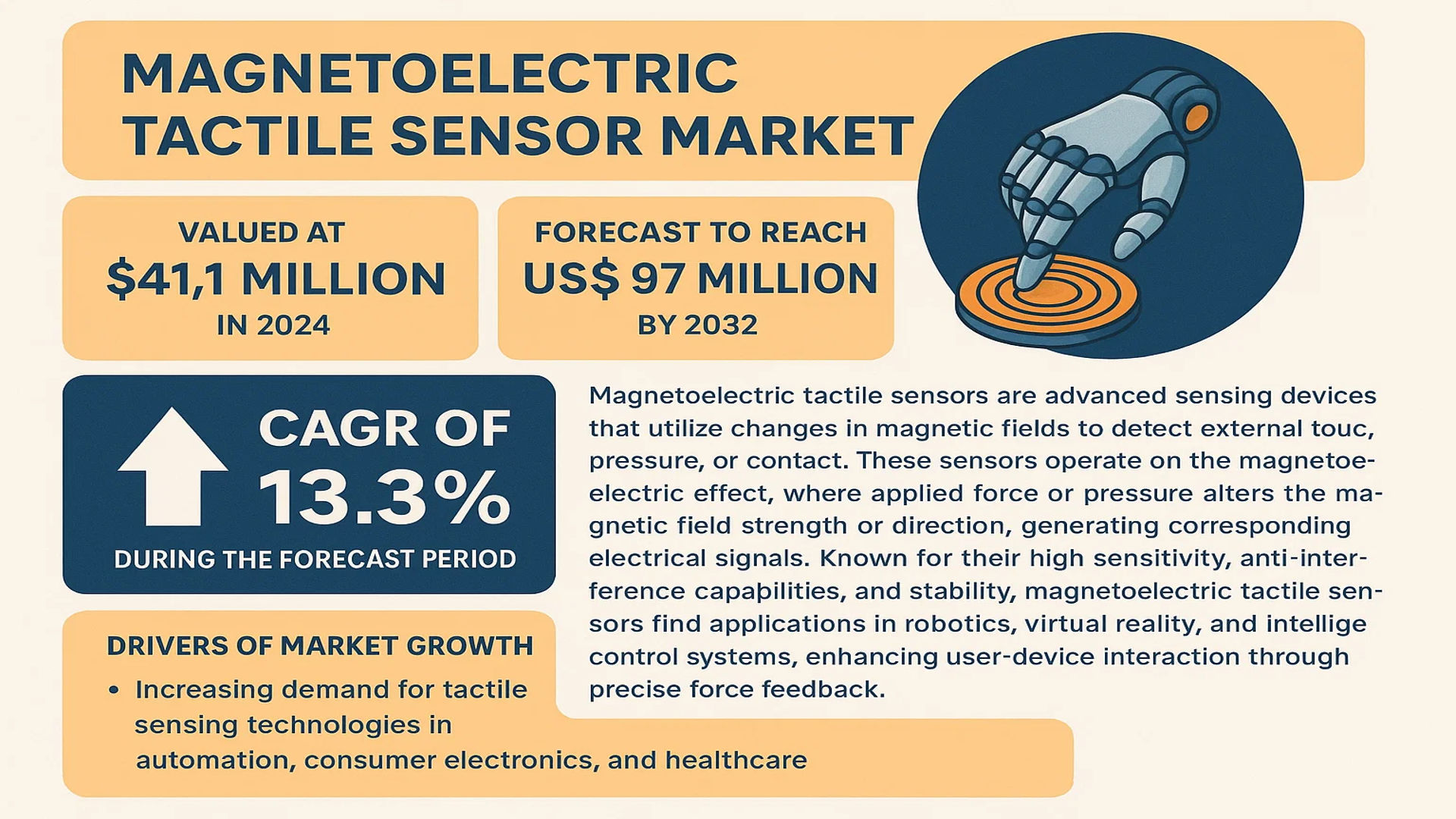
The global Magnetoelectric Tactile Sensor Market was valued at 41.1 million in 2024 and is projected to reach US$ 97 million by 2032, at a CAGR of 13.3% during the forecast period.
Magnetoelectric tactile sensors are advanced sensing devices that utilize changes in magnetic fields to detect external touch, pressure, or contact. These sensors operate on the magnetoelectric effect, where applied force or pressure alters the magnetic field strength or direction, generating corresponding electrical signals. Known for their high sensitivity, anti-interference capabilities, and stability, magnetoelectric tactile sensors find applications in robotics, virtual reality, and intelligent control systems, enhancing user-device interaction through precise force feedback.
The market growth is driven by increasing demand for tactile sensing technologies in automation, consumer electronics, and healthcare. For instance, the integration of these sensors in prosthetics and medical devices is gaining traction due to their ability to mimic human touch. Additionally, advancements in robotics and smart manufacturing are propelling adoption. Key players such as TDK Corporation, Honeywell International, and NXP Semiconductors dominate the market with innovations like compact, high-precision sensors for diverse applications.
MARKET DYNAMICS
MARKET DRIVERS
Growing Adoption in Robotics and Prosthetics to Fuel Market Expansion
The increasing integration of magnetoelectric tactile sensors in robotics and prosthetic applications is a major driver for market growth. These sensors enable precise force and tactile feedback, critical for delicate operations in surgical robots and intuitive control in advanced prosthetic limbs. The global robotics market is projected to grow at a compound annual growth rate of over 12% through 2030, creating substantial demand for high-precision sensing solutions. Recent advancements in human-robot interaction technologies particularly benefit from the sensors’ ability to detect minute pressure changes with millisecond response times.
Expansion of Consumer Electronics Driving Innovation
The consumer electronics sector presents significant growth opportunities, with tactile sensors becoming essential components in next-generation devices. Emerging applications include high-sensitivity touch interfaces for foldable displays, wearable health monitors, and advanced gaming controllers requiring precise haptic feedback. Industry leaders are investing heavily in R&D, with several major smartphone manufacturers reportedly developing proprietary tactile sensing solutions for future device generations. This sector’s continuous innovation cycle ensures sustained demand for improved tactile sensing technologies.
Automotive Safety Systems Creating New Applications
The automotive industry’s shift toward autonomous vehicles and advanced driver assistance systems (ADAS) is generating new applications for tactile sensors. These sensors are being integrated into steering wheels, control panels, and safety systems to monitor driver attention and enable touch-sensitive controls. The development of intelligent cabin systems that can detect passenger presence and position further expands potential applications. With the autonomous vehicle market expected to surpass $2 trillion by 2030, automotive applications represent a high-growth segment for magnetoelectric tactile sensors.
MARKET RESTRAINTS
High Development Costs Limiting Market Penetration
The specialized materials and precision manufacturing required for magnetoelectric tactile sensors result in significantly higher production costs compared to conventional capacitive or resistive sensors. Development of sensor arrays with sub-millimeter resolution can require custom fabrication processes that increase unit costs by 30-50% over standard alternatives. These cost barriers make widespread adoption challenging in price-sensitive consumer markets where competing technologies offer adequate performance at lower price points.
Technical Complexity in System Integration
Integration of magnetoelectric tactile sensors into existing electronic systems presents technical challenges that restrain market growth. The need for specialized signal processing circuitry and electromagnetic interference shielding adds complexity to product designs. Many industrial applications require custom calibration for each installation, increasing implementation costs and lead times. These technical hurdles have slowed adoption in mass-market applications where plug-and-play solutions are preferred.
Material Supply Chain Vulnerabilities
The sensor manufacturing process depends on specialized magnetostrictive and piezoelectric materials with limited global supply. Recent geopolitical tensions have exposed vulnerabilities in rare earth element supply chains critical for sensor production. Price volatility for these materials increased by approximately 25% in recent years, creating uncertainty for manufacturers. The industry’s reliance on a small number of specialist material suppliers represents an ongoing constraint on production scalability.
MARKET OPPORTUNITIES
Medical Robotics and Remote Surgery Applications
The expanding field of telemedicine and robotic surgery offers significant growth potential for high-precision tactile sensors. Next-generation surgical robots require force feedback systems capable of detecting sub-Newton forces with micron-level precision. Several leading medical device companies have announced development programs for sensor-integrated surgical tools, with clinical trials expected to begin within two years. The global surgical robotics market is projected to nearly triple in size by 2030, creating substantial opportunities for specialized sensor providers.
Industrial IoT and Smart Manufacturing
Industry 4.0 initiatives are driving demand for tactile sensors in smart factory applications. These sensors enable precise quality control in automated assembly lines and provide critical feedback for collaborative robotics. Recent advancements in wireless sensor networks allow deployment across large manufacturing facilities without extensive wiring infrastructure. With industrial IoT investments expected to grow at nearly 15% annually, manufacturers are increasingly adopting advanced sensing solutions to optimize production processes.
Virtual and Augmented Reality Interfaces
The emerging metaverse ecosystem requires advanced haptic feedback solutions to create immersive experiences. Magnetoelectric sensors are particularly suited for VR glove applications due to their high sensitivity and low latency characteristics. Several major technology companies have filed patents for tactile feedback systems incorporating magnetoelectric principles, indicating strong industry interest. As enterprise and consumer VR markets continue expanding, demand for sophisticated tactile interfaces is expected to grow proportionally.
MARKET CHALLENGES
Standardization and Interoperability Issues
The lack of industry-wide standards for tactile sensor interfaces creates integration challenges across different platforms and applications. Current proprietary systems often require custom drivers and software interfaces, increasing development costs for end users. The absence of common performance metrics makes direct comparison between competing solutions difficult, potentially slowing adoption decisions in cost-conscious industries.
Durability and Environmental Limitations
Maintaining sensor performance in harsh environments remains a technical challenge. Exposure to extreme temperatures, humidity, or magnetic interference can degrade accuracy over time. Industrial applications often require specialized protective housings that increase system complexity and cost. These limitations currently restrict deployment in sectors like oil and gas exploration or aerospace where environmental conditions are particularly demanding.
Competition from Alternative Technologies
Emerging alternatives including optical tactile sensors and advanced piezoelectric arrays present increasing competition. These technologies continue to improve in sensitivity and resolution while offering potential cost advantages in volume production. The development of hybrid sensing systems that combine multiple technologies may reduce the unique value proposition of pure magnetoelectric solutions in some applications. Market positioning and clear differentiation of technical advantages will be crucial for maintaining growth momentum.
MAGNETOELECTRIC TACTILE SENSOR MARKET TRENDS
Rising Demand for Advanced Human-Machine Interfaces Fuels Market Growth
The global magnetoelectric tactile sensor market is experiencing robust growth, driven by increasing adoption in robotics, medical devices, and automotive applications. This growth trajectory, projected at a CAGR of 13.3% through 2032, reflects the sensors’ unique capability to provide high-precision force feedback in challenging environments. Leading manufacturers are innovating with nanomaterials and hybrid designs to enhance sensitivity beyond traditional piezoresistive sensors. For instance, recent advancements in thin-film magnetoelectric composites have improved tactile resolution to sub-millimeter levels, significantly benefiting surgical robotics and prosthetics. Meanwhile, Asia Pacific emerges as the fastest-growing region, with China accounting for approximately 30% of new installations in industrial automation systems.
Other Trends
Healthcare Sector Adoption Accelerates
Magnetoelectric tactile sensors are revolutionizing minimally invasive surgical tools and rehabilitation devices, with the medical segment expected to capture over 25% market share by 2026. Their immunity to electromagnetic interference makes them particularly valuable in MRI-compatible equipment. A recent breakthrough involves integration with haptic feedback systems for surgical training simulators, achieving latency below 5ms – a critical threshold for realistic tactile responsiveness. This aligns with the broader $7.8 billion medical sensor market expansion in diagnostic and therapeutic applications.
Automotive HMI Innovations Drive Commercialization
The automotive industry’s transition toward autonomous vehicles and enhanced cockpit systems has spurred demand for robust tactile interfaces. Major Tier 1 suppliers are incorporating these sensors into steering wheels and control panels to detect driver presence and grip force with 98% accuracy. Europe leads in deployment, with over 15 automakers now testing magnetoelectric sensors for advanced driver monitoring systems. This complements the region’s stringent safety regulations mandating drowsiness detection by 2025. Concurrently, consumer electronics applications are growing at 18% annually, particularly in premium smartphones and AR/VR controllers requiring multi-axis force measurement.
Material Science Breakthroughs Enable Miniaturization
Recent material innovations are addressing historical limitations in sensor size and power consumption. The development of room-temperature multiferroic composites has enabled 40% smaller form factors while maintaining sub-Newton force sensitivity. Leading manufacturers are leveraging these advances to create flexible, embeddable sensor arrays for wearable health monitors. In the industrial sector, corrosion-resistant variants now withstand harsh environments, expanding applications in underwater robotics and oil/gas inspection systems. These improvements coincide with a broader industry shift toward Industry 4.0 solutions where precise tactile feedback is crucial for robotic manipulation.
COMPETITIVE LANDSCAPE
Key Industry Players
Innovative Sensor Solutions Drive Competitive Dynamics in the Magnetoelectric Tactile Sensor Market
The global magnetoelectric tactile sensor market exhibits a competitive yet fragmented landscape, with established electronics giants competing alongside specialized sensor manufacturers. TDK Corporation maintains a leadership position through its advanced Magneto-Impedance sensor technology, holding an estimated 18% revenue share in 2024. The company’s integrated manufacturing capabilities and strong relationships with automotive OEMs provide a significant competitive advantage.
European semiconductor leaders Infineon Technologies and NXP Semiconductors are gaining market traction by incorporating magnetoelectric sensing into their automotive and industrial IoT solutions. Their recent product launches demonstrate a strategic focus on miniaturization and power efficiency – critical factors for next-generation haptic applications.
The competitive intensity is further heightened by specialist players like Tacterion GmbH and Pressure Profile Systems, who are carving out niches in medical and robotics applications. These companies are pioneering flexible sensor arrays capable of capturing complex touch patterns, a capability that positions them strongly in prosthetic and surgical robotics markets.
Across the Pacific, Honeywell International and TE Connectivity are leveraging their industrial sensor expertise to develop ruggedized solutions for harsh environment applications. Their investments in noise reduction algorithms and temperature compensation technologies address longstanding industry challenges.
List of Key Magnetoelectric Tactile Sensor Companies Profiled
- TDK Corporation (Japan)
- Infineon Technologies (Germany)
- Honeywell International (U.S.)
- Allegro MicroSystems (U.S.)
- TE Connectivity (Switzerland)
- NXP Semiconductors (Netherlands)
- Melexis (Belgium)
- AMS OSRAM (Austria)
- Pressure Profile Systems (U.S.)
- Sensata Technologies (U.S.)
- Baumer Group (Switzerland)
- Aichi Steel Corporation (Japan)
- Tacterion GmbH (Germany)
- Omron (Japan)
- Murata Manufacturing (Japan)
Segment Analysis:
By Type
Magnetoelectric Effect Sensor Segment Dominates Due to Its High Sensitivity and Stability in Force Detection
The market is segmented based on type into:
- Magnetoelectric Effect Sensor
- Hall Effect Sensor
By Application
Consumer Electronics Segment Leads Owing to Rising Demand for Enhanced Haptic Feedback in Smart Devices
The market is segmented based on application into:
- Medical Industry
- Consumer Electronics
- Automotive Industry
- Industrial Automation
- Others
By Technology
Flexible Sensor Technology Gains Traction With Rising Adoption in Wearable Devices
The market is segmented based on technology into:
- Rigid Tactile Sensors
- Flexible Tactile Sensors
- Others
Regional Analysis: Magnetoelectric Tactile Sensor Market
Asia-Pacific
Asia-Pacific dominates the magnetoelectric tactile sensor market, driven by robust demand from China, Japan, and South Korea. The region’s leadership stems from its thriving electronics manufacturing sector, increasing automation in industries, and government initiatives promoting advanced robotics. China, in particular, is a key contributor due to its strong R&D investments in sensor technologies and growing adoption of smart manufacturing practices. Japan’s precision engineering capabilities further enhance the quality and adoption of tactile sensors, especially in robotics and automotive applications. However, cost sensitivity among small-scale manufacturers in emerging economies like India remains a challenge for high-end sensor adoption.
North America
The North American market benefits from significant technological advancements and investments in robotics, medical devices, and automotive applications. The U.S. leads the region, with companies like Honeywell International and TE Connectivity driving innovation. The presence of major tech firms integrating tactile sensors into AI-driven systems and prosthetics further accelerates growth. Stringent regulatory frameworks ensure high-quality standards in medical and industrial applications, though they may slow down time-to-market for new sensor technologies. Canada is emerging as a notable market with increasing focus on smart manufacturing and IoT integration.
Europe
Europe showcases steady growth in magnetoelectric tactile sensor adoption, particularly in Germany and the UK. The region benefits from strong automotive and industrial automation sectors that demand precise force feedback systems. Companies like Infineon Technologies and NXP Semiconductors contribute significantly to sensor development. The EU’s emphasis on Industry 4.0 and robotics provides a favorable ecosystem for tactile sensor applications. However, higher costs of advanced sensors and preference for conventional alternatives in some Eastern European countries may limit market expansion to some extent.
South America
The South American market shows gradual growth potential, with Brazil leading in industrial automation adoption. While the region shows interest in advanced sensor technologies, economic volatility and limited local manufacturing capabilities create dependency on imports. The automotive sector presents key opportunities, especially in Brazil and Argentina, though infrastructure constraints and slower technology adoption rates compared to other regions remain challenging factors for widespread market penetration.
Middle East & Africa
This region represents an emerging market for magnetoelectric tactile sensors, with growth primarily driven by UAE and South Africa’s developing industrial and healthcare sectors. Investments in smart city projects and limited but growing automation in oil & gas industries create niche opportunities. However, the market faces challenges including limited local expertise in advanced sensor technologies, reliance on imports, and slower adoption rates due to cost considerations. The potential for growth exists but will require stronger technological infrastructure development.
Report Scope
This market research report provides a comprehensive analysis of the global and regional Magnetoelectric Tactile Sensor markets, covering the forecast period 2024–2032. It offers detailed insights into market dynamics, technological advancements, competitive landscape, and key trends shaping the industry.
Key focus areas of the report include:
- Market Size & Forecast: Historical data and future projections for revenue, unit shipments, and market value across major regions and segments. The global Magnetoelectric Tactile Sensor market was valued at USD 41.1 million in 2024 and is projected to reach USD 97 million by 2032, growing at a CAGR of 13.3%.
- Segmentation Analysis: Detailed breakdown by product type (Magnetoelectric Effect Sensor, Hall Effect Sensor), application (Medical Industry, Consumer Electronics, Automotive Industry, Others), and end-user industry to identify high-growth segments and investment opportunities.
- Regional Outlook: Insights into market performance across North America (U.S., Canada, Mexico), Europe (Germany, France, U.K., Italy, Russia), Asia-Pacific (China, Japan, South Korea, India), Latin America, and the Middle East & Africa, including country-level analysis.
- Competitive Landscape: Profiles of leading market participants, including TDK Corporation, Infineon Technologies, Honeywell International, Allegro MicroSystems, TE Connectivity, their product offerings, R&D focus, manufacturing capacity, and recent developments.
- Technology Trends & Innovation: Assessment of emerging sensor technologies, integration with AI/IoT, and advancements in magnetoelectric materials for enhanced tactile feedback.
- Market Drivers & Restraints: Evaluation of factors driving market growth (demand in robotics, VR applications) along with challenges (high production costs, technical complexities).
- Stakeholder Analysis: Insights for component suppliers, OEMs, system integrators, and investors regarding the evolving ecosystem and strategic opportunities in tactile sensing technologies.
Primary and secondary research methods are employed, including interviews with industry experts, data from verified sources, and real-time market intelligence to ensure the accuracy and reliability of the insights presented.
FREQUENTLY ASKED QUESTIONS:
What is the current market size of Global Magnetoelectric Tactile Sensor Market?
-> Magnetoelectric Tactile Sensor Market was valued at 41.1 million in 2024 and is projected to reach US$ 97 million by 2032, at a CAGR of 13.3% during the forecast period.
Which key companies operate in Global Magnetoelectric Tactile Sensor Market?
-> Key players include TDK Corporation, Infineon Technologies, Honeywell International, Allegro MicroSystems, TE Connectivity, NXP Semiconductors, Melexis, and AMS OSRAM, among others.
What are the key growth drivers?
-> Key growth drivers include rising demand in robotics, increasing adoption in consumer electronics, and advancements in virtual reality applications.
Which region dominates the market?
-> Asia-Pacific is the fastest-growing region, driven by China and Japan, while North America leads in technological innovation.
What are the emerging trends?
-> Emerging trends include miniaturization of sensors, integration with AI for smart feedback systems, and development of flexible magnetoelectric materials.

Get Sample Report PDF for Exclusive Insights
Report Sample Includes
- Table of Contents
- List of Tables & Figures
- Charts, Research Methodology, and more...
 Download Sample Report PDF