
MARKET INSIGHTS
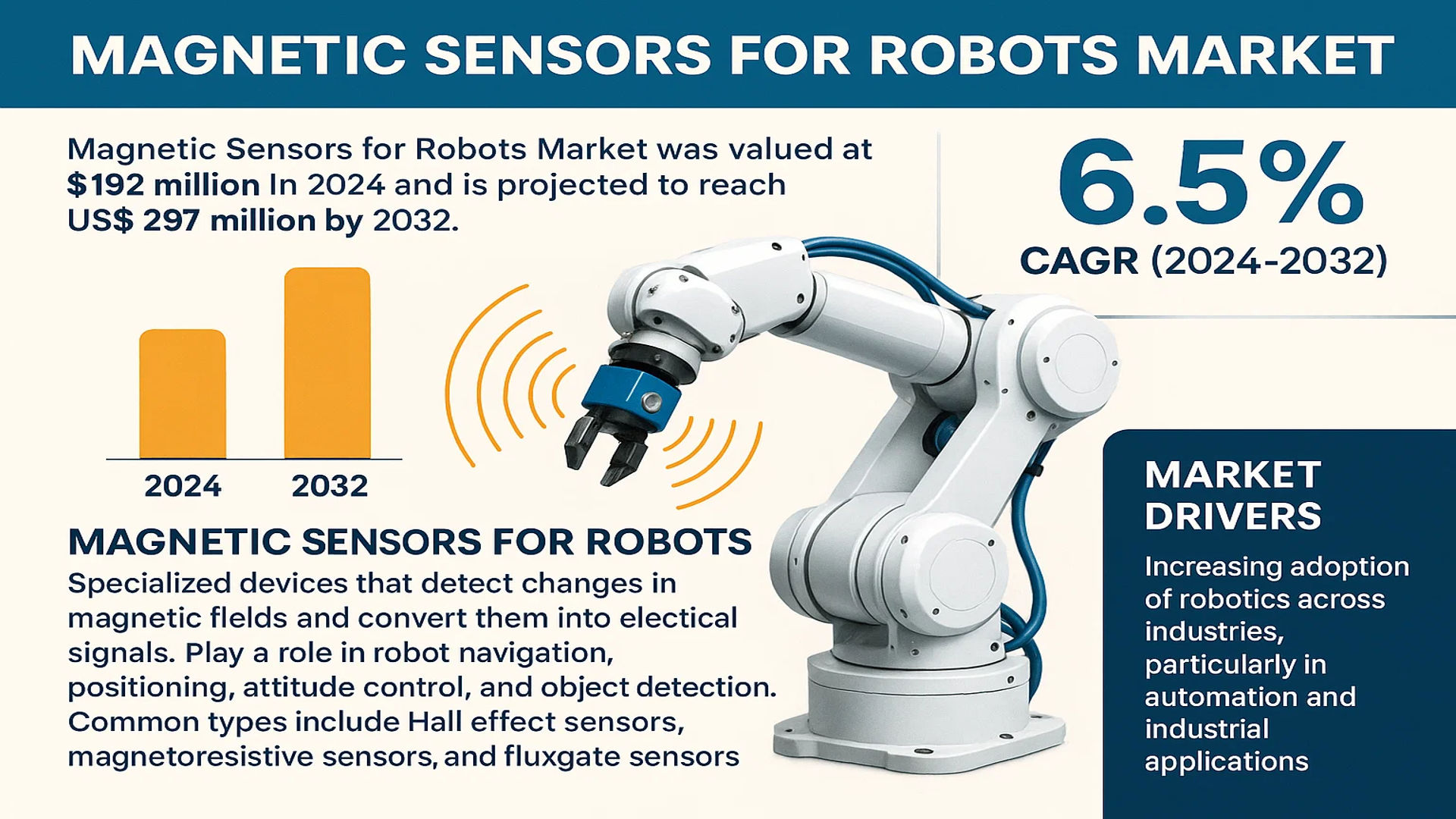
The global Magnetic Sensors for Robots Market was valued at 192 million in 2024 and is projected to reach US$ 297 million by 2032, at a CAGR of 6.5% during the forecast period.
Magnetic sensors for robots are specialized devices that detect changes in magnetic fields and convert them into electrical signals. These sensors play a critical role in robot navigation, positioning, attitude control, and object detection. Common types include Hall effect sensors, magnetoresistive sensors, and fluxgate sensors, which are integrated into robotic components such as motors and encoders.
The market growth is driven by increasing adoption of robotics across industries, particularly in automation and industrial applications. The rise of humanoid robots in 2024 has further expanded commercial opportunities for magnetic sensor manufacturers. While industrial robots currently dominate demand, service and medical robotics sectors are emerging as significant growth areas. Key players like Honeywell, Analog Devices, and Infineon Technologies are investing in advanced sensor technologies to meet evolving industry requirements.
MARKET DYNAMICS
MARKET DRIVERS
Growing Adoption of Industrial Automation to Accelerate Magnetic Sensor Demand
The rapid expansion of industrial automation is a key driver for the magnetic sensors in robotics market. With manufacturing facilities increasingly deploying robotic systems for precision tasks, the need for accurate position detection and motion control has surged. Magnetic sensors enable robots to perform complex operations with micron-level accuracy, which is critical in automotive assembly lines and electronics manufacturing. The global industrial robotics market is projected to exceed 90 billion by 2030, creating substantial demand for sensor components. Hall effect sensors in particular are seeing increased adoption due to their reliability in harsh industrial environments where electromagnetic interference is common.
Advancements in Service Robotics Creating New Application Opportunities
Service robotics represents one of the fastest-growing segments for magnetic sensors, with healthcare, logistics and domestic applications showing particularly strong growth. Magnetic encoders using anisotropic magnetoresistive (AMR) technology are becoming essential for surgical robots requiring absolute position feedback. In logistics, automated guided vehicles (AGVs) increasingly rely on magnetic field sensors for navigation in warehouse environments. The medical robotics sector alone is expected to maintain a growth rate above 15% annually through 2030, fueled by aging populations and healthcare digitization trends.
➤ Leading manufacturers have introduced innovative 3D magnetic sensing solutions that enable robots to perform complex spatial orientation tasks in dynamic environments.
Furthermore, the emergence of collaborative robots (cobots) working alongside human operators is driving demand for safety-rated magnetic sensors that can provide fail-safe position monitoring in shared workspaces.
MARKET RESTRAINTS
High Development Costs Limiting Adoption in Price-Sensitive Applications
While magnetic sensor technology continues to advance, the development and integration costs remain significant barriers for many potential adopters. Precise magnetic sensors incorporating advanced signal processing capabilities often require specialized manufacturing processes and calibration equipment. In agricultural robotics and other cost-sensitive sectors, these expenses can make sophisticated sensing solutions economically unviable. Even basic Hall effect sensors with integrated signal conditioning can cost 3@@@-5 times more than simple mechanical alternatives, creating adoption challenges in markets where price is the primary decision factor.
Other Key Restraints
Environmental Interference Issues
Magnetic sensors can be affected by external magnetic fields present in industrial environments, requiring additional shielding and compensation circuitry that increases system complexity and cost. This poses particular challenges in applications like underwater robotics where consistent sensor performance is critical.
Miniaturization Challenges
The push for smaller robotic systems creates technical hurdles for sensor manufacturers attempting to maintain performance while reducing package sizes below 2@@@x2@@@mm. This is especially relevant for medical and micro-robotics applications where space constraints are severe.
MARKET CHALLENGES
Stringent Reliability Requirements in Critical Applications
The robotics industry demands increasingly stringent reliability standards for components used in safety-critical applications. Magnetic sensors in surgical robots or aerospace robotics must maintain precision through millions of operating cycles with near-zero failure rates. Meeting these requirements while managing production costs presents a significant challenge for sensor manufacturers. Qualification processes for medical and aerospace applications can take 18@@@-24 months, delaying time-to-market for new sensor solutions.
Other Challenges
Temperature Stability Issues
Maintaining measurement accuracy across wide temperature ranges (@@@40°C to +125°C) remains problematic for many magnetic sensor technologies. Robot applications in foundries or cold storage facilities require specialized sensor designs with advanced temperature compensation algorithms.
Supply Chain Complexities
The global semiconductor shortage highlighted vulnerabilities in sensor component supply chains. Many magnetic sensor manufacturers rely on dedicated semiconductor fabrication facilities, creating potential bottlenecks when demand surges unexpectedly.
MARKET OPPORTUNITIES
Emergence of Smart Factory Ecosystems Creating New Integration Possibilities
The Industry 4.0 revolution is generating significant opportunities for magnetic sensor providers as smart factories adopt more interconnected robotic systems. Magnetic sensors equipped with IIoT connectivity capabilities allow for predictive maintenance and real-time performance optimization across robotic fleets. Manufacturers are developing sensor solutions with integrated wireless communication protocols specifically tailored for smart manufacturing environments. The global market for industrial IoT solutions is projected to grow at nearly 25% annually, presenting substantial growth potential for advanced sensing technologies.
Expansion of Autonomous Mobile Robots in Logistics
The logistics sector’s rapid automation is driving demand for magnetic sensing solutions in autonomous mobile robots (AMRs). These systems rely on precise magnetic field detection for navigation, position tracking and collision avoidance. The global AMR market is forecast to expand at over 30% CAGR through 2030, with warehouse automation being the primary growth driver. Innovative magnetic sensor arrays are being developed specifically for simultaneous localization and mapping (SLAM) applications in material handling robots.
Additionally, the development of specialized magnetic sensor solutions for harsh environment robotics – including mining, offshore and space applications – represents a significant untapped market opportunity for sensor manufacturers willing to invest in ruggedized designs.
MAGNETIC SENSORS FOR ROBOTS MARKET TRENDS
Rising Adoption of Automation Across Industries Drives Magnetic Sensor Demand
The global magnetic sensors for robots market is experiencing significant growth due to the increasing deployment of automation in manufacturing, logistics, and service sectors. With industrial robots accounting for over 40% of global installations in 2024, magnetic sensors have become indispensable for precision motion control and navigation. These sensors enable robots to perform complex tasks with micron-level accuracy, particularly in assembly lines where repeatability is crucial. The automotive sector, which represents nearly 30% of all robotics applications, heavily relies on Hall effect sensors for motor control in robotic arms used in welding and painting processes.
Other Trends
Humanoid Robot Developments
The emergence of humanoid robots with advanced locomotion systems has created new opportunities for high-precision magnetic sensors. These robots require sophisticated magnetic field detection for joint angle measurement and foot placement stability, with leading prototypes incorporating multiple magnetoresistive sensors per limb. Recent advancements in bipedal robot balancing algorithms have increased sensor sampling rates to over 1 kHz, demanding faster response times from magnetic sensing components. The commercial potential is substantial, with humanoid robot production projected to reach 1 million units annually by 2030.
Miniaturization and Power Efficiency Innovations
Sensor manufacturers are addressing the robotics industry’s need for compact, energy-efficient solutions through chip-scale packaging and low-power designs. Modern magnetic sensors now consume 60% less power compared to 2020 models while maintaining sub-millimeter positional accuracy. This evolution supports battery-operated service robots that require extended operation times between charges. Integration with MEMS technology has enabled the development of multi-axis sensors smaller than 3mm², allowing placement in constrained robot joints and end-effectors. These miniaturized sensors are proving critical for medical robotics applications where space constraints are paramount.
Expansion of Collaborative Robotics
The growing cobot (collaborative robot) segment, expected to grow at 12% CAGR through 2030, is driving specialized magnetic sensor development. Unlike traditional industrial robots, cobots require proximity detection capabilities along with precise movement tracking to ensure human safety. New hybrid sensors combining Hall effect and magneto-inductive technologies provide both position data and near-field detection in single packages. These innovations are essential for power-and-force limiting applications where robots must immediately detect and respond to human contact while maintaining operational precision.
COMPETITIVE LANDSCAPE
Key Industry Players
Technological Innovation and Strategic Partnerships Drive Market Competition
The global magnetic sensors for robots market features a dynamic competitive landscape dominated by established semiconductor and sensor manufacturers. Honeywell and Infineon Technologies are leading players, capturing significant market share in 2024 due to their diverse product portfolios and strong R&D capabilities in Hall effect and magnetoresistive sensors. Their dominance is reinforced by expanding industrial robot applications in automotive and electronics manufacturing.
Texas Instruments and NXP Semiconductors have gained traction through their focus on high-precision magnetic sensing solutions for collaborative robots (cobots) and medical robotics. Both companies have invested heavily in miniaturized sensor technologies, addressing the growing demand for compact robotic systems.
The market is also witnessing aggressive expansion strategies from Asian players like TDK (Japan) and Asahi Kasei Microdevices, who are capitalizing on the booming automation sector in their domestic markets. Recent product launches featuring improved noise immunity and wider operating temperature ranges are helping these companies compete globally.
Meanwhile, European semiconductor leader STMicroelectronics is strengthening its position through strategic acquisitions and partnerships with robot OEMs. The company’s focus on low-power consumption sensors aligns perfectly with the industry’s shift toward energy-efficient automation solutions.
List of Key Magnetic Sensor Companies Profiled
- Honeywell International Inc. (U.S.)
- Analog Devices, Inc. (U.S.)
- Infineon Technologies AG (Germany)
- Texas Instruments Incorporated (U.S.)
- NXP Semiconductors N.V. (Netherlands)
- Allegro MicroSystems, Inc. (U.S.)
- Asahi Kasei Microdevices Corporation (Japan)
- TDK Corporation (Japan)
- Melexis NV (Belgium)
- STMicroelectronics N.V. (Switzerland)
Segment Analysis:
By Type
Hall Effect Sensors Lead the Market Due to Widespread Use in Robot Navigation and Motor Control
The market is segmented based on type into:
- Hall Effect Sensor
- Subtypes: Linear, Rotary, and others
- Magnetoresistive Sensor
- Subtypes: AMR (Anisotropic), GMR (Giant), TMR (Tunnel), and others
- Fluxgate Sensor
- Others
By Application
Industrial Robots Segment Dominates Owing to High Adoption in Manufacturing Automation
The market is segmented based on application into:
- Industrial Robot
- Service Robot
- Special Robot
- Medical Robot
- Agricultural Robot
By End User
Automotive Industry Holds Significant Share with Increasing Automation in Vehicle Production
The market is segmented based on end user into:
- Automotive
- Electronics
- Healthcare
- Agriculture
- Others
By Technology
Digital Magnetic Sensors Gain Traction for Their High Precision in Robot Positioning
The market is segmented based on technology into:
- Analog Sensors
- Digital Sensors
- Smart Sensors
Regional Analysis: Magnetic Sensors for Robots Market
Asia-Pacific
The Asia-Pacific region dominates the global magnetic sensors for robots market, driven by rapid industrialization, robotics adoption, and government-led manufacturing initiatives. China, Japan, and South Korea collectively account for over 50% of the regional demand, with China leading due to its substantial investments in automation and industrial robotics. Key applications include automotive manufacturing, electronics assembly, and logistics automation. The region benefits from strong semiconductor infrastructure, with companies like TDK and Asahi Kasei Microdevices supplying critical sensor components. Emerging markets like India and Vietnam are witnessing increased adoption of service robots, fueling demand for precision magnetic sensing solutions. However, intense price competition among local manufacturers presents challenges for premium sensor suppliers.
North America
North America’s magnetic sensors market is characterized by high-value applications in aerospace, defense, and medical robotics. The U.S. accounts for approximately 38% of the region’s market share, with stringent quality standards driving adoption of advanced Hall-effect and magnetoresistive sensors. Major players like Honeywell and Allegro MicroSystems lead in innovation, particularly in miniaturized sensors for collaborative robots (cobots). The region shows strong growth in warehouse automation, with Amazon’s robotics division deploying over 750,000 mobile robots as of 2024. Canada’s focus on AI-driven agricultural robots also creates specialized demand for rugged magnetic sensors capable of operating in harsh environments.
Europe
Europe maintains a strong position in precision robotics, reflected in demand for high-accuracy magnetic sensors. Germany’s industrial robotics sector, supported by Industry 4.0 initiatives, consumes nearly 30% of the region’s sensors. Automotive manufacturers utilize these components for assembly line robots, while Nordic countries focus on marine and underwater robotics applications. The EU’s emphasis on sustainable manufacturing has spurred development of energy-efficient sensor solutions, with companies like Infineon Technologies and STMicroelectronics at the forefront. Regulatory frameworks ensure quality but increase compliance costs, creating market barriers for non-European suppliers.
Middle East & Africa
This emerging market shows potential in oil & gas robotics and infrastructure inspection applications. The UAE leads in adoption, with oilfield inspection robots utilizing magnetic sensors for pipeline monitoring. South Africa is developing mining robotics capabilities, though limited local manufacturing results in dependence on imports. While current market size remains small, projected smart city investments in Saudi Arabia and Qatar could accelerate demand for service robots with navigation sensing capabilities. Challenges include harsh operating conditions requiring specialized sensor hardening.
South America
Brazil and Argentina represent the primary markets, focusing on agricultural and food processing robotics. Magnetic sensors enable precision in harvest automation and packaging line robotics. Economic constraints limit adoption rates compared to other regions, but government subsidies for agritech modernization are creating gradual growth. Local manufacturers face challenges competing with established Asian suppliers on price, though partnerships with global technology providers are emerging as a viable strategy.
Report Scope
This market research report provides a comprehensive analysis of the Global Magnetic Sensors for Robots Market, covering the forecast period 2024–2032. It offers detailed insights into market dynamics, technological advancements, competitive landscape, and key trends shaping the industry.
Key focus areas of the report include:
- Market Size & Forecast: Historical data and future projections for revenue, unit shipments, and market value across major regions and segments. The Global Magnetic Sensors for Robots Market was valued at USD 192 million in 2024 and is projected to reach USD 297 million by 2032, growing at a CAGR of 6.5% during the forecast period.
- Segmentation Analysis: Detailed breakdown by product type (Hall Effect Sensor, Magnetoresistive Sensor, Fluxgate Sensor), application (Industrial Robot, Service Robot, Special Robot, Medical Robot, Agricultural Robot), and end-user industry to identify high-growth segments and investment opportunities.
- Regional Outlook: Insights into market performance across North America, Europe, Asia-Pacific, Latin America, and the Middle East & Africa, including country-level analysis where relevant. Asia-Pacific is expected to dominate the market, driven by rapid industrialization and robotics adoption in China and Japan.
- Competitive Landscape: Profiles of leading market participants, including Honeywell, Analog Devices, Infineon Technologies, Texas Instruments, and NXP Semiconductors, among others. The top five players accounted for approximately 40% of the market share in 2024.
- Technology Trends & Innovation: Assessment of emerging technologies, including advancements in high-precision Hall Effect sensors and the integration of AI-driven magnetic sensing solutions for robotics applications.
- Market Drivers & Restraints: Evaluation of factors driving market growth, such as increasing automation in manufacturing and rising demand for service robots, along with challenges like high development costs and technical complexities.
- Stakeholder Analysis: Insights for component suppliers, OEMs, system integrators, investors, and policymakers regarding the evolving ecosystem and strategic opportunities in the robotics sensor market.
Primary and secondary research methods are employed, including interviews with industry experts, data from verified sources, and real-time market intelligence to ensure the accuracy and reliability of the insights presented.
FREQUENTLY ASKED QUESTIONS:
What is the current market size of Global Magnetic Sensors for Robots Market?
-> Magnetic Sensors for Robots Market was valued at 192 million in 2024 and is projected to reach US$ 297 million by 2032, at a CAGR of 6.5% during the forecast period.
Which key companies operate in Global Magnetic Sensors for Robots Market?
-> Key players include Honeywell, Analog Devices, Infineon Technologies, Texas Instruments, NXP Semiconductors, Allegro MicroSystems, Asahi Kasei Microdevices, TDK, Melexis, and STMicroelectronics, among others.
What are the key growth drivers?
-> Key growth drivers include increasing automation in manufacturing, rising demand for service robots, and advancements in sensor technology.
Which region dominates the market?
-> Asia-Pacific is the fastest-growing region, driven by robotics adoption in manufacturing and healthcare sectors, while North America remains a technological leader in sensor innovation.
What are the emerging trends?
-> Emerging trends include miniaturization of sensors, integration with AI for predictive maintenance, and development of energy-efficient magnetic sensing solutions.

Get Sample Report PDF for Exclusive Insights
Report Sample Includes
- Table of Contents
- List of Tables & Figures
- Charts, Research Methodology, and more...
 Download Sample Report PDF







