
Market Insights
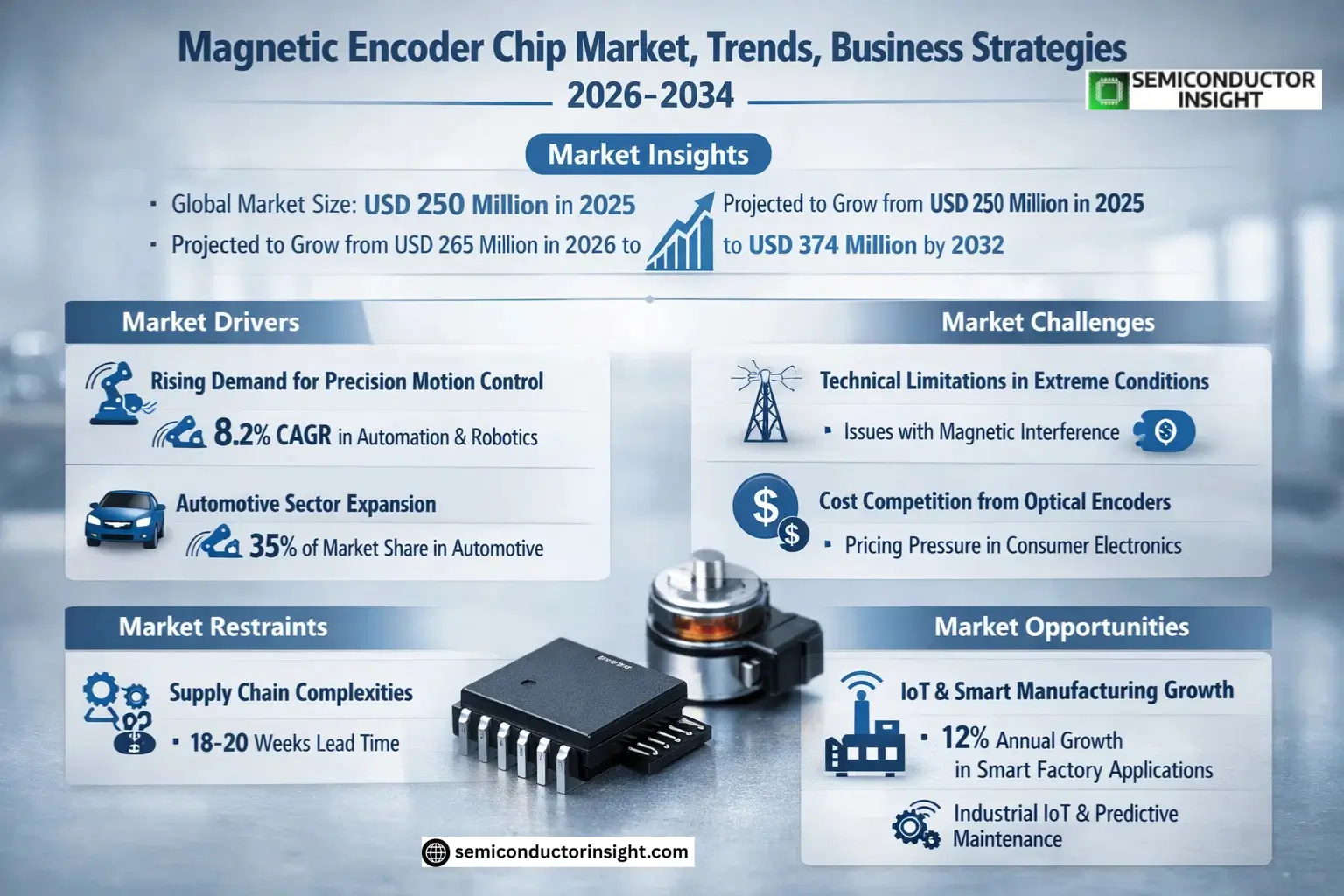
Global Magnetic Encoder Chip Market size was valued at USD 250 million in 2025. The market is projected to grow from USD 265 million in 2026 to USD 374 million by 2032, exhibiting a CAGR of 6.1% during the forecast period.
Magnetic Encoder Chip Market is a semiconductor sensor device that measures rotation angle, position, or speed by detecting changes in a magnetic field. Unlike optical encoders, these chips utilize Hall-effect, AMR (anisotropic magnetoresistance), GMR (giant magnetoresistance), or TMR (tunnel magnetoresistance) technologies to track the movement of a magnet attached to a motor shaft or linear mechanism.
The market is driven by increasing demand for precision sensing in industrial automation, robotics, and automotive applications. Magnetic encoder chips offer advantages such as durability in harsh environments, high resolution, and contactless operation. Key players like Broadcom, Allegro MicroSystems, and Melexis are expanding their product portfolios with advanced solutions integrating digital interfaces and self-calibration features.
MARKET DRIVERS
Rising Demand for Precision Motion Control
Magnetic Encoder Chip Market is experiencing significant growth due to increasing demand for high-precision motion control across industries. These chips enable accurate position sensing in harsh environments, making them ideal for automotive, industrial automation, and robotics applications. The market is projected to grow at 8.2% CAGR as manufacturers seek reliable alternatives to optical encoders.
Automotive Sector Expansion
Automotive electrification and advanced driver assistance systems (ADAS) are driving adoption of magnetic encoder chips. Their durability in extreme temperatures and resistance to contamination makes them preferred for electric power steering, transmission systems, and motor controls. The automotive segment now accounts for 35% of total magnetic encoder chip demand.
Manufacturers are investing in miniaturization and higher resolution chips to meet evolving industry requirements, creating sustained demand across multiple verticals.
MARKET CHALLENGES
Technical Limitations in Extreme Conditions
While magnetic encoder chips outperform optical versions in many environments, they face challenges with magnetic interference in applications near strong electromagnetic fields. This limits their use in certain industrial and energy applications where alternative technologies may be preferred.
Other Challenges
Cost Competition from Optical Encoders
Pricing pressure from optical encoder solutions remains significant, especially in cost-sensitive consumer electronics applications where environmental robustness is less critical.
MARKET RESTRAINTS
Supply Chain Complexities
Magnetic Encoder Chip Market faces constraints from specialized material requirements and manufacturing processes. Rare earth magnets and precision semiconductor fabrication create supply chain vulnerabilities, with lead times extending to 18-20 weeks during periods of high demand.
MARKET OPPORTUNITIES
Emerging IoT and Smart Manufacturing Applications
Industry 4.0 adoption creates new opportunities for magnetic encoder chips in predictive maintenance and condition monitoring systems. Their ability to provide reliable position feedback in industrial IoT networks positions them for 12% annual growth in smart factory applications through 2028.
Magnetic Encoder Chip Market TrendsRapid Growth in Industrial Automation and Robotics
Magnetic Encoder Chip Market is experiencing substantial growth driven by increasing automation across industries. As factories adopt Industry 4.0 solutions, demand for BLDC and PMSM motors with integrated position sensing has surged. Magnetic encoder chips provide reliable, contactless operation in harsh environments where optical encoders fail, making them ideal for robotic arms, AGVs, and automated manufacturing equipment. Their resistance to dust, vibration, and mechanical wear further accelerates adoption in industrial settings.
Other Trends
Automotive Electrification Demands Precision Sensing
Modern vehicles increasingly incorporate magnetic encoder chips for critical functions like e-steering, throttle control, and brake-by-wire systems. The transition to electric vehicles requires high-reliability position sensing that meets automotive safety standards. AMR and TMR-based encoder chips are gaining traction due to their precision, temperature stability, and ASIL-B/D compliance, particularly in ADAS applications where sensor redundancy is mandatory.
Technological Advancements Driving Market Evolution
Recent developments in TMR and GMR technologies enable higher resolution magnetic encoder chips with integrated signal processing. Manufacturers now offer devices combining sensing, ADC conversion, and digital interfaces (SPI/I²C) in single-chip solutions. This integration reduces system complexity while improving performance in space-constrained applications such as drones, medical devices, and consumer electronics. Low-power variants also expand possibilities for battery-operated IoT devices.
Regional Market Dynamics
Asia-Pacific leads Magnetic Encoder Chip adoption due to concentrated manufacturing activity, particularly in China and Japan’s automotive and electronics sectors. Meanwhile, North America shows strong growth in medical and aerospace applications requiring high-reliability sensing. European markets advance through industrial automation investments and stringent automotive safety regulations driving encoder technology upgrades.
COMPETITIVE LANDSCAPE
Key Industry Players
Global Leaders and Emerging Innovators in Magnetic Position Sensing
Global Magnetic Encoder Chip Market is dominated by semiconductor giants and specialized sensor manufacturers, with Broadcom, AMS (ams OSRAM), and Allegro MicroSystems collectively holding over 45% market share in 2025. These leaders differentiate through advanced magnetoresistive (TMR/GMR) technologies and integrated motor control solutions for automotive and industrial applications. Broadcom’s AEAT-6600 series sets industry benchmarks for resolution (up to 16-bit) and ASIL-D compliance, while Allegro dominates automotive BLDC motor applications with its Hall-effect encoder portfolio.
Second-tier players like TE Connectivity, Melexis, and Asahi Kasei Microdevices focus on high-growth niches such as medical robotics and precision automation. Emerging Chinese manufacturers like Xi’an Zhongke Alpha are gaining traction with cost-competitive Hall-effect encoder chips for consumer appliances. The market also features technology specialists like MultiDimension Technology (TMR sensors) and iC-Haus GmbH (programmable encoder ASICs) that cater to ultra-high-precision industrial applications requiring sub-arcminute resolution.
List of Key Magnetic Encoder Chip Companies Profiled
- Broadcom Inc.
- ams OSRAM AG
- TE Connectivity Ltd.
- Allegro MicroSystems
- Magntek Inc.
- Asahi Kasei Microdevices Corporation
- iC-Haus GmbH
- Melexis NV
- MultiDimension Technology Co., Ltd.
- SEMIMENT
- Renesas Electronics Corporation
- RLS d.o.o.
- Xi’an Zhongke Alpha Electronic Technology Co.
- Infineon Technologies AG
- NXP Semiconductors
Segment Analysis:
| Segment Category | Sub-Segments | Key Insights |
| By Type |
|
Magnetoresistive Type dominates due to superior precision in harsh environments:
|
| By Application |
|
Automotive Applications show strongest growth trajectory:
|
| By End User |
|
Industrial Automation Providers represent largest adoption base:
|
| By Technology |
|
TMR Technology emerging as preferred choice:
|
| By Functionality |
|
Rotary Position Sensing maintains dominance:
|
Regional Analysis: Global Magnetic Encoder Chip Market
Asia-Pacific’s dense network of electronics manufacturers and component suppliers creates optimal conditions for magnetic encoder chip production and integration. The region houses over 60% of global semiconductor packaging capacity.
Rapid electrification of vehicles across China, Japan, and India is driving substantial demand for precision position sensing solutions. Magnetic encoder chips are increasingly preferred for motor control in electric powertrains.
Korean and Japanese firms lead in developing next-generation magnetic encoder technologies with higher resolution and durability. Government-academia partnerships accelerate innovation in thin-film and 3D magnetic sensing architectures.
Factory automation initiatives across the region create strong pull for magnetic encoder solutions. The chips are essential components in servo motors and CNC equipment manufactured throughout Asia-Pacific.
North America
The North American Magnetic Encoder Chip Market benefits from advanced aerospace and defense applications alongside growing industrial robotics adoption. The region’s technological leadership drives demand for high-precision chips with enhanced reliability. U.S.-based semiconductor companies focus on developing ruggedized encoder solutions for extreme environments. Canada’s emerging medical robotics sector presents new opportunities for miniaturized magnetic encoder implementations.
Europe
Europe maintains strong demand for magnetic encoder chips in automotive and industrial applications, with German manufacturers leading adoption. The region’s emphasis on energy efficiency fuels innovation in low-power position sensing solutions. Stringent safety regulations push development of fail-safe encoder designs, particularly for automotive steering and braking systems.
Middle East & Africa
This region shows growing potential as oil & gas automation drives demand for robust position sensing solutions. Magnetic encoder chips are increasingly specified for downhole equipment and pipeline monitoring systems. Infrastructure development projects across GCC countries create secondary demand for industrial automation components.
South America
The South American market is developing gradually, with Brazil representing the primary adopter of magnetic encoder technologies. Agricultural machinery modernization and mining equipment automation present key growth avenues. Localized production remains limited, creating opportunities for import-focused distribution channels.
Report Scope
This market research report provides a comprehensive analysis of the Magnetic Encoder Chip Market, covering the forecast period 2025–2032. It offers detailed insights into market dynamics, technological advancements, competitive landscape, and key trends shaping the industry.
Key focus areas of the report include:
- Market Overview: The report begins with an overview outlining its current market scenario, key growth indicators, and industry transformation drivers. It discusses macroeconomic factors, demand-supply balance, regulatory landscape, and the strategic role of semiconductors in powering advancements across industries such as automotive, medical, industrial equipment, and consumer electronics.
- Market Size & Forecast: Historical data and future projections for revenue, unit shipments, and market value across major regions and segments.
- Segmentation Analysis: Detailed breakdown by product type (Magnetoresistive, Hall), function (Rotary, Linear, Angle), and application to identify high-growth segments.
- Regional Insights: Insights into market performance across North America, Europe, Asia, South America, and Middle East & Africa.
- Competitive Landscape: Profiles of leading market participants, including their product offerings, manufacturing capacity, and recent developments.
- Technology Trends & Innovation: Assessment of emerging sensing technologies (TMR, GMR), digital interfaces, and integration trends.
- Market Drivers & Restraints: Evaluation of factors driving market growth like electrification and automation, along with industry challenges.
- Stakeholder Insights: Strategic opportunities for suppliers, OEMs, and investors in the evolving ecosystem.
Primary and secondary research methods are employed, including industry expert interviews and verified data sources, to ensure accurate and reliable insights.
FREQUENTLY ASKED QUESTIONS:
What is the current market size of Magnetic Encoder Chip Market?
-> Magnetic Encoder Chip Market size was valued at USD 250 million in 2025. The market is projected to grow from USD 265 million in 2026 to USD 374 million by 2032, exhibiting a CAGR of 6.1% during the forecast period.
Which key companies operate in Magnetic Encoder Chip Market?
-> Key players include Broadcom, AMS, TE Connectivity, Allegro MicroSystems, Melexis, and MultiDimension Technology, among others.
What are the key growth drivers?
-> Key growth drivers include expansion of electric motors and robotics, automotive electrification trends, and demand for high-resolution integrated sensor solutions.
Which region dominates the market?
-> Asia is the largest market, with significant growth in China, Japan, and South Korea due to industrial automation and EV adoption.
What are the emerging trends?
-> Emerging trends include advanced TMR/GMR technologies, digital interface integration, and compact low-power designs for IoT applications.
Get Sample Report PDF for Exclusive Insights
Report Sample Includes
- Table of Contents
- List of Tables & Figures
- Charts, Research Methodology, and more...
 Download Sample Report PDF


