MARKET INSIGHTS
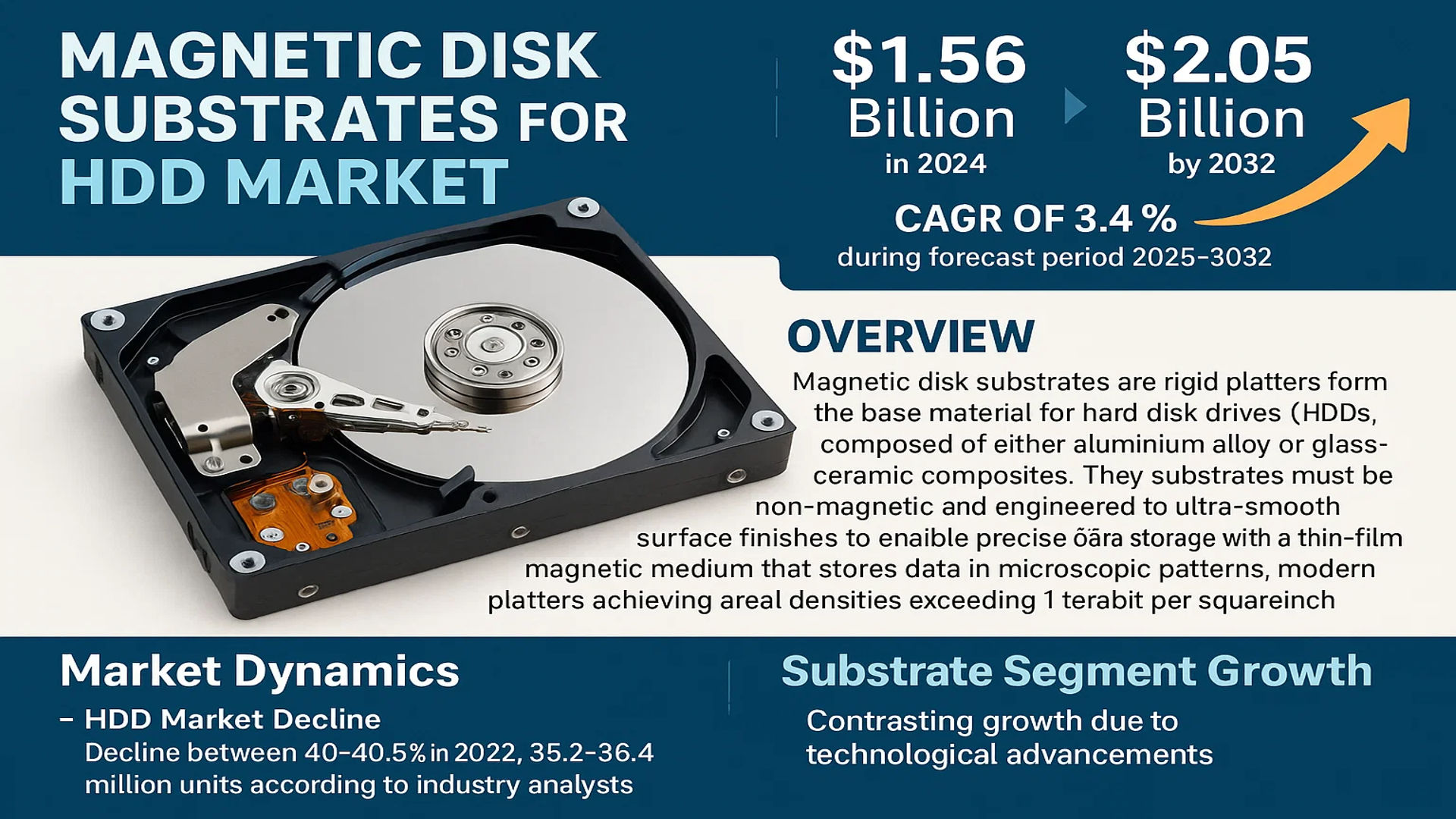
The global Magnetic Disk Substrates for HDD Market size was valued at US$ 1.56 billion in 2024 and is projected to reach US$ 2.05 billion by 2032, at a CAGR of 3.4% during the forecast period 2025-2032.
Magnetic disk substrates are rigid platters that form the base material for hard disk drives (HDDs), composed of either aluminum alloy or glass-ceramic composites. These substrates must be non-magnetic and engineered to ultra-smooth surface finishes to enable precise data storage. Both sides are coated with a thin-film magnetic medium that stores data in microscopic patterns, with modern platters achieving areal densities exceeding 1 terabit per square inch.
While the broader HDD market declined by 40-40.5% in 2022 to 35.2-36.4 million units according to industry analysts, the substrate segment shows contrasting growth due to technological advancements. The shift toward glass substrates, which offer superior rigidity and thermal stability for high-capacity drives, is reshaping the market landscape. Key players like SHOWA DENKO and HOYA are investing in next-generation substrate technologies to support the industry’s transition to higher areal densities and energy-assisted magnetic recording.
MARKET DYNAMICS
MARKET DRIVERS
Growing Demand for High-Capacity Data Storage Solutions
The exponential growth of data generation across industries is a primary driver for the magnetic disk substrates market. With organizations requiring larger storage capacities to handle big data, AI analytics, and cloud computing, the demand for high-performance hard disk drives remains robust. As storage requirements continue to escalate, manufacturers are developing substrates that support higher areal densities, enabling hard drives to store up to 30TB per disk. The increasing need for cost-effective storage in data centers, where capacity often outweighs speed requirements, particularly favors HDD technologies. Major cloud service providers continue to invest heavily in storage infrastructure, a trend that shows no signs of slowing in the near term.
Technological Advancements in Substrate Materials
The transition from aluminum alloy to glass substrates represents a significant technological leap in the HDD industry. Glass substrates offer superior rigidity, thermal stability, and surface smoothness, enabling higher data density and improved performance characteristics. Leading manufacturers are now producing glass substrates with surface roughness below 0.2 nm, allowing for more precise magnetic layer deposition. This advancement directly contributes to achieving higher areal densities, with current technologies supporting 2 TB per platter and roadmap projections indicating 5 TB per platter by 2026. As production costs decrease and yield rates improve, glass substrates are expected to capture an increasingly larger market share in enterprise storage applications.
Enterprise Storage Expansion Fuels Market Growth
Large-scale cloud providers and hyperscalers continue to expand their storage infrastructure, driving consistent demand for high-capacity HDDs. While SSDs dominate performance tiers, magnetic storage remains the most cost-effective solution for cold and warm storage applications. Recent industry reports indicate that enterprise HDD shipments for data center applications grew by approximately 8% in 2023, despite overall market contraction. This segments resilience demonstrates the ongoing necessity of magnetic storage solutions in comprehensive data storage architectures.
MARKET RESTRAINTS
Decline in Consumer HDD Demand Impacting Market Volumes
The consumer segment for hard disk drives has experienced significant contraction in recent years, primarily due to the shift toward solid-state storage in personal computing devices. Laptop manufacturers have nearly universally adopted SSDs as their primary storage solution, with HDD penetration in mobile computers falling below 15% in 2024. While external hard drives maintain some relevance for backup solutions, the convenience of cloud storage and network-attached solutions continues to erode this market segment. This structural shift has forced substrate manufacturers to reorient production toward enterprise and data center applications where demand remains more stable.
High Capital Intensity and Manufacturing Complexity
Producing high-quality magnetic disk substrates requires substantial capital investment in precision manufacturing equipment and cleanroom facilities. The transition to glass substrates has further increased production costs, with new fabrication lines requiring investments exceeding $100 million. Additionally, achieving the nanometer-level surface finishes and strict tolerances demanded by modern HDD designs creates significant yield challenges. These high barriers to entry limit market competition and make it difficult for manufacturers to quickly adjust production volumes in response to market fluctuations, creating potential supply-demand imbalances during industry transitions.
Raw Material Price Volatility
The specialized materials required for substrate manufacturing, particularly for glass substrates, are subject to significant price fluctuations. Key components such as aluminosilicate glass and specialized coating materials experience periodic supply constraints. Recent geopolitical tensions and supply chain disruptions have exacerbated these challenges, creating additional cost pressures for manufacturers. This volatility makes long-term pricing strategies difficult and can compress profit margins, particularly in the competitive enterprise storage market.
MARKET CHALLENGES
Competition from Alternative Storage Technologies
The rapid advancement of NAND flash technology presents an ongoing challenge for the magnetic storage industry. While HDDs maintain a significant cost-per-terabyte advantage for high-capacity storage, the gap continues to narrow. QLC and PLC NAND technologies are steadily increasing SSD capacities while reducing costs, with enterprise SSD pricing declining by approximately 30% in 2023. Furthermore, emerging technologies like storage-class memory and optical storage solutions present potential long-term competitive threats. These developments require HDD substrate manufacturers to continuously innovate to maintain their value proposition in the storage hierarchy.
Technological Limitations in Areal Density Growth
The pace of areal density improvements in magnetic storage has slowed significantly compared to historical trends. While the industry achieved consistent 30-40% annual growth in areal density during the 2000s, current progress has slowed to approximately 10-15% annually. This deceleration stems from fundamental physical limitations associated with the superparamagnetic effect and challenges in thermal management. While technologies like heat-assisted magnetic recording (HAMR) and microwave-assisted magnetic recording (MAMR) offer potential solutions, their commercial deployment has been slower than anticipated, delaying the next major leap in storage density.
Workforce Specialization Requirements
The highly specialized nature of substrate manufacturing creates challenges in workforce development. The complex processes require technicians with expertise in precision engineering, materials science, and thin-film deposition technologies. As veteran employees retire, transferring this specialized knowledge becomes increasingly difficult. The limited pool of qualified professionals can constrain production expansion and innovation, particularly in regions with competitive high-tech labor markets.
MARKET OPPORTUNITIES
Expansion in Edge Computing and Distributed Storage
The growth of edge computing infrastructure presents new opportunities for HDD technology. As distributed computing architectures proliferate, the need for cost-effective, high-capacity storage at the edge creates demand for robust HDD solutions. Unlike hyperscale data centers that can implement complex storage hierarchies, edge locations often require simpler, more self-contained solutions where HDDs can provide an optimal balance of capacity, reliability, and cost. Storage requirements for IoT data collection, surveillance systems, and content distribution networks are expected to drive steady demand in these applications.
Development of Specialized Enterprise Storage Solutions
Increasing specialization in enterprise storage creates opportunities for substrate manufacturers to develop differentiated products. Requirements for archival storage, video surveillance systems, and high-capacity backup solutions each have distinct performance characteristics that can be addressed through substrate optimization. The growing adoption of NVMe-over-Fabrics architectures also enables new storage paradigms where HDDs can be deployed more flexibly within performance storage environments. These trends allow substrate manufacturers to develop application-specific solutions rather than competing solely on cost.
Sustainable Manufacturing Initiatives
Growing emphasis on environmental sustainability presents opportunities for substrate manufacturers to differentiate themselves. The development of energy-efficient production processes, recycling programs for manufacturing byproducts, and reduced use of hazardous materials can provide competitive advantages. Some manufacturers are successfully implementing closed-loop water systems and renewable energy sources in their production facilities, reducing both environmental impact and operational costs. These initiatives align with the sustainability goals of major cloud providers and storage solution purchasers.
MAGNETIC DISK SUBSTRATES FOR HARD DISK DRIVE MARKET TRENDS
Transition to High-Capacity Disk Substrates Reshapes Market Dynamics
The global magnetic disk substrates market is undergoing a significant shift as demand for high-capacity hard disk drives (HDDs) intensifies. With cloud storage needs expanding at a compound annual growth rate (CAGR) exceeding 20%, manufacturers are prioritizing substrates that enable higher areal densities. Glass substrates, capable of supporting storage densities above 2.5 terabits per square inch, are gaining market share against traditional aluminum alloys due to their superior flatness and thermal stability. This transition comes as enterprise storage requirements are projected to surpass 15 zettabytes globally by 2025, creating sustained demand for advanced substrate materials.
Other Trends
Market Consolidation and Supply Chain Realignment
The magnetic disk substrate industry is experiencing consolidation as declining HDD shipments create pricing pressures across the value chain. With global HDD shipments dropping to approximately 260 million units in 2023 from 350 million in 2020, substrate manufacturers are restructuring operations to maintain profitability. Leading players are vertically integrating with drive manufacturers while smaller specialists pivot toward niche applications like surveillance systems and cold storage solutions, which continue to show stable demand growth of 3-5% annually.
Emerging Applications in Advanced Data Centers
Hyperscale data center operators are driving innovation in substrate technology through stringent performance requirements. The need for energy-efficient storage solutions has accelerated development of thinner, more durable glass substrates that reduce rotational drag in high-density drive arrays. As data centers account for over 60% of enterprise HDD purchases, substrate manufacturers are investing heavily in nanoscale surface finishing technologies that minimize flying height variations below 5nm. These advancements are critical as the total installed base of data center storage exceeds 1.2 exabytes globally, with annual storage capacity additions growing at 45% year-over-year.
COMPETITIVE LANDSCAPE
Key Industry Players
Innovation and Glass Substrate Adoption Define Market Leadership
The global magnetic disk substrates market is characterized by a mix of established HDD manufacturers and specialized substrate suppliers. While the overall HDD market has contracted by 40-40.5% in 2022 according to industry analysts, substrate manufacturers are adapting through material innovations and capacity optimizations.
Showa Denko (now Resonac Holdings) maintains technological leadership with its aluminum substrate technology, holding approximately 60% of the global market share. The company’s strength lies in its vertically integrated production and continuous improvements in surface finishing technologies that enable higher areal densities.
In parallel, HOYA Corporation has been aggressively expanding its glass substrate business, which now accounts for nearly 30% of its electronic materials segment revenue. Glass substrates are gaining traction for high-performance enterprise HDDs due to their superior rigidity and thermal stability compared to aluminum alternatives.
HDD OEMs like Western Digital and Seagate Technology have been actively diversifying their substrate supply chains while investing in next-generation media technologies. Both companies have entered long-term agreements with multiple substrate suppliers to ensure stable procurement amidst market fluctuations.
Emerging players such as Toyo Kohan are focusing on niche applications, particularly in the enterprise storage segment where higher-margin substrates are required for high-capacity drives. Their strategy involves close collaboration with HDD manufacturers to develop customized substrate solutions.
List of Key Magnetic Disk Substrate Companies
- Resonac Holdings Corporation (Japan, former Showa Denko)
- HOYA Corporation (Japan)
- Toyo Kohan Co., Ltd. (Japan)
- UACJ Corporation (Japan)
- Western Digital (U.S.)
- Seagate Technology (U.S.)
- Fuji Electric Co., Ltd. (Japan)
- AGC Inc. (Japan)
Segment Analysis:
By Type
Glass Substrates Segment Expands Due to Higher Data Density and Durability Compared to Aluminum Alloy
The Magnetic Disk Substrates for Hard Disk Drive market is segmented based on type into:
- Aluminium Alloy
- Glass
- Others
By Application
Desktop Computers Remain Key Application Area Despite Shift Toward SSDs in Consumer Electronics
The market is segmented based on application into:
- Desktop Computer
- Notebook Computer
- External Hard Disk
- Recreational Machines
- Other
By End User
Enterprise Data Centers Continue Driving Demand for High-Capacity HDD Substrates
The market is segmented based on end user into:
- Consumer Electronics
- Enterprise Storage
- Industrial Applications
- Cloud Service Providers
Regional Analysis: Magnetic Disk Substrates for Hard Disk Drive Market
Asia-Pacific
The Asia-Pacific (APAC) region dominates the global magnetic disk substrate market, accounting for over 50% of global demand due to the concentration of HDD manufacturers and suppliers in countries like China, Japan, and South Korea. China leads in both production and consumption, with manufacturers adopting advanced glass substrate technology to meet the rising demand for high-capacity HDDs in data centers. Japan remains a hub for innovation, with firms like Toyo Kohan Co. and SHOWA DENKO supplying high-precision aluminum and glass substrates. However, the market faces challenges due to declining HDD demand, with Trendfocus reporting a 40% drop in global HDD shipments in 2022. Despite this, the APAC region sustains growth through investments in cloud storage infrastructure and enterprise storage solutions.
North America
North America remains a key player in the high-performance disk substrate market, driven by demand from data centers, enterprises, and consumer electronics. The U.S. houses major HDD manufacturers like Western Digital and Seagate, which prioritize glass substrates for higher areal density. However, the region’s market growth is tempered by the rapid adoption of solid-state drives (SSDs), which has slowed HDD shipments. Research indicates that glass substrates are gaining traction in North America due to their superior durability and thermal stability, especially for enterprise storage applications. Regulatory pressures to reduce e-waste and improve energy efficiency are also influencing substrate material choices.
Europe
Europe’s magnetic disk substrate market is moderately constrained by the region’s gradual shift toward SSDs and cloud-based storage. However, specialized applications in industrial storage, automotive data logging, and legacy systems sustain demand. Germany and the UK lead in high-precision substrate manufacturing, with a focus on minimizing defects for enterprise-grade HDDs. Environmental regulations under EU REACH also encourage the use of recyclable materials, pushing manufacturers to explore sustainable substrate alternatives. Although the market is shrinking, niche applications in medical devices and archival storage ensure steady, albeit limited, growth.
South America
South America represents a small but growing market, primarily driven by Brazil and Argentina, where demand for cost-effective data storage in SMEs and consumer electronics persists. The region relies heavily on imported aluminum substrates due to limited local production capabilities. Economic volatility and currency fluctuations hinder large-scale investments in advanced substrate technologies, keeping the market dependent on traditional materials. However, the gradual expansion of data center infrastructure in major cities offers growth opportunities for glass and aluminum substrate suppliers in the long term.
Middle East & Africa
The Middle East & Africa market is in a nascent stage, with demand concentrated in GCC countries and South Africa due to rising data center investments. The UAE and Saudi Arabia are emerging as hubs for enterprise storage, driving limited demand for high-capacity HDDs. Aluminum substrates dominate due to cost advantages, though glass substrates are gaining attention for high-performance applications. Challenges include limited local manufacturing and reliance on imports, coupled with slow adoption rates of HDDs compared to SSDs. Nonetheless, increasing digitization in banking and telecommunications presents future growth potential.
Report Scope
This market research report provides a comprehensive analysis of the global Magnetic Disk Substrates for Hard Disk Drive market, covering the forecast period 2025–2032. It offers detailed insights into market dynamics, technological advancements, competitive landscape, and key trends shaping the industry.
Key focus areas of the report include:
- Market Size & Forecast: Historical data and future projections for revenue, unit shipments, and market value across major regions and segments. The market was valued at US$ 1.56 billion in 2024 and is projected to reach US$ 2.05 billion by 2032, growing at a CAGR of 3.4 % during the forecast period.
- Segmentation Analysis: Detailed breakdown by product type (Aluminum Alloy, Glass, Others), application (Desktop Computer, Notebook Computer, External Hard Disk, Recreational Machines, Others), and end-user industry to identify high-growth segments and investment opportunities.
- Regional Outlook: Insights into market performance across North America, Europe, Asia-Pacific, Latin America, and the Middle East & Africa, including country-level analysis where relevant. Asia-Pacific holds the largest market share due to high manufacturing activities in countries like China and Japan.
- Competitive Landscape: Profiles of leading market participants, including their product offerings, R&D focus, manufacturing capacity, pricing strategies, and recent developments such as mergers, acquisitions, and partnerships. Key players include Toyo Kohan Co, SHOWA DENKO, Western Digital, Seagate, HOYA, Fuji Electric, and UACJ Corporation.
- Technology Trends & Innovation: Assessment of emerging technologies, such as the shift toward glass substrates for higher data density and durability, as well as advancements in thin-film coating techniques.
- Market Drivers & Restraints: Evaluation of factors driving market growth, such as increasing demand for high-capacity storage solutions, along with challenges like declining HDD shipments and competition from SSDs.
- Stakeholder Analysis: Insights for component suppliers, OEMs, system integrators, investors, and policymakers regarding the evolving ecosystem and strategic opportunities.
Primary and secondary research methods are employed, including interviews with industry experts, data from verified sources, and real-time market intelligence to ensure the accuracy and reliability of the insights presented.
FREQUENTLY ASKED QUESTIONS:
What is the current market size of the Global Magnetic Disk Substrates for Hard Disk Drive Market?
->Magnetic Disk Substrates for HDD Market size was valued at US$ 1.56 billion in 2024 and is projected to reach US$ 2.05 billion by 2032, at a CAGR of 3.4% during the forecast period 2025-2032.
Which key companies operate in the Global Magnetic Disk Substrates for Hard Disk Drive Market?
-> Key players include Toyo Kohan Co, SHOWA DENKO, Western Digital, Seagate, HOYA, Fuji Electric, and UACJ Corporation.
What are the key growth drivers?
-> Key growth drivers include increasing demand for high-capacity storage, advancements in substrate materials, and rising adoption in data centers.
Which region dominates the market?
-> Asia-Pacific dominates the market due to strong manufacturing presence in countries like China and Japan.
What are the emerging trends?
-> Emerging trends include shift toward glass substrates, higher data density requirements, and integration of advanced thin-film coatings.

Get Sample Report PDF for Exclusive Insights
Report Sample Includes
- Table of Contents
- List of Tables & Figures
- Charts, Research Methodology, and more...
 Download Sample Report PDF