
MARKET INSIGHTS
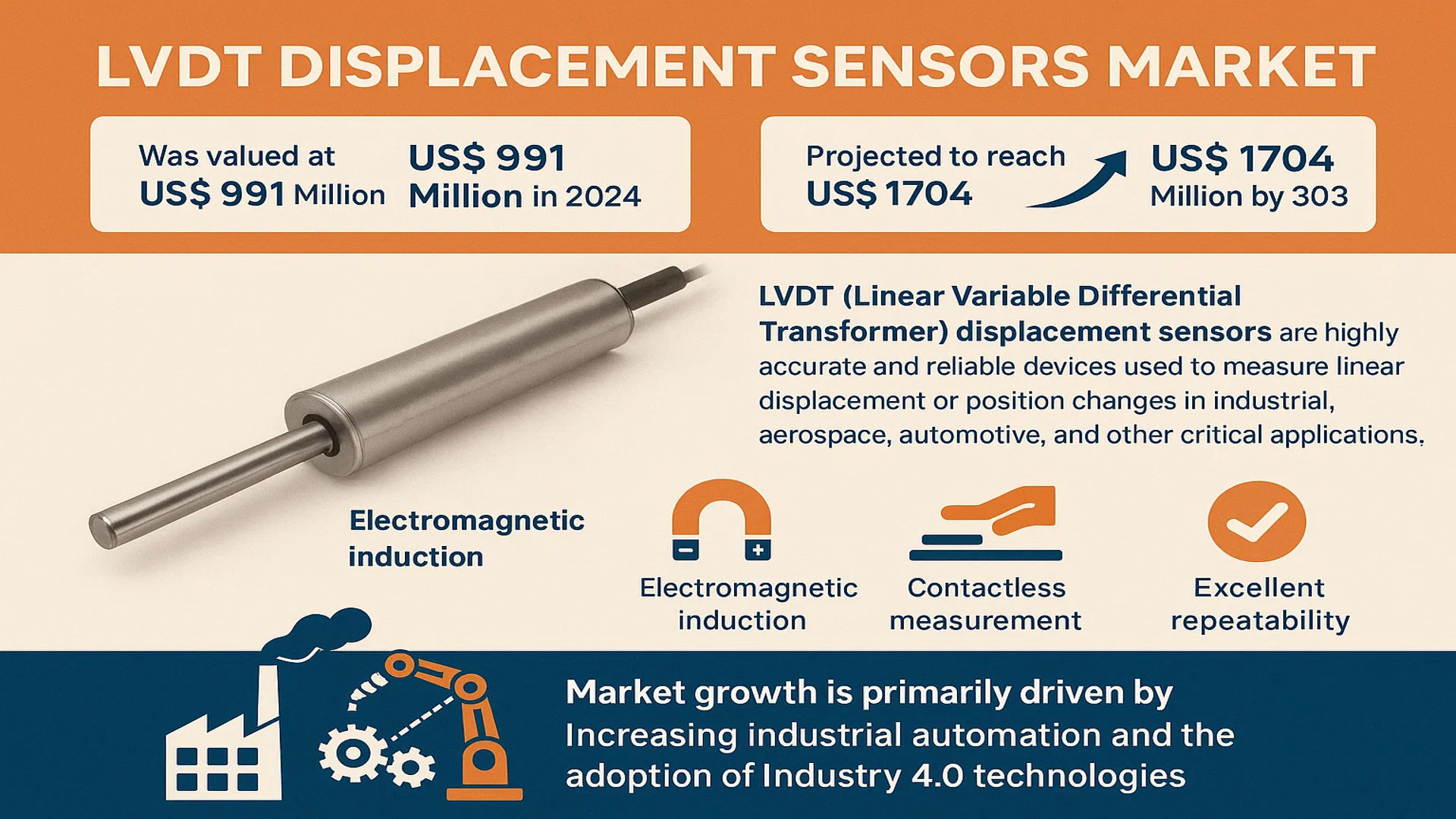
The global LVDT Displacement Sensors Market was valued at 991 million in 2024 and is projected to reach US$ 1704 million by 2032, at a CAGR of 8.1% during the forecast period.
LVDT (Linear Variable Differential Transformer) displacement sensors are highly accurate and reliable devices used to measure linear displacement or position changes in industrial, aerospace, automotive, and other critical applications. These sensors operate on the principle of electromagnetic induction, providing contactless, friction-free measurement with excellent repeatability and long operational life. LVDTs consist of a primary coil and two secondary coils wound on a cylindrical former, along with a movable ferromagnetic core.
The market growth is primarily driven by increasing industrial automation and the adoption of Industry 4.0 technologies, which require precise position feedback in manufacturing processes. Additionally, the aerospace and defense sectors continue to invest in LVDT sensors for applications requiring high reliability in extreme environments. Technological advancements in sensor design, including miniaturization and improved signal conditioning electronics, are further expanding the application scope of LVDT displacement sensors across various industries.
MARKET DYNAMICS
MARKET DRIVERS
Industry 4.0 and Smart Manufacturing Revolution Boosting LVDT Sensor Adoption
The global push toward Industry 4.0 and smart manufacturing is significantly accelerating demand for LVDT displacement sensors. These sensors provide the precise positional feedback required for automated quality control, predictive maintenance, and real-time process adjustments in modern manufacturing environments. With smart factory investments projected to grow substantially over the next five years, LVDTs are becoming indispensable components in automated production lines, robotic systems, and CNC machining centers. Their ability to deliver micron-level accuracy in harsh industrial conditions makes them particularly valuable in metalworking, automotive assembly, and heavy equipment manufacturing applications.
Aerospace and Defense Sector Driving Demand for High-Performance Sensors
LVDT sensors play a critical role in aerospace and defense applications where reliability and precision are paramount. The sensors are extensively used in aircraft control systems, landing gear mechanisms, hydraulic actuators, and structural health monitoring. With global defense spending reaching new highs and commercial aircraft production ramping up to meet post-pandemic travel demand, the need for certified aerospace-grade LVDTs has surged. These sensors must meet stringent MIL-SPEC standards while operating reliably in extreme temperatures, high vibration environments, and electromagnetic interference conditions that would compromise other sensing technologies.
Miniaturization and Technological Advancements Expanding Application Scope
Recent advancements in LVDT design are opening new application possibilities across diverse industries. Manufacturers have successfully developed compact LVDT models with diameters under 4mm, enabling their use in medical devices, semiconductor equipment, and precision instrumentation where space constraints previously limited deployment. Improved signal processing electronics now allow resolutions down to 0.1 microns, while new materials enhance durability in corrosive or high-temperature environments. Some next-generation LVDTs incorporate digital output and wireless connectivity features, simplifying integration with modern IIoT systems and Industry 4.0 architectures.
MARKET RESTRAINTS
High Initial Costs and Complex Installation Limiting Widespread Adoption
Despite their excellent performance characteristics, LVDT sensors face adoption barriers due to relatively high costs compared to alternative displacement measurement technologies. The precision manufacturing required for core components and the need for specialized signal conditioning electronics contribute to higher price points. Installation often requires careful mechanical alignment and proper shielding to minimize electromagnetic interference, adding to system integration costs. These factors can make LVDTs less competitive in price-sensitive applications where extreme precision isn’t absolutely required, particularly in small and medium-sized enterprises with tighter budgets.
Competition from Emerging Sensing Technologies
LVDT sensors face increasing competition from alternative displacement measurement technologies, particularly in applications where cost or size constraints are primary considerations. Optical encoders, laser displacement sensors, and capacitive sensors have made significant advances in resolution and reliability while offering simpler installation and often lower costs. While LVDTs maintain advantages in harsh environments and applications requiring absolute position measurement, the widening capabilities of competing technologies are impacting market share in certain industrial segments. This competitive pressure is particularly evident in consumer electronics manufacturing and general automation applications where cost minimization is prioritized.
MARKET CHALLENGES
Supply Chain Disruptions Affecting Critical Component Availability
The LVDT sensor market continues to face challenges from global supply chain disruptions affecting the availability of specialty materials and electronic components. Precision-wound coils, high-grade magnetic cores, and specialized wire used in LVDT construction often come from limited supplier bases vulnerable to geopolitical tensions and trade restrictions. Lead times for certain sensor models have extended significantly compared to pre-pandemic levels, creating challenges for manufacturers and end-users alike. Some companies have responded by qualifying alternative materials and dual-sourcing strategies, but maintaining consistent performance specifications remains an ongoing challenge.
Technical Expertise Shortage in Precision Measurement Applications
Proper specification, installation, and maintenance of LVDT systems require specialized technical knowledge that is becoming increasingly scarce in the workforce. Many traditional measurement engineers with analog sensor expertise are reaching retirement age, while newly trained engineers often focus more on digital technologies. This skills gap creates implementation challenges, particularly in field applications where improper installation can significantly degrade sensor performance. Manufacturers are addressing this through more intuitive digital interfaces, enhanced training programs, and advanced diagnostic features in modern signal conditioning electronics.
MARKET OPPORTUNITIES
Expansion into Medical and Life Sciences Applications
The medical equipment sector presents significant growth opportunities for miniature and high-precision LVDT sensors. Applications in surgical robotics, prosthesis fitting, diagnostic imaging systems, and laboratory automation increasingly require the sub-micron resolution and contamination-free operation that modern LVDTs can provide. The global medical devices market’s continued expansion, coupled with rising investments in advanced healthcare technologies, creates favorable conditions for LVDT adoption. Recent developments in biocompatible materials and hermetically sealed designs further enhance their suitability for medical applications where reliability and precision are critical.
Growing Renewable Energy Sector Driving New Applications
The rapid growth of renewable energy installations worldwide is creating new demand for robust displacement sensing solutions. LVDTs are finding increasing use in wind turbine blade pitch control systems, hydroelectric dam gate positioning, and solar tracking mechanisms where their ability to operate reliably in harsh outdoor environments provides distinct advantages. As investments in renewable energy infrastructure continue to accelerate globally, this sector is expected to become an increasingly important market for specialized LVDT solutions designed to withstand extreme weather conditions while maintaining long-term measurement accuracy.
Digital Transformation Creating Smart Sensor Opportunities
The ongoing digital transformation of industrial operations presents significant opportunities for next-generation LVDT solutions with enhanced connectivity and diagnostic capabilities. Manufacturers are developing smart LVDT variants with integrated digital interfaces, embedded diagnostics, and predictive maintenance features that align with Industry 4.0 requirements. These advanced sensors can provide not just position data but also performance metrics and health status information, enabling more sophisticated condition monitoring and process optimization. As industrial IoT adoption grows, the ability to seamlessly integrate LVDT measurements into digital ecosystems will become increasingly valuable across manufacturing, energy, and infrastructure applications.
LVDT DISPLACEMENT SENSORS MARKET TRENDS
Industry 4.0 and Automation Fueling Demand for High-Precision LVDT Sensors
The global LVDT displacement sensors market is experiencing rapid growth, driven by increasing automation across manufacturing and industrial sectors. As factories transition toward Industry 4.0 smart manufacturing solutions, the demand for highly accurate position measurement devices like LVDTs has surged. These sensors are indispensable in automated control systems where they monitor linear displacement in robotic arms, CNC machines, and precision assembly lines. Their ability to provide real-time positional feedback with micron-level accuracy makes them critical components in modern production environments. The automotive industry, in particular, has substantially increased adoption rates, utilizing LVDTs for quality control in powertrain testing and automated braking systems.
Other Trends
Aerospace & Defense Applications Driving Technological Refinements
Aerospace and defense sectors represent one of the fastest-growing segments for LVDT displacement sensors, demanding extreme reliability under harsh conditions. These sensors are extensively used in flight control systems, actuator positioning, and structural health monitoring of aircraft components. With global military expenditures rising, defense applications now account for approximately 18-22% of total LVDT sensor usage, especially in missile guidance systems and landing gear monitoring. Sensor manufacturers are responding by developing ruggedized LVDT models capable of withstanding high vibration, extreme temperatures, and electromagnetic interference – key requirements for aerospace applications.
Miniaturization and Material Advancements Reshaping Product Design
Product innovation represents a critical trend, with manufacturers focusing on miniaturized LVDT sensors for compact and portable applications while maintaining high measurement accuracy. Recent advancements in core materials and winding techniques have enabled 30-35% size reduction in some commercial models compared to traditional designs. Medical equipment manufacturers are increasingly adopting these smaller form factors for applications like surgical robotics and prosthetic limb control systems. Furthermore, industry leaders are exploring the use of advanced alloys and composite materials to enhance durability and thermal stability, enabling LVDT deployment in previously inaccessible environments such as deep-sea exploration and nuclear facilities.
While technological advancements create opportunities, certain challenges persist, particularly regarding cost sensitivity in price-competitive industrial segments and the need for customized calibration in specialized applications. However, ongoing R&D investments totaling over $120 million annually across major manufacturers suggest the market will continue its trajectory of precision improvements and application expansion through the coming decade.
COMPETITIVE LANDSCAPE
Key Industry Players
Innovation and Precision Drive Market Competition for LVDT Sensors
The global LVDT displacement sensors market features a dynamic competitive landscape with established players and emerging innovators vying for market share. Honeywell International Inc. maintains a dominant position, leveraging its extensive R&D capabilities and diversified application expertise across aerospace, industrial, and automotive sectors. The company consistently introduces advanced sensor solutions with improved accuracy and reliability.
TE Connectivity and Ametek, Inc. follow closely, accounting for significant market shares through their specialized product portfolios. TE Connectivity’s focus on miniaturized sensors for compact applications gives it an edge in portable device integration, while Ametek’s high-precision instruments cater to demanding aerospace and defense applications where failure is not an option.
Mid-sized competitors like Micro-Epsilon and Omega Engineering compete effectively through technological differentiation, offering customized solutions for niche applications. Micro-Epsilon’s focus on high-temperature LVDTs for industrial furnace applications demonstrates this specialization strategy. These firms aggressively expand their distribution networks and enhance customer support services to compete with larger players.
Investment in next-generation LVDT technology remains a key battleground, with Sensata Technologies and Curtiss-Wright recently announcing developments in wireless and IoT-enabled sensors. The industry’s competitive intensity is further heightened by strategic partnerships, with sensor manufacturers increasingly collaborating with automation solution providers to offer integrated measurement systems.
List of Key LVDT Displacement Sensor Companies
- Honeywell International Inc. (U.S.)
- TE Connectivity (Switzerland)
- Sensata Technologies (U.S.)
- Curtiss-Wright Corporation (U.S.)
- G.W. Lisk Company (U.S.)
- Ametek, Inc. (U.S.)
- Micro-Epsilon (Germany)
- Meggitt PLC (U.K.)
- Omega Engineering (U.S.)
- Sensonics Ltd (U.K.)
- Monitran Ltd (U.K.)
- RDP Electronics (U.K.)
Segment Analysis:
By Type
AC LVDTs Dominate the Market Due to Higher Precision and Wider Application Scope
The market is segmented based on type into:
- AC LVDTs
- Subtypes: Standard AC, High-performance AC, and others
- DC LVDTs
- Subtypes: Low-voltage DC, High-voltage DC, and others
By Application
Aerospace & Defense Segment Leads Due to Critical Measurement Requirements
The market is segmented based on application into:
- Aerospace & Defense
- Industrial Equipment
- Automotive
- Medical Equipment
- Consumer Electronics
- Others
By Measurement Range
Medium Range LVDTs Are Most Widely Used Across Industries
The market is segmented based on measurement range into:
- Small range (0-25mm)
- Medium range (25-100mm)
- Large range (above 100mm)
By End-Use Industry
Manufacturing Sector Shows Strong Adoption for Precision Control Applications
The market is segmented based on end-use industry into:
- Manufacturing
- Aerospace
- Automotive
- Energy & Power
- Healthcare
- Others
Regional Analysis: LVDT Displacement Sensors Market
North America
The North American market is currently the largest for LVDT displacement sensors, driven by strong demand from aerospace, industrial automation, and defense sectors. Major manufacturers like Honeywell and TE Connectivity have established strong footholds in the region, supported by technological innovation and high R&D investment. The presence of stringent regulatory standards in aerospace and medical applications creates a continuous need for high-precision measurement solutions. Furthermore, the adoption of Industry 4.0 technologies across manufacturing facilities is accelerating the deployment of advanced LVDT sensors in predictive maintenance and quality control systems.
Europe
Europe’s mature manufacturing and automotive industries rely heavily on precision measurement technologies, making it a significant market for LVDT sensors. Germany leads in industrial applications, while the UK and France show strong demand from aerospace and defense sectors. The region benefits from strict quality norms and automation trends, particularly in automotive production lines and renewable energy systems. However, the market faces some challenges due to economic uncertainties impacting industrial investments. Nonetheless, opportunities exist in emerging applications like electric vehicle battery monitoring and wind turbine positioning systems.
Asia-Pacific
Asia-Pacific represents the fastest-growing regional market, projected to exceed other regions in adoption rates by 2030. China dominates the landscape with its massive industrial base and increasing automation across factories, while Japan and South Korea contribute significantly through their advanced electronics and automotive sectors. India’s expanding manufacturing capabilities present new opportunities, particularly in steel, power, and heavy machinery applications. The region’s cost-sensitive nature drives demand for competitively priced LVDT solutions, leading to increased localization of production by international players.
South America
The South American market shows moderate but steady growth, primarily driven by oil & gas exploration, mining operations, and infrastructure development. Brazil accounts for the largest share of demand, with its developing aerospace and automotive sectors creating new application areas for displacement sensors. Economic volatility and inconsistent industrial policies somewhat hinder market expansion, but the gradual modernization of manufacturing facilities and increasing foreign investments suggest long-term growth potential, particularly in condition monitoring applications.
Middle East & Africa
This region presents a growing but niche market for LVDT sensors, primarily serving oilfield equipment monitoring and power generation applications. The UAE and Saudi Arabia lead demand through infrastructure projects and aerospace investments, while South Africa shows potential in mining and heavy industries. Market development faces constraints from limited local manufacturing capabilities and reliance on imports, though rising industrial automation trends and smart city initiatives are expected to drive gradual market expansion over the coming decade.
Report Scope
This market research report provides a comprehensive analysis of the global and regional LVDT Displacement Sensors markets, covering the forecast period 2024–2032. It offers detailed insights into market dynamics, technological advancements, competitive landscape, and key trends shaping the industry.
Key focus areas of the report include:
- Market Size & Forecast: Historical data and future projections for revenue, unit shipments, and market value across major regions and segments. The global LVDT Displacement Sensors market was valued at USD 991 million in 2024 and is projected to reach USD 1,704 million by 2032, growing at a CAGR of 8.1%.
- Segmentation Analysis: Detailed breakdown by product type (AC LVDTs, DC LVDTs), application (Automotive, Aerospace & Defense, Consumer Electronics, Medical Equipment, Industrial Equipment), and end-user industry to identify high-growth segments.
- Regional Outlook: Insights into market performance across North America, Europe, Asia-Pacific, Latin America, and Middle East & Africa, with Asia-Pacific emerging as the fastest-growing region.
- Competitive Landscape: Profiles of 15+ leading market participants including Honeywell, TE Connectivity, Sensata Technologies, Ametek, and Micro-Epsilon, analyzing their market share, product portfolios, and strategic developments.
- Technology Trends & Innovation: Assessment of emerging technologies including miniaturization, improved accuracy (up to ±0.1% of full scale), and integration with Industry 4.0 systems.
- Market Drivers & Restraints: Evaluation of factors like industrial automation growth (projected to reach USD 395 billion by 2030) and aerospace sector demand versus challenges like high initial costs.
- Stakeholder Analysis: Strategic insights for sensor manufacturers, system integrators, and investors regarding the USD 1.7 billion market opportunity by 2032.
The research employs primary interviews with industry experts and analysis of verified market data from 2020-2023, ensuring accurate 10-year projections through 2032.
FREQUENTLY ASKED QUESTIONS:
What is the current market size of Global LVDT Displacement Sensors Market?
-> LVDT Displacement Sensors Market was valued at 991 million in 2024 and is projected to reach US$ 1704 million by 2032, at a CAGR of 8.1% during the forecast period.
Which key companies operate in Global LVDT Displacement Sensors Market?
-> Key players include Honeywell, TE Connectivity, Sensata Technologies, Ametek, Micro-Epsilon, Meggitt, and Omega Engineering, commanding over 45% combined market share.
What are the key growth drivers?
-> Growth is driven by industrial automation (projected 8.9% CAGR), aerospace & defense investments (USD 1.2 trillion globally), and demand for precision measurement in medical devices.
Which region dominates the market?
-> North America currently leads with 35% market share, while Asia-Pacific is growing fastest at 9.3% CAGR due to manufacturing expansion.
What are the emerging trends?
-> Emerging trends include miniaturized sensors (under 5mm diameter), wireless LVDT systems, and smart sensors with IIoT connectivity for predictive maintenance.

Get Sample Report PDF for Exclusive Insights
Report Sample Includes
- Table of Contents
- List of Tables & Figures
- Charts, Research Methodology, and more...
 Download Sample Report PDF





