MARKET INSIGHTS
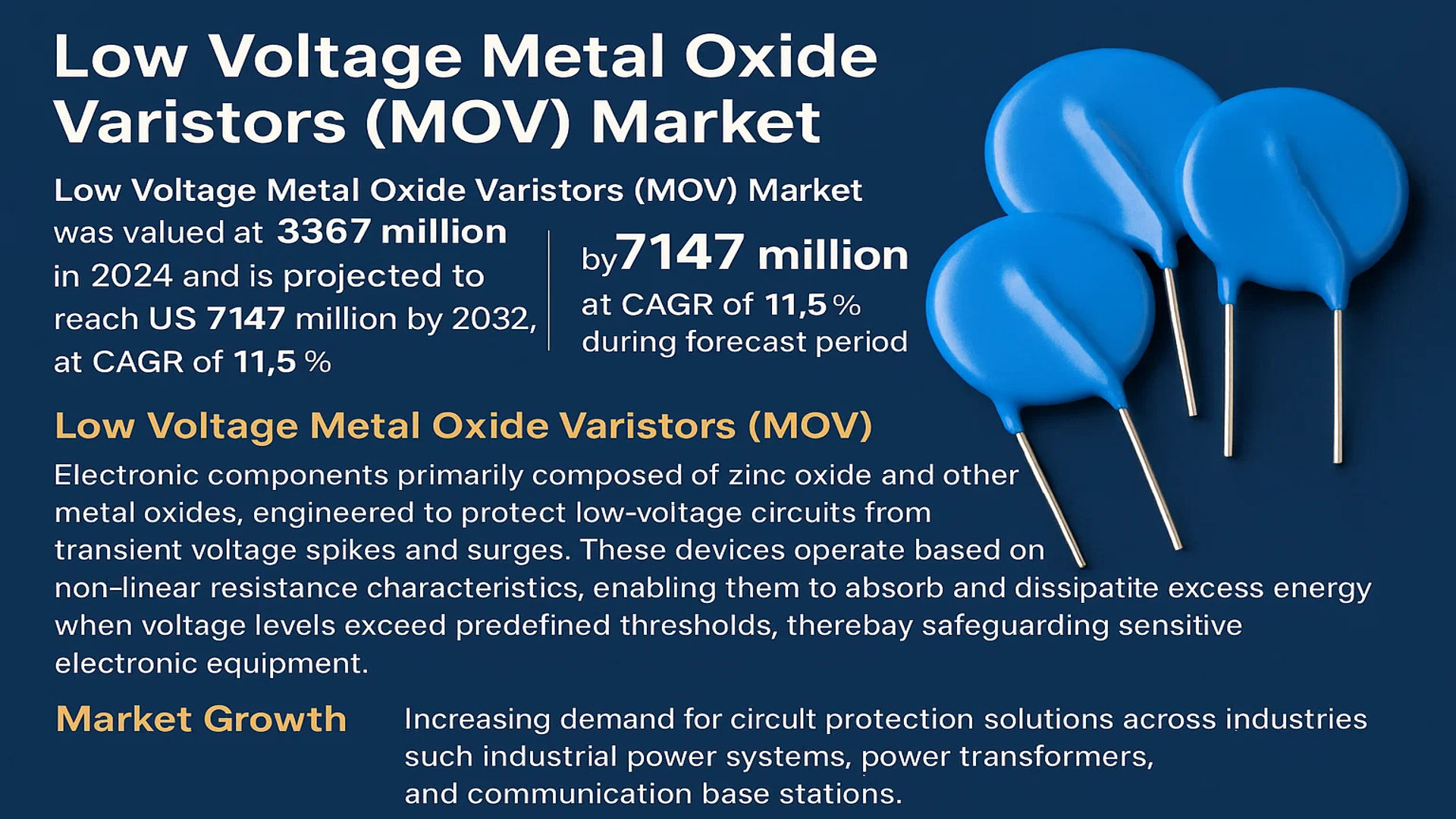
The global Low Voltage Metal Oxide Varistors (MOV) Market was valued at 3367 million in 2024 and is projected to reach US$ 7147 million by 2032, at a CAGR of 11.5% during the forecast period.
Low Voltage Metal Oxide Varistors (MOV) are electronic components primarily composed of zinc oxide and other metal oxides, engineered to protect low-voltage circuits from transient voltage spikes and surges. These devices operate based on non-linear resistance characteristics, enabling them to absorb and dissipate excess energy when voltage levels exceed predefined thresholds, thereby safeguarding sensitive electronic equipment.
The market growth is driven by increasing demand for circuit protection solutions across industries such as industrial power systems, power transformers, and communication base stations. Furthermore, advancements in surface mount technology (SMT) mounting types are contributing to market expansion. Key players including Bourns, Inc., Littelfuse, Inc., and TDK Electronics AG are actively investing in product innovations and strategic collaborations to strengthen their market position.
MARKET DYNAMICS
MARKET DRIVERS
Rising Demand for Surge Protection in Electronic Devices to Drive Market Expansion
The increasing adoption of sensitive electronic components across industries such as consumer electronics, automotive, and telecommunications is fueling the demand for Low Voltage Metal Oxide Varistors (MOVs). These components act as first-line defense mechanisms against voltage spikes, ensuring the longevity and reliability of electronic circuits. The global consumer electronics market is projected to grow significantly, with more than 8 billion connected devices expected by 2030, creating substantial demand for MOV-based circuit protection solutions.
Infrastructure Modernization and Smart Grid Development Accelerate Adoption
The ongoing modernization of power infrastructure worldwide, particularly in developing economies, presents a significant growth driver for the MOV market. Smart grid implementations, which require advanced surge protection for sensitive monitoring and control equipment, are becoming increasingly prevalent. Investments in grid modernization projects in Asia Pacific and North American regions are particularly noteworthy, with annual spending exceeding $100 billion collectively.
Furthermore, the integration of renewable energy sources into power grids creates additional requirements for voltage regulation and surge suppression. Solar panel installations and wind farms require robust protection solutions to handle voltage fluctuations, making MOVs an essential component in these applications.
MARKET RESTRAINTS
Thermal Runaway Issues and Performance Limitations Pose Challenges
While MOVs offer excellent surge protection capabilities, they face significant technical limitations that restrain market growth. One critical issue is thermal runaway, where excessive energy absorption can cause overheating and potential failure. This phenomenon becomes particularly problematic in high-energy surge conditions, limiting MOV applications in certain industrial environments.
Additionally, the degradation of MOV characteristics over time and after repeated surge events reduces their reliability. This performance deterioration can compromise protection levels without visible external signs, creating potential safety concerns in critical applications. Manufacturers are continuously working to improve these limitations, but they remain inherent challenges of the technology.
MARKET CHALLENGES
Intense Price Competition from Alternative Technologies Threatens Market Position
The MOV market faces growing competition from emerging surge protection technologies such as silicon avalanche diodes and polymer-based suppressors. These alternatives often offer superior response times and lifespan characteristics, particularly in high-frequency applications. While MOVs maintain cost advantages for many applications, price pressures continue to intensify.
Other Challenges
Supply Chain Vulnerabilities
The MOV manufacturing process relies heavily on zinc oxide and other rare earth metals, making the industry susceptible to material price fluctuations and geopolitical supply chain disruptions. Recent trade tensions and pandemic-related delays have highlighted these vulnerabilities.
Miniaturization Demands
The trend toward smaller electronic devices creates engineering challenges for MOV manufacturers, who must maintain protection capabilities while reducing component size. This requires significant R&D investment and process innovation.
MARKET OPPORTUNITIES
Expansion of 5G Infrastructure Creates New Application Potential
The global rollout of 5G networks represents a significant growth opportunity for the MOV market. 5G base stations and related infrastructure require robust surge protection due to their increased sensitivity and outdoor deployment. With projections indicating over 7 million 5G base stations to be installed worldwide by 2030, this sector is expected to drive substantial demand for advanced MOV solutions.
Furthermore, the automotive industry’s transition to electric and autonomous vehicles presents another promising avenue. Modern vehicles incorporate numerous sensitive electronic systems requiring protection from voltage transients. The electric vehicle market is forecasted to grow at a compound annual rate exceeding 20%, providing MOV manufacturers with a rapidly expanding addressable market.
LOW VOLTAGE METAL OXIDE VARISTORS (MOV) MARKET TRENDS
Demand for Reliable Circuit Protection to Drive MOV Market Growth
The global low voltage metal oxide varistors (MOV) market is experiencing significant growth, driven by the increasing demand for circuit protection in electronic devices and industrial applications. These components, made from zinc oxide and other metal oxides, play a crucial role in safeguarding circuits from transient voltage spikes, ensuring the longevity of sensitive electronics. With the global market valued at approximately $3.367 billion in 2024 and projected to reach $7.147 billion by 2032, increasing adoption across industries such as consumer electronics, automotive, and telecommunications is fueling this expansion. The growing integration of automation and IoT-driven devices in industrial and residential sectors further amplifies the need for reliable surge protection solutions.
Other Trends
Miniaturization of Electronic Components
The push for smaller, more efficient electronic devices is influencing the MOV market, with manufacturers focusing on Surface Mount Technology (SMT) mounting types as a key trend. SMT-mounted varistors are gaining traction due to their compact size, compatibility with automated assembly processes, and high performance in densely packed PCBs. The SMT segment is expected to register a strong compound annual growth rate (CAGR) over the coming years, driven by the proliferation of smart devices and wearable technology.
Growing Renewable Energy Investments
The expansion of renewable energy infrastructure, such as solar and wind power systems, is creating substantial demand for low voltage MOVs in power conditioning and distribution applications. These varistors are critical for protecting inverters, transformers, and monitoring equipment from voltage fluctuations, especially in regions with unreliable grid stability. Countries like China, the U.S., and Germany, which are leading in renewable energy adoption, are witnessing increased procurement of MOVs for solar panel installations and energy storage solutions. This trend is expected to accelerate with governments worldwide prioritizing clean energy transitions.
Automotive Electrification Surge
The rapid shift toward electric vehicles (EVs) and hybrid vehicles is another significant driver for the MOV market. EVs require robust circuit protection systems to ensure the safety and efficiency of battery management systems, charging stations, and onboard electronics. As automakers increase production of electric vehicles, the demand for high-performance, low-voltage MOVs capable of handling sudden power surges is escalating. This aligns with the broader industry push toward automotive safety standards and energy efficiency regulations, further propelling market advancements.
COMPETITIVE LANDSCAPE
Key Industry Players
Innovation and Strategic Expansion Drive Competition in the MOV Market
The global Low Voltage Metal Oxide Varistors (MOV) market features a dynamic competitive landscape with a mix of established multinational corporations and emerging regional players. Littelfuse, Inc. and TDK Electronics AG dominate market share due to their extensive product portfolios and strong technological capabilities in transient voltage suppression solutions. These companies leverage economies of scale and global distribution networks to maintain leadership positions across multiple regions, including North America and Asia-Pacific.
Panasonic Corporation and KYOCERA AVX have demonstrated consistent growth through vertical integration strategies, combining material science expertise with advanced manufacturing techniques to produce high-performance MOV components. Their ability to cater to both industrial and commercial applications, from power transformers to communication base stations, gives them a competitive edge in diverse market segments.
The market also sees active participation from specialized manufacturers like Bourns, Inc. and Vishay Intertechnology Inc., which focus on niche applications requiring customized MOV solutions. These companies differentiate themselves through rapid prototyping capabilities and technical support services, particularly valuable for OEMs developing next-generation electronic devices.
Several Chinese manufacturers, including Guangdong Uchi Electronics and Dongguan Tianrui Electronics, are gaining traction through cost-competitive offerings and responsive supply chains. While these players currently focus on domestic and emerging markets, their increasing investments in R&D suggest potential for global expansion in the coming years.
List of Key Low Voltage MOV Manufacturers
- Bourns, Inc. (U.S.)
- Littelfuse, Inc. (U.S.)
- TDK Electronics AG (Germany)
- Panasonic Corporation (Japan)
- KYOCERA AVX (U.S.)
- Vishay Intertechnology Inc. (U.S.)
- Eaton Corporation PLC (Ireland)
- Nippon Chemi-Con Corporation (Japan)
- Guangdong Uchi Electronics (China)
- Dongguan Tianrui Electronics (China)
- INPAQ Technologies Co. Ltd (Taiwan)
- Walsin Technology Corporation (Taiwan)
Segment Analysis:
By Type
Surface Mount Technology (SMT) Mounting Type Segment Dominates Due to High Demand for Compact Circuit Protection
The market is segmented based on type into:
- Surface Mount Technology (SMT) Mounting Type
- Through Hole Mounting Type
By Application
Industrial Power System Segment Leads Owing to Wide Usage in Voltage Regulation
The market is segmented based on application into:
- Industrial power system
- Power transformer
- Communication base station
- Other
By End User
Manufacturing Sector Holds Major Share Due to Need for Surge Protection Equipment
The market is segmented based on end user into:
- Electronics manufacturing
- Telecommunications
- Energy & utilities
- Automotive
- Others
Regional Analysis: Low Voltage Metal Oxide Varistors (MOV) Market
Asia-Pacific
The Asia-Pacific region dominates the global Low Voltage MOV market, accounting for over 45% of the total market share in 2024. This leadership position stems from the rapid industrialization in China, India, and Southeast Asia, where increasing investments in power infrastructure, telecommunications, and consumer electronics drive demand for surge protection components. China’s substantial electronics manufacturing sector and its “Made in China 2025” initiative have significantly boosted MOV adoption. Furthermore, Japan and South Korea remain critical hubs for advanced electronic component manufacturing, with major players like Panasonic and TDK Electronics driving innovation. While cost-competitive Chinese manufacturers supply the bulk of standard MOVs, Japanese brands lead in high-reliability applications. The region’s growth is tempered by intellectual property concerns and intensifying price competition among local suppliers.
North America
North America represents a high-value market for Low Voltage MOVs, characterized by stringent quality standards and a strong emphasis on reliability. The U.S. accounts for the majority of regional demand, driven by robust aerospace, defense, and telecommunications sectors. The growing deployment of 5G infrastructure and renewable energy systems has created new opportunities for MOV suppliers, particularly for Surface Mount Technology (SMT) variants. Canadian demand is propelled by industrial automation investments. Key players like Bourns, Littelfuse, and Eaton Corporation maintain strong positions through patented technologies and long-term contracts with OEMs. However, the market faces pressure from Asia-based competitors, prompting regional manufacturers to focus on specialized, high-margin product lines.
Europe
Europe’s Low Voltage MOV market is shaped by strict EU regulations on electronic component safety and environmental compliance, particularly the RoHS and REACH directives. Germany leads regional consumption, supported by its advanced automotive electronics and industrial equipment sectors. The UK and France follow closely, with demand concentrated in power distribution and telecommunications infrastructure. European manufacturers emphasize eco-friendly MOV production processes and recyclable materials to align with sustainability goals. While the region benefits from technological leadership in precision electronics, high production costs have led to increased reliance on imports for cost-sensitive applications. Strategic partnerships between EU-based designers and Asian manufacturers have become common to balance quality and affordability.
South America
South America presents emerging opportunities in the Low Voltage MOV market, though growth remains uneven across countries. Brazil accounts for nearly 60% of regional demand, primarily serving its industrial and energy sectors. Argentina and Chile show promising uptake in mining and telecommunications applications. However, economic instability, currency fluctuations, and limited local manufacturing capabilities constrain market expansion. Most MOVs are imported from China and the U.S., with distribution handled by regional electronics suppliers. Market growth potential exists in renewable energy projects and urban infrastructure modernization, though these require stable investment environments to materialize fully.
Middle East & Africa
The MEA Low Voltage MOV market is in a developmental phase, with growth concentrated in Gulf Cooperation Council (GCC) countries and South Africa. The UAE and Saudi Arabia lead demand through smart city initiatives and oil/gas industry modernization. Africa’s market remains largely untapped, though mobile network expansion is creating pockets of opportunity in Nigeria, Kenya, and Egypt. The region faces challenges including limited technical expertise, counterfeit components in the supply chain, and reliance on imports. Nevertheless, increasing electrification projects and data center construction present long-term growth avenues, provided political and economic stability can be maintained.
Report Scope
This market research report provides a comprehensive analysis of the global Low Voltage Metal Oxide Varistors (MOV) market, covering the forecast period 2024–2032. It offers detailed insights into market dynamics, technological advancements, competitive landscape, and key trends shaping the industry.
Key focus areas of the report include:
- Market Size & Forecast: Historical data and future projections for revenue, unit shipments, and market value across major regions and segments. The global market was valued at USD 3,367 million in 2024 and is projected to reach USD 7,147 million by 2032, growing at a CAGR of 11.5%.
- Segmentation Analysis: Detailed breakdown by product type (SMT Mounting Type, Through Hole Mounting Type), application (Industrial Power Systems, Power Transformers, Communication Base Stations), and end-user industries to identify high-growth segments.
- Regional Outlook: Insights into market performance across North America, Europe, Asia-Pacific, Latin America, and the Middle East & Africa. The U.S. and China are key markets, with Asia-Pacific expected to show the highest growth rate.
- Competitive Landscape: Profiles of 17 leading market participants including Bourns Inc., Littelfuse Inc., TDK Electronics AG, and Panasonic Corporation, covering their product portfolios, market shares, and strategic developments.
- Technology Trends: Assessment of emerging MOV technologies, miniaturization trends, and innovations in voltage protection solutions for modern electronic devices.
- Market Drivers & Restraints: Analysis of factors such as increasing demand for electronic protection devices, growth in power infrastructure, and challenges related to raw material price volatility.
- Stakeholder Analysis: Strategic insights for component manufacturers, OEMs, system integrators, and investors in the voltage protection components market.
The report employs both primary and secondary research methodologies, including interviews with industry experts and analysis of verified market data, to ensure accuracy and reliability.
FREQUENTLY ASKED QUESTIONS:
What is the current market size of Global Low Voltage Metal Oxide Varistors (MOV) Market?
-> Low Voltage Metal Oxide Varistors (MOV) Market was valued at 3367 million in 2024 and is projected to reach US$ 7147 million by 2032, at a CAGR of 11.5% during the forecast period.
Which key companies operate in Global Low Voltage MOV Market?
-> Key players include Bourns Inc., Littelfuse Inc., TDK Electronics AG, Panasonic Corporation, KYOCERA AVX, Vishay Intertechnology, and Eaton Corporation.
What are the key growth drivers?
-> Growth is driven by increasing electronics adoption, demand for circuit protection, expansion of power infrastructure, and growth in telecommunications.
Which region dominates the market?
-> Asia-Pacific dominates the market, accounting for over 45% of global demand, led by China’s electronics manufacturing sector.
What are the emerging trends?
-> Emerging trends include miniaturization of components, development of high-performance MOVs, and integration with smart protection systems.

Get Sample Report PDF for Exclusive Insights
Report Sample Includes
- Table of Contents
- List of Tables & Figures
- Charts, Research Methodology, and more...
 Download Sample Report PDF