Low Ohm Resistors Market Insights
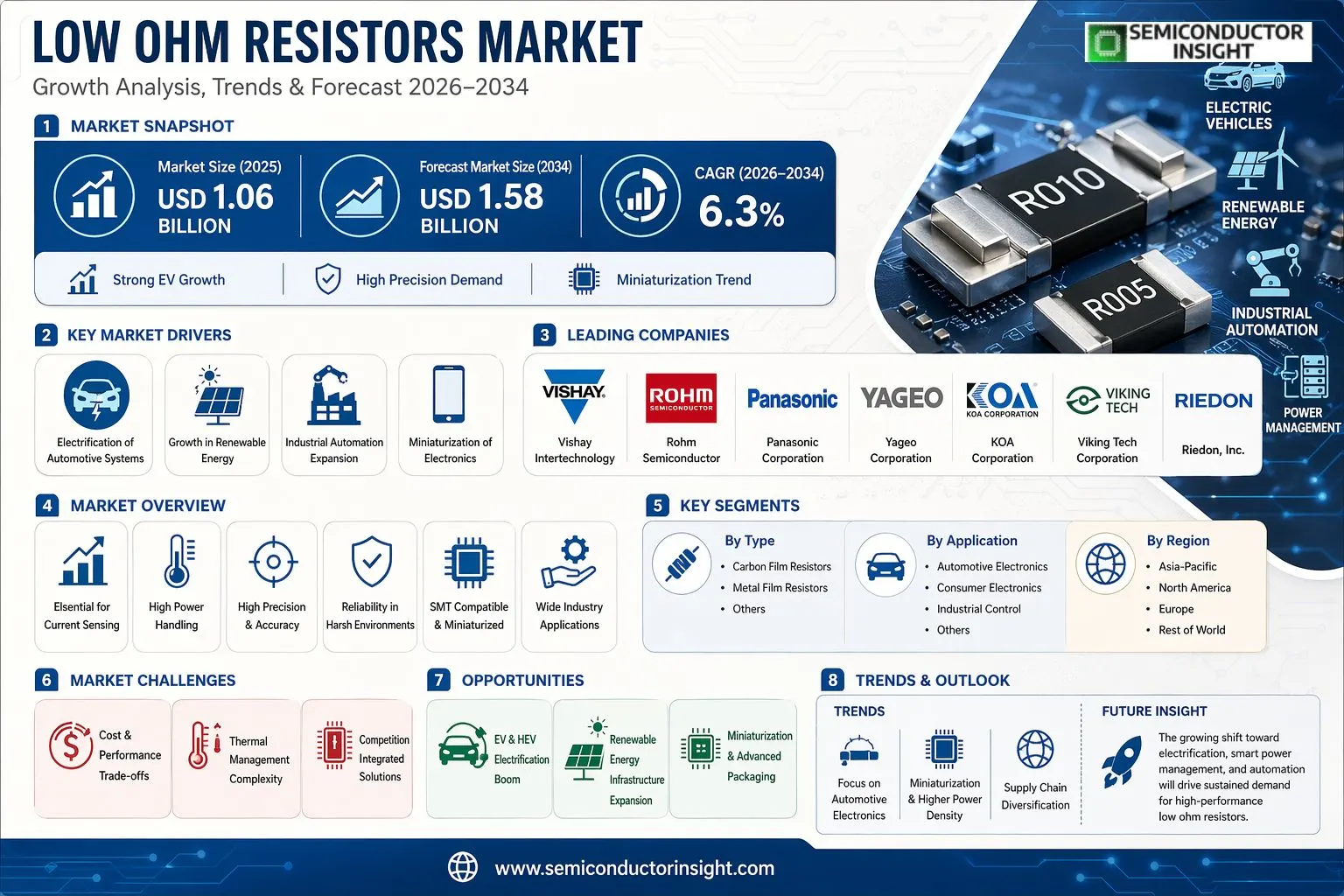
Global Low Ohm Resistors Market size was valued at USD 1.06 billion in 2025. The market is projected to grow from USD 1.13 billion in 2026 to USD 1.58 billion by 2034, exhibiting a CAGR of 6.3% during the forecast period.
Low ohm resistors are specialized passive electronic components characterized by their relatively low resistance values, typically ranging from milliohms (mΩ) to a few ohms. These components are crucial for current sensing, current limiting, and power management applications because they allow larger currents to pass through while producing minimal voltage drops, ensuring circuit efficiency and stability. Common types include metal strip resistors, metal plate resistors, and specialized variants like carbon film and metal film resistors designed for low-resistance performance.
The market is experiencing steady growth driven by several key factors, including the rapid electrification of automotive systems, the expansion of renewable energy infrastructure requiring precise power monitoring, and the relentless miniaturization of consumer electronics. Furthermore, the proliferation of industrial automation and IoT devices, which rely on accurate current measurement for control and safety, is contributing significantly to market expansion. Initiatives by leading manufacturers to develop high-precision, surface-mount technology (SMT) compatible components with improved thermal performance are also fueling growth. For instance, companies are continuously innovating to meet the demands for higher power ratings and tighter tolerances in compact form factors. Key global players operating in this competitive market with extensive portfolios include Vishay Intertechnology Inc., Rohm Semiconductor, Panasonic Corporation, Yageo Corporation, and KOA Corporation.
MARKET DRIVERS
Proliferation of High-Current Applications and Energy Efficiency Mandates
The primary driver for Low Ohm Resistors Market is the exponential growth in high-power electronics. Devices such as electric vehicle power trains, industrial motor drives, and renewable energy inverters require precise current sensing to ensure safety and optimal performance. Low ohm resistors are critical in these circuits for shunt-based current measurement, enabling real-time monitoring and control. This demand is further amplified by global energy efficiency regulations, which mandate more accurate power management systems across all industrial sectors.
Advancements Across the Electronics Value Chain
Technological evolution in adjacent sectors directly fuels the market for low value resistors. The miniaturization of circuits, especially in 5G telecommunications infrastructure and advanced computing, requires components with lower resistance, higher power ratings, and superior thermal stability in smaller packages. Furthermore, the rise of advanced driver-assistance systems (ADAS) and vehicle electrification has created a sustained need for reliable, high-precision current sensing solutions that can operate in harsh automotive environments.
➤ The push for smarter power solutions is not a trend but a foundational shift, making precision current sensing components like low ohm resistors indispensable for modern circuit design and safety.
Consequently, manufacturers Low Ohm Resistors Market are innovating with new materials like metal strip and metal plate technologies to offer lower temperature coefficients of resistance (TCR) and higher power dissipation, directly responding to these complex application requirements.
MARKET CHALLENGES
Cost and Performance Trade-offs in Precision Manufacturing
A significant challenge Low Ohm Resistors Market stems from the technical difficulty of manufacturing high-precision, low-resistance components. Achieving tolerances within 1% or even 0.5% for values below 1 ohm requires advanced production techniques and high-purity materials, which increases unit cost. This creates pricing pressure, especially in cost-sensitive, high-volume segments like consumer electronics, where designers may seek alternative, less precise solutions.
Other Challenges
Thermal Management and Power Derating
The fundamental operation of a low ohm resistor as a current-sensing shunt involves significant power dissipation (I²R). Managing the resulting heat to prevent drift and ensure long-term stability is a persistent design hurdle. Engineers must carefully design for thermal dissipation, which can complicate PCB layout and increase system size and cost.
Competition from Integrated Solutions
The market faces competition from integrated current-sensing ICs and hall-effect sensors. While shunts offer superior accuracy and linearity, integrated solutions can simplify design and reduce board space. Convincing designers of the performance benefits of discrete low ohm resistors in space-constrained applications remains a key challenge.
MARKET RESTRAINTS
Economic Cyclicality and Supply Chain Dependency
The growth of Low Ohm Resistors Market is intrinsically tied to the health of its end-use industries, such as automotive, industrial automation, and telecommunications. Economic downturns or reduced capital expenditure in these sectors can immediately suppress demand. Additionally, the market relies on stable supplies of specialized raw materials, including specific metal alloys and ceramic substrates. Geopolitical tensions or trade restrictions can disrupt this supply chain, leading to price volatility and extended lead times that restrain market expansion.
Design Complexity and Qualification Hurdles
The integration of low ohm resistors, particularly for high-reliability applications in automotive (AEC-Q200) or aerospace, involves lengthy and costly qualification processes. This extended design cycle can slow the adoption of new, advanced resistor technologies. Furthermore, the need for meticulous PCB design to minimize parasitic inductance and ensure accurate sensing adds a layer of complexity that can deter rapid prototyping and innovation in some development environments.
MARKET OPPORTUNITIES
Electrification of Transportation and Renewable Energy Integration
Globaltransition to electric vehicles (EVs) and hybrid electric vehicles (HEVs) presents the largest opportunity for Low Ohm Resistors Market. Every EV battery management system (BMS), onboard charger, and motor controller requires multiple, highly reliable current shunts. Parallel to this, the expansion of solar and wind energy infrastructure demands robust power conversion and monitoring systems, all reliant on precise current measurement components, creating a sustained, high-growth market segment.
Innovation in Miniaturization and Advanced Packaging
There is a substantial opportunity for manufacturers who can develop low ohm resistors with higher power density in smaller surface-mount packages, such as 0612 or 1206 sizes. Innovations in packaging that improve thermal conductivity to the PCB can allow for higher continuous power ratings. Furthermore, the integration of resistor networks or combined shunt-and-amplifier packages can offer value-added solutions that simplify customer design, commanding a premium in the market.
Expansion in Industrial IoT and Automation
The rise of Industry 4.0 and the Industrial Internet of Things (IIoT) drives the need for granular data collection, including precise monitoring of machine and process currents. This expands the application of low ohm resistors beyond traditional power circuits into predictive maintenance systems and smart factory equipment, opening new avenues in the industrial automation sector for reliable, long-lifetime sensing components.
Trends
Focus on Integration into Advanced Automotive Electronics
A primary and sustained trend Low Ohm Resistors Market is the deepening integration of these components into advanced automotive electronic systems. Resistors with low resistance values are essential for high-current sensing and power management in electric vehicles (EVs), battery management systems (BMS), and advanced driver-assistance systems (ADAS). This application demands components that offer high precision, reliability under harsh conditions, and space-efficient designs. As vehicle electrification accelerates globally, the need for specialized low ohm resistors to monitor current flow and protect circuits is driving significant innovation and demand, establishing automotive electronics as a key growth segment for manufacturers.
Other Trends
Miniaturization and Enhanced Power Density
Suppliers Low Ohm Resistors Market are consistently developing smaller footprint components with higher power-handling capabilities. This trend responds directly to the demands of modern consumer electronics and compact industrial designs, where board space is at a premium. The challenge is to reduce physical size while maintaining excellent thermal performance and current-carrying capacity. This has led to advancements in materials and packaging techniques, enabling resistors to manage substantial power in a smaller form factor, which is critical for next-generation portable devices and densely packed control modules.
Supply Chain Diversification and Regional Manufacturing Shifts
Recent trends Low Ohm Resistors Market highlight a strategic realignment of supply chains. Leading manufacturers are reassessing production dependencies and expanding manufacturing footprints across different regions to enhance resilience. This move is partly driven by the strong demand from Asia-Pacific, particularly China, which remains a major consumer and producer. Companies are establishing local production to better serve regional markets like North America and Europe, ensuring faster turnaround times and mitigating geopolitical and logistical risks. This trend is reshaping the competitive landscape and influencing global market dynamics.
COMPETITIVE LANDSCAPE
Key Industry Players
Fragmented Market with Intense Competition Among Established Leaders
GlobalLow Ohm Resistors market is characterized by a fragmented competitive landscape with several long-established electronics component manufacturers holding significant global market shares. Vishay Intertechnology stands as a prominent leader, offering a wide portfolio of low ohm resistors, including metal strip and metal foil types, known for high precision and power handling which are critical for automotive electronics and industrial control applications. The dominance of top players is based on extensive R&D, broad global distribution networks, and strategic acquisitions that expand product lines and technological capabilities.
Beyond the market leaders, numerous specialized and regional manufacturers compete effectively by focusing on specific resistor technologies or high-growth market niches. Companies such as Viking Tech and Riedon specialize in precision and high-power low ohm resistors, catering to demanding industrial and aerospace sectors. The Asia-Pacific region, particularly companies like Yageo and KOA Corporation, has seen significant growth, driven by the vast local consumer electronics and automotive manufacturing base. This diverse competitive environment fosters continuous innovation in materials, miniaturization, and thermal performance to meet evolving industry demands.
List of Key Low Ohm Resistors Companies Profiled
- Vishay Intertechnology, Inc.
- ROHM Semiconductor
- Panasonic Corporation
- Yageo Corporation
- KOA Corporation
- Viking Tech Corporation
- JDC Resistors GmbH
- Riedon, Inc.
- Thunder Components Ltd.
- KRL Bantry Ltd.
- Ohmite Manufacturing Co.
- KWK Resistors
- Vitrohm (TT Electronics)
- ZENITHSUN Electronics
- SURERESISTORS International Corp.
Segment Analysis:
| Segment Category | Sub-Segments | Key Insights |
| By Type |
|
Metal Film Resistors are considered a leading and technologically advanced segment. They offer superior performance characteristics critical for modern electronics, including enhanced stability, lower noise, and better tolerance precision compared to carbon film variants. This makes them highly desirable for applications requiring reliable current sensing and fine current control in stable environments. The ongoing trend towards miniaturization and higher performance in electronic circuits further solidifies their position, as manufacturers increasingly prioritize components that ensure long-term reliability and precision in increasingly dense circuit designs. |
| By Application |
|
Automotive Electronics represents a high-growth application segment driven by the rapid electrification of vehicles. The surge in electric vehicle production and advanced driver-assistance systems creates robust demand for components capable of handling high currents for battery management, motor control, and power distribution. Low ohm resistors are fundamental for current sensing and circuit protection in these harsh, high-reliability environments. The automotive industry’s stringent requirements for durability under wide temperature ranges and vibration further prioritize quality components, making this a key focus area for manufacturers seeking stable, long-term growth partnerships. |
| By End User |
|
Original Equipment Manufacturers (OEMs) constitute the dominant end-user segment, integrating low ohm resistors directly into their final products like vehicles, industrial machinery, and consumer gadgets. Their leadership is underpinned by large-volume procurement contracts and deep technical collaborations with resistor suppliers to co-develop custom solutions. This segment drives innovation, as OEMs demand components that meet specific size, performance, and cost targets for their next-generation products. Building strong relationships with major OEMs is therefore a critical strategic objective for resistor manufacturers to secure predictable demand and align with cutting-edge technological roadmaps in key industries. |
| By Technology Adoption |
|
Surface-Mount Technology (SMT) Resistors are the leading growth driver within this segmentation, reflecting the overarching industry shift towards automated, high-density PCB assembly. The preference for SMT components is universal across all modern electronics manufacturing due to advantages in assembly speed, board space savings, and improved performance at high frequencies. For low ohm resistors, the SMT format presents engineering challenges in managing heat dissipation and current capacity within a tiny footprint, pushing manufacturers to innovate in materials and design. This trend is inexorably linked to the miniaturization of everything from smartphones to automotive control units, ensuring sustained demand. |
| By Sales Channel |
|
Direct Sales through contracts with OEMs and large EMS providers is the predominant and most critical channel for major manufacturers. This channel facilitates deep technical engagement, just-in-time delivery agreements, and long-term supply partnerships that are essential for high-volume production. While distributor networks serve the vital function of providing broad geographic coverage and inventory for smaller buyers and prototyping needs, the strategic and revenue-leading channel remains direct. The complexity of product specifications and the need for collaborative design-in processes naturally favor direct manufacturer-customer relationships for the bulk of market volume, solidifying this channel’s leadership. |
Regional Analysis: Low Ohm Resistors Market
Asia-Pacific
The region’s concentration of electronics manufacturing, from PCBA to final assembly, creates a captive market for low ohm resistors. Proximity to component suppliers reduces lead times and cost, strengthening the regional Low Ohm Resistors Market’s resilience and responsiveness to global demand shifts.
As the largest producer and consumer of electric vehicles, Asia-Pacific’s automotive sector is a critical driver. Low ohm resistors are essential for battery management systems, motor drives, and onboard chargers, with regional R&D heavily focused on meeting stringent automotive-grade reliability and safety standards.
The relentless cycle of smartphone, wearable, and computing device innovation demands increasingly compact and efficient power management solutions. Regional designers prioritize low ohm resistors that offer high precision in minimal footprints, pushing the boundaries of component technology for space-constrained applications.
Large-scale investments in industrial IoT, robotics, and renewable energy projects across the region fuel demand for robust current sensing solutions. Low ohm resistors are integral to motor control, inverter systems, and power monitoring in these applications, benefiting from sustained infrastructural development.
North America
The North American Low Ohm Resistors Market is propelled by advanced technological adoption and strong defense and aerospace sectors. The region’s focus on high-reliability applications, including telecommunications infrastructure, data centers, and medical equipment, creates demand for premium-grade components with exceptional accuracy and longevity. A significant trend is the integration of low ohm resistors in next-generation power supplies for AI servers and high-performance computing, where precise current measurement is critical for efficiency and thermal management. The presence of leading automotive R&D centers, particularly for electric and autonomous vehicles, also stimulates innovation in high-power, low-resistance shunts for advanced driver-assistance systems (ADAS) and powertrain controls.
Europe
Europe’s market for low ohm resistors is characterized by stringent regulatory standards and a strong industrial base, particularly in automotive, renewable energy, and industrial automation. The region’s automotive industry, with its accelerated transition to electrification, is a primary consumer, requiring components that meet rigorous quality and safety certifications like AEC-Q200. The growth of solar and wind energy projects across the continent increases the need for reliable current sensing in inverters and converters. Furthermore, Europe’s established manufacturing sector, with its emphasis on Industry 4.0 and precision engineering, utilizes low ohm resistors in sophisticated motor drives, robotic systems, and measurement equipment, favoring suppliers that can deliver technical support and customization.
South America
The South American Low Ohm Resistors Market is evolving, with growth primarily linked to industrial modernization and regional automotive production. Countries like Brazil and Argentina are key markets where investments in industrial equipment and consumer electronics assembly drive base demand. The need for these components in automotive applications is gradually increasing alongside regional production of vehicles and aftermarket parts. However, market development is often paced by economic stability and local manufacturing capabilities. The expansion of telecommunications infrastructure presents a nascent opportunity for low ohm resistors in power management for network equipment, though the market remains more reliant on imports compared to major global regions.
Middle East & Africa
This region presents a developing market for low ohm resistors, with demand emerging from specific infrastructural and industrial projects. In the Middle East, investments in telecommunications infrastructure, data centers, and oil & gas instrumentation support steady demand. The push for economic diversification into manufacturing and technology in Gulf nations could foster future growth. In Africa, the market is fragmented, with opportunities linked to the gradual expansion of power distribution networks, renewable energy installations, and consumer electronics penetration. The overall market dynamics are defined by project-based demand rather than continuous high-volume manufacturing, with a focus on durability and performance in often challenging environmental conditions.
Report Scope
This market research report provides a comprehensive analysis of the Low Ohm Resistors Market , covering the forecast period 2026–2034. It offers detailed insights into market dynamics, technological advancements, competitive landscape, and key trends shaping the industry.
Key focus areas of the report include:
- Market Overview: The report begins with an overview outlining its current market scenario, key growth indicators, and industry transformation drivers. It discusses macroeconomic factors, demand–supply balance, regulatory landscape, and the strategic role of semiconductors in powering advancements across industries such as automotive, telecommunications, consumer electronics, and industrial automation.
- Market Size & Forecast: Historical data and future projections for revenue, unit shipments, and market value across major regions and segments.
- Segmentation Analysis: Detailed breakdown by product type, technology, application, and end-user industry to identify high-growth segments and investment opportunities.
- Regional Insights: Insights into market performance across North America, Europe, Asia-Pacific, Latin America, and the Middle East & Africa, including country-level analysis where relevant.
- Competitive Landscape: Profiles of leading market participants, including their product offerings, R&D focus, manufacturing capacity, pricing strategies, and recent developments such as mergers, acquisitions, and partnerships.
- Technology Trends & Innovation: Assessment of emerging technologies, integration of AI/IoT, semiconductor design trends, fabrication techniques, and evolving industry standards.
- Market Drivers & Restraints: Evaluation of factors driving market growth along with challenges, supply chain constraints, regulatory issues, and market-entry barriers.
- Stakeholder Insights: Insights for component suppliers, OEMs, system integrators, investors, and policymakers regarding the evolving ecosystem and strategic opportunities.
Primary and secondary research methods are employed, including interviews with industry experts, data from verified sources, and real-time market intelligence to ensure the accuracy and reliability of the insights presented.
FREQUENTLY ASKED QUESTIONS:
What is the current market size of Low Ohm Resistors Market?
-> Global Low Ohm Resistors Market was valued at USD 1057 million in 2025 and is projected to reach USD 1579 million by 2034, growing at a CAGR of 6.3% during the forecast period.
Which key companies operate Low Ohm Resistors Market?
-> Key players include Vishay, Rohm, Panasonic, Yageo, KOA, Viking Tech, JDC Resistors, Riedon, Thunder Components Ltd., and KRL Bantry, among others.
What is Low Ohm Resistors?
-> Low ohm resistors are electronic components with relatively low resistance values. They allow larger currents to pass through while producing smaller voltage drops and are often used in circuits that require high current handling capabilities or fine current control.
How is the market segmented?
-> By Type, the market is segmented into Carbon Film Resistors, Metal Film Resistors, and Others. By Application, key segments include Automotive Electronics, Consumer Electronics, Industrial Control, and Others.
Which regions are analyzed in the report?
-> The report provides analysis for North America, Europe, Asia, South America, and the Middle East & Africa, with country-level breakdowns for the U.S., China, Germany, Japan, and other key markets.

Get Sample Report PDF for Exclusive Insights
Report Sample Includes
- Table of Contents
- List of Tables & Figures
- Charts, Research Methodology, and more...
 Download Sample Report PDF