Logic IC Probe Card Market Insights
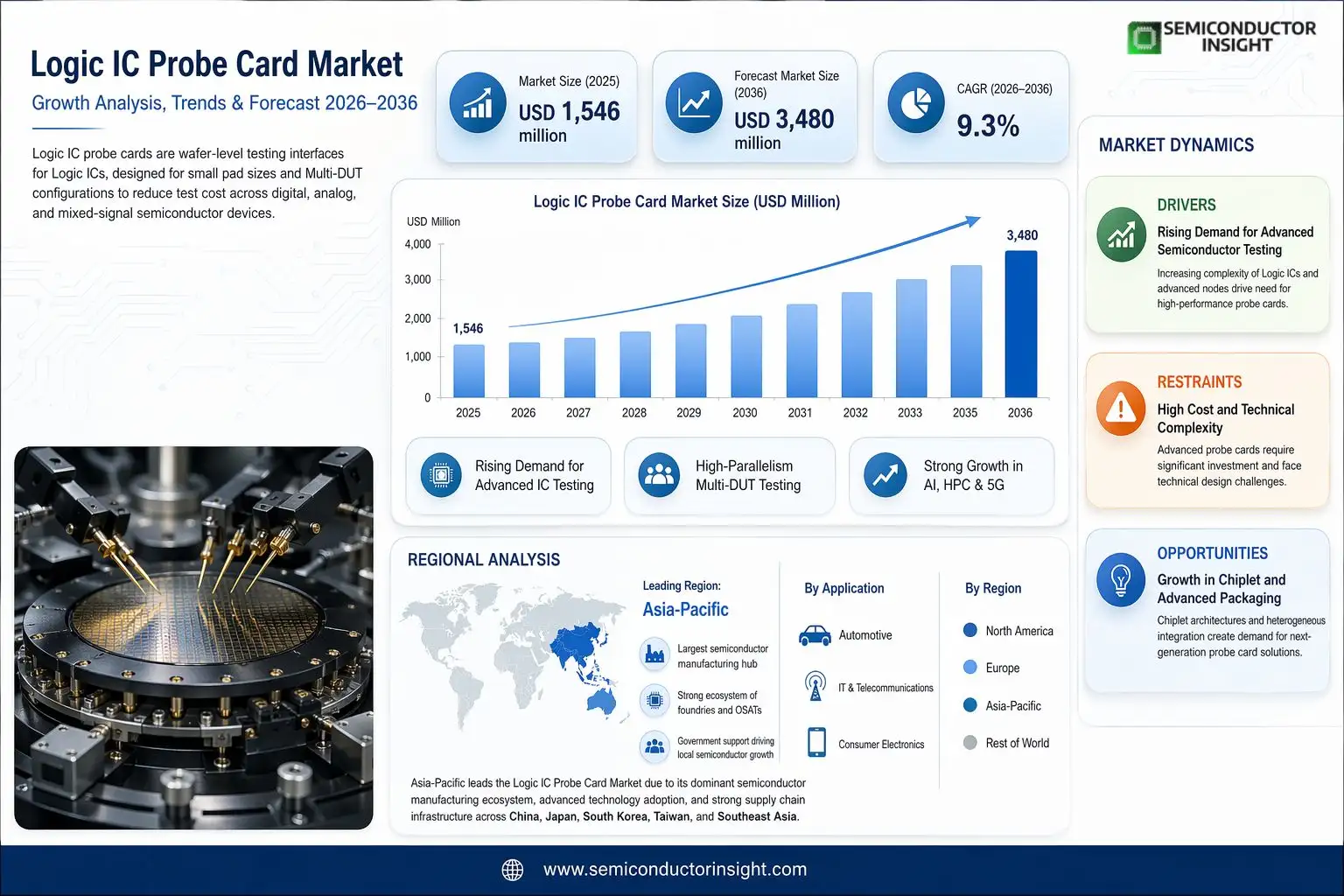
The global Logic IC Probe Card market size was valued at USD 1,546 million in 2025. The market is projected to grow from USD 1,690 million in 2026 to USD 3,480 million by 2036, exhibiting a CAGR of 9.3% during the forecast period.
Logic IC probe cards are specialized testing interfaces used in wafer-level testing, designed to handle small pad sizes and Multi-DUT (Device Under Test) configurations for Logic ICs. These probe cards are engineered to support high parallelism in testing operations, which significantly reduces the overall cost of test. They are broadly produced and deployed for use with digital, analog, and mixed-signal semiconductor devices, making them an essential component in the semiconductor manufacturing and quality assurance process. Key product types within this market include Cantilever Probe Cards, Vertical Probe Cards, and MEMS Probe Cards, each serving distinct testing requirements across varying device complexities and pitch configurations.
The market is witnessing robust growth driven by accelerating semiconductor demand across automotive electronics, IT & telecommunications, and consumer electronics sectors. The rising complexity of Logic ICs , particularly with the proliferation of advanced node chips , necessitates more precise and high-performance probe card solutions. FormFactor, Technoprobe S.p.A., Micronics Japan (MJC), Japan Electronic Materials (JEM), and Will Technology are among the prominent global manufacturers that maintain significant market presence and continue to drive innovation in probe card technology.
MARKET DRIVERS
Rising Demand for Advanced Semiconductor Testing Solutions
Logic IC Probe Card Market is experiencing significant momentum driven by the accelerating complexity of logic integrated circuits across consumer electronics, automotive, and high-performance computing segments. As semiconductor manufacturers transition to sub-7nm and sub-3nm process nodes, the need for highly precise and reliable wafer-level testing has intensified. Probe cards serve as a critical interface between test equipment and semiconductor wafers, and their role in ensuring device performance and yield optimization has become increasingly vital. The surge in production volumes for application processors, FPGAs, and AI accelerator chips is directly fueling procurement cycles for advanced logic IC probe card solutions.
Expansion of AI, HPC, and Data Center Infrastructure
The rapid global expansion of artificial intelligence infrastructure, high-performance computing clusters, and hyperscale data centers has created sustained demand for logic ICs that require rigorous wafer testing. Semiconductor foundries are scaling up capacity to meet orders from cloud service providers and AI hardware developers, driving parallel investment in test and measurement tooling including probe cards. Advanced vertical probe card designs capable of handling high pin counts and fine pitch requirements are seeing particular growth as chip architectures become more complex. This infrastructure-driven demand cycle is expected to remain a primary growth engine for Logic IC Probe Card Market through the coming years.
➤ As chip complexity increases with multi-die integration and chiplet architectures, probe card manufacturers are investing in next-generation designs capable of simultaneously testing hundreds of dies per wafer, significantly improving throughput and reducing overall cost of test.
The proliferation of edge computing devices, 5G network infrastructure components, and automotive-grade logic ICs is further broadening the addressable testing market. Automotive semiconductor content per vehicle has grown considerably, and the stringent reliability requirements of automotive-grade logic chips demand comprehensive wafer-level testing protocols, making advanced probe card technology indispensable across the semiconductor supply chain.
MARKET CHALLENGES
Technical Complexity in Testing Advanced Node Logic ICs
One of the foremost challenges confronting Logic IC Probe Card Market is the escalating technical difficulty of testing logic devices manufactured at advanced process nodes. As transistor densities increase and operating voltages decrease, probe cards must deliver exceptional signal integrity, minimal contact resistance, and precise planarity control. Designing probe cards that maintain consistent electrical performance across thousands of contact cycles at fine-pitch geometries requires significant engineering expertise and materials innovation. Manufacturers must continuously invest in research and development to keep pace with the evolving demands of leading-edge logic IC fabrication, which compresses margins and extends product development timelines.
Other Challenges
High Capital Investment and Cost Pressure
The development and production of logic IC probe cards involve substantial capital expenditure in precision manufacturing equipment, advanced materials such as tungsten and palladium alloy probes, and rigorous quality validation processes. Semiconductor manufacturers and outsourced semiconductor assembly and test providers face ongoing pressure to reduce the cost of test as a percentage of total chip manufacturing cost. This creates a challenging dynamic for probe card suppliers who must balance innovation investment against competitive pricing demands, particularly when serving price-sensitive mid-tier logic IC segments.
Limited Lifespan and Maintenance Requirements
Probe cards are consumable assets with finite operational lifespans determined by contact cycle counts and environmental factors within probe stations. In high-volume manufacturing environments, frequent probe card maintenance, reconditioning, and replacement generate recurring operational costs and potential production disruptions. Managing probe card fleet performance while minimizing downtime presents an ongoing operational challenge for wafer test floor managers, particularly as probe card designs become more intricate and harder to service in the field.
MARKET RESTRAINTS
Supply Chain Constraints and Material Availability
Logic IC Probe Card Market faces meaningful restraints related to the availability and cost of specialized materials required in probe card fabrication. Key materials including advanced ceramic substrates, precision-engineered probe needles, and high-performance PCB laminates are sourced from a concentrated supplier base, creating potential vulnerabilities in the supply chain. Geopolitical factors affecting raw material trade flows and semiconductor supply chain regionalization trends have introduced additional procurement complexity for probe card manufacturers operating on global supply chains.
Consolidation Among Semiconductor Manufacturers Limiting Buyer Base
Ongoing consolidation within the global semiconductor industry has resulted in a more concentrated customer base for logic IC probe card suppliers. A smaller number of large foundries and integrated device manufacturers now account for a disproportionately large share of probe card procurement, increasing buyer bargaining power and intensifying price negotiation pressures. This consolidation dynamic can constrain revenue growth opportunities for probe card vendors and creates dependency risks when key customer relationships experience shifts in technology roadmaps or sourcing strategies. Smaller probe card manufacturers with limited customer diversification are particularly exposed to these structural market restraints.
MARKET OPPORTUNITIES
Growth Potential in Chiplet and Heterogeneous Integration Testing
The transition toward chiplet-based architectures and heterogeneous integration in advanced logic IC design presents a compelling opportunity for Logic IC Probe Card Market. Multi-die packages assembled using advanced packaging technologies such as 2.5D interposers and 3D stacking require innovative wafer-level and package-level test strategies that demand next-generation probe card solutions. Suppliers capable of developing probe cards tailored to the unique electrical and mechanical requirements of chiplet-based logic devices are well-positioned to capture emerging revenue streams as this packaging paradigm gains broader adoption across the semiconductor industry.
Expansion into Emerging Geographic Semiconductor Ecosystems
Government-backed initiatives to establish domestic semiconductor manufacturing capabilities across the United States, Europe, Japan, and India are creating new geographic markets for logic IC probe card suppliers. Greenfield semiconductor fabrication facilities being established under industrial policy programs will require complete test and measurement ecosystems, including probe cards, creating incremental demand beyond existing markets. Probe card manufacturers that proactively establish sales and support infrastructure in these emerging semiconductor geographies stand to benefit from long-term supply relationships as new fabs ramp to volume production. This geographic diversification of semiconductor manufacturing represents one of the most structurally significant medium-term opportunities for Logic IC Probe Card Market.
Adoption of MEMS-Based Probe Card Technology
The increasing adoption of MEMS-based probe card technology offers a significant growth opportunity within the logic IC probe card landscape. MEMS probe cards provide superior planarity, higher pin density, and improved durability compared to conventional cantilever and vertical probe designs, making them well-suited for testing advanced logic ICs at fine pitch geometries. As semiconductor manufacturers advance to increasingly smaller node processes, demand for MEMS-based solutions is anticipated to grow, providing probe card technology innovators with a differentiated product opportunity that commands premium pricing and fosters long-term customer loyalty through technical performance advantages.
Trends
Rising Demand for High-Parallelism Testing Drives Logic IC Probe Card Market
Logic IC Probe Card Market is experiencing sustained growth driven by the increasing complexity of semiconductor devices and the industry-wide push toward higher test efficiency. Logic probe cards, designed specifically for wafer-level testing of logic integrated circuits with small pad sizes and Multi-DUT configurations, have become indispensable tools in modern semiconductor manufacturing. As chipmakers seek to reduce the cost of test while maintaining accuracy across digital, analog, and mixed-signal device categories, the adoption of advanced probe card technologies continues to accelerate. Leading manufacturers such as FormFactor, Technoprobe S.p.A., Micronics Japan (MJC), Japan Electronic Materials (JEM), and Spirox Corporation are actively investing in next-generation probe card solutions to meet evolving industry requirements.
Other Trends
Shift Toward MEMS and Vertical Probe Card Technologies
Among the key product trends shaping Logic IC Probe Card Market, MEMS probe cards and vertical probe cards are gaining considerable traction alongside the traditional cantilever probe card segment. MEMS-based probe cards offer superior pin-count scalability and finer pitch capability, making them well-suited for advanced logic devices manufactured at leading-edge process nodes. Vertical probe cards, known for their high contact precision and durability, are increasingly preferred for high-density logic IC testing applications. This diversification across probe card types reflects the broader industry trend of tailoring test solutions to the specific electrical and mechanical demands of each device category.
Automotive and Consumer Electronics Applications Fueling Market Expansion
Application-level demand within Logic IC Probe Card Market is being significantly shaped by the automotive and consumer electronics sectors. The rapid electrification of vehicles and the proliferation of advanced driver-assistance systems (ADAS) have elevated the requirement for rigorous wafer-level testing of automotive-grade logic ICs. Simultaneously, strong consumer electronics demand , driven by smartphones, wearables, and connected devices , continues to generate high volumes of logic IC production requiring precise probe card testing. The IT and telecommunications segment also contributes meaningfully, particularly with the global rollout of 5G infrastructure and the associated surge in high-frequency logic chip production.
Asia-Pacific Consolidates Its Position as the Dominant Regional Market
From a regional perspective, Asia , encompassing China, Japan, South Korea, and Southeast Asia , remains the dominant geography in Logic IC Probe Card Market. Japan-based manufacturers, including Micronics Japan (MJC) and Japan Electronic Materials (JEM), maintain strong technical leadership, while China-based players such as Shenzhen DGT, Sinowin, and Wuxi JUNR Technology are expanding their domestic market presence. South Korea’s robust semiconductor foundry and fabless ecosystem further reinforces Asia-Pacific’s central role in probe card consumption. North America, led by the United States, remains a key innovation hub, with companies like FormFactor headquartered there and continuing to drive product development across multiple probe card platforms.
Competitive Landscape and Strategic Developments
The competitive environment within Logic IC Probe Card Market is characterized by ongoing technological innovation, strategic partnerships, and capacity expansion initiatives among leading players. The global top five companies collectively held a significant share of total market revenue in 2025, underscoring the moderately consolidated nature of this market. Companies are prioritizing R&D investments to develop probe cards capable of supporting sub-5nm logic device testing, while also exploring opportunities in emerging application areas such as industrial automation and edge computing. As semiconductor supply chains continue to evolve globally, probe card manufacturers are adapting their production and distribution strategies to maintain responsiveness to customer demand across all key regions.
COMPETITIVE LANDSCAPE
Key Industry Players
Logic IC Probe Card Market – Global Competitive Dynamics and Leading Manufacturer Analysis
The global Logic IC Probe Card market, valued at approximately USD 1,546 million in 2025 and projected to reach USD 2,841 million by 2032 at a CAGR of 9.3%, is characterized by a moderately consolidated competitive landscape dominated by a handful of technologically advanced players. FormFactor stands out as the clear market leader, leveraging its broad probe card portfolio spanning cantilever, vertical, and MEMS-based solutions, as well as its established relationships with leading semiconductor foundries and integrated device manufacturers worldwide. Technoprobe S.p.A. represents another dominant force, particularly strong in Europe and Asia, offering high-parallelism probe card platforms specifically engineered for Logic IC wafer testing involving small pad sizes and multi-DUT configurations. Together, the top five global players collectively accounted for a significant share of total market revenue in 2025, reflecting strong brand recognition, deep R&D investment, and expansive global distribution networks as key competitive differentiators in this highly technical industry.
Beyond the market leaders, several specialized and regionally influential players contribute to the competitive intensity of Logic IC Probe Card Market. Micronics Japan (MJC) and Japan Electronic Materials (JEM) maintain robust positions in the Asia-Pacific region, particularly in Japan and South Korea, where semiconductor manufacturing density is among the highest globally. Will Technology and Spirox Corporation serve as notable mid-tier competitors, offering competitive pricing alongside reliable technical performance for digital, analog, and mixed-signal IC testing applications. In China, Shenzhen DGT and Sinowin are rapidly expanding their capabilities to capture domestic semiconductor demand fueled by government-backed initiatives, while Wuxi JUNR Technology and MemsFlex represent emerging innovators pushing boundaries in MEMS probe card development. Grand Junction Semiconductor further rounds out the competitive field with targeted solutions for niche logic IC test environments. Across all tiers, companies are competing on the basis of pin count scalability, thermal stability, probe life cycles, and total cost of test reduction , all critical considerations for automotive, consumer electronics, IT and telecommunications, and industrial end-use applications.
List of Key Logic IC Probe Card Companies Profiled
- FormFactor
- Technoprobe S.p.A.
- Micronics Japan (MJC)
- Japan Electronic Materials (JEM)
- Will Technology
- Spirox Corporation
- Shenzhen DGT
- Sinowin
- Micronics Japan Co., Ltd.
- Grand Junction Semiconductor
- Wuxi JUNR Technology
- MemsFlex
Segment Analysis:
| Segment Category | Sub-Segments | Key Insights |
| By Type |
|
MEMS Probe Card is emerging as the leading and fastest-growing segment within Logic IC Probe Card Market by product type, driven by its superior capability to handle advanced node logic devices that demand extreme precision and ultra-fine pitch contact.
|
| By Application |
|
IT & Telecommunications holds the dominant position in Logic IC Probe Card Market by application, underpinned by the relentless expansion of data center infrastructure, high-performance computing platforms, and next-generation wireless communication networks.
|
| By End User |
|
Outsourced Semiconductor Assembly and Test (OSAT) Providers represent the leading end-user segment in Logic IC Probe Card Market, as the global semiconductor industry increasingly delegates wafer-level testing to specialized third-party service providers to optimize cost efficiency and operational flexibility.
|
| By Technology Node |
|
Leading Edge Node (Below 7nm) is the most strategically important and rapidly expanding segment in Logic IC Probe Card Market when categorized by technology node, as semiconductor manufacturers push the boundaries of miniaturization to deliver next-generation logic performance.
|
| By Signal Type |
|
Mixed Signal is the leading and most technically demanding segment in Logic IC Probe Card Market when categorized by signal type, reflecting the growing prevalence of complex system-on-chip (SoC) designs that integrate both digital and analog functionalities within a single die.
|
Regional Analysis: Logic IC Probe Card Market
Asia-Pacific
Taiwan and South Korea represent the most intensive demand centers within the Asia-Pacific Logic IC Probe Card Market. World-class foundries operating at cutting-edge process nodes require probe cards engineered for ultra-fine pitch and high signal integrity. The continuous advancement toward smaller geometries intensifies requirements for probe card precision, driving sustained procurement cycles and strong relationships between chip manufacturers and specialized probe card suppliers.
China’s semiconductor self-sufficiency initiatives have catalyzed significant investment in domestic logic IC testing capabilities. Government policy frameworks and substantial funding directed at indigenous chip development are accelerating demand for probe card solutions within the country. While import reliance remains, local probe card manufacturers are rapidly maturing, intensifying competitive dynamics and offering new procurement alternatives for domestic integrated circuit producers across Logic IC Probe Card Market.
Japan’s contribution to the Asia-Pacific Logic IC Probe Card Market is rooted in its unrivaled precision engineering culture. Japanese manufacturers supply critical probe card components and complete testing solutions, benefiting from decades of expertise in microfabrication and materials science. As logic IC complexity escalates, Japan’s focus on quality and technological refinement ensures its probe card industry remains strategically relevant to regional and global semiconductor supply chains through the forecast period.
Southeast Asian nations, including Malaysia, Vietnam, and Thailand, are emerging as complementary nodes within the regional Logic IC Probe Card Market ecosystem. Increasing semiconductor assembly and testing operations being relocated or expanded into these markets are creating fresh demand for probe card deployment. As these nations develop more sophisticated back-end semiconductor infrastructure, their collective contribution to regional probe card consumption is expected to expand meaningfully through the coming years.
North America
North America represents a technologically advanced and strategically significant region within the global Logic IC Probe Card Market. The United States, in particular, is home to leading fabless semiconductor companies and a robust ecosystem of chip design firms whose products ultimately require rigorous logic IC testing at manufacturing partners worldwide. Domestic demand for probe card innovation is further shaped by the growing emphasis on semiconductor supply chain resilience, with policy-driven initiatives encouraging the revival of onshore fabrication capacity. As new advanced chip manufacturing facilities come online in states such as Arizona and Ohio, demand for sophisticated probe card solutions is expected to strengthen considerably. Additionally, North America’s leadership in artificial intelligence, data center infrastructure, and automotive electronics sustains a steady pipeline of advanced logic IC designs that place rigorous requirements on probe card performance, accuracy, and reliability across multiple testing generations.
Europe
Europe occupies a distinctive position in Logic IC Probe Card Market, characterized by its concentration of specialized semiconductor applications in automotive electronics, industrial automation, and telecommunications. Germany, the Netherlands, and France anchor the region’s semiconductor ecosystem, with a strong emphasis on reliability-critical logic IC applications that demand stringent testing protocols and high-quality probe card solutions. European chip manufacturers and foundries, while operating at smaller scales compared to Asia-Pacific counterparts, prioritize testing precision and long-term probe card durability aligned with the region’s quality-first manufacturing philosophy. Strategic investments under European semiconductor sovereignty programs are gradually expanding regional fabrication capacity, which in turn is expected to generate incremental demand for advanced Logic IC Probe Card Market participants offering localized technical support and testing expertise tailored to European industry standards and regulatory frameworks.
South America
South America remains a nascent but gradually developing participant in the global Logic IC Probe Card Market. Brazil leads the region’s semiconductor activity, supported by government initiatives aimed at fostering a domestic electronics manufacturing base and reducing reliance on imported integrated circuit solutions. While the region currently lacks large-scale advanced wafer fabrication facilities, growth in electronics assembly, consumer device manufacturing, and telecommunications infrastructure is laying the groundwork for expanded semiconductor testing requirements over the forecast period. As regional investments in technology infrastructure deepen and international semiconductor firms explore South America as a diversification destination, demand for logic IC testing solutions, including probe cards, is anticipated to emerge more meaningfully in the latter stages of the 2026-2036 outlook window.
Middle East & Africa
The Middle East and Africa region currently represents the earliest stage of engagement with Logic IC Probe Card Market, but forward-looking developments signal growing strategic interest. Gulf Cooperation Council nations, particularly Saudi Arabia and the United Arab Emirates, are channeling significant investment into technology and digital infrastructure as part of broader economic diversification agendas. Ambitions to establish semiconductor design centers and attract global technology investment create a long-term foundation for future probe card demand. Africa’s expanding telecommunications and mobile technology sectors contribute indirectly by driving demand for logic integrated circuits sourced from global supply chains. While the region’s direct contribution to Logic IC Probe Card Market volumes remains limited through the near term, its trajectory reflects a market at the cusp of meaningful technological investment and gradual semiconductor ecosystem development.
Report Scope
This market research report provides a comprehensive analysis of Logic IC Probe Card Market, covering the forecast period 2026–2036. It offers detailed insights into market dynamics, technological advancements, competitive landscape, and key trends shaping the industry.
Key focus areas of the report include:
- Market Overview: The report begins with an overview outlining its current market scenario, key growth indicators, and industry transformation drivers. It discusses macroeconomic factors, demand–supply balance, regulatory landscape, and the strategic role of semiconductors in powering advancements across industries such as automotive, telecommunications, consumer electronics, and industrial automation.
- Market Size & Forecast: Historical data and future projections for revenue, unit shipments, and market value across major regions and segments.
- Segmentation Analysis: Detailed breakdown by product type, technology, application, and end-user industry to identify high-growth segments and investment opportunities.
- Regional Insights: Insights into market performance across North America, Europe, Asia-Pacific, Latin America, and the Middle East & Africa, including country-level analysis where relevant.
- Competitive Landscape: Profiles of leading market participants, including their product offerings, R&D focus, manufacturing capacity, pricing strategies, and recent developments such as mergers, acquisitions, and partnerships.
- Technology Trends & Innovation: Assessment of emerging technologies, integration of AI/IoT, semiconductor design trends, fabrication techniques, and evolving industry standards.
- Market Drivers & Restraints: Evaluation of factors driving market growth along with challenges, supply chain constraints, regulatory issues, and market-entry barriers.
- Stakeholder Insights: Insights for component suppliers, OEMs, system integrators, investors, and policymakers regarding the evolving ecosystem and strategic opportunities.
Primary and secondary research methods are employed, including interviews with industry experts, data from verified sources, and real-time market intelligence to ensure the accuracy and reliability of the insights presented.
FREQUENTLY ASKED QUESTIONS:
What is the current market size of Logic IC Probe Card Market?
-> Global Logic IC Probe Card Market was valued at USD 1,546 million in 2025 and is projected to reach USD 2,841 million by 2032, growing at a CAGR of 9.3% during the forecast period.
Which key companies operate in Logic IC Probe Card Market?
-> Key players include FormFactor, Technoprobe S.p.A., Micronics Japan (MJC), Japan Electronic Materials (JEM), Will Technology, Spirox Corporation, Shenzhen DGT, Sinowin, Grand Junction Semiconductor, Wuxi JUNR Technology, and MemsFlex, among others.
What are the key growth drivers?
-> Key growth drivers include rising demand for high-parallelism wafer testing, miniaturization of semiconductor pads, cost reduction in testing processes, and growing adoption of Logic ICs across digital, analog, and mixed-signal applications in industries such as automotive, IT & telecommunications, and consumer electronics.
Which region dominates the market?
-> Asia-Pacific is the fastest-growing region driven by strong semiconductor manufacturing activity in China, Japan, South Korea, and Southeast Asia, while North America remains a significant market with the U.S. being a key contributor.
What are the emerging trends?
-> Emerging trends include advancements in MEMS Probe Card technology, increasing adoption of Vertical Probe Cards for fine-pitch applications, high-parallelism Multi-DUT testing solutions, and integration of probe card technologies for mixed-signal and advanced Logic IC testing.

Get Sample Report PDF for Exclusive Insights
Report Sample Includes
- Table of Contents
- List of Tables & Figures
- Charts, Research Methodology, and more...
 Download Sample Report PDF