Logarithmic RF Power Detectors Market Insights
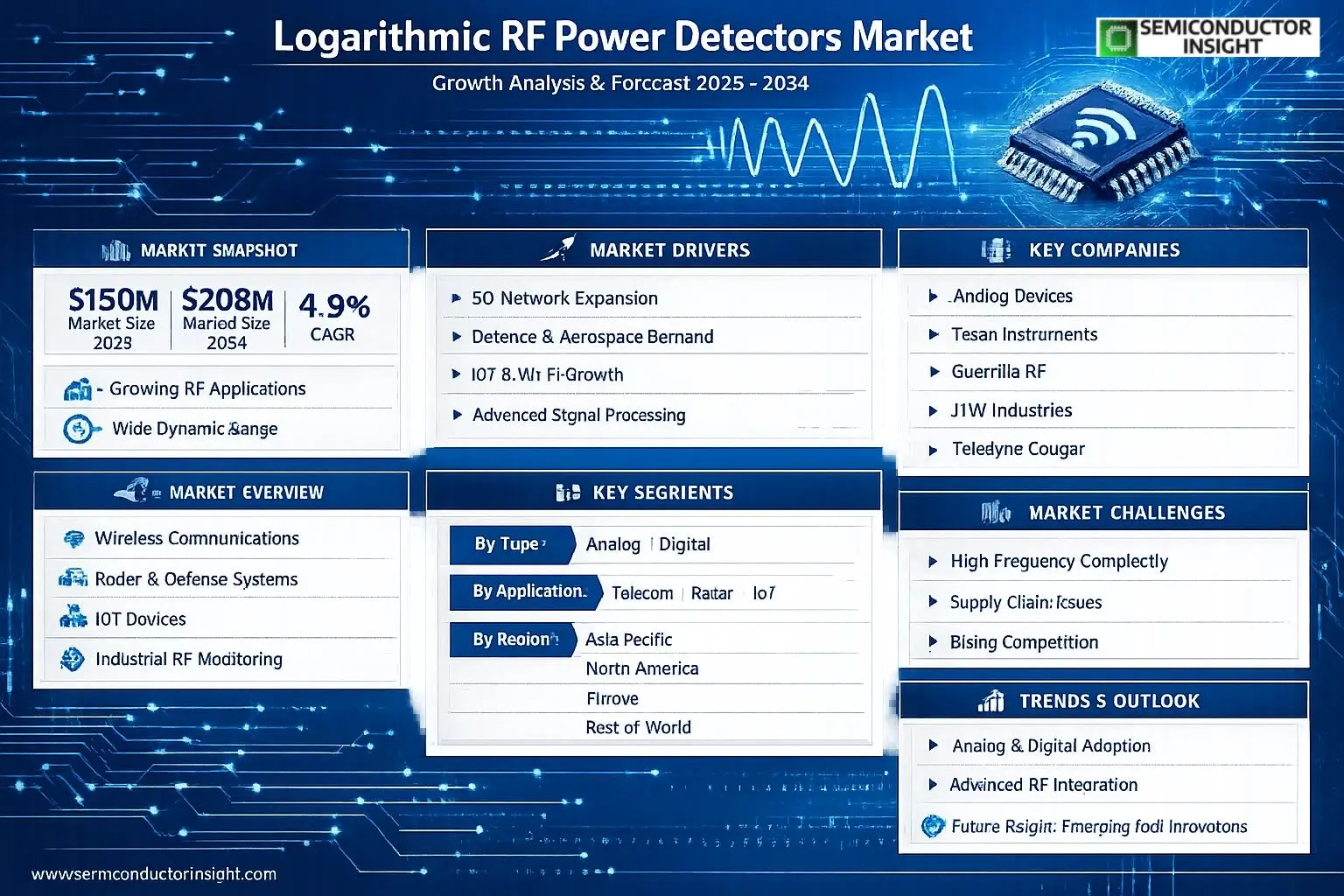
Global Logarithmic RF Power Detectors market size was valued at USD 150 million in 2025. The market is projected to grow from USD 157.4 million in 2026 to USD 208 million by 2034, exhibiting a CAGR of 4.9% during the forecast period.
Logarithmic RF Power Detectors are precision electronic devices designed to measure and monitor signal power across a logarithmic scale, delivering accurate output proportional to the logarithm of the input signal’s power level. These detectors are particularly valuable in applications where signal amplitude varies widely, such as in wireless communication systems, RF circuits, and advanced signal processing environments. By providing a logarithmic response, they enable reliable power measurements across a broad dynamic range, ensuring consistent performance even in conditions with rapidly fluctuating signal strengths. The core product types in this market include Analog and Digital variants, each serving distinct application needs across sectors such as Wireless Communications, Radar Systems, and other emerging end-use industries.
The market is experiencing steady growth driven by escalating demand for precision RF measurement components in next-generation wireless infrastructure, defense electronics, and industrial RF systems. Global rollout of 5G networks and the expansion of radar-based sensing technologies have significantly amplified the need for high-performance logarithmic detection solutions. Furthermore, continued innovation by key market participants — including Analog Devices, Texas Instruments, Guerrilla RF, JFW Industries, RF Bay, Teledyne Cougar, and Pasternack — is accelerating product development and broadening the application landscape for Logarithmic RF Power Detectors globally.
MARKET DRIVERS
Surging Demand from 5G Infrastructure Deployment
The rapid global rollout of 5G telecommunications infrastructure stands as one of the most significant forces propelling Logarithmic RF Power Detectors Market forward. As mobile network operators invest heavily in expanding their 5G base station networks, the need for precise power measurement components has grown substantially. Logarithmic RF power detectors are critical in base transceiver stations, small cells, and massive MIMO antenna arrays, where accurate signal level monitoring ensures optimal network performance and regulatory compliance. The transition from 4G LTE to 5G NR introduces broader frequency ranges and more complex signal modulation schemes, making logarithmic detection technology indispensable.
Expanding Applications in Defense and Aerospace Electronics
Defense modernization programs across North America, Europe, and Asia-Pacific continue to drive robust demand within Logarithmic RF Power Detectors Market. Electronic warfare systems, radar signal processors, satellite communication terminals, and military-grade transceivers all depend on high-accuracy logarithmic detectors capable of functioning reliably across wide dynamic ranges and harsh operating environments. Governments worldwide are allocating increased budgets toward next-generation radar and communications systems, directly benefiting suppliers of precision RF components. The ability of logarithmic detectors to deliver consistent output over temperature extremes and across multi-octave frequency bands makes them a preferred solution in mission-critical defense electronics.
➤ The integration of logarithmic RF power detectors in phased-array radar and electronic countermeasure systems is accelerating as defense agencies prioritize spectrum awareness and signal intelligence capabilities in contested electromagnetic environments.
Beyond 5G and defense, the proliferation of connected devices within the Internet of Things (IoT) ecosystem and the expansion of Wi-Fi 6/6E networks are creating additional growth vectors for Logarithmic RF Power Detectors Market. Industrial wireless sensors, smart meters, and consumer electronics platforms increasingly require embedded RF power management functions to optimize transmit power, extend battery life, and meet electromagnetic compatibility standards. This broad horizontal adoption across multiple end-use sectors reinforces sustained demand momentum and encourages semiconductor manufacturers to develop more compact, power-efficient logarithmic detector integrated circuits.
MARKET CHALLENGES
Technical Complexity in Wideband and Millimeter-Wave Frequency Operation
One of the foremost challenges confronting Logarithmic RF Power Detectors Market is the engineering difficulty associated with achieving accurate logarithmic detection performance at millimeter-wave frequencies, particularly in the 24 GHz to 77 GHz bands increasingly relevant to 5G mmWave and automotive radar applications. At these frequencies, parasitic effects, substrate losses, and device matching become significantly more complex, requiring advanced semiconductor processes such as SiGe BiCMOS or GaAs to maintain acceptable dynamic range and temperature stability. The cost of developing and qualifying these advanced-node components places meaningful financial pressure on smaller design houses and limits the number of suppliers capable of competing at the high-frequency frontier of the market.
Other Challenges
Supply Chain Vulnerabilities and Component Availability
Global RF semiconductor supply chain remains susceptible to disruptions stemming from geopolitical tensions, export control regulations, and concentration of advanced fabrication capacity in a limited number of foundries. Manufacturers of logarithmic RF power detectors that rely on specialized compound semiconductor processes face extended lead times and capacity constraints, particularly during periods of peak demand across the broader electronics industry. These supply-side pressures can delay product launches and create inventory management challenges for system integrators operating on tight development schedules.
Increasing Design-In Competition from Alternative Power Detection Architectures
Logarithmic RF Power Detectors Market faces growing competitive pressure from alternative signal power measurement approaches, including RMS power detectors and digital signal processing-based power estimation techniques embedded within modern modem chipsets. As digital processing capabilities advance and become more cost-effective, system designers in some applications may opt for software-defined power monitoring approaches that reduce reliance on dedicated analog logarithmic detector components. Addressing this challenge requires continuous innovation in logarithmic detector performance metrics such as frequency coverage, temperature compensation accuracy, and integration level to maintain design-win competitiveness.
MARKET RESTRAINTS
Stringent Calibration Requirements and Integration Complexity
A notable restraint affecting Logarithmic RF Power Detectors Market is the demanding calibration and compensation procedures required to achieve datasheet-specified accuracy across the full operating temperature range and input frequency bandwidth. In production environments, comprehensive calibration routines add to manufacturing cycle time and cost, potentially limiting the adoption of logarithmic RF power detector solutions in highly cost-sensitive, high-volume consumer applications. Design engineers must invest considerable effort in board-level layout optimization, decoupling strategies, and firmware-based correction algorithms to extract the full performance potential of logarithmic detector devices, raising barriers to entry for teams with limited RF expertise.
Price Sensitivity in High-Volume Consumer and Industrial Segments
While defense and telecommunications infrastructure segments can absorb premium component pricing, Logarithmic RF Power Detectors Market faces meaningful price compression in consumer wireless and industrial IoT application areas. Original equipment manufacturers targeting mass-market products exert consistent downward pressure on component bill-of-materials costs, compelling logarithmic detector suppliers to optimize die size, streamline packaging, and achieve higher fabrication yields without compromising performance. This dynamic constrains gross margin expansion for semiconductor vendors and necessitates ongoing investment in process technology and design efficiency to remain competitive across both performance-driven and cost-driven market segments simultaneously.
MARKET OPPORTUNITIES
Growth Potential in Automotive Radar and Vehicle-to-Everything Communication Systems
The accelerating adoption of advanced driver assistance systems and the progressive development of autonomous vehicle platforms present a compelling growth opportunity for Logarithmic RF Power Detectors Market. Automotive radar systems operating in the 77 GHz and 79 GHz frequency bands require precise transmit power monitoring and receive signal strength measurement to ensure reliable object detection and regulatory compliance with regional spectrum authorities. As global automotive safety regulations increasingly mandate radar-based collision avoidance features across vehicle segments, demand for automotive-grade logarithmic RF power detectors that satisfy AEC-Q100 qualification standards and stringent reliability requirements is expected to expand considerably over the coming years.
Emerging Opportunities in Satellite Connectivity and Low Earth Orbit Networks
The emergence of large-scale low Earth orbit satellite constellations designed to deliver broadband internet access globally represents a significant emerging opportunity within Logarithmic RF Power Detectors Market. User terminals and gateway ground stations for LEO satellite networks require sophisticated RF front-end power management, including accurate transmit power control across Ku-band, Ka-band, and V-band frequencies. The large number of terminals being deployed as part of commercial LEO broadband initiatives translates into substantial volume demand for compact, integrated logarithmic detector solutions. Semiconductor suppliers that can demonstrate performance leadership at these higher microwave and millimeter-wave frequencies while meeting the cost targets of commercial satellite terminal manufacturers stand to capture meaningful incremental market share.
Integration with Advanced Semiconductor Packaging and System-in-Package Modules
Advances in heterogeneous integration techniques, including system-in-package and wafer-level packaging technologies, are creating new design opportunities for embedding logarithmic RF power detector functionality directly within multi-chip RF front-end modules. This trend toward higher integration enables original equipment manufacturers to reduce board space, improve signal path performance, and simplify supply chain management by sourcing fully integrated RF subsystems. For Logarithmic RF Power Detectors Market participants with the semiconductor design capability and foundry partnerships to participate in integrated module programs, this trend represents a strategic opportunity to deepen customer relationships, secure longer-term design wins, and differentiate from commodity discrete component competitors.
Logarithmic RF Power Detectors Market Trends
Rising Demand from Wireless Communications Driving Market Expansion
Logarithmic RF Power Detectors Market is witnessing significant momentum, largely driven by the accelerating global rollout of advanced wireless communication infrastructure. As 5G networks continue to expand across North America, Europe, and Asia-Pacific, the need for precise RF power measurement has intensified. Logarithmic RF power detectors offer a wide dynamic range and accurate power monitoring capabilities, making them indispensable in base stations, repeaters, and signal conditioning systems. Wireless communications currently represent the dominant application segment within Logarithmic RF Power Detectors Market, and this trend is expected to persist as telecom operators invest heavily in network densification and capacity upgrades.
Other Trends
Growing Integration in Radar and Defense Systems
Defense and aerospace sectors are emerging as high-growth application areas for logarithmic RF power detectors. Modern radar systems — including phased array and AESA (Active Electronically Scanned Array) radars — require highly reliable power detection components to ensure signal integrity across wide frequency bands. Logarithmic detectors enable real-time monitoring of transmitted and received power levels, which is critical for target detection accuracy and system safety. Increased defense budgets in the United States, Germany, India, and several Middle Eastern nations are fueling procurement of advanced radar systems, indirectly boosting demand within Logarithmic RF Power Detectors Market.
Analog vs. Digital Segment Dynamics
The product landscape of Logarithmic RF Power Detectors Market is segmented into analog and digital variants. Analog logarithmic detectors continue to hold a substantial share owing to their simplicity, low latency, and cost-effectiveness in high-frequency applications. However, digital logarithmic detectors are gaining traction in applications requiring enhanced programmability, improved accuracy, and compatibility with digital signal processing platforms. Key manufacturers such as Analog Devices and Texas Instruments are actively investing in next-generation product development across both segments, further shaping competitive dynamics in this market.
Asia-Pacific Emerging as a Strategic Growth Region
From a regional standpoint, Asia-Pacific — particularly China, Japan, South Korea, and India — is establishing itself as a pivotal growth hub for Logarithmic RF Power Detectors Market. Rapid industrialization, expanding telecommunications infrastructure, and growing domestic semiconductor manufacturing capabilities are key factors contributing to this regional momentum. China’s aggressive investment in 5G deployment and indigenous RF component production has prompted both local and global manufacturers to strengthen their supply chain presence in the region. Meanwhile, North America retains its position as a technology leader, supported by strong R&D activities and the presence of established players such as Guerrilla RF, Teledyne Cougar, and Pasternack, all of whom continue to introduce application-specific logarithmic RF power detector solutions to address evolving end-user requirements.
COMPETITIVE LANDSCAPE
Key Industry Players
Logarithmic RF Power Detectors Market , Competitive Dynamics, Leading Innovators, and Strategic Positioning
Global Logarithmic RF Power Detectors market is characterized by moderate-to-high competitive intensity, with a handful of established semiconductor and RF component manufacturers commanding significant revenue shares. Analog Devices, Inc. stands out as a dominant force in this space, leveraging its broad portfolio of high-performance RF and mixed-signal integrated circuits to serve applications spanning wireless communications, radar systems, and instrumentation. Texas Instruments similarly holds a strong position, offering a wide range of logarithmic amplifier and power detector ICs that cater to both analog and digital segments of the market. These leading players benefit from extensive R&D investments, robust global distribution networks, and long-standing relationships with OEMs and system integrators across North America, Europe, and Asia-Pacific. The top five global players collectively accounted for a substantial share of the market’s estimated USD 150 million valuation in 2025, underscoring the oligopolistic nature of competition at the high-performance end of the spectrum. Ongoing trends such as the expansion of 5G wireless infrastructure, increased deployment of phased-array radar systems, and growing demand for precise power management in IoT devices continue to intensify competitive pressure and drive product innovation cycles across the industry.
Beyond the market leaders, a number of specialized and niche players contribute meaningfully to the competitive ecosystem of Logarithmic RF Power Detectors Market. Guerrilla RF has carved out a notable presence through its focus on high-efficiency RF semiconductors tailored for demanding wireless communication environments. Teledyne Cougar brings deep expertise in microwave and millimeter-wave components, serving defense and aerospace applications where logarithmic detection accuracy is mission-critical. JFW Industries and Pasternack are well-regarded for their extensive catalogs of RF/microwave components, including power detectors and related assemblies, and maintain competitive advantages through rapid prototyping capabilities and broad product availability. RF Bay rounds out the competitive picture by offering cost-effective, application-specific RF power detector solutions targeting both commercial and research markets. Collectively, these players compete on parameters including dynamic range, frequency coverage, temperature stability, package form factor, and integration capability, while also differentiating through customer support, customization services, and supply chain reliability — factors that are increasingly critical as end-market applications grow in complexity and performance demands.
List of Key Logarithmic RF Power Detectors Companies Profiled
- Analog Devices, Inc.
- Texas Instruments
- Guerrilla RF
- JFW Industries
- RF Bay, Inc.
- Teledyne Cougar
- Pasternack Enterprises
- Maxim Integrated (now part of Analog Devices)
- Broadcom Inc.
- Qorvo, Inc.
- Skyworks Solutions, Inc.
- NXP Semiconductors
- Infineon Technologies AG
- Mini-Circuits
- API Technologies
Segment Analysis:
| Segment Category | Sub-Segments | Key Insights |
| By Type |
|
Analog
|
| By Application |
|
Wireless Communications
|
| By End User |
|
Telecommunications
|
| By Frequency Range |
|
DC to 6 GHz
|
| By Package Type |
|
Surface Mount (SMT)
|
Regional Analysis: Logarithmic RF Power Detectors Market
North America
Robust demand from defense and aerospace sectors fuels the market, with emphasis on reliable power detection for mission-critical systems. Telecommunications infrastructure upgrades prioritize detectors for signal integrity in dense networks. Innovation hubs drive R&D, enhancing detector responsiveness for emerging RF applications.
Supply chain vulnerabilities pose risks amid global semiconductor dependencies. Intense competition demands continuous differentiation through superior performance metrics. Regulatory compliance for high-frequency emissions adds complexity to product development cycles.
Expansion into IoT and automotive sectors offers new avenues, leveraging detectors for precise power management. Partnerships with software firms enable AI-enhanced monitoring solutions. Growth in private 5G networks creates demand for scalable RF detection technologies.
Integration of logarithmic detectors with machine learning for predictive maintenance gains traction. Miniaturization trends support wearable and portable RF devices. Sustainability efforts promote energy-efficient designs in line with green technology initiatives.
Europe
Europe exhibits steady growth in Logarithmic RF Power Detectors Market, underpinned by stringent regulatory frameworks and a focus on industrial automation. The region’s automotive and broadcasting industries drive adoption, valuing detectors for their wide dynamic range in radar and wireless systems. Business strategies emphasize sustainability, with manufacturers developing eco-friendly production processes. Key trends include harmonization of standards across member states, facilitating cross-border deployments. Challenges arise from fragmented supply chains, yet opportunities emerge in renewable energy projects requiring precise RF monitoring. Overall, Europe’s market dynamics highlight balanced innovation and compliance-driven advancements.
Asia-Pacific
Asia-Pacific emerges as a dynamic hub in Logarithmic RF Power Detectors Market, propelled by rapid electronics manufacturing expansion. Telecom infrastructure buildouts and consumer device proliferation intensify demand for cost-effective, high-performance detectors. Business strategies revolve around vertical integration and scale economies, enabling competitive pricing. Trends point to 5G rollouts and smart city initiatives, where detectors ensure optimal signal power control. Geopolitical shifts influence supply dynamics, but local R&D investments mitigate risks, positioning the region for accelerated market penetration.
South America
South America shows promising potential in Logarithmic RF Power Detectors Market, with growth tied to telecom liberalization and digital inclusion efforts. Emerging applications in broadcasting and oil exploration favor rugged detectors for harsh environments. Business strategies focus on import substitution and local assembly to reduce costs. Infrastructure investments create opportunities, though economic volatility presents hurdles. Trends lean toward mobile network enhancements, driving demand for reliable RF power measurement solutions.
Middle East & Africa
The Middle East & Africa region advances in Logarithmic RF Power Detectors Market through telecom expansions and defense modernizations. Satellite communications and smart infrastructure projects underscore the need for versatile detectors. Business strategies prioritize public-private partnerships for technology transfer. Oil and gas sectors adopt detectors for remote monitoring. Challenges include infrastructure gaps, yet diversification initiatives foster opportunities. Trends emphasize resilient RF solutions for extreme climates, supporting regional connectivity goals.
Report Scope
This market research report provides a comprehensive analysis of Logarithmic RF Power Detectors Market, covering the forecast period 2026–2034. It offers detailed insights into market dynamics, technological advancements, competitive landscape, and key trends shaping the industry.
Key focus areas of the report include:
- Market Overview: The report begins with an overview outlining its current market scenario, key growth indicators, and industry transformation drivers. It discusses macroeconomic factors, demand–supply balance, regulatory landscape, and the strategic role of semiconductors in powering advancements across industries such as automotive, telecommunications, consumer electronics, and industrial automation.
- Market Size & Forecast: Historical data and future projections for revenue, unit shipments, and market value across major regions and segments.
- Segmentation Analysis: Detailed breakdown by product type, technology, application, and end-user industry to identify high-growth segments and investment opportunities.
- Regional Insights: Insights into market performance across North America, Europe, Asia-Pacific, Latin America, and the Middle East & Africa, including country-level analysis where relevant.
- Competitive Landscape: Profiles of leading market participants, including their product offerings, R&D focus, manufacturing capacity, pricing strategies, and recent developments such as mergers, acquisitions, and partnerships.
- Technology Trends & Innovation: Assessment of emerging technologies, integration of AI/IoT, semiconductor design trends, fabrication techniques, and evolving industry standards.
- Market Drivers & Restraints: Evaluation of factors driving market growth along with challenges, supply chain constraints, regulatory issues, and market-entry barriers.
- Stakeholder Insights: Insights for component suppliers, OEMs, system integrators, investors, and policymakers regarding the evolving ecosystem and strategic opportunities.
Primary and secondary research methods are employed, including interviews with industry experts, data from verified sources, and real-time market intelligence to ensure the accuracy and reliability of the insights presented.
FREQUENTLY ASKED QUESTIONS:
What is the current market size of Logarithmic RF Power Detectors Market?
-> Logarithmic RF Power Detectors Market was valued at USD 150 million in 2025 and is expected to reach USD 208 million by 2034, at a CAGR of 4.9%.
Which key companies operate in Logarithmic RF Power Detectors Market?
-> Key players include Analog Devices, Texas Instruments, Guerrilla RF, JFW Industries, RF Bay, Teledyne Cougar, Pasternack, among others.
What are the key growth drivers?
-> Key growth drivers include demand from wireless communication systems, radar systems, and applications requiring wide dynamic range power measurements.
Which region dominates the market?
-> North America is a dominant market, while Asia shows strong growth potential.
What are the emerging trends?
-> Emerging trends include logarithmic response for fluctuating signal strengths, integration in RF circuits and signal processing, and advancements in Analog and Digital types.

Get Sample Report PDF for Exclusive Insights
Report Sample Includes
- Table of Contents
- List of Tables & Figures
- Charts, Research Methodology, and more...