Livestock Monitoring Semiconductor Market Insights
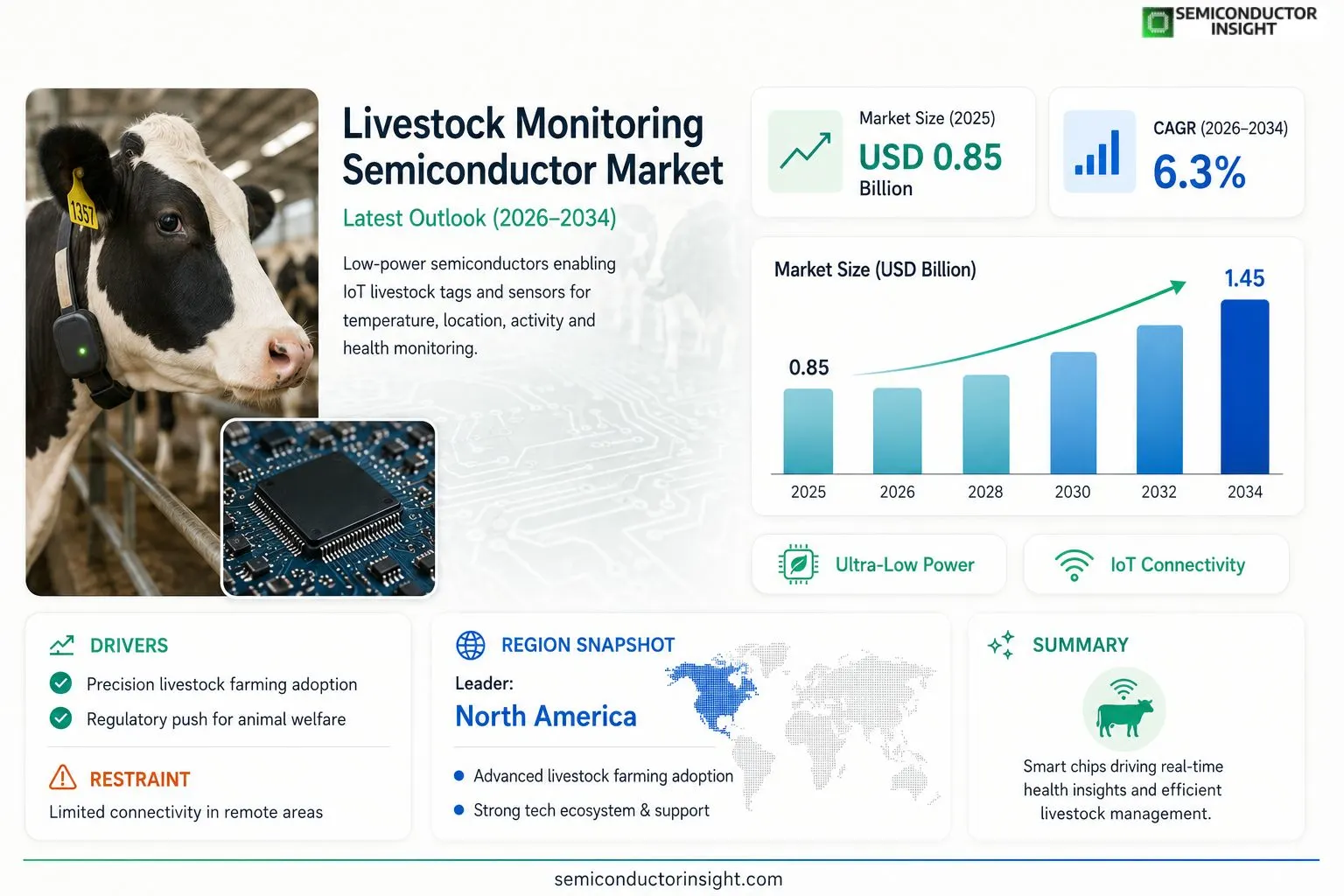
Global Livestock Monitoring Semiconductor Market size was valued at USD 0.85 billion in 2025. The market is projected to grow from USD 0.90 billion in 2026 to USD 1.45 billion by 2034, exhibiting a CAGR of 6.3% during the forecast period.
Livestock monitoring semiconductors are low‑power integrated circuits designed for IoT‑enabled tags, RFID readers, and on‑animal sensor platforms that capture temperature, location, activity and physiological signals in real time.The market is experiencing rapid growth because precision farming practices are expanding worldwide, driven by rising demand for animal welfare compliance and feed‑efficiency optimization. Furthermore, government subsidies for smart agriculture and strategic partnerships,such as Allflex’s collaboration with Bosch Sensortec on ultra‑low‑energy chips,are accelerating adoption across dairy and beef sectors.
MARKET DRIVERS
Growing Adoption of IoT‑Enabled Precision Livestock Farming
Livestock Monitoring Semiconductor Market is being propelled by the rapid integration of IoT platforms that enable continuous tracking of animal vitals, location, and behavior. Farmers are leveraging low‑power, high‑performance chips to collect granular data, which translates into improved feed efficiency and reduced mortality rates.
Regulatory Incentives for Animal Welfare
Governments across major livestock‑producing regions are introducing standards that require real‑time health monitoring, creating a mandate for semiconductor solutions that can meet stringent data accuracy and latency requirements. This regulatory push is accelerating investments in sensor‑rich ecosystems.
➤ “Advanced semiconductor sensors are now the backbone of sustainable livestock management, delivering actionable insights that were previously unattainable.”
Collectively, these drivers are expanding the addressable market, prompting both established chip manufacturers and emerging startups to develop energy‑efficient, ruggedized solutions tailored for harsh farm environments.
MARKET CHALLENGES
High Initial Capital Expenditure for Farm‑Scale Deployment
While the technology offers long‑term savings, the upfront cost of outfitting large herds with semiconductor‑based monitoring devices remains a significant barrier for small‑to‑medium producers, limiting rapid market penetration.
Other Challenges
Data Integration Complexity
Farm management systems must aggregate heterogeneous data streams from multiple sensor vendors, requiring robust middleware and standardized protocols, which adds to implementation difficulty.
MARKET RESTRAINTS
Limited Connectivity in Remote Rural Areas
Many livestock operations are located in regions with poor cellular or broadband coverage, restricting the real‑time transmission capabilities of semiconductor monitoring devices and curbing their effectiveness.Furthermore, the reliance on battery‑powered sensors creates maintenance challenges, as frequent battery replacements can be impractical in extensive grazing lands.These infrastructure constraints act as a restraint on the broader adoption of advanced monitoring solutions, prompting manufacturers to explore alternative energy harvesting techniques.
MARKET OPPORTUNITIES
Emergence of Edge‑AI Enabled Semiconductor Platforms
Integrating lightweight AI algorithms directly onto chips allows on‑device anomaly detection, reducing reliance on cloud processing and enhancing response times for health alerts.The development of ultra‑low‑power, solar‑recharged modules opens new possibilities for off‑grid deployments, addressing connectivity and power challenges simultaneously.Additionally, partnerships between semiconductor firms and agritech service providers are creating bundled solutions that combine hardware, analytics, and advisory services, unlocking new revenue streams within Livestock Monitoring Semiconductor Market.
Livestock Monitoring Semiconductor Market Trends
Growth of Low-Power Integrated Circuits
Livestock Monitoring Semiconductor Market is being reshaped by the rapid diffusion of ultra‑low‑power integrated circuits that enable continuous, real‑time data capture from animal‑borne tags. These semiconductors power IoT‑enabled devices such as temperature sensors, GPS modules, and activity monitors while maintaining battery life measured in years. As precision farming expands, producers are increasingly relying on these devices to optimize feed efficiency, detect early health issues, and comply with animal‑welfare standards. The technology’s small footprint also supports deployment on a wide range of species, from dairy cattle to small ruminants, facilitating ecosystem‑wide monitoring without extensive infrastructure upgrades. Moreover, the ability to embed diagnostic algorithms directly on the chip allows for edge processing of physiological signals, reducing transmission latency and bandwidth consumption. Farmers benefit from actionable insights delivered via mobile dashboards, which translate raw sensor streams into trend analyses for breeding decisions and disease prevention. This convergence of hardware miniaturization and data analytics is positioning the sector as a cornerstone of sustainable livestock management.
Other Trends
Integration with RFID and Sensor Networks
The integration of these chips with RFID readers creates a seamless data pipeline that can be accessed through cloud platforms or farm‑level dashboards. By embedding the semiconductor directly into the tag antenna, manufacturers achieve reliable read ranges even in dense barn environments, where metal structures and animal movement previously hampered signal integrity. Low energy consumption reduces the need for frequent battery replacement, which translates into lower operational costs and less animal disturbance. In addition, built‑in encryption modules protect the transmitted health metrics, ensuring data privacy for producers who share information with veterinary service providers. Scalability is further enhanced by mesh‑network protocols that allow thousands of tags to communicate simultaneously without overwhelming the gateway bandwidth. Consequently, farmers can aggregate temperature, location, and motion data to generate predictive models that improve herd health management, optimize grazing patterns, and reduce waste associated with over‑feeding.
Strategic Partnerships and Regulatory Momentum
Strategic collaborations between semiconductor firms and agricultural equipment manufacturers are accelerating the rollout of intelligent tagging solutions. Recent joint development programs have focused on ultra‑low‑energy architectures that meet stringent power‑budget requirements for long‑term animal monitoring. In parallel, government incentive schemes aimed at modernizing livestock production are encouraging small‑scale operations to adopt these technologies, widening market reach beyond large commercial farms. Industry analysts also note that forthcoming regulatory frameworks on animal‑welfare data reporting are likely to mandate traceability, which will further drive demand for secure, chip‑based monitoring devices. Looking ahead, the convergence of edge‑computing capabilities with advanced semiconductors is expected to enable on‑device analytics, reducing reliance on external data networks and opening new avenues for autonomous health alerts. As AI algorithms become embedded within the sensor firmware, farms will gain the ability to trigger real‑time interventions such as targeted medication delivery or automatic environmental adjustments, cementing the role of semiconductors as the backbone of next‑generation livestock management.
COMPETITIVE LANDSCAPEKey Industry Players
Livestock Monitoring Semiconductor Market Competitive Landscape
Livestock Monitoring Semiconductor Market is dominated by a handful of global semiconductor firms that have built ultra‑low‑power integrated circuits for IoT‑enabled animal tags. Allflex, leveraging its extensive RFID expertise, leads the segment through a strategic alliance with Bosch Sensortec, which supplies the ultra‑low‑energy sensor cores that power on‑animal temperature and activity modules. This partnership exemplifies the consolidation trend where device manufacturers partner with chipset specialists to accelerate time‑to‑market. Parallel to Allflex‑Bosch, STMicroelectronics and Texas Instruments provide broadly compatible MCU families that enable multi‑sensor fusion, while NXP Semiconductors offers secure connectivity solutions that address data‑privacy concerns in large‑scale livestock deployments. The market structure is thus characterized by a core of vertically integrated players complemented by specialist chipmakers that supply power‑optimized analog front‑ends and radio modules.Beyond the core tier, several niche innovators are gaining traction in specific sub‑segments. Infineon Technologies and Analog Devices focus on ruggedized power‑management ICs that extend battery life in remote pasture environments. AMS AG supplies precision optical sensors for biometric monitoring, and Sensirion delivers calibrated humidity and temperature sensors that enhance health analytics. Smaller firms such as Microchip Technology and Renesas Electronics contribute cost‑effective 32‑bit microcontrollers for low‑volume dairy operations, while ON Semiconductor and Skyworks Solutions provide high‑performance RF front‑ends for long‑range RFID readers. Collectively, these companies enrich the ecosystem, driving incremental performance gains and supporting the diversified needs of precision farming stakeholders.
List of Key Livestock Monitoring Semiconductor Companies Profiled
- Allflex
- Bosch Sensortec
- STMicroelectronics
- Texas Instruments
- NXP Semiconductors
- Infineon Technologies
- Analog Devices
- AMS AG
- Sensirion
- Microchip Technology
- Renesas Electronics
- ON Semiconductor
- Skyworks Solutions
Segment Analysis:
| Segment Category | Sub-Segments | Key Insights |
| By Type |
|
Ultra‑Low‑Energy Sensors
|
| By Application |
|
Health Monitoring
|
| By End User |
|
Dairy Farms
|
| By Connectivity |
|
LPWAN Solutions
|
| By Power Management |
|
Energy Harvesting Modules
|
Regional Analysis: North America
North America
The integration of advanced sensor technologies and data analytics is key to progress in livestock monitoring. This includes innovations in wearable devices and remote monitoring platforms designed to track animal health parameters effectively.
Evolving regulations concerning animal welfare and food safety are significantly influencing market dynamics, pushing for more sophisticated and reliable livestock monitoring solutions.
Strategic collaborations between semiconductor manufacturers and agricultural technology providers are shaping the competitive landscape, fostering innovation and market penetration.
The rising demand for higher meat and dairy production, coupled with concerns about animal well-being, are key drivers fueling investment in livestock monitoring semiconductor technology within North America.
Europe
The European Livestock Monitoring Semiconductor Market is characterized by a strong focus on sustainability and ethical farming practices. Stringent environmental regulations and growing consumer awareness are driving demand for technologies that optimize resource use and minimize animal stress. The market is witnessing a significant increase in the adoption of AI-powered solutions for real-time health monitoring and disease prevention in livestock.
Asia-Pacific
Asia-Pacific represents a rapidly expanding market for livestock monitoring semiconductors, spurred by the increasing demand for animal protein in countries like China and India. Government initiatives promoting modern agriculture and the adoption of digital technologies are contributing to market growth. The focus is on cost-effective solutions suitable for large-scale farming operations.
South America
South America’s livestock sector is a major contributor to the global meat and dairy supply, presenting a significant opportunity for livestock monitoring semiconductor solutions. The region is witnessing a gradual adoption of technology, with a focus on improving herd management and productivity in vast grazing lands.
Middle East & Africa
The Middle East and Africa offer a growing market for livestock monitoring semiconductors, particularly in countries with expanding livestock industries. The demand for improved animal health and traceability is driving adoption, with an increasing focus on solutions that can withstand harsh environmental conditions.
Report Scope
This market research report provides a comprehensive analysis of the Livestock Monitoring Semiconductor Market , covering the forecast period 2026–2034. It offers detailed insights into market dynamics, technological advancements, competitive landscape, and key trends shaping the industry.
Key focus areas of the report include:
- Market Overview: The report begins with an overview outlining its current market scenario, key growth indicators, and industry transformation drivers. It discusses macroeconomic factors, demand–supply balance, regulatory landscape, and the strategic role of semiconductors in powering advancements across industries such as automotive, telecommunications, consumer electronics, and industrial automation.
- Market Size & Forecast: Historical data and future projections for revenue, unit shipments, and market value across major regions and segments.
- Segmentation Analysis: Detailed breakdown by product type, technology, application, and end-user industry to identify high-growth segments and investment opportunities.
- Regional Insights: Insights into market performance across North America, Europe, Asia-Pacific, Latin America, and the Middle East & Africa, including country-level analysis where relevant.
- Competitive Landscape: Profiles of leading market participants, including their product offerings, R&D focus, manufacturing capacity, pricing strategies, and recent developments such as mergers, acquisitions, and partnerships.
- Technology Trends & Innovation: Assessment of emerging technologies, integration of AI/IoT, semiconductor design trends, fabrication techniques, and evolving industry standards.
- Market Drivers & Restraints: Evaluation of factors driving market growth along with challenges, supply chain constraints, regulatory issues, and market-entry barriers.
- Stakeholder Insights: Insights for component suppliers, OEMs, system integrators, investors, and policymakers regarding the evolving ecosystem and strategic opportunities.
Primary and secondary research methods are employed, including interviews with industry experts, data from verified sources, and real-time market intelligence to ensure the accuracy and reliability of the insights presented.
FREQUENTLY ASKED QUESTIONS:
What is the current market size of Livestock Monitoring Semiconductor Market?
-> Livestock Monitoring Semiconductor Market was valued at USD 0.85 billion in 2025 and is expected to reach USD 1.45 billion by 2034.
Which key companies operate in Livestock Monitoring Semiconductor Market?
-> Key players include Allflex, Bosch Sensortec, among others that are actively developing ultra‑low‑energy chips for animal‐tag applications.
What are the key growth drivers?
-> Key growth drivers include expansion of precision farming practices, rising demand for animal‑welfare compliance, feed‑efficiency optimization, and government subsidies for smart agriculture.
Which region dominates the market?
-> The market shows strong adoption across major livestock‑producing regions, with notable activity in North America and Europe due to established dairy and beef operations.
What are the emerging trends?
-> Emerging trends include integration of low‑power IoT tags, RFID‑enabled on‑animal sensors, and collaborations that leverage AI/IoT for real‑time health monitoring.
Get Sample Report PDF for Exclusive Insights
Report Sample Includes
- Table of Contents
- List of Tables & Figures
- Charts, Research Methodology, and more...
 Download Sample Report PDF