Liquid Crystal Polymer Connectors Market, Trends, Business Strategies 2025-2032

Liquid Crystal Polymer Connectors market was valued at 1393 million in 2024 and is projected to reach US$ 2249 million by 2032, at a CAGR of 7.3% during the forecast period.

PDF Icon Download Sample Report PDF
  • Quick Dispatch

    All Orders

  • Secure Payment

    100% Secure Payment

Price range: $1,500.00 through $4,250.00

Clear

MARKET INSIGHTS

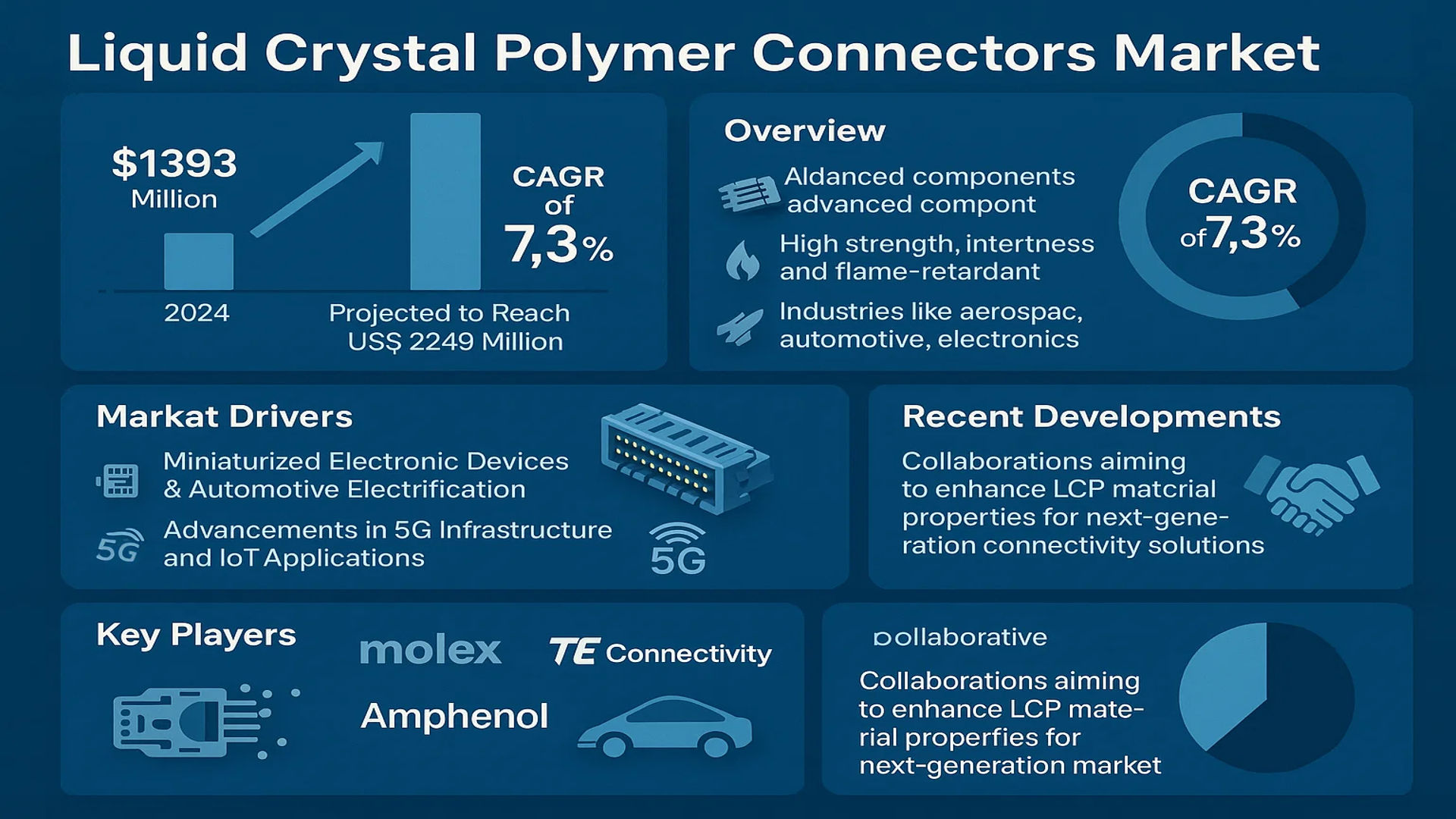
The global Liquid Crystal Polymer Connectors market was valued at 1393 million in 2024 and is projected to reach US$ 2249 million by 2032, at a CAGR of 7.3% during the forecast period.

Liquid Crystal Polymer connectors are advanced components made from aromatic polymers known for their exceptional thermal and chemical resistance. These materials exhibit high strength, inertness, and flame-retardant properties, making them ideal replacements for traditional materials like metals, ceramics, and composites in electrical and mechanical applications. LCP connectors are widely used in industries such as aerospace, automotive, and electronics due to their ability to maintain performance under extreme conditions.

The market growth is driven by increasing demand for high-performance connectors in miniaturized electronic devices and automotive electrification. Furthermore, advancements in 5G infrastructure and IoT applications are accelerating adoption. Key players like Molex, TE Connectivity, and Amphenol dominate the market, collectively holding a significant revenue share. Recent developments include collaborations to enhance LCP material properties for next-generation connectivity solutions.
Liquid Crystal Polymer Connectors market

MARKET DYNAMICS

MARKET DRIVERS

Proliferation of Miniaturized Electronics Propels Demand for LCP Connectors

The global electronics industry is witnessing an unprecedented shift toward miniaturization, with portable devices becoming increasingly compact while requiring higher performance. Liquid Crystal Polymer connectors offer unique advantages in this space due to their ability to maintain signal integrity at high frequencies while occupying minimal space. The market for LCP connectors in consumer electronics alone is projected to grow at 8.1% CAGR through 2032, driven by demand for slimmer smartphones, wearables, and IoT devices. These connectors enable manufacturers to achieve component density impossible with traditional materials while providing the necessary thermal stability for modern high-speed data transfers exceeding 10 Gbps.

Automotive Electrification Creates New Application Horizons

The automotive industry’s rapid transition toward electric vehicles is generating substantial demand for high-performance connectors capable of withstanding harsh under-the-hood environments. LCP connectors demonstrate exceptional resistance to automotive fluids, temperature fluctuations (-40°C to 150°C operating range), and vibration – making them ideal for battery management systems, onboard charging units, and ADAS components. With global EV production expected to surpass 40 million units annually by 2030, the addressable market for LCP connectors in this sector presents significant growth potential. The material’s inherent flame retardancy (UL94 V-0 rated) provides additional safety advantages critical for electric powertrains.

5G Infrastructure Deployment Accelerates Market Expansion

5G network rollouts worldwide are driving substantial investments in base stations, small cells, and data center infrastructure – all requiring high-frequency interconnects with minimal signal loss. LCP connectors exhibit excellent dielectric properties (Dk 2.9-3.1, Df 0.002-0.005) that outperform traditional materials in millimeter-wave applications. The material’s low moisture absorption (<0.02%) ensures stable performance in outdoor telecommunications equipment deployments. As 5G penetration reaches 60% of mobile connections in developed markets by 2027, the demand for high-frequency LCP connectors is expected to quadruple from current levels.

MARKET RESTRAINTS

High Material Costs Limit Widespread Adoption

While offering superior performance characteristics, LCP resins command premium pricing that remains 3The K to 5The K times higher than conventional connector materials like PBT or nylon. This cost differential creates adoption barriers in price-sensitive applications where performance advantages don’t justify the premium. The specialized processing requirements for LCP materials – including precise temperature control during injection molding – add further to the total cost of ownership. In cost-driven market segments, this pricing dynamic encourages designers to seek alternative solutions unless the application absolutely requires LCP’s unique properties.

Supply Chain Vulnerabilities Impact Market Stability

The LCP connector market faces constraints from concentrated raw material supply, with over 80% of LCP resin production controlled by a limited number of chemical manufacturers. This concentration creates vulnerability to supply disruptions, as witnessed during recent global supply chain challenges. The specialized nature of LCP polymerization also means capacity expansions require significant capital investments and extended lead times. These factors contribute to periodic material shortages that can delay product launches and limit market growth potential despite strong demand signals from end-user industries.

Design Complexity Increases Development Timelines

Engineers face considerable challenges when designing with LCP materials due to their anisotropic properties and unique flow characteristics during molding. The material’s molecular orientation affects mechanical properties differently in flow versus transverse directions, requiring specialized design expertise. This learning curve lengthens development cycles compared to conventional connector materials, particularly for complex, high-pin-count applications. The need for mold flow simulations and iterative prototyping increases both time-to-market and development costs, creating a barrier for smaller manufacturers with limited engineering resources.

MARKET OPPORTUNITIES

Medical Device Innovation Opens New Application Frontiers

The medical technology sector presents significant growth opportunities for LCP connectors, particularly in miniaturized implantable devices and surgical robotics. The material’s biocompatibility, combined with its ability to withstand repeated sterilization cycles (including autoclaving), makes it ideal for critical medical applications. The global market for medical LCP components is projected to grow at 9.2% annually, driven by advancements in minimally invasive surgical techniques and portable diagnostic equipment. Emerging applications include MRI-compatible connectors for neurostimulation devices and miniature interconnects for endoscopic capsules.

Advanced Packaging Technologies Drive Next-Generation Solutions

The semiconductor industry’s shift toward advanced packaging architectures like 2.5D and 3D ICs creates demand for ultra-high-density interconnects where LCP excels. The material’s coefficient of thermal expansion (CTE) closely matches silicon (12-16 ppm/°C), reducing stress in chip-scale packages. Leading OSAT providers are actively evaluating LCP-based solutions for fine-pitch interposers and high-speed substrate applications. With the advanced packaging market growing at 8.7% CAGR, this presents substantial opportunity for LCP connector manufacturers to develop specialized solutions addressing the unique requirements of heterogeneous integration.

Sustainability Initiatives Create Material Substitution Opportunities

Growing emphasis on environmentally responsible electronics manufacturing is driving interest in LCP as a high-performance alternative to halogenated flame retardant materials. Several major OEMs have committed to eliminating brominated and chlorinated compounds from their supply chains by 2025, creating demand for inherently flame-retardant solutions like LCP. The material’s recyclability and potential for reuse in closed-loop systems further enhance its sustainability profile. These factors are driving adoption in applications ranging from server farms to industrial automation where both performance and environmental considerations are paramount.

MARKET CHALLENGES

Material Property Variability Impacts Consistency

LCP materials exhibit batch-to-batch variability in key performance parameters such as melt viscosity and shrinkage rates, posing challenges for high-volume manufacturing. These variations stem from the complex molecular orientation behavior during processing and can lead to inconsistencies in connector performance. Manufacturers must implement rigorous incoming material inspection protocols and process controls to maintain quality standards, adding to production costs. The industry continues working toward improved resin formulations with more predictable processing characteristics to address this challenge.

Limited Color Options Constrain Design Flexibility

Unlike many engineering plastics, LCP offers limited opportunities for color customization while maintaining optimal material properties. The typical natural amber color of LCP materials restricts design options in consumer-facing applications where aesthetic considerations are important. Attempts to pigment LCP often degrade its excellent electrical characteristics or thermal stability. This limitation forces designers to make difficult trade-offs between performance and visual appeal in applications like wearables and smart home devices where both factors are important purchase considerations.

Competitive Materials Threaten Market Position

Emerging high-performance polymers like PPSU and PEKK, along with improved formulations of traditional materials, increasingly challenge LCP’s value proposition in certain applications. These alternatives offer better mechanical strength, broader color options, or lower cost while still meeting many technical requirements. The connector industry’s ongoing material science advancements may erode LCP’s competitive advantages unless manufacturers continue innovating to enhance performance characteristics and cost-effectiveness. Maintaining differentiation through advanced material formulations and processing techniques remains critical for long-term market positioning.

LIQUID CRYSTAL POLYMER CONNECTORS MARKET TRENDS

Miniaturization and High-Performance Demands Fueling Market Growth

The increasing demand for miniaturized, high-performance connectors in advanced electronics is driving significant growth in the Liquid Crystal Polymer (LCP) connectors market. These connectors offer exceptional mechanical stability, thermal resistance up to 300°C, and chemical inertness, making them ideal for compact devices where conventional materials fail. The global smartphone market, which saw over 1.3 billion units shipped in 2023, continues to push manufacturers toward LCP connectors due to space constraints in 5G-enabled devices. Furthermore, automotive electrification trends have led to a 74% year-over-year growth in LCP connector adoption for battery management systems in electric vehicles, where high-temperature resistance is critical for safety and reliability.

Other Trends

Accelerated 5G Infrastructure Deployment

5G network expansion is creating unprecedented demand for LCP connectors in base stations and telecommunications equipment. The material’s low dielectric constant (2.9 at 1GHz) and minimal signal loss properties make it indispensable for high-frequency applications. With global 5G subscriptions projected to exceed 4 billion by 2027, telecom operators are increasingly specifying LCP-based interconnect solutions to ensure signal integrity in millimeter-wave frequencies. This trend is particularly pronounced in Asia-Pacific markets, where governments have allocated over $200 billion collectively for 5G infrastructure development through 2025.

Medical Device Innovation Driving Specialized Applications

The medical device sector is rapidly adopting LCP connectors for implantable electronics and diagnostic equipment due to their biocompatibility and sterilization resilience. Recent FDA approvals for next-generation neuromodulation devices using LCP interconnects have opened a $1.2 billion niche market for specialized medical connectors. Additionally, the global endoscopy equipment market, growing at 6.8% annually, increasingly utilizes LCP connectors in flexible scopes where their combination of mechanical flexibility and chemical resistance outperforms traditional materials. This shift reflects broader healthcare trends toward minimally invasive procedures requiring reliable, high-density interconnections.

Sustainability Initiatives Reshaping Material Selection Criteria

Environmental regulations are prompting manufacturers to reevaluate connector materials, with LCP emerging as a sustainable alternative to halogenated plastics. The European Union’s circular economy action plan and recent restrictions on brominated flame retardants have accelerated LCP adoption, particularly in consumer electronics where 83% of major brands now have formal sustainability targets. LCP’s recyclability and reduced material waste during high-precision molding processes align with these initiatives, while its durability extends product lifespans—a key consideration as extended producer responsibility (EPR) regulations gain global traction. This environmental advantage complements the material’s technical benefits, creating dual drivers for market expansion across regulated industries.

COMPETITIVE LANDSCAPE

Key Industry Players

Leading Connector Manufacturers Invest in LCP Technology to Capture Market Growth

The global liquid crystal polymer (LCP) connectors market features a partially consolidated competitive landscape, with significant presence from multinational conglomerates and specialized electronic component manufacturers. As the market is projected to grow from $1.39 billion in 2024 to $2.25 billion by 2032, companies are aggressively expanding their high-performance connector portfolios to cater to demanding applications in aerospace, automotive, and electronics sectors.

Molex, a subsidiary of Koch Industries, currently leads the market with its extensive range of LCP-based interconnect solutions. The company’s advantage stems from its vertically integrated manufacturing capabilities and strong relationships with automotive OEMs. While Molex dominates the North American market, TE Connectivity has been gaining traction through strategic acquisitions and R&D investments focused on miniaturized LCP connectors for IoT applications.

Asian players are demonstrating remarkable growth as well. Hirose Electric and JST Mfg have been capitalizing on the booming electronics manufacturing sector in China and Southeast Asia, where demand for high-temperature resistant connectors is particularly strong. Meanwhile, Amphenol Corporation continues to expand its market share through both organic growth and targeted acquisitions like that of MTS Systems’ sensor business.

The competitive intensity is further heightened by material science innovators such as Celanese Corporation and Sumitomo Chemical, who are developing next-generation LCP compounds that enable thinner wall sections and better flow characteristics. These advancements are helping connector manufacturers push the boundaries of miniaturization while maintaining the exceptional mechanical and electrical properties that make LCP so valuable.

List of Key Liquid Crystal Polymer Connector Manufacturers

Segment Analysis:

By Type

Rectangular Connector Segment Leads the Market Due to High Adoption in High-Density Applications

The market is segmented based on type into:

  • Rectangular Connector
    • Subtypes: Board-to-board, Wire-to-board, and others
  • Circular Connector
  • D-Connector
    • Subtypes: Standard, High-density, and others
  • Other

By Application

Electronic Product Segment Dominates Market Owing to Widespread Use in Miniaturized Devices

The market is segmented based on application into:

  • Electronic Product
  • Automobile
  • Aerospace
  • Industrial Machinery
  • Other

By End User

Consumer Electronics Sector Holds Significant Share Due to Growing Demand for Compact Connectors

The market is segmented based on end user into:

  • Consumer Electronics
  • Automotive
  • Aerospace & Defense
  • Industrial
  • Medical

Regional Analysis: Liquid Crystal Polymer Connectors Market

North America
The North American market for Liquid Crystal Polymer (LCP) Connectors is driven by advanced technological adoption, stringent performance standards, and robust demand from the aerospace and automotive sectors. The U.S. dominates the region, accounting for a significant share of the global market revenue. With major industry players like TE Connectivity and Molex headquartered here, innovation in high-performance connectors for 5G infrastructure, medical devices, and electric vehicles fuels growth. Regulatory frameworks emphasizing miniaturization and durability in electronics further bolster adoption. However, higher production costs compared to conventional materials remain a challenge for cost-sensitive applications. The U.S. government’s increasing focus on semiconductor self-sufficiency, including initiatives like the CHIPS Act, also indirectly supports demand for advanced LCP connectors in electronics manufacturing.

Europe
Europe presents a mature yet steadily growing market for LCP connectors, propelled by stringent environmental and safety regulations under EU REACH and demands for high-reliability solutions in automotive and industrial automation. Germany leads the region, supported by its strong manufacturing base and presence of key players like HARTING Technology Group. The shift toward electric vehicles (EVs) and renewable energy infrastructure has increased the need for heat-resistant and chemically inert connectors. While the region shows growth, broader adoption faces hurdles due to competition from lower-cost alternatives and slower industrialization in Eastern Europe. Nevertheless, the emphasis on sustainability and the circular economy pushes manufacturers to adopt durable materials like LCP.

Asia-Pacific
Asia-Pacific is the fastest-growing market, driven by China, Japan, and South Korea. The region benefits from large-scale electronics production, particularly in semiconductor and consumer electronics, where LCP connectors enable high-speed data transmission and miniaturization. China’s expanding 5G network rollout and EV supply chain propel demand, making it a critical market. Japan’s expertise in high-end connector manufacturing, with companies like JAE Electronics, further strengthens regional dominance. However, price sensitivity in emerging economies like India and Southeast Asia limits broader adoption, favoring conventional polymer alternatives. The lack of stringent material regulations in some countries also slows mandatory shifts toward LCP technology.

South America
South America represents a niche but growing opportunity, primarily led by Brazil’s industrial and automotive sectors. The region’s economic volatility, however, restricts widespread adoption, with manufacturers often opting for cost-effective substitutes. Limited investment in high-tech infrastructure development and minimal regulatory pressure for advanced materials hinder acceleration. Still, the gradual expansion of telecommunications and medical device production creates pockets of demand. Key players are cautiously exploring partnerships with local suppliers to penetrate this market.

Middle East & Africa
The Middle East & Africa market remains nascent but shows promise due to increasing investments in telecommunications and oil & gas sectors. The UAE and Saudi Arabia lead in adopting advanced connectors for smart city initiatives and industrial automation, though overall demand is constrained by limited local manufacturing capabilities. Africa’s growth potential is hampered by underdeveloped supply chains and low industrial output, but sectors like automotive aftermarkets offer incremental opportunities. Long-term prospects depend on infrastructure modernization and economic diversification efforts in key countries.

Report Scope

This market research report provides a comprehensive analysis of the global and regional Liquid Crystal Polymer (LCP) Connectors markets, covering the forecast period 2024–2032. It offers detailed insights into market dynamics, technological advancements, competitive landscape, and key trends shaping the industry.

Key focus areas of the report include:

  • Market Size & Forecast: Historical data and future projections for revenue, unit shipments, and market value across major regions and segments. The Global LCP Connectors market was valued at USD 1,393 million in 2024 and is projected to reach USD 2,249 million by 2032, growing at a CAGR of 7.3%.
  • Segmentation Analysis: Detailed breakdown by product type (Rectangular, Circular, D-Connector, Others), application (Aerospace, Automobile, Industrial Machinery, Electronic Products), and end-user industry to identify high-growth segments and investment opportunities.
  • Regional Outlook: Insights into market performance across North America, Europe, Asia-Pacific, Latin America, and the Middle East & Africa, including country-level analysis where relevant. Asia-Pacific dominates the market, with China showing significant growth potential.
  • Competitive Landscape: Profiles of leading market participants including Molex, TE Connectivity, Amphenol, Hirose Connector, and Sumitomo Chemical Company, covering their product portfolios, R&D investments, and strategic initiatives.
  • Technology Trends & Innovation: Assessment of emerging LCP formulations, miniaturization trends, high-frequency applications, and integration with next-gen electronics.
  • Market Drivers & Restraints: Evaluation of factors driving market growth (5G deployment, EV adoption, IoT expansion) along with challenges (raw material volatility, stringent regulations).
  • Stakeholder Analysis: Strategic insights for connector manufacturers, material suppliers, OEMs, and investors regarding supply chain optimization and technology partnerships.

The research methodology combines primary interviews with industry experts and secondary data from verified sources, ensuring the reliability and accuracy of market intelligence.

FREQUENTLY ASKED QUESTIONS:

What is the current market size of Global Liquid Crystal Polymer Connectors Market?

-> Liquid Crystal Polymer Connectors market was valued at 1393 million in 2024 and is projected to reach US$ 2249 million by 2032, at a CAGR of 7.3% during the forecast period..

Which key companies operate in Global LCP Connectors Market?

-> Key players include Molex, TE Connectivity, Hirose Connector, Amphenol, Sumitomo Chemical Company, Wurth Group, 3M, and Celanese Corporation, among others.

What are the key growth drivers?

-> Key growth drivers include 5G infrastructure expansion, electric vehicle production growth, and increasing demand for miniaturized electronics.

Which region dominates the market?

-> Asia-Pacific leads the market due to strong electronics manufacturing, while North America shows significant growth in high-performance applications.

What are the emerging trends?

-> Emerging trends include development of high-temperature LCP grades, adoption in automotive electrification, and use in next-gen communication devices.

Liquid Crystal Polymer Connectors Market, Trends, Business Strategies 2025-2032

Get Sample Report PDF for Exclusive Insights

Report Sample Includes

  • Table of Contents
  • List of Tables & Figures
  • Charts, Research Methodology, and more...
PDF Icon Download Sample Report PDF

Download Sample Report

Table of Content

1 Introduction to Research & Analysis Reports
1.1 Liquid Crystal Polymer Connectors Market Definition
1.2 Market Segments
1.2.1 Segment by Type
1.2.2 Segment by Application
1.3 Global Liquid Crystal Polymer Connectors Market Overview
1.4 Features & Benefits of This Report
1.5 Methodology & Sources of Information
1.5.1 Research Methodology
1.5.2 Research Process
1.5.3 Base Year
1.5.4 Report Assumptions & Caveats
2 Global Liquid Crystal Polymer Connectors Overall Market Size
2.1 Global Liquid Crystal Polymer Connectors Market Size: 2024 VS 2032
2.2 Global Liquid Crystal Polymer Connectors Market Size, Prospects & Forecasts: 2020-2032
2.3 Global Liquid Crystal Polymer Connectors Sales: 2020-2032
3 Company Landscape
3.1 Top Liquid Crystal Polymer Connectors Players in Global Market
3.2 Top Global Liquid Crystal Polymer Connectors Companies Ranked by Revenue
3.3 Global Liquid Crystal Polymer Connectors Revenue by Companies
3.4 Global Liquid Crystal Polymer Connectors Sales by Companies
3.5 Global Liquid Crystal Polymer Connectors Price by Manufacturer (2020-2025)
3.6 Top 3 and Top 5 Liquid Crystal Polymer Connectors Companies in Global Market, by Revenue in 2024
3.7 Global Manufacturers Liquid Crystal Polymer Connectors Product Type
3.8 Tier 1, Tier 2, and Tier 3 Liquid Crystal Polymer Connectors Players in Global Market
3.8.1 List of Global Tier 1 Liquid Crystal Polymer Connectors Companies
3.8.2 List of Global Tier 2 and Tier 3 Liquid Crystal Polymer Connectors Companies
4 Sights by Product
4.1 Overview
4.1.1 Segment by Type – Global Liquid Crystal Polymer Connectors Market Size Markets, 2024 & 2032
4.1.2 Rectangular Connector
4.1.3 Circular Connector
4.1.4 D-Connector
4.1.5 Other
4.2 Segment by Type – Global Liquid Crystal Polymer Connectors Revenue & Forecasts
4.2.1 Segment by Type – Global Liquid Crystal Polymer Connectors Revenue, 2020-2025
4.2.2 Segment by Type – Global Liquid Crystal Polymer Connectors Revenue, 2026-2032
4.2.3 Segment by Type – Global Liquid Crystal Polymer Connectors Revenue Market Share, 2020-2032
4.3 Segment by Type – Global Liquid Crystal Polymer Connectors Sales & Forecasts
4.3.1 Segment by Type – Global Liquid Crystal Polymer Connectors Sales, 2020-2025
4.3.2 Segment by Type – Global Liquid Crystal Polymer Connectors Sales, 2026-2032
4.3.3 Segment by Type – Global Liquid Crystal Polymer Connectors Sales Market Share, 2020-2032
4.4 Segment by Type – Global Liquid Crystal Polymer Connectors Price (Manufacturers Selling Prices), 2020-2032
5 Sights by Application
5.1 Overview
5.1.1 Segment by Application – Global Liquid Crystal Polymer Connectors Market Size, 2024 & 2032
5.1.2 Aerospace
5.1.3 Automobile
5.1.4 Industrial Machinery
5.1.5 Electronic Product
5.1.6 Other
5.2 Segment by Application – Global Liquid Crystal Polymer Connectors Revenue & Forecasts
5.2.1 Segment by Application – Global Liquid Crystal Polymer Connectors Revenue, 2020-2025
5.2.2 Segment by Application – Global Liquid Crystal Polymer Connectors Revenue, 2026-2032
5.2.3 Segment by Application – Global Liquid Crystal Polymer Connectors Revenue Market Share, 2020-2032
5.3 Segment by Application – Global Liquid Crystal Polymer Connectors Sales & Forecasts
5.3.1 Segment by Application – Global Liquid Crystal Polymer Connectors Sales, 2020-2025
5.3.2 Segment by Application – Global Liquid Crystal Polymer Connectors Sales, 2026-2032
5.3.3 Segment by Application – Global Liquid Crystal Polymer Connectors Sales Market Share, 2020-2032
5.4 Segment by Application – Global Liquid Crystal Polymer Connectors Price (Manufacturers Selling Prices), 2020-2032
6 Sights by Region
6.1 By Region – Global Liquid Crystal Polymer Connectors Market Size, 2024 & 2032
6.2 By Region – Global Liquid Crystal Polymer Connectors Revenue & Forecasts
6.2.1 By Region – Global Liquid Crystal Polymer Connectors Revenue, 2020-2025
6.2.2 By Region – Global Liquid Crystal Polymer Connectors Revenue, 2026-2032
6.2.3 By Region – Global Liquid Crystal Polymer Connectors Revenue Market Share, 2020-2032
6.3 By Region – Global Liquid Crystal Polymer Connectors Sales & Forecasts
6.3.1 By Region – Global Liquid Crystal Polymer Connectors Sales, 2020-2025
6.3.2 By Region – Global Liquid Crystal Polymer Connectors Sales, 2026-2032
6.3.3 By Region – Global Liquid Crystal Polymer Connectors Sales Market Share, 2020-2032
6.4 North America
6.4.1 By Country – North America Liquid Crystal Polymer Connectors Revenue, 2020-2032
6.4.2 By Country – North America Liquid Crystal Polymer Connectors Sales, 2020-2032
6.4.3 United States Liquid Crystal Polymer Connectors Market Size, 2020-2032
6.4.4 Canada Liquid Crystal Polymer Connectors Market Size, 2020-2032
6.4.5 Mexico Liquid Crystal Polymer Connectors Market Size, 2020-2032
6.5 Europe
6.5.1 By Country – Europe Liquid Crystal Polymer Connectors Revenue, 2020-2032
6.5.2 By Country – Europe Liquid Crystal Polymer Connectors Sales, 2020-2032
6.5.3 Germany Liquid Crystal Polymer Connectors Market Size, 2020-2032
6.5.4 France Liquid Crystal Polymer Connectors Market Size, 2020-2032
6.5.5 U.K. Liquid Crystal Polymer Connectors Market Size, 2020-2032
6.5.6 Italy Liquid Crystal Polymer Connectors Market Size, 2020-2032
6.5.7 Russia Liquid Crystal Polymer Connectors Market Size, 2020-2032
6.5.8 Nordic Countries Liquid Crystal Polymer Connectors Market Size, 2020-2032
6.5.9 Benelux Liquid Crystal Polymer Connectors Market Size, 2020-2032
6.6 Asia
6.6.1 By Region – Asia Liquid Crystal Polymer Connectors Revenue, 2020-2032
6.6.2 By Region – Asia Liquid Crystal Polymer Connectors Sales, 2020-2032
6.6.3 China Liquid Crystal Polymer Connectors Market Size, 2020-2032
6.6.4 Japan Liquid Crystal Polymer Connectors Market Size, 2020-2032
6.6.5 South Korea Liquid Crystal Polymer Connectors Market Size, 2020-2032
6.6.6 Southeast Asia Liquid Crystal Polymer Connectors Market Size, 2020-2032
6.6.7 India Liquid Crystal Polymer Connectors Market Size, 2020-2032
6.7 South America
6.7.1 By Country – South America Liquid Crystal Polymer Connectors Revenue, 2020-2032
6.7.2 By Country – South America Liquid Crystal Polymer Connectors Sales, 2020-2032
6.7.3 Brazil Liquid Crystal Polymer Connectors Market Size, 2020-2032
6.7.4 Argentina Liquid Crystal Polymer Connectors Market Size, 2020-2032
6.8 Middle East & Africa
6.8.1 By Country – Middle East & Africa Liquid Crystal Polymer Connectors Revenue, 2020-2032
6.8.2 By Country – Middle East & Africa Liquid Crystal Polymer Connectors Sales, 2020-2032
6.8.3 Turkey Liquid Crystal Polymer Connectors Market Size, 2020-2032
6.8.4 Israel Liquid Crystal Polymer Connectors Market Size, 2020-2032
6.8.5 Saudi Arabia Liquid Crystal Polymer Connectors Market Size, 2020-2032
6.8.6 UAE Liquid Crystal Polymer Connectors Market Size, 2020-2032
7 Manufacturers & Brands Profiles
7.1 Molex
7.1.1 Molex Company Summary
7.1.2 Molex Business Overview
7.1.3 Molex Liquid Crystal Polymer Connectors Major Product Offerings
7.1.4 Molex Liquid Crystal Polymer Connectors Sales and Revenue in Global (2020-2025)
7.1.5 Molex Key News & Latest Developments
7.2 TE Connectivity
7.2.1 TE Connectivity Company Summary
7.2.2 TE Connectivity Business Overview
7.2.3 TE Connectivity Liquid Crystal Polymer Connectors Major Product Offerings
7.2.4 TE Connectivity Liquid Crystal Polymer Connectors Sales and Revenue in Global (2020-2025)
7.2.5 TE Connectivity Key News & Latest Developments
7.3 Hirose Connector
7.3.1 Hirose Connector Company Summary
7.3.2 Hirose Connector Business Overview
7.3.3 Hirose Connector Liquid Crystal Polymer Connectors Major Product Offerings
7.3.4 Hirose Connector Liquid Crystal Polymer Connectors Sales and Revenue in Global (2020-2025)
7.3.5 Hirose Connector Key News & Latest Developments
7.4 Amphenol
7.4.1 Amphenol Company Summary
7.4.2 Amphenol Business Overview
7.4.3 Amphenol Liquid Crystal Polymer Connectors Major Product Offerings
7.4.4 Amphenol Liquid Crystal Polymer Connectors Sales and Revenue in Global (2020-2025)
7.4.5 Amphenol Key News & Latest Developments
7.5 Sumitomo Chemical Company
7.5.1 Sumitomo Chemical Company Company Summary
7.5.2 Sumitomo Chemical Company Business Overview
7.5.3 Sumitomo Chemical Company Liquid Crystal Polymer Connectors Major Product Offerings
7.5.4 Sumitomo Chemical Company Liquid Crystal Polymer Connectors Sales and Revenue in Global (2020-2025)
7.5.5 Sumitomo Chemical Company Key News & Latest Developments
7.6 Wurth Group
7.6.1 Wurth Group Company Summary
7.6.2 Wurth Group Business Overview
7.6.3 Wurth Group Liquid Crystal Polymer Connectors Major Product Offerings
7.6.4 Wurth Group Liquid Crystal Polymer Connectors Sales and Revenue in Global (2020-2025)
7.6.5 Wurth Group Key News & Latest Developments
7.7 3M
7.7.1 3M Company Summary
7.7.2 3M Business Overview
7.7.3 3M Liquid Crystal Polymer Connectors Major Product Offerings
7.7.4 3M Liquid Crystal Polymer Connectors Sales and Revenue in Global (2020-2025)
7.7.5 3M Key News & Latest Developments
7.8 Celanese Corporation
7.8.1 Celanese Corporation Company Summary
7.8.2 Celanese Corporation Business Overview
7.8.3 Celanese Corporation Liquid Crystal Polymer Connectors Major Product Offerings
7.8.4 Celanese Corporation Liquid Crystal Polymer Connectors Sales and Revenue in Global (2020-2025)
7.8.5 Celanese Corporation Key News & Latest Developments
7.9 RTP Company
7.9.1 RTP Company Company Summary
7.9.2 RTP Company Business Overview
7.9.3 RTP Company Liquid Crystal Polymer Connectors Major Product Offerings
7.9.4 RTP Company Liquid Crystal Polymer Connectors Sales and Revenue in Global (2020-2025)
7.9.5 RTP Company Key News & Latest Developments
7.10 HARTING Technology Group
7.10.1 HARTING Technology Group Company Summary
7.10.2 HARTING Technology Group Business Overview
7.10.3 HARTING Technology Group Liquid Crystal Polymer Connectors Major Product Offerings
7.10.4 HARTING Technology Group Liquid Crystal Polymer Connectors Sales and Revenue in Global (2020-2025)
7.10.5 HARTING Technology Group Key News & Latest Developments
7.11 OMRON Corporation
7.11.1 OMRON Corporation Company Summary
7.11.2 OMRON Corporation Business Overview
7.11.3 OMRON Corporation Liquid Crystal Polymer Connectors Major Product Offerings
7.11.4 OMRON Corporation Liquid Crystal Polymer Connectors Sales and Revenue in Global (2020-2025)
7.11.5 OMRON Corporation Key News & Latest Developments
7.12 JST
7.12.1 JST Company Summary
7.12.2 JST Business Overview
7.12.3 JST Liquid Crystal Polymer Connectors Major Product Offerings
7.12.4 JST Liquid Crystal Polymer Connectors Sales and Revenue in Global (2020-2025)
7.12.5 JST Key News & Latest Developments
7.13 JAE Electronics
7.13.1 JAE Electronics Company Summary
7.13.2 JAE Electronics Business Overview
7.13.3 JAE Electronics Liquid Crystal Polymer Connectors Major Product Offerings
7.13.4 JAE Electronics Liquid Crystal Polymer Connectors Sales and Revenue in Global (2020-2025)
7.13.5 JAE Electronics Key News & Latest Developments
7.14 Cinch Connectivity Solutions
7.14.1 Cinch Connectivity Solutions Company Summary
7.14.2 Cinch Connectivity Solutions Business Overview
7.14.3 Cinch Connectivity Solutions Liquid Crystal Polymer Connectors Major Product Offerings
7.14.4 Cinch Connectivity Solutions Liquid Crystal Polymer Connectors Sales and Revenue in Global (2020-2025)
7.14.5 Cinch Connectivity Solutions Key News & Latest Developments
8 Global Liquid Crystal Polymer Connectors Production Capacity, Analysis
8.1 Global Liquid Crystal Polymer Connectors Production Capacity, 2020-2032
8.2 Liquid Crystal Polymer Connectors Production Capacity of Key Manufacturers in Global Market
8.3 Global Liquid Crystal Polymer Connectors Production by Region
9 Key Market Trends, Opportunity, Drivers and Restraints
9.1 Market Opportunities & Trends
9.2 Market Drivers
9.3 Market Restraints
10 Liquid Crystal Polymer Connectors Supply Chain Analysis
10.1 Liquid Crystal Polymer Connectors Industry Value Chain
10.2 Liquid Crystal Polymer Connectors Upstream Market
10.3 Liquid Crystal Polymer Connectors Downstream and Clients
10.4 Marketing Channels Analysis
10.4.1 Marketing Channels
10.4.2 Liquid Crystal Polymer Connectors Distributors and Sales Agents in Global
11 Conclusion
12 Appendix
12.1 Note
12.2 Examples of Clients
12.3 DisclaimerList of Tables
Table 1. Key Players of Liquid Crystal Polymer Connectors in Global Market
Table 2. Top Liquid Crystal Polymer Connectors Players in Global Market, Ranking by Revenue (2024)
Table 3. Global Liquid Crystal Polymer Connectors Revenue by Companies, (US$, Mn), 2020-2025
Table 4. Global Liquid Crystal Polymer Connectors Revenue Share by Companies, 2020-2025
Table 5. Global Liquid Crystal Polymer Connectors Sales by Companies, (K Units), 2020-2025
Table 6. Global Liquid Crystal Polymer Connectors Sales Share by Companies, 2020-2025
Table 7. Key Manufacturers Liquid Crystal Polymer Connectors Price (2020-2025) & (US$/Unit)
Table 8. Global Manufacturers Liquid Crystal Polymer Connectors Product Type
Table 9. List of Global Tier 1 Liquid Crystal Polymer Connectors Companies, Revenue (US$, Mn) in 2024 and Market Share
Table 10. List of Global Tier 2 and Tier 3 Liquid Crystal Polymer Connectors Companies, Revenue (US$, Mn) in 2024 and Market Share
Table 11. Segment by Type – Global Liquid Crystal Polymer Connectors Revenue, (US$, Mn), 2024 & 2032
Table 12. Segment by Type – Global Liquid Crystal Polymer Connectors Revenue (US$, Mn), 2020-2025
Table 13. Segment by Type – Global Liquid Crystal Polymer Connectors Revenue (US$, Mn), 2026-2032
Table 14. Segment by Type – Global Liquid Crystal Polymer Connectors Sales (K Units), 2020-2025
Table 15. Segment by Type – Global Liquid Crystal Polymer Connectors Sales (K Units), 2026-2032
Table 16. Segment by Application – Global Liquid Crystal Polymer Connectors Revenue, (US$, Mn), 2024 & 2032
Table 17. Segment by Application – Global Liquid Crystal Polymer Connectors Revenue, (US$, Mn), 2020-2025
Table 18. Segment by Application – Global Liquid Crystal Polymer Connectors Revenue, (US$, Mn), 2026-2032
Table 19. Segment by Application – Global Liquid Crystal Polymer Connectors Sales, (K Units), 2020-2025
Table 20. Segment by Application – Global Liquid Crystal Polymer Connectors Sales, (K Units), 2026-2032
Table 21. By Region – Global Liquid Crystal Polymer Connectors Revenue, (US$, Mn), 2025-2032
Table 22. By Region – Global Liquid Crystal Polymer Connectors Revenue, (US$, Mn), 2020-2025
Table 23. By Region – Global Liquid Crystal Polymer Connectors Revenue, (US$, Mn), 2026-2032
Table 24. By Region – Global Liquid Crystal Polymer Connectors Sales, (K Units), 2020-2025
Table 25. By Region – Global Liquid Crystal Polymer Connectors Sales, (K Units), 2026-2032
Table 26. By Country – North America Liquid Crystal Polymer Connectors Revenue, (US$, Mn), 2020-2025
Table 27. By Country – North America Liquid Crystal Polymer Connectors Revenue, (US$, Mn), 2026-2032
Table 28. By Country – North America Liquid Crystal Polymer Connectors Sales, (K Units), 2020-2025
Table 29. By Country – North America Liquid Crystal Polymer Connectors Sales, (K Units), 2026-2032
Table 30. By Country – Europe Liquid Crystal Polymer Connectors Revenue, (US$, Mn), 2020-2025
Table 31. By Country – Europe Liquid Crystal Polymer Connectors Revenue, (US$, Mn), 2026-2032
Table 32. By Country – Europe Liquid Crystal Polymer Connectors Sales, (K Units), 2020-2025
Table 33. By Country – Europe Liquid Crystal Polymer Connectors Sales, (K Units), 2026-2032
Table 34. By Region – Asia Liquid Crystal Polymer Connectors Revenue, (US$, Mn), 2020-2025
Table 35. By Region – Asia Liquid Crystal Polymer Connectors Revenue, (US$, Mn), 2026-2032
Table 36. By Region – Asia Liquid Crystal Polymer Connectors Sales, (K Units), 2020-2025
Table 37. By Region – Asia Liquid Crystal Polymer Connectors Sales, (K Units), 2026-2032
Table 38. By Country – South America Liquid Crystal Polymer Connectors Revenue, (US$, Mn), 2020-2025
Table 39. By Country – South America Liquid Crystal Polymer Connectors Revenue, (US$, Mn), 2026-2032
Table 40. By Country – South America Liquid Crystal Polymer Connectors Sales, (K Units), 2020-2025
Table 41. By Country – South America Liquid Crystal Polymer Connectors Sales, (K Units), 2026-2032
Table 42. By Country – Middle East & Africa Liquid Crystal Polymer Connectors Revenue, (US$, Mn), 2020-2025
Table 43. By Country – Middle East & Africa Liquid Crystal Polymer Connectors Revenue, (US$, Mn), 2026-2032
Table 44. By Country – Middle East & Africa Liquid Crystal Polymer Connectors Sales, (K Units), 2020-2025
Table 45. By Country – Middle East & Africa Liquid Crystal Polymer Connectors Sales, (K Units), 2026-2032
Table 46. Molex Company Summary
Table 47. Molex Liquid Crystal Polymer Connectors Product Offerings
Table 48. Molex Liquid Crystal Polymer Connectors Sales (K Units), Revenue (US$, Mn) and Average Price (US$/Unit) & (2020-2025)
Table 49. Molex Key News & Latest Developments
Table 50. TE Connectivity Company Summary
Table 51. TE Connectivity Liquid Crystal Polymer Connectors Product Offerings
Table 52. TE Connectivity Liquid Crystal Polymer Connectors Sales (K Units), Revenue (US$, Mn) and Average Price (US$/Unit) & (2020-2025)
Table 53. TE Connectivity Key News & Latest Developments
Table 54. Hirose Connector Company Summary
Table 55. Hirose Connector Liquid Crystal Polymer Connectors Product Offerings
Table 56. Hirose Connector Liquid Crystal Polymer Connectors Sales (K Units), Revenue (US$, Mn) and Average Price (US$/Unit) & (2020-2025)
Table 57. Hirose Connector Key News & Latest Developments
Table 58. Amphenol Company Summary
Table 59. Amphenol Liquid Crystal Polymer Connectors Product Offerings
Table 60. Amphenol Liquid Crystal Polymer Connectors Sales (K Units), Revenue (US$, Mn) and Average Price (US$/Unit) & (2020-2025)
Table 61. Amphenol Key News & Latest Developments
Table 62. Sumitomo Chemical Company Company Summary
Table 63. Sumitomo Chemical Company Liquid Crystal Polymer Connectors Product Offerings
Table 64. Sumitomo Chemical Company Liquid Crystal Polymer Connectors Sales (K Units), Revenue (US$, Mn) and Average Price (US$/Unit) & (2020-2025)
Table 65. Sumitomo Chemical Company Key News & Latest Developments
Table 66. Wurth Group Company Summary
Table 67. Wurth Group Liquid Crystal Polymer Connectors Product Offerings
Table 68. Wurth Group Liquid Crystal Polymer Connectors Sales (K Units), Revenue (US$, Mn) and Average Price (US$/Unit) & (2020-2025)
Table 69. Wurth Group Key News & Latest Developments
Table 70. 3M Company Summary
Table 71. 3M Liquid Crystal Polymer Connectors Product Offerings
Table 72. 3M Liquid Crystal Polymer Connectors Sales (K Units), Revenue (US$, Mn) and Average Price (US$/Unit) & (2020-2025)
Table 73. 3M Key News & Latest Developments
Table 74. Celanese Corporation Company Summary
Table 75. Celanese Corporation Liquid Crystal Polymer Connectors Product Offerings
Table 76. Celanese Corporation Liquid Crystal Polymer Connectors Sales (K Units), Revenue (US$, Mn) and Average Price (US$/Unit) & (2020-2025)
Table 77. Celanese Corporation Key News & Latest Developments
Table 78. RTP Company Company Summary
Table 79. RTP Company Liquid Crystal Polymer Connectors Product Offerings
Table 80. RTP Company Liquid Crystal Polymer Connectors Sales (K Units), Revenue (US$, Mn) and Average Price (US$/Unit) & (2020-2025)
Table 81. RTP Company Key News & Latest Developments
Table 82. HARTING Technology Group Company Summary
Table 83. HARTING Technology Group Liquid Crystal Polymer Connectors Product Offerings
Table 84. HARTING Technology Group Liquid Crystal Polymer Connectors Sales (K Units), Revenue (US$, Mn) and Average Price (US$/Unit) & (2020-2025)
Table 85. HARTING Technology Group Key News & Latest Developments
Table 86. OMRON Corporation Company Summary
Table 87. OMRON Corporation Liquid Crystal Polymer Connectors Product Offerings
Table 88. OMRON Corporation Liquid Crystal Polymer Connectors Sales (K Units), Revenue (US$, Mn) and Average Price (US$/Unit) & (2020-2025)
Table 89. OMRON Corporation Key News & Latest Developments
Table 90. JST Company Summary
Table 91. JST Liquid Crystal Polymer Connectors Product Offerings
Table 92. JST Liquid Crystal Polymer Connectors Sales (K Units), Revenue (US$, Mn) and Average Price (US$/Unit) & (2020-2025)
Table 93. JST Key News & Latest Developments
Table 94. JAE Electronics Company Summary
Table 95. JAE Electronics Liquid Crystal Polymer Connectors Product Offerings
Table 96. JAE Electronics Liquid Crystal Polymer Connectors Sales (K Units), Revenue (US$, Mn) and Average Price (US$/Unit) & (2020-2025)
Table 97. JAE Electronics Key News & Latest Developments
Table 98. Cinch Connectivity Solutions Company Summary
Table 99. Cinch Connectivity Solutions Liquid Crystal Polymer Connectors Product Offerings
Table 100. Cinch Connectivity Solutions Liquid Crystal Polymer Connectors Sales (K Units), Revenue (US$, Mn) and Average Price (US$/Unit) & (2020-2025)
Table 101. Cinch Connectivity Solutions Key News & Latest Developments
Table 102. Liquid Crystal Polymer Connectors Capacity of Key Manufacturers in Global Market, 2023-2025 (K Units)
Table 103. Global Liquid Crystal Polymer Connectors Capacity Market Share of Key Manufacturers, 2023-2025
Table 104. Global Liquid Crystal Polymer Connectors Production by Region, 2020-2025 (K Units)
Table 105. Global Liquid Crystal Polymer Connectors Production by Region, 2026-2032 (K Units)
Table 106. Liquid Crystal Polymer Connectors Market Opportunities & Trends in Global Market
Table 107. Liquid Crystal Polymer Connectors Market Drivers in Global Market
Table 108. Liquid Crystal Polymer Connectors Market Restraints in Global Market
Table 109. Liquid Crystal Polymer Connectors Raw Materials
Table 110. Liquid Crystal Polymer Connectors Raw Materials Suppliers in Global Market
Table 111. Typical Liquid Crystal Polymer Connectors Downstream
Table 112. Liquid Crystal Polymer Connectors Downstream Clients in Global Market
Table 113. Liquid Crystal Polymer Connectors Distributors and Sales Agents in Global Market

List of Figures
Figure 1. Liquid Crystal Polymer Connectors Product Picture
Figure 2. Liquid Crystal Polymer Connectors Segment by Type in 2024
Figure 3. Liquid Crystal Polymer Connectors Segment by Application in 2024
Figure 4. Global Liquid Crystal Polymer Connectors Market Overview: 2024
Figure 5. Key Caveats
Figure 6. Global Liquid Crystal Polymer Connectors Market Size: 2024 VS 2032 (US$, Mn)
Figure 7. Global Liquid Crystal Polymer Connectors Revenue: 2020-2032 (US$, Mn)
Figure 8. Liquid Crystal Polymer Connectors Sales in Global Market: 2020-2032 (K Units)
Figure 9. The Top 3 and 5 Players Market Share by Liquid Crystal Polymer Connectors Revenue in 2024
Figure 10. Segment by Type – Global Liquid Crystal Polymer Connectors Revenue, (US$, Mn), 2024 & 2032
Figure 11. Segment by Type – Global Liquid Crystal Polymer Connectors Revenue Market Share, 2020-2032
Figure 12. Segment by Type – Global Liquid Crystal Polymer Connectors Sales Market Share, 2020-2032
Figure 13. Segment by Type – Global Liquid Crystal Polymer Connectors Price (US$/Unit), 2020-2032
Figure 14. Segment by Application – Global Liquid Crystal Polymer Connectors Revenue, (US$, Mn), 2024 & 2032
Figure 15. Segment by Application – Global Liquid Crystal Polymer Connectors Revenue Market Share, 2020-2032
Figure 16. Segment by Application – Global Liquid Crystal Polymer Connectors Sales Market Share, 2020-2032
Figure 17. Segment by Application -Global Liquid Crystal Polymer Connectors Price (US$/Unit), 2020-2032
Figure 18. By Region – Global Liquid Crystal Polymer Connectors Revenue, (US$, Mn), 2025 & 2032
Figure 19. By Region – Global Liquid Crystal Polymer Connectors Revenue Market Share, 2020 VS 2024 VS 2032
Figure 20. By Region – Global Liquid Crystal Polymer Connectors Revenue Market Share, 2020-2032
Figure 21. By Region – Global Liquid Crystal Polymer Connectors Sales Market Share, 2020-2032
Figure 22. By Country – North America Liquid Crystal Polymer Connectors Revenue Market Share, 2020-2032
Figure 23. By Country – North America Liquid Crystal Polymer Connectors Sales Market Share, 2020-2032
Figure 24. United States Liquid Crystal Polymer Connectors Revenue, (US$, Mn), 2020-2032
Figure 25. Canada Liquid Crystal Polymer Connectors Revenue, (US$, Mn), 2020-2032
Figure 26. Mexico Liquid Crystal Polymer Connectors Revenue, (US$, Mn), 2020-2032
Figure 27. By Country – Europe Liquid Crystal Polymer Connectors Revenue Market Share, 2020-2032
Figure 28. By Country – Europe Liquid Crystal Polymer Connectors Sales Market Share, 2020-2032
Figure 29. Germany Liquid Crystal Polymer Connectors Revenue, (US$, Mn), 2020-2032
Figure 30. France Liquid Crystal Polymer Connectors Revenue, (US$, Mn), 2020-2032
Figure 31. U.K. Liquid Crystal Polymer Connectors Revenue, (US$, Mn), 2020-2032
Figure 32. Italy Liquid Crystal Polymer Connectors Revenue, (US$, Mn), 2020-2032
Figure 33. Russia Liquid Crystal Polymer Connectors Revenue, (US$, Mn), 2020-2032
Figure 34. Nordic Countries Liquid Crystal Polymer Connectors Revenue, (US$, Mn), 2020-2032
Figure 35. Benelux Liquid Crystal Polymer Connectors Revenue, (US$, Mn), 2020-2032
Figure 36. By Region – Asia Liquid Crystal Polymer Connectors Revenue Market Share, 2020-2032
Figure 37. By Region – Asia Liquid Crystal Polymer Connectors Sales Market Share, 2020-2032
Figure 38. China Liquid Crystal Polymer Connectors Revenue, (US$, Mn), 2020-2032
Figure 39. Japan Liquid Crystal Polymer Connectors Revenue, (US$, Mn), 2020-2032
Figure 40. South Korea Liquid Crystal Polymer Connectors Revenue, (US$, Mn), 2020-2032
Figure 41. Southeast Asia Liquid Crystal Polymer Connectors Revenue, (US$, Mn), 2020-2032
Figure 42. India Liquid Crystal Polymer Connectors Revenue, (US$, Mn), 2020-2032
Figure 43. By Country – South America Liquid Crystal Polymer Connectors Revenue Market Share, 2020-2032
Figure 44. By Country – South America Liquid Crystal Polymer Connectors Sales, Market Share, 2020-2032
Figure 45. Brazil Liquid Crystal Polymer Connectors Revenue, (US$, Mn), 2020-2032
Figure 46. Argentina Liquid Crystal Polymer Connectors Revenue, (US$, Mn), 2020-2032
Figure 47. By Country – Middle East & Africa Liquid Crystal Polymer Connectors Revenue, Market Share, 2020-2032
Figure 48. By Country – Middle East & Africa Liquid Crystal Polymer Connectors Sales, Market Share, 2020-2032
Figure 49. Turkey Liquid Crystal Polymer Connectors Revenue, (US$, Mn), 2020-2032
Figure 50. Israel Liquid Crystal Polymer Connectors Revenue, (US$, Mn), 2020-2032
Figure 51. Saudi Arabia Liquid Crystal Polymer Connectors Revenue, (US$, Mn), 2020-2032
Figure 52. UAE Liquid Crystal Polymer Connectors Revenue, (US$, Mn), 2020-2032
Figure 53. Global Liquid Crystal Polymer Connectors Production Capacity (K Units), 2020-2032
Figure 54. The Percentage of Production Liquid Crystal Polymer Connectors by Region, 2024 VS 2032
Figure 55. Liquid Crystal Polymer Connectors Industry Value Chain
Figure 56. Marketing Channels