
MARKET INSIGHTS
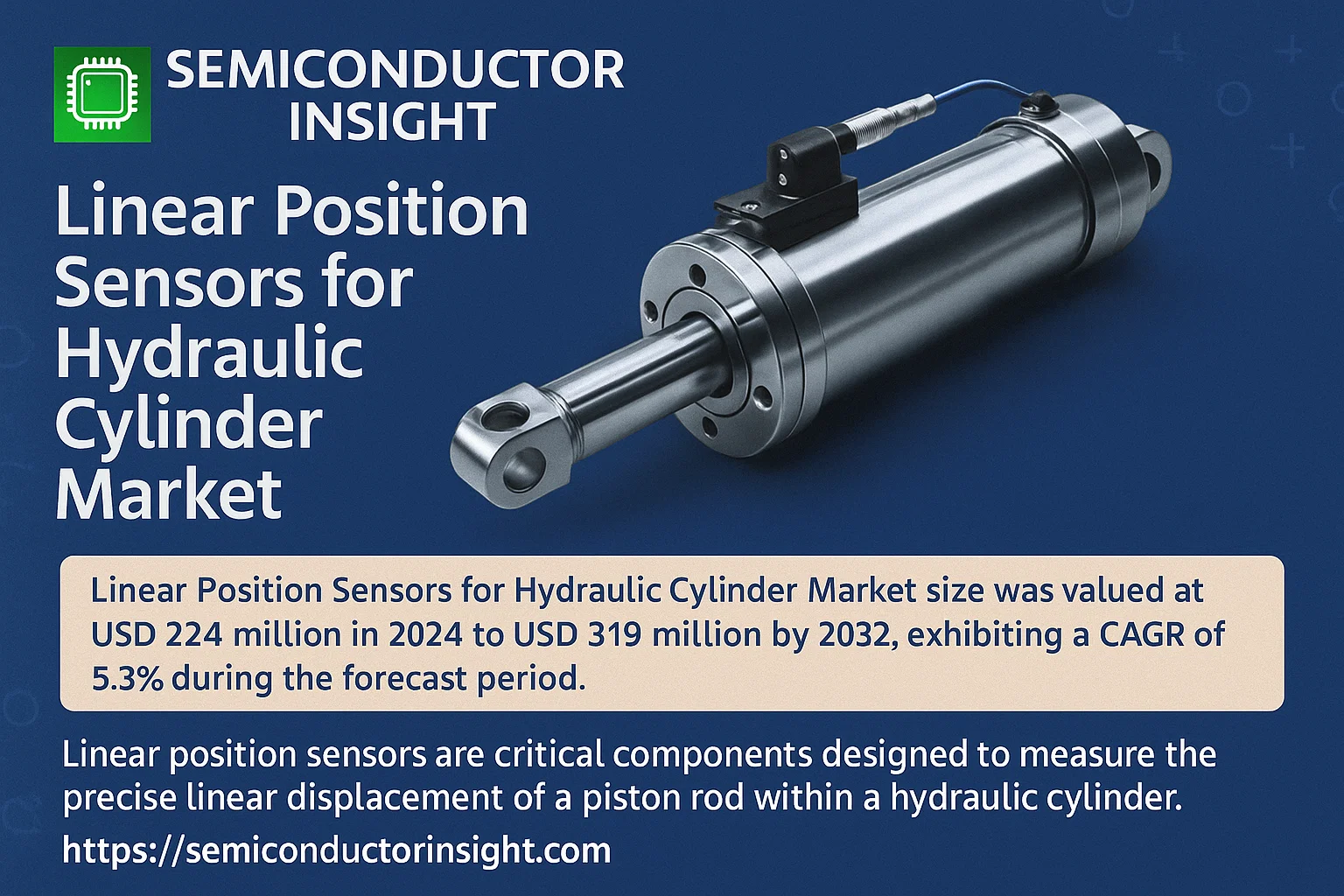
Global Linear Position Sensors for Hydraulic Cylinder Market size was valued at USD 224 million in 2024 to USD 319 million by 2032, exhibiting a CAGR of 5.3% during the forecast period.
Linear position sensors are critical components designed to measure the precise linear displacement of a piston rod within a hydraulic cylinder. These devices convert the mechanical position into an analog or digital signal, which is then used for real-time monitoring and control by a PLC or motion controller. This enables accurate feedback on parameters like extension, retraction, and velocity, which is essential for automation and operational safety.
The Market is experiencing steady growth driven by increasing automation in manufacturing and rising demand for heavy machinery in construction and agriculture. Furthermore, stringent safety regulations and the push for higher operational efficiency are compelling industries to adopt advanced sensor technologies. Initiatives by key players are also fueling innovation; for instance, manufacturers are increasingly integrating robust Magnetostrictive (MLDTs) and non-contact sensors that offer higher accuracy and longer lifecycles in harsh environments. MTS Sensor Technologie GmbH & Co. KG, Balluff, Gefran, and Micro-Epsilon are some of the key players that operate in the Market with a wide range of portfolios.
MARKET DRIVERS
Rising Demand for Precision Control and Automation
The push towards Industry 4.0 and smart manufacturing is a primary driver for the linear position sensor Market in hydraulic cylinders. Industries such as construction, agriculture, and material handling are increasingly integrating sensors to enable precise feedback for automated control systems, improving operational efficiency and safety.
Stringent Safety and Emission Regulations
Global regulations mandating higher safety standards and reduced emissions in heavy machinery are compelling OEMs to adopt advanced monitoring solutions. Linear position sensors provide critical data for predictive maintenance and ensure machinery operates within safe and efficient parameters, which is essential for regulatory compliance.
➤ Growing adoption of IoT-enabled sensors for real-time data monitoring and fleet management is accelerating Market growth.
The need for improved machine diagnostics and the prevention of costly downtime is further driving demand. Sensors that offer high accuracy and reliability in harsh environments are becoming standard in new hydraulic cylinder designs.
MARKET CHALLENGES
High Cost and Integration Complexity
The integration of sophisticated linear position sensors into existing hydraulic systems can be technically complex and costly. Retrofitting older machinery often requires significant modifications, which can be a barrier for small and medium-sized enterprises.
Other Challenges
Harsh Operating Environments
Hydraulic cylinders often operate in extreme conditions involving high pressures, temperatures, and contamination. Developing sensors that are both highly accurate and sufficiently robust to withstand these environments without failure presents a significant engineering challenge.
Standardization and Interoperability
The lack of universal communication protocols can lead to interoperability issues between sensors and different machine control systems, complicating integration and increasing overall system costs.
MARKET RESTRAINTS
Economic Volatility and Capital Expenditure Cycles
The Market for linear position sensors is closely tied to capital investment in heavy machinery industries. Economic downturns and fluctuations in sectors like construction and mining can lead to reduced machinery purchases, directly restraining the demand for new sensor integrations.
Cost Sensitivity in Price-Competitive Markets
In highly competitive Markets, OEMs and end-users are often highly price-sensitive. The added cost of high-performance sensors can be a deterrent, particularly for applications where the cost-benefit ratio of advanced feedback is not immediately clear to the customer.
MARKET OPPORTUNITIES
Expansion into Emerging Economies
Rapid industrialization and infrastructure development in emerging economies present significant growth opportunities. The increasing adoption of modern, sensor-equipped machinery in these regions is expected to drive Market expansion.
Development of Wireless and Compact Sensor Solutions
There is a growing opportunity for the development of compact, wireless, and energy-efficient linear position sensors. These innovations reduce installation complexity and costs, opening up new applications in mobile equipment and space-constrained environments.
Advancements in Predictive Maintenance
The integration of sensor data with AI and analytics platforms for predictive maintenance is a key opportunity. This allows for the transition from scheduled maintenance to condition-based monitoring, maximizing equipment uptime and lifecycle value.
Linear Position Sensors for Hydraulic Cylinder Market Trends
Steady Market Growth Fueled by Industrial Automation
Global Linear Position Sensors for Hydraulic Cylinder Market is on a solid growth trajectory, valued at USD 224 million in 2024 and projected to reach USD 319 million by 2032, representing a compound annual growth rate (CAGR) of 5.3%. These sensors are critical for providing precise feedback on the linear position of a hydraulic cylinder’s piston rod, converting this mechanical position into an analog or digital signal for monitoring and control systems. This sustained growth is primarily driven by the increasing adoption of automation and Industrial Internet of Things (IIoT) technologies across manufacturing, construction, and mobile machinery sectors, where accurate positioning is vital for efficiency and safety.
Other Trends
Regional Market Dynamics
The geographical consumption of these sensors exhibits a distinct pattern, with Europe being the largest Market, accounting for approximately 32% of global demand. This is closely followed by the United States, which holds a 25% Market share. The concentration of advanced manufacturing and heavy machinery industries in these regions underpins their leadership. Meanwhile, the Asia-Pacific region is emerging as a significant growth area, driven by rapid industrialization and infrastructure development, presenting new opportunities for Market expansion.
Technology Segment Evolution
The Market is segmented by technology type, with Magnetostrictive Linear Displacement Transducers (MLDTs), Linear Variable Inductance Transducers (LVITs), and Linear Resistance Potentiometers (POTS) being the primary categories. Magnetostrictive sensors are increasingly favored for applications requiring non-contact, high-precision, and robust measurement capabilities, especially in harsh industrial environments. This trend reflects the industry’s continuous pursuit of greater reliability and longevity in sensor performance.
Competitive Landscape and Industry Consolidation
The competitive environment features established global players such as MTS Sensor Technologie GmbH & Co. KG, Balluff, and Gefran. The Market is characterized by a focus on technological innovation, with companies investing in research and development to enhance sensor accuracy, durability, and integration with digital control systems. Recent Market activities include strategic mergers and acquisitions as key players seek to expand their product portfolios and geographical footprint to capitalize on the growing demand.
COMPETITIVE LANDSCAPE
Key Industry Players
A Fragmented Market Led by Established European and American Sensor Specialists
Global Market for Linear Position Sensors for Hydraulic Cylinders is characterized by the presence of several established international players, with MTS Sensor Technologie GmbH & Co. KG, Balluff, and Gefran being widely recognized as Market leaders. These companies have secured strong positions due to their extensive product portfolios, robust R&D capabilities, and long-standing relationships with major OEMs in industries such as industrial automation, mobile hydraulics, and heavy machinery. The Market structure is moderately fragmented, with the top five companies accounting for a significant portion of the global revenue in 2024. The competition is largely technology-driven, focusing on advancements in sensor accuracy, durability in harsh environments, and the integration of Industry 4.0 features like IO-Link connectivity. Europe represents the largest consumer Market, contributing to the strength of regional players, followed closely by the United States.
Beyond the top-tier manufacturers, a number of other significant players compete effectively by focusing on specific niches, application segments, or regional Markets. Companies like Magnetbau-Schramme GmbH & Co. KG and Micro-Epsilon are known for their high-precision sensor solutions, while others such as Soway Tech Limited offer competitive options, particularly in the Asian Market. The competitive dynamics are further influenced by specialized firms like Positek, which focuses on non-contact sensing technologies, and Rota Engineering Ltd, which serves specific industrial sectors. This diverse landscape ensures a wide range of product choices for end-users, from cost-effective solutions to high-performance sensors for critical applications, fostering continuous innovation and price competition across different Market segments.
List of Key Linear Position Sensors for Hydraulic Cylinder Companies Profiled
- MTS Sensor Technologie GmbH & Co. KG
- Balluff
- Gefran
- Magnetbau-Schramme GmbH & Co. KG
- Micro-Epsilon
- Soway Tech Limited
- Positek
- Rota Engineering Ltd
- Germanjet
- TE Connectivity
- ASM Sensor
- Turck
- Siko
- Althen Sensors
- Hans Turck GmbH & Co. KG
Segment Analysis:
| Segment Category | Sub-Segments | Key Insights |
| By Type |
|
Magnetostrictive Linear Displacement Transducers are the leading segment due to their non-contact measurement principle, which offers superior reliability and longevity in harsh industrial environments. Their high accuracy and repeatability make them the preferred choice for critical applications in heavy machinery, where precise cylinder position feedback is essential for operational safety and efficiency. The technology’s robustness against contamination and its ability to provide absolute position data without the need for homing routines further solidifies its Market leadership. |
| By Application |
|
Mobile Hydraulics represents the dominant application segment, driven by the extensive use of hydraulic cylinders in construction equipment like excavators and agricultural machinery such as tractors. The demand for precise control and automation in these mobile applications to enhance productivity and safety is a key growth driver. This segment benefits from continuous technological advancements that improve sensor durability against extreme vibration, shock, and environmental contaminants commonly encountered in fieldwork. |
| By End User |
|
Original Equipment Manufacturers are the leading end-user segment, as they incorporate linear position sensors directly into new hydraulic cylinder systems during production. The demand is fueled by the push towards smarter, more connected machinery that requires embedded sensing for automation and data collection. OEMs prioritize sensors that offer long-term reliability, ease of integration, and compliance with industry standards, driving innovation and partnerships with key sensor suppliers to develop customized solutions. |
| By Technology |
|
Non-Contact Sensing Technology is the leading segment, favored for its inherent advantages in durability and maintenance-free operation. By eliminating physical contact with the moving parts of the cylinder, these sensors avoid wear and tear, leading to a significantly longer service life and higher reliability. This is particularly critical in applications where downtime is costly. The trend towards Industry 4.0 and predictive maintenance further accelerates the adoption of non-contact sensors for their ability to provide continuous, accurate data. |
| By Sales Channel |
|
Direct Sales is the predominant channel for this Market, as it facilitates close technical collaboration between sensor manufacturers and large OEMs or major industrial end-users. This channel allows for customized product development, streamlined integration support, and strong after-sales service, which are critical factors for complex hydraulic system components. While distributor networks are vital for reaching a broader MRO audience, the technical nature and customization requirements of these sensors make direct relationships with manufacturers the preferred route for high-volume and specialized applications. |
Regional Analysis: Linear Position Sensors for Hydraulic Cylinder Market
The Market is heavily influenced by the region’s leadership in Industry 4.0 and smart manufacturing. This drives demand for sensors that offer seamless integration with IoT platforms and programmable logic controllers for real-time monitoring and predictive maintenance of hydraulic systems, enhancing overall operational efficiency and equipment uptime.
Demand is strongly anchored in the aerospace, defense, and heavy machinery sectors. These applications require sensors with exceptional precision, reliability, and the ability to perform under extreme pressures and temperatures, leading to a preference for advanced technologies like magnetostrictive and LVDT-based sensors over simpler alternatives.
Strict occupational safety and machine directive standards enforced by bodies like OSHA compel equipment manufacturers to integrate precise positional feedback systems. This regulatory environment creates a non-negotiable Market for high-quality sensors that ensure machinery operates safely and within designed parameters, preventing accidents and enhancing productivity.
A well-established network of distributors and service providers supports a vibrant afterMarket. This ecosystem ensures the availability of replacement sensors, retrofitting services, and technical support, which is crucial for maintaining the vast installed base of hydraulic equipment and extending the lifecycle of existing machinery.
Europe
Europe represents a highly advanced and mature Market, characterized by a strong emphasis on precision engineering, energy efficiency, and compliance with rigorous EU directives. The manufacturing heartlands of Germany and Italy, known for their expertise in industrial machinery and automotive sectors, are key drivers. The region’s focus on reducing carbon footprints and improving energy efficiency in industrial processes incentivizes the adoption of sensors that optimize hydraulic system performance, minimizing energy waste. The presence of leading global sensor manufacturers fuels competition and innovation, particularly in developing compact, sealed sensors resistant to contaminants like metal shavings and hydraulic fluid, which are common in harsh industrial environments.
Asia-Pacific
The Asia-Pacific region is the fastest-growing Market, propelled by rapid industrialization, massive infrastructure development, and expanding manufacturing capabilities, especially in China, Japan, and South Korea. The sheer volume of mobile hydraulic equipment production, including excavators and forklifts, creates immense demand for cost-effective and durable linear position sensors. While price sensitivity is a significant factor, leading to strong competition, there is a growing trend towards adopting more advanced sensor technologies to improve the quality and export potential of locally manufactured machinery. Government initiatives promoting smart manufacturing and domestic production of key components are also beginning to influence the Market dynamics significantly.
South America
The Market in South America is more niche and heavily tied to the cyclical nature of the mining, agriculture, and oil and gas industries, with Brazil and Chile being key Markets. Demand is primarily driven by the need for reliable sensor solutions in heavy-duty equipment used in these extractive sectors. Market growth is often correlated with commodity prices, which influence investment in new machinery and the modernization of existing fleets. The challenging operating conditions, including exposure to dust, moisture, and vibration, necessitate sensors with high robustness and ingress protection ratings, creating specific requirements for suppliers operating in the region.
Middle East & Africa
This region presents a Market with significant potential, though it is currently characterized by varying levels of development. The Gulf Cooperation Council (GCC) countries drive demand through large-scale construction projects, oil and gas infrastructure, and desalination plants, requiring sensors for hydraulic systems in cranes and other heavy equipment. In contrast, other parts of Africa see demand mainly from the mining sector. The key Market characteristics include a need for extreme durability to handle high ambient temperatures and dusty conditions, and a reliance on imports, with a growing interest in establishing local service and maintenance capabilities to support critical infrastructure.
Report Scope
This Market research report provides a comprehensive analysis of the Linear Position Sensors for Hydraulic Cylinder Market , covering the forecast period 2025–2032. It offers detailed insights into Market dynamics, technological advancements, competitive landscape, and key trends shaping the industry.
Key focus areas of the report include:
- Market Overview: The report begins with an overview outlining its current Market scenario, key growth indicators, and industry transformation drivers. It discusses macroeconomic factors, demand–supply balance, regulatory landscape, and the strategic role of semiconductors in powering advancements across industries such as automotive, telecommunications, consumer electronics, and industrial automation.
- Market Size & Forecast: Historical data and future projections for revenue, unit shipments, and Market value across major regions and segments.
- Segmentation Analysis: Detailed breakdown by product type, technology, application, and end-user industry to identify high-growth segments and investment opportunities.
- Regional Insights: Insights into Market performance across North America, Europe, Asia-Pacific, Latin America, and the Middle East & Africa, including country-level analysis where relevant.
- Competitive Landscape: Profiles of leading Market participants, including their product offerings, R&D focus, manufacturing capacity, pricing strategies, and recent developments such as mergers, acquisitions, and partnerships.
- Technology Trends & Innovation: Assessment of emerging technologies, integration of AI/IoT, semiconductor design trends, fabrication techniques, and evolving industry standards.
- Market Drivers & Restraints: Evaluation of factors driving Market growth along with challenges, supply chain constraints, regulatory issues, and Market-entry barriers.
- Stakeholder Insights: Insights for component suppliers, OEMs, system integrators, investors, and policymakers regarding the evolving ecosystem and strategic opportunities.
Primary and secondary research methods are employed, including interviews with industry experts, data from verified sources, and real-time Market intelligence to ensure the accuracy and reliability of the insights presented.
FREQUENTLY ASKED QUESTIONS:
What is the current Market size of Linear Position Sensors for Hydraulic Cylinder Market?
-> Linear Position Sensors for Hydraulic Cylinder Market size was valued at USD 224 million in 2024 to USD 319 million by 2032, exhibiting a CAGR of 5.3% during the forecast period.
Which key companies operate in Linear Position Sensors for Hydraulic Cylinder Market?
-> Key players include MTS Sensor Technologie GmbH & Co. KG, Balluff, Gefran, Magnetbau-Schramme GmbH & Co. KG, MICRO-EPSILON, Soway Tech Limited, POSITEK, Rota Engineering Ltd, and Germanjet, among others.
What are the key growth drivers?
-> Key growth drivers include advancements in industrial automation, increasing demand for precision measurement in hydraulic systems, and the integration of sensors for improved machinery efficiency and safety.
Which region dominates the Market?
-> Europe is the largest consumer Market, with a share of about 32%, followed by the United States with 25%.
What are the emerging trends?
-> Emerging trends include the development of more robust and accurate sensor technologies like magnetostrictive transducers, the integration of smart sensors with IoT capabilities, and the miniaturization of components for compact hydraulic systems.

Get Sample Report PDF for Exclusive Insights
Report Sample Includes
- Table of Contents
- List of Tables & Figures
- Charts, Research Methodology, and more...
 Download Sample Report PDF


